Martin Luther King Jr. Biography: Civil Rights, Nonviolence, Speeches and Legacy
A Martin Luther King Jr. biography is incomplete if it reduces him to the “I Have a Dream” speech. King was a Baptist minister who became one of the most consequential leaders of the American civil-rights movement, but his importance came from more than his ability to speak. He helped organise campaigns, raise money, negotiate with officials, endure repeated arrest and violence, coordinate national attention and develop nonviolent direct action into a method for forcing institutions to confront racial injustice.
His public career also changed substantially over time. Montgomery made him nationally famous. Birmingham and the March on Washington established him as the movement's best-known spokesman. Selma helped focus the country on Black voting rights. But King did not stop there. He later confronted housing segregation in northern cities, publicly opposed the Vietnam War and increasingly argued that racial inequality could not be separated from poverty and economic power.
When King was assassinated in Memphis on April 4, 1968, he was not attending a ceremonial civil-rights anniversary. He was supporting striking sanitation workers and preparing the Poor People's Campaign, a multiracial mobilisation demanding jobs, income and economic security. The King of 1968 was therefore politically broader, more controversial and in some respects more radical than the version remembered through one speech from 1963.
Martin Luther King Jr. at a Glance
| Fact | Detail |
|---|---|
| Full name | Martin Luther King Jr. |
| Born | January 15, 1929 |
| Birthplace | Atlanta, Georgia |
| Profession | Baptist minister and civil-rights leader |
| Education | Morehouse College, Crozer Theological Seminary, Boston University |
| Major organisation | Southern Christian Leadership Conference |
| Major campaigns | Montgomery, Birmingham, Selma, Chicago, Poor People's Campaign |
| Best-known speech | “I Have a Dream,” August 28, 1963 |
| Nobel Peace Prize | 1964 |
| Major later causes | Economic justice and opposition to the Vietnam War |
| Assassinated | April 4, 1968 |
| Place of death | Memphis, Tennessee |
| Age at death | 39 |
The Nobel Foundation records King as born in Atlanta on January 15, 1929, and awarded the 1964 Nobel Peace Prize for his nonviolent struggle for civil rights.
Early Life in Atlanta
Martin Luther King Jr. was born into a prominent Black Baptist family in segregated Atlanta. He was originally named Michael King Jr.; his father, also originally named Michael King, later adopted the name Martin Luther King, and his son's name changed as well.
Religion was central to the family. King's father, Martin Luther King Sr., became pastor of Ebenezer Baptist Church, while King's maternal grandfather had also led the congregation. King therefore grew up inside a Black church tradition that combined Christian faith, community leadership and resistance to racial humiliation.
Segregation was not an abstract political issue in his childhood. Georgia's Jim Crow system structured education, public facilities, transportation and many everyday interactions between Black and white residents. King's later theology of dignity and social justice emerged partly from experiencing those restrictions while also seeing strong Black institutions operating within Atlanta.
Education and Intellectual Development
King entered Morehouse College at fifteen and graduated in 1948. One important influence was Morehouse president Benjamin Mays, a theologian and educator who connected Christian ministry with social responsibility and racial dignity.
King then studied at Crozer Theological Seminary in Pennsylvania, receiving his Bachelor of Divinity degree in 1951. He continued graduate study at Boston University and received his doctorate in systematic theology in 1955.
His intellectual development is sometimes presented as though he simply combined Christianity with Mahatma Gandhi's nonviolence. The actual intellectual background was broader. King drew from the Black Baptist tradition, Protestant social ethics, personalist philosophy, constitutional ideals and Gandhian nonviolent resistance.
Gandhi was especially important because India's independence movement demonstrated that organised nonviolent action could operate as a form of political power rather than passive moral witness. King and other activists adapted those ideas to the very different institutional environment of the United States.
Marriage to Coretta Scott King
While studying in Boston, King met Coretta Scott, an Alabama-born musician studying at the New England Conservatory of Music. They married in 1953 and later had four children.
Coretta Scott King should not be treated simply as the wife of a famous leader. She had political commitments of her own and became increasingly active on peace, civil rights and social justice. After King's assassination, she played an enormous role in preserving, interpreting and institutionalising his legacy.
In 1954 King became pastor of Dexter Avenue Baptist Church in Montgomery, Alabama. Within little more than a year, events in Montgomery transformed the twenty-six-year-old minister into a national public figure.
Montgomery Bus Boycott: King Did Not Start the Movement Alone
The Montgomery bus boycott began after Rosa Parks was arrested on December 1, 1955, for refusing to surrender her seat under the city's segregated transportation system.
Public memory sometimes presents the sequence as Parks spontaneously refusing to move, King immediately leading a protest and segregation collapsing. The history was more organised.
Parks already had a record of civil-rights activity. Jo Ann Robinson and the Women's Political Council had discussed a bus boycott before Parks's arrest. E.D. Nixon and other local leaders had years of organising experience. Montgomery's Black churches provided institutions capable of mobilising thousands of residents.
King was chosen to lead the newly created Montgomery Improvement Association partly because he was relatively new to Montgomery and had not become entangled in older local organisational rivalries.
King himself later emphasised the collective character of the boycott, describing it as the work of tens of thousands of Black Montgomery residents rather than the drama of one individual leader.
How the Montgomery Bus Boycott Worked
The boycott lasted more than a year. Black residents refused to use segregated city buses while activists created alternative transportation arrangements, raised funds and pursued legal action.
This required far more than speeches. Carpools had to be coordinated. Churches hosted meetings. Drivers transported workers. Money was raised. Organisers communicated across the city. Participants had to remain committed despite economic cost and intimidation.
King's home was bombed. He was arrested. Other activists faced threats and violence.
The boycott ultimately coincided with the federal court case Browder v. Gayle, which struck down Alabama's bus-segregation laws. After the U.S. Supreme Court allowed that ruling to stand, Montgomery's buses were desegregated in late 1956. The victory made King nationally prominent and showed how mass economic pressure, organisation, litigation and nonviolent protest could reinforce one another.
Founding the Southern Christian Leadership Conference
In 1957 King and other Black ministers helped establish the Southern Christian Leadership Conference, or SCLC, to coordinate nonviolent civil-rights activism across the South. King became its president.
The organisation drew heavily on Black churches, which offered meeting places, leadership networks, fundraising capacity and large community constituencies.
This model had major advantages, but it also created tensions. Local activists sometimes felt national organisations arrived after years of grassroots work and then received disproportionate public credit. Younger activists associated with the Student Nonviolent Coordinating Committee, or SNCC, often favoured deeper local organising and more decentralised leadership.
Understanding these organisational differences helps correct the misconception that the civil-rights movement followed one leader and one strategy.
Albany Showed That Nonviolent Protest Could Fail
Not every King-led campaign succeeded.
The Albany Movement in Georgia in 1961–62 challenged segregation across a wide range of institutions. SCLC participated, but the campaign did not achieve the dramatic breakthrough King and his colleagues hoped for.
Police chief Laurie Pritchett understood how television coverage of violent repression could strengthen civil-rights activists. He therefore frequently avoided the visually spectacular police violence that would later make Birmingham internationally infamous. The movement also pursued broad demands that made it difficult to convert pressure into a clear negotiating victory.
Albany became strategically important partly because it exposed limitations in SCLC's approach. Later campaigns would focus pressure more narrowly and think more deliberately about targets, escalation, negotiation and public confrontation.
Birmingham and King's Strategy of Nonviolent Direct Action
The Birmingham Campaign of 1963 became one of the defining confrontations of the civil-rights movement.
Birmingham, Alabama, had an entrenched segregation system and a history of racist violence. SCLC entered the campaign in partnership with local activist Fred Shuttlesworth and the Alabama Christian Movement for Human Rights.
The campaign used boycotts, marches, sit-ins and mass meetings to pressure downtown businesses and local authorities. It was deliberately timed to affect the Easter shopping season, using economic leverage alongside moral protest.
King was arrested on April 12, 1963. While imprisoned, he produced the argument that became known as the “Letter from Birmingham Jail.”
What “Letter From Birmingham Jail” Actually Argued
The letter is sometimes remembered as a gentle appeal for racial understanding. Its argument was considerably sharper.
King was responding to white clergy who criticised demonstrations as poorly timed and urged activists to pursue negotiation instead. King argued that the problem was precisely that negotiation had repeatedly failed because those benefiting from segregation had little incentive to change.
Nonviolent direct action, in his theory, created pressure that made continued avoidance more costly. The resulting tension was not an accidental side effect. Properly disciplined, it was part of the strategy.
This is essential to understanding King's politics. His nonviolence was not passive waiting or simply behaving politely in front of injustice. It involved organised disruption designed to force negotiations that existing power relationships had prevented. The Birmingham campaign's structure reflects this theory.
The Birmingham Children's Campaign and Police Violence
As the campaign continued, large numbers of school-age participants joined demonstrations. Their participation remains ethically debated because organisers knowingly exposed young people to arrest and possible violence.
Birmingham authorities responded with police dogs and high-pressure fire hoses. Images of children and teenagers being attacked circulated nationally and internationally.
Those photographs transformed the political environment. They showed that maintaining segregation required coercion that became difficult to defend when exposed publicly.
Local negotiations produced desegregation commitments from businesses, but Birmingham's wider impact was national. The campaign helped increase pressure on the federal government to pursue comprehensive civil-rights legislation.
March on Washington for Jobs and Freedom
On August 28, 1963, more than 250,000 people gathered in Washington, D.C., for the March on Washington for Jobs and Freedom. The full name is important because the demonstration combined demands for racial civil rights with demands involving employment and economic justice.
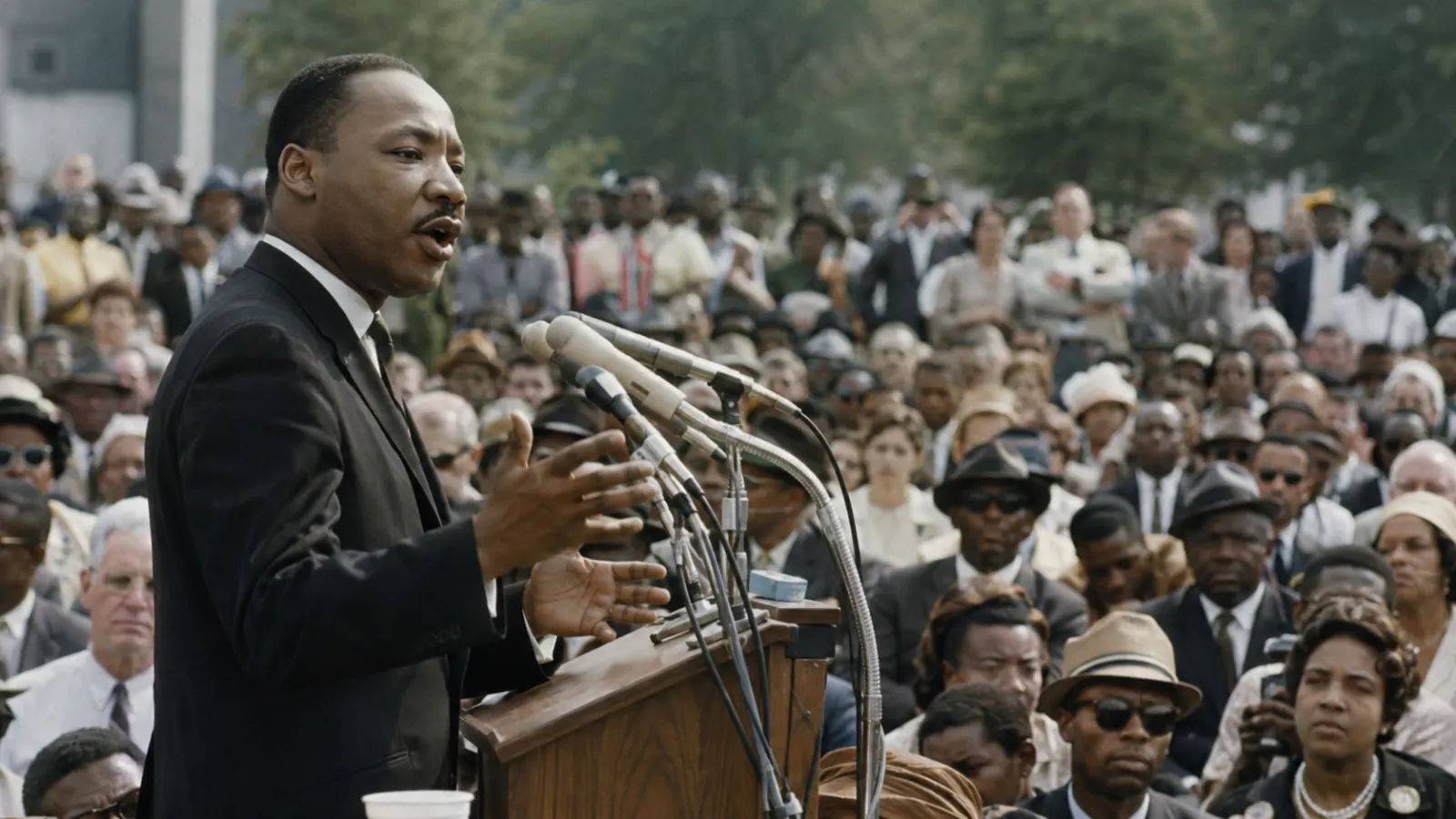
King delivered the final major speech of the programme, later known as “I Have a Dream.” It became the most famous address of his life.
But King did not create the march. The mobilisation emerged from a broad coalition, with A. Philip Randolph and Bayard Rustin playing particularly important organisational roles alongside labour, religious and civil-rights groups. The official programme contained numerous speakers and organisations, underscoring that the march was a coalition rather than a one-man event.
What “I Have a Dream” Meant in Its Original Context
The speech is often reduced to a few lines about children living in harmony or people being judged by character rather than skin colour.
Those themes are genuinely present, but isolating them can remove the conflict surrounding the speech.
King also addressed police brutality, segregation, voting exclusion and the country's failure to honour its constitutional and democratic promises. The dream was not an announcement that racial injustice was nearly solved. It was an indictment of the gap between American ideals and American institutions.
The March on Washington itself demanded jobs, voting rights, school desegregation, fair employment and meaningful civil-rights legislation. The National Archives describes the event as a mass demonstration intended partly to pressure Congress to pass the pending civil-rights bill.
Civil Rights Act of 1964
President Lyndon B. Johnson signed the Civil Rights Act of 1964 into law on July 2, 1964.
The legislation prohibited discrimination in important areas of public life, strengthened school desegregation efforts and prohibited employment discrimination. The National Archives describes it as the most sweeping civil-rights legislation enacted since Reconstruction.
King and SCLC helped create the political environment in which such legislation became possible, particularly through Birmingham and the March on Washington. But the law cannot accurately be credited to King alone.
Its passage reflected decades of Black activism, litigation, congressional negotiation, presidential action, labour support, religious mobilisation and public confrontation. One of the recurrent lessons of King's biography is that individual leadership mattered inside institutions and movements larger than any individual.
Nobel Peace Prize
King received the Nobel Peace Prize in 1964 for his nonviolent struggle for civil rights. At age thirty-five, he was then the youngest person to receive the prize.
He announced that the prize money would be used to support the civil-rights movement.
The award transformed King from an American civil-rights leader into an even more prominent international figure. It also reinforced his tendency to frame the struggle against racial oppression as part of a broader global moral problem involving colonialism, poverty and war.
Winning an international peace prize did not mean his political struggle was nearing completion. Black voter suppression remained deeply entrenched in parts of the South.
That problem soon became the focus of Selma.
Selma and the Fight for Voting Rights
Black activists in Selma, Alabama, had spent years challenging barriers to voter registration before SCLC made the city a national focus in 1965.
The campaign involved local organisations, the Dallas County Voters League, SNCC organisers, SCLC and others.
On March 7, 1965, demonstrators attempted to march from Selma to Montgomery. Alabama state troopers attacked them after they crossed the Edmund Pettus Bridge in the event that became known as Bloody Sunday.
King was not leading that first march. John Lewis and Hosea Williams were among those at its head. This matters because popular retellings often insert King into every iconic moment even where other activists carried the immediate risk.
Televised images of police beating marchers produced enormous national outrage.
Selma to Montgomery and the Voting Rights Act
After further confrontation and legal proceedings, a federally protected Selma-to-Montgomery march began on March 21. King, John Lewis, James Forman and other leaders eventually led thousands into Montgomery.
The campaign helped create pressure for federal voting-rights legislation.
President Johnson signed the Voting Rights Act of 1965 on August 6. The law gave the federal government stronger tools against discriminatory voting practices such as literacy tests that had been used to disenfranchise Black voters.
Again, the legislative breakthrough was connected to King's national prominence but rested on years of local organising and sacrifice.
Why the Civil-Rights Movement Did Not End in 1965
The Civil Rights Act and Voting Rights Act represented enormous achievements, but neither eliminated racial inequality.
Formal Jim Crow statutes were particularly visible in the South. In many northern cities, racial inequality operated through mechanisms that were harder to attack with one court ruling or federal statute.
These included housing discrimination, residential segregation, unequal schools, employment exclusion, policing and poverty.
King increasingly concluded that winning access to restaurants and ballot boxes, while indispensable, did not answer every dimension of racial inequality.
That shift led him north.
Chicago and Northern Housing Segregation
In 1966 King and SCLC participated in the Chicago Freedom Movement, focusing particularly on housing discrimination and residential segregation.
Campaigners encountered fierce hostility when marching through some white neighbourhoods. The experience challenged any assumption that racism was fundamentally a southern problem.
Northern inequality also proved strategically harder to dramatise. There were often no “Whites Only” signs to remove. Segregation emerged through real-estate markets, zoning, lending, school boundaries and informal discrimination.
Negotiations produced commitments, but implementation disappointed many activists.
Chicago became an important moment in King's political development because it pushed him toward a stronger emphasis on structural economic inequality rather than formal legal segregation alone. The King Institute chronology places the Chicago Campaign from January through August 1966.
King and the Rise of Black Power
By the mid-1960s, younger activists increasingly questioned whether interracial nonviolence and integration remained adequate strategies.
The phrase Black Power gained prominence, reflecting demands for greater Black political control, institutional independence and self-determination.
King rejected racial separatism and remained committed to nonviolence and interracial coalition politics. But his response was more complicated than simply condemning younger activists.
He recognised that the popularity of Black Power reflected frustration with persistent poverty, police violence and the limited pace of change even after major federal legislation.
This disagreement exposes an important feature of the movement: there was never one universally accepted Black political strategy.
King and Malcolm X
King and Malcolm X are often presented as simple opposites: King representing nonviolence and integration, Malcolm representing militancy and separatism.
That framing makes both men less interesting.
Their strategies and rhetoric differed substantially, but both changed over time. Malcolm's politics evolved after leaving the Nation of Islam, while King's later political arguments became increasingly critical of economic inequality and American militarism.
The two met only briefly in Washington in 1964.
An Editors Outlook article on Malcolm X and the Debate Over Black Political Strategy would make a strong internal companion to this biography because their differences illuminate broader debates within Black political thought.
King's Nonviolence Was a Strategy, Not Passivity
One of the biggest misconceptions about King is that nonviolence meant avoiding confrontation.
His own political method suggests almost the opposite.
Nonviolent direct action was designed to create enough social, economic and political pressure that authorities could no longer comfortably ignore demands for change.
The methods included boycotts, sit-ins, marches, civil disobedience and mass mobilisation. These tactics imposed costs while attempting to maintain disciplined nonviolence.
Birmingham illustrates the mechanism. Businesses faced economic pressure. Authorities faced national criticism. Arrests overloaded the system. Public confrontation changed political incentives.
Nonviolence therefore involved power, not simply moral appeal.
Why Organisation Was Essential to King's Strategy
Television frequently showed the public event: a march, an arrest or a speech.
Behind those moments stood infrastructure.
Churches had to host meetings. Organisers recruited participants. Volunteers arranged transportation. Lawyers prepared for arrests. Donors funded campaigns. Leaders trained demonstrators in nonviolent discipline. Communications networks spread information.
A charismatic leader could attract national media attention, but attention was useful only when organisers had built a campaign capable of converting visibility into pressure.
This is why Albany's problems mattered and why Birmingham's narrower targets produced different results.
King's leadership was real, but it operated inside systems built by thousands of other people.
FBI Surveillance of Martin Luther King Jr.
King's political prominence also made him the target of extensive federal surveillance.
FBI director J. Edgar Hoover viewed King with intense hostility. Surveillance involved wiretaps, bugs and efforts to collect information that could discredit him. The King Institute notes that Hoover escalated attempts to damage King's reputation as King's national influence grew.
The surveillance was tied partly to Cold War fears about alleged Communist influence within civil-rights organisations and among some of King's advisers.
Understanding this history requires care. FBI records are historical sources, but the agency collecting them was actively attempting to undermine King. Claims derived from surveillance therefore need corroboration and careful attention to provenance rather than automatic acceptance.
King Was Not Universally Popular During His Lifetime
Modern commemoration can create the impression that King was broadly admired while alive.
His reputation was actually highly contested.
Segregationists despised him. Hoover attacked him. White moderates criticised protest tactics. Some younger Black activists believed his strategy was too cautious. His public opposition to the Vietnam War damaged relationships with parts of the Johnson administration and brought criticism from major newspapers and some civil-rights allies.
The nationally honoured King familiar today is partly the product of later memory.
The political King frequently created disruption and controversy because his campaigns were designed to make injustice harder to ignore.
Martin Luther King Jr. and the Vietnam War
King became increasingly outspoken against the Vietnam War, culminating in his major April 4, 1967, address at Riverside Church in New York, commonly known as “Beyond Vietnam.”
Civil-rights allies worried that publicly attacking the war would weaken relations with President Johnson, whose administration had supported the Civil Rights Act and Voting Rights Act.
King nevertheless concluded that civil rights, poverty and militarism could not remain separate moral questions.
He argued that military spending competed with domestic programmes and that poor Americans were being sent to fight abroad while inequality persisted at home. His antiwar position further reduced his political popularity and intensified government hostility.
Why King's Vietnam Position Matters
The Vietnam issue demonstrates how far King's politics had moved beyond a narrow demand for legal desegregation.
By 1967, his critique addressed national priorities themselves.
He increasingly connected what he saw as three major forms of injustice: racism, poverty and militarism. This did not mean every part of his programme formed a fully developed economic or foreign-policy theory, but it showed that he no longer believed racial equality could be secured by changing southern segregation laws alone.
This later King is often less visible in public memory because his criticisms are harder to incorporate into a simple national story of inevitable civil-rights progress.
Poverty and Economic Justice
Economic concerns had never been completely absent from King's politics. The March on Washington was explicitly a march for Jobs and Freedom, and the Montgomery boycott itself used economic pressure.
But King's focus on poverty became substantially stronger later in the decade.
He argued that formal civil rights could coexist with deep material insecurity. Someone could legally enter a restaurant but still lack the income needed to eat there. Voting rights mattered enormously, but political equality did not automatically create employment, housing or economic security.
This led King and SCLC toward the Poor People's Campaign.
What Was the Poor People's Campaign?
King announced the Poor People's Campaign in late 1967.
The idea was to bring poor Americans from different racial backgrounds to Washington and create sustained pressure on the federal government around employment, income, housing and education.
The King Institute describes the campaign as an attempt to demand jobs, unemployment insurance, a fair minimum wage and educational improvement. King's objective was to make poverty politically unavoidable in the same way Birmingham and Selma had made racial segregation and voter suppression nationally unavoidable.
This shows continuity in King's method. He was changing the issue—from segregation toward economic inequality—but still believed organised pressure was necessary because sympathy alone rarely produced structural reform.
Memphis Sanitation Workers' Strike
In 1968 Black sanitation workers in Memphis, Tennessee, went on strike over dangerous working conditions, wages, union recognition and dignity.
King travelled to Memphis to support them.
The famous “I AM A MAN” signs associated with the strike expressed something larger than one labour dispute: workers were demanding recognition as equal human beings as well as better employment conditions.
A King-led march on March 28 descended into disorder and violence, deeply troubling him because disciplined nonviolence was central to his strategy.
He returned to Memphis rather than abandoning the campaign.
“I've Been to the Mountaintop”
On April 3, 1968, King delivered what became his final public speech, often called “I've Been to the Mountaintop.”
The speech addressed the Memphis struggle and the broader movement. Its ending later became especially famous because King spoke about mortality and indicated that he was not personally afraid of what might happen to him.
The next evening, King was standing on the balcony of the Lorraine Motel when he was shot.
Assassination of Martin Luther King Jr.
King was assassinated in Memphis on April 4, 1968, at age thirty-nine.
James Earl Ray was later arrested and pleaded guilty to the murder, although controversy and conspiracy claims continued for decades. The King Institute records that the FBI investigation traced evidence including a rifle and fingerprints to Ray.
King's death triggered grief, protest and unrest across the United States.
More than 100,000 mourners later participated in the Atlanta funeral procession. Coretta Scott King subsequently helped establish institutions that preserved and expanded his public legacy.
The Poor People's Campaign Continued After King's Death
King did not live to lead the Washington mobilisation he had planned.
SCLC and other organisers continued the campaign after his assassination. Demonstrators established Resurrection City, a temporary settlement in Washington, D.C., in 1968.
The campaign failed to achieve the comprehensive economic transformation King had hoped for, but it remains crucial to understanding the final stage of his politics.
If King's biography ends at the March on Washington, this entire development disappears.
King's Leadership and the Problem of the “Great Man” Story
King unquestionably mattered.
His rhetorical ability attracted national attention. His leadership helped build coalitions. His fundraising capacity strengthened campaigns. His willingness to accept arrest and personal danger gave credibility to his arguments.
But explaining the civil-rights movement primarily through King creates a distorted picture.
Rosa Parks, Ella Baker, Bayard Rustin, Fannie Lou Hamer, Diane Nash, John Lewis, Fred Shuttlesworth, A. Philip Randolph, Jo Ann Robinson, E.D. Nixon, local ministers, students, lawyers, organisers and thousands of ordinary participants all shaped events.
King's significance does not become smaller when their contributions are restored. Instead, his leadership becomes historically clearer because we can see what he actually did within a mass movement.
Ella Baker and a Different Model of Leadership
Ella Baker is particularly important because her organising philosophy differed from leader-centred models.
She emphasised developing local leadership and building structures in which ordinary people could act for themselves. Her influence on SNCC helped encourage a more decentralised organising tradition.
King's public prominence and SCLC's minister-led structure could work extremely effectively in high-profile campaigns, but Baker's approach reminds us that movements also require long-term local capacity.
The difference between these traditions was not simply personal conflict. It reflected a genuine strategic question: should movements depend heavily on nationally recognised leaders, or should they prioritise decentralised grassroots leadership?
The civil-rights movement experimented with both.
King and Bayard Rustin
Bayard Rustin was another crucial figure frequently overshadowed by King's public fame.
Rustin had extensive experience with nonviolent activism, pacifism and organising. He advised King during Montgomery and later became the principal organiser of the 1963 March on Washington.
His expertise helped transform large political ideas into operational campaigns.
Rustin was also openly gay within a movement operating in a period of severe discrimination against LGBTQ+ people. Political opponents and some movement allies viewed his sexuality as a vulnerability.
His story provides another reminder that the infrastructure beneath King's public leadership contained organisers whose contributions were essential but less publicly celebrated.
King's Relationship With Presidents Kennedy and Johnson
King's relationship with federal political leaders was neither simple alliance nor permanent confrontation.
President John F. Kennedy initially moved cautiously on civil rights. Birmingham and other events increased pressure on his administration, and Kennedy eventually proposed major civil-rights legislation in 1963.
After Kennedy's assassination, President Lyndon B. Johnson used significant political skill to secure passage of the Civil Rights Act and later made voting rights a major legislative priority.
King worked with the administration when their objectives aligned, but he also maintained outside pressure.
That distinction is important. Movements and governments can cooperate while still occupying different roles. King's political method depended partly on making it costly for elected officials to postpone action.
His later opposition to the Vietnam War strained his relationship with Johnson substantially.
What Did King Mean by Nonviolence?
King's nonviolence combined moral principles with political strategy.
Morally, he believed violence risked reproducing the hatred and dehumanisation that movements were trying to overcome. Christianity and Gandhi both influenced this conviction.
Strategically, nonviolent protest could expose injustice while expanding participation. People who would not join an armed rebellion might participate in a boycott, sit-in, march or voter-registration drive.
Nonviolence also created a stark political contrast when peaceful demonstrators were attacked by authorities. Birmingham and Selma showed how state violence could shift public opinion when broadcast nationally.
But disciplined nonviolence required training and organisation. It was not simply an instinctive refusal to fight back.
Was Martin Luther King Jr. a Pacifist?
King had strong pacifist influences and consistently defended nonviolence, but his political thinking developed in complex circumstances.
He did not simply discuss personal refusal to use violence. He developed nonviolent resistance as a collective political method and later extended his critique to warfare itself.
His opposition to Vietnam made peace politics a major part of his final years.
The Nobel Committee explicitly awarded him the 1964 Peace Prize for his nonviolent struggle for civil rights.
King's View of Integration
King is often associated with integration, but the word can be misunderstood.
He did not simply mean allowing Black and white people to occupy the same physical spaces.
Legal desegregation mattered because segregation encoded racial hierarchy in law. But King's later politics increasingly emphasised whether people possessed meaningful access to housing, employment, education and political power.
A formally integrated society could therefore remain deeply unequal.
This is one reason Chicago and the Poor People's Campaign belong in any serious account of his development.
King's Approach to Love Was Political, Not Sentimental
King frequently used the language of love, which can make his politics sound softer than it was.
He was not arguing that oppressed people should simply feel affection for people harming them and wait for their conscience to change.
Love, in his framework, rejected hatred while still permitting—and requiring—strong resistance to injustice. The opponent's humanity was not a reason to tolerate oppression.
This allowed King to combine moral reconciliation with aggressive political mobilisation.
The distinction matters because later commemorations sometimes preserve the language of love while removing the organised confrontation that made it politically meaningful.
What Martin Luther King Jr. Actually Achieved
No individual “created” the Civil Rights Act, Voting Rights Act or end of Jim Crow.
King nevertheless made several distinctive contributions.
He helped demonstrate that mass nonviolent protest could operate at national political scale. He connected Black church networks with sophisticated campaigning. His speeches translated movement demands into language capable of reaching enormous audiences. His national profile brought press coverage and funding to campaigns.
He also helped create political crises that federal institutions eventually had to address.
The most important contribution may therefore have been the combination of moral language and organised leverage.
He could explain why segregation was unjust while participating in campaigns designed to make maintaining that injustice politically and economically expensive.
Why Martin Luther King Jr. Remains Controversial
King today occupies an unusually honoured place in American public memory. The United States observes a federal holiday in his name, streets and schools carry his name and political leaders across ideological traditions quote him.
Yet different groups remember different Kings.
Some emphasise colour-blind individual equality. Others emphasise his criticism of white moderates, poverty, militarism and structural racism. Labour activists remember Memphis. Peace activists emphasise Vietnam. Christian communities emphasise his theology.
These interpretations are not equally complete.
The safest approach is to return to the chronology of his actual campaigns and writings rather than extracting a single sentence and making it stand for his entire politics.
Martin Luther King Jr. Timeline
| Year | Event |
|---|---|
| 1929 | Born in Atlanta, Georgia |
| 1948 | Graduates from Morehouse College |
| 1951 | Graduates from Crozer Theological Seminary |
| 1953 | Marries Coretta Scott |
| 1954 | Becomes pastor in Montgomery |
| 1955 | Receives doctorate; Montgomery bus boycott begins |
| 1957 | SCLC founded |
| 1961–62 | Albany Movement |
| 1963 | Birmingham Campaign; “Letter from Birmingham Jail”; March on Washington |
| 1964 | Civil Rights Act; Nobel Peace Prize |
| 1965 | Selma campaign; Voting Rights Act |
| 1966 | Chicago campaign |
| 1967 | “Beyond Vietnam”; Poor People's Campaign announced |
| 1968 | Supports Memphis sanitation strike |
| April 3, 1968 | Delivers final speech in Memphis |
| April 4, 1968 | Assassinated |
| May–June 1968 | Poor People's Campaign continues after his death |
The King Institute's chronology confirms the progression from Birmingham and Washington through Selma, Chicago, Vietnam, Memphis and the Poor People's Campaign.
Frequently Asked Questions About Martin Luther King Jr.
Who was Martin Luther King Jr.?
Martin Luther King Jr. was a Baptist minister and civil-rights leader who became one of the most prominent advocates of nonviolent resistance against racial segregation and inequality in the United States.
When was Martin Luther King Jr. born?
He was born on January 15, 1929, in Atlanta, Georgia.
Was Martin Luther King Jr.'s original name Michael?
Yes. He was born Michael King Jr. and later became known as Martin Luther King Jr.
Where did Martin Luther King Jr. study?
King attended Morehouse College, Crozer Theological Seminary and Boston University, where he received his doctorate in 1955.
Was Martin Luther King Jr. a pastor?
Yes. He became pastor of Dexter Avenue Baptist Church in Montgomery and later served as co-pastor at Ebenezer Baptist Church in Atlanta.
What made Martin Luther King Jr. famous?
The Montgomery bus boycott brought King national prominence. Birmingham, the March on Washington, Selma and later campaigns established him as the best-known public leader of the civil-rights movement.
Did Martin Luther King Jr. start the Montgomery bus boycott?
No. The boycott emerged from local Black organising after Rosa Parks's arrest. King was selected to lead the Montgomery Improvement Association after the protest began.
What was the SCLC?
The Southern Christian Leadership Conference was an organisation founded in 1957 by King and other ministers to coordinate nonviolent civil-rights activism across the South.
What was Martin Luther King Jr.'s philosophy of nonviolence?
King believed disciplined nonviolent resistance could challenge injustice without reproducing violence while also creating social and political pressure strong enough to force negotiation and institutional change.
Did Martin Luther King Jr. believe people should simply wait peacefully for change?
No. His Birmingham argument explicitly rejected indefinite waiting. He believed nonviolent direct action should create pressure when authorities refused meaningful negotiation.
What was the Birmingham Campaign?
The 1963 Birmingham Campaign used boycotts, marches, sit-ins and other direct-action tactics against segregation in Birmingham, Alabama. Police repression of demonstrators produced national outrage.
Why did Martin Luther King Jr. write “Letter from Birmingham Jail”?
He wrote it after white religious leaders criticised civil-rights demonstrations as badly timed and urged negotiation. King defended direct action and argued that unjust conditions rarely change simply because oppressed people wait patiently.
When did Martin Luther King Jr. give the “I Have a Dream” speech?
He delivered it on August 28, 1963, during the March on Washington for Jobs and Freedom.
How many people attended the March on Washington?
More than 250,000 people attended.
Did Martin Luther King Jr. organise the March on Washington alone?
No. It was a broad coalition effort. A. Philip Randolph and Bayard Rustin were particularly important organisers alongside several civil-rights, labour and religious organisations.
What did Martin Luther King Jr. do for the Civil Rights Act?
King and other movement leaders helped generate national political pressure through campaigns such as Birmingham and the March on Washington. Congress passed the Civil Rights Act in 1964, but the law resulted from a much broader movement and political process.
When did Martin Luther King Jr. win the Nobel Peace Prize?
He received the Nobel Peace Prize in 1964 for his nonviolent civil-rights struggle.
How old was Martin Luther King Jr. when he won the Nobel Prize?
He was thirty-five and was then the youngest Nobel Peace Prize recipient.
Was Martin Luther King Jr. at Bloody Sunday?
King did not lead the first Selma march on Bloody Sunday, March 7, 1965. John Lewis and Hosea Williams were among the march's leaders.
What did the Selma campaign achieve?
The campaign exposed violent voter suppression and helped create political pressure that contributed to passage of the Voting Rights Act of 1965.
Did Martin Luther King Jr. support the Vietnam War?
No. He became a major public critic of the war and delivered his prominent “Beyond Vietnam” address in 1967.
Why did Martin Luther King Jr. oppose the Vietnam War?
King connected the war with militarism, poverty and racial inequality and argued that war consumed resources and moral authority needed to address injustice at home.
What was the Poor People's Campaign?
It was King's final major national project, designed to mobilise poor Americans across racial lines around jobs, income, education and economic security.
Why was Martin Luther King Jr. in Memphis?
He was there supporting striking Black sanitation workers who were demanding safer conditions, better wages, union recognition and dignity.
When was Martin Luther King Jr. assassinated?
He was assassinated on April 4, 1968, in Memphis, Tennessee.
Who killed Martin Luther King Jr.?
James Earl Ray pleaded guilty to King's murder. Questions and conspiracy claims continued afterward, but Ray was convicted through his guilty plea.
How old was Martin Luther King Jr. when he died?
He was thirty-nine years old.
Was Martin Luther King Jr. investigated by the FBI?
Yes. The FBI under J. Edgar Hoover subjected King and his associates to extensive surveillance and attempted to damage his public reputation.
Was Martin Luther King Jr. popular when he was alive?
His reputation was deeply divided. He had enormous support within the civil-rights movement and internationally, but he was also attacked by segregationists, the FBI, political officials and critics of his protest tactics and antiwar position.
Was Martin Luther King Jr. only fighting racial segregation?
No. His later work increasingly addressed poverty, housing, labour rights, economic inequality and war as well as racial discrimination.
What was Martin Luther King Jr.'s last campaign?
At the time of his death he was supporting the Memphis sanitation workers and preparing the Poor People's Campaign.
Why is Martin Luther King Jr. important?
King helped develop nonviolent mass protest into a powerful political strategy, played a major role in campaigns that contributed to landmark civil-rights legislation and increasingly connected racial equality with economic justice and peace.
Martin Luther King Jr.'s Legacy Is Larger Than the Dream
The central lesson of a serious Martin Luther King Jr. biography is that his political life cannot end on the steps of the Lincoln Memorial.
The “I Have a Dream” speech mattered enormously, but the campaigns around it explain why the words had power.
Montgomery demonstrated organised economic noncooperation. Birmingham showed how disciplined direct action could create a political crisis. Washington displayed the strength of coalition mobilisation. Selma exposed voter suppression. Chicago confronted structural inequality outside the legal Jim Crow system. Vietnam extended King's critique to militarism, and the Poor People's Campaign pushed his politics further into economic inequality.
None of those campaigns was the work of one man.
King operated inside a mass movement containing local organisers, churches, students, unions, lawyers, Black political organisations and ordinary citizens willing to risk employment, arrest and violence.
His distinctive contribution was to combine that organising infrastructure with unusually powerful public communication and a theory of nonviolent pressure.
He argued that unjust institutions rarely change merely because their injustice has been explained politely. People without conventional political power therefore had to create leverage—through boycotts, marches, sit-ins, civil disobedience and sustained organisation—while refusing to reproduce the violence of the system they opposed.
That makes the later sanitised version of King incomplete.
He did speak about dreams, reconciliation and love. He also spoke about power, delayed justice, poverty, war and the need to make institutions uncomfortable enough that postponing reform became harder than negotiating it.
King's politics developed because the problems he confronted developed. Winning desegregated buses did not secure voting rights. Winning voting rights did not eliminate housing discrimination. Legal equality did not eliminate poverty. International recognition did not prevent him from challenging his own government's war.
When he died in 1968, he was still widening the argument.
Remembering Martin Luther King Jr. accurately therefore does not require diminishing his dream. It requires restoring the dream to the organised conflict that made it politically meaningful.
He was a preacher and an extraordinary speaker.
But he was also something harder to memorialise: an organiser of democratic pressure who believed moral principles became politically consequential only when people built enough collective power to force institutions to confront them.