Ludwig van Beethoven: Music, Deafness and the Making of Genius
Ludwig van Beethoven is often introduced through one extraordinary fact: he gradually lost his hearing and yet continued composing some of the most celebrated music in European history. The fact is true, but the familiar version of the story can reduce an enormous career to a motivational lesson about overcoming disability. Beethoven’s hearing loss was devastating. It threatened his profession as a performer, made conversation increasingly difficult, contributed to social isolation and forced him to change the practical conditions under which he worked.
His historical importance, however, cannot be explained by deafness alone. Beethoven belonged to a musical world shaped by aristocratic patronage, public concerts, publishers, changing technologies of musical circulation and the Classical traditions of composers such as Joseph Haydn and Wolfgang Amadeus Mozart. He inherited established genres—the symphony, piano sonata, concerto and string quartet—and repeatedly expanded what those genres could accomplish.
Beethoven did not single-handedly invent Romantic music, nor did he simply abandon the Classical tradition. What changed was the intensity and scale of his intervention. His symphonies became larger architectural arguments, tiny rhythmic ideas could generate enormous structures, and chamber music acquired a seriousness that later generations treated almost philosophically. His sketchbooks also helped strengthen a new cultural image of artistic creation: the masterpiece was not necessarily the result of effortless inspiration but could emerge through relentless revision.
By the time Beethoven died in 1827, the European idea of the composer was changing. A composer could increasingly be imagined not merely as a skilled musician providing entertainment for a patron, church or court, but as an autonomous creative figure whose works deserved repeated performance, interpretation and study. Beethoven did not create that transformation alone, but few composers became more powerful symbols of it.
Bonn: Growing Up Inside a Musical Profession
Beethoven was baptised in Bonn on 17 December 1770. His exact birth date is not documented, although 16 December is generally accepted because baptism commonly took place soon after birth. Bonn was the seat of the Elector of Cologne and possessed an organised court culture in which music was an established profession rather than merely private entertainment.
The Beethoven family already belonged to this world. His grandfather, also named Ludwig van Beethoven, had achieved considerable professional standing as Kapellmeister, while his father Johann worked as a court singer and music teacher. Music was therefore not something Beethoven discovered unexpectedly as a child. It was already woven into his family’s economic and professional life.
Johann attempted to promote his son as a prodigy, partly in a European culture already fascinated by the extraordinary childhood career of Mozart. Later recollections portray Beethoven’s father as harsh, unstable and sometimes abusive, although some dramatic details of the family story come from memories recorded long afterward and should be treated carefully. What is securely established is that Beethoven received intensive musical training and entered professional musical life very young.
One of his most important early teachers was Christian Gottlob Neefe, who recognised Beethoven’s abilities and introduced him to significant repertory, including the music of Johann Sebastian Bach. By the early 1780s Beethoven was publishing compositions and working within the Bonn court establishment as an assistant organist. The later image of the rebellious genius therefore began with something much more conventional: a young professional learning to perform, accompany, compose and operate within musical institutions.
Enlightenment Ideas and a Changing Political World
Bonn also exposed Beethoven to intellectual currents associated with the Enlightenment. Ideas about education, individual dignity, political reform and liberty circulated in the social world around the court. These ideas became especially important because Beethoven reached adulthood during the French Revolution and lived through the Napoleonic era.
Political modernity did not arrive as a clean replacement of one social order by another. Aristocratic institutions continued to dominate cultural life even while revolutionary language about equality and individual freedom became increasingly powerful. Beethoven’s own career reflected this contradiction. He could admire ideals associated with liberty while depending heavily on noble patrons.
This complexity matters when interpreting works such as the Eroica Symphony and Fidelio. Beethoven was politically aware, but his music should not be reduced to a modern party programme. He lived in a world in which political beliefs, professional dependence and personal ambition frequently overlapped in complicated ways.
Vienna: From Student to Celebrated Pianist
Beethoven moved permanently to Vienna in 1792. The city offered extraordinary musical opportunities but was also intensely competitive. He had to build a network of teachers, aristocratic supporters, performers and publishers before he could establish himself as a major composer.
He studied with Joseph Haydn and other musicians, although his relationship with Haydn was not always easy. Later histories sometimes portray this as a symbolic confrontation between the old Classical tradition and Beethoven’s emerging revolutionary style. The real relationship was more complicated. Beethoven learned from the musical world represented by Haydn even as he increasingly pushed against its expectations.
Before achieving his later reputation primarily as a composer, Beethoven became famous as a pianist and improviser. Contemporary observers repeatedly commented on the force of his playing. Improvisation was an important part of elite musical life, allowing musicians to demonstrate invention, memory, technique and dramatic personality in front of audiences.
This reputation gave Beethoven access to aristocratic salons and patrons. Figures such as Prince Lichnowsky, Prince Lobkowitz and later Archduke Rudolph became important supporters. Their assistance could take the form of money, commissions, introductions, performance opportunities or social prestige.
Patronage Without Complete Servitude
Beethoven’s relationship with aristocratic patronage was historically unusual without being completely independent. He did not escape elite financial support, but he increasingly resisted the idea that a composer should function simply as a household servant. He cultivated several patrons, accepted dedications and gifts, negotiated fees and made money from publication rather than attaching himself permanently to one employer.
This transitional economic model helped strengthen the later myth of Beethoven as the first fully independent modern composer. That description goes too far because he remained dependent on aristocratic networks throughout important parts of his career. Still, something genuinely new was developing: Beethoven increasingly expected patrons to recognise the authority of the artist rather than treating artistic decisions as something purchased outright.
Publishing strengthened that position. Printed scores allowed works to circulate far beyond the immediate audience for whom they might initially have been performed. Beethoven negotiated aggressively with publishers because control over publication was both an artistic and financial matter. Economic independence and artistic independence were closely connected.
The Early Works: Transformation From Inside the Classical Tradition
Beethoven’s early major works did not suddenly destroy the Classical style inherited from Mozart and Haydn. His First Symphony, premiered in 1800, remains clearly connected to the established Viennese symphonic tradition. His piano sonatas similarly demonstrate a composer working with familiar formal structures rather than abandoning them.
The transformation emerges gradually. Beethoven lengthens formal spans, intensifies contrasts, delays expected resolutions and gives rhythmic motives unusual structural importance. A tiny musical idea can begin organising an entire movement. Silences become dramatic, transitions become psychologically charged and climaxes can be prepared across long periods.
This is why describing Beethoven simply as the inventor of Romantic music is misleading. The development of musical periods is never the work of one person. Beethoven’s achievement was more subtle and perhaps more consequential: he demonstrated just how much expressive and structural pressure inherited Classical forms could withstand.
Hearing Loss Began During His Professional Rise
Beethoven’s hearing difficulties began while he was still a young professional whose identity depended heavily on performance and social interaction. Letters from around 1801 reveal that the deterioration was already serious enough to frighten him. He confided in trusted friends while trying to prevent the condition from becoming widely known.
His fear was understandable. A celebrated pianist depended upon hearing in ways that seemed obvious to audiences and patrons. Public knowledge that his hearing was deteriorating could threaten the reputation he had spent years building.
The condition also altered ordinary social life. Beethoven struggled to follow conversations and sometimes withdrew from gatherings because he could not hear properly. Behaviour interpreted by others as rudeness or aloofness could therefore have practical roots in disability.
The medical cause of Beethoven’s deafness remains uncertain. Numerous retrospective diagnoses have been proposed, but the surviving evidence does not justify one definitive explanation. What historians can document more securely is the progressive nature of the impairment and the profound effect it had on his life.
The Heiligenstadt Testament
In October 1802 Beethoven wrote the document now known as the Heiligenstadt Testament. Addressed to his brothers but apparently never sent, it describes the emotional crisis produced by his hearing loss. Beethoven wrote about withdrawal from society, despair and thoughts of death while also explaining that his commitment to art had prevented him from ending his life.
The document is one of the most powerful surviving sources for Beethoven’s internal struggle, but it should not be turned into an overly neat turning point. Popular biography often presents the story as crisis in 1802 followed by immediate heroic rebirth. Beethoven’s real life remained much less orderly.
His hearing continued deteriorating. Personal relationships remained difficult. Money, illness and family conflicts continued. The Testament documents an extraordinary crisis, but it does not divide Beethoven’s biography cleanly into defeat and triumph.
Adaptation Rather Than Miracle
As Beethoven’s hearing worsened, he experimented with ear trumpets and other devices. In his later years, visitors increasingly communicated by writing in conversation books. These documents preserve valuable information but also have an important limitation: visitors usually wrote their contributions while Beethoven often responded verbally, meaning historians frequently possess only one side of the exchange.
The question of how Beethoven could continue composing after severe hearing loss has often been treated as almost supernatural. In reality, he had spent decades building an extraordinarily sophisticated internal understanding of musical relationships. Experienced musicians can read notation and imagine sound internally, and Beethoven had enormous experience with instruments, harmony, counterpoint, form and performance.
His deafness changed the conditions of composition. It did not erase everything he had learned before it. Nor did hearing loss automatically create the musical originality of his later works. Training, memory, theory, sketching, revision and collaboration with performers remained essential.
The Eroica and a New Symphonic Scale
Beethoven’s Third Symphony, the Eroica, became one of the defining works of his middle period. Its scale was extraordinary compared with the expectations surrounding many earlier symphonies. The first movement stretches formal development over an unusually long span, while the second introduces an extended funeral march of enormous gravity.
The symphony was initially connected with Napoleon Bonaparte. Beethoven admired aspects of Napoleon’s heroic and republican image before becoming disillusioned when Napoleon declared himself emperor. The familiar story of Beethoven dramatically destroying or erasing the dedication reflects a genuine change in his attitude, although later retellings often make the moment more theatrically precise than the surviving evidence permits.
The political story should not overshadow the musical one. The Eroica turned the symphony into something that could carry extraordinary architectural and psychological ambition. Later composers could no longer approach the genre as though Beethoven had not changed its possibilities.
The Fifth Symphony and the Problem of Myth
The opening gesture of Beethoven’s Fifth Symphony is among the most recognisable motives in Western music. Four notes generate an enormous process of development and transformation across the work.
Later tradition attached the phrase “fate knocking at the door” to the famous opening. The description is memorable, but it should not be treated as a secure explanation supplied by Beethoven himself. The power of the symphony does not depend upon a literal story.
Its achievement is partly structural. Beethoven demonstrates how a minimal rhythmic idea can create coherence across a vast musical argument. That capacity to turn small material into large-scale architecture became one of the characteristics most strongly associated with his compositional style.
The Pastoral Shows a Different Beethoven
The Sixth Symphony, known as the Pastoral, offers an important contrast with the Fifth. Beethoven explicitly associated its movements with experiences of the countryside, including arrival in the country, a scene by a brook, a storm and feelings of gratitude afterward.
Even here, however, Beethoven did not treat music as simple illustration. The goal was closer to expressing emotional experience than reproducing literal environmental sounds.
The Fifth and Sixth were premiered at the same enormous concert in Vienna on 22 December 1808. That event also included the Fourth Piano Concerto and the Choral Fantasy, among other works. The concert later became legendary because so many compositions now central to the repertory appeared together.
The practical reality was much less glamorous. Beethoven had to secure performers, rehearsal time, a venue and an audience. The programme was extremely long and the conditions difficult. Great artistic ambition still depended on mundane organisation.
Beethoven, Money and the Annuity of 1809
In 1809 Beethoven considered leaving Vienna for a position associated with Jérôme Bonaparte’s court in Kassel. Three aristocratic supporters—Archduke Rudolph, Prince Lobkowitz and Prince Kinsky—arranged an annuity intended to persuade him to remain.
The agreement demonstrates Beethoven’s exceptional status. Instead of simply accepting a conventional court position, he was effectively being supported to remain in Vienna as an important independent artistic presence.
Yet the arrangement did not solve every financial problem. War, inflation and changes in the patrons’ circumstances reduced the practical value of the payments. Beethoven continued worrying about income and negotiating intensely with publishers.
There is nothing contradictory about this. Artistic independence required money. Beethoven understood that control over his career depended partly upon his ability to secure financial support without surrendering complete control over what he composed.
Fidelio and the Difficulty of Opera
Beethoven wrote only one opera, Fidelio, and revised it repeatedly. The story centres on imprisonment, loyalty, injustice and liberation, themes that connected naturally with contemporary ideals of human freedom.
Opera, however, required Beethoven to work differently from the way he worked in instrumental music. Singers, staging, dramatic pacing and theatrical expectations placed additional constraints on the composer. Musical architecture alone could not determine whether the evening succeeded.
The repeated revisions of Fidelio reveal something central to Beethoven’s creative process. He was not simply waiting for complete masterpieces to arrive through inspiration. He reconsidered, rewrote and reconstructed his material.
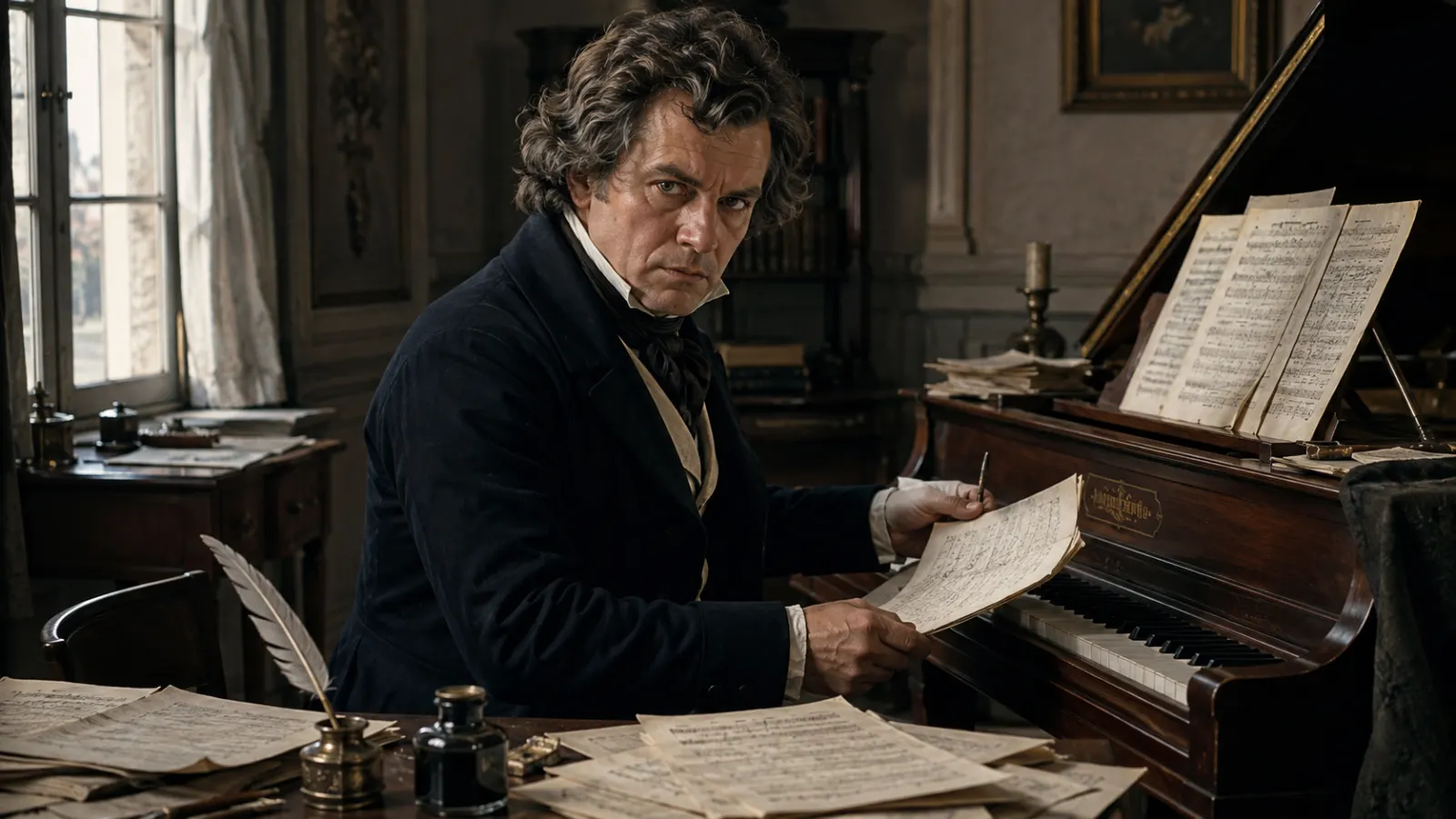
His surviving sketchbooks make this visible across the career. Familiar musical themes often emerged through numerous alternatives and discarded possibilities. Composition was labour.
Beethoven the Relentless Reviser
The sketchbooks became particularly important to Beethoven’s later reputation because they allowed admirers to see artistic struggle on the page. Crossed-out ideas and competing alternatives seemed to reveal the composer’s mind at work.
This contributed to a broader cultural transformation in the idea of genius. Greatness no longer needed to mean producing perfect work effortlessly. Revision could itself become evidence of seriousness.
The manuscript became almost dramatic. The finished work showed the solution, while the sketches preserved the struggle required to reach it.
This view influenced later ideas of artistic creation far beyond music. Genius increasingly meant not simply inspiration but the capacity to reshape material until it achieved the form the creator believed necessary.
The End of Beethoven’s Career as a Public Pianist
Progressive hearing loss eventually made Beethoven’s earlier public career as a virtuoso impossible. He could no longer participate in performance and improvisation as he had during his rise in Vienna.
This was a profound professional transformation. The performer-composer increasingly became primarily a composer whose scores circulated without his direct involvement.
The change had wider historical significance. Music increasingly existed as a work separated from the composer who created it. Performers interpreted Beethoven, publishers circulated Beethoven and audiences encountered Beethoven through scores and concerts even when Beethoven himself could no longer participate normally.
His authority remained embedded in the composition.
A Difficult Personal Life
The monumental image of Beethoven can also hide the difficulties of his personality. He could be loyal, generous and emotionally intense, but he could also be suspicious, controlling and volatile.
The guardianship struggle involving his nephew Karl provides one of the clearest examples. After the death of Beethoven’s brother Kaspar Karl, Beethoven became involved in a prolonged and bitter conflict with Karl’s mother, Johanna, over the boy’s future.
Beethoven attempted to exercise extensive control over his nephew’s life. The relationship became extremely damaging, and Karl attempted suicide in 1826.
This history matters because artistic greatness should not be converted into moral perfection. Beethoven’s suffering was real, but suffering does not automatically make someone kind or justify the harm they may cause others.
The Late Style Was Not Simply More Heroic
Beethoven’s middle-period works created a powerful image of struggle and triumph. His late music complicates that image.
The final piano sonatas, late string quartets, Missa solemnis and Ninth Symphony move through very different expressive worlds. Some passages are monumental, but others are intimate, fragmented, contrapuntal, unexpectedly simple or structurally strange.
The late quartets in particular challenged early audiences. Their abrupt contrasts, fugues and unusual formal relationships could be difficult for nineteenth-century listeners to understand.
Today these works stand at the centre of the chamber-music canon. Their prestige can make their first reception seem inevitable.
It was not.
Great works can become easier to understand only after generations of listeners learn how to hear them.
The Ninth Symphony and Ode to Joy
Beethoven’s Ninth Symphony premiered in Vienna in 1824. Its final movement incorporated vocal soloists and chorus singing words from Friedrich Schiller’s Ode to Joy. The introduction of voices into Beethoven’s symphonic world had enormous historical consequences.
The composition later accumulated political meanings far beyond anything Beethoven could control. Ode to Joy has appeared in political ceremonies, protests, official events and European institutions. Competing political traditions have claimed the music for dramatically different purposes.
This afterlife demonstrates an important cultural principle. Once an artwork enters public history, its meaning is no longer controlled exclusively by its creator.
Later societies reinterpret it.
Did Beethoven Hear the Audience at the Ninth Symphony Premiere?
One of the most famous Beethoven stories concerns the premiere of the Ninth Symphony. Accounts describe the profoundly hearing-impaired composer as being unaware of the audience’s enthusiastic response until someone directed his attention toward them.
The central historical point is secure enough: Beethoven’s hearing loss was severe and limited his awareness of what was happening around him.
The precise details vary across accounts.
This distinction is important because Beethoven’s biography has repeatedly been improved into dramatic scenes. Historians do not need to embellish the reality.
The real situation is already extraordinary.
Deafness Should Not Become a Motivational Cliché
Beethoven’s hearing loss is inseparable from his life, but it should not be turned into a story in which disability exists primarily to inspire other people.
He did not simply defeat deafness through determination. He continued living with it.
He sought treatment, concealed the condition, struggled socially, changed communication methods and lost the public performing career that had helped establish his reputation.
Nor should his later music be described as automatically deeper because he became deaf.
His compositional development resulted from decades of knowledge, experimentation and revision. Disability changed the conditions of work without becoming a magical source of artistic greatness.
The more meaningful achievement is that creative work continued under radically transformed sensory circumstances.
The Immortal Beloved Mystery
After Beethoven’s death, a passionate letter addressed to an unnamed “Immortal Beloved” was discovered among his possessions.
The identity of its recipient remains disputed.
Numerous candidates have been proposed across generations of scholarship and popular biography. None has produced universally accepted certainty.
The uncertainty should be preserved rather than filled through romantic invention.
The letter demonstrates an intense emotional attachment. It does not allow historians to identify the recipient beyond reasonable doubt.
Sometimes “we do not know” is the most accurate historical conclusion.
Beethoven’s Death and Public Fame
Beethoven died in Vienna on 26 March 1827. His funeral attracted a large public crowd, demonstrating the scale of his reputation before the later nineteenth-century canon had fully developed.
After his death, private documents became public cultural objects. The Heiligenstadt Testament became evidence of personal struggle. The Immortal Beloved letter generated romantic speculation. Sketchbooks became monuments to creative labour.
The difficult living composer gradually became a cultural institution.
This process is crucial to understanding modern Beethoven. We inherit both the music and the mythology created around the person who wrote it.
How Beethoven Changed the Symphony
Haydn and Mozart had already created extraordinary symphonies. Beethoven did not invent the genre.
He changed the historical expectations surrounding it.
After Beethoven, composing a symphony increasingly meant entering a serious artistic conversation with Beethoven’s existing works. Later composers could feel the weight of that comparison intensely.
Johannes Brahms became one famous example. Completing his First Symphony was difficult partly because the genre had acquired enormous historical prestige through Beethoven.
The symphony was no longer just one major genre among others.
It had become a site of artistic ambition.
Instrumental Music Became Intellectually Monumental
Beethoven also contributed powerfully to the growing prestige of instrumental music.
A symphony without words could increasingly be treated as something capable of carrying deep intellectual and emotional meaning. Listeners and critics could analyse development, transformation and structure as though the work contained an argument.
This became important to nineteenth-century discussions of so-called absolute music.
Beethoven was not the only composer responsible for this development.
His works became some of its strongest examples.
Beethoven Changed the Image of the Composer
Perhaps Beethoven’s most influential legacy beyond the music itself was the cultural image of the composer.
Earlier composers commonly worked as church or court employees. Beethoven still relied on patrons, but he increasingly asserted that artistic creation carried its own authority.
The composer did not merely provide a service.
The composer produced works that could justify resistance to patronal demands, repeated revision and long-term interpretation.
Romantic culture later intensified this image into the ideal of the autonomous genius.
Beethoven became one of its central symbols.
The Myth Contains Truth but Distorts the Career
The myth survives because each part contains something real.
Beethoven was difficult.
He did resist patrons.
He did revise relentlessly.
He did lose his hearing.
He did produce extraordinary music under severe personal conditions.
The distortion occurs when these facts become a single heroic narrative.
The historical Beethoven depended on aristocrats, performers, publishers, concert organisers, instrument makers and audiences. His supposedly independent genius remained part of a social and economic system.
Understanding those dependencies does not diminish him.
It explains how musical culture actually worked.
Why Beethoven’s Sketches Matter So Much
Finished music produces an illusion of inevitability.
Once a listener knows the famous theme, it becomes difficult to imagine the piece beginning any other way.
Sketches restore uncertainty.
They show alternative ideas, discarded phrases and structural problems that had not yet been solved.
For this reason Beethoven’s manuscripts became unusually important to later concepts of creativity.
They reveal that artistic invention can involve repeated failure and correction.
The masterpiece appears effortless only after the labour has disappeared.
Frequently Asked Questions
Was Beethoven born deaf?
No. Beethoven had normal enough hearing to develop into an accomplished pianist and professional musician before his hearing progressively deteriorated during adulthood.
When did Beethoven begin losing his hearing?
His surviving correspondence shows that he was already experiencing serious hearing problems around the beginning of the nineteenth century.
How could Beethoven compose when he was deaf?
Beethoven had decades of musical training, an extensive internal understanding of harmony, instruments and musical structure, and a highly developed ability to work through notation and sketches.
What is the Heiligenstadt Testament?
It is a private document Beethoven wrote in 1802 describing the emotional suffering caused by his hearing loss and his decision to continue living partly because of his commitment to art.
What caused Beethoven’s deafness?
No single retrospective medical diagnosis has been established with certainty.
Did Beethoven study with Haydn?
Yes. Beethoven studied with Joseph Haydn after moving to Vienna, although their professional relationship contained some tension.
Did Beethoven invent Romantic music?
No. Beethoven worked within and transformed the Classical tradition, while his music became enormously influential for later Romantic composers.
Why is the Eroica Symphony important?
It expanded the scale and structural ambition associated with the symphony and became one of the defining works of Beethoven’s middle period.
Did Beethoven write the Fifth Symphony about fate?
The famous expression “fate knocking at the door” belongs to later anecdotal tradition and should not be treated as a securely documented programme supplied by Beethoven.
What was Beethoven’s only opera?
Fidelio, which he revised extensively.
Why is Beethoven’s Ninth Symphony important?
Its final movement combines symphonic writing with vocal soloists and chorus setting Schiller’s Ode to Joy, a decision with enormous later influence.
Who was Beethoven’s Immortal Beloved?
The identity of the person addressed in the surviving letter remains disputed.
When did Beethoven die?
He died in Vienna on 26 March 1827.
The Real Beethoven Is More Interesting Than the Legend
The simplified Beethoven story is emotionally powerful: a musical genius loses his hearing, refuses to surrender and creates masterpieces anyway. Nothing in that story is completely false, but it leaves out almost everything that made Beethoven a historical composer rather than an inspirational symbol.
Beethoven spent years mastering an existing musical tradition before transforming it. He relied on aristocratic patrons while demanding unusual artistic independence. He negotiated constantly with publishers because money affected creative autonomy. He organised difficult public concerts, worked with performers and revised compositions obsessively.
His life contained political idealism and aristocratic dependence, profound emotional suffering and behaviour that could harm people close to him. His hearing loss transformed his daily life without magically creating his artistic imagination. His music emerged from training, experimentation, memory, notation, revision and intense engagement with the forms inherited from earlier composers.
That working Beethoven is more compelling than the statue.
The Central Idea
Beethoven’s importance does not depend on reducing his life to the story of a deaf genius triumphing over fate. His achievement was larger and historically more interesting. He entered European musical culture as a pianist and composer trained in the Classical tradition and progressively changed expectations surrounding the symphony, piano sonata, string quartet and the cultural authority of instrumental music.
His hearing loss remained a profound reality throughout much of that transformation. The source you provided correctly emphasises that Beethoven did not simply “ignore” disability. He sought medical help, feared public knowledge of the condition, withdrew socially, experimented with devices and eventually relied heavily on written communication.
Yet the music cannot be explained by deafness alone. Beethoven’s artistic world also depended upon aristocratic patronage, publishers, public concerts, performers, musical instruments and decades of accumulated knowledge. His sketchbooks reveal how much revision lay behind the finished compositions.
His later reputation transformed these realities into the mythology of genius. The difficult personality became heroic independence. Messy manuscripts became visible struggle. Hearing loss became inspirational triumph. Monumental works became evidence of a composer standing alone against history.
The historical Beethoven was never completely alone.
He was a working musician living inside institutions that he repeatedly challenged but could never entirely escape.
That is what makes his career so important.
Beethoven did not become great because music somehow arrived despite the conditions of his life. He became great partly because he spent decades thinking, revising and creating within those conditions—and repeatedly pushed the musical structures he inherited further than audiences expected them to go.