lithium cobalt rare earths: Why It Matters for India
Latin America is becoming strategically important for two reasons that define the future economy: lithium and food. The same region that holds vast agricultural potential also contains some of the world's most important reserves of energy-transition minerals. In an age of electric vehicles, batteries, solar power, food inflation and climate stress, Latin America is no longer a distant cultural region for India. It is a resource frontier with global consequences.
Why the issue matters now
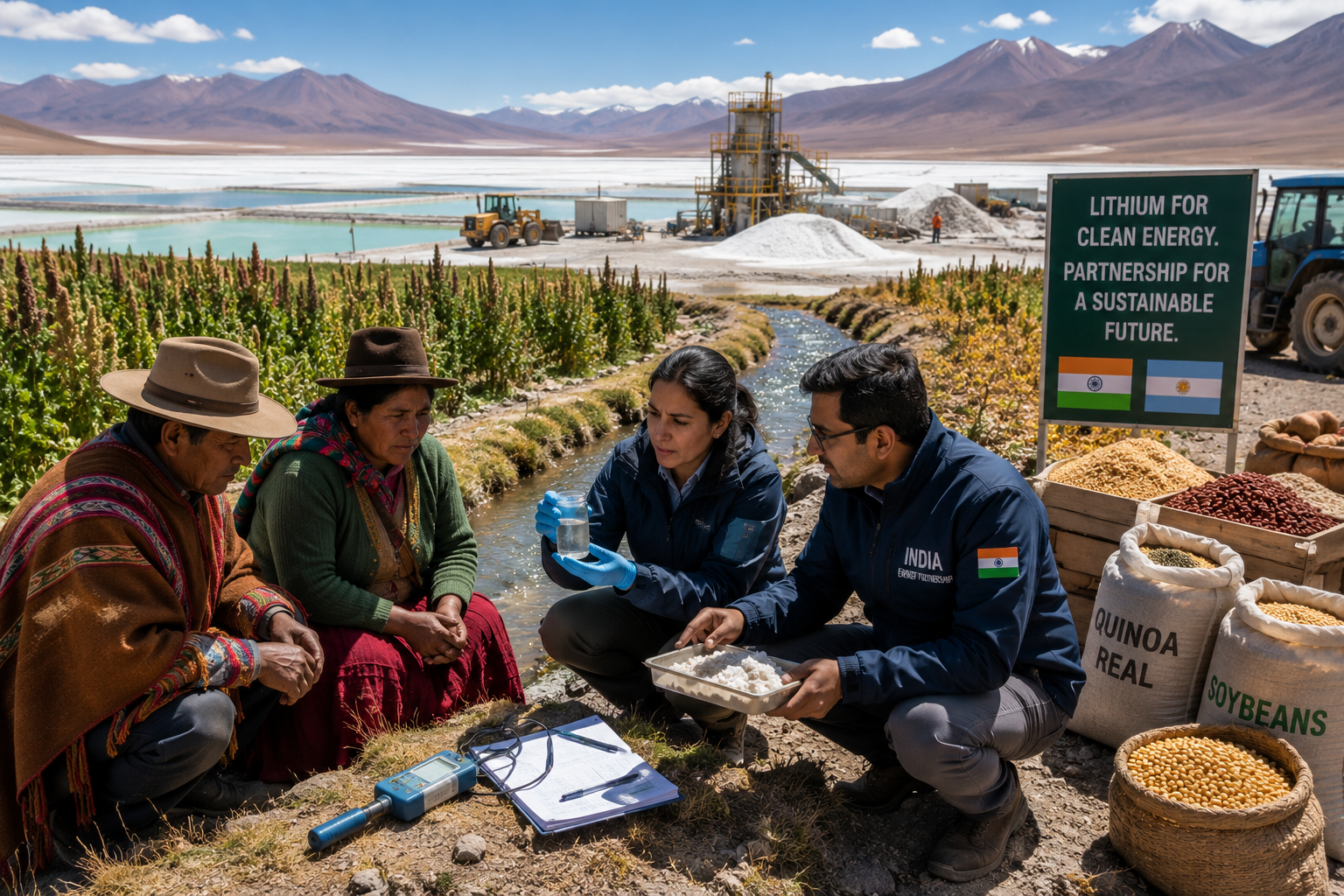
The lithium story is the most visible. The so-called Lithium Triangle - Argentina, Bolivia and Chile - holds a large share of the world's lithium resources. Lithium is essential for many battery chemistries used in electric vehicles and grid storage. As countries pursue clean-energy transition, battery supply chains become strategic. Whoever controls mining, processing, refining and battery technology will have leverage over the future of mobility and energy storage.
But lithium is not the only mineral story. Chile and Peru are major copper producers. Brazil has strategic minerals and agricultural strength. Argentina has lithium and food exports. Bolivia has lithium potential but faces governance and extraction challenges. Mexico, though often discussed in North American terms, also matters in manufacturing and critical mineral supply chains. The region's importance lies in the combination of resources, geography and political choice.
The International Energy Agency's Global Critical Minerals Outlook 2025 highlights the importance of copper, lithium, nickel, cobalt, graphite and rare earth elements for energy transition. UNCTAD has also argued that critical energy transition minerals include inputs required for renewable energy, electric vehicles and battery storage. This means mineral-rich developing regions can gain new bargaining power if they move up the value chain instead of exporting raw materials.
The strategic geography
Latin American countries understand this. Chile has debated stronger state involvement in lithium. Bolivia has long wanted to avoid a simple raw-extraction model. Argentina has attracted investment through provincial and market-oriented approaches. Across the region, governments are asking how to capture more value through refining, battery manufacturing, technology transfer and local employment. The question is not whether lithium will be mined. The question is who benefits from the value chain.
India has a direct stake. India's electric mobility, renewable energy storage and battery manufacturing ambitions require secure access to lithium and other minerals. India cannot build a clean-energy future while remaining dependent on uncertain mineral supply chains dominated by geopolitical rivals. China already has strong positions in mineral processing and battery supply chains. If India wants industrial independence in electric vehicles, grid storage and electronics, Latin America must be part of its external resource strategy.
Food security is the second pillar. Latin America is one of the world's major agricultural regions. Brazil and Argentina are central to global soy, maize, meat and edible oil markets. Climate shocks, export restrictions, war, fertiliser disruptions and shipping problems can quickly affect food prices worldwide. India is a major agricultural producer, but it still faces pressure in edible oils, pulses, feed, fertilisers and climate-sensitive crops. Diversified food partnerships can reduce vulnerability.
India angle
The link between minerals and food is deeper than it seems. Both are about resource security in a volatile world. Both are affected by climate change, water stress, land conflict, indigenous rights, logistics and global commodity prices. Both create tension between development and environmental protection. Lithium extraction can require water in ecologically fragile regions. Agricultural expansion can threaten forests and indigenous communities. Strategic resources can become politically explosive if local communities feel excluded.
This is why India's Latin America policy must be more sophisticated than simple import sourcing. India should engage governments, provinces, companies, universities and communities. It should support sustainable mining, water-efficient technologies, environmental safeguards and local value addition. It should also connect mineral partnerships with manufacturing cooperation in batteries, mobility, chemicals and recycling.
Food partnerships can also be expanded. India can build long-term arrangements in edible oils, pulses, fertiliser feedstocks, agri-tech, cold chains, farm machinery and climate-resilient agriculture. Latin America can benefit from Indian pharmaceuticals, IT services, digital public infrastructure, affordable healthcare, education and small-business technologies. A minerals-only relationship would be too narrow.
Counter-view and complexity
The geopolitical competition is already underway. China has invested heavily in Latin American infrastructure, mining and trade. The United States sees the region through supply-chain security, migration, democracy and strategic rivalry. Europe wants climate partnerships and access to raw materials. Gulf states are interested in food security and agricultural investment. India is late but not irrelevant. It has goodwill, markets and technology, but it must scale up diplomatic and commercial presence.
The counter-view is that Latin America is too far from India and that logistics make deep engagement difficult. Distance increases freight costs and weakens business familiarity. Language barriers, political instability, regulatory uncertainty and local opposition to mining can complicate projects. India has often underinvested diplomatically in the region compared with Africa, West Asia or Southeast Asia. These are real constraints.
What happens next
Yet distance is becoming less important than supply-chain risk. If a mineral is critical, geography can be managed through long-term contracts, shipping, storage, refining partnerships and overseas investments. Japan, China, Korea, Europe and the United States have all pursued distant resource partnerships when strategic necessity demanded it. India must think with similar seriousness.
What happens next will depend on three trends. First, whether lithium prices and battery technologies stabilise enough for large projects to remain viable. Second, whether Latin American governments can balance resource nationalism with investor confidence. Third, whether countries like India can offer partnerships that go beyond extraction.
For India, the policy direction should be clear. Build mineral diplomacy with Argentina, Chile, Bolivia, Brazil and Peru. Support Indian public and private companies in overseas resource acquisition. Invest in battery recycling to reduce future import dependence. Expand embassies, trade missions and language capacity. Link Latin America with India's EV, solar, storage and food-security policies. Treat the region as a strategic partner, not an occasional supplier.
A deeper reading of Latin America's role must separate resource ownership from resource power. Having lithium, copper or agricultural land does not automatically create geopolitical influence. Influence comes when countries control extraction terms, processing capacity, technology, transport, finance and market access. Latin America's challenge is to avoid repeating the old commodity trap in a new green form.
The lithium triangle shows this clearly. Chile has stronger institutions and established mining experience. Argentina has attracted investment but faces macroeconomic volatility. Bolivia has large resources but has struggled to convert potential into commercial scale. Each country has different politics, environmental debates and investor conditions. India cannot design one policy for all three. It needs country-specific strategies and patience.
Water is a critical issue. Lithium extraction in salt flats can affect fragile ecosystems and local communities. Indigenous rights, environmental permits and local consent are not obstacles to strategy; they are part of strategy. Any country that ignores these issues may face protests, legal disputes and project delays. India should support responsible mining technologies and transparent community engagement if it wants durable access.
Processing is the real prize. Raw lithium exports create limited value compared with refining, cathode manufacturing, cell production and battery recycling. China understood this earlier than most countries and built dominance in processing. India must not limit itself to buying raw materials. It should pursue joint ventures in refining, battery materials, recycling and research. Otherwise, it will remain dependent even after securing mineral contracts.
Food security has similar complexity. Latin America can supply commodities, but food systems are vulnerable to climate change, fertiliser costs, logistics shocks and political decisions. Droughts in South America can affect global prices. Export restrictions can create uncertainty. India should diversify suppliers, but also invest in domestic productivity, storage and oilseed strategies. External sourcing cannot replace domestic resilience.
There is also a diplomatic opportunity. Latin America and India share Global South concerns on development, climate finance, technology access and reform of global institutions. Yet political engagement remains thin. More high-level visits, parliamentary exchanges, academic ties and media familiarity are needed. Many Indians know little about Latin America beyond football, culture and distant geography. Strategic seriousness requires knowledge infrastructure.
Brazil deserves special attention. It is a major food power, climate actor, BRICS member and Latin America's largest economy. India-Brazil cooperation can cover agriculture, biofuels, pharmaceuticals, digital governance, space and multilateral reform. Argentina matters for lithium, agriculture and Antarctic links. Chile matters for copper and lithium. Peru matters for minerals. Mexico matters for manufacturing and North American supply chains. A serious Latin America policy must prioritise.
The deeper conclusion is that the energy transition may reproduce old inequalities if developing countries export raw materials while others control technology. India should not only seek minerals from Latin America; it should support a fairer value-chain model. That would align India's resource needs with its Global South diplomacy and create a more credible partnership than pure extraction.
India should create a dedicated Latin America critical minerals strategy. It should identify priority minerals, priority countries, potential public-sector and private-sector investors, financing tools and risk-insurance mechanisms. Without such a strategy, Indian companies will enter too late and negotiate from weakness.
Battery recycling should be part of the same policy. Even if India secures lithium abroad, long-term resilience will require recycling, alternative chemistries and domestic processing. Resource security is not only about overseas mines. It is about circular economy, technology choices and industrial policy.
Food security cooperation can include research on climate-resilient crops, biofuels, oilseeds and animal-feed supply chains. Brazil's experience with ethanol and tropical agriculture, Argentina's strengths in grains and Chile's logistics and mining governance all offer learning opportunities. India should treat Latin America as a knowledge partner, not just a commodity source.
The political challenge is that Latin America has ideological cycles. Governments can shift from market-oriented policies to resource nationalism and back. Long-term Indian strategy must therefore be resilient across political changes. Building relationships with institutions, provinces, companies and civil society can reduce dependence on one government or one ideological moment.
The editorial insight is this: Latin America matters because the green transition and food security both run through land, water and minerals. The next phase of geopolitics will not be decided only by oil wells and sea lanes. It will also be decided by salt flats, copper mines, soy fields, ports and processing plants. India cannot afford to remain a spectator.
Internal Links to Add
Related regional explainer articles from the Master Article Shell should be added during CMS upload based on topical proximity.