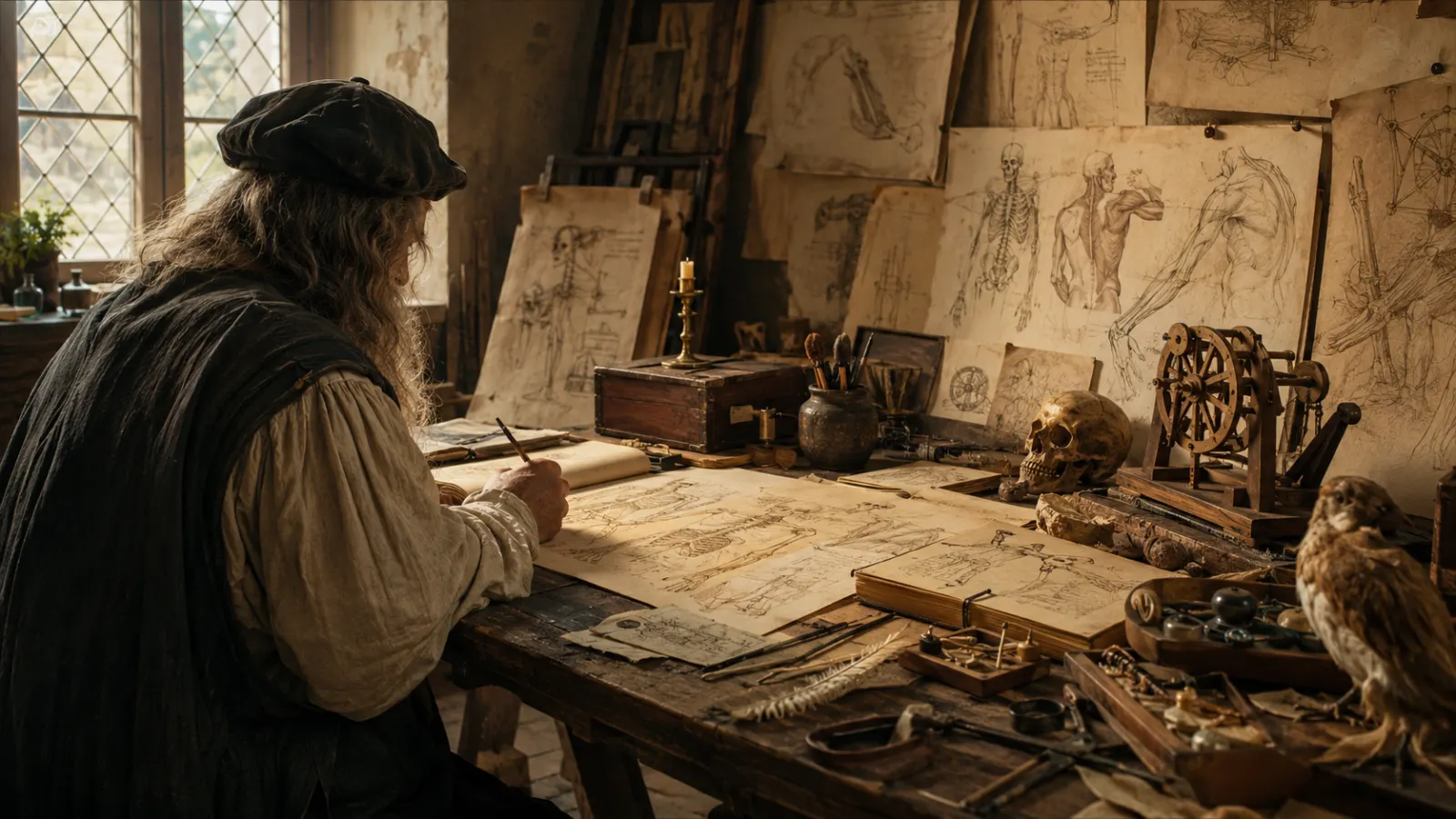
Leonardo da Vinci: Art, Anatomy and the Science of Seeing
Leonardo da Vinci has become the archetype of the “universal genius.” He painted the Mona Lisa and The Last Supper, dissected human bodies, studied water and geology, designed machines, investigated flight and filled notebooks with observations ranging from anatomy and optics to fortifications and mechanics.
That range makes it tempting to describe him as a modern painter, scientist, engineer, anatomist and inventor somehow transported into fifteenth-century Italy. The description flatters Leonardo, but it also distorts him. The modern professions implied by those labels did not yet exist in their current forms, and Renaissance knowledge was organised differently.
Leonardo belonged to a world of workshops, courts, religious commissions, military engineering, humanist learning, classical texts, craft knowledge and aristocratic patronage. Artists could be expected to design festival machinery, buildings, costumes, hydraulic systems, weapons and monumental sculpture alongside paintings. Practical knowledge and intellectual inquiry overlapped much more freely than modern academic departments often suggest.
What made Leonardo exceptional was therefore not simply that he possessed many unrelated talents. His deeper brilliance lay in the way he connected them. Anatomy informed painting. Optics informed perspective. Water studies informed his understanding of motion. Geometry entered the study of the body. Engineering drawings became investigations into force and mechanism.
Again and again, Leonardo treated drawing as a form of reasoning.
For him, to observe carefully was already to begin understanding.
Born Near Vinci
Leonardo was born on 15 April 1452 near Vinci in Tuscany. He was the son of Ser Piero, a Florentine notary, and a woman named Caterina. Because his parents were not married to one another, Leonardo did not follow the conventional professional path that might otherwise have connected him more directly with his father’s notarial career.
Instead, he entered the world of artistic training.
This mattered because Renaissance workshops offered a very different education from universities. Leonardo did not receive the formal scholastic training associated with physicians, theologians or lawyers, and he never became completely comfortable with Latin, which remained central to elite learned culture.
He occasionally described himself as a “man without letters.”
The phrase can sound self-deprecating, but it points toward an important distinction in his intellectual life. Leonardo lacked some of the textual education available to university-trained scholars, yet his workshop education gave him intensive familiarity with materials, geometry, perspective, pigments, tools, mechanisms and fabrication.
He learned knowledge through making.
That practical foundation would shape almost everything that followed.
Verrocchio’s Workshop Was a Production Environment
As a young man, Leonardo entered the Florentine workshop of Andrea del Verrocchio. Modern audiences may imagine an artist’s studio as a quiet space occupied by one individual producing personal works. A Renaissance workshop operated more like a complicated production environment.
Apprentices and assistants learned drawing, painting, sculpture, metalworking, casting, surface preparation and other specialised skills. Large commissions could involve several hands. Designs might originate with the master while assistants executed particular passages or objects.
This collaborative system matters because later museum culture tends to place one famous name beside each masterpiece. Renaissance artistic production was often less individually compartmentalised.
Leonardo learned within this collective environment.
He developed increasingly sophisticated abilities in drawing, modelling, light, perspective, landscape and the representation of the human figure. He also inherited one of Renaissance Florence’s most important intellectual convictions: visual representation could be analysed systematically through geometry and perspective.
An artist did not merely imitate appearances.
The artist could investigate why appearances looked the way they did.
Florence Encouraged Ambition—and Exposed a Lifelong Problem
Leonardo established himself as an artist in Florence, but his career quickly revealed a pattern that would follow him for decades: enormous ambition combined with difficulty finishing everything he began.
Several commissions remained incomplete.
It is easy to interpret this as simple procrastination or perfectionism. Neither explanation is sufficient.
Leonardo’s method encouraged questions to multiply. A painting might begin as a commission but become an investigation into facial expression, atmospheric perspective, anatomy or light. A technical problem could generate additional experiments. A design might be revised repeatedly because the underlying problem became more interesting than the deadline.
From Leonardo’s intellectual perspective, this expansion could be productive.
From a patron’s perspective, it could be extremely frustrating.
His career therefore demonstrates an important tension between curiosity and completion. The same mentality that generated extraordinary investigation also made it difficult to treat every commission as a finite task to be executed efficiently and delivered.
Milan and the Engineer Leonardo Wanted Patrons to See
Around 1482, Leonardo moved to Milan and entered the orbit of Ludovico Sforza.
A famous document connected with his search for patronage presents Leonardo in a striking way. The letter emphasises military engineering, fortifications, bridges, weapons, hydraulic systems and other technical abilities before turning to painting.
Modern readers sometimes treat this as evidence that Leonardo secretly considered himself an engineer rather than an artist.
The more revealing conclusion concerns Renaissance patronage.
A court artist could be useful in many ways. Rulers required military designs, public spectacles, architecture, monuments, machines and decorative programmes. The division between “artist” and “engineer” was not as rigid as it would become later.
Leonardo’s versatility therefore had practical value at court.
Milan gave him opportunities to develop some of his most important artistic, anatomical and mechanical investigations.
It also produced one of his greatest surviving paintings.
The Last Supper Turned Gesture Into Narrative
Leonardo painted The Last Supper during the 1490s for the refectory of Santa Maria delle Grazie in Milan. The biblical subject was familiar, but Leonardo transformed the scene into an unusually intense study of human reaction.
Christ has announced that one of the apostles will betray him.
The composition captures the psychological shock that follows.
The apostles do not sit as twelve isolated symbolic figures. They react in groups. Bodies lean toward one another. Hands gesture. Faces question, accuse or recoil. Gesture becomes a vehicle for narrative.
Perspective reinforces the effect. The architectural lines lead the viewer toward Christ, establishing him as the compositional centre while emotional disturbance unfolds around him.
Leonardo therefore turns theology into human psychology without abandoning the religious meaning of the scene.
The painting also reveals another characteristic of his career: experimentation could produce extraordinary artistic results while creating practical problems.
Leonardo’s Experimental Technique Damaged the Painting
Traditional fresco requires artists to work on wet plaster, limiting how slowly and subtly pigments can be manipulated.
Leonardo wanted greater tonal flexibility.
He therefore experimented with a wall-painting technique that allowed him more freedom than conventional fresco. The decision supported the extraordinarily subtle effects he wanted to achieve but produced an unstable surface.
The Last Supper began deteriorating relatively early.
The damage is often treated as an unfortunate technical accident separate from Leonardo’s artistic brilliance.
The two are more closely connected.
His willingness to challenge established methods enabled innovation, but experimentation carries risk. Leonardo’s search for greater control over light and colour contributed both to the painting’s artistic distinction and its physical vulnerability.
Innovation and failure can originate in the same decision.
Leonardo Thought Painting Was an Intellectual Discipline
Leonardo repeatedly treated painting as something far more demanding than decorative craft.
A painter attempting to represent the visible world convincingly needed to understand geometry, light, perspective, anatomy, movement, colour and vision.
This belief provides one of the best explanations for the apparent diversity of his notebooks.
His anatomy was relevant to painting because the painter needed to understand the body beneath the skin. Optics mattered because painting depends on light and vision. Geology and botany improved landscape. The study of water revealed forms of movement. Geometry allowed spatial relationships to be understood.
The Louvre’s modern scholarship has emphasised this integrated idea as Leonardo’s “science of painting.” Your supplied article correctly identifies this as a key to understanding why his scientific and artistic activity should not be separated too sharply.
Leonardo did not possess one artistic career and another scientific career running beside it.
The investigations continually fed one another.
Anatomy Began With the Visible Body and Went Beneath It
Leonardo’s interest in the human figure eventually led him far beyond surface anatomy.
He participated in dissections and produced detailed drawings of bones, muscles, organs, the vascular system, reproductive anatomy and the brain. A substantial body of this work survives in the Royal Collection.
Some drawings display extraordinary structural understanding.
His studies of the spine are particularly impressive because they show the vertebral column with a degree of spatial clarity unusual for the period. He investigated muscles not merely as shapes but as systems producing movement. Joints became mechanical structures. The heart became an object whose internal operation could be analysed.
The drawings combine observation with diagrams, labels and explanatory notes.
This is visual thinking at its most powerful.
Leonardo’s Anatomy Was Brilliant but Not Modern Medicine
Leonardo’s anatomical work is so impressive that popular accounts sometimes promote him into a secret founder of modern medicine.
That creates another historical distortion.
Some of his anatomical observations were remarkably accurate. Others were wrong or incomplete. His famous drawing of a fetus in the womb demonstrates both strengths at once: exceptional observational ambition combined with inaccuracies influenced partly by animal dissection and inherited medical ideas.
Leonardo worked before modern physiology, microbiology, advanced surgery and many of the experimental techniques available to later medicine.
He should therefore not be judged by the unreasonable standard that he ought to have discovered everything that twentieth- or twenty-first-century biomedical science would later establish.
The more useful question is how far careful observation allowed one Renaissance investigator to move beyond inherited assumptions.
The answer remains extraordinary.
The Anatomical Drawings Had Limited Immediate Influence
One distinction is essential when evaluating Leonardo’s scientific importance: discovering something and changing a field are not the same thing.
Leonardo seems at various points to have intended to organise his anatomical investigations into a systematic publication.
He never completed it.
Much of the work therefore remained inside manuscripts rather than circulating widely through European medicine.
That sharply limited its immediate influence.
Andreas Vesalius later transformed the study of anatomy partly because his De humani corporis fabrica, published in 1543, could be printed, distributed, studied and debated.
Leonardo’s unpublished drawings demonstrate remarkable personal knowledge.
They did not transform sixteenth-century medical education in an equivalent way.
This difference between discovery and dissemination is fundamental to intellectual history.
Knowledge changes a field only when other people can encounter, test, criticise and develop it.
Leonardo’s Machines Need the Same Historical Caution
The notebooks contain mechanical designs that resemble technologies familiar to modern viewers: flying machines, parachute-like devices, armoured vehicles, diving equipment and many other mechanisms.
This has produced one of the most persistent Leonardo myths.
He supposedly “invented” helicopters, tanks, submarines and aeroplanes centuries before they existed.
The sketches are certainly remarkable.
The claim still needs qualification.
Many designs were conceptual investigations rather than finished engineering systems. Others depended on materials or power sources unavailable in Leonardo’s time. Some were related to engineering traditions that predated him. A drawing can investigate a principle without functioning as a practical construction plan.
The important question is therefore not simply:
Did Leonardo invent the helicopter?
A better question is:
What mechanical problem was Leonardo trying to understand through the drawing?
That shift takes us much closer to the way his notebooks actually work.
Flight Became a Problem of Mechanics
Leonardo’s fascination with flight demonstrates his investigative method especially clearly.
Humans had dreamed about flying for centuries.
Leonardo tried to analyse how it might work physically.
He studied birds and wing movement. He investigated air, balance, force and the relationship between body weight and lifting surfaces. Some designs imagined human-powered flapping mechanisms, while others approached gliding or parachute-like concepts.
Many of these machines would not have functioned as Leonardo imagined.
Human muscle power is insufficient for several of the proposed mechanisms.
That practical limitation does not make the studies meaningless.
The intellectual change lies in converting flight from mythic aspiration into a mechanical question.
How do wings interact with air?
How does balance affect motion?
What forces keep a body aloft?
Leonardo tried to move from wonder toward mechanism.
Water Fascinated Leonardo Because Motion Had Patterns
Few natural phenomena appear more frequently in Leonardo’s notebooks than water.
He drew currents, vortices, erosion, waves and hydraulic devices. The shapes of moving water often resemble the curling patterns appearing in his studies of hair.
This visual similarity was not merely decorative.
Leonardo was searching for recurring forms of movement in nature.
A vortex in water and a curl in hair could both reveal patterns produced by flowing material.
His hydraulic interests also had practical dimensions. Courts and cities cared about canals, water management, irrigation and military engineering.
Again, theoretical curiosity and practical application were not separate worlds.
The same investigation could belong to art, engineering and natural philosophy simultaneously.
Leonardo’s Geological Observations Were Remarkably Naturalistic
Leonardo also examined fossils and rock layers.
Marine shells embedded in mountains presented an obvious puzzle. How had organisms associated with the sea reached high elevations?
Traditional explanations could invoke catastrophic floods.
Leonardo considered much longer geological processes.
He recognised that fossil shells represented organisms that had once lived in marine environments and that landscapes could change over enormous spans of time through deposition and erosion.
These observations were striking.
But once again, most remained in notebooks.
Leonardo did not become the institutional founder of modern geology.
He independently reasoned toward ideas that demonstrate how powerful direct observation could become when used critically against inherited explanation.
The Monumental Horse That Never Became Bronze
Leonardo spent years developing plans for a monumental equestrian statue honouring Francesco Sforza.
The commission was technically ambitious.
He produced extensive studies and eventually created a large clay model.
The final bronze monument was never completed.
Political and military crisis intervened, and bronze intended for the project was redirected to other uses. The clay model was later destroyed.
The episode captures Leonardo’s career unusually well.
Years of artistic and technical investigation could accumulate around an object that ultimately never existed in its intended final form.
A conventional list of Leonardo’s surviving masterpieces therefore underestimates the scale of his activity.
Some of his most consequential projects survive primarily through drawings, descriptions and influence.
Political Change Could Destroy Artistic Plans Overnight
Leonardo’s career depended heavily on courts and rulers, which meant political instability could transform his circumstances rapidly.
French military intervention ended the Sforza regime in Milan.
Leonardo left.
This reminds us that Renaissance artistic careers were inseparable from politics.
A patron could fall from power.
A war could redirect materials.
A court could disappear.
An unfinished project might therefore reflect historical collapse rather than individual artistic failure.
Leonardo moved through several Italian centres after leaving Milan and eventually entered the service of Cesare Borgia as a military engineer and mapmaker.
This phase produced another striking example of drawing used as practical knowledge.
The Map of Imola Turned Vision Into Administrative Power
Leonardo’s map of Imola is remarkable because it approaches the city through systematic planimetric representation.
Rather than presenting buildings symbolically or creating a picturesque urban view, the map attempts to show spatial relationships in a form useful for planning and military administration.
The drawing demonstrates how visual accuracy can become operational power.
A ruler who understands streets, walls and surrounding terrain possesses strategic information.
Here again Leonardo’s artistic abilities cannot be separated neatly from engineering.
Perspective, measurement, observation and drawing become instruments for understanding and controlling space.
The Mona Lisa Is More Than a Famous Smile
Leonardo returned to Florence in the early sixteenth century and began the portrait now known as the Mona Lisa, generally identified as Lisa Gherardini, wife of the Florentine merchant Francesco del Giocondo.
The painting’s modern celebrity can make it difficult to see what was technically unusual about it.
Leonardo used extraordinarily subtle tonal transitions to soften boundaries between light and shadow. This approach is associated with sfumato, the gradual modulation that reduces the sense of hard outlines around forms.
The sitter therefore does not appear cut sharply from the surrounding atmosphere.
Skin, landscape and shadow seem connected through light.
The expression also resists easy interpretation. Slight changes around the mouth and eyes contribute to the psychological ambiguity that later viewers made central to the painting’s reputation.
Leonardo appears to have continued working on the portrait for years rather than simply delivering it as an ordinary commission.
This was characteristic.
A painting could remain an active problem long after most patrons would have considered it finished.
Sfumato Grew From Leonardo’s Study of Vision
Sfumato should not be treated merely as a signature artistic trick.
It belongs to Leonardo’s larger investigation of how people actually see.
Objects are rarely perceived as perfectly hard outlines detached from air and light. Atmospheric conditions soften contrast. Distance changes colour. Shadows contain gradual transitions rather than simple borders.
Leonardo’s optical investigations examined precisely these problems.
His mature painting therefore embodies research.
Visual style becomes evidence of a theory about perception.
He was not merely asking how to make objects look beautiful.
He was asking what conditions make objects visible at all.
Optics Connected the Eye With Painting
Leonardo studied light, shadow, reflection, perspective and the operation of vision.
Some of his anatomical and optical models were incorrect by modern standards, but the programme itself was unusually systematic.
How does light travel?
How do shadows change?
Why do distant objects lose contrast?
How does the eye receive visual information?
These questions mattered directly to painters, but Leonardo pushed them beyond practical workshop recipes.
Perspective could become mathematics.
Shadow could become an optical problem.
Atmosphere could become part of the mechanics of perception.
This integrated treatment of art and optics helps explain why Leonardo remains difficult to classify using modern professional categories.
Vitruvian Man Is an Investigation, Not Just an Icon
The Vitruvian Man has become such a universal symbol of Renaissance genius that its original intellectual problem can disappear.
The drawing engages with the Roman architectural writer Vitruvius and his discussion of the proportions of the human body.
Leonardo investigates how those proportions relate to geometric forms, especially the circle and square.
He did not invent the Renaissance interest in ideal bodily proportion, nor was he the only artist to study Vitruvius.
What makes his drawing exceptional is the way it converts textual description into visual analysis.
The body becomes geometry.
Geometry becomes a method for testing a written authority.
The page therefore demonstrates Leonardo’s characteristic procedure: read, observe, measure and draw.
The drawing is not merely illustrating an idea.
It is interrogating it.
The Battle of Anghiari Became a Famous Lost Work
Florence later commissioned Leonardo to produce a monumental battle scene for the Palazzo Vecchio.
Michelangelo was separately commissioned to work on another battle scene nearby.
The imagined confrontation between the two giants of Renaissance art has become famous.
Neither project survives as the intended completed mural.
Leonardo’s Battle of Anghiari is known through preparatory drawings, copies and later descriptions.
The loss is historically important.
Art history is built from survival, and survival is uneven.
Some extraordinarily influential compositions become known through fragments and copies rather than complete original objects.
Leonardo’s reputation therefore rests partly on works that no modern viewer can experience in the form his contemporaries might have seen.
Leonardo and Michelangelo Represent Different Forms of Renaissance Greatness
Leonardo and Michelangelo are often treated as interchangeable examples of Renaissance genius.
Their approaches differed sharply.
Michelangelo’s imagination repeatedly concentrated enormous expressive force in the human body, sculpture and monumental design.
Leonardo moved more restlessly between observation, mechanism, painting and natural processes.
The comparison should not become a competition over which artist was “greater.”
It reveals the range of intellectual possibilities available within Renaissance art.
Both crossed what modern viewers would call disciplinary boundaries.
They crossed them in different ways.
Rome Showed That Even Genius Has a Career Cycle
Leonardo eventually moved to Rome, where the centre of artistic prestige had shifted.
Michelangelo and Raphael were producing major papal commissions. Leonardo remained intellectually active but received fewer monumental artistic opportunities than might be expected from his later reputation.
This phase offers a useful correction to the myth of timeless genius.
Creative careers take place inside institutions.
Patronage changes.
Generations compete.
Styles change.
A person who appears revolutionary during one decade can belong to an older artistic generation during another.
Leonardo’s greatness did not remove him from the ordinary problem of professional opportunity.
Francis I Offered Leonardo a Different Final Role
Around 1516, Leonardo accepted an invitation from King Francis I of France and moved to the Loire Valley.
He lived at Clos Lucé near Amboise and brought important paintings and manuscripts with him.
His role in France differed from the conventional image of a court painter continuously producing commissioned pictures.
By then Leonardo was an internationally respected elder figure whose value included design, conversation, intellectual prestige and accumulated knowledge.
He continued working on artistic and technical ideas.
He died in France on 2 May 1519.
The paintings and papers he left behind eventually followed complicated paths through pupils, heirs, royal collections and later institutions.
That dispersal shaped which Leonardo later generations would discover.
The Notebooks Preserve Thinking Rather Than Finished Knowledge
Thousands of Leonardo’s drawings and manuscript pages survive.
They are among the most extraordinary documentary records left by any Renaissance artist.
Text and image continually interact.
A mechanical diagram appears beside notes.
An anatomical study acquires measurements.
A face shares a page with geometric investigations.
Ideas are repeated, modified and sometimes contradicted.
These were not polished textbooks prepared for publication.
They were working documents.
That is precisely why they are so valuable.
The viewer encounters not merely conclusions but uncertainty.
We can see Leonardo thinking.
Mirror Writing Is Less Mysterious Than Popular Culture Suggests
Leonardo often wrote from right to left in mirror script.
The habit has encouraged generations of speculation. Some popular explanations suggest secret codes or deliberate concealment.
There is little reason to explain every reversed note as a mystery.
Leonardo was left-handed, and mirror writing may simply have been comfortable or practical for him.
Some material may indeed have been private, but the direction of the writing should not be transformed automatically into evidence of secrecy.
The myth is revealing because Leonardo’s reputation makes ordinary habits appear extraordinary.
Historical analysis should resist turning every unusual feature into proof of hidden genius.
Leonardo Worked With Assistants and Pupils
The image of the completely solitary Leonardo is also misleading.
He operated workshops and had pupils and assistants.
Giovanni Antonio Boltraffio, Francesco Melzi and others belonged to his artistic circle. Leonardo’s compositions were copied and adapted. Workshop participation makes the attribution of some surviving works difficult.
Modern technical analysis—such as examination of underdrawing, materials and changes beneath the painted surface—can help scholars determine which passages may belong directly to Leonardo and which may involve workshop participation.
This complicates the seemingly simple question:
How many paintings did Leonardo make?
Renaissance authorship was not always organised according to modern expectations of one artist executing every part of an object personally.
A master could conceive, design, revise and supervise work partly executed by others.
Collaboration Does Not Reduce Leonardo’s Originality
Acknowledging workshops and intellectual networks does not diminish Leonardo.
It clarifies where originality exists.
Leonardo learned from Verrocchio.
He encountered ancient authors.
He knew the engineering traditions circulating in Italy.
He depended on physicians and institutions for access to anatomical dissection.
Assistants worked around him.
Patrons financed projects.
Military and political institutions supplied practical problems worth solving.
No major thinker creates knowledge from nothing.
Originality consists partly in how existing materials are selected, connected and transformed.
Leonardo’s exceptional gift was the intensity with which he recombined them.
Was Leonardo Really a Scientist?
Calling Leonardo a scientist is understandable because many of his activities resemble later scientific investigation.
Historically, however, the word can be misleading.
The modern profession of scientist did not yet exist. Leonardo did not consistently publish findings for an international research community operating through the institutions and experimental conventions familiar today.
Much of his work remained private.
Yet many habits visible in the notebooks resemble important features of later science: careful observation, measurement, repeated testing, diagrammatic analysis, mechanical explanation and willingness to question inherited claims when direct evidence seemed to contradict them.
The most accurate description may therefore be that Leonardo practised systematic natural inquiry before science became the institutional profession we recognise today.
That preserves both his extraordinary continuity with later scientific thinking and the historical difference between his world and ours.
Leonardo Was Not Simply an Inventor Ahead of His Time
The phrase “ahead of his time” is attractive because it makes Leonardo appear almost supernatural.
It also creates problems.
Every inventor works with materials, technologies, concepts and questions inherited from their own period.
Leonardo did the same.
He studied engineering traditions available to him. He adapted existing mechanisms. He imagined new configurations. He sometimes produced designs that could not have functioned effectively with contemporary materials or power sources.
The extraordinary thing is therefore not that Leonardo escaped the Renaissance.
It is what he managed to imagine inside it.
His notebooks show what happens when workshop knowledge, mathematics, observation and extraordinary visual imagination are concentrated in one investigator.
Leonardo’s Greatest Tool Was Drawing
The thread connecting Leonardo’s work is not one subject.
It is a method.
He drew muscles to understand movement.
He drew machines to understand mechanics.
He drew water to understand flow.
He drew wings to understand flight.
He drew rock formations to understand geological processes.
He drew optical diagrams to investigate vision.
He drew faces to understand expression.
The drawing was not always preparing a painting.
Often the drawing itself was the experiment.
That is the key to Leonardo’s intellectual world.
The Difference Between Seeing and Looking
Most people look at things constantly.
Leonardo cultivated seeing as disciplined attention.
A hand was not merely a familiar body part. It contained bones, tendons and mechanical relationships.
Water was not simply a landscape feature. It moved according to patterns.
A bird was not merely an animal capable of flight. Its wings provided information about forces operating between bodies and air.
A face was not merely recognisable. Minute changes in shadow could alter emotional expression.
Leonardo repeatedly slowed observation down until ordinary things became problems requiring explanation.
That habit may be more important than any individual machine sketch.
Why Leonardo’s Unfinished Projects Matter
A biography focused only on completed masterpieces gives a misleading impression of Leonardo’s career.
The unfinished and unrealised projects matter because they reveal his actual working process.
The Sforza monument never became bronze.
The Battle of Anghiari disappeared.
Several paintings remained incomplete.
Anatomical publication never materialised.
Technical projects remained drawings.
Yet enormous amounts of knowledge emerged from these unfinished enterprises.
Completion is not the only measure of intellectual productivity.
A failed commission can generate successful investigation.
An unfinished machine can reveal a powerful mechanical insight.
A lost mural can influence other artists through copies.
Leonardo’s career repeatedly demonstrates that cultural significance and completed output are not identical.
Why Publication Matters in the History of Ideas
Leonardo also offers an important lesson about communication.
Brilliant knowledge that remains private has a different historical effect from knowledge that circulates.
His anatomical work is the clearest example.
Some discoveries were exceptional.
Their immediate influence remained comparatively limited because the planned systematic publication did not appear.
This does not mean unpublished knowledge has no value.
It means science and scholarship are social systems.
Ideas must circulate before communities can test and extend them.
Leonardo was extraordinarily good at discovering questions.
He was much less effective at converting all of those investigations into published bodies of knowledge.
That difference shaped his historical influence.
The Mona Lisa’s Fame Can Hide the Larger Leonardo
Today Leonardo is often encountered first through the Mona Lisa.
Its fame is so overwhelming that visitors can treat Leonardo primarily as the author of one mysterious portrait.
The painting deserves its status.
But it represents only part of the method that made Leonardo distinctive.
The same attention to light visible in the portrait appears in his optical investigations.
The anatomical understanding of the body developed through dissection informs his figures.
The atmospheric landscape belongs to his observations of nature.
The portrait therefore connects with the notebooks more deeply than museum categories might initially suggest.
Painting and investigation converge on the same surface.
The Last Supper Shows the Same Integration
The Last Supper provides another example.
Its emotional power depends upon human gesture.
Gesture depends upon the body.
The body depends upon anatomy and movement.
The room depends upon perspective.
Perspective depends upon geometry.
Light creates hierarchy.
Psychological expression emerges through visual observation.
The result is a religious painting, but the visual intelligence producing it extends across several fields of inquiry.
This is what makes Leonardo difficult to divide neatly into artist and scientist.
The painting itself contains both.
Leonardo’s Errors Matter Too
The mythology of genius often treats errors as embarrassing details to be hidden.
Leonardo’s incorrect ideas are historically valuable.
They show the limits of his evidence.
They reveal where inherited assumptions remained influential.
They remind us that disciplined observation does not guarantee perfect conclusions.
This makes the notebooks more scientifically interesting, not less.
Real inquiry produces false starts.
A page containing a wrong theory beside a brilliant observation is closer to the actual history of knowledge than a retrospective list containing only correct predictions.
Leonardo was capable of extraordinary insight.
He was not an oracle.
The Myth of Universal Genius Needs Qualification
Calling Leonardo a universal genius captures something real about the range of his curiosity.
It also risks creating an impossible standard.
Modern scientific and technical knowledge is vastly more specialised than Renaissance knowledge. No one person today could seriously operate at the research frontier of anatomy, aerospace engineering, geology, optics, fluid mechanics and painting simultaneously.
Leonardo lived before those disciplines developed into the enormous institutional structures they now possess.
His cross-disciplinary range therefore belonged partly to his historical moment.
What remains exceptional is how far he pushed that opportunity.
He moved between fields not merely because the boundaries were loose, but because he persistently looked for structural relationships among them.
Frequently Asked Questions
Who was Leonardo da Vinci?
Leonardo da Vinci was a Renaissance artist and investigator born near Vinci in Tuscany in 1452. He worked in painting, drawing, anatomy, mechanics, engineering, optics, water studies and other areas of natural inquiry.
What is Leonardo da Vinci most famous for?
His best-known surviving paintings include the Mona Lisa and The Last Supper. He is also famous for anatomical drawings, engineering studies and notebooks covering a remarkable range of subjects.
Was Leonardo da Vinci a scientist?
He practised systematic investigation of nature through observation, measurement and drawing, but the modern scientific profession did not yet exist. Calling him a scientist can therefore be useful if the historical difference is kept clear.
Was Leonardo an engineer?
He worked on engineering problems involving fortifications, water systems, military devices, mechanics and machines, particularly while seeking and serving court patrons.
Did Leonardo invent the helicopter?
Leonardo drew a machine sometimes compared with a helicopter, but it was not a practical modern helicopter and should not be treated as one. The drawing is better understood as an investigation into mechanical flight.
Did Leonardo invent the aeroplane?
No practical aeroplane resulted from his work. He studied birds, wings, gliding, balance and human-powered flying devices as part of a broader investigation of flight.
Why did Leonardo study anatomy?
Anatomy supported his representation of the human body in art, but his investigations eventually became much more extensive and included bones, muscles, organs, the heart, brain and reproductive anatomy.
Were Leonardo’s anatomical drawings accurate?
Some were remarkably accurate for their period, while others contained mistakes or relied partly on animal anatomy and inherited theories.
Why didn't Leonardo's anatomy transform medicine immediately?
Much of the work remained unpublished and therefore did not circulate widely among physicians during his lifetime.
What is sfumato?
Sfumato refers to extremely subtle transitions between light and shadow that reduce hard outlines. Leonardo used the technique prominently in works such as the Mona Lisa.
Why is the Mona Lisa important?
Beyond its later fame, the painting demonstrates Leonardo’s highly developed control of atmosphere, tonal transition, psychological expression and visual perception.
Why did The Last Supper deteriorate?
Leonardo experimented with a wall-painting method different from conventional true fresco. The approach allowed greater tonal flexibility but proved physically unstable.
What is the Vitruvian Man?
It is Leonardo’s study of human proportion in relation to geometric forms and the ideas of the Roman architectural writer Vitruvius.
Why did Leonardo write backwards?
Leonardo frequently used mirror writing. As a left-handed writer, he may have found the direction comfortable. It should not automatically be interpreted as secret code.
Did Leonardo work alone?
No. Like other Renaissance masters, he worked within workshops and had pupils and assistants. Attribution of some works remains complicated partly because of workshop participation.
Why did Leonardo leave so many projects unfinished?
There was no single cause. His continual experimentation and revision played a role, but political change, patronage problems and the enormous ambition of particular projects also mattered.
What happened to Leonardo's giant horse monument?
He produced studies and a major clay model for a monumental Sforza equestrian statue, but the final bronze monument was never cast after military circumstances redirected the necessary resources.
Did Leonardo understand fossils?
He recognised that marine fossils in rock could represent ancient marine life and reasoned about geological change through natural processes.
Where did Leonardo die?
Leonardo died in France on 2 May 1519 after spending his final years near the court of Francis I.
Why is Leonardo still important?
His importance lies not simply in individual inventions or masterpieces but in a method that connected close visual observation with artistic, mechanical and natural investigation.
Leonardo’s Real Achievement Is Better Than the Myth
The legendary Leonardo predicts the helicopter, discovers modern anatomy, invents countless machines and paints perfect masterpieces while working almost entirely alone.
The historical Leonardo is more interesting.
He learned through a workshop.
He depended on patrons.
He borrowed, adapted and transformed existing ideas.
He collaborated.
He made mistakes.
He abandoned projects.
He produced technically unsuccessful experiments.
He struggled to publish investigations.
He lived through political collapses that destroyed commissions.
And yet within those limitations he developed one of the most remarkable visual-intellectual practices in European history.
His notebooks show an individual repeatedly refusing to accept appearances as sufficient explanations.
That habit is more consequential than the myth of a man who somehow knew the future.
The Central Idea
Leonardo da Vinci’s brilliance did not come from escaping the Renaissance.
It came from exploiting the intellectual possibilities of the Renaissance with extraordinary intensity.
Workshop training taught him materials, fabrication, perspective and drawing. Court patronage exposed him to architecture, military engineering, festival design and hydraulic problems. Humanist culture connected him with classical texts and mathematical ideas. Access to anatomical dissection allowed him to investigate the body beneath the surface.
Leonardo brought those worlds together through drawing.
A drawing could represent something already seen, but it could also test a hypothesis. A muscle could be separated into mechanical relationships. Water could become flow and vortex. A wing could become a problem of force. The human body could become geometry. Light could become an optical system.
Your supplied draft captures this particularly well: Leonardo treated visual attention as an intellectual discipline, and his greatest achievement may lie less in individual “inventions” than in the connections he repeatedly discovered between seeing and understanding.
That interpretation also explains why his failures remain important.
The unstable technique of The Last Supper grew from experimentation. The unrealised Sforza monument generated extensive technical research. Anatomical discoveries failed to transform medicine immediately because they remained unpublished. Flying-machine sketches could be mechanically impractical while still demonstrating increasingly analytical thinking about flight.
Leonardo’s notebooks therefore should not be read as a catalogue of modern inventions waiting five centuries to be built.
They are something more historically valuable.
They record a mind testing the visible world.
Modern knowledge depends on specialisation because contemporary disciplines are too large for any individual to master completely. Leonardo’s world allowed wider movement among fields, but his example still carries an important lesson.
Specialisation should not become intellectual blindness.
The human body does not know that anatomy and engineering belong to different departments. Water does not distinguish between art and fluid mechanics. Light does not care whether it is being studied by a painter or physicist.
Leonardo’s achievement was to keep looking long enough for those connections to become visible.