Leo Tolstoy: The Novelist, the Prophet and the Contradictions He Could Not Escape
Leo Tolstoy lived long enough to become two public figures who can appear almost incompatible. The first was the aristocratic novelist who wrote War and Peace and Anna Karenina, vast works of psychological observation, family conflict and historical imagination. The second was the religious and moral critic who attacked private property, institutional Christianity, war, punishment, state coercion and the comfortable lives of elites—including the privileged world into which he himself had been born. Tolstoy never fully resolved the contradiction between those identities, and that unresolved tension is one reason his life remains as compelling as his fiction.
It is tempting to divide his biography neatly into the great novelist of the nineteenth century and the bearded prophet of his later years. The division is convenient but misleading. The moral questions that dominated Tolstoy after his spiritual crisis were already present in his fiction: why people obey authority, how individuals rationalise violence, what gives life meaning, how social institutions distort moral judgment and whether people can recognise their own self-deception. His religious transformation did not replace the imaginative concerns of the novelist. It radicalised them.
Tolstoy could condemn wealth while continuing to live on an inherited estate, preach chastity after a complicated sexual past, reject literary vanity after becoming one of the world's most celebrated writers and attack property rights while remaining entangled in family disputes over copyrights and financial security. These contradictions make sainthood an inadequate framework for understanding him. They also make hypocrisy, by itself, an inadequate explanation. Tolstoy repeatedly recognised the gap between what he believed and how he lived, and much of his later life became an increasingly painful attempt to close it.
Yasnaya Polyana and the Problem of Privilege
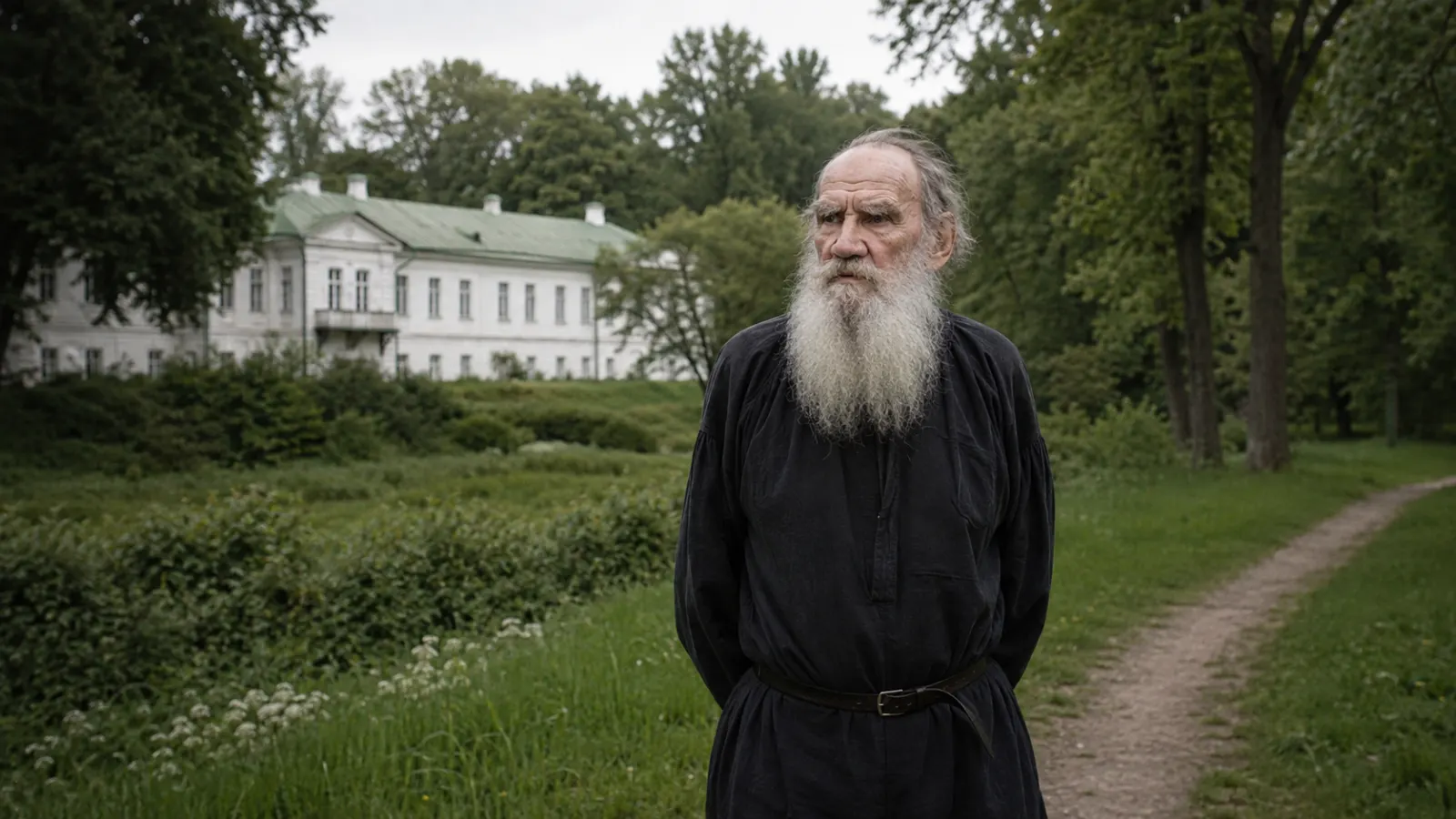
Lev Nikolayevich Tolstoy was born in 1828 at Yasnaya Polyana, his family's estate near Tula in the Russian Empire. He belonged to the aristocracy and inherited a world structured by land, status and peasant labour. His parents died while he was young, and relatives oversaw the upbringing of Tolstoy and his siblings. Yasnaya Polyana would remain central throughout his life—as home, workplace, agricultural estate, educational experiment and eventually the physical centre of his public legend.
The estate also embodied the contradiction that would later trouble him. Tolstoy's critique of hierarchy and private property emerged from inside a life materially sustained by inherited privilege. He could question the moral legitimacy of ownership while benefiting from the social order that made him a count and landowner.
He attended Kazan University but did not complete a degree. His early diaries record ambitious programmes of self-discipline alongside repeated failures to follow them. He gambled, accumulated debts and participated in the social life available to a young aristocrat while searching unsuccessfully for a stable purpose. These diaries matter because they show that the later moralist's obsession with self-examination did not suddenly begin with his religious conversion. Tolstoy had long treated his own conduct as evidence to be interrogated.
That habit of self-analysis became one of the deepest continuities between his life and fiction. He was unusually alert to the stories people tell themselves in order to justify desire, status and failure. But the ability to diagnose self-deception did not automatically free him from it.
The Caucasus and the Education of a Writer
In 1851 Tolstoy followed his older brother Nikolai to the Caucasus and entered military service. The region exposed him to imperial warfare, danger, landscapes far removed from aristocratic drawing rooms and communities living at the frontier of Russian expansion. These experiences later entered his fiction, but they also gave the young Tolstoy practical material from which to think about violence, courage and the difference between official narratives and individual experience.
His first published work, Childhood, appeared in 1852, followed later by Boyhood and Youth. These works drew heavily from personal experience without functioning as straightforward autobiography. Even at the beginning of his career, Tolstoy was transforming memory rather than merely recording it.
His military experience became more intense during the Crimean War, when he served at Sevastopol. The resulting Sevastopol Sketches brought him significant attention. Their importance lies partly in the way they undermine conventional heroic language. Tolstoy wrote about bravery, but also fear, vanity, confusion, boredom, wounded bodies and the enormous gap between patriotic rhetoric and what soldiers actually experienced.
He had not yet developed the uncompromising pacifism of his later years, but his distrust of military glory was already visible. That distrust would become central to War and Peace, where battle is rarely presented as the rational implementation of a commander's plan. Instead, events emerge through confusion, limited perception, accident and countless actions no single leader fully controls.
Europe, Education and the Question of Authority
After leaving the army, Tolstoy travelled in Europe and became interested in educational ideas while remaining suspicious of systems built on coercive authority. At Yasnaya Polyana he established a school for peasant children and experimented with relatively non-coercive approaches to teaching.
These educational experiments are sometimes treated as a side episode between his military service and major novels, but they reveal an important part of Tolstoy's intellectual development. He was already asking when instruction becomes domination and whether institutions designed to improve people can instead suppress their independence.
Tolstoy's educational ideas were not always systematic, and his practical experiments had obvious limits. Their importance lies less in whether they produced a complete educational theory than in the recurring suspicion behind them. Schools, churches, governments and armies all claimed the authority to direct human behaviour. Tolstoy increasingly asked what justified that authority.
The question would grow larger as he aged.
Marriage to Sophia Behrs: The Hidden Infrastructure of Authorship
Tolstoy married Sophia Behrs in 1862. Their marriage lasted nearly five decades and produced a large family. Any account of Tolstoy as a solitary genius working independently at Yasnaya Polyana misses the enormous amount of domestic and administrative labour surrounding his literary career.
Sophia copied manuscripts, managed household and estate responsibilities, dealt with publishers, raised children and preserved documents. War and Peace went through extensive drafting and copying, and her contribution to the practical infrastructure that allowed Tolstoy to write was substantial.
The marriage nevertheless became increasingly painful. Tolstoy's later religious and moral transformation created disputes over sexuality, property, copyright and family obligation. His diaries and earlier sexual history also affected their relationship. Sophia's own diaries are therefore essential because they provide a perspective that cannot be reconstructed from Tolstoy's writings or the accounts of his disciples alone.
Later admirers sometimes portrayed Sophia as a worldly obstacle preventing a saintly Tolstoy from achieving spiritual renunciation. That interpretation is inadequate. Tolstoy's desire to give up property and literary rights affected a family whose security depended partly on those assets. A principle that appeared morally pure to Tolstoy could produce additional administrative and financial burdens for his wife.
Their conflict was therefore not simply materialism against spirituality. It was also a conflict between competing ideas of responsibility.
War and Peace: History Without the Great-Man Illusion
Tolstoy worked on War and Peace through much of the 1860s, drawing on the Napoleonic wars and the French invasion of Russia in 1812. The work combines family history, battlefield experience, philosophical argument and historical reconstruction on a scale that resists simple genre classification.
One of its central intellectual targets is the idea that history is created primarily by extraordinary leaders. Napoleon may appear to command enormous events, but Tolstoy repeatedly undermines the assumption that issuing orders means controlling outcomes. Commands arrive late, cannot be implemented or describe events that have already changed. Soldiers see only tiny fragments of the battlefield, while later historians reconstruct events into coherent narratives that participants themselves never experienced.
This argument reflects Tolstoy's military understanding. A battlefield seen from a commander's map looks organised. A battlefield inhabited by individuals is confusion.
The philosophical passages sometimes frustrate readers interested primarily in the novel's characters, but they belong to the same project. Tolstoy is asking how human beings act with limited knowledge and then construct stories that make those actions appear inevitable afterward.
Private life operates similarly. Families, marriages and individuals create explanations for why they behave as they do, often without understanding the forces shaping their own decisions.
Anna Karenina and Divided Sympathy
Tolstoy began Anna Karenina in the 1870s. Its world is smaller than the Napoleonic landscape of War and Peace, but its psychological and social analysis is equally ambitious. The novel examines adultery, marriage, family, agriculture, status, jealousy and moral searching through characters whose perspectives refuse simple moral sorting.
Anna's relationship with Vronsky unfolds alongside the slower development of Levin and Kitty. Tolstoy gives readers access to conflicting consciousnesses with extraordinary flexibility. A character can appear persuasive from inside one perspective and self-deceiving from another.
Anna's tragedy is deeply affected by social judgment. Elite society tolerates male sexual behaviour that becomes catastrophic for a woman whose transgression threatens accepted forms of respectability. Yet Tolstoy does not reduce the tragedy to social hypocrisy alone. Jealousy, dependence, emotional isolation and psychological deterioration also matter.
Levin more obviously carries some of Tolstoy's own concerns about agriculture, family and faith, but treating him as a simple authorial spokesman is too easy. Tolstoy's fiction is powerful partly because questions can be distributed among characters rather than resolved through one official voice.
The enormous success of Anna Karenina secured Tolstoy's place among the major European novelists. It did not solve the question he increasingly considered more important: what, if anything, made life worth continuing?
The Spiritual Crisis
By the late 1870s Tolstoy possessed wealth, family, literary fame and international recognition, yet he entered a profound crisis of meaning. In A Confession, he later described confronting the apparent inevitability of death and questioning why any human activity mattered if everything ultimately disappeared.
His response was a renewed engagement with Christianity, but not a return to conventional Russian Orthodoxy. Tolstoy rejected doctrines, rituals and ecclesiastical authority that he believed obscured the ethical teaching of Jesus. He became particularly focused on the Sermon on the Mount and the command not to resist evil through violence.
The conversion therefore led outward as well as inward. Tolstoy concluded that institutional Christianity had compromised itself by accepting war, punishment, property inequality and state coercion. His religious writing became an attack on both church and government.
He condemned capital punishment, military service and organised violence, arguing that a person who genuinely followed Christ could not consistently participate in institutions based on coercion. He also attacked economic exploitation and increasingly questioned the moral legitimacy of private property.
The novelist who had spent decades examining rationalisation now tried to build an ethical system designed to make rationalisation impossible.
The Rupture With the Orthodox Church
Tolstoy's religious views eventually placed him in direct conflict with the Russian Orthodox Church. In 1901 the Holy Synod issued a formal statement declaring that he had rejected central church doctrines and placed himself outside its communion. The episode is commonly described as Tolstoy's excommunication, although the precise institutional language and Orthodox canonical context are more complicated than the popular image of a dramatic medieval anathema.
What is not ambiguous is the fundamental rupture. Tolstoy rejected core Orthodox teachings, the Church publicly declared his separation from it, and he did not return.
The confrontation increased his international visibility. Admirers saw a moral prophet confronting institutional religion, while critics regarded Tolstoy as an aristocratic writer constructing a private Christianity around his own ethical preferences.
Tolstoy did not seek to become founder of a conventional church, but communities influenced by his teachings nevertheless emerged. Tolstoyans experimented with pacifism, vegetarianism, communal living and voluntary simplicity. The irony was difficult to escape: a thinker suspicious of institutions generated an international movement organised around his ideas.
Art After the Conversion
Tolstoy's spiritual transformation also changed his theory of art. In What Is Art? he attacked much elite artistic culture as inaccessible, decadent or morally empty. The criticism was particularly startling because it came from the author of War and Peace and Anna Karenina, works firmly embedded in the European high-cultural canon.
He increasingly valued art capable of communicating sincere feeling across social boundaries, but his later fiction did not become artistically crude or simple. The Death of Ivan Ilyich, The Kreutzer Sonata, Resurrection and Hadji Murat show that Tolstoy's narrative power remained formidable.
The Death of Ivan Ilyich compresses his lifelong interest in self-deception into the experience of a respectable official confronting death and discovering that the socially approved life he constructed may have been fundamentally false. Resurrection attacks legal and social institutions through a privileged man's confrontation with his own responsibility for another person's suffering. Hadji Murat returns to the Caucasus and the world of imperial violence with remarkable restraint.
Tolstoy therefore produced another contradiction he never completely resolved. He distrusted art as prestige while continuing to demonstrate what extraordinarily sophisticated art could do.
Property, Copyright and the Limits of Renunciation
Tolstoy increasingly attempted to align his material life with his moral principles. He wanted to renounce property claims and make some of his writings more freely available. These decisions generated serious conflict within his household.
Sophia worried about the family's financial security and literary rights. Vladimir Chertkov, Tolstoy's close disciple and editor, became increasingly influential and was deeply involved in disputes over manuscripts, diaries and copyrights.
It is possible to tell this story as heroic renunciation: a wealthy aristocrat trying to abandon privilege. It is equally easy to tell it as hypocrisy: a count preaching poverty while continuing to live in circumstances made possible by wealth.
Neither version is sufficient. Tolstoy clearly understood the contradiction and suffered over it, but his attempts to renounce possessions could transfer practical consequences to other people. Moral purity is easier to proclaim individually than to implement inside a large household with dependants and legal obligations.
His marriage became the institution in which the practicality of his moral system was tested most painfully.
Nonviolence and Tolstoy's Global Influence
Tolstoy's opposition to violence travelled far beyond Russia. The Kingdom of God Is Within You argued that institutional Christianity had betrayed the teachings of Jesus by accepting state coercion, military service and war.
In 1908 he wrote A Letter to a Hindu in response to the Indian revolutionary Taraknath Das, arguing that liberation could not ultimately be achieved through violence. Mohandas K. Gandhi, then in South Africa, encountered the text and corresponded with Tolstoy between 1909 and Tolstoy's death in 1910.
Tolstoy should not be presented as the single intellectual source of Gandhian nonviolence. Gandhi drew from Indian religious and philosophical traditions, Christianity, Jain thought, political experience and numerous other influences. But Tolstoy was an important documented influence, and the South African settlement known as Tolstoy Farm reflected that intellectual connection.
The exchange demonstrates how moral ideas can change as they travel. Tolstoy's radical Christian nonresistance became one element within Gandhi's development of satyagraha rather than simply being copied unchanged.
Through such intellectual networks, Tolstoy's influence eventually extended into later traditions of organised nonviolent resistance.
Peasant Simplicity and the Risk of Idealisation
Tolstoy increasingly treated peasant life as a source of moral authenticity. He admired manual labour, simplicity and forms of faith he considered less corrupted by elite institutions. His clothing and public habits became part of the image of the later Tolstoy, reinforced by photographs of the famous count dressed simply at Yasnaya Polyana.
But idealising peasants creates its own distortion. Rural poverty was not morally beautiful to those forced to endure it, and Tolstoy remained a landowner whose social experience differed fundamentally from that of the people he admired.
His willingness to question aristocratic privilege was unusual, but critique from privilege did not erase privilege.
This is another area in which Tolstoy becomes more revealing when contradiction is preserved rather than resolved. He could see the moral emptiness of elite life without fully escaping the social system that had produced him.
Sexuality, Marriage and Moral Absolutism
Tolstoy's later sexual ethics became increasingly severe. He praised chastity and often regarded sexual desire as a threat to moral life. The Kreutzer Sonata presents an extreme treatment of jealousy, marriage and sexuality that provoked intense controversy.
These positions cannot be separated entirely from Tolstoy's biography. His earlier sexual behaviour, his marriage and conflicts over jealousy and desire gave the subject profound personal significance. His later moral absolutism can partly be understood as an attempt to solve through doctrine problems that had remained painfully unresolved in life.
Modern readers do not need to excuse troubling attitudes because Tolstoy was a major novelist, but neither is it necessary to discard the literature simply because the author's moral programme became severe. One of the most striking features of Tolstoy's fiction is that it frequently exceeds his doctrines.
His characters remain complicated precisely where his later moral essays sometimes seek absolute answers.
Leaving Yasnaya Polyana
In October 1910, at the age of eighty-two, Tolstoy left Yasnaya Polyana with his doctor. He was trying to escape escalating domestic conflict and a way of life he increasingly believed contradicted his moral principles.
Once the journey became known, it turned into an international news event. Tolstoy fell ill and was forced to stop at the railway station of Astapovo. Reporters, family members, officials and followers gathered as information about his condition travelled through newspapers and telegraph networks.
The scene contained one final Tolstoyan contradiction. A man who had rejected celebrity and sought simplicity died surrounded by the machinery of modern fame.
Tolstoy died in November 1910. He was buried at Yasnaya Polyana in a simple grave, without the monumental religious ceremony that might normally have accompanied an international literary figure of comparable stature.
The Novelist and the Prophet Were Not Separate People
The later moral critic can appear so different from the novelist that readers sometimes treat them as two separate Tolstoys. Yet the continuities are substantial.
War and Peace distrusts the belief that rulers genuinely control history. The later Tolstoy distrusts governments claiming the moral right to command violence. Anna Karenina examines how social institutions judge intimate life, while the later essays attack institutional morality. The Death of Ivan Ilyich exposes a socially respectable life organised around false values, while A Confession turns the same suspicion toward Tolstoy himself.
What changes most is the form. Fiction permits contradiction, ambiguity and competing perspectives. Moral essays seek conclusions.
Tolstoy the novelist could inhabit contradictions that Tolstoy the prophet wanted desperately to resolve.
This may explain why many readers who find some of his later moral doctrines rigid continue to find the novels inexhaustible. The fiction understands how difficult moral transformation actually is.
Frequently Asked Questions
Who was Leo Tolstoy?
Leo Tolstoy was a Russian novelist, essayist and moral thinker best known for War and Peace and Anna Karenina. In later life he also became an influential critic of organised religion, state violence, private property and social inequality.
When and where was Tolstoy born?
He was born in 1828 at Yasnaya Polyana, his family's estate near Tula in the Russian Empire.
Was Tolstoy an aristocrat?
Yes. Tolstoy was born into the Russian aristocracy and inherited land and social privilege, a background that later became a source of moral conflict for him.
Did Tolstoy serve in the military?
Yes. He served in the Caucasus and during the Crimean War, including at Sevastopol. His military experience strongly influenced his writing about war.
What are Tolstoy's most famous books?
His best-known novels are War and Peace and Anna Karenina. Major later works include The Death of Ivan Ilyich, Resurrection, Hadji Murat, A Confession, The Kingdom of God Is Within You and What Is Art?
What is War and Peace about?
Beyond its family stories and Napoleonic setting, War and Peace examines history, war, freedom and the limitations of the idea that great leaders control historical events.
What is Anna Karenina about?
The novel explores marriage, adultery, family, social judgment, desire and moral searching through the parallel experiences of Anna and Vronsky and of Levin and Kitty.
Why did Tolstoy experience a spiritual crisis?
Despite wealth, family and literary success, Tolstoy became deeply troubled by questions of death and the meaning of life. He later described this crisis in A Confession.
Was Tolstoy an Orthodox Christian?
He developed a radical interpretation of Christianity that rejected many doctrines and institutions of the Russian Orthodox Church. The Church formally declared that he had separated himself from its communion.
Was Tolstoy excommunicated?
The 1901 Holy Synod statement is commonly described as an excommunication, although the precise Orthodox institutional and canonical language is more nuanced. What is clear is that Tolstoy publicly rejected central Orthodox teachings and remained outside church communion.
Was Tolstoy a pacifist?
His later religious philosophy strongly rejected war and state violence and advocated nonresistance to evil through violence.
Did Tolstoy influence Mahatma Gandhi?
Yes. Gandhi read Tolstoy, corresponded with him and acknowledged him as an important influence, although Gandhian nonviolence developed from many intellectual, religious and political sources.
What was Tolstoy Farm?
Tolstoy Farm was a community established in South Africa connected with Gandhi's satyagraha movement and named in recognition of Tolstoy's influence.
Who was Sophia Tolstoy?
Sophia Behrs Tolstoy was Tolstoy's wife. She played a major role in managing the family and estate, copying manuscripts, dealing with publishers and preserving literary material.
Was Tolstoy's marriage happy?
The marriage lasted nearly fifty years but became increasingly conflict-ridden, particularly over sexuality, religion, property, literary rights and Tolstoy's attempts at renunciation.
Did Tolstoy reject his own novels?
His later theory of art became highly critical of elite culture and complicated his attitude toward his earlier literary achievement, but he continued to produce powerful fiction after his religious transformation.
Why did Tolstoy criticise private property?
His later Christian ethics led him to question ownership, economic inequality and the relationship between property and exploitation.
Did Tolstoy give away all his wealth?
His efforts at renunciation were complicated by family obligations, estate ownership and disputes over copyright. The reality was considerably more conflicted than the simplified legend of complete renunciation.
Why did Tolstoy leave Yasnaya Polyana?
At eighty-two, amid escalating domestic conflict and frustration over living in conditions he believed contradicted his principles, Tolstoy left the estate shortly before his death.
Where did Tolstoy die?
He became ill during his final journey and died at Astapovo railway station in November 1910.
Why is Tolstoy still important?
His fiction profoundly influenced the modern novel, while his moral and political writings influenced pacifists, religious dissenters and advocates of nonviolent resistance. His continuing importance also comes from the intensity with which he examined power, self-deception, violence and moral responsibility.
Tolstoy's Contradictions Are Part of the Achievement
A simplified biography can turn Tolstoy into either a saint or a hypocrite. Both interpretations make him less interesting. The saintly version hides the pain his moral demands could impose on his family and ignores the material privileges he never completely escaped. The cynical version assumes that inconsistency proves insincerity, overlooking how relentlessly Tolstoy confronted contradictions most people prefer not to examine.
His fiction repeatedly demonstrates that moral knowledge does not automatically produce moral action. People understand themselves incompletely, rationalise behaviour and act within institutions they only partially control. Tolstoy's own life became evidence for the same proposition.
That is why his biography and novels illuminate one another. The author who could see contradiction everywhere in human behaviour eventually attempted to construct a life without contradiction and discovered how difficult that demand was to satisfy.
The Central Idea
Tolstoy's life should not be divided too sharply between the novelist and the prophet. The moral questions of the later essays were already embedded in the imaginative world of the novels. War and Peace questions claims of historical control, Anna Karenina examines social judgment, The Death of Ivan Ilyich dismantles respectable self-deception, and A Confession applies that destructive scrutiny directly to Tolstoy's own existence.
What changed was Tolstoy's willingness to tolerate ambiguity. Fiction allowed several truths to coexist. His later moral philosophy increasingly demanded that one principle should govern behaviour completely: do not kill, do not participate in coercion, do not make wealth the basis of life and do not allow institutions to override conscience.
His attempts to live according to those principles exposed their practical difficulty. He criticised property while living on an estate, advocated renunciation while remaining responsible to a large family, challenged sexuality after a complicated personal history and rejected literary prestige after becoming internationally famous.
Those inconsistencies do not need to be erased in order to take his moral thought seriously. They are part of the historical evidence.
Tolstoy's imagination understood how people rationalise violence, desire, hierarchy and social respectability. His later moral programme attempted to strip those rationalisations away completely. The novels are often greater than the doctrine because they understand how difficult that stripping away actually is.
The enduring Tolstoy is therefore neither only the author of two monumental novels nor only the prophet of nonviolence. He is the writer who made contradiction into a method of seeing human beings—and then spent the second half of his life trying, unsuccessfully but enormously influentially, to remove contradiction from his own life.