Lao Tzu: Life, Philosophy, Tao Te Ching and the Mystery of the Old Master
Few figures in world philosophy are as famous—and as historically elusive—as Lao Tzu. His name appears in histories of Chinese philosophy, translations of the Tao Te Ching, discussions of leadership, martial-arts culture, spirituality and modern ideas such as “going with the flow.” Yet the closer historians move toward the earliest surviving evidence, the harder it becomes to identify a single, securely documented person behind the name.
Chinese tradition presents Lao Tzu as an ancient sage, an older contemporary of Confucius and the author of one of China's most influential philosophical works. Modern scholarship is much more cautious. There is no contemporary biography of Lao Tzu, no surviving archive unquestionably written by him and no early manuscript in which an identifiable author signs the work now called the Daodejing or Tao Te Ching. The Stanford Encyclopedia of Philosophy notes that some modern scholars regard Laozi as legendary, while others leave open the possibility that a historical figure lies behind at least part of the tradition.
That uncertainty is not a weakness in the story. It is one of the most important things to understand about Lao Tzu. “Laozi,” usually translated as “Old Master,” can be approached as three overlapping realities: a traditional sage remembered in later historical accounts, an authorial identity attached to an evolving philosophical text, and a figure who eventually became sacred within religious Daoism.
Understanding Lao Tzu therefore requires separating tradition, historical evidence and philosophy rather than forcing them into a single neat biography.
Who Was Lao Tzu?
“Laozi” is the modern pinyin spelling of the name commonly written Lao Tzu in older English-language works. The name is generally understood to mean “Old Master.” Unlike Confucius, whose life can be reconstructed with somewhat greater historical confidence, Lao Tzu appears through traditions compiled well after the period in which he supposedly lived.
The most influential traditional account identifies him with a man named Li Er, also called Li Dan or Lao Dan, who was said to have come from the state of Chu and worked as a keeper of archival records at the Zhou court. According to this tradition, he possessed unusual knowledge of ritual and the Way, or Dao, and was respected even by Confucius. The principal source for this portrait is Sima Qian's Records of the Grand Historian, written centuries later.
That chronological gap matters. A later source can preserve older memories, but it cannot automatically be treated like an eyewitness biography. Sima Qian himself reports competing possibilities surrounding Lao Tzu's identity, which suggests that uncertainty existed long before modern historians began questioning the traditional story.
The Traditional Life of Lao Tzu
The traditional biography is memorable precisely because it reads almost like philosophical literature. Lao Tzu supposedly served at the Zhou court for many years but eventually became disillusioned as political order deteriorated. Rather than competing for influence, he decided to leave.
According to Sima Qian's account, Lao Tzu travelled westward and reached a frontier pass controlled by an official traditionally known as Yin Xi. Recognising the sage, Yin Xi asked him to write down his teachings before disappearing from civilisation. Lao Tzu then composed a work of roughly five thousand Chinese characters concerning Dao and de before travelling onward, after which nobody knew where he went.
This became one of the most powerful stories in Chinese intellectual history: the philosopher who distrusted fame leaves society rather than founding an institution, writes only when asked and then disappears. The narrative beautifully reflects themes associated with the Tao Te Ching—humility, withdrawal from excessive ambition and influence without self-display.
But cultural power is not the same as historical proof. The story belongs to the Lao Tzu tradition; historians cannot verify that it happened as described.
Did Lao Tzu Really Live in the Sixth Century BCE?
Traditional chronology places Lao Tzu in the sixth century BCE, making him older than or roughly contemporary with Confucius, who lived from 551 to 479 BCE. This chronology was accepted for centuries and remains common in popular biographies.
Modern scholarship has complicated that picture because the philosophical material associated with the Daodejing fits strongly within the intellectual and political environment of the later Warring States period, particularly the fourth and third centuries BCE. That does not prove that every saying in the text originated that late. Older oral or written material may have been incorporated into later collections. What becomes difficult to defend is the simple picture of one sixth-century author producing the final 81-chapter book exactly as it survives today.
The most accurate answer to “When was Lao Tzu born?” is therefore that tradition places him in the sixth century BCE, but historians cannot establish his birth date or even securely reconstruct one historical life matching the later biography.
Was Lao Tzu a Real Person?
This is one of the most searched questions about Lao Tzu, but the evidence does not permit a simple yes or no.
One possibility is that a historical teacher named Lao Dan or another related figure stood behind some early teachings. Another is that memories of several individuals gradually merged into the sage known as Laozi. A third possibility is that “Laozi” functioned primarily as an authoritative master-persona under whose name a body of teachings was collected.
The Stanford Encyclopedia's revised treatment emphasises that there is no scholarly consensus on the date or authorship of the Laozi and that some scholars consider Lao Tzu entirely legendary. That does not mean ancient Chinese tradition deliberately invented a fraudulent author. Early intellectual cultures often transmitted teachings through oral traditions, lineages, collections and later editorial organisation rather than through the modern model of a single named author publishing a finished book.
The safest conclusion is therefore one of historical uncertainty rather than historical denial. We cannot confidently reconstruct Lao Tzu as an individual, but we can reconstruct significant parts of the textual and philosophical tradition associated with his name.
Did Lao Tzu Meet Confucius?
Chinese tradition famously brings Lao Tzu and Confucius together. Sima Qian says that Confucius consulted Lao Tzu about ritual, and stories involving Confucius and a figure called Lao Dan also appear in other early Chinese literature. These accounts helped establish Lao Tzu as an older and exceptionally authoritative sage.
Historians cannot verify the meeting as an event. Its literary function, however, is easy to understand. By showing Confucius—the enormously respected teacher of ritual and ethical cultivation—seeking advice from Lao Tzu, the story symbolically establishes Lao Tzu's wisdom and seniority.
Ancient philosophical biographies often work this way. A conversation between two masters can communicate how later communities understood the relationship between their ideas, even when the conversation itself cannot be independently confirmed.
Lao Tzu and Confucius Were Not Simply Opposites
Popular accounts often reduce the two thinkers to a neat contrast: Confucius represents ritual, discipline and social order, while Lao Tzu represents nature, freedom and escape from convention. There are genuine philosophical disagreements, but this simple rivalry obscures how much their traditions share.
Both emerged from an intellectual world concerned with political disorder, the decline of inherited authority, moral cultivation and the problem of creating good government. Confucian traditions generally place greater confidence in education, ritual, cultivated virtue and responsible social roles. The Laozi is more suspicious of deliberate moral display, excessive regulation and attempts to manufacture order through visible intervention.
The difference is therefore not between one philosopher who cared about society and another who wanted to escape it. Both were deeply concerned with how rulers govern, how people cultivate themselves and what produces durable social order. Their disagreement lies partly in how much deliberate human intervention that order requires.
The Tao Te Ching Is Older and More Complicated Than the Famous Legend Suggests
Tradition attributes the Tao Te Ching to Lao Tzu. In modern scholarship, the work is generally called the Daodejing, literally the “Classic of the Way and Virtue,” although the older Wade-Giles title Tao Te Ching remains much more familiar to English readers.
The received book contains 81 short chapters divided conventionally into a Dao section and a De section. If the traditional frontier-pass story were taken literally, readers might imagine Lao Tzu composing this exact work at one moment and later generations faithfully copying it unchanged.
Archaeology has made that picture much harder to sustain.
What the Guodian Manuscripts Changed
In 1993, archaeologists excavated an ancient tomb at Guodian in Hubei province. Among hundreds of inscribed bamboo slips were three groups containing material closely corresponding to passages later found in the Daodejing. The tomb is usually dated to around 300 BCE, making these among the earliest surviving physical witnesses to Laozi-related material.
The Guodian materials contain only a portion of the text familiar today and arrange passages differently. Scholars disagree about precisely how to interpret them. They may represent an earlier form of the Laozi, collections from which the later work developed, or related textual material circulating before a standard version had formed.
What they clearly demonstrate is that Laozi-related teachings existed in written form during the Warring States period and that the textual tradition was not identical to the later received book. The manuscripts therefore shifted scholarship away from a simple one-author, one-edition model toward questions of collection, transmission and editorial development.
What the Mawangdui Manuscripts Revealed
An equally important discovery had occurred two decades earlier. In 1973, archaeologists excavating a tomb at Mawangdui in Hunan found two Laozi manuscripts written on silk. The tomb was sealed in 168 BCE, and the manuscripts are consequently much earlier than the medieval editions through which the work had traditionally been transmitted.
The Mawangdui texts contain essentially the full material known from the received Laozi, but they preserve differences in wording and organisation. Most famously, material associated with De comes before Dao, the reverse of the familiar ordering suggested by the later title Daodejing.
This does not mean the familiar text is “wrong.” It means the work has a textual history. Different arrangements, copying traditions and interpretive decisions existed before later forms became dominant.
Did Lao Tzu Write the Tao Te Ching?
Chinese tradition answers yes. Historical scholarship has to answer more cautiously.
The surviving manuscripts show that sayings associated with Laozi circulated in different combinations and arrangements. One possible model is that an older core of material gradually expanded. Another is that related collections from several teaching traditions were eventually combined. Oral traditions may also have preceded the surviving written forms.
Recent scholarship continues to study Guodian, Mawangdui and other manuscript evidence as different witnesses to the formation of the Laozi rather than assuming a single unchanged original.
None of this proves that a historical Lao Tzu contributed nothing to the text. It does mean that the statement “Lao Tzu wrote all 81 chapters exactly as we have them today” goes beyond what the evidence can establish.
Why Are There 81 Chapters?
The familiar Daodejing consists of 81 chapters, with chapters 1–37 conventionally forming the Daojing and chapters 38–81 the Dejing. But that exact arrangement appears to be part of the text's development rather than something historians can confidently trace back to one original author.
Early manuscripts show signs that portions of the material were divided into sections, so textual organisation itself is ancient. However, the Stanford Encyclopedia notes that the now-standard 81-chapter structure is likely later than some of the earliest textual stages.
This matters for interpretation. The modern reader encounters a carefully structured classic; ancient readers may have encountered somewhat different arrangements of overlapping material.
What Did Lao Tzu Actually Teach?
The Tao Te Ching is remarkably short considering the scale of its influence. It does not present philosophy through long arguments or detailed biographies. Instead, it works through compressed observations, images, contradictions and reversals.
Again and again, the text questions assumptions that appear obvious. More control does not necessarily create better government. Greater force does not necessarily create greater power. Accumulating more wealth does not guarantee satisfaction. Being visibly dominant does not necessarily make a ruler secure. Sometimes softness outlasts hardness, emptiness makes usefulness possible and deliberate striving destroys the result it was intended to produce.
Four concepts are particularly important for understanding the philosophy associated with Lao Tzu: Dao, de, wuwei and ziran.
What Is the Dao?
Dao is usually translated as “the Way.” The word could refer in early Chinese thought to a path, method, course, way of acting or way of governing. In the Daodejing, however, it takes on an unusually broad philosophical role.
The Dao is associated with the underlying process or order through which the multiplicity of the world emerges. It is not described straightforwardly as a personal creator god, nor can it be possessed by a ruler or philosopher who claims to have captured it completely in words.
The famous opening of the Daodejing immediately warns that a Dao which can be completely articulated is not the constant Dao. The point is not simply that language is useless. Rather, the text repeatedly questions whether naming and conceptualising reality gives human beings the degree of control they imagine.
That tension gives Lao Tzu's philosophy much of its distinctive character: the book uses language to teach readers about the limits of language.
What Is De?
The second major term in the title is de. It is frequently translated as “virtue,” but that translation can be misleading if virtue is understood only as moral goodness.
Depending on context, de can also suggest power, efficacy, potency, integrity or the distinctive way in which Dao becomes expressed through a person or thing. This is why English translations of Daodejing can look so different even at the level of the title: “The Classic of the Way and Virtue,” “The Way and Its Power” and other formulations each highlight different aspects of the Chinese terms.
These differences reveal an important fact about reading Lao Tzu. Translation is not simply replacing each Chinese word with one English equivalent. Every choice carries an interpretation.
Wuwei Does Not Mean “Do Nothing”
Perhaps no Lao Tzu concept has been simplified more than wuwei. It is commonly translated as “non-action,” which can sound as if Lao Tzu recommended passivity, laziness or withdrawal from every responsibility.
That is not a satisfactory reading. Wuwei is better understood as action without unnecessary forcing, coercion or artificial contrivance. The Stanford Encyclopedia notes translations such as non-assertive action, non-coercive action and effortless action because the concept concerns the quality of action, not the total absence of action.
A ruler practising wuwei does not literally refuse to govern. Rather, the ruler avoids constantly disrupting society simply to demonstrate authority. Likewise, an individual does not become inert. Action becomes less distorted by compulsive striving, ego and the desire to control every outcome.
The ideal is not inactivity. It is effectiveness without unnecessary force.
Why Water Matters So Much in Lao Tzu's Philosophy
Water is one of the Tao Te Ching's most memorable images because it expresses several of the text's paradoxes at once. Water appears soft and yielding, yet it can wear away what is hard. It seeks low places rather than competing for the highest position. It adapts to obstacles instead of confronting every obstacle directly.
The point is not merely to turn Lao Tzu into the author of a motivational slogan telling readers to “be like water.” The image is connected with a deeper theory of power. What looks weak may possess extraordinary resilience; what loudly displays strength may actually be unstable.
Applied politically, the image challenges rulers who confuse domination with effectiveness. Applied personally, it challenges the belief that every difficulty must be overcome through greater force.
What Is Ziran?
Ziran is commonly translated as “naturalness” or “spontaneity,” but neither English term captures it completely. Literally, it carries the sense of being “so of itself.”
In Laozi philosophy, ziran describes a way of being in which people and communities are less distorted by artificial pressure, status competition and excessive interference. It is closely related to wuwei: when unnecessary forcing diminishes, things have greater scope to develop according to their own character.
This is not identical to the modern idea of abandoning civilisation and returning to untouched wilderness. Lao Tzu's “naturalness” also concerns political and social life. The question is whether human systems can function without constantly deforming behaviour through manufactured desire, coercion and display.
Why Lao Tzu Values Simplicity
The Tao Te Ching is consistently suspicious of excess. It questions excessive wealth, ambition, weapons, regulation, competition, status and desire—not because every material possession or social institution is inherently evil, but because accumulation can become self-defeating.
A society that continually creates prestigious objects for people to compete over may generate envy and theft, then respond to the resulting disorder with more punishment. A ruler who constantly demonstrates power may generate resistance and insecurity, then respond by displaying still more power.
Lao Tzu repeatedly reverses conventional political logic. The institutions intended to produce order can sometimes produce the disorder they claim to solve.
Simplicity therefore functions as a critique of manufactured complexity and compulsive striving, not merely as an aesthetic preference for owning fewer things.
Lao Tzu's Philosophy Is More Political Than Modern Self-Help Versions Suggest
Modern adaptations often portray Lao Tzu primarily as a teacher of inner peace. Personal cultivation is certainly important, but much of the Daodejing addresses rulers, government, warfare, punishment, taxation and social order.
The text is deeply interested in leadership. Its ideal ruler does not need to advertise authority constantly. Excessive interference can weaken social order, while humility and restraint can make leadership more effective.
This political dimension matters because removing it fundamentally changes the work. “Go with the flow” captures only a small fragment of a philosophy that repeatedly asks how states should govern and why governments become destructive when they pursue control too aggressively.
What Did Lao Tzu Think About War?
The Tao Te Ching displays profound suspicion toward military glory. Weapons are treated as unfortunate instruments rather than symbols of greatness, and victory does not erase the human suffering through which victory is achieved.
These ideas make sense within the broader environment of ancient China, especially a world increasingly shaped by conflict among competing states, military expansion and political centralisation. The Laozi challenges the assumption that territorial expansion and overwhelming military force demonstrate successful government.
Calling Lao Tzu a modern pacifist would nevertheless be too simple. The text recognises that conflict may occur and often addresses rulers who possess political power. Its stronger argument is against aggression, militarism, triumphalism and unnecessary coercion.
The Strange Ideal of a Small State
One of the most striking sections of the Daodejing imagines a small state with few people. Its inhabitants possess tools without becoming obsessed with exploiting them, live close to neighbouring communities and value ordinary life rather than constant expansion.
Taken literally, this can look like an anti-technological utopia. It may instead function partly as a rhetorical counter-image to the expanding states, bureaucracies and armies of ancient China.
The passage asks readers to question an assumption that remains familiar today: must political greatness always mean greater scale, greater movement, greater accumulation and greater control?
The Laozi provides no detailed constitution for such a society. The image works more powerfully as a challenge to the ideology of endless expansion.
Lao Tzu Was Not Simply Saying “Go With the Flow”
Few modern phrases have distorted wuwei more effectively than “go with the flow.” Flexibility is certainly part of the tradition, but Lao Tzu's philosophical challenge is more demanding.
The real question is: when does deliberate effort become counterproductive? A manager who controls every decision may weaken an organisation. A ruler trying to eliminate every uncertainty may create greater instability. A person obsessed with appearing successful may become controlled by the very status competition they hoped to master.
Wuwei therefore does not ask people to accept every injustice or abandon purposeful action. It asks whether an action is appropriately responsive to circumstances or driven by a compulsion to dominate them.
The Tao Te Ching Is Difficult to Translate
The global Lao Tzu readers encounter is overwhelmingly a translated Lao Tzu. That creates a major interpretive problem because Classical Chinese is compact and often leaves subjects, grammatical relationships and implications unstated in ways that English normally cannot.
Terms such as dao, de, wuwei and ziran have no single perfect English equivalents. A translator who chooses “virtue” for de leads the reader in one direction; a translator who chooses “power” or “integrity” leads in another. Neither decision is neutral.
The difficulty is increased by textual variation. Translators are not dealing merely with a distant language but with a work that itself circulated in different manuscript forms. The Chinese Text Project provides access to the received Chinese text and historical translation resources, making these differences easier for readers to examine.
Responsible reading therefore benefits from comparing more than one translation rather than assuming that the smoothest modern English version reproduces exactly what an ancient author “really said.”
Why Modern Versions Sometimes Turn Lao Tzu Into Therapy
The Tao Te Ching adapts unusually easily to modern therapeutic and motivational language. Its chapters are short, its imagery is memorable and its teachings about simplicity, desire and non-forcing resonate with contemporary concerns about stress and overwork.
But adaptation can quietly rewrite the philosophy. Dao becomes “the universe.” Wuwei becomes “relax.” Ziran becomes “just be yourself.” Political criticism becomes leadership advice for corporate executives.
Modern application is not necessarily illegitimate; important philosophical works survive partly because new generations find new uses for them. The problem begins when a modern interpretation is presented as though it were a transparent translation of ancient Chinese thought.
Historically, the Laozi is not merely a wellness book. It is also a difficult reflection on politics, language, social order, desire and power.
Lao Tzu and the Development of Daoism
Lao Tzu is commonly called the founder of Taoism or Daoism, but that description requires qualification. Daoism did not appear fully formed as one unified philosophical and religious system founded by a single individual at one moment.
The Laozi became foundational to what modern scholarship often calls philosophical Daoism, alongside works such as the Zhuangzi. Centuries later, organised religious Daoist traditions developed institutions, priesthoods, ritual systems, scriptures and complex cosmologies of their own.
The Stanford Encyclopedia stresses that the term Daoism covers a highly diverse intellectual and religious tradition rather than one homogeneous “ism.”
Lao Tzu became central to both sides of that history, but his role changed dramatically over time.
From Philosopher to Divine Lord Lao
By the early centuries CE, Laozi was no longer understood only as an ancient philosopher. Within developing religious Daoist traditions, he could be revered as Lord Lao, a divine manifestation or personification associated with the Dao itself.
The emergence of the Way of the Celestial Masters in the second century CE was especially important. In this religious setting, Laozi gained a hagiographic and revelatory role far beyond the uncertain historical sage described by Sima Qian.
Later Daoism developed sophisticated rituals, meditation systems, sacred texts, communal institutions and cosmologies. Describing this simply as the “corruption” of an originally pure philosophy would therefore distort Chinese religious history.
The transformation instead shows how philosophical authority can become incorporated into sacred history.
Was Lao Tzu Worshipped as a God?
In later religious Daoist traditions, yes. But this should not be projected backwards automatically onto the earliest Laozi material.
The traditional human sage and the later divine Laozi belong to different stages of the tradition. Over time, the Old Master could be presented not simply as someone who understood the Dao but as a cosmic and sacred manifestation connected with it.
This explains why later Chinese art sometimes depicts Lao Tzu as an immortal or supernatural sage. Such images are historically valuable evidence for how later communities imagined Lao Tzu, not documentary portraits of what an ancient philosopher looked like.
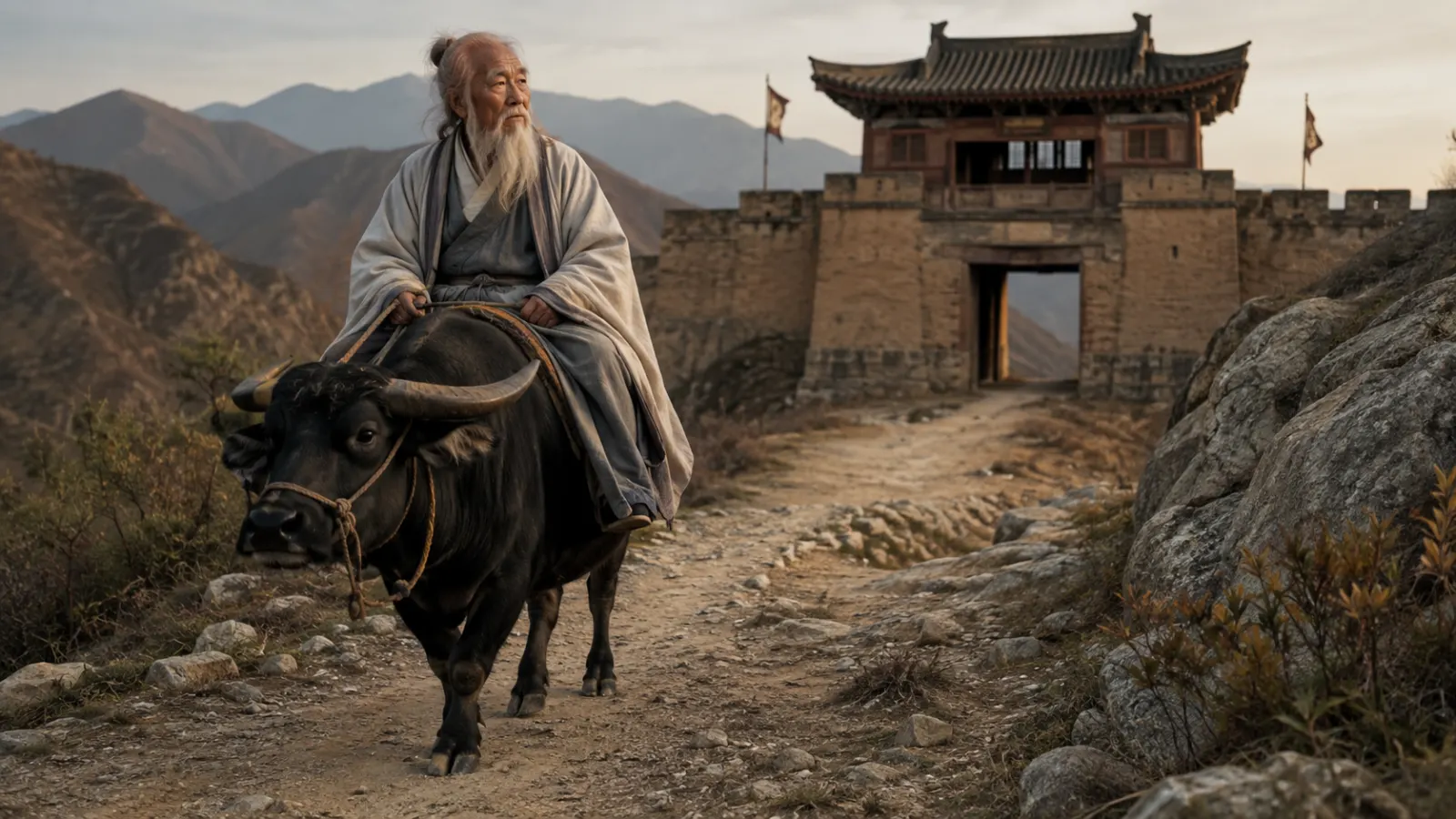
Why Is Lao Tzu Often Shown Riding an Ox?
One of the most recognisable visual traditions depicts an elderly Lao Tzu travelling westward on an ox, usually associated with his legendary departure from Zhou territory.
The image condenses several themes into one scene: withdrawal from political decline, humility, travel toward the frontier and departure from conventional society. Over centuries it became part of the visual identity of the Old Master.
No contemporary portrait of Lao Tzu is known. A later painting, bronze or sculpture may be an authentic historical artwork while still being a much later interpretation of Lao Tzu rather than a likeness of him.
This distinction is particularly important when discussing archaeological or museum objects. Authenticity of the artwork does not equal authenticity as portraiture.
How Commentators Changed Lao Tzu
The text did not simply survive; it was continually interpreted. Two of the most influential traditions are associated with the Heshang Gong commentary and the philosopher Wang Bi, who lived from 226 to 249 CE.
Wang Bi's interpretation strongly influenced later philosophical readings of the Daodejing, particularly discussions of Dao, being, non-being and nonaction. Other commentarial traditions placed stronger emphasis on self-cultivation, longevity, religion or political administration. Over the centuries, emperors, religious specialists, philosophers and scholars all produced or sponsored interpretations of the work.
There was therefore never only one “Lao Tzu” after antiquity. Each historical period inherited the text and asked different questions of it.
That flexibility helps explain its longevity.
What the Manuscripts Really Changed
The Guodian and Mawangdui discoveries did not suddenly solve the mystery of Lao Tzu. In some respects, they made the mystery more sophisticated.
Before these discoveries, debates about authorship could rely heavily on later transmitted editions and traditional historical narratives. Archaeology supplied physical evidence that early Laozi material existed in different arrangements and stages.
The Guodian slips contain only part of the received material and may preserve textual building blocks or an earlier stage of collection. Mawangdui presents a much fuller form but differs from later received editions, including in the ordering of the Dao and De sections.
This supports a historically cautious model in which the Daodejing emerged through transmission, collection, editing and stabilisation, even though the precise process remains debated.
The Manuscripts Do Not Prove Lao Tzu Never Existed
This distinction is essential.
Archaeology shows that the text had a developmental history. It does not show that no teacher, sage or historical individual contributed to the tradition.
Likewise, the existence of later legends does not prove every part of the traditional biography is false. Historical evidence often permits probabilities rather than absolute answers.
The responsible position is therefore neither “everything in the legend happened exactly as described” nor “Lao Tzu was definitely invented.”
It is: the historical individual cannot presently be reconstructed with confidence, while the textual tradition can be studied in increasing detail.
Why Lao Tzu Still Matters
Lao Tzu's importance does not depend on recovering a birth certificate.
The Daodejing became one of the foundational works of Chinese intellectual history and influenced philosophy, political thought, religion, poetry, visual art and later interpretations far beyond China. Its reception across centuries has produced radically different Lao Tzus: political thinker, mystic, religious deity, metaphysician, critic of civilisation, environmental inspiration and modern leadership teacher.
The continuing appeal lies partly in the questions the text asks. When does control become counterproductive? Can apparent weakness be more resilient than force? Can a leader become more effective by intervening less? Does endless status competition manufacture desires that cannot be satisfied? Can language capture everything that matters?
These questions survived because they concern recurring problems in human life rather than one ancient political crisis alone.
Common Myths About Lao Tzu
Lao Tzu definitely lived in the sixth century BCE. That is the traditional chronology, not an established historical fact. Modern scholarship remains divided about his historical identity and the date of the textual materials attributed to him.
Lao Tzu wrote the entire Tao Te Ching at a frontier gate. This is the famous traditional narrative, but early manuscripts show a more complex textual history involving different arrangements and collections.
Wuwei means doing nothing. It is better understood as action that avoids unnecessary forcing, coercion and contrivance rather than complete inactivity.
Dao simply means nature. The Dao has a much broader philosophical meaning involving way, process, order and the generative character of reality.
Lao Tzu and Confucius were simply enemies. Their traditions differ substantially, but both grapple with good government, personal cultivation and social order.
The Tao Te Ching is basically a self-help book. Modern readers can apply it personally, but the text also contains extensive political reflection about rulers, war, punishment, desire and government.
Ancient-looking pictures of Lao Tzu show what he really looked like. No securely contemporary portrait exists. Later representations belong to the history of Lao Tzu's cultural and religious reception.
Frequently Asked Questions About Lao Tzu
Who was Lao Tzu?
Lao Tzu, or Laozi, is the traditional Chinese sage associated with the Tao Te Ching and the development of Daoist philosophy. Traditional sources identify him as an ancient Zhou archivist, but modern historians cannot securely establish a single biography corresponding to the later legend.
What does Lao Tzu mean?
“Laozi” is generally translated as “Old Master.” Lao Tzu is the older Wade-Giles romanisation, while Laozi is the modern pinyin spelling.
When did Lao Tzu live?
Traditional accounts place him in the sixth century BCE and make him an older contemporary of Confucius. Modern scholars often associate significant stages of the Laozi textual tradition with the later Warring States period, and Lao Tzu's exact dates remain unknown.
Is Laozi the same person as Lao Tzu?
Yes. The two forms represent different systems for romanising Chinese.
Is the Tao Te Ching the same as the Daodejing?
Yes. Tao Te Ching is the older English romanisation, while Daodejing follows modern pinyin.
Did Lao Tzu write the Tao Te Ching?
Traditional Chinese history attributes it to him. Modern scholarship cannot securely identify one author, while manuscript discoveries show that Laozi material circulated in different forms before the received 81-chapter text became standard.
What are Lao Tzu's main ideas?
The central concepts associated with the Laozi include Dao, de, wuwei, ziran, simplicity, humility, non-coercive action, scepticism toward excessive desire and suspicion of political power that depends on constant force.
What does wuwei mean?
Wuwei is conventionally translated “non-action,” but it does not mean refusing to act. It refers more closely to action without excessive forcing, artificial intervention or ego-driven coercion.
Did Confucius meet Lao Tzu?
Traditional accounts say that Confucius consulted Lao Tzu about ritual. Historians cannot verify the encounter, so it is best treated as an influential philosophical and biographical tradition rather than securely established history.
Was Lao Tzu the founder of Taoism?
He became the foundational sage associated with Daoist philosophy and later an important sacred figure in religious Daoism. Daoism itself, however, developed through many texts, teachers, communities and institutions over centuries rather than being founded in one moment by one person.
Was Lao Tzu a god?
The earliest philosophical tradition does not require that interpretation. In later religious Daoism, however, Laozi became divinised and could be worshipped as Lord Lao or understood as a manifestation connected with the Dao.
What are the Guodian manuscripts?
They are bamboo manuscripts excavated in Hubei in 1993 containing early material corresponding to sections of the later Daodejing. They date to around 300 BCE and are among the most important physical witnesses to the early Laozi textual tradition.
What are the Mawangdui manuscripts?
They are two ancient Laozi manuscripts written on silk and excavated in Hunan in 1973. They preserve most or all of the material known from the later work but contain textual and organisational differences, including placing the De section before the Dao section.
Why is Lao Tzu still influential?
Because the Laozi asks enduring questions about leadership, desire, force, language, humility and the limits of control. These themes have allowed the text to be reinterpreted repeatedly across philosophy, religion, politics and modern culture.
Lao Tzu's Life Is Uncertain. His Legacy Is Not.
Modern biography usually asks for dates, education, career, relationships and documented events. Lao Tzu resists that form. The traditional story gives us an old sage working at the Zhou court, advising or impressing Confucius, leaving a declining political order and writing approximately five thousand characters before disappearing into the West. It is one of the great philosophical biographies of world culture, but it cannot simply be treated as a documentary record.
The surviving evidence gives us something more complicated and, in many ways, more interesting. Guodian reveals early collections of Laozi-related material. Mawangdui preserves fuller but differently arranged versions. Later editors and commentators helped stabilise and reinterpret the text. Religious communities eventually transformed the Old Master into a divine figure. The person, text and tradition are connected, but they are not identical.
That historical uncertainty does not reduce Lao Tzu's importance. It changes where that importance should be located. We may never know whether one Zhou archivist wrote the words eventually organised into the Tao Te Ching. We do know that a body of ideas associated with the Old Master became one of the most durable challenges to humanity's instinct for domination, accumulation and certainty.
The Laozi asks whether strength always needs to appear strong, whether leadership always requires visible control, whether social order can be damaged by attempts to perfect it and whether language can ever capture reality completely. Its recurring answer is deliberately paradoxical: what appears weak may endure, what appears empty may be useful, and what refuses to dominate may sometimes exercise the deepest influence.
That is why Lao Tzu remains difficult to reduce to either biography or slogan. The man is uncertain. The legend is powerful. The text evolved. The philosophy remains alive.