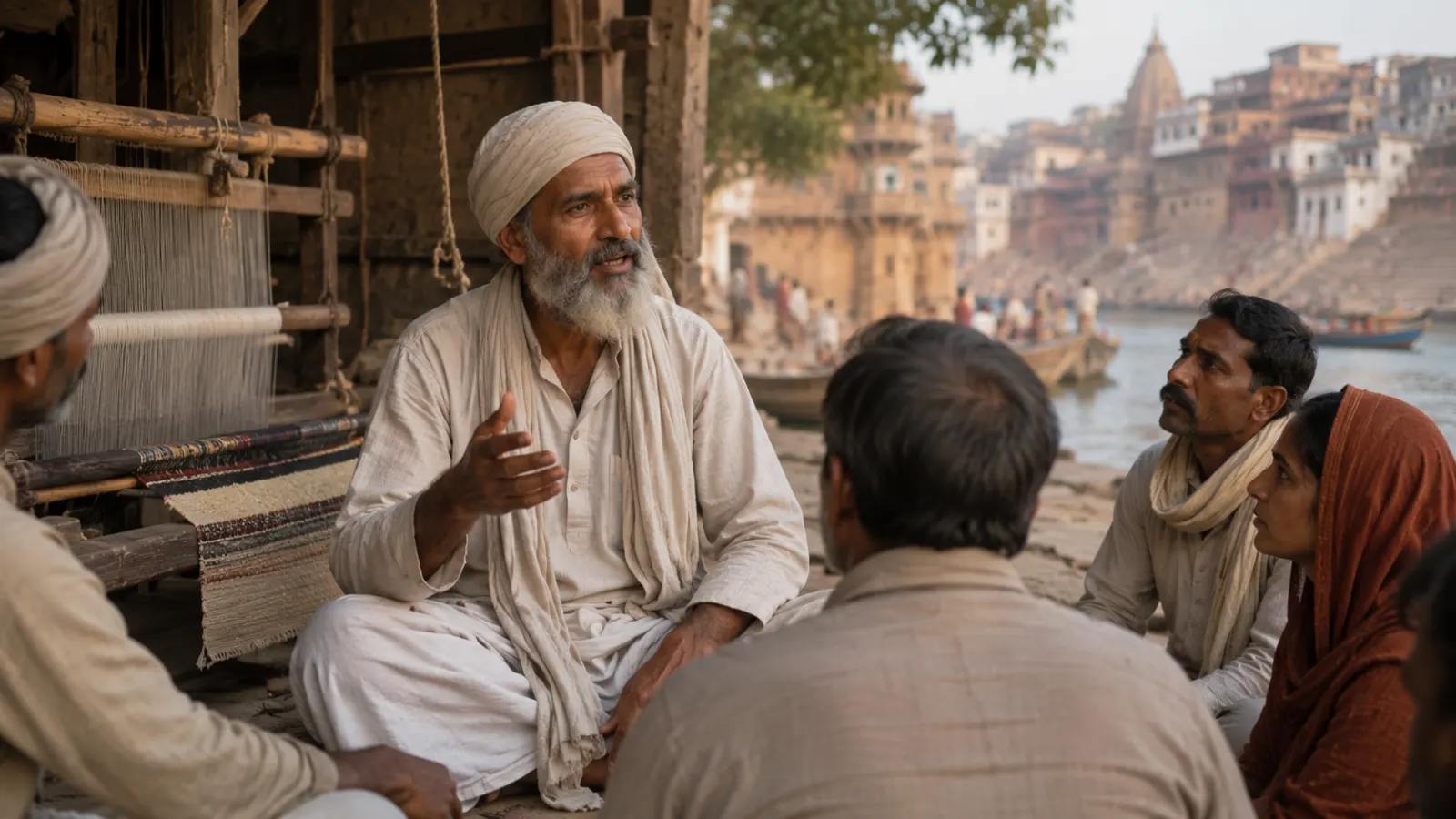
Kabir: Life, Poetry and the Voice That Challenged Religious Boundaries
Kabir is remembered with remarkable confidence for a poet whose biography remains remarkably uncertain.
Schoolbooks assign him dates. Religious traditions describe his parents, teacher, journeys, disputes and death. Thousands of verses circulate under his name. A Kabir couplet can still appear in a classroom, political speech, devotional song or social-media post to criticise hypocrisy, caste pride, empty ritual or excessive attachment to status.
Yet when historians move back towards the fifteenth century, many of the familiar details become difficult to verify.
That uncertainty is not a weakness in Kabir's history.
It is one of the most important facts about him.
Kabir was not a ruler whose reign produced inscriptions and administrative archives. He was not a court poet whose manuscripts were preserved in a royal library. The Kabir known today emerged through poetry transmitted orally, sung traditions, manuscript collections, religious communities and later biographies.
Different communities preserved somewhat different Kabirs.
The Bijak became especially important within the Kabir Panth. Other north Indian manuscript traditions preserved overlapping material. Compositions attributed to Kabir entered the Guru Granth Sahib and became part of Sikh scripture.
The result is unusual.
Kabir is both a historical poet and a cultural tradition that continued developing long after the poet himself was gone.
That makes his biography difficult.
It also helps explain why his voice survived.
Kabir at a glance
| Period | Probably fifteenth century |
| Region | North India, strongly associated with Banaras |
| Traditional occupation | Weaver |
| Religious/literary context | North Indian devotional traditions, often associated with nirguna bhakti |
| Major themes | Divine reality, hypocrisy, ritual, caste pride, ego, direct spiritual experience |
| Language | North Indian vernacular poetic idioms rather than elite Sanskrit or Persian |
| Important textual traditions | Bijak, Kabir Granthavali traditions, Guru Granth Sahib |
| Later community | Kabir Panth |
| Historical difficulty | Exact dates, birth narrative, Ramananda relationship and many life episodes remain uncertain |
| Legacy | Poetry, music, devotional traditions, anti-caste thought and religious criticism across communities |
The first problem in writing Kabir's biography: we know less than tradition suggests
Kabir is often assigned the dates 1398–1518.
They appear in textbooks and popular biographies so frequently that they can look like ordinary historical facts.
They are not that secure.
Scholars have proposed different chronologies, and modern historical treatments often place Kabir broadly in the fifteenth century rather than claiming certainty about a precise 120-year lifespan.
The problem begins with the sources.
Detailed narratives of Kabir's life were recorded and elaborated after his lifetime. Sectarian traditions preserved memories that served devotional purposes as well as biographical ones. Oral tradition continued to reshape stories and verses.
Kabir's poetry itself provides clues about his religious and social world, but it does not give historians anything resembling a modern autobiography.
This distinction matters throughout the article.
There are really two Kabirs that continually overlap:
the historical poet whom scholarship attempts to reconstruct;
and
the remembered saint whose life was narrated by later communities.
Both matter.
But they are not the same kind of evidence.
Was Kabir born into a family of Muslim weavers?
One of the most familiar traditions says that Kabir was raised by a Muslim weaving couple commonly remembered as Niru and Nima near Banaras.
Some narratives describe him as an abandoned infant discovered and adopted by them. Other traditions give more miraculous versions of his origins.
The detailed birth stories cannot be established as contemporary history.
The association with the world of weaving, however, is much more deeply rooted in Kabir's historical memory.
Modern scholarship commonly connects Kabir with a community of weavers in or around Banaras. Even his Arabic name, Kabir, places him naturally within an Islamicate linguistic environment.
This social background matters because weaving was not merely biographical colour.
The world of craft appears repeatedly in Kabir-associated poetry.
Threads, cloth, bodies, vessels, marketplaces, tools and ordinary labour become material for spiritual arguments.
Kabir's language often brings metaphysical questions into the world of everyday work.
That helps explain why his poetry could travel beyond elite scholarly circles.
Banaras: the religious city behind Kabir's voice
Kabir is strongly associated with Banaras, now Varanasi.
The city was already one of South Asia's most important centres of pilgrimage, Sanskrit learning and religious activity. It was also a living urban economy inhabited by artisans, traders, religious specialists, ascetics and communities connected to multiple devotional traditions.
This environment matters because Kabir's vocabulary does not belong neatly to one sealed intellectual world.
The poetry attributed to him can invoke:
Ram;
Hari;
Allah;
Khuda;
Sahib;
the divine Name;
yogic imagery;
rebirth;
maya;
the body;
and ideas circulating through devotional, Nath, Vaishnava and Islamicate environments.
That does not mean Kabir assembled a simple mixture of Hinduism and Islam.
The historical world was more complicated than that.
Ideas, words, songs and people crossed social boundaries even while communities disagreed strongly about doctrine, ritual and authority.
Kabir's poetry emerged from that connected but contested environment.
Was Ramananda really Kabir's Guru?
Perhaps no single biographical story is more famous.
Kabir, according to later tradition, wanted initiation from the Vaishnava teacher Ramananda but could not approach him normally because of social barriers.
Kabir therefore lay on the steps where Ramananda would descend to bathe before dawn.
Ramananda accidentally stepped on him and uttered the divine name.
Kabir then accepted the utterance as his initiation.
It is an extraordinarily effective story.
In a single episode it communicates several themes later associated with Kabir:
the rejection of caste barriers;
the superiority of genuine spiritual calling over formal status;
the centrality of the divine Name;
and the idea that religious authority can appear outside recognised institutional channels.
Historically, however, the relationship is difficult to establish with certainty.
Even Ramananda's own chronology has been debated by scholars. The famous initiation story belongs primarily to hagiographical tradition rather than independently documented fifteenth-century biography.
The correct historical response is therefore not to dismiss the story as meaningless.
It is to ask a different question:
Why did later communities consider this the right story to tell about Kabir?
The answer reveals how they understood his authority.
Kabir and nirguna devotion
Kabir is commonly associated with the nirguna tradition of north Indian bhakti.
Nirguna literally suggests the divine without limiting qualities or attributes and is often contrasted with saguna devotion directed towards the divine in manifest form.
The distinction is useful.
Kabir's language, however, does not always behave as neatly as textbook categories imply.
He frequently uses the name Ram.
But the Ram invoked in Kabir-associated poetry cannot automatically be reduced to the royal hero of the Ramayana.
Ram can function as the Name of the ultimate divine reality—a reality not monopolised by temple, image, pilgrimage centre or social community.
The divine is described as near and yet overlooked.
Present within existence and yet sought in distant places.
Intimate and impossible to possess.
This produces one of Kabir's most characteristic reversals:
people travel enormous distances searching for what is already present closer than they realise.
Kabir's real target was religious pretence
Kabir is often described as a critic of both Hindu and Muslim ritual.
That is broadly correct.
But the deeper target is not simply ritual itself.
It is the substitution of religious performance for spiritual transformation.
The poetry attacks outward marks of holiness when they become sources of pride.
Pilgrimage can be mocked when the traveller returns morally unchanged.
Scriptural learning can be criticised when scholarship produces arrogance instead of wisdom.
Religious specialists can become targets when institutional status disguises greed or ignorance.
Muslim forms of religious observance are also criticised when public piety is disconnected from inner truth.
The targets differ.
The underlying accusation remains consistent.
A person can possess the correct label, perform the correct ritual and display the correct religious identity while remaining spiritually unchanged.
This is why Kabir should not be reduced to the modern slogan:
“All religions are the same.”
His poetry is much more confrontational.
Kabir does not simply reassure every community that it is already correct.
He questions what each community thinks gives it authority.
Kabir was not a polite interfaith diplomat
Modern public culture frequently turns Kabir into a saint of religious harmony.
There is an understandable reason.
His remembered background, vocabulary and reception cross boundaries commonly associated with Hindu and Muslim traditions.
But his religious language is not usually diplomatic.
Kabir can mock.
Accuse.
Provoke.
Reverse sacred hierarchies.
Ridicule learned pretension.
Expose ritual contradiction.
His universalism, when the term is useful, comes not from saying that all doctrines are interchangeable.
It comes from insisting that ultimate reality cannot be owned by inherited religious identity.
That is a much sharper claim.
Why the doha became Kabir's most portable form
For many modern readers, Kabir means the doha—a compact two-line verse capable of compressing a large moral or spiritual argument into something memorable.
The form was ideal for circulation.
A theological treatise needs a manuscript.
A couplet can be remembered.
Repeated.
Sung.
Quoted.
Adapted.
Taught to children.
Used in conversation.
This portability became one of the foundations of Kabir's extraordinary afterlife.
The best-known Kabir sayings often attack predictable human weaknesses:
pride in learning;
religious hypocrisy;
obsession with status;
social superiority;
false renunciation;
and the tendency to search externally for what must be confronted internally.
But the popularity of Kabir's couplets creates an editorial problem.
Not every “Kabir doha” on the internet is securely Kabir's
Thousands of verses are now attributed to Kabir.
That does not mean historians can demonstrate that every one originated with the fifteenth-century poet.
This is not unusual for a poet transmitted for centuries through oral performance and manuscript culture.
Lines change.
Regional vocabulary enters.
Verses migrate.
Performers adapt language.
Memorable sayings become attached to famous names.
Modern Hindi editions may regularise older forms.
And the internet has accelerated attribution dramatically.
Once fifty websites copy the same “Kabir quote,” repetition begins to resemble evidence even when all fifty copied from one another.
Linda Hess's work on Kabir's oral traditions emphasises precisely this fluidity: poems and phrases can move through performers, regions and media, producing recognisably different textual and cultural “Kabirs.”
Editors therefore need a basic rule:
The fame of an attribution is not proof of its antiquity.
For major quotations, the textual source matters.
The Bijak is essential—but it is not a notebook written by Kabir
One of the most important collections associated with Kabir is the Bijak.
It became the sacred textual authority of major Kabir Panth traditions and contains several poetic forms, especially materials conventionally grouped as Ramaini, Shabda and Sakhi.
Linda Hess and Shukdeo Singh's major study of the Bijak describes it as the sacred book of the Kabir Panth and emphasises the distinctive force of its rough, direct and confrontational poetic voice.
But the Bijak should not be described casually as:
“the book Kabir wrote.”
The surviving textual tradition developed through transmission after the poet's lifetime.
That distinction completely changes how we think about authorship.
A modern author normally produces a manuscript, authorised edition or identifiable text.
Kabir belonged to a world in which poetry could circulate through performance, memory, discipleship and handwritten transmission before becoming standardised in print.
We therefore possess Kabir traditions, not one untouched authorial manuscript.
There is more than one major Kabir textual tradition
The Bijak is not the only important route through which Kabir survived.
Different regional manuscript traditions preserved additional bodies of verse.
The Kabir Granthavali tradition became influential in Hindi literary study.
And perhaps most importantly for the wider religious history of South Asia, compositions attributed to Kabir were incorporated into the Guru Granth Sahib.
These collections overlap.
They are not identical.
That is not merely an inconvenience.
It is evidence.
The variation shows how widely Kabir circulated and how different communities selected, preserved and understood his voice.
Instead of asking:
“Which modern book contains everything the historical Kabir wrote?”
a better question is:
“How did different communities recognise and transmit poetry as Kabir's?”
Kabir in the Guru Granth Sahib
The Sikh scriptural tradition provides one of Kabir's most important textual afterlives.
The Guru Granth Sahib preserves compositions explicitly attributed to Bhagat Kabir.
For example, sections of the scripture identify Salok Bhagat Kabir Jio Ke—the saloks of Bhagat Kabir—and other compositions appear under musical ragas elsewhere in the canon.
Kabir was not a Sikh Guru.
That distinction matters.
His inclusion demonstrates something else: Sikh scriptural formation preserved selected devotional voices beyond the line of Sikh Gurus.
Kabir therefore occupies an unusual historical position.
He is central to Kabir Panth traditions.
He belongs to the wider history of north Indian devotional poetry.
And his compositions became canonically preserved within Sikh scripture.
Few premodern poets travelled across religious institutions in quite the same way.
The problem of asking whether Kabir was Hindu or Muslim
Was Kabir Hindu?
Was he Muslim?
Popular biographies often want a clean answer.
Kabir's historical and literary legacy repeatedly frustrates the question.
His name belongs to an Islamic linguistic environment.
Tradition places him in a Muslim weaving household.
Later narratives connect him with Ramananda and Vaishnava devotion.
His poetry uses vocabulary familiar from Hindu, Muslim and yogic environments.
His verses criticise religious authorities in more than one community.
Hindus preserved him.
Muslims remembered him.
Kabir Panthis organised around him.
Sikhs canonically preserved his compositions.
Trying to force Kabir into a modern census category can therefore obscure the more historically interesting issue.
His authority developed in a world where religious boundaries were real but where language, devotion, occupation and intellectual exchange could cross those boundaries.
Kabir did not need to occupy a modern category in order to criticise the limitations of inherited identity.
The flowers at Kabir's death
One of the most famous Kabir legends concerns his death.
Hindus and Muslims, the story says, argued over what should happen to his body.
One group wanted cremation.
The other wanted burial.
When the cloth covering Kabir's body was removed, the body had disappeared.
Flowers remained.
The two communities divided the flowers and performed their respective rites.
There is no reason to present this as independently verified history.
Its importance is symbolic.
The story turns the struggle to possess Kabir into the final lesson of Kabir's life.
Even in death, neither community can claim exclusive ownership.
The legend survived because it expresses something later generations considered fundamentally true about him, whether or not the miracle occurred as narrated.
Kabir's challenge to caste
Kabir's reputation as an opponent of caste has a strong basis in the poetry associated with him.
He repeatedly attacks pride based on inherited social rank.
The human body becomes one of his most effective argumentative tools.
Birth.
Blood.
Hunger.
Sex.
Age.
Death.
All disrupt claims that spiritual value can be read directly from caste status.
His remembered position in the weaving community intensifies this challenge.
Religious authority appears through a person associated with artisan labour rather than through the highest ritual status.
That is socially important.
But Kabir should not be turned anachronistically into a modern constitutional theorist.
He did not write a contemporary policy programme for caste abolition.
His criticism is devotional, ethical and social.
Its radical force lies in denying divine legitimacy to inherited superiority.
David Lorenzen's work on Kabir and the Kabir Panth likewise stresses the significance of Kabir's social and religious dissent, including attacks on caste superiority and religious authority.
Kabir's language helped him escape elite institutions
Kabir did not need elite Sanskrit to communicate theological depth.
Nor did his poetry depend on Persian court culture.
The language associated with Kabir belongs broadly to the vernacular world of north India and contains features linked to different regional linguistic environments.
Scholars have used labels such as Sadhukkari to describe aspects of this mixed or transregional idiom, although the surviving textual traditions make any attempt to reconstruct one perfectly fixed “Kabir language” difficult.
This linguistic flexibility contributed to the poetry's mobility.
A verse did not need to remain inside one monastery, court or learned caste.
It could travel through singers.
Artisans.
Religious communities.
Pilgrims.
Teachers.
Manuscripts.
And eventually print, recordings and digital media.
Kabir became portable.
Simple vocabulary does not mean simple thought
Kabir often builds arguments from ordinary objects.
A fish.
Water.
A clay pot.
Thread.
Cloth.
A market.
A body.
A house.
The imagery feels accessible because it emerges from ordinary life.
But the argument can be philosophically difficult.
Kabir repeatedly overturns the listener's assumptions.
The seeker travels in search of something already present.
The knowledgeable person turns out to understand nothing.
The religiously pure person is exposed through ordinary bodily existence.
The renouncer remains attached to ego.
The language may be familiar.
The reversal is not.
This quality is central to Kabir's continuing appeal.
He can be remembered in two lines and studied for years.
Kabir's poetry should not be separated from music
Modern readers often meet Kabir on a printed page.
Historically and culturally, Kabir also belongs to performance.
Poems attributed to him have been sung and recited across north India for centuries.
Linda Hess's research on oral-performative Kabir traditions shows how performers, audiences, regional styles and religious communities continually participate in the life of the text.
This helps explain why searching for the “original wording” of every Kabir song can become difficult.
Oral performance is not simply defective manuscript copying.
It is another mode of transmission.
A singer receives a song.
Performs it.
Remembers it.
Interprets it.
Sometimes changes it.
And passes it onward.
Kabir survived because the poetry remained alive in human voices.
The Kabir Panth: when the critic of institutions became the centre of one
Eventually, communities organised themselves explicitly around Kabir.
The Kabir Panth developed monasteries, religious lineages, sacred centres, teachers and textual traditions.
The Bijak became especially important to many of these communities.
The precise early chronology of the Panth is difficult to reconstruct. Hess notes that estimates for its formation are themselves uncertain, with organised institutional development taking shape after Kabir's lifetime.
This created a fascinating religious paradox.
Kabir's poetry frequently attacks institutional pretension.
Yet preserving Kabir eventually required institutions.
Someone had to copy the texts.
Teach the songs.
Maintain places of memory.
Train leaders.
Organise communities.
Transmit interpretations.
The anti-institutional voice became the centre of organised religious traditions.
That should not automatically be called hypocrisy.
It illustrates one of the basic problems every charismatic movement encounters:
How do you preserve a challenge to authority without eventually creating new forms of authority?
Different communities created different Kabirs
The longer Kabir circulated, the more interpretations accumulated around him.
For some, Kabir was a nirguna bhakti saint.
For others, an opponent of caste.
A mystic.
A religious reformer.
A working artisan who challenged elite authority.
A teacher of Hindu-Muslim unity.
A radical critic of organised religion.
A divine figure.
A poet of inward spirituality.
A social dissenter.
None of these images emerged from nowhere.
But no single one exhausts the historical Kabir.
This is why textual and historical scholarship matters.
It helps distinguish between:
what early traditions preserve;
what later communities developed;
and what modern politics wants Kabir to mean.
Kabir in modern India
Kabir has acquired an extraordinary modern afterlife.
His couplets remain part of school education.
Musicians continue to sing his poetry.
Kabir festivals and performance traditions bring old verses into contemporary spaces.
Political speakers quote him.
Anti-caste thinkers invoke him.
Religious communities honour him.
Writers translate and reinterpret him.
Social media circulates lines in his name—sometimes accurately and sometimes not.
This continuous reinvention demonstrates Kabir's cultural power.
It also makes historical discipline more important.
The more useful Kabir becomes to modern causes, the greater the temptation to make the fifteenth-century poet say exactly what the twenty-first century wants him to say.
The danger of turning Kabir into a motivational speaker
Perhaps the easiest modern distortion is to make Kabir harmless.
A quotation appears over a beautiful background.
Its message becomes:
be kind;
stay humble;
think positively;
ignore negativity.
Kabir can certainly speak about humility and wisdom.
But his poetry is often much less comfortable.
It accuses.
Mocks.
Exposes.
Attacks spiritual vanity.
Questions the proud scholar.
Challenges ritual specialists.
Ridicules social hierarchy.
Refuses to treat inherited identity as proof of truth.
Linda Hess characterises the Bijak voice as rough, direct and hard-hitting for good reason.
A Kabir who never offends anyone is probably a substantially domesticated Kabir.
Reading Kabir responsibly today
Modern readers face three related challenges.
First: identify the textual source
Is the verse in the Bijak?
The Guru Granth Sahib?
A Granthavali manuscript tradition?
A modern oral performance?
A twentieth-century Hindi collection?
Or only an unattributed internet quotation?
Second: distinguish translation from original wording
Kabir's language is often modernised in Hindi and transformed further in English translation.
Translation is interpretation.
A memorable English line should not automatically be treated as though Kabir literally spoke those English words.
Third: preserve uncertainty
If the textual history of a popular couplet is unclear, say so.
Historical caution does not weaken Kabir.
It prevents later invention from replacing the traditions we actually possess.
Why Kabir still matters
Kabir's biography remains uncertain.
His importance does not.
The poetry associated with his name survived across regions, languages, religious communities and textual traditions.
It challenged caste pride.
Exposed ritual without transformation.
Questioned religious specialists.
Distrusted scholarship without wisdom.
Refused to let inherited identity monopolise divine reality.
And communicated difficult religious ideas through ordinary language capable of travelling far beyond elite institutions.
Kabir's most enduring questions remain uncomfortable because they turn criticism back toward the listener.
What happens when religious identity becomes a substitute for ethical life?
When learning produces pride rather than insight?
When ritual becomes performance?
When a community claims exclusive access to truth?
When social rank is mistaken for spiritual worth?
When a person searches everywhere for what they refuse to confront within themselves?
Those questions did not disappear with the fifteenth century.
That is one reason Kabir did not disappear either.
The historical man remains difficult to reconstruct in complete detail.
But the transmitted voice became extraordinarily durable.
Kabir survived in manuscripts.
In Sikh scripture.
In Kabir Panth communities.
In oral performance.
In classrooms.
In music.
And in the moral vocabulary of generations that continued arguing over what his words meant.
Perhaps that is the most historically appropriate way to understand him.
Kabir is difficult to possess because possession itself is one of the things his poetry repeatedly teaches us to question.