Jamsetji Tata: The Industrial Visionary Who Helped Build Modern India
Jamsetji Tata is often called the “father of Indian industry,” but the phrase needs qualification. India possessed sophisticated traditions of textiles, metalworking, shipbuilding, banking and long-distance trade centuries before he was born. Jamsetji’s historical importance lies somewhere more specific: he belonged to the first generations of Indian entrepreneurs who attempted to build large, technologically modern, Indian-owned industrial institutions inside a colonial economy dominated by British capital and manufacturing.
His ambitions eventually extended far beyond the textile mills from which he made much of his fortune. He wanted India to manufacture its own steel, generate large quantities of hydroelectric power, educate scientists and engineers at a world-class research institution and possess commercial institutions capable of competing with those of Europe. He also experimented unusually early with worker welfare and used private wealth to support higher education.
The most revealing fact about Jamsetji’s career is that three projects now inseparable from his reputation—Tata Steel, the Indian Institute of Science and Tata hydroelectric power—were completed only after his death in 1904. The Taj Mahal Palace in Bombay, opened in 1903, was the major late-life project he actually lived to see become reality. Tata’s own historical records describe steel, hydroelectric power and scientific education as the three great ambitions that occupied him from around 1880 until his death. (tata.com)
His legacy therefore cannot be measured only by companies he personally managed. Jamsetji Tata’s distinctive achievement was imagining institutions that other people were able to complete.
From Navsari Merchant Family to Industrial Entrepreneur
Jamsetji Nusserwanji Tata was born on 3 March 1839 in Navsari, in present-day Gujarat. His family came from a long line of Parsi priests, but his father, Nusserwanji Tata, broke with that tradition and entered business. Jamsetji joined him in Bombay as a teenager and studied at Elphinstone College, completing his education there in 1858. He then entered his father’s trading operation at a time when Bombay was becoming one of the most important commercial centres of the British Empire in Asia. (tata.com)
Bombay’s commercial position exposed Jamsetji to a world far larger than western India. Cotton, opium, manufactured goods, shipping and finance connected the city with Britain, China and other markets. His early years in trade also coincided with the disruptions created by the American Civil War, when the interruption of American cotton supplies produced a dramatic boom in Indian cotton exports to Britain.
Trading could generate fortunes, but it also revealed India’s subordinate position in the industrial economy. India supplied raw cotton while British factories converted cotton into manufactured textiles that could then compete in Indian and Asian markets.
Jamsetji increasingly concluded that Indian enterprise needed to move from trading toward manufacturing.
In 1868, after years in his father’s business, he founded his own trading company. The following year he acquired a bankrupt oil mill in Bombay, converted it into the Alexandra cotton mill and later sold it at a profit. Travel to England allowed him to study Lancashire’s textile industry, including machinery and factory organisation. The lesson he brought back was not that India should reject foreign technology. It was that Indian entrepreneurs should learn from advanced industrial systems and then build comparable capabilities themselves. (tata.com)
That distinction would shape almost everything that followed. Jamsetji’s economic nationalism was not based on technological isolation. He was willing to obtain machinery, expertise and ideas from Britain, the United States and continental Europe. What he resisted was the assumption that Indians should remain permanently dependent on foreign-controlled industry.
Empress Mills Showed How Jamsetji Thought About Industrialisation
Jamsetji’s decisive industrial breakthrough came in textiles.
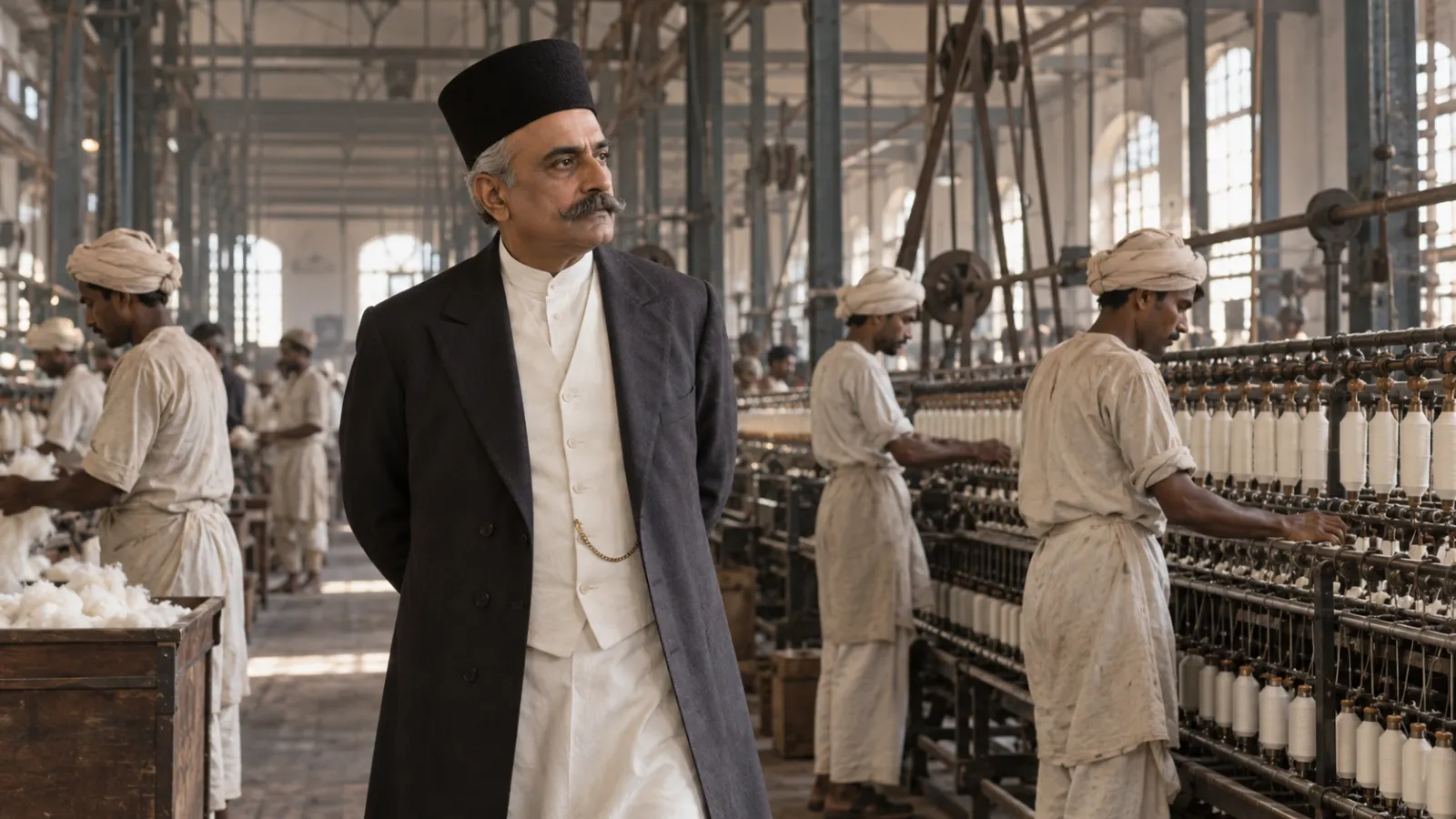
Bombay was the obvious location for a cotton mill, but he chose Nagpur. His reasoning anticipated what modern business strategy would describe as location economics. Nagpur was closer to cotton-producing regions, had railway access and offered water and fuel. In 1874, Jamsetji formed the Central India Spinning, Weaving and Manufacturing Company, and Empress Mills began operations on 1 January 1877. (tata.com)
The choice mattered because it demonstrated that Jamsetji was prepared to question the geography established by existing industry. A successful modern factory did not necessarily have to sit beside Bombay’s merchant houses if another location offered a better combination of raw material, transport and operating conditions.
Empress Mills also became important to the later Tata reputation for employee welfare. Tata Trusts records initiatives including free medical help, paid leave, crèches and primary classes for workers’ children, as well as pension, provident-fund, maternity and accident-compensation arrangements. Tata historical records date a pension fund to 1886 and accident compensation to 1895. (tatatrusts.org) (tata.com)
These claims should still be framed carefully. Jamsetji was not operating a modern welfare state inside a nineteenth-century factory, and the much larger labour institutions later associated with Tata Steel developed over subsequent generations. His businesses remained capitalist enterprises with clear hierarchies between owners, managers and workers.
But there is credible institutional evidence that his mills adopted measures concerning ventilation, sanitation, medical care and financial protection unusually early in colonial Indian industrialisation. The important historical point is not that Jamsetji created a morally perfect workplace. It is that he seems to have understood worker conditions as connected to industrial performance rather than wholly separate from it.
His next textile venture demonstrated a different quality: persistence through failure.
In 1886, Jamsetji purchased the troubled Dharamsi Mills in Bombay and renamed them Svadeshi Mills, years before the mass Swadeshi Movement associated with the anti-partition politics of 1905. His goal was to produce finer textiles that could compete with British goods. The mill initially struggled badly: shipments were rejected, dividends disappeared and its share price collapsed. Tata’s own historical account says Jamsetji committed personal resources, replaced machinery and transferred capable managers from Nagpur before the business eventually recovered. (tata.com)
The episode matters because founder biographies often erase unsuccessful years. Jamsetji’s industrial career contained misjudgements, capital pressure and projects that took far longer than expected. His significance came partly from an unusually long planning horizon.
For Jamsetji, Industry Became a Form of National Capability
Jamsetji was not a mass political leader, but economic development and Indian political self-respect increasingly overlapped during his lifetime. He was sympathetic to early Indian political reformers and moved in circles that included figures such as Dadabhai Naoroji and Pherozeshah Mehta, but his principal contribution was industrial rather than electoral.
His form of nationalism was constructive: India needed the ability to manufacture, generate power, conduct advanced research and develop technically trained people.
The idea becomes clearer when his major ambitions are considered together. Steel provided the material foundation of machinery, railways and heavy construction. Electricity could power factories and cities. Scientific education could create people capable of developing and adapting technology rather than simply importing it.
Seen separately, these might look like unrelated business or philanthropic projects. Seen together, they form a theory of development.
India could not become economically stronger merely by consuming more goods or exporting raw materials. It needed productive capacity.
This is also why Jamsetji’s relationship with foreign knowledge was more complicated than a simple “Indian versus British” story. He travelled extensively, hired foreign specialists and studied industrial systems abroad. In the steel project, American engineering and geological expertise became important. His problem was not that foreign technology existed; it was that India lacked enough control over the institutions capable of using technology on its own terms.
His nationalism therefore rejected dependency, not learning.
Steel Was the Most Difficult of His Industrial Dreams
No project better illustrates the scale of Jamsetji’s ambition than his attempt to establish a modern iron and steel industry.
Steel was fundamental to industrial power. Railways required rails; factories required machinery; cities required structural material; military and infrastructure systems increasingly depended on large-scale steel production. Yet building an integrated steel plant required the simultaneous availability of suitable iron ore, coal, water, transport, capital and technical knowledge.
Jamsetji pursued the project for years without seeing a plant built.
The search for raw materials was particularly difficult. Geological information was incomplete and promising locations could be remote. A major breakthrough came through the Indian geologist Pramatha Nath Bose, who identified significant iron-ore deposits in the Gorumahisani hills of Mayurbhanj and wrote to Jamsetji on 24 February 1904 urging further investigation. Tata Steel describes Bose’s intervention as crucial to the search that ultimately led to the establishment of the company. (tatasteel.com)
Jamsetji died only months later.
His son Dorabji Tata, cousin R. D. Tata and other collaborators continued the work. Tata Iron and Steel Company was incorporated in 1907, and the search for an appropriate plant location eventually focused on Sakchi, at the meeting of the Subarnarekha and Kharkai rivers. The settlement later became Jamshedpur. Tata Steel began producing steel after Jamsetji’s death; Tata records the first ingot in 1912. (tata.com) (tatasteel.com)
This chronology is important because simplified biographies sometimes make Jamsetji sound as though he personally constructed the Jamshedpur steel plant.
He did not.
What he supplied was the strategic obsession, early investigation, organisational momentum and belief that Indian capital could build an industry many contemporaries considered unrealistic. His successors converted the idea into physical infrastructure.
Jamsetji’s planning extended even beyond the factory. A famous 1902 letter to Dorab described wide streets, shade trees, gardens, recreational grounds and places of worship for different communities in the settlement that would eventually house steel workers. That vision anticipated the planned industrial city later constructed at Jamshedpur. (tata.com)
The steel project therefore reveals both the strength and limits of founder-centred history. Jamsetji mattered enormously, but the institution depended on geologists, engineers, managers, financiers and family members who continued working after him.
The Indian Institute of Science Was Philanthropy Designed as Infrastructure
Jamsetji’s educational ambitions may reveal his development philosophy even more clearly than steel.
He did not treat scientific education merely as charitable support for individuals. He believed India needed an institution capable of producing advanced knowledge and technically trained people over generations.
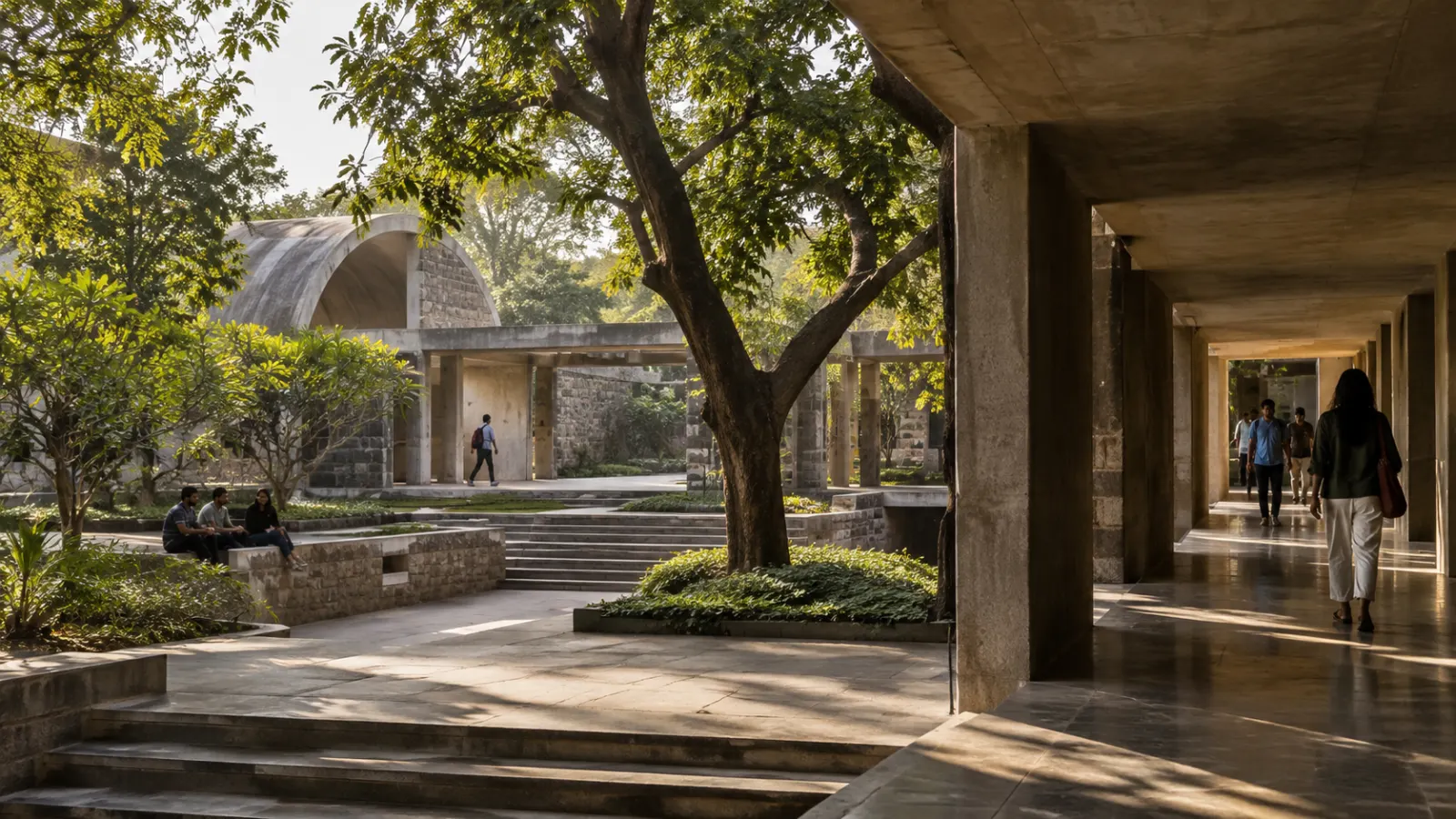
The Indian Institute of Science traces its origins directly to his efforts. IISc records that Jamsetji conceived a university of science in 1896 and created an endowment in 1898 to support the project. Its establishment ultimately required cooperation among the Tata family, the colonial Government of India and the Mysore State. The Regent Queen of Mysore provided more than 370 acres in Bangalore and financial support. The institute formally came into existence on 27 May 1909, five years after Jamsetji’s death, and its first students began their studies in 1911. (iisc.ac.in) (iisc.ac.in)
That history also challenges the idea of the solitary industrial hero. Burjorji Padshah played an important role in working out the institution’s academic design. The Mysore royal house provided crucial land and funding. Colonial officials had to approve and participate in the project. Jamsetji supplied vision and a major financial commitment, but IISc emerged from collaboration.
The institute represented a distinctive form of philanthropy.
Jamsetji had already established the JN Tata Endowment in 1892 to support Indians pursuing advanced studies overseas. The research university went further. Instead of helping only a limited number of individuals obtain knowledge elsewhere, India would possess an institution capable of creating and teaching advanced knowledge at home. (tata.com)
This helps explain what Tata histories sometimes describe as his preference for constructive philanthropy. Temporary relief addressed immediate hardship. Educational institutions and scholarships attempted to expand long-term human capability.
That approach had limitations. Elite scientific education could not by itself solve mass poverty, poor public health or unequal access to schooling. But as a theory of philanthropy, it was structurally ambitious: build an institution that would continue producing capability long after the donor disappeared.
IISc became perhaps the purest example of Jamsetji’s ability to invest in a future he would never personally see.
Hydroelectric Power Connected Industry With Urban Infrastructure
Jamsetji understood another constraint on industrialisation: factories required reliable energy.
Bombay’s mills depended heavily on coal, producing pollution while tying industrial expansion to fuel supply. Jamsetji became interested in using the heavy rainfall and elevation of the Western Ghats to generate hydroelectricity. Tata historical material traces versions of this ambition back to the 1870s, and the project later became one of the three major dreams associated with the final decades of his life. (tata.com)
Again, he did not live to see the system operate.
The Tata Hydroelectric Power Supply Company was incorporated in 1910, and the Khopoli generating station began supplying power in 1915. Additional hydroelectric development followed at Bhivpuri and Bhira. Tata Power explicitly traces these projects to Jamsetji’s plan to harness Western Ghats water for Bombay’s industrial growth. (tatapower.com)
Hydroelectricity demonstrates why calling Jamsetji merely a textile magnate understates his thinking.
Steel without energy would be constrained. Factories without electricity would remain dependent on older technologies. Scientific institutions without industrial demand would have fewer opportunities to transform research into production.
He increasingly thought in systems.
This is a recurring theme across his later ambitions: build the supporting institutions that allow other institutions to become possible.
The Taj Mahal Palace Was the Grand Vision He Actually Saw Completed
The Taj Mahal Palace opened in Bombay on 16 December 1903, only months before Jamsetji’s death. Tata records describe it as the major late-life venture he actually saw completed. (tata.com)
A famous story claims he decided to construct the hotel after being refused entry to a European-only establishment because he was Indian.
The story is attractive because it transforms the Taj into an immediate act of resistance to racial exclusion. But Tata’s own biography labels the episode as legend, not established historical fact. It should therefore not be repeated as a confirmed motive. (tata.com)
The documented achievement is impressive without the story.
Bombay was an international port and commercial centre, and Jamsetji wanted it to possess a luxury hotel comparable with major establishments abroad. Tata histories describe the Taj as technologically advanced for its time, equipped with electricity, elevators, imported fittings and other amenities associated with international luxury hospitality. (tata.com)
Unlike the steel plant, research institute and hydroelectric network, the hotel offered Jamsetji the rare experience of seeing an ambitious idea become a functioning institution.
But it also fitted the same broader pattern. The hotel was not simply an indulgent building. It expressed the belief that Indian capital could create institutions meeting international standards rather than accepting a permanently subordinate place within colonial commerce.
Jamsetji’s Achievements Depended on Networks, Not Founder Mythology
There is a tendency in business history to compress complicated organisations into the personality of one founder.
Jamsetji Tata’s career makes that approach particularly tempting because his ideas were unusually ambitious. Yet none of his major achievements can be understood properly without the people and institutions around him.
His father introduced him to commerce. Managers and engineers made the textile mills function. P. N. Bose supplied geological intelligence important to the steel project. Foreign technical specialists contributed industrial knowledge. Burjorji Padshah helped develop the scientific-institute plan. The rulers of Mysore supplied land and funding for IISc. Dorabji Tata and R. D. Tata carried major projects forward after Jamsetji’s death.
Recognising these contributions does not diminish him.
It clarifies what leadership meant in his case.
His unusual strength was not performing every technical or managerial function personally. It was identifying large problems, assembling networks capable of addressing them and making projects sufficiently persuasive that collaborators continued pursuing them after he was gone.
The colonial economy made those tasks harder. Industrial finance remained limited, government decisions could determine whether large projects were viable, and British firms possessed stronger international networks and political influence. Machinery and specialised expertise frequently had to come from abroad.
Jamsetji’s response was pragmatic rather than isolationist. He wanted Indian ownership and capability while remaining willing to import whatever knowledge could accelerate development.
That combination—national ambition without technological insularity—became one of the defining features of his industrial approach.
Jamsetji Tata’s Legacy Is Larger Than the Companies He Founded
Jamsetji died in Germany on 19 May 1904. At that moment, the steel plant for which he had struggled did not yet exist. The Indian Institute of Science had not formally opened. The hydroelectric system had not begun producing power.
If his career were judged only by projects completed during his lifetime, much of the legacy associated with him would disappear.
Instead, his historical importance rests partly on the opposite fact.
He created plans capable of surviving the planner.
Tata Steel was incorporated in 1907. IISc formally came into existence in 1909. The hydroelectric company was incorporated in 1910 and Khopoli began generating power in 1915. These were achievements of Jamsetji’s successors and collaborators, but they developed from institutional projects he had pursued for years. (tatasteel.com) (iisc.ac.in) (tatapower.com)
That is why “father of Indian industry,” although historically imprecise, has proved such a durable description. Jamsetji did not invent Indian industry, nor did he single-handedly industrialise the country. What he helped establish was a particular model of Indian corporate ambition: competitive manufacturing linked with technology, infrastructure, scientific education, employee welfare and institution-building.
There is also a danger in turning that model into uncomplicated corporate mythology. Jamsetji was an elite capitalist working within a deeply unequal colonial society. Business philanthropy did not remove structural poverty. Worker welfare did not eliminate differences of power between labour and ownership. National industrial development did not automatically distribute prosperity evenly.
Those qualifications make the history stronger, not weaker.
Jamsetji Tata matters because he recognised a problem that remains relevant to developing economies: how can private enterprise create national capability rather than simply extract value from an existing market?
His answer was unusually broad.
Build businesses capable of competing internationally. Learn from the best technology available. Create infrastructure before demand is fully mature. Educate scientists and engineers. Invest in workers. Support talented people through philanthropy. Build institutions that can survive their founders.
Steel, electricity, research and textiles might appear to belong to separate sectors. Jamsetji increasingly saw them as parts of the same transformation.
The most important institution he created was therefore not any single mill, hotel, company or trust.
It was an industrial imagination in which Indian enterprise could think simultaneously about production, technology, knowledge, infrastructure and national development.
That idea outlived him—and became one of the foundations of modern Indian corporate history.