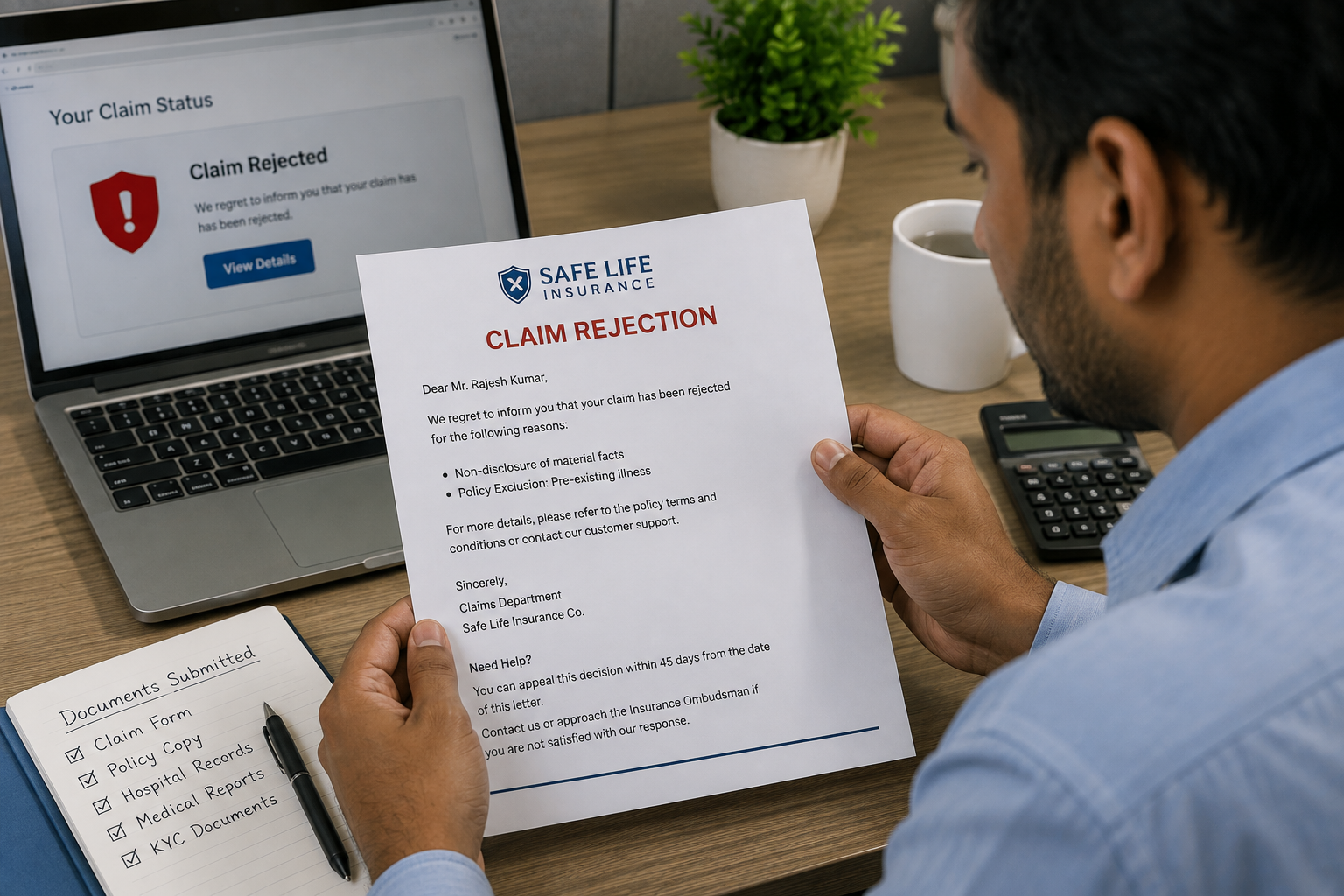
An insurance claim rejection hurts because it arrives when the policyholder is already under pressure. A family has faced hospitalisation, death, accident, fire, theft or damage. Bills have been paid. Documents have been collected. The claim has been submitted with the belief that insurance will now do what it was bought to do. Then the insurer says no.
For many policyholders, rejection feels like betrayal. But every rejection must be understood carefully. Sometimes the insurer is applying a valid exclusion. Sometimes the claimant has misunderstood the policy. Sometimes documents are incomplete. Sometimes the rejection is weak, mechanical or unfair. The difference matters because a valid rejection teaches policy discipline, while an unfair rejection must be challenged.
Rejection, Deduction and Delay Are Different
The first mistake is to treat every claim problem as rejection. A claim may be delayed because documents are pending. It may be partly deducted because some expenses are not payable. It may be queried because the insurer needs more information. It may be repudiated because the insurer denies liability under the policy. These are different situations.
A policyholder should ask the insurer to state the exact status in writing. If the claim is under process, what is pending? If there is a deduction, what clause supports it? If the claim is rejected, what is the exact reason and policy condition? A vague message such as “claim not payable” is not enough for a serious policyholder. Insurance decisions should be traceable to policy wording, documents and facts.
Why Insurance Claims Are Rejected
The most common reason is non-disclosure or misrepresentation. If a person buys health or life insurance without revealing pre-existing disease, past surgery, smoking habit, alcohol dependence, hazardous occupation or previous claim history, the insurer may later argue that the contract was issued on incomplete information. Insurance depends on risk assessment. If the risk was hidden, the claim can become vulnerable.
The second reason is policy exclusion. Every policy covers some events and excludes others. Health policies may have waiting periods, disease-specific exclusions, consumables, non-medical expenses, room-rent limits or treatment restrictions. Motor policies may exclude drunken driving, invalid licence, commercial use under a private policy or damage outside policy terms. Life policies may have suicide clauses or rider-specific restrictions.
The third reason is lapse or non-payment of premium. A policy is not a permanent promise if premium obligations are not met. Grace periods, revival rules and paid-up values differ by product. A customer who assumes that an old policy is active without checking premium status may face a painful surprise.
The fourth reason is insufficient evidence. A claim must prove that a covered event happened and that the claimant is entitled to payment. Missing bills, unclear medical records, no FIR in a theft or accident case, incomplete death documents, mismatch in names or bank details, and poor documentation can all delay or weaken a claim.
The fifth reason is fraud or exaggerated claim. Inflated bills, staged accidents, fake hospitalisation, forged documents or false declarations damage the insurance pool. Insurers are expected to protect genuine policyholders from fraudulent claims because every false payout ultimately affects premiums.
Health Insurance Rejections
Health insurance is one of the most sensitive areas because claim disputes happen during medical distress. A claim may be rejected because the disease falls within a waiting period, the illness was pre-existing and not disclosed, the treatment is excluded, hospitalisation was not medically necessary, the hospital is not eligible under policy terms, or documents do not support the diagnosis.
There may also be partial deductions rather than full rejection. Non-payable items, room-rent proportionate deductions, consumables, registration charges, convenience charges, attendant charges and treatment outside sub-limits can reduce the payout. Many policyholders discover these conditions only after hospitalisation, which is too late.
This is why a policyholder must read the customer information sheet, policy schedule and exclusions before a claim. The cheapest policy is not always the best policy if it creates high deduction risk.
Life Insurance Rejections
Life insurance rejections often involve non-disclosure, policy lapse, disputed nominee status or policy exclusions. If death occurs soon after policy issuance, the insurer may investigate medical history and proposal-form answers. If the insured person had a known serious illness and declared good health, the claim may be contested.
This is why proposal forms should never be outsourced blindly to agents. A policyholder should personally verify every answer. If an agent writes “non-smoker” when the buyer smokes, the family may pay the price later. If income is overstated to obtain a large sum assured, claim scrutiny may increase. The policyholder’s signature confirms the information. That signature should not be treated casually.
Motor and General Insurance Rejections
In motor insurance, claims may be rejected for driving without a valid licence, use of a private vehicle for commercial purposes, drunken driving, policy expiry, delay in intimation that prejudices assessment, or repair before survey where survey is required. In property insurance, issues may arise around underinsurance, excluded perils, poor maintenance, lack of proof of ownership or breach of warranty conditions.
The broader lesson is simple: insurance is not a blank cheque. It is a contract. The policyholder must know the conditions before the loss occurs.
What to Do After a Rejection
The first step is to obtain the rejection letter or repudiation letter. Verbal rejection is not enough. The letter should identify the policy clause and factual basis. The policyholder should then compare the reason with the policy schedule, proposal form, medical records and submitted documents.
The second step is to identify whether the rejection is factual, documentary or interpretive. A factual issue may involve wrong dates, wrong diagnosis or mistaken policy status. A documentary issue may be solved by submitting missing records. An interpretive issue may require arguing that the policy clause has been wrongly applied.
The third step is to respond with evidence. A strong representation should include policy number, claim number, timeline, disputed point, supporting documents and requested action. Avoid vague statements. The insurer needs a reason to review the decision.
The fourth step is escalation. Approach the insurer’s grievance cell. If the response is unsatisfactory, use regulator-monitored grievance mechanisms and, where eligible, approach the Insurance Ombudsman. For high-value or legally complex matters, consumer commission or legal advice may be appropriate.
The Role of Policy Wording
Policy wording is the battlefield of a rejected claim. Marketing brochures, agent promises and website highlights cannot override the actual contract. This is why customers should download and save the final policy document, not only the brochure.
A rejection should be tested against three questions. Did the policy cover the event? Did any exclusion apply? Did the policyholder comply with claim conditions? If the answer favours the claimant, the rejection can be challenged. If the answer favours the insurer, the rejection may be legally difficult to reverse even if it feels harsh.
Prevention Is Better Than Appeal
The best way to fight rejection is to prevent it. Disclose facts honestly. Renew policies on time. Understand waiting periods. Keep medical and financial records. Inform the insurer promptly after an event. Use network hospitals where possible. Read exclusions before buying. Do not rely only on premium comparisons. Maintain nominee details. Preserve email communication.
For health insurance, policyholders should also check room-rent limits, co-payment, deductibles, sub-limits, disease-wise caps, consumables, restoration rules and claim process. For life insurance, they should verify medical disclosures, income justification, nomination and premium status. For motor insurance, they should keep licence, registration, pollution certificate and policy documents updated.
Why Rejection Exists
It is easy to see claim rejection only as insurer behaviour. But rejection also exists because insurance works by pooling risk. If every claim, valid or invalid, were paid without scrutiny, premiums would rise for everyone. Claims assessment protects the pool.
The problem begins when scrutiny becomes opacity. A fair insurer should reject only with clear reasoning, policy support and proper process. A fair policyholder should not expect payment for events outside the contract. Trust requires discipline on both sides.
Final Takeaway
An insurance claim rejection is not always injustice, and it is not always final. It is a decision that must be tested against the contract, the facts and the law. The policyholder’s power lies in documentation, written communication and knowledge of grievance channels.
Insurance buyers should stop treating policy purchase as the end of the process. The real process includes disclosure, renewal, record-keeping, claim awareness and dispute readiness. A rejected claim is painful, but a well-prepared policyholder is not helpless.