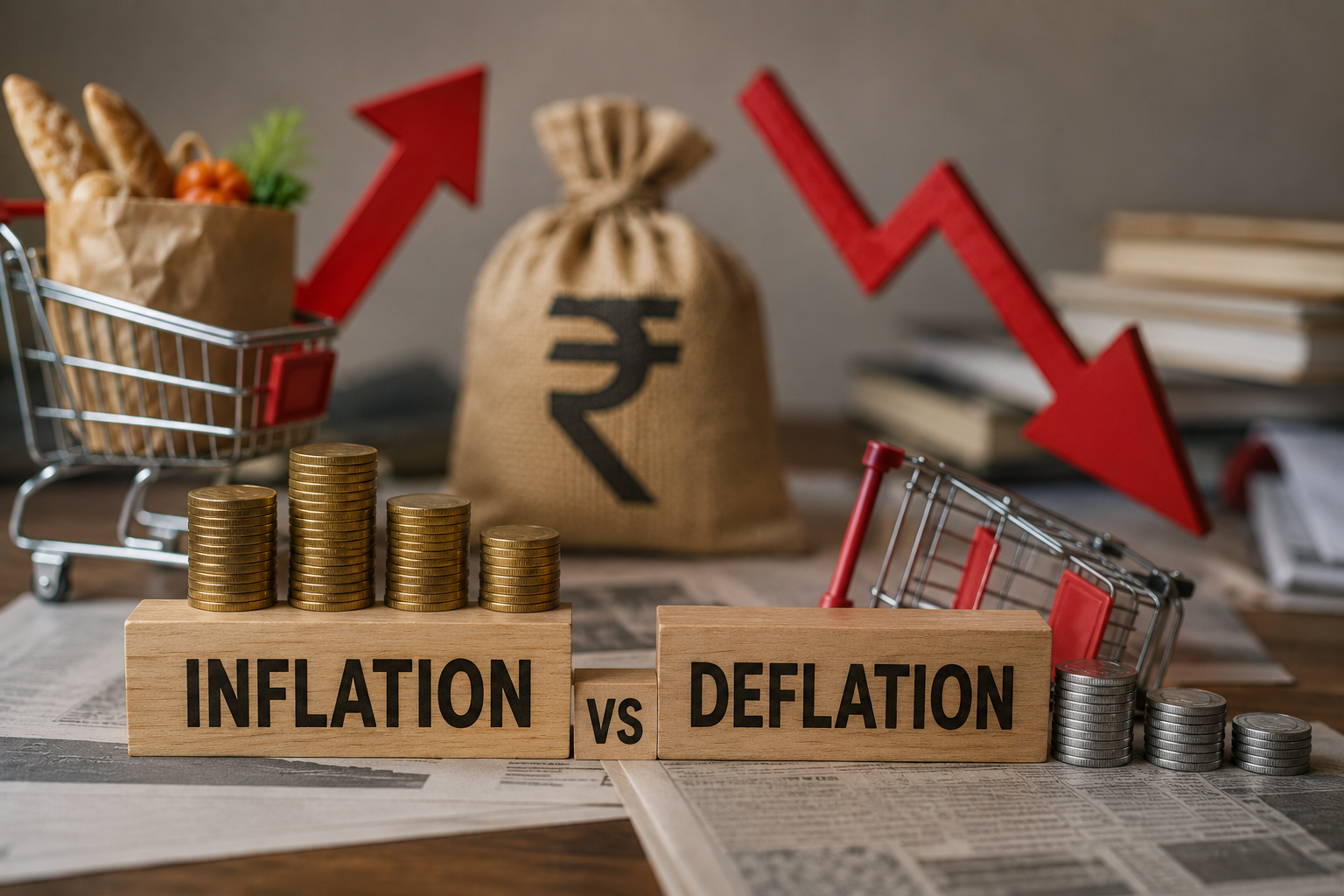
Inflation and deflation look like opposites. Inflation means prices are rising. Deflation means prices are falling. At first glance, the choice appears obvious. Rising prices hurt consumers, so falling prices should help them. But economics is rarely that simple. Persistent deflation can be as dangerous as high inflation, sometimes more dangerous, because it can weaken demand, increase debt burdens and trap an economy in stagnation.
The basic difference is straightforward. Inflation is a sustained rise in the general price level. Deflation is a sustained fall in the general price level. If the average cost of a broad basket of goods and services rises year after year, the economy is experiencing inflation. If that broad basket keeps becoming cheaper, the economy is experiencing deflation.
The word sustained matters. A temporary fall in vegetable prices after a good harvest is not necessarily deflation. A discount season is not deflation. A decline in the price of smartphones because technology improves is not automatically deflation. Deflation becomes a macroeconomic issue when prices fall broadly across the economy for a meaningful period.
There is also a third term: disinflation. Disinflation does not mean prices are falling. It means inflation is slowing. If inflation falls from 7 percent to 4 percent, prices are still rising, but at a slower pace. Many people confuse disinflation with deflation. This distinction matters because a lower inflation rate does not mean life has become cheaper. It means life is becoming expensive more slowly than before.
Inflation reduces the purchasing power of money. If prices rise 6 percent and income rises only 3 percent, real income falls. Households feel squeezed. Savers worry about negative real returns. Businesses face higher input costs. Policymakers face public pressure.
Deflation increases the purchasing power of money in a narrow sense. If prices fall, the same cash can buy more goods and services. That sounds attractive to consumers. But when deflation becomes persistent, the economy can enter a damaging loop.
The first danger is delayed spending. If consumers believe prices will be lower next month, they may postpone purchases. This is especially true for durable goods such as cars, appliances, property and electronics. If many households delay spending together, company sales fall. Businesses then reduce production, cut investment and postpone hiring. The expectation of lower prices becomes a cause of lower demand.
The second danger is falling revenue. In a deflationary environment, companies may have to sell at lower prices even though some costs, such as rent, interest and fixed salaries, do not fall immediately. Profit margins shrink. Firms may cut wages, jobs or investment. This weakens household income and reduces demand further.
The third danger is the real debt burden. Deflation makes old debt heavier in real terms. Suppose a borrower owes Rs 10 lakh. If prices and incomes rise over time, repayment may become easier in real terms. But if prices and incomes fall, the same debt becomes more painful. This affects households, businesses and governments. Debt contracts are usually fixed in nominal terms, while income may decline during deflation.
This is one reason economists fear debt-deflation cycles. Falling prices increase the real burden of debt. Higher debt stress forces borrowers to cut spending. Lower spending reduces demand. Lower demand pushes prices down further. The cycle can become self-reinforcing.
Inflation has its own dangers. High inflation can destroy planning, reduce real wages, punish savers and create social anger. If prices rise unpredictably, businesses cannot price contracts confidently. Investors demand higher returns. Workers demand wage increases. Central banks may raise interest rates sharply, which can slow growth.
But moderate inflation is often easier to manage than persistent deflation. Central banks can raise interest rates to cool excess demand. Governments can improve supply chains, reduce bottlenecks and use targeted relief. Deflation is harder because interest rates cannot fall indefinitely below zero in practical terms, and people may still avoid spending if confidence is weak.
Inflation and deflation also affect inequality differently. High inflation hurts the poor when food, fuel and rent rise faster than income. It hurts those living on fixed pensions or fixed salaries. Asset owners may be protected if property, equities or gold rise in nominal value. Borrowers with fixed-rate loans may benefit if income rises with inflation.
Deflation can hurt debtors, workers and businesses. Cash holders may gain because money buys more. But if deflation causes job losses and wage cuts, ordinary households may not benefit from cheaper goods. A cheaper economy is not helpful if income disappears.
The source of price movement matters. Not all falling prices are bad. If prices fall because productivity rises, technology improves and supply expands, consumers benefit. For example, electronics can become cheaper because manufacturing becomes more efficient. That is healthy price decline in a specific sector.
Deflation is dangerous when prices fall because demand is weak. If households are afraid, businesses are not investing and banks are cautious, falling prices reflect economic stress. The economy becomes trapped not by abundance but by pessimism.
Similarly, not all inflation is equally harmful. A moderate inflation rate driven by healthy demand and rising wages can coexist with growth. Inflation becomes damaging when it is too high, too volatile or driven by supply shocks that reduce real income.
This is why policymakers focus on price stability rather than zero inflation. Price stability does not mean prices never change. It means inflation remains low, predictable and credible enough for households and businesses to make long-term decisions. In India, the monetary policy framework gives the RBI a CPI inflation target of 4 percent with a tolerance band of 2 percent to 6 percent. The aim is not to make inflation vanish, but to keep it stable.
For households, understanding the difference helps in financial planning. During inflation, families must protect purchasing power through income growth, budgeting and suitable savings choices. During deflation, job security and debt management become critical. A falling price environment may tempt people to hold cash, but the larger risk may be income uncertainty.
For investors, inflation and deflation change asset behaviour. Inflation can support real assets but hurt fixed-income returns if interest rates lag. Deflation can make safe cash attractive but hurt equities, real estate and credit-sensitive sectors if growth weakens. The correct investment response depends not only on price direction but on interest rates, earnings, debt levels and policy credibility.
For businesses, inflation requires pricing power and cost control. Deflation requires demand resilience and balance-sheet strength. A company with high debt and weak demand is vulnerable in deflation. A company with strong brands and flexible costs may handle inflation better.
For governments, both conditions create political challenges. Inflation creates anger because citizens see prices rising. Deflation creates frustration because jobs and wages weaken. Inflation demands credibility on price control. Deflation demands confidence-building and demand revival.
The key lesson is that falling prices are not automatically good and rising prices are not automatically catastrophic. The deeper question is why prices are moving, how broad the movement is, whether incomes are keeping pace, whether debt burdens are manageable and whether expectations remain stable.
Inflation is the problem of money losing purchasing power too quickly. Deflation is the problem of money gaining purchasing power in a way that can paralyse spending, increase debt stress and weaken growth. Between the two lies the healthier goal: stable, low and predictable inflation.
A mature economy does not chase the cheapest possible price level. It seeks a stable price environment in which wages, savings, investment, borrowing and production can be planned with confidence. That confidence is the real value of price stability.
A useful practical test is to ask whether price changes are improving welfare or reducing confidence. Falling prices due to better technology, stronger competition or improved productivity can be healthy. Falling prices due to fear, weak demand and debt stress can be destructive. Rising prices due to stronger wages and expanding demand may be manageable. Rising prices due to shortages, currency pressure and broken supply chains may be dangerous. The same visible movement can therefore carry different economic meanings.
For public communication, this distinction is crucial. Citizens often hear that inflation has fallen and assume prices should return to earlier levels. Policymakers must explain that a lower inflation rate usually means slower price rise, not a reversal of past price increases. Similarly, they must explain why broad deflation is not a gift if it comes with unemployment, falling wages and heavier debt. Economic clarity reduces frustration because it helps people separate discomfort from diagnosis.
The healthiest economy is not the one where every price is frozen. It is the one where price movements are understandable, moderate and supported by rising productivity and income. Price stability should therefore be treated as a foundation for fairness, investment and trust, not as a technical obsession of central bankers.
Disclaimer
This article is for general educational and editorial use. It is not investment, lending, business-pricing or monetary-policy advice. Definitions and policy frameworks should be checked against current official releases before publication.