Hydropower Explained: How It Works, Types, Benefits and Environmental Impact
Hydropower converts the energy of moving water into electricity. The most familiar version is a massive dam holding back a reservoir, but that image represents only one part of the technology. Hydroelectric systems range from huge reservoir projects to small run-of-river plants, turbines installed in existing canals or water infrastructure, and pumped-storage facilities that behave more like enormous rechargeable batteries than ordinary power stations.
All of these systems depend on the same physics. Water at elevation contains gravitational potential energy. When it moves downward, that energy becomes motion, and a turbine converts part of the moving water’s energy into mechanical rotation. A generator then converts the rotating shaft’s mechanical energy into electricity through electromagnetic induction.
Two characteristics of a site strongly influence how much power can be produced: flow, meaning the amount of water moving through the turbine, and head, meaning the vertical difference in elevation through which the water falls. A river carrying enormous volumes of water can produce substantial electricity with relatively little head, while a high mountain site can generate significant power using smaller flows because the water falls through a much greater height.
Hydropower is therefore renewable, but it is not impact-free. A turbine does not burn coal or gas, yet dams and reservoirs can transform rivers, block fish migration, trap sediment, inundate ecosystems and communities, alter downstream flows and in some cases produce methane from decomposing organic matter. Hydropower is also unusually exposed to climate change because its fuel is ultimately the water cycle itself.
This combination of strengths and constraints makes hydropower one of the most interesting technologies in the energy transition. It can provide low-carbon electricity for decades, respond rapidly when electricity demand changes and store enormous amounts of energy through pumped storage. But whether a particular hydro project is environmentally or economically sensible depends heavily on the river, geography, ecology, community and infrastructure involved.
How Hydropower Works and the Main Types of Hydroelectric System
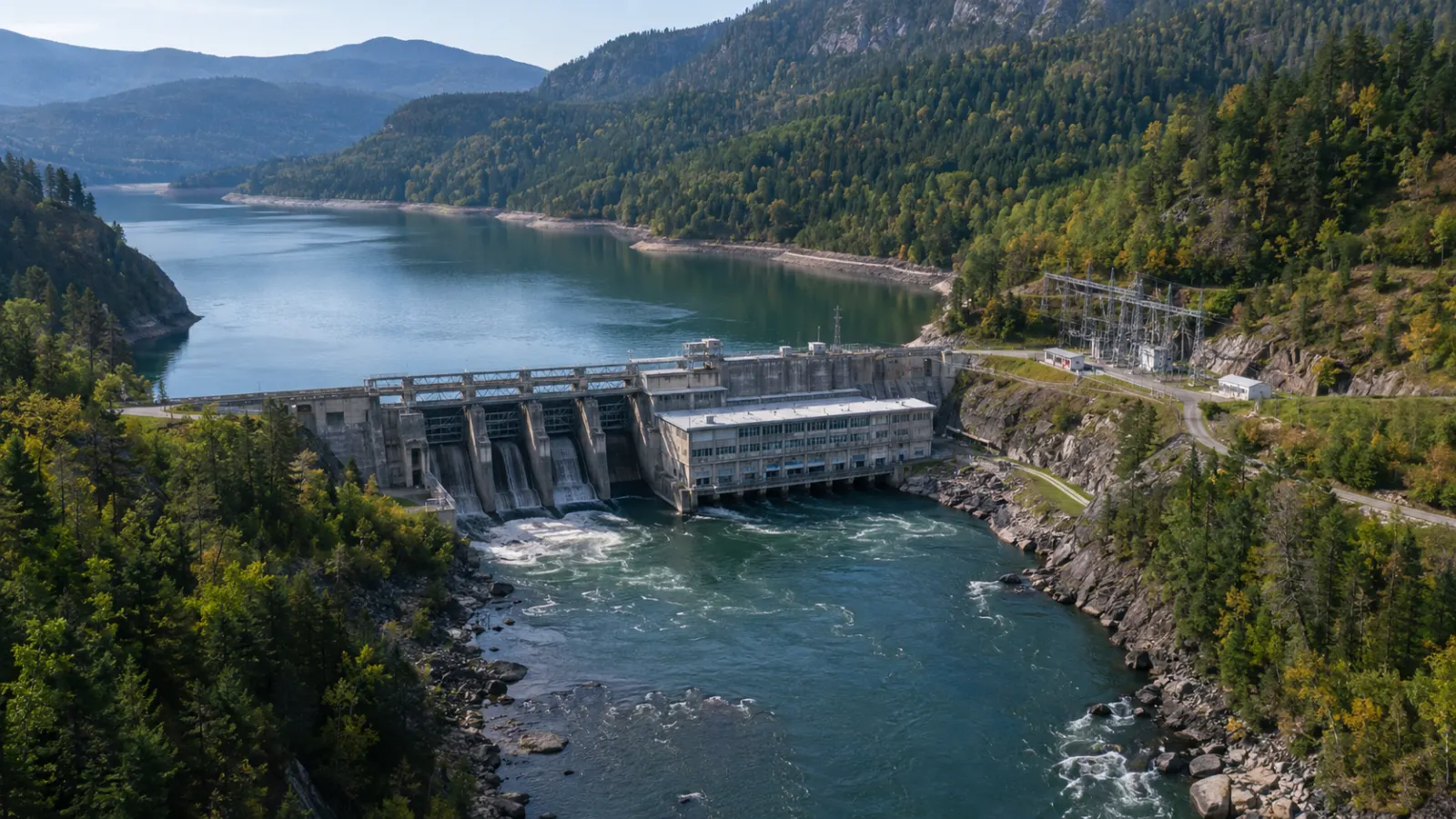
A conventional hydropower plant channels water toward a turbine through a pipe or passage often called a penstock. The water pushes against turbine blades or a runner, rotating a shaft connected to an electrical generator. After passing through the turbine, the water normally returns to the river downstream. The plant does not consume the water as fuel in the way a coal plant consumes coal, but storing, diverting and releasing that water can substantially alter the river system.
Modern turbines are selected according to the head and flow available at a site. High-head projects may use different turbine designs from low-head, high-flow systems because the hydraulic conditions are different. Hydroelectric machines are highly efficient: the IPCC notes that peak efficiency of hydroelectric plants can exceed 85%, meaning a large fraction of the available hydraulic energy can be converted into electricity.
The best-known configuration is reservoir hydropower. A dam stores water at an elevated level, creating both head and a supply of water that operators can release through turbines. Storage allows generation to be shifted in time. Instead of producing only when the river happens to be flowing strongly, operators may be able to conserve water when electricity demand is low and increase generation when the grid needs more power, subject to reservoir levels, environmental requirements and competing water uses.
This dispatchability is one of hydropower’s most valuable characteristics. A reservoir plant may increase output rapidly in response to rising electricity demand or a sudden fall in wind and solar production. Large hydro generators can also provide grid services such as frequency control, voltage support and spinning reserve. Hydropower’s system value therefore cannot be judged solely by the number of kilowatt-hours it generates annually.
Reservoirs frequently serve several purposes simultaneously. The same water body may support electricity generation, irrigation, drinking-water supply, navigation, recreation and flood management. Those purposes can conflict. Hydropower operators may prefer higher reservoir levels to maximise energy availability, while flood managers may need empty storage capacity before a period of heavy rainfall. Farmers may want water released during irrigation seasons, while ecological requirements may demand particular downstream flow patterns.
Run-of-river hydropower uses much less storage. A portion of river flow may be diverted through a channel or penstock toward a turbine and then returned downstream. Because there is limited ability to store water, electricity production generally follows river flow more closely. Generation may therefore rise substantially during wet seasons or snowmelt and decline during droughts or dry seasons.
Run-of-river systems can avoid the enormous reservoirs associated with some major dams, but the term should not be confused with “zero environmental impact.” Water diversion can reduce flows through bypassed river reaches, affect aquatic habitat and change fish movement. Access roads, transmission lines and powerhouses still occupy land, while cumulative effects can become substantial if many projects are constructed along the same river system.
Not every hydropower project requires an entirely new dam. Existing irrigation canals, municipal water systems and non-powered dams can sometimes be fitted with turbines. The U.S. Department of Energy emphasises that hydro facilities can range from enormous conventional dams to very small projects using existing water flows or diversion structures. This distinction matters because adding generation to existing infrastructure can create very different environmental consequences from building a new barrier across a largely unmodified river.
Pumped-Storage Hydropower Is Really an Energy-Storage System
Pumped-storage hydropower, or PSH, looks superficially similar to conventional hydroelectricity because water passes through turbines, but its role in the electricity system is fundamentally different. Pumped storage normally uses two reservoirs at different elevations. When electricity is abundant or inexpensive, pumps move water from the lower reservoir to the upper reservoir. Later, when demand increases or other electricity sources produce less, the stored water is released downhill through turbines to generate electricity.
Because pumping water uphill requires more electricity than the plant later returns, pumped storage is not a net primary energy source. Energy is lost through pumping, hydraulic friction and generation. Its purpose is energy shifting: moving electricity from one period to another.
That can become extremely valuable in grids with large amounts of solar and wind. Solar farms may produce more electricity than the system can immediately use during bright afternoons. Pumped storage can absorb some of that surplus and retain the energy as elevated water. The water can then be released during the evening peak when solar output has fallen but homes and businesses still require electricity.
DOE describes pumped storage as functioning like a giant battery, and its current figures indicate that PSH provides about 88% of U.S. utility-scale energy-storage capacity. Globally, batteries are growing rapidly, but pumped storage remains one of the most established methods for storing extremely large amounts of electricity over many hours.
Its role is likely to expand. The IEA expects more than 154 GW of new hydropower capacity to come online globally between 2025 and 2030 and projects annual pumped-storage additions to roughly double to 16.5 GW by 2030, driven largely by the need to integrate increasing amounts of variable renewable generation. China is expected to account for more than 60% of global pumped-storage growth over that period.
Pumped-storage designs do not always require damming an undisturbed river. Some projects use off-river or closed-loop upper and lower reservoirs with limited connection to natural river systems. Such designs can avoid some river-fragmentation impacts, although they still require land, excavation, water and large civil-engineering works.
The important distinction is therefore simple: conventional hydropower converts the natural movement or storage of water into electricity, while pumped storage uses electricity to create a stored water-energy reserve that can be recovered later.
Why Hydropower Still Matters in an Era of Solar, Wind and Batteries
Solar photovoltaic and wind generation are adding capacity much faster than traditional hydropower in many parts of the world. Yet hydropower continues to occupy a uniquely important position because it combines renewable electricity generation with capabilities that variable renewables do not automatically provide.
In 2024, hydropower supplied about 14% of global electricity, making it the largest individual source of renewable electricity worldwide. Wind accounted for around 8% and solar PV about 7% that year. In 2025, global renewable generation continued expanding strongly, although hydropower output declined in parts of Europe and Eurasia because production remained dependent on regional hydrological conditions.
Hydro’s value increasingly lies in flexibility. Reservoir plants can often increase or reduce output more rapidly than conventional thermal power stations. Pumped-storage facilities can absorb surplus generation and return it later. Hydroelectric generators can also provide inertia, frequency response and other services needed to keep electricity grids stable.
This creates a complementary relationship rather than a simple competition among renewables. Solar can produce inexpensive electricity during daylight hours. Wind may generate strongly at night or during particular seasons. Batteries can move electricity over hours and respond almost instantaneously. Reservoir hydro can provide both energy and flexible generation, while pumped storage can move very large quantities of electricity across hours or potentially longer periods.
Hydropower also differs economically from technologies manufactured in factories. Solar panels and wind turbines can be produced in large standardised volumes and installed at many different sites. A hydropower project is closely tied to its geography. River flow, elevation, geology, foundations, tunnelling, dam construction, environmental mitigation and transmission requirements can make two projects with identical electrical capacity cost radically different amounts.
This site-specific nature explains why global averages should be used cautiously. IRENA reported a global weighted-average levelised cost of electricity of about USD 62 per megawatt-hour for newly commissioned hydropower in 2025. But a modernisation project using an existing dam may cost far less than a large greenfield project requiring major tunnelling, resettlement and civil works.
The initial investment can be enormous, while construction can take many years. Once built, however, hydroelectric plants may operate for many decades. Turbines, generators and control systems can be replaced or upgraded while the dam, reservoir and waterways remain in service, extending the useful life of infrastructure far beyond that of many other power-generation technologies.
For that reason, the future of hydro may depend as much on modernising existing assets as constructing new giant dams. Digital controls, more efficient turbines, improved forecasting and environmental upgrades can increase output and flexibility without necessarily creating an entirely new reservoir.
The Environmental Impact of Hydropower Depends Heavily on the Project
Calling hydropower renewable answers an energy-resource question. It does not answer whether a particular project is environmentally desirable.
A large dam fundamentally changes a river. Flowing water becomes a reservoir. Seasonal floods can be reduced or shifted. Sediment becomes trapped behind the dam instead of moving downstream. Water temperature and oxygen levels can change. Fish migration routes can be blocked, while downstream floodplains, wetlands and deltas may receive less water and sediment than they did naturally.
Reservoir creation can also inundate forests, farmland, archaeological sites and settlements. Some of the largest historical dam projects required the displacement of very large human populations. The social consequences therefore need to be included alongside electricity benefits rather than treated as unrelated problems.
These impacts vary enormously by location. A turbine added to an existing municipal water pipe cannot reasonably be evaluated in the same way as a new multi-gigawatt dam flooding a large inhabited valley. A run-of-river diversion affects a river differently from a massive seasonal-storage reservoir. Environmental assessment therefore has to examine the particular project rather than relying on the generic label hydropower.
Fish migration provides one of the clearest examples. Migratory species may need to travel between spawning and feeding habitats located on opposite sides of a dam. Engineers use fish ladders, lifts, bypass systems, screens, trap-and-haul operations and increasingly fish-friendly turbine designs to reduce mortality and maintain connectivity. DOE explicitly notes that there is no one-size-fits-all fish-passage solution because species, river conditions and hydropower facilities differ.
Technology can improve outcomes substantially. DOE-supported tests of specialised restoration turbines have reported very high survival rates for certain fish species under specific experimental and field conditions. But successful passage through one turbine does not mean a dam has become ecologically equivalent to an undammed river. Fish may still face changes in habitat, water temperature, migration timing and river flow.
Sediment is another major issue. Rivers naturally transport sand, silt and nutrients downstream. Reservoirs slow the water, causing much of that material to settle. Over decades this can reduce reservoir storage capacity while simultaneously depriving downstream channels and deltas of sediment. In extreme cases, reduced sediment supply can contribute to riverbed erosion or coastal vulnerability.
Environmental management can sometimes reduce these effects through controlled flows, sediment bypassing, reservoir flushing or habitat restoration, but solutions are highly site-specific and may involve trade-offs with electricity generation.
Hydropower Is Low Carbon, but Reservoirs Can Emit Greenhouse Gases
Hydropower is often called “zero-carbon” because no fossil fuel is burned when water passes through a turbine. That description is incomplete.
Building dams, roads, tunnels, generators and transmission systems creates lifecycle emissions through cement, steel, construction equipment and other processes. Reservoirs can also emit carbon dioxide and methane when vegetation, soils and organic matter decompose after being submerged.
Methane is especially important because waterlogged, oxygen-poor conditions can support microbial processes that generate it. Some methane is released directly from the reservoir surface, while additional emissions can occur downstream or when deep water passes through turbines and pressure changes allow dissolved gas to escape.
The magnitude varies enormously among reservoirs. Climate, reservoir depth, flooded vegetation, nutrient levels, age and the amount of electricity generated per unit of flooded area all matter. The IPCC therefore stresses that the carbon footprint of reservoir hydropower is highly project-specific and that some reservoirs have much higher emissions than others.
This makes a single universal hydropower emissions number misleading. Many projects have lifecycle greenhouse-gas emissions far below coal or gas generation, particularly high-power projects in suitable locations. Some reservoirs—especially those flooding large areas of organic-rich land relative to their electricity production—can perform much less favourably.
The scientifically useful question is not whether hydropower “has emissions” in the abstract. Almost every energy technology has lifecycle impacts. The relevant comparison is how much climate impact a specific project produces per unit of useful energy and what alternative system would otherwise provide that energy.
Climate Change Creates a Paradox for Hydropower
Hydropower can help reduce reliance on fossil fuels, but hydropower itself depends on climate-sensitive water systems.
A turbine cannot generate its expected electricity if the river does not provide enough water. Drought can reduce reservoir inflows and force operators to cut generation. Changes in snowfall can shift the seasonal timing of runoff. Warmer temperatures can increase evaporation from reservoirs, while more intense rainfall can create flood-management and dam-safety challenges.
The IPCC concludes with high confidence that climate change has already negatively affected hydropower production globally through drought, altered river-flow seasonality and related hydrological changes. It also stresses that future effects will vary considerably by region: some areas may receive greater runoff, while others face declining flow and more competition for water.
This creates a planning problem because many hydropower facilities were designed using historical rainfall, snowpack and river-flow records. If future hydrology differs systematically from the past, those records may become less reliable guides to how much electricity a project will produce or how safely a reservoir should be operated.
Climate change can also influence sediment. Stronger rainfall and erosion may increase sediment inflow into some reservoirs, reducing storage and increasing maintenance challenges. In other regions, retreating glaciers may temporarily increase flows before long-term glacier loss reduces the contribution of meltwater.
Multi-purpose reservoirs make these pressures even more complicated. During a drought, electricity generation may compete with irrigation, drinking-water supply and minimum ecological flows. Hydropower therefore cannot be separated from broader water governance.
DOE has conducted repeated climate-change assessments of federal hydropower precisely because future water availability can materially change electricity production and reservoir management. This vulnerability does not eliminate hydropower's climate benefits, but it means projects should be evaluated using future hydrological scenarios rather than assuming twentieth-century river conditions will continue indefinitely.
Hydropower’s Future May Depend More on Flexibility and Modernisation Than on Mega-Dams
The next phase of hydropower development will not look identical everywhere. Some countries still have substantial undeveloped river resources and are constructing new conventional plants. Others have already developed much of their economically attractive hydro potential and are focusing on upgrading existing facilities, adding turbines to non-powered dams and expanding pumped storage.
The IEA expects global hydropower development to accelerate modestly through 2030, with more than 154 GW of new capacity during 2025–2030 and particularly rapid growth in pumped storage. That pattern reflects the changing role of hydro in an electricity system increasingly dominated by solar and wind additions.
Modernisation can improve efficiency without building a new dam. Replacing old turbine runners, generators and control equipment may allow more electricity to be produced from the same water. Digital systems can improve forecasting and coordinate reservoir operations with changing electricity prices and renewable output.
Environmental innovation is developing simultaneously. Fish-friendly turbines, better fish-detection systems, improved environmental-flow management and new sediment strategies aim to reduce ecological damage at existing facilities. Research continues because many historical hydropower projects were designed when ecological objectives received much less engineering attention than they do today.
Pumped storage may become particularly important because its value increases as electricity production becomes more variable. A grid with abundant inexpensive solar electricity in the middle of the day does not only need more generating capacity; it needs ways to move that electricity to periods when sunlight is unavailable. Large pumped-storage reservoirs can perform that role at a scale difficult to achieve with many other long-duration technologies.
Still, pumped storage is not environmentally free. Projects require reservoirs, excavation, tunnels and water. Off-river designs can reduce effects on natural river connectivity, but they still require careful siting.
The future of hydropower will therefore be determined less by the question “Is hydropower good or bad?” than by a more demanding set of questions. Is this the right river or existing infrastructure for the project? How much flexible electricity or storage will it provide? What ecosystems and communities will be affected? Can existing infrastructure provide the same service through modernisation? Could another clean-energy combination supply equivalent reliability with lower social or ecological cost?
Those are the questions appropriate to a mature technology.
Hydropower Compared With Other Renewable Energy Sources
Hydropower, solar and wind all generate renewable electricity, but they perform different functions inside the grid.
| Technology | Major strength | Major limitation |
|---|---|---|
| Reservoir hydropower | Dispatchable renewable generation and rapid grid response | River alteration, high capital cost and dependence on water availability |
| Run-of-river hydropower | Renewable generation with less storage infrastructure | Output follows seasonal river flow more closely and diversions still affect ecosystems |
| Pumped-storage hydropower | Very large-scale, long-duration electricity storage | Loses energy during the storage cycle and requires suitable geography/infrastructure |
| Solar PV | Rapid deployment, modular construction and very low generation costs in many markets | Output varies with daylight and weather |
| Wind power | Large scalable renewable resource with competitive costs | Variable and strongly dependent on wind conditions |
| Battery storage | Very rapid response and flexible siting | Cost and economics can become more challenging for very long storage durations |
No column identifies a universal winner because electricity systems require several capabilities simultaneously. The cheapest annual energy does not automatically provide adequate power during every hour, while the most flexible generator may not be the cheapest way to produce bulk electricity.
Hydropower's increasingly important role may therefore be to provide firmness, flexibility and storage around a rapidly expanding core of solar and wind generation.
Frequently Asked Questions About Hydropower
What is hydropower? Hydropower is electricity generation that converts the energy of moving or falling water into mechanical rotation in a turbine and then into electrical energy in a generator.
How does hydropower work? Water flows through or past a turbine, causing it to rotate. The turbine shaft drives a generator that converts the mechanical rotation into electricity.
What determines how much hydropower a site can generate? Two of the most important variables are water flow and head, the vertical distance through which the water falls.
What are the main types of hydropower? Major types include reservoir hydropower, run-of-river or diversion projects and pumped-storage hydropower.
Is hydropower renewable? Yes. Hydropower relies on water continually circulated by the hydrological cycle. However, renewable does not mean environmentally consequence-free.
Is hydroelectric power the same as a dam? No. Many dams do not generate electricity, and some hydropower systems use diversions, canals or existing water infrastructure without a large storage dam.
What is run-of-river hydropower? Run-of-river plants use flowing river water with limited storage, so their electricity output tends to follow natural or managed river flows more closely.
What is pumped-storage hydropower? Pumped storage uses electricity to pump water uphill into an upper reservoir and later releases that water through turbines to recover much of the stored energy. It is therefore an energy-storage technology rather than a primary energy source.
Is pumped storage 100% efficient? No. Energy is lost during pumping, friction and regeneration, so less electricity is returned than was originally used to move the water uphill.
Why is hydropower useful with solar and wind? Reservoir hydro can increase generation when variable renewable output falls, while pumped storage can absorb surplus electricity and return it later.
How much of the world's electricity comes from hydropower? Hydropower generated about 14% of global electricity in 2024 and remained the world's largest individual renewable electricity source.
Does hydropower produce greenhouse gases? Hydropower does not burn fossil fuel during generation, but construction produces lifecycle emissions and some reservoirs emit methane and carbon dioxide from decomposing organic material. Emissions vary greatly among projects.
Do dams harm fish? They can block migration and alter habitat. Fish ladders, lifts, bypass systems and specialised turbines can reduce some impacts, but effectiveness varies by species and facility.
Does hydropower affect sediment? Yes. Reservoirs can trap sediment that would otherwise travel downstream, changing river morphology, nutrient transport and potentially coastal or delta systems.
Can hydropower cause people to be displaced? Large reservoirs can inundate settlements and land, so some major dam projects have required resettlement. Social impacts depend strongly on project location and design.
Is hydropower cheap? Costs are highly site-specific. IRENA reported a global weighted-average levelised electricity cost of about USD 62/MWh for hydropower projects commissioned in 2025, but individual projects can differ substantially.
How long do hydropower plants last? Major civil works can operate for many decades when properly maintained, while turbines, generators and controls can be refurbished or replaced during the facility's life.
Can climate change reduce hydropower production? Yes. Drought, changes in precipitation, snowmelt, evaporation and river-flow timing can all affect generation, with impacts varying substantially by region.
Is hydropower better than solar or wind? They provide different services. Solar and wind can often produce inexpensive new electricity rapidly, while reservoir hydropower offers greater dispatchability and pumped storage offers large-scale energy storage.
What is the future of hydropower? Future growth is expected to include new plants in some regions, but modernisation of existing hydro and rapid expansion of pumped-storage capacity are likely to become increasingly important as electricity systems add more solar and wind.
Hydropower Is Renewable Energy Built Inside a River System
The strongest argument for hydropower is easy to understand. Moving water can generate electricity without continually burning fuel, hydroelectric plants can operate for many decades and reservoir facilities can respond rapidly when the electricity system needs additional power. Pumped storage adds another capability by turning elevation and water into one of the world's most established large-scale energy-storage systems.
The strongest caution is equally important. A river is not simply a source of mechanical energy waiting to be harvested. It is an ecological system that moves water, organisms, sediment and nutrients across landscapes. It may support fisheries, agriculture, drinking-water systems, wetlands, cultural sites and communities long before anyone calculates its electricity potential.
This is why hydropower should not be evaluated through simplistic labels. Calling it renewable does not prove that every new dam is environmentally desirable. Pointing to ecological impacts does not erase the enormous low-carbon electricity and grid flexibility provided by existing hydro systems.
The meaningful comparison is project-specific.
A turbine installed at an existing non-powered dam is different from flooding an intact valley. Modernising a century-old powerhouse is different from blocking a major migratory river. A pumped-storage project built away from a natural river has different consequences from a large storage dam serving electricity, irrigation and flood control simultaneously.
Climate change adds another layer. Hydropower can help reduce greenhouse-gas emissions while the rivers supplying it become more variable. Future hydro planning therefore needs to treat climate resilience as part of basic project engineering rather than an optional environmental consideration.
The global electricity system is also changing around hydropower. Solar and wind are growing much faster, while demand for flexibility and storage is increasing. This may make hydro's ability to respond quickly and pumped storage's ability to shift large quantities of energy more valuable even when hydropower's share of total generation does not grow dramatically.
The future of the technology may consequently be less about constructing a giant dam across every remaining river and more about getting more value from existing infrastructure, expanding carefully selected pumped storage, improving ecological performance and building new projects only where the electricity benefits justify the full social and environmental cost.
Hydropower demonstrates one of the most important lessons of the energy transition: renewable energy still requires choices.
Water can generate reliable electricity for generations, but rivers provide far more than electricity. The best hydropower systems are therefore not simply those that extract the maximum amount of energy from moving water.
They are the systems that produce valuable electricity while recognising that the river must continue functioning as a river after the turbines are installed.