How to Save Water at Home: The Changes That Make the Biggest Difference
People often think of household water conservation as a collection of small acts: turning off the tap while brushing, shortening a shower by a minute or reusing a glass of unfinished drinking water. Those habits are sensible, but they can distract from much larger and more persistent sources of waste. A leaking toilet can lose water around the clock, an inefficient showerhead repeats the same excess flow every day, and a badly programmed irrigation system can send large volumes onto a lawn when plants do not need them. The most effective conservation strategy is therefore not to count every drop with anxiety but to identify the biggest flows and remove waste at the source.
Household water use varies by climate, country, dwelling type, income and infrastructure, so no single ranking applies perfectly to every home. Still, evidence from efficiency programmes such as the U.S. Environmental Protection Agency’s WaterSense initiative provides a useful practical hierarchy. Start with leaks because they provide no useful service at all. Next, improve high-use fixtures and appliances. Then look at outdoor watering, where demand can become especially large in dry climates, before reinforcing those gains with sensible daily habits.
Start With Leaks Because Waste Can Be Continuous
Leaks deserve priority because they consume water without delivering any benefit. A tap that drips visibly may be annoying, but a toilet valve leaking silently into the bowl can be much more important because the loss continues every hour of the day. Underground irrigation leaks, damaged hoses and service-line problems can be equally difficult to notice until the water bill rises unexpectedly.
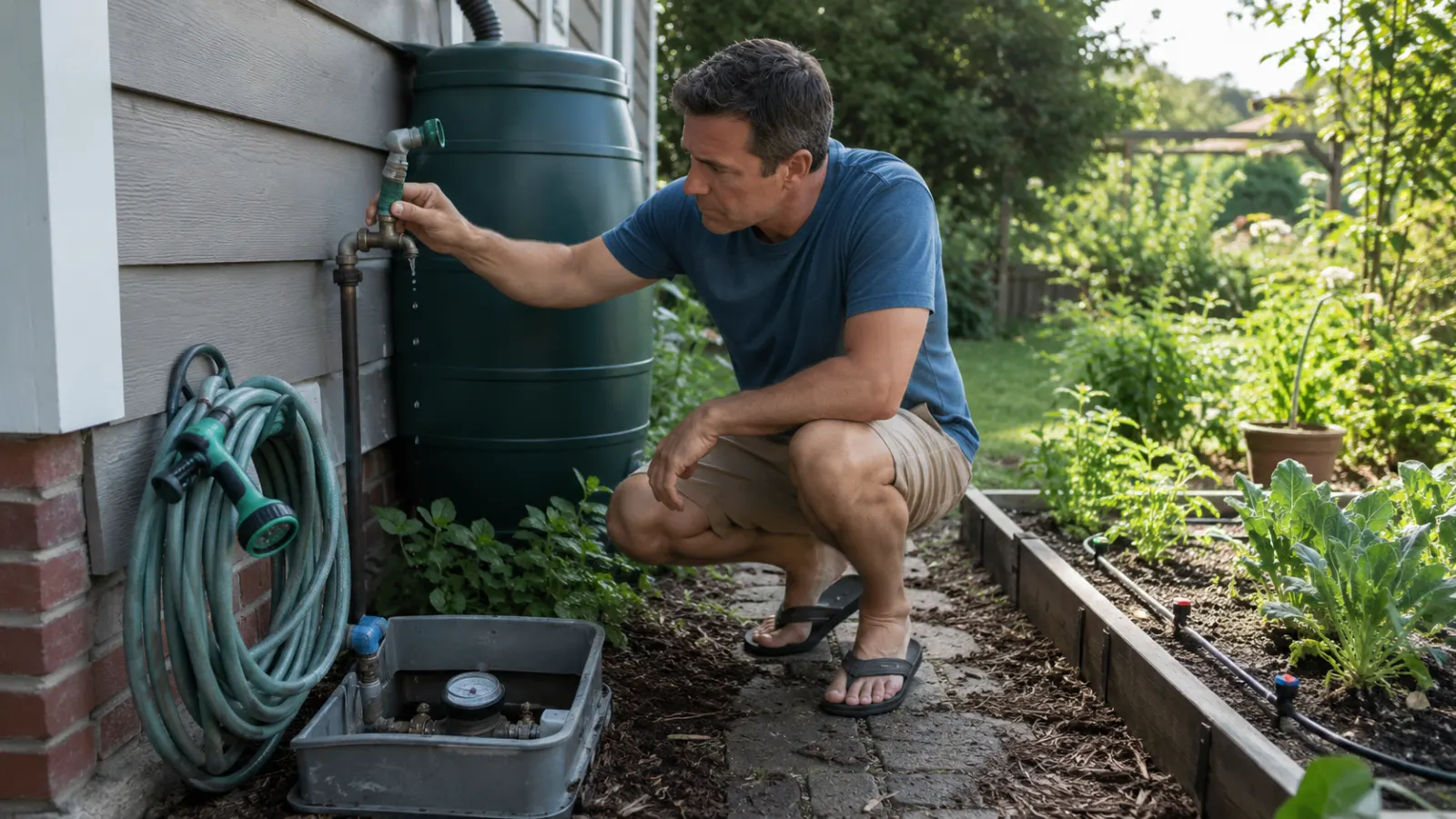
A practical household audit can begin with the water meter. Turn off all known water-using fixtures and appliances, then observe whether the meter still shows flow. If it does, the home may have a leak that needs investigation. Modern flow-monitoring systems can provide additional help by detecting unusual consumption patterns and notifying occupants when water continues to run at unexpected times.
Toilets, taps, shower connections, water heaters, irrigation lines and outdoor hose connections are all useful places to check. The principle is simple: fixing unnecessary flow is generally more valuable than trying to compensate for it by reducing legitimate use elsewhere. A household should not spend weeks taking shorter showers while an undetected toilet leak continues wasting water all day.
Toilets Can Be One of the Largest Indoor Uses
Toilets deserve more attention than they usually receive because flushing happens repeatedly and the water use is largely determined by the fixture itself. EPA WaterSense data cited in the supplied article indicate that toilets account for nearly 30% of average indoor residential water use in the United States. Older toilets can use substantially more water per flush than modern efficient models, which means replacing a frequently used high-volume fixture can create savings automatically for years.
In the United States, WaterSense-labelled toilets are designed to use 1.28 gallons per flush or less while meeting performance requirements. That specification should not be treated as a universal global standard because efficiency labels and plumbing regulations differ by country. The transferable lesson is to compare local efficiency ratings and actual performance rather than assuming that all toilets use similar amounts of water.
Maintenance remains just as important as design. A high-efficiency toilet with a damaged flapper or seal can waste more water than an older toilet that functions correctly. Replacing fixtures without repairing leaks therefore solves only half the problem.
Shower Use Depends on Both Flow and Time
Shower water consumption is easy to understand mathematically because it depends on flow rate multiplied by shower duration. Reducing either lowers water use, while reducing both has an even larger effect. EPA estimates cited in the supplied article put showering at roughly 17% of indoor household water use in the United States, which makes showers an important target for efficiency.
An efficient showerhead reduces flow automatically without requiring the user to make a conservation decision every morning. This is why fixture efficiency is often more durable than relying only on behaviour. However, a lower-flow showerhead does not make shower duration irrelevant. If flow falls modestly but shower time doubles, total water use can still rise.
The best approach combines a comfortable efficient fixture with a reasonable shower duration. Conservation should not require making basic hygiene unpleasant, because measures people dislike are less likely to remain part of everyday life. Reducing hot-water use has an additional benefit because heating less water can lower household energy consumption as well.
Use Taps Intelligently, Not Obsessively
Turning off the tap while brushing teeth, shaving or carrying out another task that does not require continuous running water is sensible. A tap should not run simply because nobody has bothered to close it. Faucet aerators can also reduce flow automatically, especially in bathrooms where full high-volume flow is rarely necessary.
At the same time, tap conservation should remain proportional to the rest of the home’s water use. A person can diligently turn off the tap while brushing and still waste far more water through a leaking toilet or badly programmed garden irrigation system. Conservation works best when small habits reinforce larger improvements rather than replace them.
In kitchens, avoiding unnecessary continuous flow can also help. Drinking water can be cooled in the refrigerator instead of leaving the tap running until it becomes cold, and vegetables can be washed using only the amount of water actually required. These habits matter, but they should be understood as part of a larger conservation system.
Run Dishwashers Efficiently
Modern dishwashers can be surprisingly water-efficient when used correctly. The assumption that hand washing is automatically better often comes from the fact that a person can see the water being used, while dishwasher consumption is hidden inside the appliance. In reality, a modern efficient dishwasher operating with a full load can use water very effectively.
EPA WaterSense guidance recommends running dishwashers when appropriately loaded and scraping plates rather than rinsing each one extensively under a running tap before loading. The exact efficiency depends on appliance design, cycle choice and local product standards, but the general principle is straightforward: use the capacity of the machine rather than repeatedly operating it with only a few items.
When replacing an appliance, compare both energy and water performance. The most efficient product is not necessarily the cheapest to purchase, but recurring savings can accumulate across hundreds of cycles during its lifetime.
Use Washing Machines at Appropriate Loads
Laundry follows the same basic principle. Running a nearly empty washing machine can consume disproportionate water and energy compared with using the machine closer to an appropriate full load. When the appliance provides load-size settings, those controls should match the actual amount of laundry.
Modern high-efficiency washing machines can reduce both water and energy demand, so appliance replacement offers an opportunity to improve household efficiency automatically. Product labels vary internationally, which means users should consult local efficiency standards rather than relying only on American specifications.
Again, the important measure is not whether the user can see the water but how much water the appliance consumes per useful cycle. Efficiency should be evaluated through actual consumption and performance rather than intuition.
Outdoor Watering Can Dominate Household Demand
In homes with gardens, lawns or irrigation systems, the largest conservation opportunity may be outdoors. EPA estimates cited in the supplied article suggest that outdoor use accounts for around 30% of average household water use nationally in the United States and can become substantially higher in arid regions.
This means household conservation advice should change according to climate and property type. A small apartment with no garden has very different priorities from a detached home maintaining a heavily irrigated landscape through a dry summer. In the second case, changing irrigation practices may save far more water than all indoor tap habits combined.
Watering should reflect plant need rather than a rigid schedule. Broken sprinkler heads should be repaired, irrigation should reach plants rather than pavements, and watering during cooler periods can reduce unnecessary evaporation where appropriate. Mulching can also reduce moisture loss from soil and help plants remain hydrated for longer between irrigation cycles.
Landscape Choice Determines Long-Term Water Demand
One of the most important outdoor conservation decisions happens before the irrigation system is switched on: what is being planted? A landscape designed around species requiring frequent irrigation in a naturally dry climate will always be difficult to make water-efficient. The irrigation system may become technically sophisticated, but it is still compensating for a mismatch between plants and climate.
Native and drought-tolerant plants can reduce water demand, although “native” should not be interpreted as “requires no water.” Plant needs depend on local rainfall, soil, maturity and season. Local horticultural advice is therefore more useful than generic claims about one universal list of low-water plants.
Grouping plants according to similar water requirements can also improve irrigation efficiency. A drought-tolerant plant should not receive the same watering schedule as a species requiring consistently moist soil simply because both happen to share one irrigation zone.
Smarter Irrigation Is Better Than Blindly Watering Less
Outdoor conservation is not simply about reducing watering time. A badly designed irrigation system can waste water through runoff, overspray, leaks and poor timing even when the schedule appears conservative. Smarter systems attempt to match irrigation more closely to actual conditions.
Weather-based controllers can reduce watering after rainfall or adjust schedules according to climate conditions, while soil-moisture sensors can help determine whether irrigation is necessary. Drip irrigation can deliver water more directly to root zones for appropriate plants, reducing some of the losses associated with spraying large areas.
Technology still requires maintenance. Emitters clog, pipes crack, sprinkler heads shift and sensors can fail. Homeowners should occasionally observe the irrigation system while it is operating instead of assuming that a system installed several years earlier still performs exactly as intended. Many obvious problems become visible only when someone watches where the water actually goes.
Water and Energy Use Are Connected
Household water consumption also creates energy demand. Utilities use energy to extract, treat and move water, while households use energy to heat water for showers, cleaning and washing. Wastewater then requires collection and treatment after use.
This means saving hot water can produce two types of benefit at once. Efficient showerheads, taps, dishwashers and washing machines can reduce the amount of water consumed while also lowering the energy needed to heat or process it. In some homes, the energy savings can be as financially noticeable as the water savings.
This connection is useful because conservation does not need to be framed only as an environmental sacrifice. Efficient systems can reduce operating costs while maintaining the service people actually need.
Rainwater Harvesting Can Reduce Demand on Treated Water
Roof runoff can be captured in a rain barrel or larger storage system for gardening or other permitted non-potable uses. This can reduce demand on mains water and provide local storage during wet periods. It may also retain some stormwater on the property rather than sending all of it immediately into drainage systems.
However, stored rainwater should not automatically be considered safe to drink. Roof materials, animal droppings, dust and storage conditions can introduce contamination. Potable use therefore requires appropriate treatment and compliance with local public-health rules. The source article correctly treats rainwater harvesting as a useful conservation tool without presenting it as an automatic substitute for safe drinking-water systems.
Storage also needs to be properly managed. Tanks and barrels should be protected against mosquito breeding and accidental contamination, and overflow should be routed safely.
Greywater Reuse Can Reduce Potable-Water Demand
Greywater is wastewater from sources such as showers, baths or laundry that may sometimes be reused for irrigation or toilet flushing. In suitable homes and jurisdictions, reuse can reduce demand for potable water by giving water a second function before it leaves the household system.
But greywater is not simply clean water that happens to have been used once. It can contain detergents, salts, microorganisms and other contaminants, and inappropriate use can harm soil or create health risks. Plumbing systems also need to prevent greywater from contaminating drinking-water supplies.
Local building codes and health requirements therefore matter. Greywater reuse can be effective, but it should be treated as a designed water system rather than an improvised shortcut.
Household Water Treatment Can Also Produce Wastewater
Some household water-treatment technologies consume additional water as part of the purification process. Reverse-osmosis systems, for example, reject part of the incoming water while producing treated water. The amount rejected varies substantially according to system design and operating conditions.
Where treatment is genuinely needed for health or water-quality reasons, that benefit is more important than reducing water use at any cost. The objective should not be to compromise drinking-water safety simply to achieve conservation. Instead, households should understand the actual local water-quality problem before purchasing treatment equipment and select efficient systems where treatment is appropriate.
Marketing can encourage people to install treatment technologies even when they have not established what problem they are solving. Good conservation therefore begins with evidence: test or understand the water-quality issue, choose treatment suited to that issue and maintain the equipment properly.
Measure Water Use Instead of Guessing
Household conservation becomes far more useful when consumption is measured. Water bills can provide monthly or seasonal baselines showing how much water the property actually uses. The consumption figure is usually more informative than the final amount charged because tariffs and fixed fees can change independently of physical use.
A sudden unexplained increase can indicate a leak. A large summer spike may reveal that irrigation dominates household demand. A change following the installation of efficient fixtures can show whether those measures produced measurable savings.
The logic is similar to managing electricity: a household that never looks at consumption has little evidence about whether its efficiency efforts are working. Establish a baseline, make changes and compare the results.
High Bills Can Reveal Hidden Problems
A higher water bill is not always caused by people consciously using more water. Seasonal irrigation, unnoticed toilet leaks, broken underground pipes or malfunctioning appliances can produce increases without obvious behavioural change.
Comparing consumption across similar months from different years can be more useful than comparing one month directly with the previous month. A July household may naturally use more water than a January household, but a July consumption figure that suddenly rises well above previous summers deserves investigation.
Monitoring therefore serves two purposes: it measures conservation and acts as an early-warning system for waste.
Make Efficient Choices Automatic
The strongest household conservation measures are usually those that continue working without constant attention. A repaired leak stops wasting water automatically. An efficient toilet uses less with every flush. A properly configured irrigation controller reduces unnecessary watering without requiring someone to remember every weather change.
Behaviour still matters, but systems reduce the amount of willpower required. This is important because a conservation strategy based entirely on constant vigilance is difficult to sustain. People forget, routines change and households contain multiple users with different habits.
Designing efficiency into the home makes the lower-water option the default. That is more durable than relying solely on repeated reminders.
Replace Fixtures Strategically, Not Automatically
Efficiency does not mean throwing away every existing fixture and appliance immediately. Manufacturing replacements also consumes materials and money, and a properly functioning existing fixture may still perform adequately.
Replacement makes the strongest case when the current product uses unusually large amounts of water, is already approaching the end of its life or needs frequent repair. A leaking old toilet or inefficient washing machine may justify replacement much sooner than a low-use fixture that functions perfectly.
The decision should therefore consider both current consumption and expected future use. Conservation is strongest when investment is directed toward the products producing the largest recurring losses.
Think in Terms of Lifetime Savings
One reason efficient fixtures matter is that small per-use reductions become large when repeated thousands of times. A toilet may be flushed several times per person every day. A showerhead may operate every morning. A washing machine may run hundreds of cycles during its useful life.
This is different from one-time behavioural savings. An efficient fixture creates a recurring reduction each time it operates, which is why improving high-use systems can have such a large cumulative effect.
The same logic applies to leaks in the opposite direction. A small continuous loss may appear trivial in one minute but become substantial after weeks or months.
Do Not Treat Conservation as a Competition in Discomfort
Household water advice can become counterproductive when it implies that the best conservation is whichever habit feels most inconvenient. Extremely short showers, avoiding normal hygiene or refusing reasonable water use can make conservation seem like deprivation.
The goal should be to remove waste while preserving useful service. An efficient shower that remains comfortable is better than an unpleasant arrangement people eventually abandon. A well-designed garden that needs less irrigation is better than repeatedly allowing unsuitable plants to suffer.
Durable conservation is usually achieved through design, maintenance and appropriate technology rather than through making ordinary life unnecessarily difficult.
Teach Household Members Where the Water Actually Goes
Water conservation becomes easier when everyone in the household understands which uses matter most. Children and adults can learn to close taps, report running toilets and avoid unnecessary outdoor watering, but the explanation should remain proportional.
A household that knows irrigation dominates its summer use can focus attention there. Another home may discover that a leaking toilet or old fixture is the main problem. Conservation works better when people are responding to actual consumption rather than generic guilt.
Simple measurement can therefore improve both behaviour and decision-making.
Water-Saving Habits Still Matter
System improvements do not make behaviour irrelevant. People can still waste water through unnecessarily long showers, leaving taps running, repeatedly operating half-empty appliances or watering landscapes without regard to weather.
The point is to place behaviour in the correct hierarchy. Once continuous leaks are repaired and high-use systems are efficient, daily habits reinforce those structural savings. Behaviour becomes the final layer of conservation rather than the only layer.
This produces a much healthier approach. The household is not asked to compensate indefinitely for poor infrastructure through constant self-denial.
Household Conservation Is Only One Part of Water Security
It is important not to confuse household efficiency with solving an entire regional or national water crisis. Agriculture, industry, power generation, groundwater extraction and public-network leakage can account for much larger water volumes than domestic use in many places.
A person taking shorter showers cannot offset the consequences of an aquifer being over-pumped at regional scale or a municipal system losing enormous quantities of treated water through damaged infrastructure. The supplied article correctly emphasises that household conservation should create a culture of efficient use without shifting responsibility away from institutions controlling the largest withdrawals.
The strongest water policy therefore combines efficient households with efficient utilities, sustainable agricultural management, water reuse, pollution control and credible limits on extraction. Individual action and institutional reform are complements rather than substitutes.
Frequently Asked Questions
What is the best way to save water at home?
Start by finding and repairing leaks because they waste water continuously without providing any benefit. Then improve high-use fixtures and appliances, manage outdoor watering efficiently and reinforce those savings with sensible daily habits.
Are leaking toilets a major source of waste?
Yes. Toilet leaks can continue silently for long periods, making them an important target for household water audits.
How can I check for a hidden leak?
Turn off known water-using fixtures and appliances and check whether the water meter still shows consumption. Persistent flow may indicate a leak that needs investigation.
Do efficient toilets really save water?
They can, particularly when replacing older high-volume toilets in frequently used bathrooms. Local efficiency standards should be used when selecting a replacement.
Is taking shorter showers useful?
Yes. Shower use depends on both flow rate and duration, so reducing either can lower consumption. Combining a reasonable shower duration with an efficient showerhead can produce larger recurring savings.
Does turning off the tap while brushing matter?
Yes, because running water provides no useful service during that period. However, it should not distract from larger sources of waste such as leaks or excessive irrigation.
Is a dishwasher more efficient than washing dishes by hand?
Modern efficient dishwashers can use water effectively when operated with appropriate full loads. Hand washing is not automatically more efficient simply because the user can see the water.
Should washing machines always be run completely full?
They should generally be used at appropriate loads or with the correct load-size setting rather than repeatedly operating with very small loads.
How much household water is used outdoors?
The amount varies enormously by climate and property type. EPA figures cited in the supplied article estimate around 30% nationally for U.S. households, with considerably higher shares possible in arid areas.
How can I reduce garden water use?
Choose plants suited to local climate, group plants with similar water requirements, repair irrigation leaks, avoid watering pavements, use mulch and adjust irrigation according to actual weather and plant needs.
Are smart irrigation controllers useful?
They can be. Weather-based and soil-moisture-based controllers can reduce unnecessary watering when correctly installed, configured and maintained.
Does saving hot water save energy?
Yes. Heating water requires energy, so reducing unnecessary hot-water consumption can lower both water and energy use.
Can rainwater harvesting save mains water?
Yes. Harvested rain can substitute for treated mains water for appropriate non-potable uses such as garden irrigation, subject to local rules and safe system design.
Is rainwater safe to drink?
Not automatically. Roofs, gutters and storage systems can introduce contamination, so potable use requires appropriate treatment and compliance with local health guidance.
What is greywater reuse?
Greywater reuse involves using certain wastewater from showers, baths or laundry for suitable purposes such as irrigation or toilet flushing where local health and plumbing rules permit.
Does reverse osmosis waste water?
Some reverse-osmosis systems reject part of the incoming water during treatment. Efficiency varies significantly by system.
Should I avoid water treatment to save water?
No. Safe drinking water takes priority. Where treatment is genuinely necessary, choose a system appropriate to the water-quality problem and consider efficiency as one factor.
Can my water bill help detect waste?
Yes. Unexpected increases in consumption can reveal leaks or changing outdoor use, particularly when compared with similar seasons from previous years.
Are small daily habits enough to solve water scarcity?
No. Household efficiency helps, but regional scarcity may be driven much more strongly by agriculture, industry, groundwater depletion or public infrastructure losses.
A Practical Household Water-Saving Order
A useful sequence begins with leak detection and repair, because continuous losses provide no service. Next, examine high-use fixtures such as toilets and showers, followed by washing machines and dishwashers where replacement or operating habits can improve efficiency. Outdoor irrigation should then receive serious attention because it can dominate total demand in homes with gardens, particularly in dry climates.
After those structural improvements, everyday habits become the final layer: close taps when water is not needed, operate appliances efficiently, avoid unnecessary shower time and pay attention to unusual consumption. Rainwater harvesting, greywater reuse or smarter treatment systems can then provide additional savings where they fit local conditions.
This order matters because not all litres are equally easy to save. The best conservation measure is often the one that eliminates repeated waste automatically.
The Central Idea
Saving water at home is most effective when households stop treating every drop as though it has equal conservation value. A few seconds of unnecessary tap flow matter, but a silent toilet leak may waste water continuously. A slightly shorter shower helps, but an efficient showerhead reduces consumption every time anyone uses it. A carefully rinsed plate saves little if the garden irrigation system is sending water onto pavement for an hour.
The supplied article’s strongest practical principle is therefore the correct one: find the biggest flows, eliminate continuous waste, then improve everyday habits.
This hierarchy turns conservation from a guilt-based exercise into a systems problem. Measurement identifies where water is actually going. Repairs eliminate consumption that provides no useful service. Efficient fixtures and appliances reduce demand automatically. Better landscaping and irrigation address outdoor use, which can dominate household demand in dry climates. Behaviour then protects and reinforces those gains.
More advanced measures such as rainwater harvesting and greywater reuse can contribute where local climate, regulations and building design support them, but they should not be implemented casually. Drinking-water safety, mosquito control, plumbing standards and water quality still matter.
Household conservation also needs to remain in perspective. Homes should avoid waste, but major water crises cannot be solved entirely through individual behaviour when agriculture, industrial use, groundwater depletion or municipal leakage dominate the larger water balance.
The best household strategy is therefore neither indifference nor obsession. It is to make efficient water use the default condition of the home.
Repair what leaks. Improve what repeatedly uses too much. Measure what you consume. Manage outdoor demand according to actual need. Then support those structural improvements with sensible habits.
Conservation becomes far easier when the house itself is designed not to waste water by default.