Guru Nanak Biography: Life, Teachings and the Foundations of Sikhism
A Guru Nanak biography can begin with a sentence that appears straightforward: Guru Nanak was the founder of Sikhism. The statement is correct, but by itself it conceals one of the most important aspects of his historical significance.
Religious traditions rarely appear fully formed in a single moment. They develop through teaching, communities, sacred texts, practices, institutions and systems of authority. Several of those foundations were already visible by the end of Guru Nanak's life. He composed hymns, articulated a distinctive understanding of the One divine reality, challenged caste pride and religious performance without ethical substance, gathered disciples and established a settled community at Kartarpur organised around worship, work and shared life.
Most consequentially, Guru Nanak appointed a successor. Instead of allowing the movement to depend entirely on his personal charisma, he entrusted Guruship to Bhai Lehna, who became Guru Angad.
That is why describing Nanak simply as a poet of Hindu-Muslim harmony is inadequate. His teachings certainly challenged religious division, but they went much further. They created the theological, devotional and communal foundations of a path that the succeeding Gurus developed into the Sikh Panth.
Guru Nanak at a glance
| Born | 1469 |
| Birthplace | Rai Bhoi di Talwandi, now Nankana Sahib in Pakistan |
| Parents | Mehta Kalu and Mata Tripta |
| Close early supporter | Bebe Nanaki, his elder sister |
| Religious tradition | Founder and first Guru of Sikhism |
| Close companion in tradition | Bhai Mardana |
| Major settlement | Kartarpur |
| Core themes | Ik Onkar, Naam, hukam, truthful living, equality, honest work and sharing |
| Successor | Guru Angad |
| Died | 1539 at Kartarpur |
Talwandi and the Punjab of the fifteenth century
Guru Nanak was born in 1469 at Rai Bhoi di Talwandi, the town now known as Nankana Sahib in Pakistan. Sikh institutional tradition identifies his parents as Mehta Kalu and Mata Tripta and remembers his elder sister, Bebe Nanaki, as an important early supporter.
Understanding Punjab during Nanak's lifetime is essential to understanding his thought.
The region belonged to a connected social and cultural world shaped by Persianate government, Islamic religious institutions, Hindu communities, agriculture, commerce and numerous devotional movements. Sufis, Nath yogis, Vaishnava teachers, ascetics and local religious specialists operated within the wider landscape.
Modern retellings can make this world appear as though Nanak stood between two completely separate civilisations called Hinduism and Islam. Fifteenth- and sixteenth-century Punjab was considerably more entangled. Languages, poetry, music, administrative traditions and religious ideas crossed social boundaries even while different communities maintained their own institutions and identities.
Guru Nanak's compositions reflect this environment. His vocabulary engages concepts familiar from Sanskritic, vernacular and Islamicate traditions, yet the theology expressed through those terms should not be reduced to a simple combination of borrowed Hindu and Muslim ideas.
What do historians actually know about Guru Nanak?
Writing a historical biography of Guru Nanak presents an unusual source problem.
His own hymns provide the most important early evidence for his religious thought. Some compositions also engage contemporary political events and social conditions.
The detailed stories of his life, however, come largely from later narratives called the Janamsakhis, literally accounts or testimonies of birth and life.
These narratives became enormously important within Sikh tradition. They describe Nanak's childhood, spiritual awakening, travels, encounters with religious figures and extraordinary events. But they were composed after his lifetime and combine historical memory with theology, symbolism, instruction and miracle narratives.
Historians therefore do not normally treat every Janamsakhi story as if it were a contemporary diary entry.
That does not make the Janamsakhis useless. They reveal how Sikh communities remembered Guru Nanak and understood the religious meaning of his life.
A careful biography needs to preserve both levels. Tradition matters, but tradition and independently verifiable history are not always the same category of evidence.
Sultanpur Lodhi and Nanak's spiritual calling
An important phase of Nanak's adult life is associated with Sultanpur Lodhi, where Sikh tradition places him in employment connected with the administration of Daulat Khan Lodi. His sister Nanaki and her husband were also associated with the town.
The best-known story from this period describes Nanak disappearing while bathing, remaining absent for several days and returning with a transformed spiritual mission.
Later tradition associates this episode with the proclamation commonly rendered as:
“There is no Hindu, there is no Muslim.”
The precise historical circumstances and wording cannot be established with the certainty of a contemporary documentary record.
The theological point is nevertheless powerful.
Inherited religious identity, by itself, does not guarantee truthful living or closeness to the divine.
This should not be interpreted as Nanak claiming that all religious differences were meaningless. His hymns contain definite theological positions and sharp criticisms of practices he considered spiritually empty.
The deeper challenge was to the assumption that a label could substitute for spiritual and ethical transformation.
Ik Onkar: the centre of Guru Nanak's theology
The Sikh scriptural tradition opens with Ik Onkar, affirming the One Reality.
The Mul Mantar that follows describes the divine through a compact sequence of ideas including truth, creative reality, freedom from fear and enmity, transcendence of ordinary birth and knowledge through divine grace.
For Sikh theology, this is foundational.
God is not simply “one god” within a larger catalogue of possible gods. Divine reality is the ultimate source and ground of existence.
The One is beyond limitation yet present within creation.
This is why Guru Nanak's theology cannot be understood merely as a numerical claim that there is one God instead of many. The more important religious question is how the human being lives in relation to that One Reality.
Naam, hukam and haumai
Three concepts are particularly important for understanding Guru Nanak's thought: Naam, hukam and haumai.
Naam
Naam, literally the divine Name, involves far more than mechanically repeating a particular word.
It signifies remembrance, awareness and orientation toward divine reality. The later Sikh practice of Naam Simran develops this principle through sustained remembrance and meditation on the divine Name.
Hukam
Hukam can be translated as divine command, order or ordinance.
Human beings exist within a reality that they do not control. Wisdom involves learning to live according to that order rather than imagining that the individual ego is the independent master of existence.
Haumai
Haumai is commonly translated as ego or self-centredness.
It describes the condition in which the individual becomes trapped in a false sense of separation and self-importance.
Pride in caste, wealth, scholarship, status or even religious achievement can become expressions of the same underlying problem.
This gives Guru Nanak's criticism of hierarchy a theological basis. Equality is not merely an attractive social principle. Human superiority becomes difficult to justify when all existence depends on the same ultimate divine reality.
Naam Japo, Kirat Karo and Vand Chhako
A popular modern summary of Guru Nanak's teaching presents three principles:
Naam Japo — remember the divine.
Kirat Karo — earn through honest work.
Vand Chhako — share what you have with others.
These formulations are extremely useful summaries of Sikh ethical teaching. They should not, however, automatically be treated as though the exact modern three-part slogan appears everywhere in the earliest sources in precisely this form.
The underlying ideas are nevertheless deeply embedded in Sikh tradition.
Guru Nanak did not teach that spiritual life required permanent abandonment of family, work or society.
The householder could pursue a spiritual life while earning honestly, resisting exploitation and sharing resources with other people.
This was a significant alternative to religious models in which liberation was closely associated with renunciation.
Economic behaviour therefore became part of religious life.
How wealth is earned matters.
How resources are shared matters.
How a person participates in community matters.
Guru Nanak on caste and equality
Guru Nanak's hymns challenge caste pride and inherited claims of spiritual superiority.
Again and again, social status is denied the power to determine a person's ultimate religious worth.
The implication is profound: birth does not create a hierarchy before the divine.
Later Sikh institutions gave increasingly visible social form to this principle. Congregation and the development of langar, the shared community kitchen, placed people together in ways that challenged inherited hierarchy.
Historical precision is important here.
The existence of anti-caste theology does not mean that caste disappeared immediately from Punjabi society or from the lives of every Sikh. Caste identities continued to influence marriage, occupation and social relationships.
But the persistence of social practice does not erase the theological challenge.
Sikh teaching removed legitimate spiritual authority from claims of caste superiority.
A religious tradition can reject a hierarchy even when its followers continue struggling with structures inherited from the surrounding society.
Bhai Mardana, kirtan and the power of music
Guru Nanak's teaching cannot be separated from poetry and music.
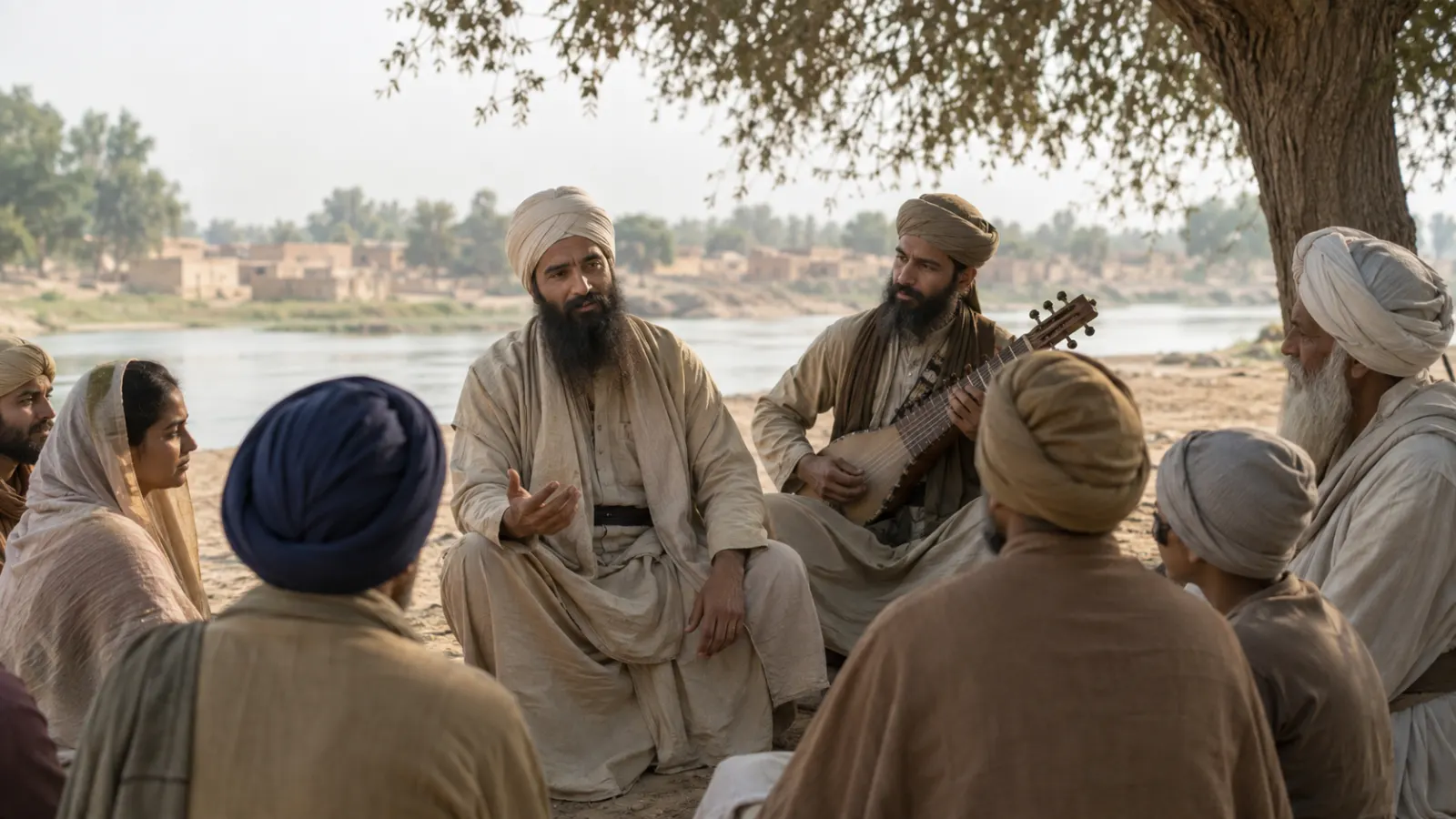
Sikh tradition remembers Bhai Mardana, a Muslim musician associated with the mirasi community, as Nanak's close companion. Mardana is traditionally portrayed playing the rabab while Nanak sings his compositions.
The image captures several features of early Sikh religious life: musical performance, poetry in accessible language, companionship across inherited community boundaries and the importance of sung teaching.
Gurbani is therefore not simply religious information intended to be read silently.
Much of Sikh scripture is organised through musical frameworks known as ragas, and its performance as kirtan remains central to Sikh worship.
Music also helped turn theological ideas into communal experience.
A hymn can be heard, remembered, repeated and sung together.
Through sound, religious teaching moves from individual insight into shared practice.
The Udasis: Guru Nanak's journeys
Sikh tradition attributes extensive journeys, known as the Udasis, to Guru Nanak.
Janamsakhi accounts describe him travelling across the Indian subcontinent and beyond it. Traditional itineraries include religious centres associated with Hindus, Muslims and yogis, with narratives placing him at locations including Haridwar, Banaras, Jagannath Puri, Himalayan centres, Mecca and Baghdad.
The broad image of Guru Nanak as an itinerant teacher is deeply embedded in Sikh memory.
The exact route and historicity of every individual journey are more difficult to establish.
Many travel episodes function simultaneously as biographies and theological lessons.
At Haridwar, for example, Nanak is traditionally described as throwing water in the opposite direction from pilgrims to expose ritual performed without understanding.
In the celebrated Mecca narrative, a dispute concerning the direction of his feet becomes a lesson about the impossibility of confining the divine to one geographic direction.
Stories of encounters with yogis similarly develop the argument that spiritual truth does not necessarily require withdrawal from society.
The historical and theological layers should therefore be kept distinct.
Sikh tradition remembers enormous missionary journeys. Historical scholarship can recognise the tradition without claiming independent documentation for every detail found in later narratives.
Guru Nanak and Babur's invasions
Guru Nanak's compositions are not limited to private devotion.
Some of his hymns respond directly to the political violence associated with Babur's invasions of north India. These compositions are commonly referred to as the Babur Bani.
They are especially important because they provide evidence of Guru Nanak responding to events occurring during his own lifetime.
Conquest is not treated as morally legitimate simply because an army succeeds.
Violence, suffering and political arrogance are judged within a larger ethical and theological framework.
This prevents Guru Nanak's spirituality from being interpreted as indifference to the world.
Yet it would also be anachronistic to turn his criticism into a modern nationalist political programme. Nanak lived centuries before the creation of modern India and Pakistan and before contemporary political categories existed.
His judgment was theological and moral: power remained answerable to truth.
Kartarpur: where a teaching became a community
Guru Nanak's settlement at Kartarpur, on the Ravi River, was among the most important developments in his life.
The travelling teacher eventually established a settled community.
Followers gathered around regular devotion and singing. Agricultural and household life continued. Shared food and collective life became important features of the community.
This matters enormously for understanding the emergence of Sikhism.
Guru Nanak was not presenting perpetual wandering as the ideal religious condition.
Kartarpur demonstrated that spiritual life could be organised through stable social forms.
Here we begin to see a pattern that could survive beyond the founder:
congregation, devotion, work, household life, service and sharing.
The concept of sangat, the congregation, became central to Sikh life.
Religious authority was therefore not limited to an individual's private mystical experience. It was embodied increasingly in a community.
Guru Nanak's most consequential decision: choosing a successor
Before his death in 1539, Guru Nanak selected Bhai Lehna as his successor.
Lehna became Guru Angad, the second Sikh Guru.
Few decisions were more important for the future of the Sikh tradition.
Movements centred on charismatic teachers frequently fragment when their founders die. Family members may compete for authority, disciples may create rival factions and teaching traditions may split.
Guru Nanak established another principle.
Guruship would continue.
Succession also did not pass automatically to one of his sons. Spiritual authority was transferred through recognised discipleship rather than simply inherited as family property.
The institution of Guruship continued through nine successors after Nanak.
Each Guru operated in a different historical environment and contributed to the continued development of Sikh scripture, institutions, community organisation and identity.
Sikhism cannot therefore be understood as though every later institution appeared completely formed during Nanak's lifetime.
But the continuity made possible by succession began with him.
From Guru Nanak's hymns to Sikh scripture
Guru Nanak did not write a conventional systematic theological treatise.
He composed hymns.
Those compositions became part of the developing Sikh scriptural tradition and eventually entered the Adi Granth, compiled under Guru Arjan in 1604.
The scripture included the compositions of Sikh Gurus alongside selected works of Bhagats and other devotional voices whose teachings were received into the Sikh canon.
The scriptural tradition later incorporated the hymns of Guru Tegh Bahadur. With the conclusion of the line of human Gurus under Guru Gobind Singh, the Guru Granth Sahib came to occupy the position of enduring Guru within Sikh tradition.
This process is important historically.
Guru Nanak survives not only through later biographies about him but also through an extensive body of attributed compositions preserved inside Sikh scripture.
The availability of these hymns gives historians and theologians a much stronger foundation for examining his thought than would exist if only later miracle narratives had survived.
Why “Hindu-Muslim harmony” does not adequately explain Guru Nanak
Modern public commemorations frequently present Guru Nanak as someone who taught Hindus and Muslims to live peacefully together.
The description contains an important truth but can become so general that it removes the specificity of his religious teaching.
Guru Nanak did not simply announce that every existing belief or practice was equally correct.
He criticised falsehood.
He attacked empty ritual.
He questioned inherited status.
He articulated a theology centred on the One.
He emphasised remembrance, truthful living, honest work and sharing.
He created a congregation.
And he established continuity through Guruship.
His teaching had a universal orientation but developed through a distinctive religious form.
Recognising that distinction is essential for understanding Sikhism as a tradition in its own right rather than portraying it simply as a compromise between Hinduism and Islam.
Guru Nanak on rulers, power and truthful conduct
Guru Nanak's hymns also contain a political and ethical vocabulary that is sometimes overlooked when his teaching is reduced to private spirituality.
His compositions criticise unjust rulers, exploitation and religious authorities whose external respectability exists alongside moral failure.
The Babur-related hymns offer the clearest historical example, but the underlying concern is broader.
Political authority is not automatically righteous.
A ruler remains accountable to truth.
Rank, wealth and temporal power are temporary, and power becomes morally corrupted when it serves domination and ego rather than justice.
Guru Nanak did not leave behind a detailed theory of the state. It would therefore be misleading to project modern constitutional or political ideologies backward onto him.
Nevertheless, Sikh ethics had a public dimension from an early stage.
The marketplace, household, congregation and political world could not be completely separated from religious truth.
Honest work is important because exploitation is morally significant.
Sharing food is important because inequality has material consequences.
Congregation is important because religious truth must become visible through relationships between human beings.
Later Sikh institutions developed under circumstances very different from those of Guru Nanak.
Guru Hargobind, Guru Tegh Bahadur and Guru Gobind Singh confronted political conditions that produced institutional responses not found in exactly the same form during Nanak's lifetime.
Historical development therefore matters.
The stronger argument is not that every later Sikh institution was secretly designed by Guru Nanak in advance. It is that later developments continued to draw from principles already present in Sikh teaching: truthful conduct, collective responsibility, human dignity and the refusal to detach spirituality entirely from injustice.
Continuity in principle and change in institution can exist together.
Why Guru Nanak still matters
Guru Nanak's legacy survives through institutions and practices that continue to shape Sikh life: Gurbani, the Guru Granth Sahib, sangat, kirtan, langar, Naam, seva and the historical succession of the Gurus.
His hymns also continue to pose questions that extend far beyond the sixteenth century.
What value does religious identity possess without truthful conduct?
What happens when ego hides behind learning, wealth or ritual?
Can work become a spiritual practice?
What does equality mean when society continues ranking human beings according to birth?
What happens when religion becomes performance rather than transformation?
And how should a community organise itself so that devotion produces service rather than private prestige?
Guru Nanak's answer was not withdrawal from human life.
His teaching made room for remembrance, work, family, music, service and community.
That is why even the term religious reformer describes him only partially.
A reformer changes an existing institution.
Guru Nanak's teachings, disciples, community and succession created the foundations from which a distinct Sikh religious tradition developed.
Frequently Asked Questions
Who was Guru Nanak?
Guru Nanak was the first Sikh Guru and the founder of Sikhism. Born in Punjab in 1469, he became a religious teacher and poet whose hymns emphasised the One divine reality, remembrance of God, truthful conduct, equality, honest work and sharing.
Where was Guru Nanak born?
Guru Nanak was born at Rai Bhoi di Talwandi in Punjab. The town is now called Nankana Sahib and is located in present-day Pakistan.
What were Guru Nanak's main teachings?
His teaching centred on devotion to the One divine reality, remembrance of Naam, living within hukam, overcoming haumai or ego, honest livelihood, sharing, truthful conduct and rejection of inherited spiritual superiority.
What does Ik Onkar mean?
Ik Onkar expresses the foundational Sikh affirmation of the One ultimate divine Reality. It introduces the Mul Mantar at the beginning of Sikh scripture.
Did Guru Nanak oppose caste?
Guru Nanak strongly criticised caste pride and the idea that birth determines spiritual worth. Later Sikh practices, including congregation and langar, gave institutional expression to the principle of human equality.
Who travelled with Guru Nanak?
Sikh tradition especially remembers Bhai Mardana, a Muslim musician who played the rabab while Guru Nanak sang hymns.
What were Guru Nanak's Udasis?
The Udasis were the extensive journeys traditionally attributed to Guru Nanak during which he travelled, taught and interacted with different religious communities. Historians distinguish the broad travel tradition from the historical certainty of every itinerary described in later Janamsakhis.
What was Kartarpur's importance?
Kartarpur became the settled community where Guru Nanak spent the later part of his life. It brought together congregation, worship, work, household life and sharing and became an important model for the developing Sikh community.
Who succeeded Guru Nanak?
Guru Nanak chose Bhai Lehna as his successor. He became Guru Angad, the second Sikh Guru.
Did Guru Nanak found Sikhism?
Yes, Guru Nanak is recognised as the founder and first Guru of Sikhism. Historically, however, Sikh institutions continued developing through the nine Gurus who followed him, so the formation of the Sikh tradition was a process rather than a single event.