Guru Gobind Singh Biography: Life, Khalsa, Battles and Legacy
Guru Gobind Singh is often remembered as the warrior Guru who founded the Khalsa. Both descriptions are important, but neither by itself explains why the tenth Sikh Guru occupies such a decisive place in Sikh history.
Born Gobind Rai in Patna in 1666, he inherited the Guruship as a child after the execution of his father, Guru Tegh Bahadur. Over the next three decades he became a religious leader, poet, organiser and military commander whose life unfolded amid conflict with hill rulers, Mughal officials and imperial power.
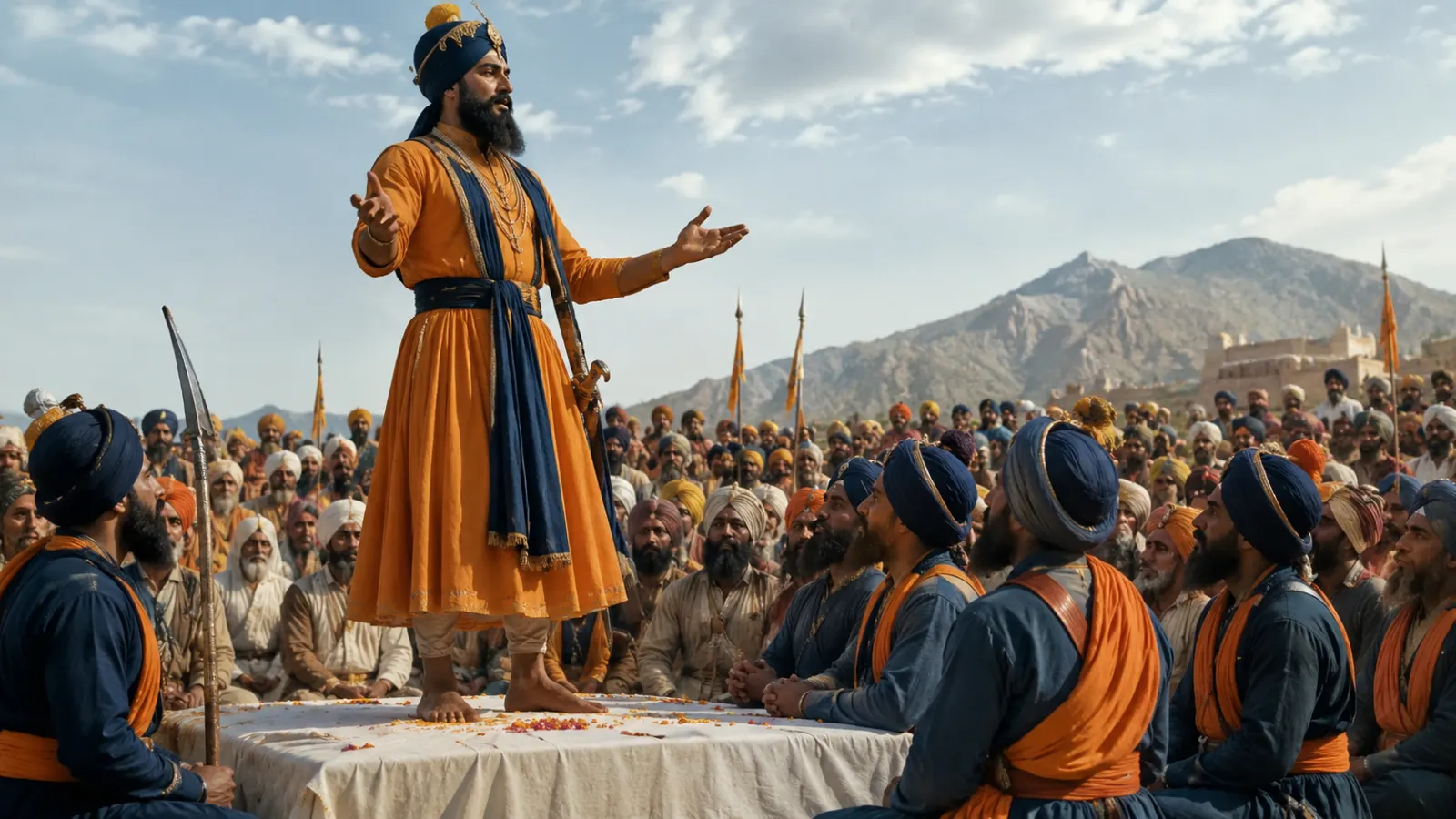
His most famous institutional act came at Anandpur on Vaisakhi in 1699, when Sikh tradition remembers the creation of the Khalsa and the initiation of the Panj Pyare, the Five Beloved Ones.
But the Khalsa did not create Sikhism from nothing.
About 230 years had passed since Guru Nanak's birth. Nine Gurus had already developed Sikh scripture, congregations, centres of worship, systems of leadership and a distinctive religious path. Guru Hargobind had earlier linked spiritual and temporal responsibility through the tradition remembered as miri-piri.
Guru Gobind Singh inherited that history and transformed its institutional form.
The Khalsa gave initiated Sikhs a disciplined collective identity combining devotion, ethical responsibility, equality and readiness to resist oppression. Before his death in 1708, Guru Gobind Singh also brought the succession of individual human Gurus to an end, leaving Sikh authority centred on scripture and community.
Those decisions made his life much more than the biography of a warrior.
They helped determine the future structure of Sikhism.
Guru Gobind Singh at a glance
| Birth name | Gobind Rai |
| Born | 22 December 1666 |
| Birthplace | Patna, Bihar |
| Father | Guru Tegh Bahadur |
| Mother | Mata Gujri |
| Position | Tenth Sikh Guru |
| Became Guru | 1675 |
| Known for | Founding the Khalsa, Sikh leadership, literature and resistance to oppression |
| Khalsa established | Vaisakhi, 1699 at Anandpur |
| Major literary association | Zafarnama and compositions associated with the Dasam Granth |
| Died | 1708 at Nanded |
| Historical legacy | Khalsa identity and transition from human Guruship to enduring scriptural/community authority |
The SGPC gives 22 December 1666 at Patna as Guru Gobind Singh's birth date, while modern scholarship treats the creation of the Khalsa in 1699 as the decisive institutional turning point of his career.
Patna: the childhood of Gobind Rai
Guru Gobind Singh was born as Gobind Rai in Patna in 1666 while his father, Guru Tegh Bahadur, was travelling in eastern India.
His birthplace later became Takht Sri Harmandir Sahib Patna Sahib, one of the major Takhts, or seats of Sikh religious authority.
Gobind Rai's childhood did not remain centred in Bihar. His family eventually returned towards Punjab, and he became associated with the community at Anandpur in the Himalayan foothills.
Sikh accounts describe him as receiving an education that combined religious and literary learning with horsemanship and martial training. Later tradition associates him with Punjabi, Braj and Persian literary culture.
Some details of his education come from later narratives rather than contemporary administrative records. But the mature Guru's literary output, court culture and military leadership demonstrate that intellectual and martial formation were both central to the world in which he operated.
The execution of Guru Tegh Bahadur
The defining crisis of Guru Gobind Singh's childhood came in 1675.
His father, Guru Tegh Bahadur, the ninth Sikh Guru, was executed in Delhi during the reign of the Mughal emperor Aurangzeb.
Sikh tradition remembers Guru Tegh Bahadur's martyrdom particularly as a defence of freedom of conscience and associates it with appeals from Kashmiri Brahmins facing religious persecution.
Modern historical scholarship debates aspects of the circumstances, imperial motives and later narrative development. The execution itself, however, is not in doubt.
For Gobind Rai the consequence was immediate.
At roughly nine years of age, he became the tenth Sikh Guru.
He inherited a religious community whose relationship with political authority had already been shaped by persecution, negotiation and armed defence.
Guru Gobind Singh inherited a changing Sikh tradition
A common simplification divides Sikh history into a peaceful period beginning with Guru Nanak and a military period beginning with Guru Gobind Singh.
The historical development was more gradual.
Guru Arjan, the fifth Guru, had overseen the compilation of the Adi Granth and was executed during the reign of Jahangir.
Guru Hargobind subsequently emphasised the complementary dimensions remembered through miri-piri, conventionally understood as spiritual and temporal authority, and maintained an armed following.
Successive Gurus expanded Sikh networks and institutions while dealing with regional and imperial political realities.
Guru Gobind Singh therefore did not suddenly introduce the principle that Sikhs could defend themselves.
He inherited it.
His major innovation was to turn the disciplined Sikh community into a more explicit and increasingly collective institution through the Khalsa. J. S. Grewal's historical treatment similarly places Guru Gobind Singh within the longer relationship between the Sikh Panth, Mughal state and Punjab hill powers rather than treating 1699 as an isolated event.
Anandpur and the pressures surrounding the Sikh community
Anandpur became the principal centre of Guru Gobind Singh's activity during much of his career.
Its growth increased the religious and political visibility of the Sikh community.
The Guru operated near several hill states whose rulers existed within the complicated political structure surrounding Mughal imperial authority. Conflict arose repeatedly between his following, neighbouring chiefs and Mughal officials.
Religion mattered, but it was not the only variable.
Local power, political autonomy, territorial influence, revenue, alliances and imperial authority also shaped conflict.
That complexity makes simplistic communal descriptions misleading.
Some Hindu hill rulers fought against Guru Gobind Singh.
Muslims could also assist or support the Guru.
Political alignments in seventeenth-century north India did not divide neatly into one Sikh-Hindu bloc fighting one Muslim bloc.
The Battle of Bhangani
The Battle of Bhangani, generally dated to 1688, was one of the earliest major military confrontations associated with Guru Gobind Singh's leadership.
Sikh literary traditions remember the conflict in heroic terms and describe fighting involving hill rulers and their allies.
Its importance extended beyond the immediate battlefield.
The battle demonstrated that the Guru's following had acquired substantial martial organisation and could defend itself under his leadership.
Yet calling Guru Gobind Singh simply a warrior can obscure what martial authority meant within Sikh thought.
Force was expected to exist under ethical discipline.
Later Sikh language captured this ideal through the sant-sipahi, or saint-soldier: the person who combines spiritual discipline with readiness to defend others and confront oppression.
Why Vaisakhi 1699 changed Sikh history
The most famous event of Guru Gobind Singh's life took place at Anandpur during Vaisakhi in 1699.
According to Sikh tradition, the Guru addressed a large gathering and demanded a person willing to offer his head.
One volunteer came forward.
The Guru repeated the call until five men had responded.
They emerged as the Panj Pyare, the Five Beloved Ones.
They are traditionally remembered as:
Bhai Daya Singh
Bhai Dharam Singh
Bhai Himmat Singh
Bhai Mohkam Singh
Bhai Sahib Singh
Their remembered origins in different regions and social backgrounds became part of the egalitarian meaning attached to the event.
The Guru prepared amrit using water stirred with a double-edged sword while sacred compositions were recited. He initiated the Five into the Khalsa.
Then came one of the ceremony's most significant elements.
Guru Gobind Singh asked the Five to initiate him.
The authority that had flowed from Guru to disciples was ritually returned from the disciplined community to the Guru.
The event remains one of the foundational moments of Sikh institutional history. Cambridge sources likewise describe Vaisakhi 1699 as the founding moment of the Khalsa while recognising the powerful role subsequently played by the traditional narrative of the Five volunteers.
What does Khalsa mean?
Khalsa became the name of the initiated Sikh order associated above all with Guru Gobind Singh's transformation of 1699.
The institution brought together religious commitment, collective discipline and an increasingly explicit political identity.
It also changed the relationship between individual Sikhs and authority.
The initiated Sikh was not merely following a charismatic leader from a distance.
The Khalsa was expected to embody the Guru's discipline through daily conduct.
Grewal's modern study goes further in describing the 1699 Khalsa as a political community with aspirations that eventually contributed to the emergence of Khalsa sovereignty during the eighteenth century.
Singh, Kaur and the visible Sikh identity
Khalsa initiation increasingly produced a distinctive public Sikh identity.
Initiated men came to use Singh, meaning lion. Kaur became the characteristic name associated with Sikh women.
The Khalsa tradition also came to be identified through the articles of faith now universally summarised as the Five Ks:
Kesh — unshorn hair
Kangha — comb
Kara — iron or steel bracelet
Kachhera — prescribed short drawers
Kirpan — sword or blade
Together these made religious discipline visible on the body.
Visibility carried practical and symbolic importance.
A visibly identifiable Sikh could not simply conceal religious identity whenever danger appeared.
The Khalsa body therefore became a declaration of commitment.
Historical scholarship does debate exactly when the now-standard Five-K formulation crystallised in its familiar form, so it is safer to distinguish the Khalsa discipline instituted around Guru Gobind Singh from the later standardised terminology used to describe all five articles together.
The Khalsa and caste
The creation of the Khalsa also challenged inherited social hierarchy.
The Five Beloved Ones were remembered as coming from different regional and caste backgrounds.
Initiation placed them inside one disciplined fellowship.
Birth was not supposed to outrank Khalsa identity.
This continued an egalitarian principle already visible in the teachings of Guru Nanak and the institutions established by earlier Gurus.
As with caste in earlier Sikh history, however, theological rejection did not instantly erase every inherited social practice.
Caste identities continued to influence parts of Punjabi social life.
The historical point is therefore not that 1699 magically eliminated caste.
It is that the Khalsa deprived inherited caste rank of legitimate superiority within its religious ideal.
Was the Khalsa simply an army?
No.
This is one of the most important misconceptions about Guru Gobind Singh.
The Khalsa clearly possessed a martial dimension. Sikhs were expected to defend themselves and resist oppression.
But Khalsa initiation was also a religious discipline.
Prayer, moral conduct, loyalty to Sikh teaching, community responsibility and control of the self were essential to the ideal.
The kirpan therefore cannot be understood simply as a weapon.
Within Sikh interpretation it represents a responsibility connected with justice, dignity and defence.
The Khalsa combined categories that modern descriptions often separate: a religious fellowship, an ethical discipline, a visible community and a martial body.
That combination later helped Sikh communities survive intense persecution during the eighteenth century.
Guru Gobind Singh as poet and intellectual
Guru Gobind Singh's battles sometimes overshadow another central aspect of his life: literature.
His court became associated with substantial poetic and scholarly activity.
A wide body of compositions developed around him and his literary milieu, including works associated with titles such as Jaap Sahib, Akal Ustat, Bachittar Natak, Chandi di Var and the Persian Zafarnama.
Much of this material later became associated with the Dasam Granth.
Authorship requires care.
Different Sikh scholars and communities have debated the authorship and textual history of individual compositions within the modern Dasam Granth.
It is therefore more precise to recognise Guru Gobind Singh's major literary role without casually claiming that every line of every current recension was personally written by him.
Oxford scholarship itself contains different strands of Dasam Granth scholarship, illustrating why a responsible historical article should acknowledge the textual discussion rather than conceal it.
The siege and evacuation of Anandpur
Conflict around Anandpur intensified during the early eighteenth century.
Hill forces and Mughal officials repeatedly confronted the Guru's community.
A prolonged siege eventually placed severe pressure on food and supplies.
Sikh tradition records assurances of safe passage if Anandpur was evacuated.
The Sikhs eventually left.
The promised security did not prevent renewed fighting.
During the chaotic evacuation and movement across the Sarsa, followers and members of the Guru's family became separated.
The events that followed produced the greatest personal losses of his life.
Chamkaur and the elder Sahibzade
Guru Gobind Singh reached Chamkaur with a relatively small group of Sikhs while hostile forces closed around them.
His two elder sons, Ajit Singh and Jujhar Singh, died in the fighting.
Sikh memory presents their deaths as deliberate acts of courage in the face of overwhelming danger.
Later accounts give dramatic numerical descriptions of the armies involved, but those exact figures should be treated cautiously.
The historically important point does not depend upon enormous numbers.
Guru Gobind Singh's two elder sons died during the military catastrophe that followed the evacuation of Anandpur.
Oxford historian J. S. Grewal likewise records their deaths at Chamkaur as part of the sequence leading to Guru Gobind Singh's later confrontation with Aurangzeb through the Zafarnama.
The younger Sahibzade and Sirhind
Guru Gobind Singh's two younger sons, Zorawar Singh and Fateh Singh, had become separated from him with their grandmother, Mata Gujri.
They were eventually captured and brought before the authorities at Sirhind.
Sikh tradition remembers them refusing demands to abandon their faith and being executed under the authority of Wazir Khan, the Mughal official at Sirhind.
The famous tradition of the children being enclosed within a brick wall has enormous importance within Sikh memory, although retellings differ over some details of the execution.
The historical core should therefore be stated carefully.
The younger Sahibzade were captured and executed, and Sikh tradition remembers their refusal to convert as central to their martyrdom.
Guru Gobind Singh had now lost all four sons.
Yet Sikh memory did not interpret this simply as the destruction of a biological dynasty.
The idea of kinship expanded into the Panth and Khalsa.
The Zafarnama: confronting Aurangzeb with words
Among the most remarkable texts associated with Guru Gobind Singh is the Persian Zafarnama, or Epistle of Victory, addressed to Emperor Aurangzeb.
Its significance lies partly in its form.
The Guru did not merely condemn the emperor from outside Mughal political culture.
He addressed him through Persian—the language of elite imperial and literary discourse—and challenged the morality of broken promises and political conduct.
The Zafarnama therefore demonstrates that Guru Gobind Singh's confrontation with imperial power was intellectual and moral as well as military.
Force required justification.
Power without truth was not sufficient merely because the ruler possessed an empire.
Louis E. Fenech's Oxford study describes the Zafarnama as a Persian work responding to what Guru Gobind Singh regarded as Aurangzeb's treachery and emphasises the wider Islamicate context within which the Sikh text operated.
Aurangzeb's death changed the political situation
Aurangzeb died in 1707.
The Mughal succession struggle changed the political environment immediately.
Guru Gobind Singh developed relations with Prince Muazzam, who emerged victorious and became Emperor Bahadur Shah I.
This episode is particularly important because it prevents Sikh-Mughal history from being reduced to an eternal conflict between two religions.
Political circumstances changed.
Relationships changed with them.
Guru Gobind Singh interacted with the new imperial regime even though the disputes and memories surrounding Sirhind had not disappeared.
Grewal's reconstruction records Guru Gobind Singh's decision to support Muazzam after Aurangzeb's death.
Nanded and Banda Singh Bahadur
Guru Gobind Singh eventually travelled to Nanded in the Deccan.
Sikh tradition associates his time there with an encounter with Madho Das Bairagi, who subsequently became Banda Singh Bahadur.
The Guru commissioned Banda to travel north, where he later became one of the most consequential military leaders of early eighteenth-century Sikh history.
Banda Singh's campaign eventually struck Sirhind and created a short-lived but historically important centre of Sikh political power.
But Banda did not become the eleventh Guru.
That distinction is essential.
His authority was military and political within the emerging post-Guru order.
Guru Gobind Singh was preparing the Panth for a future without another individual human Guru.
The end of the human Gurus
Guru Gobind Singh died at Nanded in 1708 after being wounded in an assassination attempt.
Before his death, Sikh tradition remembers him as ending the succession of individual human Gurus and affirming the Guru Granth Sahib as the continuing Guru of the Sikhs.
The collective Khalsa Panth also acquired an important dimension of authority.
The later formulation Guru Granth–Guru Panth expresses this relationship between scripture and disciplined community.
Modern historical scholarship treats the crystallisation of these doctrines as a crucial legacy of Guru Gobind Singh, while also recognising that their institutional expression continued developing after his death.
This was one of the most consequential decisions in Sikh history.
A succession crisis no longer needed to be settled by discovering an eleventh charismatic human Guru.
Authority could continue beyond the biological lifetime of an individual leader.
Guru Gobind Singh and the Guru Granth Sahib
Guru Gobind Singh's relationship with scripture needs to be explained carefully.
The Adi Granth had originally been compiled under Guru Arjan in 1604.
Sikh tradition associates Guru Gobind Singh's later period at Damdama with the incorporation of the hymns of his father, Guru Tegh Bahadur, into the received scriptural corpus.
He then affirmed the Guru Granth Sahib as the enduring Guru.
His own literary corpus occupies a different textual position.
Compositions associated with Guru Gobind Singh may have enormous devotional, historical and literary importance, but the Dasam Granth and Guru Granth Sahib do not possess identical canonical status within Sikhism.
Confusing them produces a fundamental error in explaining Sikh scripture.
Sikh-Mughal history was not simply Sikhs versus Muslims
Guru Gobind Singh's life included serious conflict with Mughal officials.
His father was executed.
His children died during struggles with Mughal power and its officials.
His own followers suffered repeated attacks.
Religious persecution therefore cannot simply be removed from the history.
But neither should every conflict be reconstructed as a timeless war between Sikhs and Muslims.
Guru Gobind Singh fought Hindu hill rulers.
Muslims could assist him.
The Sikh historical tradition remembers Muslim figures such as Pir Buddhu Shah among those associated with his cause.
And Guru Gobind Singh later interacted politically with Bahadur Shah.
J. S. Grewal's scholarship likewise places the Guru within a political landscape encompassing the Mughal empire, subordinate hill states and an increasingly autonomous Sikh Panth.
Historical accuracy requires holding all of these facts together.
The saint-soldier ideal
Guru Gobind Singh's legacy is often expressed through the idea of the sant-sipahi, the saint-soldier.
The term captures a fundamental Sikh ethical synthesis.
The saint pursues remembrance, humility and moral discipline.
The soldier possesses the courage to resist oppression and defend others.
Neither side is sufficient alone.
Violence without ethical restraint cannot create the saint-soldier.
But spirituality that ignores injustice can also fail its ethical responsibility.
The Khalsa gave this synthesis a durable institutional form.
Why Guru Gobind Singh still matters
Guru Gobind Singh's historical importance ultimately rests on what he created under extraordinary pressure.
He became Guru as a child after his father's execution.
He developed Anandpur into an important Sikh centre.
He founded the Khalsa.
He fought repeated wars.
He lost all four sons.
He participated in an extraordinary literary culture.
He challenged Aurangzeb through both armed resistance and the moral argument of the Zafarnama.
And, before his death, he helped establish a structure in which Sikh authority could continue without another human Guru.
Reducing such a life to the word warrior therefore misses its deepest significance.
His greatest legacy was institutional.
Guru Nanak had established the foundations of the Sikh path.
The Gurus who followed developed scripture, congregation, centres and authority across generations.
Guru Gobind Singh inherited those institutions and reorganised the Sikh community for an exceptionally dangerous historical environment.
The Khalsa was the public embodiment of that transformation.
The enduring authority associated with the Guru Granth Sahib ensured that it would survive him.
Those two developments place Guru Gobind Singh at one of the decisive turning points in Sikh history.
Frequently Asked Questions
Who was Guru Gobind Singh?
Guru Gobind Singh was the tenth Sikh Guru. Born in Patna in 1666, he became Guru after the execution of his father, Guru Tegh Bahadur. He is especially remembered for founding the Khalsa in 1699 and for ending the succession of individual human Sikh Gurus.
What was Guru Gobind Singh's birth name?
His childhood name was Gobind Rai.
Where was Guru Gobind Singh born?
He was born in Patna, in present-day Bihar. His birthplace is associated with Takht Sri Harmandir Sahib Patna Sahib.
Why did Guru Gobind Singh create the Khalsa?
The Khalsa provided initiated Sikhs with a disciplined collective religious identity combining devotion, equality, ethical responsibility and readiness to resist oppression.
When was the Khalsa founded?
Sikh tradition places the creation of the Khalsa at Anandpur on Vaisakhi in 1699.
Who were the Panj Pyare?
The Panj Pyare, or Five Beloved Ones, were the first five men traditionally remembered as responding to Guru Gobind Singh's call at Vaisakhi in 1699 and receiving Khalsa initiation.
What are the Five Ks?
The Five Ks are Kesh, Kangha, Kara, Kachhera and Kirpan, the five articles associated with Khalsa Sikh identity.
Who were Guru Gobind Singh's four sons?
His four Sahibzade were Ajit Singh, Jujhar Singh, Zorawar Singh and Fateh Singh.
What is the Zafarnama?
The Zafarnama is a Persian epistle traditionally attributed to Guru Gobind Singh and addressed to Mughal emperor Aurangzeb. It challenges broken promises and the morality of imperial conduct.
Did Guru Gobind Singh write the Guru Granth Sahib?
No. The Adi Granth had been compiled under Guru Arjan in 1604. Sikh tradition associates Guru Gobind Singh with the later inclusion of Guru Tegh Bahadur's hymns and with affirming the Guru Granth Sahib as the enduring Guru.
Was Guru Gobind Singh the last Sikh Guru?
He was the tenth and last individual human Sikh Guru. Sikh tradition recognises the Guru Granth Sahib as the enduring Guru after him.
Who came after Guru Gobind Singh?
There was no eleventh human Guru. Banda Singh Bahadur subsequently became an important Sikh military-political leader, but not a Guru.