Great Pacific Garbage Patch Explained: What It Really Is—and What It Is Not
The name Great Pacific Garbage Patch creates an almost irresistible mental image.
A floating island of plastic bottles, shopping bags, broken containers and discarded fishing nets stretches across the Pacific Ocean. The rubbish is imagined as so densely packed that ships must steer around it—or perhaps that a person could almost walk across it.
That image is wrong.
The Great Pacific Garbage Patch is a vast, shifting region of the North Pacific where ocean circulation causes floating marine debris—especially plastic—to become more concentrated than in surrounding waters.
There is no solid island.
There is no shoreline.
There is no permanent border visible from space.
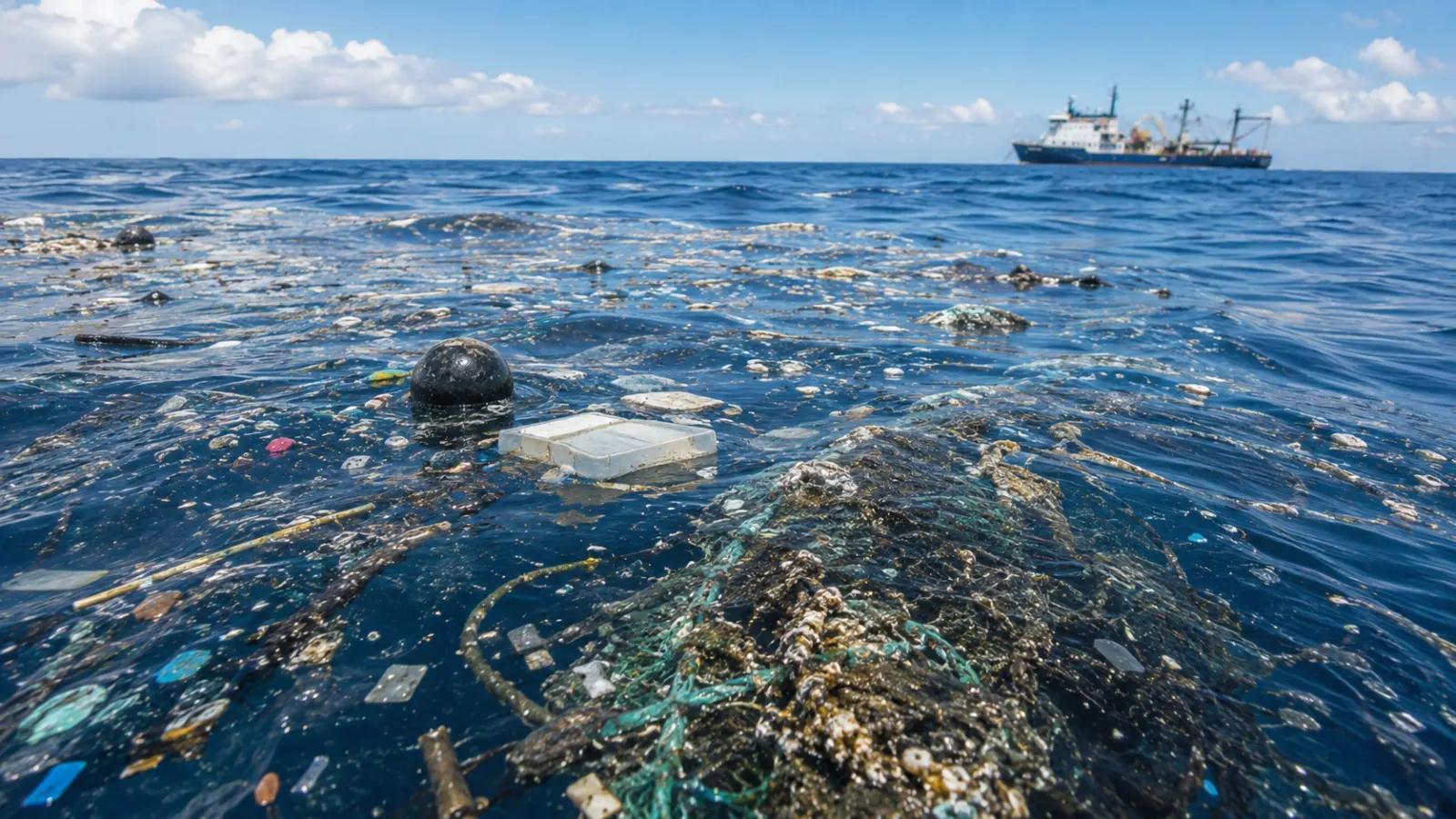
Much of the material consists of plastic fragments so small that a ship can travel through the region while passengers see apparently ordinary open ocean.
NOAA has repeatedly emphasised that the phrase “garbage patch” is misleading. A better mental image is not a floating landfill but plastic fragments distributed through a huge moving body of seawater, mixed with larger debris such as bottles, crates, ropes, buoys and fishing nets. (oceanexplorer.noaa.gov)
That distinction is more than semantic.
If the patch were a compact island, the obvious solution would be to scoop it up.
The real problem is much harder.
Great Pacific Garbage Patch at a glance
| Question | What the evidence shows |
|---|---|
| Is it a floating island? | No |
| Where is it? | Broadly within the North Pacific subtropical gyre between Hawaii and California |
| Does it have a fixed border? | No. Its location, shape and concentrations change |
| Can you see it from a satellite? | Not as one continuous garbage mass |
| Is most of it plastic? | Yes, especially persistent buoyant plastics |
| Are most pieces microplastics? | By number, yes |
| Is most of the mass microplastic? | No. Larger debris contributes much of the mass |
| Does fishing gear matter? | Yes. One major study estimated fishing nets represented at least 46% of the plastic mass |
| How large is it? | A 2018 modelling study used a concentration boundary covering about 1.6 million km², but that is not a physical shoreline |
| Can it simply be scooped out? | Larger floating debris can be targeted, but dispersed small plastic makes complete cleanup much harder |
| Is it the world's only garbage patch? | No. Similar accumulation zones occur in the world's major subtropical gyres |
Ocean currents create accumulation zones
The world's oceans are constantly moving.
Wind pushes surface water. Earth's rotation influences the direction of large-scale circulation through the Coriolis effect. Continents constrain the movement of water.
Together, these forces help create enormous rotating current systems called ocean gyres.
Five major subtropical gyres are commonly recognised:
the North Pacific;
South Pacific;
North Atlantic;
South Atlantic;
and Indian Ocean gyres.
Floating material entering the ocean can be transported by winds and currents over extraordinary distances.
Some of that debris eventually reaches areas where circulation patterns favour accumulation.
The Great Pacific Garbage Patch occurs within the North Pacific subtropical circulation, broadly in the ocean between California and Hawaii. NOAA describes garbage patches as large regions where marine debris becomes concentrated because of rotating ocean currents. (oceanservice.noaa.gov)
But “concentrated” needs context.
The ocean remains mostly water.
There is no giant whirlpool sucking every bottle into one point
The gyre is sometimes illustrated like a bathtub drain pulling rubbish into a single centre.
That is too simple.
Ocean currents shift.
Wind changes.
Storms alter surface conditions.
Different debris responds differently depending on its size, shape, density and how much of it sits above the water.
A lightweight bottle can respond more strongly to wind than a waterlogged fishing net.
A piece of plastic can wash ashore.
Another can remain offshore.
Another can become coated with organisms, lose buoyancy and sink.
Another can fragment into progressively smaller pieces.
The Great Pacific Garbage Patch is therefore better understood as a dynamic accumulation region rather than one precise destination.
Why the patch has no fixed edge
A country can be drawn on a map because it has political boundaries.
A lake usually has a shoreline.
The Great Pacific Garbage Patch has neither.
Plastic concentrations generally change gradually across the ocean.
Scientists who want to estimate the patch's area therefore have to decide what level of plastic concentration counts as being “inside” the patch.
That decision matters.
A major 2018 study published in Scientific Reports combined vessel sampling, aerial surveys and ocean-transport modelling. Its researchers defined a concentration boundary covering approximately 1.6 million square kilometres. Within that modelled region, they estimated roughly 79,000 tonnes of floating plastic and about 1.8 trillion individual plastic pieces. (nature.com)
Those numbers are useful.
But they are often misunderstood.
The researchers did not discover a 1.6-million-square-kilometre solid object.
They defined an enormous oceanic region within which floating plastic concentrations met the criteria used in their model.
If a different threshold or method is used, the estimated boundary can change.
That is why sensational comparisons such as:
“It is twice the size of Texas”
or
“It is three times the size of France”
should be handled carefully.
Such comparisons can help readers visualise scale, but they easily revive the false idea of a continent made of rubbish.
What would you actually see if you sailed through it?
Probably much less than you expect.
You might encounter a buoy.
A bottle.
A crate.
A fragment of fishing net.
A piece of rope.
But for long periods you might see nothing obviously unusual.
That does not mean the plastic is absent.
Much of it is simply small.
NOAA compares garbage-patch debris to pepper flakes dispersed through soup rather than a solid layer floating on top. It is entirely possible to sail through part of a garbage patch without seeing obvious rubbish. (oceantoday.noaa.gov)
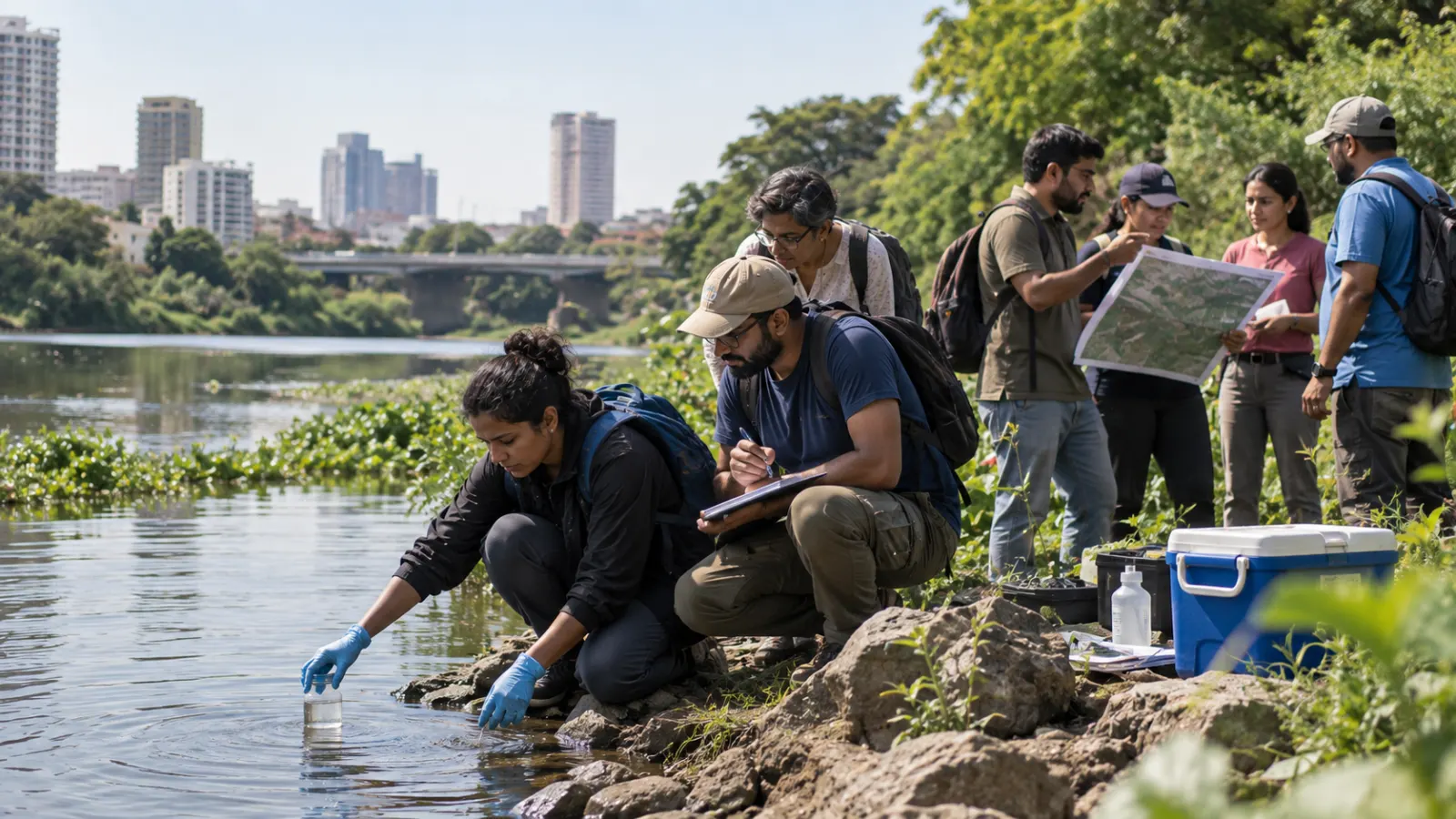
Scientists therefore sample the water.
Specialised nets can capture plastic particles that the human eye would easily miss from the deck of a vessel.
Microplastics dominate by number—but not by mass
This distinction is essential.
A microplastic is generally defined as a plastic particle smaller than five millimetres.
In the 2018 Great Pacific Garbage Patch study, microplastics represented an estimated 94% of the plastic pieces by number.
That sounds as though microplastics must also account for almost all of the weight.
They did not.
The same study estimated microplastics contributed only about 8% of the total plastic mass.
Larger plastic objects accounted for most of the weight. More than three-quarters of estimated plastic mass came from debris larger than five centimetres. (nature.com)
So two statements can simultaneously be true:
Most individual pieces are tiny.
Most of the mass is contained in larger objects.
That distinction becomes important when designing cleanup strategies.
How does large plastic become microplastic?
Plastic does not normally disappear quickly in the marine environment.
Instead, many plastics weather and fragment.
Sunlight, especially ultraviolet radiation, weakens material.
Waves bend and break objects.
Temperature changes contribute to deterioration.
Mechanical abrasion damages surfaces.
A bottle can become fragments.
Those fragments can break again.
Eventually one large item can become thousands of increasingly small pieces.
The plastic has not disappeared.
Its form has changed.
This is one reason preventing large plastic from entering or remaining in the ocean matters.
Today's identifiable object can become tomorrow's dispersed microplastic.
The surface patch is not the whole ocean-plastic problem
The famous garbage patch concerns floating debris concentrated near the surface and upper ocean.
But plastic also exists elsewhere.
It washes onto shorelines.
Becomes trapped in coastal vegetation.
Moves through rivers.
Sinks through the water column.
Accumulates on the seafloor.
Enters sediments.
And fragments into particles too small to be captured by many ordinary sampling systems.
NOAA notes that marine debris has been found from remote shorelines and Arctic ice to the deepest parts of the ocean. (marinedebris.noaa.gov)
The Great Pacific Garbage Patch is therefore not “where all the ocean's plastic ends up.”
It is one especially visible example of a much larger pollution system.
Fishing gear is a surprisingly large part of the problem
Images of ocean plastic usually focus on consumer waste.
Plastic bags.
Straws.
Bottles.
Food packaging.
Those items matter.
But the Great Pacific Garbage Patch contains another major category of debris:
fishing gear.
The 2018 study estimated that at least 46% of the total plastic mass in the patch consisted of fishing nets. For the very largest category of floating plastic examined, fishing nets made up an even greater proportion. (nature.com)
This substantially changes how the pollution problem should be understood.
The patch is not simply the consequence of households using disposable plastic products.
Marine industries are part of the picture too.
What is ghost fishing?
Fishing gear can continue doing its job after nobody controls it.
A lost gillnet does not know that it has been lost.
A discarded trap does not stop catching animals because the fisher is gone.
This phenomenon is called ghost fishing.
NOAA defines derelict fishing gear as lost, abandoned or discarded gear that can continue trapping animals, entangling wildlife, damaging habitats and creating navigation hazards. (oceanservice.noaa.gov)
Lost nets, lines, traps and pots can catch:
fish;
crustaceans;
sea turtles;
seabirds;
and marine mammals.
The gear can remain dangerous for long periods because modern synthetic materials are designed to withstand harsh marine conditions.
Durability is extremely useful while fishing equipment remains under human control.
It becomes a pollution problem when that equipment is lost.
Where does the plastic come from?
There is no single source.
Some marine debris originates on land.
Poorly managed waste can enter storm drains.
Rivers transport litter.
Floods can carry enormous quantities of material.
Waste from coastal recreation can enter the sea.
Wind can move lightweight debris from landfills or streets into waterways.
Other debris originates at sea.
Fishing gear can be lost accidentally during storms, snagged on underwater structures or abandoned.
Cargo can fall overboard.
Waste can originate from vessels or offshore activities.
NOAA describes both land-based and ocean-based pathways into the marine environment. (marinedebris.noaa.gov)
Once plastic enters the ocean, however, tracing it back to a precise source can become extremely difficult.
Ocean debris can travel for years
The plastic item found today may have entered the sea thousands of kilometres away.
Currents move debris between regions.
Objects can circulate offshore.
Storms can redirect them.
Some wash onto beaches and later return to sea.
Others remain within accumulation regions for long periods.
The 2018 study even found identifiable objects manufactured decades earlier, suggesting that some durable debris can persist in the accumulation zone for a very long time. (nature.com)
The patch is therefore also a kind of physical archive.
It contains material from different countries, industries and decades.
Unfortunately, the archive is pollution.
Marine debris harms wildlife in several ways
The ecological problem is not that one giant rubbish island covers the ocean surface.
The danger comes from repeated encounters between wildlife and persistent human-made objects.
Animals can become entangled.
They can ingest debris.
Lost fishing gear can continue trapping them.
Plastic can interact with habitats.
Floating debris can also transport organisms beyond their normal geographic ranges.
NOAA reports documented marine-debris impacts across hundreds of species, including fish, seabirds, sea turtles, marine mammals and invertebrates. (marinedebris.noaa.gov)
The effect depends heavily on the species and type of debris.
A sea turtle caught in fishing line faces a different hazard from an animal ingesting tiny plastic particles.
Marine plastic pollution should therefore not be treated as one single biological mechanism.
Entanglement can kill directly
Large plastic creates obvious physical hazards.
A net can restrict swimming.
A line can tighten around a growing animal.
Plastic bands can cut tissue.
An entangled marine mammal may struggle to surface, feed or move normally.
NOAA notes that marine-debris entanglement has been documented across hundreds of species and can cause injury, starvation, drowning and death. (marinedebris.noaa.gov)
For some large debris, the relationship between object and harm is therefore straightforward.
The animal becomes trapped.
Plastic ingestion is more complicated
Animals can also eat plastic.
Sometimes it resembles food.
Sometimes it is consumed accidentally alongside prey.
Large swallowed objects can obstruct the digestive system or reduce the animal's ability to eat normally.
Smaller particles raise more complicated research questions involving exposure, particle size, additives, attached chemicals and biological effects.
The evidence differs across species and exposure conditions.
This is why responsible environmental reporting should avoid turning every laboratory finding about microplastics into a universal claim that all ocean organisms are being poisoned in exactly the same way.
The underlying pollution is real.
The biological consequences need to be described with the same precision.
Plastic can move organisms around the ocean
Floating material provides surfaces.
Barnacles, microorganisms and other organisms can attach to plastic and travel with it.
Because plastic can remain afloat for long periods, it can transport organisms far beyond the locations where they would normally remain.
This creates another ecological concern:
marine debris can act as a transport pathway for species.
Not every transported organism becomes invasive.
But long-lived floating plastic provides a human-made mechanism for biological movement across oceanic distances.
Why satellites cannot simply photograph the whole patch
If the Great Pacific Garbage Patch were a continuous island, satellite imagery would solve many measurement problems.
But most of the patch consists of water containing varying concentrations of debris.
Tiny plastic fragments are far below the scale at which an ordinary satellite image could reveal a solid mass.
Even large objects may be widely separated.
Scientists therefore rely on combinations of:
ship-based sampling;
surface trawls;
aerial observations;
ocean-current models;
and other monitoring techniques.
Measurement is difficult precisely because the patch is dispersed and mobile.
Why estimating the amount of plastic is difficult
Scientists face several sampling problems.
A small trawl samples only a tiny fraction of an enormous ocean.
Large fishing nets and buoys are much rarer than microplastic fragments, so they can be underrepresented when only small sampling nets are used.
Wind can push lightweight material differently from partially submerged objects.
Waves move plastic vertically.
Some debris sinks below sampling depth.
The 2018 study attempted to improve estimates of larger debris by combining hundreds of surface trawls with aircraft observations and numerical modelling. That produced an estimate several times larger than some previous assessments, largely because earlier methods had underestimated large objects. (nature.com)
Scientific estimates can therefore change without the earlier scientists having been dishonest.
Better measurement changes what can be counted.
Is the patch getting bigger?
This question needs careful wording.
Because the patch has no fixed boundary, asking whether it is “growing” can mean several things.
Is the total plastic mass increasing?
Are concentrations increasing?
Is the area above a particular concentration threshold expanding?
Are different sizes of debris changing at the same rate?
The 2018 study found historical evidence suggesting plastic concentrations within the Great Pacific Garbage Patch had increased substantially over previous decades and were rising faster than in surrounding waters. (nature.com)
But monitoring such trends requires consistent sampling and modelling.
A viral photograph cannot tell us whether an accumulation zone expanded by 20% in a year.
The uncertainty surrounding its precise dimensions should not be confused with uncertainty about whether plastic pollution exists.
The Great Pacific Garbage Patch is not unique
The North Pacific patch became famous partly because it has been intensively studied and widely covered by the media.
But ocean circulation creates accumulation zones elsewhere too.
NOAA identifies garbage patches associated with all five major subtropical gyres.
There are accumulation areas in:
the North Pacific;
South Pacific;
North Atlantic;
South Atlantic;
and Indian Ocean. (oceanservice.noaa.gov)
There are also coastal debris hotspots, convergence zones and shoreline accumulation areas outside these major patches.
Cleaning one famous location would therefore not mean ocean plastic pollution had been solved.
Why can't we simply send ships and scoop everything out?
Because the patch combines two extremely inconvenient properties:
enormous area and low average concentration.
Imagine trying to remove pepper flakes from a swimming pool.
Now imagine the swimming pool is an ocean region measured in millions of square kilometres.
And some of the pepper flakes are microscopic.
Collection becomes much harder.
Ships need fuel and crews.
Equipment must survive rough ocean conditions.
Cleanup systems need to collect plastic without unnecessarily capturing marine organisms.
The smallest particles are especially difficult because nets fine enough to capture them can also interact with plankton and other small life.
But offshore cleanup is not impossible
“Difficult” does not mean “nothing can be removed.”
Large floating debris presents a more practical target than the smallest microplastics.
Fishing nets, ropes and other persistent macroplastic can be collected.
Several organisations have tested large-scale offshore cleanup systems.
A 2026 Scientific Reports study used data from three years of operational collection in the North Pacific Garbage Patch to model future removal scenarios. The underlying operations had collected hundreds of tonnes of floating plastic larger than the systems' mesh sizes between 2021 and 2024. The modelling suggested that a sufficiently large fleet could substantially reduce the mass of catchable floating plastic over a decade under favourable assumptions. (nature.com)
That is significant.
But it does not mean scientists have discovered a machine that can remove every plastic particle from the Pacific.
The modelling focused on plastic above particular size thresholds.
Microplastics smaller than the collection mesh remain a much harder problem.
And cleanup systems themselves require environmental monitoring to manage possible bycatch and other impacts.
Cleanup has to be evaluated environmentally too
Removing pollution sounds automatically beneficial.
But marine cleanup is itself an intervention in an ecosystem.
Equipment moves through surface waters.
Ships consume fuel.
Organisms can interact with collection systems.
Large operations require repeated vessel activity.
A 2025 Scientific Reports assessment specifically examined the environmental trade-offs involved in removing plastic from the North Pacific accumulation zone, emphasising that cleanup benefits should be assessed against possible ecological costs. (nature.com)
That is the appropriate scientific standard.
The question is not simply:
“Can we collect plastic?”
It is:
“Can we remove enough harmful plastic to create a net environmental benefit?”
Cleanup and prevention are not competing ideas
Debates about ocean plastic sometimes become unnecessarily binary.
One side says:
“Cleanup is pointless. Prevention is all that matters.”
The other says:
“The plastic is already there. We just need better cleanup technology.”
In reality, both problems exist.
There is legacy pollution already circulating in the ocean.
And there is new pollution continuing to enter waterways.
Removing old fishing nets can reduce ongoing ghost fishing.
Collecting large persistent plastics may prevent some future fragmentation.
But if new plastic continues entering the ocean faster than it can be removed, cleanup becomes an endless task.
The strongest strategy therefore combines prevention, interception, retrieval and better waste management.
The easiest plastic to remove is the plastic that never reaches the open ocean
Once a plastic fragment is five millimetres wide and drifting hundreds of kilometres from land, intervention is extraordinarily difficult.
Much earlier stages offer more practical opportunities.
Waste can be collected properly.
Storm drains can capture litter.
Rivers can be monitored.
Ports can accept old fishing gear.
Lost equipment can be reported and retrieved.
Products can be redesigned.
Unnecessary material can be reduced.
Waste systems can be improved.
Fishing gear can be tracked.
Coastal cleanup can remove debris before it returns to sea.
This does not mean every piece of land-based plastic would otherwise travel to the Great Pacific Garbage Patch.
It means prevention operates before material becomes widely dispersed and difficult to trace.
Fishing gear requires its own prevention strategy
Policies aimed only at plastic shopping bags or drink bottles cannot address every major component of the patch.
Fishing gear requires different interventions.
These may include:
gear marking;
tracking;
reporting systems;
retrieval programmes;
port reception facilities;
financial incentives for returning damaged gear;
and designs intended to reduce persistent ghost fishing after loss.
NOAA works with fishing communities and other organisations on both removal and prevention of derelict fishing gear. (marinedebris.noaa.gov)
This illustrates a broader principle.
“Plastic pollution” is not one source and therefore does not have one solution.
Consumer action matters—but infrastructure matters more
Individuals can reduce unnecessary disposable plastic.
Dispose of waste properly.
Avoid littering.
Participate in cleanups.
Recover fishing line.
Choose reusable products where they genuinely reduce waste.
Those actions are useful.
But an environmental problem operating across international supply chains, fisheries, cities, rivers and waste systems cannot be solved entirely through personal virtue.
Infrastructure matters.
Collection systems matter.
Product design matters.
Waste regulation matters.
Fishing management matters.
International coordination matters.
A household cannot personally control what happens to every plastic product after disposal if the surrounding waste system fails.
Why the “trash island” myth matters
Some environmental myths exaggerate a problem without changing what people should do.
This one changes the apparent solution.
If the Great Pacific Garbage Patch were literally an island made of rubbish, society could imagine:
locating the island;
surrounding it with ships;
removing it;
and declaring victory.
The real problem is fundamentally different.
Plastic enters the ocean from many places.
Currents transport it.
Waves and sunlight fragment it.
Some sinks.
Some beaches.
Some remains floating.
Some concentrates in gyres.
Large fishing gear mixes with billions or trillions of tiny fragments.
The pollution is distributed across an enormous three-dimensional environment.
That is a much harder engineering and governance problem than collecting one pile of rubbish.
Another myth: there is one exact universally agreed size
Headlines frequently assign the patch one precise size.
That can imply more certainty than exists.
The widely cited 1.6 million square kilometre figure comes from a specific 2018 study using a particular model and concentration boundary. (nature.com)
It is a scientifically valuable estimate.
It is not a permanent legal boundary.
Winds, currents and concentrations change.
Other measurement methods can define the accumulation region differently.
So the correct statement is:
One major study modelled an accumulation zone covering approximately 1.6 million km².
Not:
Scientists discovered an island exactly 1.6 million km² in size.
Another myth: most of it is plastic straws and bottles
Consumer plastics are highly visible in public campaigns.
But the Great Pacific Garbage Patch does not reflect only consumer litter.
The large contribution from fishing nets and other marine-industry debris shows why the composition of pollution matters.
A campaign that dramatically reduces plastic straws may have legitimate waste-reduction benefits.
It should not be presented as though it directly removes the largest mass category identified in the Great Pacific Garbage Patch.
Different pollution sources demand different interventions.
Another myth: if you cannot see it, it cannot be serious
Open ocean can look clean.
That visual impression tells us surprisingly little.
Many environmental pollutants are difficult to see.
Microplastics can be smaller than a grain of rice.
Some debris floats partly below the surface.
Other material has sunk.
Scientific sampling exists precisely because human eyesight from the deck of a ship is not an adequate pollution-monitoring instrument.
The absence of dramatic photographs is not evidence of absence.
The Great Pacific Garbage Patch is a process, not an object
This is the most useful way to understand it.
The patch is not a thing sitting in one place.
It is the visible result of several processes occurring together:
plastic production;
waste loss;
fishing activity;
river and coastal transport;
ocean circulation;
fragmentation;
biological interaction;
sinking;
beaching;
and long-term persistence.
Human activity creates the debris.
Ocean physics redistributes it.
Material properties determine which plastics persist at the surface.
Currents concentrate some of what remains.
The patch is therefore best understood as a dynamic symptom of the global marine-plastic system.
Frequently Asked Questions
What is the Great Pacific Garbage Patch?
The Great Pacific Garbage Patch is a large region within the North Pacific subtropical gyre where currents cause floating marine debris, particularly plastic, to occur at higher concentrations than in surrounding ocean waters.
Is the Great Pacific Garbage Patch a floating island?
No. NOAA explicitly warns that the name is misleading. The debris is dispersed through an enormous area of ocean, and much of it consists of small plastic fragments that are difficult to see. (oceanexplorer.noaa.gov)
Where is the Great Pacific Garbage Patch?
It is broadly located within the North Pacific subtropical circulation between Hawaii and California.
How big is the Great Pacific Garbage Patch?
A major 2018 study defined a modelled accumulation zone of roughly 1.6 million square kilometres. This figure represents a concentration boundary used by the researchers, not a fixed physical edge. (nature.com)
How much plastic is in the Great Pacific Garbage Patch?
The same 2018 study estimated approximately 79,000 tonnes of floating plastic and about 1.8 trillion pieces within its defined study area, with substantial uncertainty around those estimates. (nature.com)
Is most of the garbage patch made of microplastics?
By number of individual pieces, yes. The 2018 study estimated microplastics accounted for about 94% of pieces. By mass, however, larger debris dominated and microplastics accounted for only around 8%. (nature.com)
How much of the patch is fishing gear?
The 2018 study estimated that fishing nets accounted for at least 46% of total plastic mass in its Great Pacific Garbage Patch assessment. (nature.com)
Can the Great Pacific Garbage Patch be seen from space?
Not as one continuous floating island. The debris is too dispersed, and much of it is too small, for ordinary satellite imagery to show a single solid garbage mass.
Can ships sail through it?
Yes. Ships can pass through areas of the patch while seeing little obvious debris because much of the plastic consists of small fragments distributed through the water.
Why does plastic accumulate there?
Large-scale North Pacific circulation transports and concentrates some buoyant debris within the subtropical gyre. Winds, waves and currents continuously move the material, so the accumulation zone itself shifts.
Does plastic disappear naturally in the ocean?
Many plastics persist for long periods. Rather than rapidly biodegrading into harmless natural material, larger plastics can weather and fragment into smaller pieces.
Is the Great Pacific Garbage Patch the only garbage patch?
No. NOAA identifies marine-debris accumulation zones associated with all five major subtropical gyres. (oceanservice.noaa.gov)
Can we clean up the Great Pacific Garbage Patch?
Some larger floating plastic and fishing gear can be collected, and recent offshore systems have demonstrated significant removal capacity. Complete removal is much harder, particularly for small dispersed microplastics, and environmental trade-offs need to be monitored. (nature.com)
What is the best way to reduce the Great Pacific Garbage Patch?
No single intervention is sufficient. Reducing waste leakage, improving waste and river management, preventing fishing-gear loss, removing derelict gear and other large debris, and targeted offshore cleanup can all play roles.
Why the Great Pacific Garbage Patch matters
The most important fact about the Great Pacific Garbage Patch is not that it resembles a continent.
It does not.
Its importance lies precisely in the opposite fact.
Human-made material has become so persistent and so widely dispersed that enormous ocean-current systems can now concentrate it thousands of kilometres from many of its sources.
A discarded object enters a river.
Another falls from a vessel.
A fishing net is lost.
Currents carry them.
Sunlight weakens them.
Waves fragment them.
Organisms encounter them.
Some sink.
Some reach beaches.
Some continue circulating.
And some accumulate in one of the most remote parts of the Pacific.
By the time durable material has reached that stage, society is attempting to solve the problem at one of the most difficult possible points.
That is why the Great Pacific Garbage Patch should not be understood primarily as a spectacular island waiting to be removed.
It is evidence of a system.
A system in which durable products escape waste management, enter waterways, travel across national boundaries and remain in the environment long enough for planetary-scale ocean circulation to reorganise them.
Cleanup matters.
Removing dangerous fishing gear matters.
New technologies may make removal of larger floating plastics increasingly practical.
But the patch will remain a moving target if new material continually replaces what is removed.
The deepest lesson is therefore not simply that there is plastic in the Pacific.
It is that preventing durable waste from becoming ocean debris is vastly easier than recovering it after the ocean has dispersed, fragmented and transported it across millions of square kilometres.
That is what the Great Pacific Garbage Patch really represents.