Galileo Galilei: Biography, Discoveries, Trial and the Evidence That Changed Astronomy
Galileo Galilei did not invent the telescope.
He did something historically more consequential.
He recognised what the instrument could become.
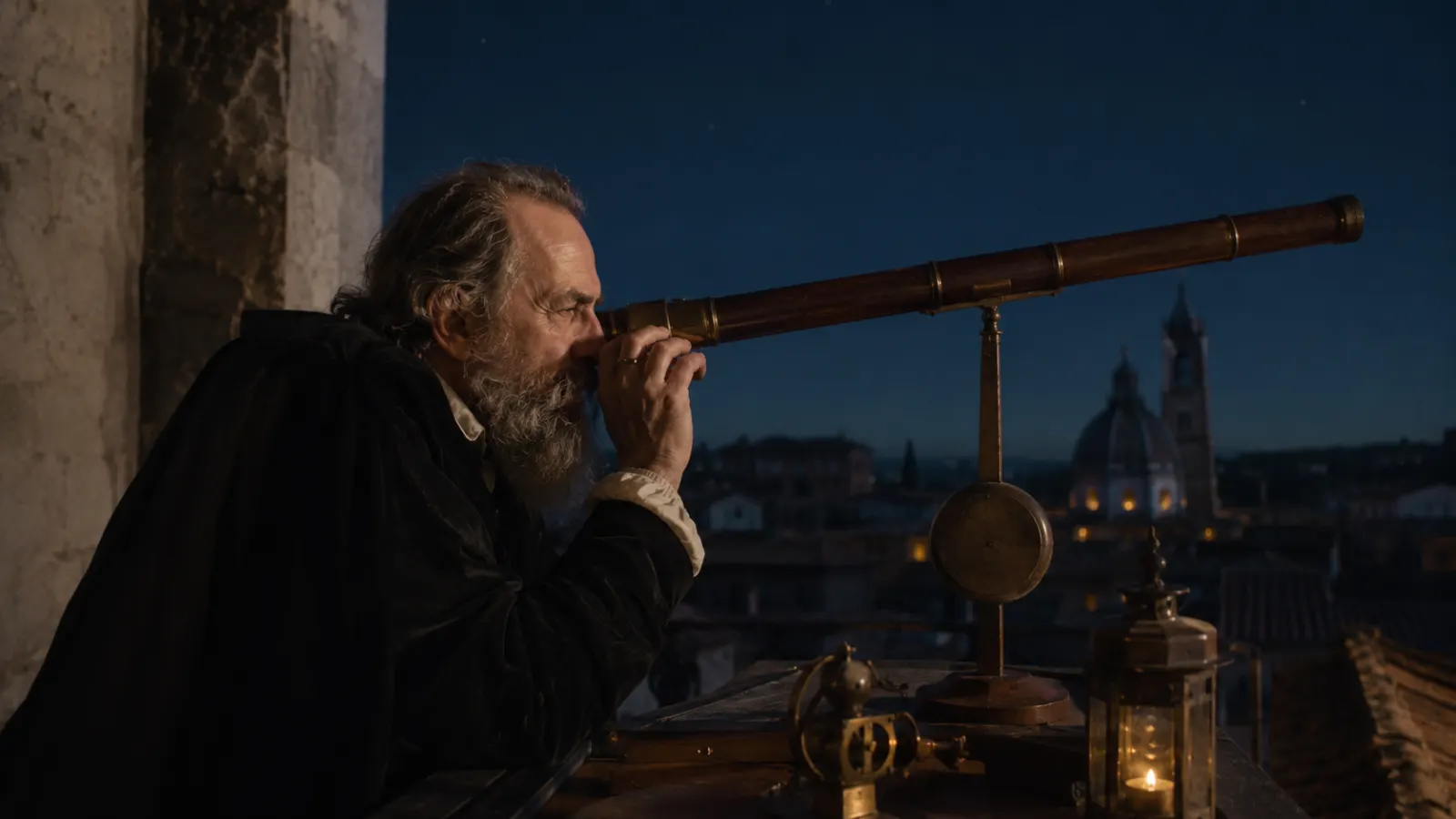
Early “spyglasses” were already being produced in the Netherlands when news of them reached Venice in 1609. Galileo understood the optical principle, constructed his own versions and improved their magnification. Museo Galileo notes that he developed instruments capable of roughly 20-power magnification and quickly transformed the telescope from a device for making distant terrestrial objects appear closer into an instrument for astronomical measurement.
Then he pointed it toward the sky.
The result was not a single discovery.
It was a sequence of shocks.
The Moon appeared rough rather than perfectly smooth.
The Milky Way resolved into enormous numbers of faint stars.
Jupiter possessed bodies orbiting it.
Venus displayed a full sequence of phases.
Dark spots moved across the Sun.
None of those observations by itself “proved everything Galileo believed.”
Together, however, they made the older Aristotelian-Ptolemaic picture of the heavens increasingly difficult to defend unchanged.
And Galileo did something else extraordinarily well:
he made observations into arguments.
He published quickly.
He drew what he saw.
He provided telescopes to other observers.
He attached discoveries to powerful patrons.
He wrote in a style capable of turning technical disputes into public intellectual events.
He challenged inherited philosophical authority.
He also made mistakes.
His theory of the tides was wrong.
His position on comets was badly mistaken.
He could be combative, sarcastic and politically reckless.
His strongest evidence for heliocentrism remained incomplete.
And eventually his efforts to present Earth's motion as physically real brought him before the Roman Inquisition.
That complicated Galileo—the brilliant observer, mathematician, instrument-maker, polemicist, courtier and sometimes stubbornly mistaken scientist—is far more interesting than the simplified martyr of legend.
Galileo Galilei at a Glance
| Question | Short answer |
|---|---|
| Who was Galileo Galilei? | An Italian mathematician, natural philosopher and astronomer whose work transformed the study of motion and telescopic astronomy. |
| When was Galileo born? | 15 February 1564. |
| Where was he born? | Pisa, in the Duchy of Florence. |
| Did Galileo invent the telescope? | No. Dutch spyglasses already existed. Galileo independently built and substantially improved telescopes and recognised their astronomical potential. |
| What did Galileo discover? | Among his major telescopic observations were Jupiter’s four large moons, lunar mountains, numerous faint stars, the phases of Venus and sunspots. |
| Did Galileo discover heliocentrism? | No. Copernicus had published a heliocentric planetary model decades earlier, and Kepler was already a committed heliocentrist. |
| Did Galileo prove Earth moves? | Not conclusively with the evidence available to him. His observations strongly challenged Ptolemaic astronomy but also fit aspects of the Tychonic system. |
| What did Galileo discover about motion? | He developed mathematical treatments of accelerated fall, projectile motion and principles that helped prepare the way for later inertial mechanics. |
| What was Sidereus Nuncius? | Galileo’s 1610 Starry Messenger, announcing major telescopic discoveries including Jupiter’s satellites. |
| Why was Galileo tried? | The 1633 proceedings centred on whether his Dialogue violated restrictions imposed after the Church’s 1616 action against Copernicanism. |
| Was Galileo tortured? | He was formally threatened with torture during proceedings, but there is no evidence that torture was actually carried out. |
| Was Galileo imprisoned in a dungeon for years? | No. His sentence was quickly converted into house arrest. |
| Did Galileo say “And yet it moves”? | The famous phrase is not securely documented as something he said immediately after his abjuration. |
| When did Galileo die? | 1642. |
| What was his final major scientific work? | Discourses and Mathematical Demonstrations Relating to Two New Sciences, published in 1638. |
Who Was Galileo Galilei?
Galileo was born in Pisa on 15 February 1564.
His father, Vincenzo Galilei, was a musician and musical theorist.
That detail is more interesting than it first appears.
Vincenzo investigated musical relationships experimentally and challenged some inherited doctrines concerning harmony. Historians have often noted the intellectual environment this may have created for Galileo, although children should not simply be treated as copies of their parents.
Galileo initially entered the University of Pisa expecting to study medicine.
Mathematics increasingly attracted him instead.
He left without completing the medical degree and eventually built a career in mathematics and natural philosophy.
Museo Galileo records that he held the mathematics chair at Pisa from 1589 to 1592 before moving to the University of Padua, where he taught until 1610.
Those Padua years were among the most productive periods of his life.
Galileo at Padua
At Padua, Galileo worked on far more than astronomy.
His interests included:
- mechanics;
- mathematics;
- fortification;
- military technology;
- instruments;
- motion;
- hydraulics;
- and practical computation.
He developed a geometrical and military compass, an instrument useful for calculations involving artillery, proportions and other technical problems.
He also earned money:
- teaching students;
- manufacturing instruments;
- and cultivating patrons.
This matters because the Scientific Revolution did not happen inside a modern university research system.
Scientists—or “natural philosophers,” as Galileo would more readily have been called—operated within networks of:
courts,
universities,
printers,
wealthy patrons,
church institutions,
and
craft production.
Galileo needed intellectual ability.
He also needed a career.
Did Galileo Drop Objects From the Leaning Tower of Pisa?
This is one of the most famous stories about him.
Galileo supposedly climbed the Leaning Tower of Pisa and publicly dropped bodies of different weights to demonstrate that heavier objects do not fall in direct proportion to their weight.
The story became famous through later accounts.
Its exact historical basis is uncertain.
This does not mean Galileo performed no experiments on falling bodies.
His actual investigations were more sophisticated than the dramatic tower story.
He used combinations of:
- mathematical reasoning;
- measurements;
- inclined-plane analysis;
- thought experiments;
- and idealisation
to understand accelerated motion.
Even Museo Galileo cautions that surviving later inclined-plane apparatus cannot be claimed as the exact physical experiment Galileo personally performed.
The lesson is familiar:
the legend is simpler than the science.
Galileo and the Science of Falling Bodies
A major problem inherited from Aristotelian physics concerned how bodies move.
Galileo increasingly treated motion as something that could be described mathematically.
For freely falling bodies, he developed the relationship that velocity increases systematically with elapsed time under uniform acceleration.
His later Two New Sciences presented a mature mathematical treatment of accelerated motion.
Museo Galileo summarises Galileo’s formulation as one in which equal intervals of time produce equal increases of speed under uniform acceleration.
This became foundational for later mechanics.
But Galileo did not possess Newton's final formulation of inertia or force.
It is better to say that he developed concepts and methods that prepared the path toward Newtonian mechanics.
Galileo and Projectile Motion
Galileo also analysed projectiles.
A cannonball seems to perform one complicated motion.
Galileo showed how the trajectory could be understood by combining:
horizontal motion
with
accelerated vertical fall.
Under idealised conditions, the resulting path is a parabola.
Museo Galileo dates Galileo’s development of this idea to around 1609 and notes that it was formally presented in Two New Sciences.
This way of thinking became enormously important.
Instead of simply describing what a projectile looked like, Galileo decomposed the problem mathematically.
Modern physics uses this strategy constantly.
A complicated phenomenon is broken into simpler components whose behaviour can be analysed independently.
Idealisation: One of Galileo's Deepest Contributions
Everyday motion is messy.
Objects experience:
- friction;
- air resistance;
- uneven surfaces;
- imperfect release;
- measurement error.
If science only described unmodified everyday experience, simple physical laws could remain hidden.
Galileo increasingly asked:
What would happen under ideal conditions?
What if friction were reduced?
What if a body could continue moving without interference?
What relationship would appear if acceleration were isolated from distracting effects?
This combination of:
experiment + mathematical abstraction + idealisation
became one of the defining habits of theoretical physics.
The scientific law does not always look exactly like ordinary experience.
Ordinary experience may contain too many interfering variables.
The Telescope Reaches Italy
In 1609, reports circulated about a Dutch optical device that made distant objects appear closer.
Galileo did not invent the underlying telescope.
Museo Galileo explicitly notes that the earliest spyglasses were fabricated in Holland and that Galileo then recognised their astronomical possibilities, built improved versions and increased their power.
His surviving telescopes used:
- a convex objective lens;
- and a concave eyepiece.
One original instrument from around 1609–1610 survives in the Museo Galileo collection.
But the important innovation was not only optical.
It was epistemological.
Galileo turned the telescope into a scientific instrument.
Seeing Through a Telescope Had to Be Learned
Modern readers often assume:
Look through telescope → see objective reality → argument finished.
That was not how the first telescopic astronomy worked.
Early telescopes had:
- small fields of view;
- optical distortions;
- imperfect lenses;
- focusing difficulties;
- and low image quality compared with modern instruments.
Observers had to learn how to distinguish:
celestial feature
from
optical artefact.
That meant Galileo could not rely only on:
“I saw it.”
He needed replication.
He demonstrated instruments.
He gave or sold telescopes to others.
Other astronomers reproduced several of his observations.
Gradually, telescopic evidence became trustworthy because the instrument itself became trustworthy.
This is a fundamental point about science:
instruments do not eliminate interpretation.
A new instrument creates a new category of evidence whose reliability must itself be established.
Galileo Was Not the Only Early Telescopic Astronomer
Galileo's fame can create another exaggerated claim:
he was the first human being to point a telescope at the sky.
Other observers were experimenting with astronomical telescopes around the same period.
What made Galileo uniquely influential was the combination of:
- improving the instrument;
- conducting sustained observation;
- understanding the cosmological importance of what he saw;
- publishing rapidly;
- and turning those observations into public scientific controversy.
Priority alone does not explain historical impact.
Communication matters.
The Moon Was Not Perfect
When Galileo observed the Moon, he saw patterns of light and shadow that he interpreted as:
- mountains;
- depressions;
- and irregular terrain.
That mattered philosophically.
Traditional Aristotelian cosmology drew a strong distinction between:
the changing, imperfect terrestrial world
and
the perfect heavens.
Galileo's Moon looked remarkably Earth-like.
It had topography.
That did not single-handedly destroy Aristotelian philosophy.
But it weakened one of its most visually intuitive assumptions.
The heavens no longer appeared geometrically immaculate.
The Milky Way Became Thousands of Stars
The telescope also transformed the Milky Way.
What looked to the naked eye like a diffuse luminous band could be resolved into enormous numbers of stars.
Likewise, seemingly empty regions of the sky contained far more stars than human vision alone could detect.
This expanded the scale of the observable universe.
It also introduced an idea that now feels obvious but was intellectually radical:
human senses reveal only part of nature.
Technology can make previously invisible phenomena observable.
Jupiter's Moons
The most dramatic discovery announced in Sidereus Nuncius came from Jupiter.
In January 1610, Galileo observed small points of light near the planet.
Their positions changed night after night.
Eventually he concluded that they were not fixed stars.
They were bodies orbiting Jupiter.
Today they are known as:
Io, Europa, Ganymede and Callisto.
Museo Galileo confirms that Galileo announced these four satellites in Sidereus Nuncius and initially named them the Medicean Stars in honour of the Medici family.
Why Jupiter's Moons Mattered
The observation challenged a simple objection to Copernicanism.
Critics could argue:
If Earth moves around the Sun, how can the Moon remain attached to Earth?
Jupiter provided a visible counterexample.
A planet could apparently move through the heavens while carrying satellites around it.
The Jovian system also demonstrated that:
not everything in the universe orbits Earth.
That result damaged an Earth-centred interpretation of celestial organisation.
But it did not by itself prove Earth orbits the Sun.
That distinction is crucial.
Sidereus Nuncius: Scientific Publication as Career Strategy
Galileo published his discoveries in March 1610 under the title:
Sidereus Nuncius — The Starry Messenger.
The publication did more than report observations.
It transformed Galileo's social position.
He dedicated the Jovian moons to the Medici dynasty, naming them the Medicean Stars.
This was calculated patronage.
Museo Galileo notes that the dedication helped open the way for Galileo's appointment as mathematician and philosopher to Cosimo II de' Medici in Tuscany.
Science and patronage were intertwined.
A discovery could become:
evidence,
publication,
prestige,
and
political capital
at the same time.
The Phases of Venus
Galileo's later observations of Venus were even more damaging to the traditional Ptolemaic arrangement.
Through the telescope, Venus showed a range of phases analogous to those of the Moon.
That required Venus to move around the Sun in a way inconsistent with the classic Ptolemaic configuration in which its epicycle remained between Earth and Sun.
Museo Galileo explains that Galileo correctly recognised that the observations meant Venus moved around the Sun.
This was major evidence.
But there is a frequently omitted qualification.
The Phases of Venus Did Not Uniquely Prove Copernicus
The phases ruled out important forms of traditional Ptolemaic astronomy.
They did not distinguish uniquely between:
Copernicus
and
Tycho Brahe.
In Tycho's geoheliocentric system:
- Earth remained stationary;
- Sun orbited Earth;
- other planets orbited the Sun.
Venus therefore still went around the Sun and would show the observed phases.
Museo Galileo explicitly notes that the Tychonic system accommodated Venus's phases.
So:
“Galileo saw the phases of Venus and proved Earth goes around the Sun”
is historically too strong.
His observation established something narrower but still revolutionary:
the old Ptolemaic arrangement was wrong.
Sunspots and the Changing Heavens
Galileo also observed sunspots.
Dark features appeared on the Sun and changed position over time.
Their existence created another problem for the concept of perfect, unchanging celestial bodies.
Galileo was not alone in observing them, and disputes arose over:
- interpretation;
- priority;
- and their physical location.
Again the interesting story is not merely:
new observation defeats old idea.
Different observers could agree that dark marks were visible and still disagree about what the marks were.
Evidence requires interpretation.
Galileo and Johannes Kepler
Galileo's story is often told as though he alone defended Copernicus.
That is false.
Johannes Kepler was already a committed heliocentrist.
Indeed, Museo Galileo notes that Galileo had written to Kepler as early as 1597, describing himself as sympathetic to Copernicanism.
Kepler would eventually develop three mathematical laws of planetary motion, including elliptical rather than perfectly circular planetary orbits.
Galileo never fully incorporated Kepler's orbital breakthroughs into his own cosmological argument.
That is another useful reminder:
even revolutionary scientists do not necessarily recognise every important discovery made by their contemporaries.
Galileo, Copernicus and Tycho Brahe
By the early seventeenth century, astronomical debate was not simply:
Ptolemy vs Galileo.
There were several major options.
Ptolemaic system
Earth stationary at the centre.
Copernican system
Earth and other planets orbit the Sun.
Tychonic system
Earth remains stationary while the Sun circles Earth and planets circle the Sun.
The telescope damaged the traditional Ptolemaic system severely.
But some new observations could be incorporated into the Tychonic arrangement.
This explains why a sophisticated astronomer could reject Ptolemy yet remain unconvinced that Earth physically moved.
The Missing Evidence: Stellar Parallax
If Earth travels around the Sun, then nearby stars should appear to shift slightly relative to more distant stars as Earth's position changes during the year.
That effect is stellar parallax.
Seventeenth-century astronomers could not detect it.
The obvious possibilities were:
Earth does not move
or
the stars are so extraordinarily distant that the shift is too small to measure.
Copernicans adopted the second explanation.
They were eventually proved right.
But the necessary measurements were far beyond Galileo's instruments.
ESA notes that Friedrich Bessel produced the first widely accepted stellar-parallax measurement only in 1838, more than two centuries after Galileo's first telescopic observations.
That historical gap matters.
The heliocentric argument in Galileo's lifetime was powerful.
It was not observationally complete.
Galileo and Scripture
Astronomical controversy eventually intersected with biblical interpretation.
Certain passages appeared, under familiar readings, to describe:
- a moving Sun;
- and a stationary Earth.
Galileo argued that Scripture and nature could not ultimately contradict because both originated with God.
But he also argued that biblical language often addressed ordinary human understanding rather than teaching technical astronomy.
His Letter to the Grand Duchess Christina developed this position.
The argument was sophisticated.
It was also politically dangerous.
Why the Counter-Reformation Context Matters
Galileo's conflict did not happen in an abstract conversation between:
science
and
religion.
It occurred during the Counter-Reformation.
The Catholic Church was operating in an environment of intense conflict over:
- doctrinal authority;
- Protestant challenges;
- biblical interpretation;
- and institutional discipline.
Who possessed the authority to interpret Scripture was therefore not a minor academic question.
When Galileo argued publicly about the proper interpretation of biblical passages touching astronomy, he was entering a jurisdictional conflict as well as a scientific one.
1616 Was Not Galileo's Trial
The events of 1616 are often collapsed into the famous 1633 trial.
They were separate.
In 1616, Church authorities acted against the proposition that the Sun stood immobile at the centre while Earth moved.
Copernicus's De revolutionibus was suspended pending corrections.
Cardinal Robert Bellarmine admonished Galileo concerning his advocacy of Copernicanism. Museo Galileo describes him as being instructed not to advocate or teach Copernican astronomy as physical truth.
Galileo was not imprisoned in 1616.
He continued:
- researching;
- publishing;
- corresponding;
- and maintaining elite connections.
But a boundary had been established.
That boundary became central seventeen years later.
Galileo Was Sometimes Wrong
The heroic version of Galileo can become scientifically misleading.
He was not simply:
evidence personified.
He defended wrong ideas too.
The clearest cases concern:
- comets;
- and tides.
These errors matter because they show what science actually looks like.
A scientist can be:
methodologically innovative
and
factually wrong about a particular problem
at the same time.
Galileo and the Comets
Three bright comets appeared in 1618.
A controversy developed involving Galileo's circle and Jesuit mathematician Orazio Grassi.
Galileo rejected the interpretation of comets as distant celestial bodies and argued instead for an optical or atmospheric explanation.
On this issue, his position was substantially wrong.
Yet the controversy eventually helped produce one of Galileo's most famous works:
Il Saggiatore — The Assayer, published in 1623.
The episode is valuable precisely because the eloquent methodological hero did not possess the correct physical answer.
Scientific rhetoric and scientific truth are not identical.
“The Book of Nature Is Written in Mathematics”
The Assayer is famous for Galileo's argument that nature must be understood through mathematical language.
The broader principle became enormously influential.
Physical reality, for Galileo, was not adequately explained through verbal categories alone.
It could be measured using:
- number;
- geometry;
- proportion;
- and motion.
This became one of the central ambitions of modern physics.
But again, methodology did not guarantee infallibility.
Galileo could believe deeply in mathematical natural philosophy and still misunderstand comets.
Pope Urban VIII and a New Opportunity
In 1623, Maffeo Barberini became Pope Urban VIII.
Galileo knew him and initially believed the political atmosphere might become more favourable.
He eventually obtained permission to write about competing cosmological systems under conditions intended to prevent him from simply presenting Copernicanism as established physical truth.
The result was one of the most famous books in the history of science.
Dialogue Concerning the Two Chief World Systems
Published in 1632, Galileo's Dialogue took the form of a conversation among three characters:
Salviati — presenting the strongest arguments associated with Galileo and Copernicanism;
Sagredo — an intelligent and increasingly persuaded interlocutor;
Simplicio — defending traditional Aristotelian and geocentric positions.
The formal structure presented competing viewpoints.
The rhetorical balance did not.
Copernican reasoning clearly received the stronger treatment.
Museo Galileo describes the Dialogue as presenting the major arguments concerning:
- Earth's motion;
- the Moon;
- Jupiter's satellites;
- sunspots;
- relativity of motion;
- and tides.
Did Galileo Insult the Pope Through Simplicio?
A famous explanation for Galileo's downfall says Urban VIII became furious because one of the Pope's arguments was placed into the mouth of Simplicio, the character who often appears intellectually weakest.
There is historical substance behind the political sensitivity.
Museo Galileo's detailed account notes that the Pope's argument concerning divine omnipotence appeared through Simplicio near the end of the work.
But the trial should not be reduced to:
Galileo made the Pope look stupid, so the Pope punished him.
The deeper issues included:
- the 1616 restriction;
- the book's strongly Copernican character;
- licensing;
- theological authority;
- and Galileo's treatment of Earth's motion as physically persuasive.
Personal politics intensified the crisis.
They did not create it from nothing.
Galileo Thought the Tides Proved Earth Moves
This is one of the most useful facts to include in any serious Galileo biography.
Galileo believed tides provided important physical evidence for Earth's motion.
His reasoning depended on combining:
- Earth's daily rotation;
- with its yearly revolution around the Sun.
He argued that those motions would cause ocean water to surge relative to its container.
The theory was not a successful explanation of tides.
Museo Galileo notes that Galileo rejected an important lunar role in tides, while Kepler had correctly taken the Moon's influence seriously.
Later gravitational theory supplied a fundamentally better explanation.
Why Galileo's Wrong Tide Theory Matters
The tide problem destroys the simplest version of the Galileo affair:
Galileo had complete scientific proof.
The Church simply refused to look.
Reality was more complicated.
Galileo possessed impressive evidence against important components of traditional cosmology.
But he lacked a decisive mechanical demonstration of Earth's motion.
His favourite proposed physical proof—the tides—was wrong.
The expected stellar parallax was undetectable.
The Tychonic system could incorporate much of the telescopic evidence.
None of this justifies censorship.
It does explain why the scientific dispute in the early seventeenth century was more open than later mythology suggests.
The Road to the 1633 Trial
The Dialogue was published in 1632.
Problems arose quickly.
The book's distribution was halted.
Galileo was ordered to appear before the Roman Inquisition.
Museo Galileo's chronology records that he arrived in Rome in 1633 after delays caused partly by his poor health.
The proceedings focused heavily on the relationship between the Dialogue and what Galileo had been ordered to do—or not do—in 1616.
The precise documentary status of that earlier instruction became crucial.
The 1633 Trial
Galileo was interrogated before the Roman Inquisition.
The issue was not:
Did Jupiter have moons?
Jesuit astronomers and others had already confirmed major telescopic observations.
The key legal problem was whether Galileo had violated the prohibition surrounding Copernicanism.
On 22 June 1633, Galileo was condemned as “vehemently suspected of heresy” and required to abjure Copernican claims.
Museo Galileo records the condemnation and abjuration following the Holy Office proceedings.
Was Galileo Tortured?
Galileo was threatened within an inquisitorial process that permitted coercive interrogation.
Museo Galileo's chronology says he was threatened with torture during the proceedings.
There is no secure evidence that physical torture was actually carried out.
This distinction matters.
Saying:
“Galileo was tortured”
is stronger than the evidence.
Saying:
“Galileo was tried under a coercive judicial system and formally threatened with torture”
is more accurate.
Did Galileo Spend Years in Prison?
No.
He was sentenced to imprisonment, but the practical sentence became house arrest.
He eventually returned to his villa at Arcetri, near Florence.
Museo Galileo records that by December 1633 he was permitted to return to the villa known as Il Gioiello, under continuing restrictions.
This was still punishment.
His freedom was constrained.
His publication options were restricted.
He was not, however, spending the rest of his life chained inside a dungeon.
Did Galileo Say “And Yet It Moves”?
The Italian phrase is:
Eppur si muove — “And yet it moves.”
According to the popular story, Galileo muttered it after publicly denying Earth's motion.
There is no secure contemporary documentation for the episode.
The phrase appears in later tradition.
It should therefore be presented as:
a famous legend associated with Galileo
rather than
a verified quotation from the moment of his trial.
The fact that the line is probably legendary does not weaken Galileo's historical significance.
It tells us how later generations wanted to remember him.
House Arrest Did Not End Galileo's Science
After condemnation, Galileo was no longer free to pursue the Copernican controversy publicly.
But his scientific work continued.
He turned strongly toward the physics of:
- motion;
- falling bodies;
- projectiles;
- and material strength.
The result became:
Discourses and Mathematical Demonstrations Relating to Two New Sciences.
Published in Leiden in 1638, outside Italy, the book brought together work developed across much of Galileo's career.
Museo Galileo describes it as the culmination of his research on motion and one of the foundational works of the new mechanics.
Galileo Became Blind
During his final years, Galileo suffered severe deterioration in his eyesight and eventually became blind.
Yet correspondence, dictation and intellectual work continued.
He died at Arcetri in 1642.
That same year is traditionally given as the birth year of Isaac Newton under the English calendar then in use.
The symbolic continuity is irresistible:
Galileo helped transform the mathematical study of motion.
Newton would later integrate motion and gravitation into an even more powerful framework.
But scientific history is not a relay race between isolated geniuses.
Between Galileo and Newton stood:
- Kepler;
- Descartes;
- Huygens;
- Hooke;
- and many others.
Galileo and Newton
Newton's mechanics would later formalise ideas that Galileo had helped make possible.
Galileo developed important treatments of:
- accelerated fall;
- projectile motion;
- relative motion;
- mathematical idealisation.
Newton added:
- general laws of motion;
- force;
- universal gravitation;
- and a much broader mathematical system.
The relationship demonstrates how scientific revolutions actually happen.
Later thinkers do not merely “replace” earlier thinkers.
They inherit problems that earlier scientists made tractable.
Did Galileo Invent the Scientific Method?
No.
There is no single inventor of the scientific method.
Methods of:
- observation;
- experiment;
- measurement;
- mathematical reasoning;
- controlled comparison;
- and empirical testing
developed through many traditions and cultures.
Galileo's contribution was unusually important because he brought together several of these practices with exceptional force.
He combined:
instruments + mathematics + experiment + idealisation + publication + argument.
That combination became central to later physics.
Was Galileo the Father of Modern Science?
Titles such as:
father of modern science
father of observational astronomy
and
father of modern physics
are common.
They are also historically imprecise.
Modern science had no single father.
Its development involved:
- Copernicus;
- Kepler;
- Tycho;
- Galileo;
- Bacon;
- Descartes;
- Boyle;
- Hooke;
- Huygens;
- Newton;
- instrument makers;
- navigators;
- physicians;
- artisans;
- and countless others.
Galileo does not need exclusive parenthood to be enormously important.
His actual achievement is impressive enough.
Galileo Was a Courtier as Well as a Scientist
Modern scientific culture often idealises independence from political influence.
Galileo operated in a different world.
Patronage could determine:
- employment;
- access;
- prestige;
- publication;
- protection;
- and social rank.
Naming Jupiter's satellites after the Medici was not an embarrassing distraction from “real science.”
It was part of how scientific careers worked.
Historian Mario Biagioli has especially emphasised this courtly dimension of Galileo's career.
The scientist who discovered new worlds in the telescope was also navigating very terrestrial hierarchies.
Galileo Was an Exceptional Communicator
One reason Galileo became historically dominant was his writing.
He could make:
- technical questions;
- astronomical disputes;
- and philosophical disagreements
feel vivid.
That skill increased his influence.
It also increased his danger.
A quietly written mathematical treatise might circulate among specialists.
Galileo's prose could embarrass opponents before a much wider educated audience.
His scientific career therefore shows that communication is not external to knowledge.
How an argument is presented can change who pays attention to it.
Replication Was Central to Galileo's Success
The telescope initially forced observers to trust:
Galileo
and
Galileo's instrument.
That was unstable.
Once independent astronomers could observe:
- Jupiter's moons;
- Venus's phases;
- lunar irregularities;
- and sunspots,
the evidential situation changed.
The observations no longer depended on Galileo alone.
This is a central principle in science:
reproducibility turns personal observation into shared evidence.
Galileo's discoveries became durable not because he was charismatic.
They became durable because others could look.
Why the Galileo Affair Was Not Simply “Science vs Religion”
The simplified version goes:
Galileo represented science.
The Church represented religion.
Science was right.
Religion tried to silence it.
There is truth hidden inside that narrative.
The Roman Inquisition did restrict Galileo's freedom to defend a scientific position.
That coercion was real.
But the wider intellectual landscape was more complicated.
Religious astronomers:
- used telescopes;
- confirmed observations;
- performed mathematics;
- debated cosmological models.
Jesuit scholars were themselves major contributors to seventeenth-century astronomy.
Meanwhile, Galileo:
- made scientifically weak arguments;
- misunderstood tides;
- rejected a better account of comets;
- and lacked direct parallax evidence for Earth's orbit.
The conflict involved:
science,
religion,
scriptural authority,
institutional jurisdiction,
evidence,
personality,
patronage,
and
Counter-Reformation politics.
Complexity does not excuse Galileo's censorship.
It explains the historical event more accurately.
What the Galileo Affair Actually Shows
The affair illustrates several enduring problems.
Evidence does not interpret itself
People can agree on observations and disagree about what they imply.
New instruments require trust
A telescope had to become accepted as a reliable source of knowledge.
Scientific conclusions can be stronger than available proof
Galileo's Copernican commitment sometimes exceeded what his evidence uniquely established.
Institutions can restrict inquiry
Authority can set boundaries around what may be publicly argued.
Scientists can be right and wrong simultaneously
Galileo was right about much of the astronomical transformation and wrong about tides and comets.
Communication changes scientific power
Galileo's prose made technical debates impossible to contain within a small specialist community.
Science develops collectively
Copernicus, Tycho, Kepler and Galileo each supplied pieces of a much larger transformation.
Common Myths About Galileo Galilei
Myth 1: Galileo invented the telescope
False.
Dutch spyglasses already existed. Galileo developed improved telescopes and transformed them into astronomical instruments.
Myth 2: Galileo was the first person ever to point a telescope at the sky
Too strong.
Other early telescopic observers existed. Galileo's unusual influence came from the systematic and public use he made of the instrument.
Myth 3: Galileo proved heliocentrism immediately
False.
His observations strongly undermined Ptolemaic astronomy, but alternatives such as the Tychonic system remained compatible with important evidence.
Myth 4: The phases of Venus proved Earth moves
False.
They showed Venus orbits the Sun but did not uniquely establish Earth's orbital motion.
Myth 5: Galileo had direct stellar-parallax evidence
False.
Reliable stellar parallax was not measured until the nineteenth century.
Myth 6: Galileo was always scientifically correct
False.
His theories of comets and tides contained major errors.
Myth 7: Galileo was imprisoned in a dungeon for the rest of his life
False.
His sentence became house arrest.
Myth 8: Galileo was tortured
He was threatened with torture during inquisitorial proceedings, but there is no solid evidence that torture was carried out.
Myth 9: “And yet it moves” is a proven courtroom quotation
No.
It belongs to later Galileo legend.
Myth 10: Galileo single-handedly created modern science
False.
He was one unusually important participant in a much broader transformation.
Galileo Galilei Timeline
| Year | Event |
|---|---|
| 1564 | Galileo born in Pisa |
| 1581 | Enters University of Pisa |
| 1589 | Becomes professor of mathematics at Pisa |
| 1592 | Moves to University of Padua |
| 1597 | Correspondence indicates his sympathy for Copernicanism |
| 1609 | Builds improved telescope and begins major astronomical observations |
| 1610 | Publishes Sidereus Nuncius; announces Jupiter's moons |
| 1610 | Observes phases of Venus |
| 1611 | Visits Rome and gains major recognition |
| 1613–15 | Writes on Copernicanism and Scripture |
| 1616 | Church censures Copernican propositions; Galileo receives admonition |
| 1618–23 | Comet controversy leads eventually to The Assayer |
| 1623 | The Assayer published |
| 1632 | Dialogue Concerning the Two Chief World Systems published |
| 1633 | Tried and condemned by Roman Inquisition |
| 1633 onward | Lives under house arrest |
| 1638 | Two New Sciences published |
| 1642 | Galileo dies at Arcetri |
| 1838 | Bessel publishes first widely accepted stellar parallax—evidence Galileo's era could not obtain |
Frequently Asked Questions
Who was Galileo Galilei?
Galileo Galilei was an Italian mathematician, natural philosopher and astronomer whose work on motion and telescopic astronomy became central to the Scientific Revolution.
When was Galileo born?
He was born on 15 February 1564 in Pisa.
When did Galileo die?
He died in 1642 near Florence.
Did Galileo invent the telescope?
No. Telescopic spyglasses originated in the Netherlands. Galileo built improved versions and rapidly recognised their astronomical usefulness.
What did Galileo discover with the telescope?
His major observations included:
- lunar topography;
- stars invisible to the naked eye;
- Jupiter's four large moons;
- the phases of Venus;
- and sunspots.
What are Galileo's four moons of Jupiter?
They are:
Io, Europa, Ganymede and Callisto.
They are collectively called the Galilean moons.
What did Galileo call Jupiter's moons?
He called them the Medicean Stars, honouring the Medici dynasty.
What is Sidereus Nuncius?
It is Galileo's 1610 Starry Messenger, the publication in which he announced several major telescopic discoveries, especially Jupiter's moons.
Did Galileo discover heliocentrism?
No.
Nicolaus Copernicus had published a heliocentric model in 1543.
Did Galileo prove heliocentrism?
His observations provided powerful evidence against traditional Ptolemaic cosmology and supported heliocentric interpretations, but they did not uniquely prove Earth's motion.
Why were the phases of Venus important?
They demonstrated that Venus moves around the Sun and contradicted the classic Ptolemaic arrangement. However, they also fit Tycho Brahe's geoheliocentric model.
Why couldn't Galileo detect stellar parallax?
The stars are so distant that their annual shifts are extremely small. Seventeenth-century instruments lacked the precision needed. A reliable stellar parallax was not published until 1838.
What did Galileo discover about falling objects?
He developed a mathematical theory of uniformly accelerated fall in which velocity increases systematically with time.
What did Galileo discover about projectiles?
He showed that projectile motion could be analysed as the combination of horizontal motion and accelerated vertical fall, producing a parabolic trajectory under ideal conditions.
Did Galileo drop balls from the Leaning Tower of Pisa?
The famous public demonstration is part of later biographical tradition and is not securely documented in the form usually retold.
Why was Galileo opposed by the Church?
His defence of the physical reality of Copernicanism collided with Church rulings concerning heliocentrism and scriptural interpretation, especially after 1616.
What happened to Galileo in 1616?
He was admonished not to defend the Copernican proposition as established physical truth. He was not imprisoned at that time.
Why was Galileo tried in 1633?
The Roman Inquisition examined whether his 1632 Dialogue had violated the restrictions established around his advocacy of Copernicanism.
What was Galileo convicted of?
He was declared vehemently suspected of heresy, forced to abjure and sentenced to imprisonment that was converted to house arrest.
Was Galileo tortured?
He was threatened with torture during the proceedings, but there is no reliable evidence that physical torture was actually inflicted.
Did Galileo spend years in a dungeon?
No.
He spent his later years under house arrest, eventually at his Arcetri villa.
Did Galileo really say “And yet it moves”?
There is no secure contemporary evidence that he said the phrase immediately after his abjuration.
Was Galileo right about tides?
No. His proposed mechanism connecting tides directly to Earth's combined motions was inadequate, and he wrongly dismissed the importance of lunar influence.
Was Galileo right about comets?
His atmospheric or optical interpretation of comets was substantially wrong.
What was Two New Sciences?
Galileo's 1638 work on motion and material strength, bringing together major results from decades of mechanical research.
Did Galileo invent modern science?
No individual invented modern science. Galileo was one of the most important figures in establishing mathematical, experimental and instrument-based approaches to natural philosophy.
Why is Galileo important today?
His legacy includes:
- mathematical analysis of motion;
- telescopic astronomy;
- experimental idealisation;
- instrumental evidence;
- and one of history's most important conflicts over the authority to interpret nature.
Why Galileo Galilei Still Matters
Galileo's importance is often summarised with a telescope.
That is too narrow.
The telescope itself already existed.
Galileo's deeper achievement was understanding what a new instrument could do to the structure of knowledge.
Before the telescope, human eyesight set a hard boundary around astronomy.
After the telescope, observers had to confront a new question:
Can a machine reveal truths the unaided senses cannot?
Galileo helped make the answer:
yes—if the instrument can be tested, understood and its observations reproduced.
That is a foundational principle of modern science.
Much of contemporary knowledge depends on things no human being can directly perceive:
- microscopic cells;
- radio waves;
- X-rays;
- gravitational waves;
- subatomic particles;
- distant galaxies.
We trust these phenomena through instruments embedded inside systems of calibration, theory and replication.
Galileo's telescope belongs near the beginning of that history.
The Trial Was Important—but It Was Not His Only Legacy
Galileo is now so closely associated with his trial that his scientific work can become merely the background to the courtroom.
That reverses the historical importance.
The trial became famous because the scientific work mattered.
By 1633, Galileo had already helped transform:
- mechanics;
- observational astronomy;
- cosmology;
- and scientific communication.
His condemnation then turned a scientific dispute into an enduring symbol of the danger created when institutions use coercive authority to control claims about nature.
But the strongest lesson is not:
religion bad, science good.
Nor is it:
Galileo was scientifically uncertain, so censorship was reasonable.
Both are oversimplifications.
A better lesson is:
scientific knowledge can be incomplete and still deserve open investigation.
Scientists can be wrong without institutions being entitled to silence them.
Religious people can contribute to science while religious institutions can also misuse authority.
Scientific evidence can challenge inherited interpretations without instantly answering every competing question.
History becomes useful when those truths are allowed to coexist.
The Central Idea
Galileo did not change astronomy because he was the first person ever to question authority.
He did not change it because he alone discovered heliocentrism.
And he did not change it because a telescope automatically revealed the truth.
His importance came from a more powerful combination.
He took mathematical reasoning seriously.
He treated motion as measurable.
He used idealised physical situations to expose hidden regularities.
He transformed a new optical instrument into a source of scientific evidence.
He published observations quickly enough that others could test them.
He understood that new evidence could force old cosmologies to change.
And he argued—sometimes brilliantly and sometimes too aggressively—that claims about nature should ultimately answer to nature.
He was not always right.
That fact makes his scientific legacy stronger, not weaker.
His wrong theory of tides shows that evidence must remain open to correction.
His comet controversy shows that methodological sophistication does not eliminate bias.
His failure to produce direct proof of Earth's motion shows how scientific knowledge can advance while important evidential gaps remain.
His trial shows what can happen when uncertainty, authority, doctrine and personality collide.
And his later Two New Sciences shows that even condemnation did not stop the questions.
Galileo's telescope enlarged distant objects.
His greater achievement was helping enlarge the meaning of evidence.
After Galileo, natural philosophy increasingly had to contend with a world that could be:
measured,
mathematised,
magnified,
replicated
and
used to challenge what authority had previously assumed.
That is why Galileo Galilei still stands near the centre of the Scientific Revolution.
Not because he was an infallible hero.
Because curiosity, evidence and argument became difficult to separate after him.