Security is no longer shaped only by soldiers, borders and weapons. It is also shaped by bank accounts, shell companies, wire transfers, charities, crypto wallets, trade invoices and beneficial ownership records. The Financial Action Task Force, better known as FATF, shows how financial rules can become instruments of national and international security.
FATF does not command armies. It does not impose traditional sanctions in the way the UN Security Council or national governments do. Yet its standards and country listings can influence banking access, investment sentiment, compliance costs and diplomatic pressure. A country placed under increased monitoring faces reputational damage and closer scrutiny from the financial system. A country identified as high-risk faces even sharper consequences.
This is why FATF matters: it converts technical compliance into strategic pressure. It shows that in the modern world, the ability to move money is part of power.
Why the Issue Matters Now
Terrorist financing, money laundering and proliferation financing have become more complex. Illicit networks use formal banks, informal value transfer systems, charities, real estate, trade misinvoicing, precious metals, virtual assets and cross-border corporate structures. Security agencies cannot fight these networks only through arrests. They need financial intelligence, regulatory standards and international cooperation.
FATF sits at this intersection. Its recommendations create global standards for anti-money laundering, counter-terrorist financing and counter-proliferation financing. Its mutual evaluations examine whether countries have laws and whether those laws actually work. Its grey and black lists signal weaknesses to the global financial system.
The result is a form of governance that is both technical and political. Technical because it involves compliance systems; political because listing decisions can affect national reputation and strategic behaviour.
Historical Context
FATF was established in 1989 by the G7 to combat money laundering. After the September 11 attacks, its mandate expanded strongly into terrorist financing. Later, proliferation financing became another pillar. This evolution mirrors the changing nature of security itself. Money laundering was once treated mainly as a crime issue. It is now understood as a threat to the integrity of states, markets and security systems.
The expansion also reflects globalisation. As finance became faster and more interconnected, illicit actors learned to exploit gaps across jurisdictions. A weak registry in one country, a poorly regulated money service business in another, and a shell company in a third can together form a channel for moving funds. FATF's logic is that weak links endanger the whole system.
Analytical Dimension 1: Standards as Power
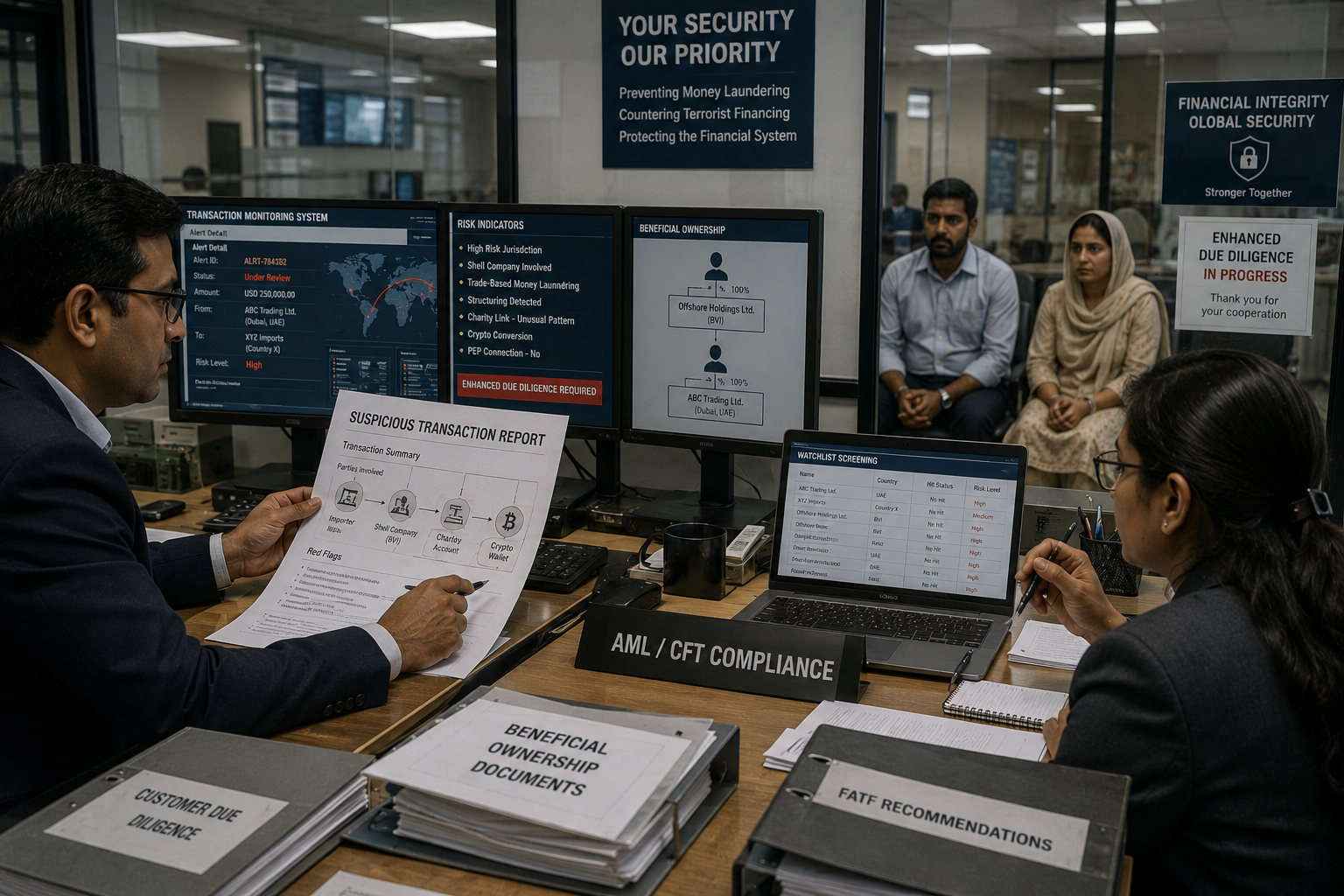
FATF's recommendations set expectations for legal frameworks, supervision, customer due diligence, beneficial ownership transparency, suspicious transaction reporting, asset freezing, international cooperation and risk-based regulation. These standards may appear administrative, but they shape state behaviour.
Countries reform laws, strengthen regulators and improve enforcement partly because they want to avoid negative FATF outcomes. This makes FATF a powerful example of how standards can discipline states without direct coercion. The pressure comes through markets, banks, investors and diplomatic reputation.
Analytical Dimension 2: Grey Lists and Market Signalling
The grey list, officially known as jurisdictions under increased monitoring, is one of FATF's most visible tools. It does not mean a country is cut off from the world. It means the country has strategic deficiencies and has committed to fix them under closer scrutiny.
The practical effect can be significant. Banks may apply enhanced due diligence. Investors may reassess risk. Correspondent banking relationships may become more cautious. Governments may find themselves under domestic pressure to pass laws and demonstrate enforcement. FATF listing works because reputational risk travels quickly through the financial system.
Analytical Dimension 3: Terror Financing and State Behaviour
FATF's impact is especially visible in counter-terrorism. Terrorist groups need funding for recruitment, logistics, propaganda, weapons, travel and local networks. Cutting finance does not eliminate ideology, but it can weaken operational capacity.
For states accused of tolerating or failing to prevent terror financing, FATF scrutiny can become a diplomatic constraint. It forces governments to demonstrate prosecutions, asset freezes, institutional coordination and financial intelligence. The issue is no longer only what a state declares. It is what it can document.
Analytical Dimension 4: The Compliance Burden
FATF also creates costs. Banks, fintech companies, charities, lawyers, accountants, real estate actors and non-profit organisations may face heavier compliance requirements. In poorer countries, limited administrative capacity can make implementation difficult.
There is also the danger of de-risking. Banks may avoid entire categories of customers, regions or charities because compliance seems too costly. This can unintentionally hurt financial inclusion and humanitarian activity. A strong FATF system must therefore be risk-based, not fear-based.
Analytical Dimension 5: Crypto, Digital Finance and New Frontiers
The rise of virtual assets has expanded FATF's relevance. Crypto can support innovation, remittances and financial experimentation. It can also be used for ransomware payments, sanctions evasion, fraud and illicit transfers. FATF's standards now increasingly address virtual asset service providers and digital payment transparency.
The future challenge is enforcement. Illicit finance moves quickly across platforms and jurisdictions. Regulators move more slowly. FATF must help countries build systems that can track risk without killing innovation or pushing activity further underground.
India Angle
India has a strong interest in FATF because terrorism and cross-border financing directly affect its national security. FATF standards support India's diplomatic case that financial systems must not be used to enable terrorism. They also strengthen domestic efforts around suspicious transactions, beneficial ownership, shell companies and financial intelligence.
At the same time, India must manage compliance burdens for legitimate businesses, fintech players, charities and small financial actors. A secure financial system must not become an inaccessible financial system. The policy balance is between vigilance and inclusion.
Global Implications
FATF demonstrates the securitisation of finance. The global banking system has become a frontline in the fight against terrorism, organised crime, corruption and proliferation. This gives regulators and compliance officers a strategic role that was once reserved for intelligence agencies and diplomats.
It also raises questions of fairness. Countries with more capacity can comply more easily. Countries with weaker institutions may be punished by markets even when they are trying to reform. Technical assistance therefore matters. Standards without capacity support can become another form of inequality.
Counter-view and Complexity
Critics argue that FATF can become politicised, that listing decisions may reflect power relations, or that compliance can encourage box-ticking rather than real enforcement. They also warn that financial surveillance can threaten privacy and civil society if misused.
These concerns are serious. But they do not negate FATF's importance. The answer is better transparency, clearer methodology, proportional regulation and safeguards for legitimate activity. Illicit finance thrives where rules are weak. But liberty suffers where rules are blunt.
What Happens Next
The next phase of FATF's relevance will be shaped by virtual assets, proliferation networks, sanctions evasion, trade-based money laundering and beneficial ownership transparency. Countries will be judged not only on passing laws but on proving effectiveness.
FATF's deeper lesson is that security outcomes can be shaped by financial architecture. In the twenty-first century, a weak compliance regime can become a security vulnerability. A strong one can become a strategic asset.
Deeper Editorial Lens: Why This Is Not a Single-Issue Story
The first mistake in reading FATF and terror financing is to treat it as a narrow file. It is not. It is a pressure point where economics, security, legitimacy and institutional design meet. The central tension is the conversion of technical financial compliance into geopolitical pressure. That tension makes the subject larger than a headline and more durable than a news cycle.
Every serious assessment has to follow at least five moving parts: mutual evaluation, beneficial ownership, suspicious transaction reports, grey listing and risk-based supervision. None of these works in isolation. A change in one can alter the political meaning of another. This is why simple explanations often fail; they describe the event but miss the operating system underneath it.
The deeper story is about confidence. Citizens need confidence that national leaders have not lost control. Markets need confidence that rules are predictable. Partners need confidence that commitments will be honoured. Rivals watch for loss of confidence because it creates strategic openings. In that sense, FATF and terror financing is a test of authority as much as policy.
Domestic Political Economy
International issues become decisive when they enter domestic life. In this case, the pressure can be felt through bank compliance, charity regulation, fintech rules, privacy concerns and business costs. These are not abstract variables. They affect household budgets, political narratives, elite bargaining and the credibility of governments.
Domestic politics also determines how much room leaders have to compromise. A technically rational agreement can become politically impossible if citizens see it as surrender, elites see it as a loss of privilege, or opposition forces convert it into a symbol of weakness. Good statecraft is therefore not only about choosing the correct policy; it is about creating the consent required to sustain it.
This is why the public language around FATF and terror financing matters. Governments often prefer strategic ambiguity, but citizens tend to demand clarity. The gap between what diplomacy requires and what domestic politics rewards can become the space in which miscalculation grows.
Institutional Choices and the Credibility Gap
The relevant institutions - FATF, financial intelligence units, central banks, law enforcement and banks - can reduce uncertainty, but only if they are seen as legitimate. Institutions do not work merely because charters exist. They work when powerful actors accept restraint and weaker actors believe the process is not rigged.
A credibility gap emerges when rules are invoked selectively. States then comply when convenient, delay when costly, and reinterpret obligations when power allows. This is not always dramatic. Often it appears as procedural delay, vague communiques, underfunded commitments or carefully worded statements that preserve unity while avoiding difficult choices.
For FATF and terror financing, institutional credibility will depend on whether rules produce behaviour change. Declarations, scorecards and summits are useful only if they alter incentives. Otherwise, the process becomes performative governance: visible enough to claim action, weak enough to avoid transformation.
India's Strategic Calculation
India cannot look at FATF and terror financing only as a distant global issue. It connects with counter-terror financing, financial intelligence, cross-border terrorism diplomacy and fintech regulation. These are central to India's foreign policy because New Delhi is trying to expand influence without losing autonomy, deepen partnerships without entering rigid blocs, and defend development space while accepting global responsibilities.
India's approach therefore tends to combine principle with prudence. It supports rules, but resists rules written without developing-country participation. It supports stability, but does not want stability to become a code word for preserving old hierarchies. It supports reform, but prefers reform that expands strategic options rather than replacing one dependency with another.
The Indian lens also brings a neighbourhood test. If FATF and terror financing produces instability around India, the cost will not remain diplomatic. It can affect trade, technology flows, migration, energy prices, security planning and domestic political debate. For a rising power, external shocks increasingly become internal governance questions.
Risk Map for 2026 and Beyond
The immediate risk map includes de-risking, politicisation claims, box-ticking compliance and crypto abuse. These risks are not equal in probability, but they are connected. A small procedural failure can produce political mistrust; mistrust can produce harder bargaining; harder bargaining can make a crisis more likely.
The medium-term risk is normalisation. The world can become used to dysfunction. Repeated crises, repeated warnings and repeated emergency meetings can create fatigue. Once fatigue sets in, even serious risks begin to look routine until a shock proves they were not routine at all.
The long-term question is whether FATF and terror financing becomes a case study in adaptation or drift. Adaptation would mean clearer rules, better financing, stronger deterrence, more credible institutions and wider participation. Drift would mean symbolic language, selective enforcement and rising costs postponed to the next crisis. The choice between these paths will define the strategic value of the issue.
What Serious Readers Should Track
First, track the financial base behind every promise linked to FATF and terror financing. Announcements are easy; budget lines, lending windows, enforceable timelines and operational capacity reveal seriousness. A policy without resources is often a press release disguised as strategy.
Second, track who controls information. In FATF and terror financing, data, inspections, disclosures, intelligence, market signals and official statements can all become instruments of power. The actor that defines the facts often shapes the political choices available to everyone else.
Third, track the behaviour of middle powers. Great powers dominate headlines, but middle powers often determine whether FATF and terror financing becomes polarised or manageable. Their hedging, coalition-building and refusal to accept binary choices can slow escalation and preserve diplomatic space.
Fourth, track the cost distribution. Every settlement around FATF and terror financing creates winners and losers. If costs fall mainly on weaker states, poorer citizens, smaller firms or politically excluded groups, the settlement may appear stable in documents but unstable in society.
Fifth, track whether crisis language becomes permanent. Emergency logic can justify extraordinary policies, but when emergency tools become routine, accountability weakens. The line between necessary urgency and institutional overreach must remain visible.
Sixth, track the India connection. Even when FATF and terror financing appears geographically distant, it can affect Indian trade, technology, energy, diplomacy, security planning and the larger debate over strategic autonomy. India's rise makes external shocks harder to treat as external.
Seventh, track narrative competition. Countries do not only fight over territory, money or rules; they fight over interpretation. Whoever frames FATF and terror financing as fairness, sovereignty, security, development or coercion gains political advantage.
Finally, track implementation after public attention shifts elsewhere. Many international issues look dramatic during summits and silent between them. The real story often happens in the quiet phase: regulations written, budgets released, inspections scheduled, projects delayed, ships deployed, or creditors called back to the table.
Publishing Angle for Editors Outlook
For an Editors Outlook audience, the value of this article lies in making FATF and terror financing understandable without making it simplistic. The article should not read like a policy brief alone. It should read like a map of power: who has leverage, who is exposed, who pays, who delays and who benefits from ambiguity.
The strongest headline treatment should connect FATF and terror financing with a wider question of sovereignty, security, development or institutional fairness. This helps the reader see why the subject belongs in a serious international section rather than a narrow explainer box.
The article should use facts carefully but not drown the reader in numbers. Figures are useful when they prove scale, reveal imbalance or challenge a popular assumption. A number without interpretation is decoration; interpretation without evidence is opinion. The article needs both.
The best visual treatment would avoid literal cliches. For FATF and terror financing, the image should show pressure, networks, institutions and strategic geography rather than a simple flag collage. Editorial visuals should help readers feel the structure of the issue before they read the full argument.
The concluding social-media caption should be framed around a question: what does FATF and terror financing reveal about the world we are entering? This encourages engagement without reducing the subject to outrage or slogan.
Editorial Conclusion
The most important conclusion is that FATF and terror financing cannot be solved by one speech, one summit or one technical adjustment. It requires political patience and institutional seriousness. Leaders must stop treating structural problems as temporary disturbances.
For readers, the key is to watch implementation rather than announcement. Who funds the promise? Who changes behaviour? Who bears the cost? Who gains leverage? Who remains excluded? These questions reveal more than diplomatic language ever will.
In the end, the story of FATF and terror financing is the story of a world struggling to update its rules under pressure. The old order is not fully gone, and the new order is not fully born. That unstable middle is where the most important strategic stories now unfold.
Internal Links to Add
• WHO Reform Remains Critical After the Pandemic Shock
• IAEA Faces Pressure as Nuclear Risks Return to Global Politics
• The United Nations Faces a Crisis of Authority and Reform
• UNSC Reform Remains Stuck in the Politics of Power
Premium editorial feature image for FATF terror financing: geopolitical map, diplomatic table, flags, corridors and strategic pressure lines. Dark navy, muted gold and deep red palette, realistic magazine style, no text, no cartoon.
Source Notes / Fact-checking References
Use these sources to verify figures, institutional positions and latest developments before publishing:
• FATF Recommendations: https://www.fatf-gafi.org/en/publications/Fatfrecommendations/Fatf-recommendations.html
• FATF high-risk and other monitored jurisdictions: https://www.fatf-gafi.org/en/countries/black-and-grey-lists.html
• FATF publications and mutual evaluation methodology: https://www.fatf-gafi.org
• Excel source priority: https://www.un.org; https://www.imf.org; https://www.wto.org