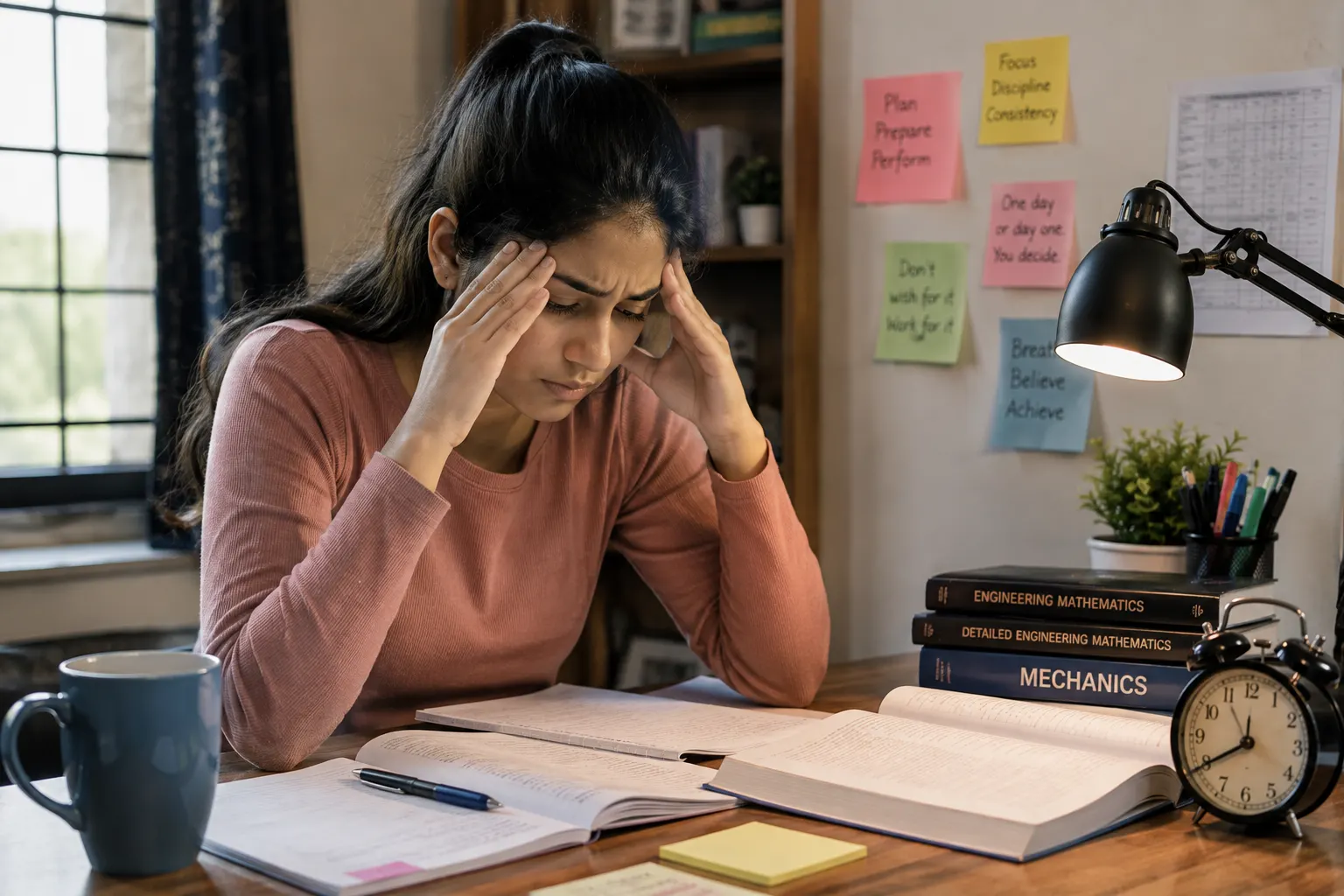
When exam anxiety becomes more than ordinary nerves
A little tension before an important examination is not automatically a problem. The body is preparing for something consequential: attention sharpens, heart rate may rise, and the mind becomes alert to possible failure. For many students, that activation is uncomfortable but manageable.
Exam anxiety becomes more concerning when worry and physiological arousal are so strong that they interfere with studying, sleep, concentration or performance. Research commonly separates test anxiety into cognitive components such as worry and self-focused thoughts, and emotional or physiological components such as tension, sweating, a racing heart or nausea. A study by Steinmayr and colleagues found that the worry component of test anxiety was particularly relevant to academic achievement, which fits a broader body of research linking excessive test anxiety with poorer educational outcomes.
The key distinction is therefore not whether you feel nervous. It is whether the nervousness is helping you mobilise or repeatedly blocking the work you need to do.
Why anxiety can interfere with performance
An examination places several demands on working memory at once. You need to understand the question, retrieve relevant knowledge, organise an answer, monitor time and resist distractions. Worry competes for some of the same limited mental resources.
A student who is solving a problem while simultaneously thinking, 'I am going to fail', 'Everyone else is faster', or 'What happens if I cannot remember this?' is effectively trying to perform two tasks. The second task contributes nothing to the answer but still consumes attention.
This does not mean anxiety mechanically causes every disappointing result. Preparation, prior knowledge, sleep, task difficulty and many other factors matter. It does explain why students can sometimes know material during revision yet struggle to access it under evaluative pressure.
The anxiety-preparation feedback loop
Exam anxiety and preparation can reinforce each other in both directions. Poor preparation can increase anxiety because the student has accurate reasons to feel uncertain. Anxiety can then make preparation more difficult by encouraging avoidance, perfectionism or frantic switching between topics.
The result is a loop: uncertainty creates worry, worry disrupts studying, incomplete studying creates more uncertainty.
One way to break the loop is to convert vague fear into measurable information. Instead of asking, 'Am I ready?', test yourself. Which topics can you retrieve without notes? Which question types still cause errors? How long does a practice paper take? Specific evidence is often easier to act on than a global feeling of being unprepared.
Start with preparation that produces evidence
Study preparation is not a complete treatment for severe anxiety, but it is one of the most controllable contributors to ordinary exam stress. In a study of medical students, a structured study-preparation intervention was associated with reduced test anxiety and improved performance, illustrating the practical value of replacing uncertainty with a plan.
Useful preparation includes active recall, spaced revision, practice questions and realistic mock exams. These methods do more than improve memory. They show you what you can and cannot yet do.
That matters psychologically. A timetable can say you studied for four hours; a practice paper can show that you can answer 70 percent of the questions correctly within the time limit. Evidence of competence is more informative than hours logged.
Practise the situation, not only the subject
A student may know the content and still feel overwhelmed by the examination setting. Familiarity with the format can reduce some of that uncertainty.
Use practice papers under gradually more realistic conditions. At first, pause to check answers and learn. Later, complete sections without notes. Eventually, practise within the real time limit.
The purpose is not to frighten yourself repeatedly. It is to make the mechanics of the examination familiar: reading instructions, allocating time, choosing question order, recovering after a difficult item and continuing when you do not immediately know an answer.
Confidence based on rehearsal is more robust than confidence based on reassurance alone.
Separate the problem from the prediction
Anxious thinking often converts a possibility into a certainty. 'This chapter is difficult' becomes 'I will fail this subject.' 'I forgot one answer' becomes 'My mind is going blank.'
A useful response is not forced positive thinking. It is more accurate thinking.
Replace predictions with questions you can test: What evidence do I have? What specifically is weak? What can I improve today? What happened in the last practice test?
The American Psychological Association recommends gently challenging unhelpful thinking when supporting anxious students. The objective is not to argue that failure is impossible. It is to prevent catastrophic assumptions from being treated as established facts.
Use short physiological down-regulation techniques
Anxiety is experienced in the body as well as in thought. Slow breathing, grounding attention in the immediate environment, relaxing tense muscle groups or taking a brief walk can help reduce acute arousal.
Mindfulness-based approaches have also been studied for test anxiety. A 2024 meta-analysis reported reductions in test anxiety across mindfulness interventions, although the studies varied in design and quality. That means mindfulness should be presented as a potentially useful tool, not as a universal cure.
A practical pre-exam routine might be simple: arrive early enough to avoid logistical panic, put away last-minute group speculation, take several slow breaths, notice physical contact with the chair or floor, and bring attention back to the first concrete task.
Protect sleep and routine
Anxiety tempts students to increase control by studying later and sleeping less. That can backfire. Fatigue makes concentration and emotional regulation harder and can make normal uncertainty feel more threatening.
Keep basic routines reasonably stable during the final days: sleep, meals, hydration, movement and study breaks. The goal is not an ideal wellness programme. It is to avoid creating additional physiological stress at the same time you are trying to manage academic stress.
What to do when anxiety spikes during the exam
If anxiety rises sharply, the immediate objective is not to eliminate every sensation. It is to regain enough control to continue.
First, stop adding interpretation. A racing heart is uncomfortable, but the thought 'I am losing control' can intensify it. Take a slower breath and extend the exhale. Read the instructions again. Identify one question you can begin.
If a difficult question traps you, mark it and move on if the exam format allows. Completing accessible questions can restore task focus and prevent one blockage from consuming the entire paper.
Use the paper in front of you as an attentional anchor. Ask: What is this question asking? What do I know? What is the next line I can write?
When to seek additional help
Some students experience anxiety that is persistent, severe or present well beyond examinations. Warning signs can include repeated inability to attend tests, panic-like episodes, major sleep disruption, significant changes in eating, prolonged distress or anxiety that interferes with ordinary daily functioning.
At that point, productivity advice is not enough. A school or university counsellor, qualified mental-health professional, doctor or relevant student-support service can help assess what is happening and what support is appropriate. Educational institutions may also have formal procedures for students whose health significantly affects assessment.
Seeking help is not a substitute for preparation; it is an appropriate response when anxiety itself has become a substantial barrier.
Do not borrow anxiety from the room
Exam anxiety can be socially contagious. In the final minutes before a test, students often compare how much they studied, trade rumours about likely questions or announce topics they believe they have forgotten. That conversation can make your own preparation feel inadequate even when nothing about your actual knowledge has changed.
Choose deliberately what you do before the exam. If group discussion helps you recall key material, use it. If it reliably increases panic, step away, review a short personal checklist or simply wait quietly. Managing the information environment is part of managing attention. You do not need to adopt another student's emotional state as evidence about your readiness.
The realistic goal
The aim is not to walk into every examination feeling perfectly calm. Important situations often produce some nervousness.
A more realistic goal is to reduce unnecessary uncertainty, recognise unhelpful thought patterns, practise the assessment conditions, protect basic routines and know how to return attention to the task when anxiety rises.
Exam anxiety becomes easier to manage when it is no longer treated as one mysterious feeling. It is a combination of preparation, thoughts, physiological arousal, habits and context. Each part offers a different point of intervention.
You may not control whether an exam feels important. You can control much more about how you prepare for it and what you do when the pressure arrives.