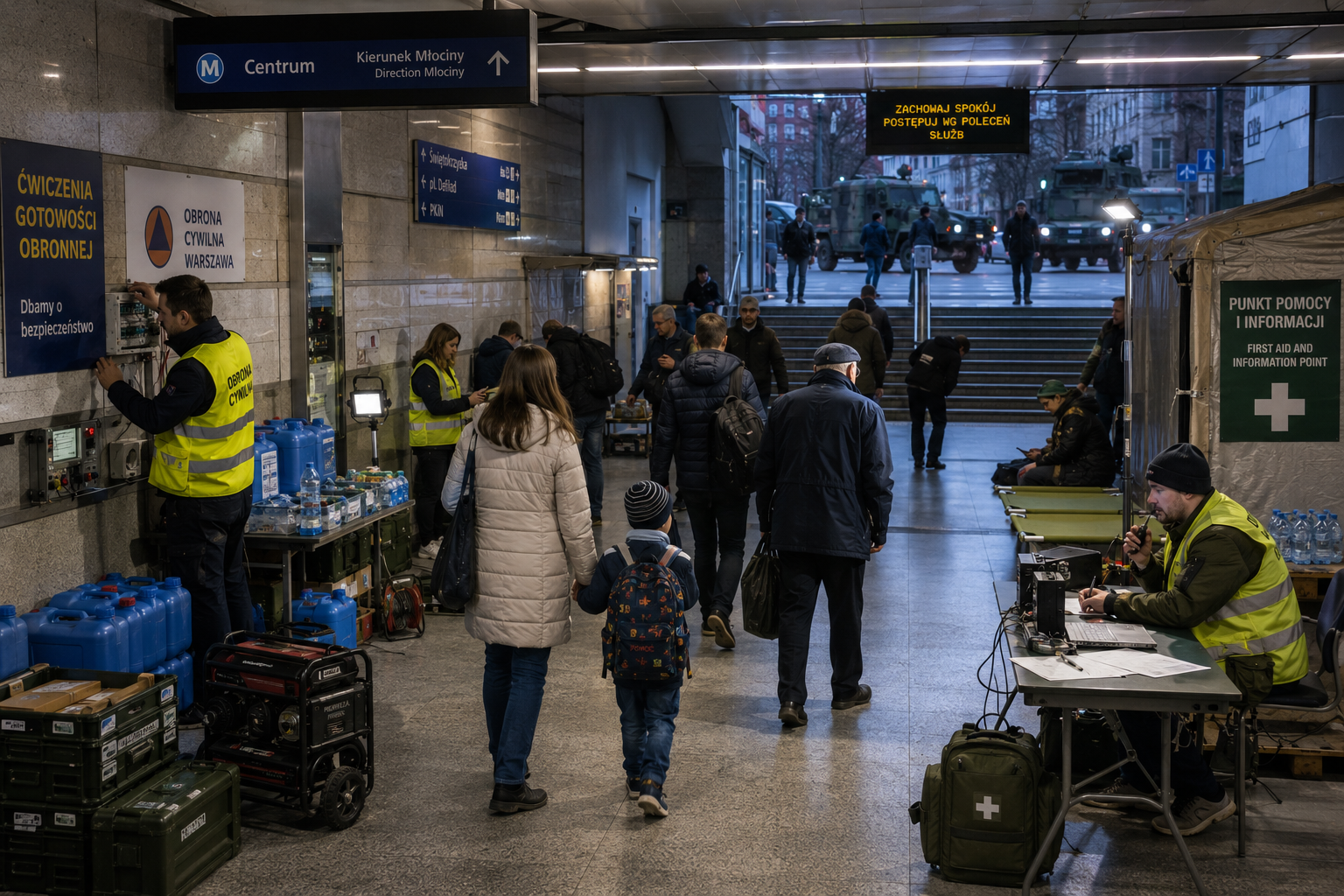
Europe is rebuilding its security architecture because the old assumptions broke. For decades after the Cold War, many European states believed that economic interdependence, American protection and institutional enlargement would keep the continent stable. Russia's war in Ukraine shattered that comfort. It exposed military shortages, energy dependence, ammunition gaps, industrial weakness and strategic overreliance on the United States. Europe is now trying to rediscover hard power.
Why the issue matters now
The transformation is visible in budgets, doctrines and institutions. NATO has regained centrality. Finland and Sweden's accession ended long traditions of military non-alignment. Eastern Europe has become the frontline of threat perception. Germany announced a major shift in defence spending. Poland has emerged as a major military actor. France continues to argue for European strategic autonomy. The European Union, once seen mainly as an economic and regulatory project, is now building defence-financing tools, industrial policies and readiness plans.
The European Commission's White Paper for European Defence - Readiness 2030, presented in March 2025, captures the new mood. It frames a new approach to defence, identifies capability gaps and proposes ways for member states to invest more heavily in defence industry and readiness. The ReArm Europe Plan and related instruments are designed to create financial space for military investment. The proposed flagship projects, including the Eastern Flank Watch, European Drone Defence Initiative, European Air Shield and European Space Shield, show that Europe is thinking beyond symbolic unity.
The immediate driver is Russia. The Ukraine war has shown that large-scale land war in Europe is not a historical memory. Artillery, drones, air defence, cyber operations, electronic warfare and logistics have returned to the centre of strategic planning. European militaries that were designed for limited expeditionary missions now need to prepare for territorial defence, attrition warfare and long-term deterrence.
The strategic geography
The second driver is uncertainty about the United States. Europe still depends heavily on American military power, intelligence, nuclear deterrence and logistics. But American politics has become less predictable. European leaders worry that Washington's future commitment may be conditional, transactional or distracted by China. This does not mean Europe can replace the United States quickly. It means Europe wants more capacity to act even when American attention shifts.
The third driver is technology. War in Ukraine has shown the importance of drones, satellite imagery, cyber tools, air defence, precision artillery, secure communications and industrial scale. Europe has high-end defence companies, but fragmented procurement and limited production capacity have slowed responsiveness. Rebuilding security architecture therefore means not only buying weapons but restructuring defence production, standardisation, stockpiles and innovation.
Energy security is also part of Europe's new architecture. The war forced Europe to reduce dependence on Russian energy. This involved LNG imports, renewables acceleration, storage management and difficult price adjustments. Energy is now treated as a security issue, not a mere market question. Critical infrastructure, pipelines, undersea cables, ports and grids are increasingly seen as vulnerable assets.
India angle
The India angle is significant. A stronger Europe can become a more serious defence and technology partner for India. India has long depended on Russia for defence equipment, but the Ukraine war has exposed the risks of overdependence on any single supplier. European states can offer aircraft, naval systems, engines, sensors, cyber capabilities, green technology and advanced manufacturing partnerships. India should not see European security only as a distant NATO matter. It affects India's defence diversification.
At the same time, Europe and India do not always see Russia in the same way. Europe views Russia as the central threat to its security. India views Russia as a long-standing defence partner, a Eurasian power and a balancing factor in a China-dominated Asian order. This difference has produced diplomatic friction. Europe wants stronger Indian alignment on Ukraine; India wants Europe to understand its strategic constraints. Managing this difference will be important for the India-Europe relationship.
Europe's rebuilding also affects global power balances. If Europe becomes more militarily capable, it may reduce some American burden in the Atlantic theatre, allowing Washington to focus more on the Indo-Pacific. That could indirectly affect India-China dynamics. If Europe remains weak, the United States will continue to carry a heavy European burden, reducing flexibility elsewhere. European security is therefore connected to Asian security, even if the geography seems separate.
Counter-view and complexity
There is also an economic dimension. Defence spending can revive European industry, but it can also strain welfare states and public finances. Europe's political systems are already under pressure from inflation, migration debates, populism and social polarisation. ReArm Europe may face public resistance if citizens see defence spending as coming at the cost of social priorities. Democratic politics will shape military readiness.
The counter-view is that Europe's security awakening may be too slow, too fragmented and too dependent on the United States to be transformative. EU defence policy has often suffered from duplication, national pride, procurement fragmentation and disagreement over threat perception. Southern Europe worries about migration and the Mediterranean. Eastern Europe worries about Russia. France thinks about autonomy. Germany thinks about restraint and industry. These differences will not vanish because of one white paper.
What happens next
Yet the direction of travel is unmistakable. Europe has crossed a psychological threshold. War has returned as a planning assumption. Defence industry has returned as an economic priority. The eastern flank has returned as a strategic frontier. NATO has returned as Europe's military backbone. The EU has returned as a financing and industrial actor.
What happens next will depend on whether Europe can turn money into capability. Announcing spending is easier than producing ammunition, training soldiers, integrating air defence or building drones at scale. It will also depend on Ukraine's future, Russia's military regeneration, US political choices and Europe's internal political cohesion.
For India, the right approach is pragmatic. It should deepen defence-industrial cooperation with Europe, pursue technology partnerships, maintain dialogue on Russia without surrendering autonomy, and use Europe as a pillar of a diversified global strategy. India should also study Europe's experience in resilience, civil defence, energy security and critical infrastructure protection.
A deeper reading of Europe's security shift must begin with the failure of the peace dividend. After the Cold War, many European states reduced defence spending, cut ammunition stocks and assumed that major war was unlikely. The result was a continent with advanced economies but limited readiness for sustained conflict. Ukraine exposed the gap between Europe's political ambition and its military inventory. Shells, air defence, drones and logistics became urgent once again.
Europe's problem is not a lack of wealth. It is fragmentation. Defence procurement is divided among national systems, political preferences and industrial interests. Multiple countries buy different platforms, maintain different standards and protect domestic industries. This reduces scale and raises costs. A European security architecture must therefore solve not only threat perception but industrial coordination.
The eastern flank is now central. Poland, the Baltic states, Finland and Romania see Russia not as an abstract risk but as a direct military problem. Western and southern European states increasingly recognise the threat, but their strategic cultures differ. This uneven threat perception will shape the success of Europe's new defence plans. Unity is easier during shock; it is harder during long budget cycles.
Ukraine is both a battlefield and a laboratory. It has shown that cheap drones can threaten expensive platforms, that air defence is decisive, that electronic warfare changes battlefield dynamics, and that civilian infrastructure becomes a target. European militaries are studying these lessons intensely. The future European force will need mass as well as sophistication. High-end systems matter, but so do stockpiles, repair capacity and rapid production.
The nuclear question is also returning. Europe relies heavily on the US nuclear umbrella. France has its own nuclear deterrent, and Britain remains a nuclear power outside the EU. If US security guarantees become less predictable, European debates on deterrence will intensify. This does not mean Europe will quickly create a common nuclear doctrine, but the conversation itself shows how deeply the security environment has changed.
For India, Europe's defence awakening creates both opportunities and diplomatic complications. Opportunities include co-development, technology transfer, naval systems, aerospace, cyber security, space security and resilient supply chains. Complications arise when European partners expect India to align more openly against Russia. India must explain that strategic autonomy is not neutrality for convenience; it is rooted in defence dependence, continental threats and a desire to avoid bloc politics.
Europe also matters to India's economy. The EU is a major trade and regulatory power. Defence industrial policy, sanctions, technology controls, carbon rules and supply-chain due diligence can affect Indian firms. A more security-minded Europe may become more selective about technology partnerships and more demanding on standards. India must be prepared for a Europe that uses regulation as strategy.
The Indo-Pacific link is growing. European countries such as France, Germany, the Netherlands and the UK have shown interest in Indo-Pacific strategy. France has territories and military presence in the Indian Ocean and Pacific. If Europe becomes more capable, it can contribute more to maritime security, technology partnerships and balancing behaviour in Asia. If it remains overstretched by Russia, its Indo-Pacific role will remain limited.
The deeper conclusion is that Europe is trying to become a geopolitical actor after decades of acting primarily as a market and normative power. This transition will be uneven. It requires money, political will, industrial capacity and social consent. But the direction is clear: Europe is relearning that prosperity without security is fragile.
Europe's security rebuilding will also reshape global arms markets. As European states place large defence orders, production lines may become crowded and delivery timelines may lengthen. Countries like India that seek European equipment must plan early and negotiate co-production where possible. The era of easy off-the-shelf acquisition may become more difficult as Europe prioritises its own readiness.
Sanctions policy is another area to watch. Europe has become more willing to use financial restrictions, export controls and technology limits as strategic instruments. Indian companies operating globally must build compliance capacity. A security-minded Europe will scrutinise dual-use technology, supply chains and links with sanctioned actors more closely.
Europe's internal politics could either support or weaken the security shift. If voters accept the Russian threat and support defence spending, the rebuilding will continue. If economic pressures and populist politics grow, governments may struggle to sustain spending. India's diplomats should understand that European policy is not made only in Brussels; it is shaped by national elections and coalition politics.
The deeper Indo-European opportunity is in resilience. India and Europe can cooperate on cyber security, critical infrastructure protection, trusted technology, maritime domain awareness, space situational awareness and defence manufacturing. These areas matter to both Russia-facing Europe and China-facing India. Strategic convergence should be built through such practical projects.
The editorial insight is this: Europe is rebuilding its security architecture because history did not end; it returned with artillery, drones and energy blackmail. For India, Europe's awakening is not a distant continental drama. It is part of the wider redistribution of power that will shape the Indo-Pacific, defence technology and the future of strategic autonomy.
Internal Links to Add
Related regional explainer articles from the Master Article Shell should be added during CMS upload based on topical proximity.