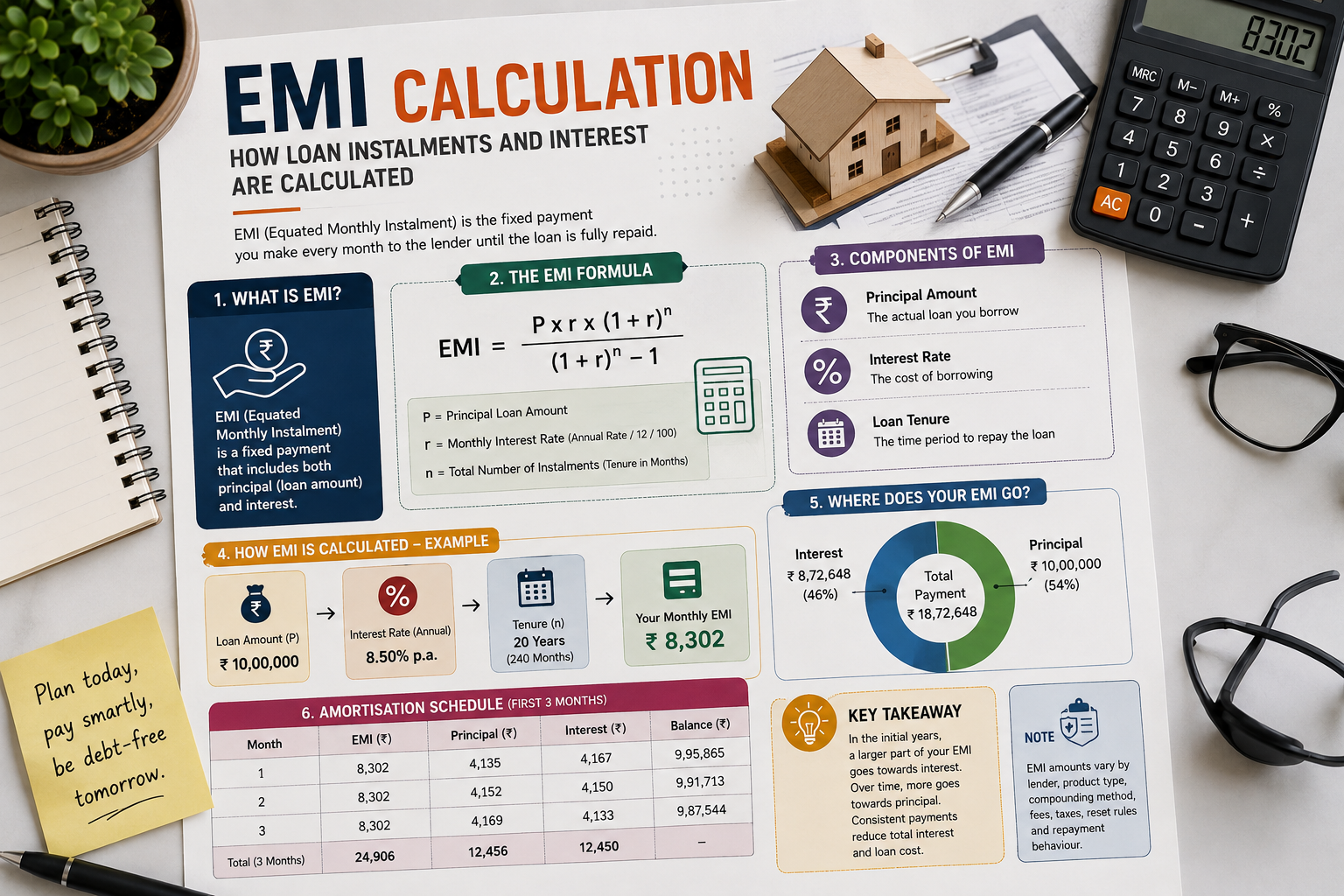
An EMI is simple to pay but complex to understand
An EMI, or equated monthly instalment, is one of the most familiar numbers in household finance. People talk about home-loan EMI, car-loan EMI, education-loan EMI, personal-loan EMI, phone EMI, appliance EMI and credit-card EMI. The appeal is obvious: a large expense becomes a smaller monthly payment. A product that feels unaffordable today becomes manageable when divided across months.
But the simplicity of the monthly number can hide the complexity of the loan. An EMI is not just the price of convenience. It is a structured repayment that combines principal and interest. The borrower pays the same instalment every month in many standard loans, but the internal composition changes over time. Early EMIs often contain more interest and less principal. Later EMIs contain more principal and less interest.
Understanding EMI matters because borrowers often judge affordability only by the monthly amount. A lower EMI feels better, but it may come from a longer tenure and a higher total interest cost. A higher EMI may feel uncomfortable, but it may reduce total cost. The central lesson is this: EMI tells you cash-flow burden; total interest tells you economic burden. You need to understand both.
The three variables that decide EMI
Every standard EMI is shaped by three main variables: loan amount, interest rate and tenure. The loan amount is the principal borrowed. The interest rate is the cost charged by the lender. The tenure is the time over which the loan will be repaid. Change any one of these and the EMI changes.
A bigger loan increases EMI. A higher rate increases EMI. A longer tenure usually reduces EMI but increases total interest because the borrower uses the lender’s money for a longer time. This is why a long-tenure loan can look comfortable month by month but expensive over its life.
Borrowers should therefore not ask only, “What EMI can I afford?” They should also ask, “How much total interest will I pay?” and “How long will this debt occupy my future income?” A loan is not only a monthly commitment. It is a claim on future cash flow.
The basic EMI formula in plain language
The technical EMI formula uses principal, monthly interest rate and number of instalments. In simplified form, EMI rises with principal, rises with interest rate and falls when tenure is extended. The formula exists because lenders need to recover both interest and principal through equal periodic payments.
A borrower does not need to memorise the formula to make good decisions. Online calculators can compute EMI instantly. What matters is understanding what the calculator is doing. It is spreading the loan across time while charging interest on the outstanding balance. The longer the outstanding balance remains unpaid, the more interest is collected.
This is why two loans with the same amount and rate can have very different total costs if their tenures differ. The EMI number alone can deceive. A lower EMI may simply mean the borrower is paying slowly, and slow repayment gives interest more time to accumulate.
Principal and interest split
An EMI has two parts: principal repayment and interest payment. Principal repayment reduces the loan balance. Interest payment compensates the lender for lending money. In the early stage of a long loan, a larger share of EMI often goes toward interest because the outstanding principal is still high. As the loan ages and principal declines, the interest portion falls and the principal portion rises.
This pattern is called amortisation. It explains why borrowers sometimes feel disappointed after paying a home loan for a few years and seeing that the principal has not fallen as much as expected. They were paying EMIs, but a large portion was servicing interest in the early years.
An amortisation schedule is therefore an important document. It shows month by month how much of each EMI goes to interest, how much goes to principal and what outstanding balance remains. Every borrower should look at this schedule before taking a major loan.
Reducing balance versus flat rate
The method of interest calculation changes the real cost of borrowing. In a reducing balance loan, interest is calculated on the outstanding principal. As the borrower repays principal, the interest base reduces. This is common in many formal loan products and is generally more transparent for long-term borrowing.
A flat-rate loan may quote interest on the original principal for the whole tenure, even though the borrower is repaying every month. The flat rate may appear lower than a reducing balance rate but can be costlier in effective terms. This is why borrowers should be careful when comparing loans based on advertised rates.
The better comparison is annual percentage rate or effective cost where available, along with total amount payable. A borrower should never assume that a 10 percent flat rate equals a 10 percent reducing balance rate. The words around the number matter.
How tenure changes total interest
Tenure is the most underestimated variable in EMI planning. Extending tenure can make a loan look affordable because the monthly EMI falls. But the borrower pays interest for more months or years. In long loans, this difference can be substantial.
For example, if a borrower stretches a loan from five years to seven years, the monthly payment may become easier, but the total interest may rise sharply. The lender is not giving relief for free. The lender is giving time, and time has a price.
That does not mean short tenure is always best. A very high EMI can create cash-flow stress and increase the risk of default. The right tenure balances affordability and total cost. The EMI should be manageable, but not so low that the borrower pays unnecessary interest for years.
Floating rates and EMI changes
Many loans, especially home loans, may be linked to floating interest rates. When the benchmark rate changes, the lender may adjust EMI, tenure or both. If rates rise, the borrower may face a higher EMI or a longer remaining tenure. If rates fall, the borrower may benefit through lower cost, depending on how the lender passes through changes.
Borrowers should ask how rate resets work before taking the loan. Will the EMI change automatically? Will the tenure increase? Will the lender ask for consent? How often will statements show principal and interest recovered? What options exist if the borrower wants to switch rate type or prepay?
Floating rates are not bad. They can be beneficial in falling-rate cycles. But they require awareness. A borrower who takes a floating-rate loan must be prepared for movement rather than assuming the first EMI is permanent.
Prepayment and the power of reducing principal early
Prepayment can reduce total interest because it lowers the outstanding principal faster. The earlier the prepayment is made, the more powerful it is, especially in long-tenure loans where early payments save interest across many future months.
Even small extra payments can matter. A borrower who receives an annual bonus, business surplus or tax refund may use part of it to reduce principal. Over time, this can shorten tenure and reduce total cost. However, borrowers must check whether part-payment is allowed and whether charges apply.
Prepayment should be balanced with liquidity. It is unwise to empty an emergency fund just to reduce a loan. The best financial plan reduces debt without making the household vulnerable to the next emergency.
Common EMI mistakes borrowers make
The first mistake is choosing the lowest EMI without checking the total cost. Low EMI is attractive because it protects monthly cash flow, but it may extend the loan and increase total interest. The second mistake is borrowing to the maximum eligible amount. Lender eligibility is based on risk assessment; it is not a recommendation that the borrower should take the highest possible loan.
The third mistake is ignoring other financial goals. A household may be able to pay the EMI today but lose the ability to invest, buy insurance, build an emergency fund or handle medical expenses. A loan that consumes too much monthly surplus creates fragility even if there is no default.
The fourth mistake is assuming that every EMI purchase is harmless because it is small. Several small EMIs can combine into a large fixed obligation. Phone EMI, appliance EMI, card EMI, personal loan EMI and vehicle EMI may individually look manageable. Together, they can turn future income into pre-committed money before the month even begins.
The safest habit is to calculate total fixed obligations before accepting a new EMI. If future income is already crowded, affordability is weaker than the monthly instalment suggests.
Final takeaway
An EMI makes borrowing manageable, but it should not make borrowing careless. The monthly instalment is only one part of the story. The full story includes principal, interest rate, tenure, calculation method, fees, reset rules, prepayment flexibility and total interest paid.
A smart borrower studies the amortisation schedule, compares effective cost, avoids unnecessarily long tenure, keeps room for emergencies and tries to prepay when possible. The goal is not to avoid all debt. The goal is to ensure that debt serves a real purpose at a cost the borrower understands.
EMI is a bridge between today’s need and tomorrow’s income. Used wisely, it can help build assets and manage cash flow. Used blindly, it can quietly mortgage the future. The difference lies in understanding how interest is calculated before the first instalment is paid.