Dilip Kumar: The Acting Style That Changed Hindi Cinema
Dilip Kumar changed Hindi screen acting partly through what he chose not to do. In a cinema still carrying strong traditions of theatrical projection, declamatory dialogue and visibly signalled emotion, he demonstrated how much a camera could discover in a lowered voice, an unfinished sentence, a delayed reply or a face that remained still while the character appeared to be thinking.
That restraint did not make his performances unemotional. It made emotion appear to originate inside the character rather than being placed on top of the scene for the audience to recognise. Grief could contain pride. Love could contain hesitation. Anger could be held inside the body before appearing in speech. A reaction shot could become as important as the dialogue that preceded it.
This is one reason later generations repeatedly describe him as a foundational figure in modern Hindi-film acting. The term “method actor” is frequently attached to Dilip Kumar, including by film histories and retrospectives, but it can create more certainty than the evidence allows. It should not imply that he belonged formally to one Western acting school or imported a fixed system into India. What can be seen more clearly in the work is an actor who approached performance analytically: observing behaviour, controlling speech and gesture, adjusting himself to the camera and searching for a psychological logic behind what a character did. Cinemaazi similarly describes his acting as unusually naturalistic for his period and associates him with intensive preparation.
His achievement was therefore not the invention of psychological acting in India. Indian theatre and cinema already contained sophisticated performance traditions. His importance was that he made a particular form of controlled interiority commercially central to mainstream Hindi cinema.
Audiences did not have to choose between popular melodrama and detailed acting.
Dilip Kumar showed that the two could inhabit the same frame.
From Yusuf Khan to a Performer Learning What the Camera Sees
Dilip Kumar was born Muhammad Yusuf Khan on 11 December 1922 in Peshawar, then part of British India. His family later settled in Bombay, where his father was connected with the fruit trade. He did not emerge from an established film dynasty, and his eventual entry into cinema brought him into the studio environment of Bombay Talkies, one of the major institutions of 1940s Hindi filmmaking. Cinemaazi records both his Peshawar birth and his 1944 debut in Jwar Bhata.
The adoption of the screen name Dilip Kumar became part of his public identity, but the more important transformation happened professionally.
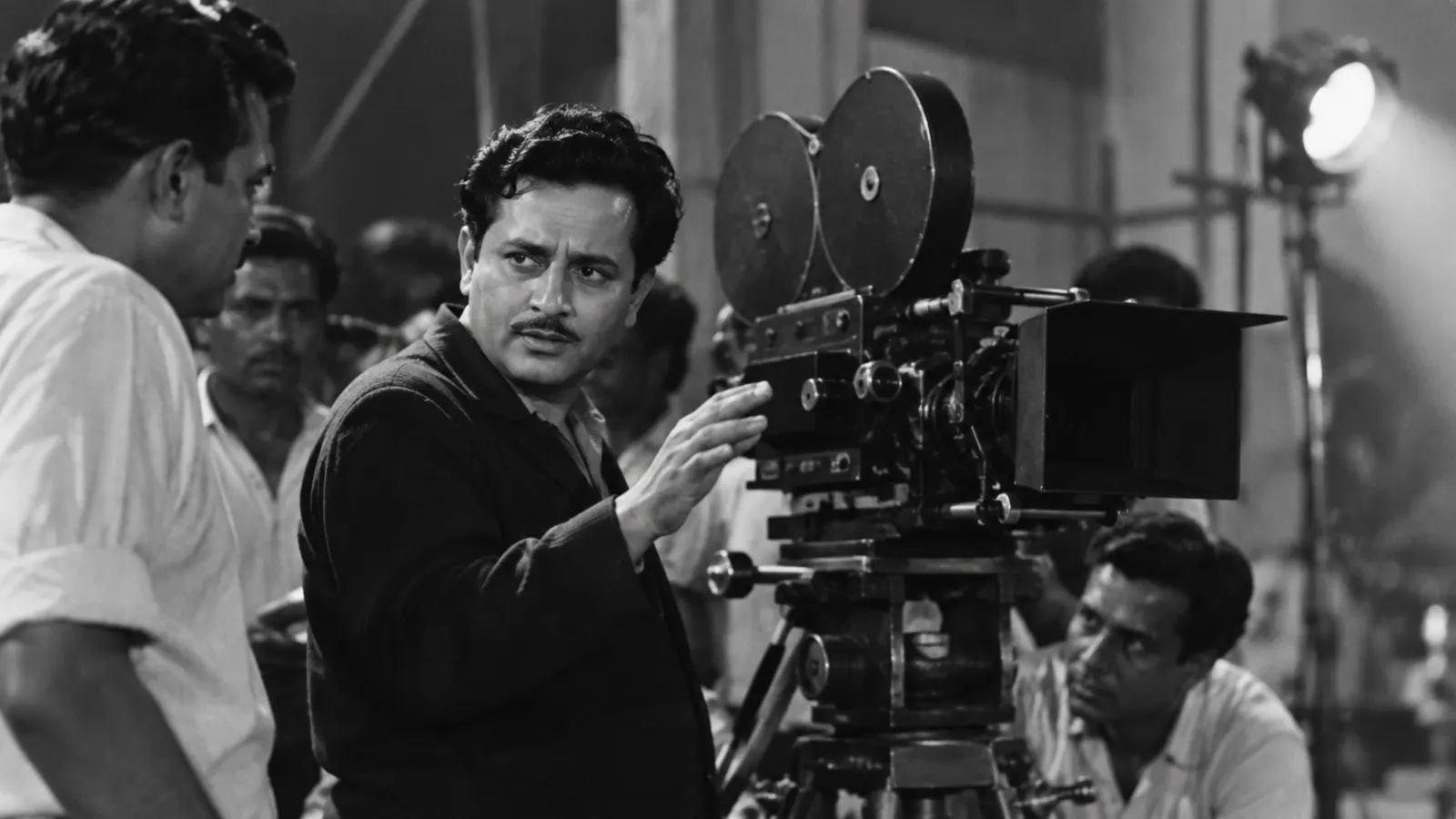
Film acting required different calculations from ordinary social behaviour or stage performance. A theatre performer must project across physical distance. A film actor may be shown in a close-up large enough for a slight movement around the eyes to become visible to hundreds of spectators. Microphones change how speech works. Editing means performances are built across separate takes. Continuity requires apparently spontaneous movements to be reproduced precisely.
Dilip Kumar learned those restrictions over time.
His debut did not immediately contain the fully developed performer remembered today. Like most significant actors, he acquired craft through repetition: where to direct the eyes, how long to hold a pause, how much movement a close-up could tolerate and how dialogue sounded when spoken for a microphone rather than a theatre hall.
By the later 1940s, films such as Jugnu, Mela, Shaheed and particularly Mehboob Khan's Andaz had turned him into a major star. Cinemaazi identifies Jugnu as his first major hit and Andaz as a breakthrough that helped establish the wounded romantic image that would recur through several subsequent roles.
Andaz is important because it demonstrates how star persona and acting style can develop together. Dilip Kumar's character is emotionally exposed but not constantly demonstrative. Desire, misunderstanding and resentment accumulate across scenes. The audience begins to associate the actor with a man who cannot easily convert feeling into uncomplicated action.
That association eventually produced one of Hindi cinema's most durable labels.
The “Tragedy King.”
The Tragedy King Was Built Through Control, Not Continuous Sadness
Dilip Kumar's reputation for tragedy developed through films including Mela, Jogan, Deedar, Daag, Devdas and Madhumati. Cinemaazi lists several of these works among the films responsible for establishing the “Tragedy King” identity.
The label is accurate enough to describe part of his career, but it can also flatten what made the performances effective.
His tragic acting was rarely powerful because he looked continuously miserable.
Instead, suffering often appeared through conflict between emotions. Pride prevented confession. Desire collided with social obligation. Shame interrupted tenderness. Anger concealed vulnerability. The most memorable characters frequently seemed trapped not simply by external circumstances but by their own inability to act straightforwardly.
Bimal Roy's Devdas provides the clearest example.
Devdas is an inherently melodramatic character: failed love, alcoholism, self-destruction and death could easily invite continuous emotional display. Dilip Kumar frequently does the opposite. Vocal energy rises and falls. A line may be delayed as though the thought preceding it matters. Physical deterioration appears gradually rather than as one fixed expression of despair.
The performance is built around paralysis.
Devdas feels deeply but repeatedly fails to convert feeling into timely decision. Dilip Kumar makes that incapacity readable without needing to explain it. The tragedy becomes behavioural.
This is where the actor's famous pauses become more than mannerism. A useful pause does not simply slow the film. It creates the impression that one thought is colliding with another before speech emerges.
That technique helped change the emotional grammar available to commercial Hindi cinema.
Silence could carry narrative information.
A still face could remain dramatic.
The audience could be trusted to interpret what the actor had not explicitly announced.
Yet the tragic persona soon became restrictive. An actor repeatedly associated with wounded men risks making every character appear like another variation on the same emotional temperament. Dilip Kumar's subsequent career is important partly because he refused to remain inside that box.
Comedy, Romance and Dual Roles Exposed the Range Behind the Persona
Films such as Azaad and Kohinoor demonstrate why “Tragedy King” should never be mistaken for a complete description of Dilip Kumar's abilities.
Comedy requires a different relationship with time.
Tragedy often allows emotion to accumulate before release. Comedy can depend on speed, surprise, reversals and an actor's willingness to surrender dignity at exactly the right moment. Physical behaviour becomes lighter. The body cannot carry the same weight it carries in Devdas.
Dilip Kumar could make that adjustment.
That versatility matters because it proves that the tragic intensity for which he became famous was constructed rather than merely an extension of his off-screen temperament. A performer who can shift convincingly between emotional registers is demonstrating control over technique.
The argument becomes even stronger with Ram Aur Shyam.
Released in 1967, the film placed Dilip Kumar in a double role built around opposites: one character inhibited and fearful, the other confident and energetic. The technical premise could easily have remained a novelty—one star appearing twice in the frame—but the acting challenge was more interesting.
The audience had to know which man it was watching before the plot explained it.
Dilip Kumar therefore differentiates the two through behavioural systems. Posture changes. Walking rhythm changes. Speech changes. The amount of space each character believes he is entitled to occupy changes.
The timid man seems to shrink around authority.
The confident man moves as though the environment belongs to him.
The same face produces two different social presences.
Film Heritage Foundation included Ram Aur Shyam among four landmark works selected for its 2022 centenary retrospective, alongside Aan, Devdas and Shakti, reflecting how strongly the film remains associated with his range.
This range is essential to understanding his influence. Dilip Kumar did not simply make sadness more believable. He demonstrated that a major Hindi-film star could treat characterisation as a set of specific behavioural choices.
Voice Was One of His Most Precise Acting Instruments
Much discussion of screen acting concentrates on the face, but Dilip Kumar's voice was equally important.
His Urdu-Hindustani diction could be formal and literary without automatically becoming theatrical declamation. Words remained carefully articulated, yet the volume did not always rise simply because the dialogue was important.
He understood that microphones had changed performance.
A line delivered quietly could still fill a cinema hall after recording and amplification. This allowed vocal intensity to be separated from vocal volume.
Pauses became part of syntax. Breath became part of meaning. A sentence could begin confidently and weaken as a character's certainty disappeared.
The result often creates the impression that dialogue is being produced by thought in the moment rather than recalled from a screenplay.
That illusion is one of film acting's central achievements.
A written line has existed for weeks or months. It may have been rehearsed repeatedly. The camera may require several takes. Yet the actor must make it appear that the character has never said or heard these words before.
Dilip Kumar's vocal rhythm frequently helped create that freshness.
Language also carried social identity. His more refined urban characters could employ polished speech, while Gunga Jumna demanded a dramatically different linguistic world. In that film, regional inflection becomes part of character rather than merely comic decoration.
This willingness to alter speech complicates the popular image of Dilip Kumar as simply the master of elegant Urdu dialogue.
Good diction is not always polished diction.
Good diction is speech appropriate to the person being played.
Gunga Jumna Showed How Far the Actor Could Move From His Established Image
Gunga Jumna, released in 1961, is one of the most revealing films in Dilip Kumar's career because it expands the discussion from performance to authorship and creative control.
He was deeply involved with the project beyond simply appearing in front of the camera, and the film's rural world required him to move far from the polished tragic-romantic persona associated with several earlier successes.
Gunga is physically and socially different.
The body carries labour differently. Anger comes from another class position. Language is regionally inflected. The character's movement from ordinary village life toward outlaw status has to feel connected to social pressure rather than merely to star charisma.
The story of brothers placed on opposite sides of law and social circumstance would echo through later Hindi cinema, although it would be simplistic to claim that one film single-handedly created the tradition.
What matters for acting history is the transformation.
A successful star always faces pressure to repeat recognisable qualities because recognition sells tickets. Gunga Jumna shows Dilip Kumar using stardom to move in the opposite direction: away from refinement and toward a more localised physical and linguistic identity.
That willingness is one reason descriptions of him as psychologically analytical remain persuasive.
He did not simply ask how Dilip Kumar should behave in the scene.
He appears to have asked what this particular man, from this particular environment, would sound and feel like.
Mughal-e-Azam Proved That Restraint Could Survive Spectacle
K. Asif's Mughal-e-Azam presented a completely different acting problem.
The film is monumental by design. Architecture, costume, dialogue, music and historical scale all announce grandeur. Prithviraj Kapoor's Emperor Akbar carries imperial authority through an expansive vocal and physical presence. Madhubala's Anarkali brings another kind of emotional intensity.
Dilip Kumar, playing Prince Salim, had every opportunity to compete with that scale.
He often chooses not to.
Salim's rebellion becomes powerful partly because it can be compressed into gaze, stance and controlled speech. His authority is different from Akbar's authority. The dramatic relationship works precisely because the two performers do not attempt to occupy the same performance register.
This is an important lesson about acting inside spectacle.
A large film does not necessarily require large acting from everyone in every scene.
Sometimes the set has already communicated scale. The music has already communicated emotion. The camera has already moved close enough that another layer of exaggeration would become redundant.
Dilip Kumar's ability to understand his place inside the entire audiovisual construction distinguishes performance control from merely impressive dialogue delivery.
This is also why directors matter so much to any assessment of his acting.
Bimal Roy's visual restraint in Devdas permits one kind of inward performance. K. Asif's monumental staging in Mughal-e-Azam requires another. B. R. Chopra's Naya Daur places the star within a social drama of work, technology and community. Ramesh Sippy's Shakti later turns him into one half of a generational confrontation.
There is no single Dilip Kumar style independent of filmmaking context.
His craft included knowing how much each film required from him.
Melodrama and Naturalism Were Never True Opposites
It is tempting to tell the history simply: old Hindi cinema was theatrical, and Dilip Kumar arrived to make it natural.
That story is too neat.
Dilip Kumar remained a major star within melodrama. His films contained doomed romance, sacrifice, family conflict, coincidence, moral confrontation, songs and situations far removed from ordinary daily life.
He did not abolish melodrama.
He altered the behavioural texture inside it.
A story could remain heightened while the actor's response became controlled. Dialogue could remain literary while it seemed psychologically motivated. A hero could suffer spectacular narrative misfortune while still expressing that suffering through small physical changes.
This synthesis was particularly valuable for popular cinema because commercial filmmaking did not have to abandon emotional scale in order to gain psychological detail.
Madhumati demonstrates the same principle in another genre.
Bimal Roy's film mixes romance, reincarnation, gothic atmosphere, music and mystery. A literal idea of realism would have difficulty explaining why a naturalistic actor belongs inside such a world.
But screen naturalism does not require ordinary circumstances.
It requires behavioural credibility within the world the film establishes.
Dilip Kumar does not need to tell the audience that reincarnation is extraordinary. The screenplay, music and atmosphere already provide that information. His responsibility is to respond to the film's emotional problem as though it matters completely to the character.
Taking genre seriously is itself an acting discipline.
Listening Was as Important as Speaking
One of the easiest ways to recognise an inexperienced screen performer is to watch what happens while another actor is speaking.
The novice often seems to wait for the cue to deliver the next line.
A skilled actor appears to receive information.
Dilip Kumar's strongest performances repeatedly show the importance of this distinction. Scenes with Nargis, Madhubala, Vyjayanthimala, Meena Kumari, Waheeda Rehman, Saira Banu and later Amitabh Bachchan often depend on what happens to his face before he answers.
The reaction is not empty space between pieces of dialogue.
It is part of the dialogue.
A small alteration in gaze can indicate disbelief. A held breath can precede anger. Silence can suggest that a character is deciding whether truth is safe to reveal.
This responsiveness also reminds us that screen acting is collaborative.
No actor creates a performance in isolation. Co-stars determine rhythm. Directors determine scale. Editors choose which reactions survive. Cinematographers decide whether a movement is shown in close-up or lost inside a wide frame.
Dilip Kumar's apparent stillness was therefore never simply inactivity.
The camera had to be close enough to read it, another actor had to provide something worth reacting to, and the edit had to leave enough time for the reaction to register.
His achievement was learning how much information could exist in that small interval.
Naya Daur Connected Psychological Stardom With a Social World
B. R. Chopra's Naya Daur is another useful corrective to the idea that Dilip Kumar's acting was mainly concerned with private suffering.
The film stages a conflict around mechanisation, labour and community. Its celebrated horse-cart-versus-bus competition is melodramatic, but the underlying tension belongs to post-independence development: what happens when technological change threatens existing livelihoods?
Dilip Kumar's character operates inside a collective conflict rather than an entirely private tragedy.
The star's charisma therefore has a social function.
He must remain an emotionally legible individual while simultaneously becoming a representative of a community under pressure.
This kind of performance was crucial to post-independence popular Hindi cinema, where personal stories frequently carried broader arguments about poverty, class, modernisation, corruption and social responsibility.
The screen hero could embody an ethical position without becoming merely a political speech.
Dilip Kumar was especially effective in such films because his seriousness could make the moral problem feel personal.
The viewer did not only encounter an abstract debate about machines and labour.
The debate acquired a face.
The Hiatus Revealed That Even Great Acting Depends on an Industry's Needs
By the 1970s, the dominant Hindi-film hero was changing.
Political frustration, urban violence and new forms of action cinema helped create a cultural environment increasingly associated with Amitabh Bachchan's “angry young man”. The romantic and tragic male star of earlier decades no longer occupied exactly the same industrial position.
Dilip Kumar's career slowed and he stepped away from acting for several years.
This is important because star careers are not controlled by talent alone.
An actor can remain technically capable while audiences, producers, genres and ideas of masculinity change around him. Longevity therefore requires more than maintaining craft. It requires accepting that the dramatic function available to the performer may have changed.
Dilip Kumar's return in Kranti in 1981 demonstrated precisely that adjustment. Cinemaazi identifies the film as his comeback after the break.
He did not return by pretending that the romantic leading man of the 1950s had simply grown older without changing.
Age became part of the new star image.
The voice now carried institutional and paternal authority. Physical stillness meant something different. Moral seriousness could be used for senior characters whose conflicts came from responsibility, history and power rather than youthful romance.
The reinvention culminated especially effectively in Shakti.
Shakti Turned Two Eras of Hindi Acting Into a Family Conflict
Ramesh Sippy's Shakti placed Dilip Kumar opposite Amitabh Bachchan, making comparison inevitable.
The casting itself carried historical meaning. Dilip Kumar represented one foundational tradition of post-independence Hindi stardom; Bachchan represented the dominant star form that had emerged later.
The film wisely does not require either man to imitate the other.
Dilip Kumar plays Ashwini Kumar, a police officer whose commitment to duty has helped create emotional distance from his son. Bachchan's character carries another kind of intensity—resentment, wounded masculinity and generational anger.
Their conflict works because each actor's established screen authority becomes part of the drama.
Cinemaazi notes the continuing importance of Shakti within Dilip Kumar's later career, while Film Heritage Foundation selected it alongside Aan, Devdas and Ram Aur Shyam for its centenary retrospective.
For Dilip Kumar, the film demonstrated that restraint could survive ageing.
The face had changed, the body had changed and the screen position had changed. The underlying craft remained recognisable: measured speech, controlled pauses and the suggestion that a moral argument was occurring internally before it appeared in dialogue.
This may be the central achievement of his later career.
Reinvention did not require erasing the earlier performer.
It required preserving method while releasing the old image.
Senior Stardom Allowed Authority to Replace Romantic Centrality
Films including Vidhaata, Mashaal, Karma and Saudagar continued the later phase of Dilip Kumar's career.
These roles were often more explicitly authoritative than his earlier work. He could play patriarchs, institutional figures, mentors or men carrying histories larger than one romantic relationship.
Some performances in this period also operate at a broader scale than the celebrated naturalism of his youth. That difference should not automatically be treated as artistic decline.
The films themselves had changed.
Commercial Hindi cinema of the 1980s frequently demanded stronger declarative dialogue, heightened confrontation and a larger dramatic register. Dilip Kumar adjusted again, though the strongest moments continued to depend on timing rather than volume alone.
Saudagar in 1991 also turned cinema history itself into part of the spectacle by placing him opposite Raaj Kumar decades after their earlier work together.
His final film, Qila, appeared in 1998. Cinemaazi's filmography likewise records Qila as the endpoint of an acting career that had begun with Jwar Bhata in 1944.
That span is remarkable not merely for its length but for the industrial transformations it crosses.
He began in the studio era of black-and-white filmmaking and remained visible through colour spectacle, post-independence social cinema, the rise of the action hero, the consolidation of the superstar system and the beginning of a more globally oriented Hindi film economy.
Few actors provide such a long view of how Indian screen performance changed.
Public Honours Confirmed a Cultural Status Larger Than Stardom
Dilip Kumar's public identity eventually extended well beyond box-office success.
The Government of India awarded him the Dadasaheb Phalke Award in 1994 and the Padma Vibhushan in 2015. He also served as a member of the Rajya Sabha from 2000 to 2006. When he died in Mumbai on 7 July 2021 at the age of 98, he was accorded full state honours. The Government of India's condolence noted that his appeal extended across the subcontinent.
That cross-border dimension matters.
Dilip Kumar was born in Peshawar before Partition and became one of the central stars of Indian cinema after it. His career therefore belonged to a South Asian cultural world divided politically but never entirely separated artistically.
Films, songs and stars continued to circulate through memory even when national relationships were hostile.
This is one reason his cultural status cannot be understood purely through the history of one national film industry. Audiences across South Asia recognised the style, voice and persona.
The actor became part of a shared archive.
His Influence Is Better Understood as Permission Than Imitation
Claims about influence can become exaggerated very quickly.
It is easy to say that every important Hindi-film actor after Dilip Kumar copied him. That would be historically careless. Amitabh Bachchan, Naseeruddin Shah, Om Puri, Shah Rukh Khan and many later performers developed very different styles and worked in radically different industrial circumstances.
A more defensible claim is that Dilip Kumar expanded what mainstream audiences and producers understood screen acting could contain.
He gave later performers permission to trust small behaviour.
A major star could hesitate.
He could listen.
He could lower his voice instead of raising it.
A masculine hero could reveal internal conflict without becoming dramatically weak.
A close-up could be filled with thought rather than movement.
That possibility became part of the acting landscape available to everybody who followed, whether or not they consciously copied his gestures.
His enormous commercial visibility was crucial.
Naturalistic performance in a small experimental film can influence actors and critics. Naturalistic performance inside major commercial successes changes what producers believe large audiences will accept.
Dilip Kumar's restraint therefore became industrial precedent as well as acting craft.
The distinction matters.
His influence was not simply that actors admired him.
It was that audiences had already rewarded the kind of acting he represented.
Why Calling Him a “Method Actor” Requires Care
No discussion of Dilip Kumar's legacy can avoid the phrase “method acting”, but it should be used carefully.
Cinemaazi describes him as practising a form of method acting and notes his analytical investment in roles. Numerous later actors and commentators have used similar language.
Yet “the Method” has specific histories associated with Stanislavski-derived acting practices, the Group Theatre, Lee Strasberg and other schools. Dilip Kumar's development occurred in another theatrical, linguistic and cinematic environment.
There is little value in forcing his career into a Western genealogy simply to make his seriousness legible.
The observable evidence is strong enough without doing that.
He studied behaviour.
He altered voice and physicality across characters.
He appears to have thought carefully about motivation and emotional continuity.
He understood camera scale.
He controlled gestures rather than treating more visible emotion as automatically better acting.
Those characteristics justify describing his performance style as psychologically detailed or internally motivated without requiring a claim that he adhered to one codified school.
The distinction also protects Indian film history from another simplification: the idea that psychological performance arrived only when someone discovered a Western acting technique.
Indian performance traditions had their own sophisticated ideas about emotion, embodiment, gesture and character long before cinema.
Dilip Kumar's achievement belongs within that more complex history.
Why the Performances Still Survive Changes in Acting Fashion
Screen acting ages quickly.
A gesture considered subtle in one decade can seem mannered in another. Dialogue styles change. Editing becomes faster. Microphones become more sensitive. Audiences become accustomed to different degrees of behavioural realism.
Some of Dilip Kumar's films inevitably carry the conventions of their time.
Yet the strongest performances remain readable because their internal objectives are clear.
The viewer understands what the character wants.
The viewer understands what he is refusing to say.
The viewer can see why one piece of information changes his behaviour.
A pause therefore remains meaningful even if contemporary films would edit the scene more quickly.
This is a more durable measure of acting than asking whether every gesture appears identical to twenty-first-century everyday behaviour.
Naturalism itself is a construction.
An actor must stand where lighting and focus can find him, reproduce movements across takes, respond to marks on the floor, accommodate edits and speak so recording equipment can capture the performance.
What appears effortless is highly technical.
Dilip Kumar's achievement was making technical control look psychologically spontaneous.
The character often seems to think before speaking.
That tiny interval became one of his signatures.
The Lasting Legacy Was Acting as Thought Made Visible
Dilip Kumar is remembered through many convenient descriptions: Tragedy King, method actor, screen legend, veteran superstar.
None fully explains what made him transformative.
His deeper contribution was demonstrating that popular Hindi cinema could place inner behaviour at the centre of star acting.
Emotion did not always need to become gesture immediately.
Speech could seem to emerge from thought.
Listening could be active.
Silence could create tension.
A character could contain contradictory feelings without resolving them for the audience.
That approach worked across very different forms—from the fatal romanticism of Devdas and the historical spectacle of Mughal-e-Azam to the rural social world of Gunga Jumna, the comic duality of Ram Aur Shyam and the generational conflict of Shakti.
Film Heritage Foundation's centenary tribute described him as one of the great icons of Indian cinema and selected films spanning exactly this range—Aan, Devdas, Ram Aur Shyam and Shakti—to introduce his work again on the big screen.
The range matters because it prevents subtlety from becoming a synonym for quietness.
Dilip Kumar could be comic, angry, romantic, authoritative or tragic. What remained consistent was attention to how the emotion reached the surface.
His greatest performances create the impression that something exists behind the face before the audience is allowed to see it.
That is why the famous restraint still matters.
Dilip Kumar did not make Hindi cinema emotionally smaller.
He made the space between feeling and expression dramatically larger.
And inside that space, the camera learned to look for thought.