The Truth About Dietary Fats: Why the Type of Fat Matters
For decades, dietary fat carried an unusually simple reputation: fat made people fat, clogged arteries and therefore ought to be avoided. The reality is considerably more useful. Fat is an essential part of human nutrition. The body needs it, many nutritious foods contain it, and removing fat indiscriminately can produce a diet that is no healthier than the one it replaced.
Modern nutrition guidance therefore asks a more precise question: what kind of fat is being eaten, and what is it replacing?
The World Health Organization’s current healthy-diet guidance recommends that dietary fat should come predominantly from unsaturated sources. For people aged two years and older, WHO advises limiting saturated fat to no more than 10% of total energy and trans fat to no more than 1%. Its broader guidance recommends keeping total fat at about 30% of energy or less for adults seeking to avoid unhealthy weight gain.
Why the body needs fat
Dietary fats are not merely stored energy. Fat is incorporated into cell membranes and participates in biological processes throughout the body. Dietary fat also allows the absorption of the fat-soluble vitamins A, D, E and K and supplies essential fatty acids that humans cannot manufacture in adequate quantities themselves.
Fat is energy-dense, which is one reason quantity still matters. But energy density alone does not determine whether a food belongs in a healthy diet. Nuts, seeds, fish and vegetable oils can all contain substantial amounts of fat while also contributing useful nutrients.
That distinction helps explain why modern dietary recommendations focus on the composition of the diet, rather than treating every gram of fat as nutritionally identical. WHO explicitly states that both the quantity and quality of dietary fat matter.
Saturated, unsaturated and trans fat
The three broad categories people encounter most often are saturated fats, unsaturated fats and trans fats.
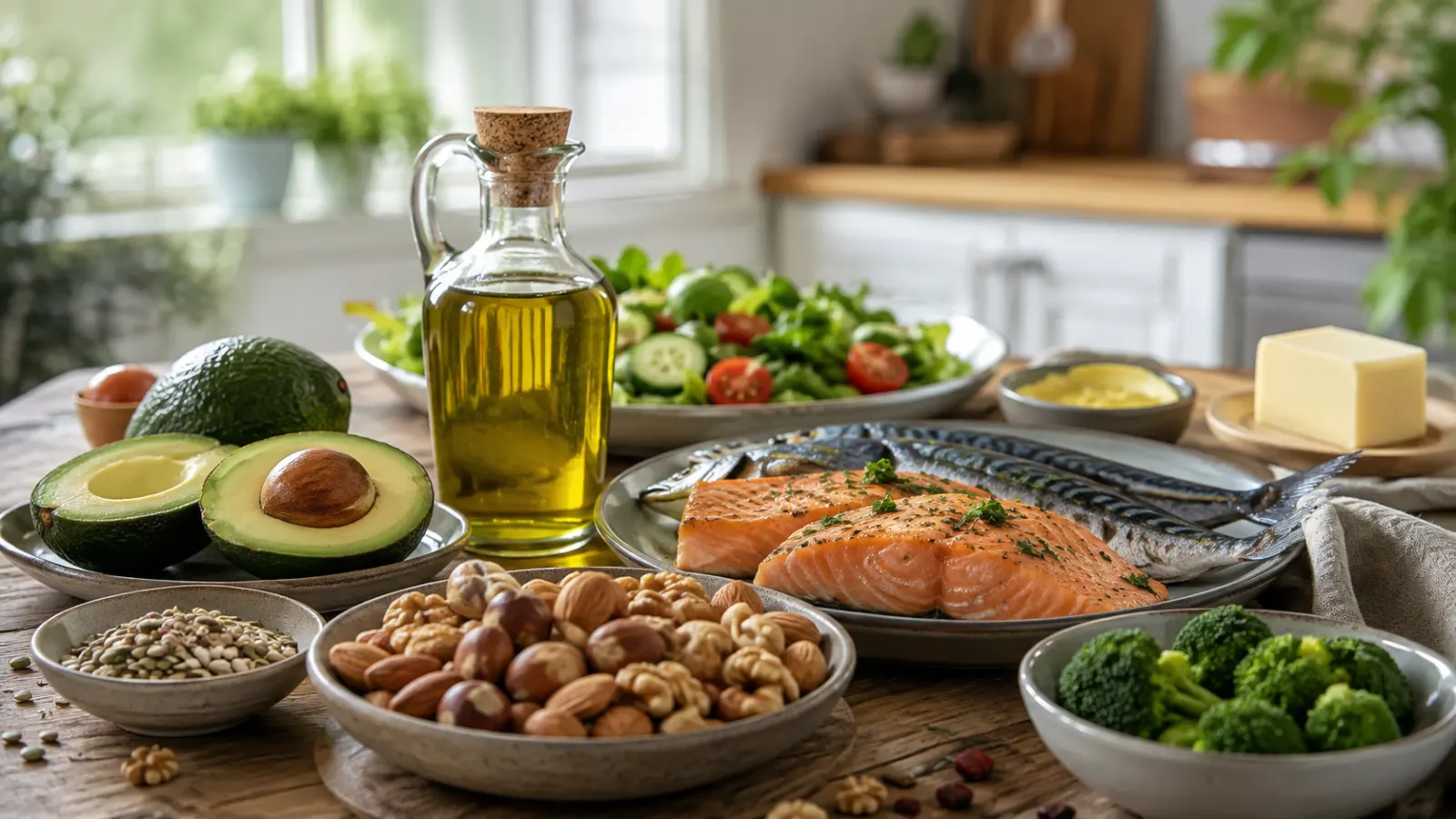
Unsaturated fats include monounsaturated and polyunsaturated fatty acids. Common food sources include fish, avocado, nuts and oils such as olive, sunflower, soybean and canola oil. WHO considers these preferable to saturated and trans fats.
Saturated fats occur in foods including fatty meats, butter, ghee, cream, cheese, lard, coconut oil and palm oil. Saturated fat does not have to disappear completely from the diet, but WHO recommends keeping it below 10% of total energy.
Trans fats deserve particular attention. Some occur naturally in small amounts in meat and dairy from ruminant animals, while industrial trans fats have historically been produced through partial hydrogenation of oils and used in some fried foods, bakery products and shortenings. WHO recommends keeping total trans-fat consumption below 1% of energy and has pursued global elimination of industrially produced trans fat from food supplies.
What matters is the replacement
Suppose someone reduces butter but replaces it largely with refined sugary foods. The nutritional effect is different from replacing some butter with nuts, seeds, olive oil or other unsaturated-fat sources.
That is why statements such as “eat less saturated fat” are incomplete unless they address what takes its place.
WHO recommends replacing saturated and trans fats with polyunsaturated fats, monounsaturated fats from plant sources, or carbohydrates from foods naturally rich in fibre, including whole grains, vegetables, fruits and pulses.
This principle of substitution is one of the most important ideas in nutrition. Foods do not disappear from a diet into empty space. Eating less of one thing usually means eating more of something else.
Does eating fat automatically make you gain weight?
No single macronutrient automatically determines body weight.
Body weight is influenced over time by energy intake, energy expenditure, appetite, food environment, physical activity, metabolism and numerous individual factors. Because fat is energy-dense, large quantities can make it easier to consume substantial energy. That does not mean that simply identifying a food as “high fat” tells us whether the overall dietary pattern is healthy.
WHO’s recommendation on total fat intake is aimed partly at preventing unhealthy weight gain, but the same guidance simultaneously stresses that the fat people do consume should predominantly be unsaturated.
Why “low fat” does not automatically mean healthy
The low-fat label can create a nutritional illusion.
A food can contain relatively little fat while being high in refined starch, free sugars or sodium. Conversely, a food such as walnuts, almonds, seeds or avocado may contain substantial fat while fitting comfortably within a healthy dietary pattern.
Assessing a food therefore requires more than looking at one nutrient.
The broader pattern matters: vegetables and fruit, whole grains, pulses, appropriate protein sources, minimally processed foods where practical, and a balance of energy intake with individual needs. WHO’s current healthy-diet framework similarly evaluates fats alongside carbohydrate quality, free sugars, sodium, fruit, vegetables and fibre.
What about coconut oil and ghee?
Coconut oil and ghee are sometimes promoted as uniquely healthy fats. Both, however, are significant sources of saturated fat and are classified as such in WHO dietary guidance. That does not mean that a small amount makes a diet unhealthy; it means their saturated-fat content should be included when considering the total dietary pattern.
The same logic applies to butter and other saturated-fat-rich foods. Nutrition is rarely improved by turning individual foods into either medicine or poison.
A practical way to improve fat quality
For most people, improving dietary fat does not require calculating every fatty acid.
Use predominantly unsaturated vegetable oils rather than relying heavily on butter, ghee or lard.
Include nuts and seeds where appropriate.
Include fish where it fits dietary preferences and availability.
Limit foods that remain significant sources of industrial trans fat where these are still present.
Consider the entire food rather than choosing products solely because they are labelled “low fat.”
WHO also recommends cooking methods such as steaming or boiling in place of frequent frying as one way to reduce excessive fat intake.
The larger lesson about fat
The science of dietary fat is less dramatic than decades of diet marketing have made it appear.
Fat is neither a nutritional villain nor a licence to eat unlimited quantities of supposedly “healthy fats.” It is an essential macronutrient whose effects depend partly on fatty-acid composition, quantity, food source and the nutrient that replaces it.
The most durable message is therefore not “avoid fat.” It is: make unsaturated fats the predominant fats in a varied diet, limit saturated fat, minimise trans fat, and judge the diet as a whole.
Medical note: This article provides general nutritional information and is not a substitute for individual medical or dietetic advice. People with cardiovascular disease, lipid disorders, malabsorption disorders or other medical conditions may need personalised recommendations.