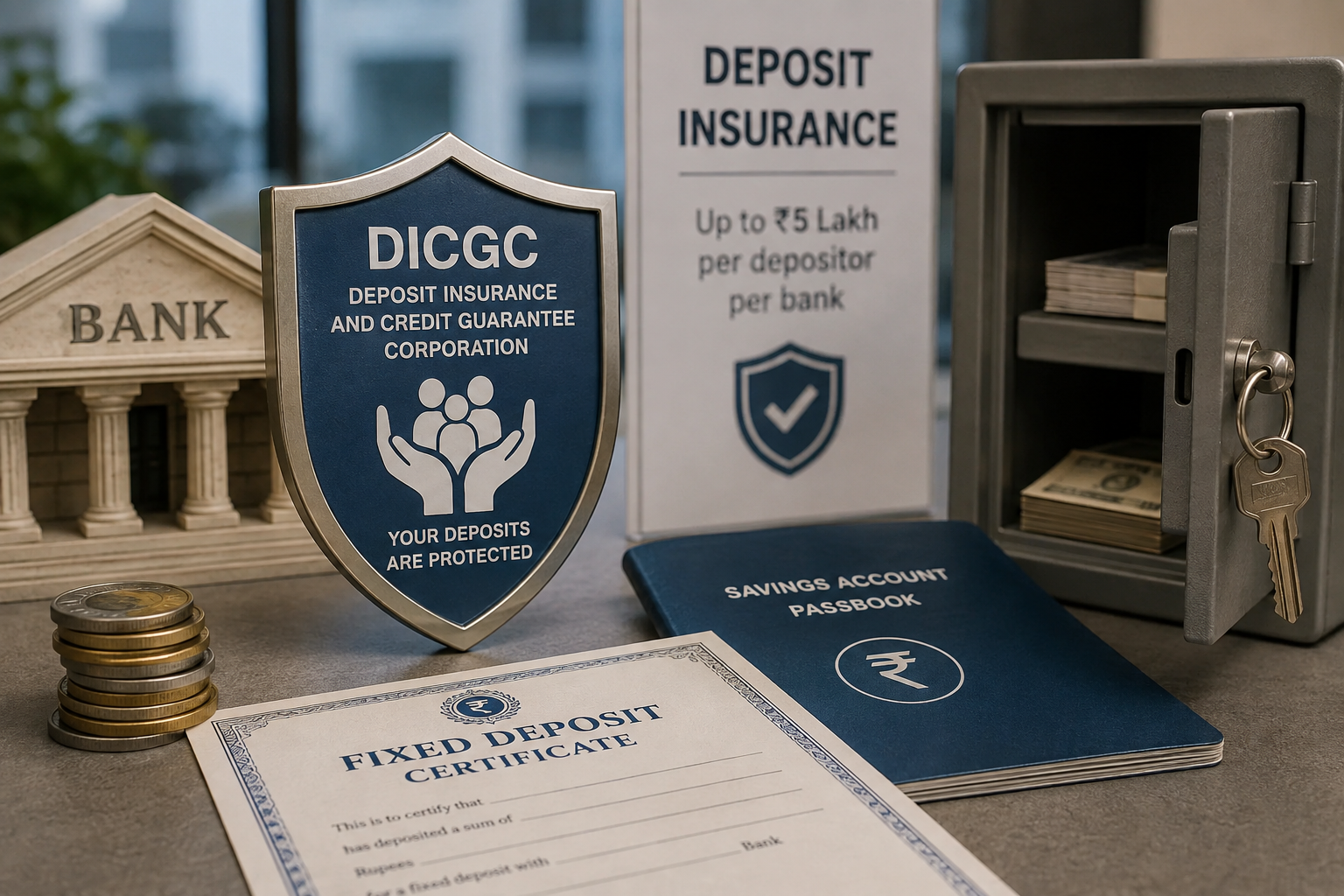
The protection most depositors forget to understand
Deposit insurance is one of the most important safety nets in banking, yet many savers learn about it only when a bank is already in trouble. People spend years comparing fixed deposit rates, savings account features and branch convenience, but rarely ask the deeper question: what happens if the bank itself fails?
That is the question deposit insurance tries to answer. It does not make every bank risk-free. It does not guarantee every rupee without limit. It does not protect all financial products. But it gives small depositors a defined layer of protection when an insured bank fails under the applicable legal framework.
For ordinary households, this matters enormously. Bank deposits are treated as safe money. Salaries, pensions, emergency funds, school-fee savings, retirement income and business working capital often sit in bank accounts. If depositors doubt the safety of banks, the economy loses a basic foundation of trust.
The value of deposit insurance is therefore both personal and systemic. It protects a saver at the household level, but it also protects confidence at the economy level. Those two functions cannot be separated.
What deposit insurance means
Deposit insurance is a promise that eligible deposits in an insured bank will be protected up to a specified limit if the bank fails in a legally recognised manner. In India, this protection is provided by the Deposit Insurance and Credit Guarantee Corporation, commonly known as DICGC.
The insurance generally covers eligible bank deposits such as savings deposits, current deposits, recurring deposits and fixed deposits, subject to the rules in force. The protection is not based on whether the depositor personally bought an insurance policy. Banks pay the premium to the deposit insurer, and eligible depositors receive protection under the statutory framework.
The key idea is reassurance. A small depositor should not have to become a banking analyst to keep basic savings in a bank. Deposit insurance reduces panic and supports confidence in the banking system.
The coverage limit is not unlimited
The most important detail is the coverage limit. Official DICGC and RBI materials state that deposits are insured up to a maximum amount of Rs 5 lakh for both principal and interest, for deposits held by a depositor in the same right and same capacity in the same bank. This limit is the practical centre of depositor protection in India.
The phrase same right and same capacity matters. It means the law does not simply look at every account separately in a mechanical way. Accounts held in the same name and same capacity in the same bank are generally aggregated for insurance purposes. But deposits held in different rights or capacities may be treated separately according to DICGC rules.
This is why depositors should not assume that five fixed deposits of Rs 5 lakh each in the same bank automatically create Rs 25 lakh of insurance protection. The structure of ownership, bank identity and capacity matters.
Same bank, different bank, different capacity
Deposit insurance is usually easier to understand through three questions. First, how much money do you have in one bank? Second, in what capacity is it held? Third, are your deposits spread across separate banks or only across branches of the same bank?
Branches do not usually create separate insurance limits. If a depositor has deposits in multiple branches of the same bank in the same right and capacity, the balances are generally aggregated for insurance coverage. Separate banks, however, may carry separate coverage subject to rules because each insured bank is treated separately.
Different capacities can also matter. An individual account, a joint account, a trustee capacity, a guardian capacity, or a partnership capacity may be evaluated under the applicable rules. This is a technical area, so depositors with significant balances should verify directly rather than rely on assumptions.
What deposit insurance covers and does not cover
Deposit insurance is designed for bank deposits. It is not a blanket guarantee for every financial product sold through a bank branch or app. Mutual funds, shares, bonds, insurance policies, pension products, gold schemes, crypto assets and market-linked products are separate instruments with their own risks and regulatory frameworks.
This distinction is important because many customers buy investment products from bank relationship managers. A product purchased through a bank is not necessarily a bank deposit. The branding of the sales channel should not be confused with the legal nature of the product.
Deposit insurance also does not protect against poor investment choices, inflation, tax liability, fraud outside the covered framework, or loss of purchasing power. It is a bank-failure protection mechanism, not a complete financial safety guarantee.
The safest habit is to name the product correctly before trusting it. A fixed deposit is different from a market-linked debenture. A savings account is different from a mutual fund sweep. A bank locker is different from a deposit account. Protection follows legal form, not emotional expectation.
Why the system exists
Deposit insurance exists because the banking system depends on public confidence. Without it, small depositors may rush to withdraw whenever rumours appear. A small rumour can become a bank run. A bank run can damage even institutions that might have survived under orderly supervision.
By assuring depositors that a defined amount is protected, deposit insurance reduces the incentive to panic. It protects households, stabilises the banking system and gives regulators more time to manage weak banks in an orderly way.
It also reflects a moral choice. Small depositors often do not have the knowledge, time or access to evaluate bank balance sheets. A pensioner, worker, student or small shopkeeper should not be expected to monitor capital adequacy, asset quality and governance every week.
Why deposit insurance cannot replace supervision
Deposit insurance is necessary, but it is not enough. If banks are poorly governed, undercapitalised or recklessly managed, insurance alone cannot make the system healthy. It can only reduce damage to depositors after failure. Prevention still depends on regulation, supervision, audits, capital rules, risk management and enforcement.
There is also a risk known as moral hazard. If depositors believe everything is protected without limit, they may stop caring about bank risk and simply chase the highest interest rate. If banks know depositors are indifferent, weak institutions may attract deposits by offering aggressive rates.
The solution is balance. Deposit insurance protects small savers, while supervision disciplines banks. The two must work together. A country cannot build banking trust only by promising compensation after failure; it must also reduce the likelihood of failure.
What happens when a bank fails
Deposit insurance becomes relevant when a bank faces liquidation, cancellation of licence, or a merger, amalgamation or reconstruction under the applicable framework. The exact process depends on the regulatory action and legal status of the institution.
The depositor does not usually file an ordinary insurance claim like a motor or health policy claim. The process is handled through the bank, liquidator or official mechanism, with DICGC paying insured amounts according to the rules. The timing and procedure depend on the nature of resolution.
This is why official communication matters. In a crisis, depositors should read notices from the bank, DICGC and RBI carefully. Rumours may exaggerate both danger and protection. The safest source is the official framework, not social media interpretation.
The India lens: fixed deposits and rate chasing
In India, many households treat fixed deposits as the safest financial asset. This trust is understandable. FDs are simple, familiar and predictable. But the search for higher rates can push depositors toward weaker banks, small cooperative institutions or unregulated schemes without adequate understanding.
A slightly higher interest rate should never be the only reason to move large savings. The depositor should ask: Is this a regulated bank? Is the deposit covered by DICGC? How much is covered? How much of my total money is concentrated here? Am I confusing a bank deposit with another product?
For large balances, diversification across banks may be more important than squeezing the last fraction of interest. Safety planning is not pessimism. It is basic financial hygiene.
How savers should use deposit insurance wisely
The first step is to know your total exposure to each bank, including savings accounts, fixed deposits, recurring deposits and accrued interest. The second step is to understand ownership structure, especially for joint accounts, business accounts, nominee arrangements and deposits held in different capacities.
The third step is to avoid blindly trusting informal claims. If an entity is not a bank or is not covered under the applicable deposit insurance framework, the promise of safety may be misleading. Depositors should verify regulatory status before depositing money.
The fourth step is to maintain emergency liquidity. Even if insured money is ultimately recoverable, a failure can create temporary stress. Households should avoid keeping every rupee of emergency funds in one place.
Final takeaway
Deposit insurance is not a reason to stop thinking. It is a reason to think clearly. It gives bank depositors a defined safety net, but that safety net has limits, conditions and exclusions.
For most savers, the lesson is practical: understand the Rs 5 lakh protection limit, know how same right and same capacity works, distinguish bank deposits from investment products, and do not chase interest rates without checking safety.
A good depositor is neither paranoid nor careless. They trust the banking system, but they also understand its rules. Deposit insurance protects confidence, but financial literacy protects decisions.