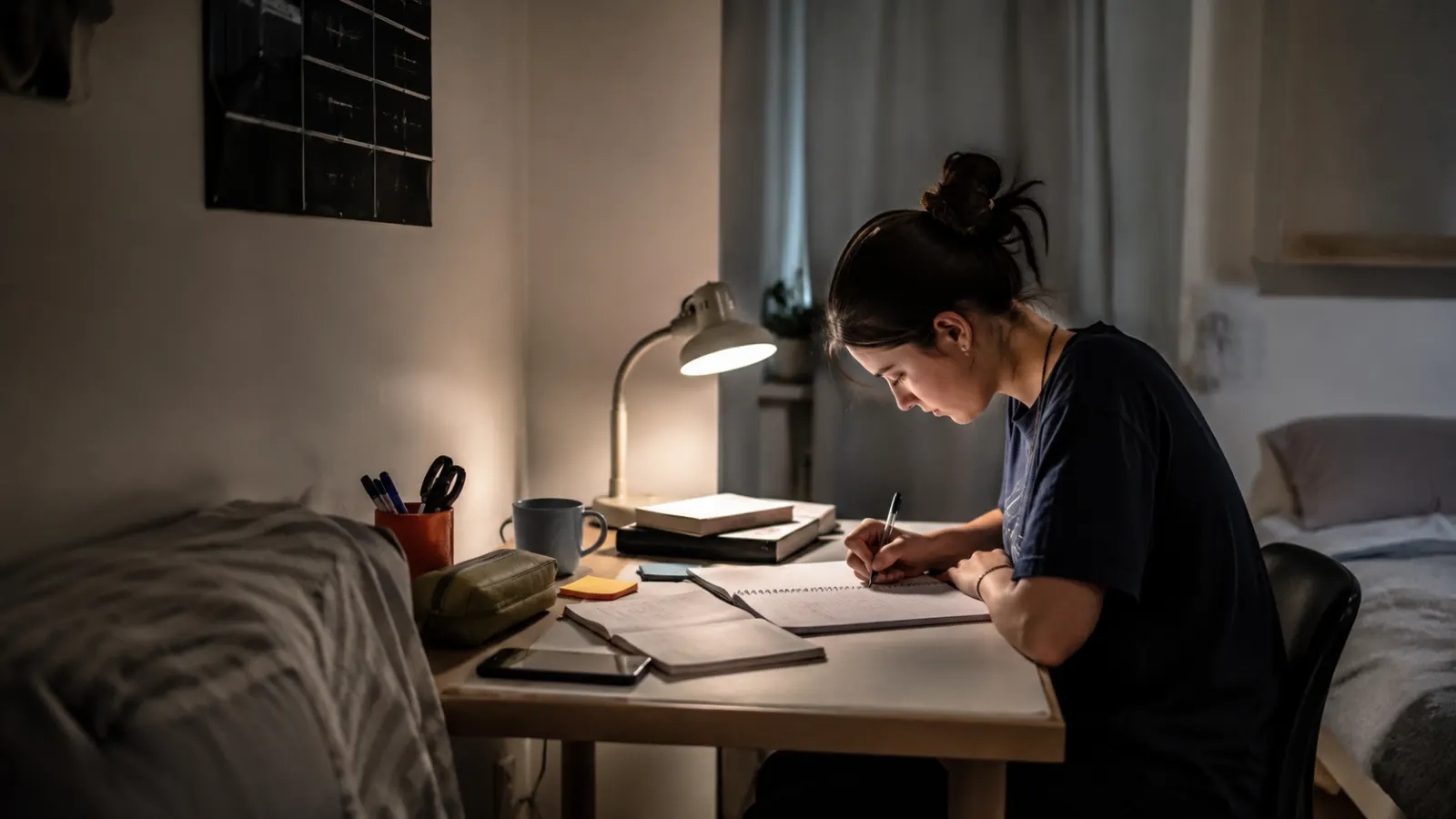
Dedicated Study Space: Benefits, Setup Tips and What Actually Helps Learning
A dedicated study space is often presented as a decorating project.
Buy a desk.
Add a lamp.
Arrange notebooks.
Choose an attractive chair.
Put motivational quotes on the wall.
Create the perfect “study aesthetic.”
But the most useful benefit of a study space is much less glamorous.
It removes decisions.
When you repeatedly study in a predictable environment, you already know:
- where the materials are;
- where you will sit;
- what needs to be moved;
- where the charger is;
- what lighting you will use;
- and what activity is supposed to happen there.
The environment takes over part of the setup work.
That matters because studying already requires decisions about:
what to learn, how to practise it, what to retrieve, what to review and how long to continue.
Every unnecessary environmental decision adds another opportunity to delay starting.
A useful study space therefore does not need to be beautiful, expensive or private.
It needs to make focused learning easier to begin and easier to continue.
For one student, that may be a desk in a bedroom.
For another, it may be one end of a dining table.
For another, it may be the same seat in a library.
And for someone living in a crowded home, the most realistic “study space” may be a portable set of cues rather than a permanent location.
Dedicated study space at a glance
| Question | Short answer |
|---|---|
| What is a dedicated study space? | A location or repeatable setup primarily associated with focused learning. |
| Do I need a separate room? | No. A corner, table, library seat or portable setup can work. |
| Why does a study space help? | It can reduce setup decisions, distractions and behavioural friction. |
| Does studying in the same place improve memory? | Environmental context can influence recall under some conditions, but a dedicated space is more useful as a behavioural cue than as a memory trick. |
| Should a study room be completely silent? | Not necessarily. The goal is to reduce unpredictable or meaningful noise that repeatedly captures attention. |
| Is music good for studying? | It depends on the task and learner. Meaningful speech and lyrics can be especially distracting during language-heavy tasks. |
| Is studying in bed bad? | Not universally, but beds often cue rest and provide poor posture or high-distraction conditions for demanding work. |
| Does lighting affect studying? | Visual comfort matters. Adequate light and low glare can reduce unnecessary discomfort. |
| Does temperature matter? | Yes. Excessive heat, cold and poor ventilation can interfere with comfort and performance. |
| Should the desk be completely empty? | No. Remove distracting items, not every personal object. |
| Can I study in different places? | Yes. A stable space can help starting behaviour, while varying contexts can sometimes be useful when testing flexible retrieval. |
| What matters most on a low budget? | Fewer interruptions, a usable surface, adequate light, phone control and readily available materials. |
What Is a Dedicated Study Space?
A dedicated study space is a physical environment or repeatable setup that is consistently associated with learning.
It does not necessarily mean:
- a study room;
- a large desk;
- custom furniture;
- expensive lighting;
- or a Pinterest-style workspace.
The defining feature is functional consistency.
Examples include:
- one corner of a bedroom;
- one end of a dining table during specified hours;
- the same library desk;
- a campus study room;
- a quiet café table for particular tasks;
- or a portable kit containing the same essential study materials.
The location becomes useful because the student knows:
“When I set up here, this is where focused work begins.”
Why a Dedicated Study Space Helps
There is no single mechanism.
A useful study environment can help through several routes:
1. It reduces setup friction.
2. It creates a recurring behavioural context.
3. It allows distractions to be controlled in advance.
4. It keeps materials accessible.
5. It can improve physical comfort.
6. It creates clearer boundaries between studying and competing activities.
7. It reduces the number of choices required before starting.
None of these guarantees learning.
You can sit at an excellent desk for four hours and learn very little if you:
- reread passively;
- avoid retrieval practice;
- keep switching apps;
- or never test understanding.
The space supports learning behaviour.
It does not replace effective learning methods.
A Study Space Is Useful Because It Removes Decisions
Consider two study sessions.
Session A
You decide to study.
First you need to find somewhere to sit.
The table contains other items.
Your charger is missing.
The textbook is in another room.
Someone is watching television.
Your phone is beside you.
You spend ten minutes rearranging things.
Session B
You sit in the usual place.
The necessary materials are already nearby.
The phone goes to its normal location.
You open the planned task.
Work begins.
The second environment does not make the student smarter.
It simply reduces the number of steps between:
“I should study”
and
actual studying.
That reduction in friction can matter enormously over repeated sessions.
Stable Context Can Support Study Habits
Habit research helps explain part of this effect.
A 2022 study examined context stability during intentional habit building. In one study, university students spent six weeks developing new study habits.
Students assigned to more stable contexts were instructed to keep the time and location more consistent, while another group varied those conditions.
Greater context stability was associated with stronger automaticity and better habit-repetition goal attainment.
The practical implication is not:
“You must always study in exactly the same chair.”
It is:
predictable contexts can make the act of starting easier to automate.
A repeated sequence such as:
sit down → put phone away → open task list → begin first question
can become increasingly familiar.
Location Can Become a Start Cue
At first, studying often requires negotiation.
Should I begin now?
Maybe after one video.
Perhaps I should organise my notes first.
I should probably check messages.
A stable environment can become one element of a stronger start routine.
For example:
1. Sit at study table.
2. Put phone outside immediate reach.
3. Open only the required materials.
4. Write the exact study objective.
5. Begin the first retrieval question.
The important part is not the table.
It is the repeated transition into the behaviour.
Study Environment and Learning Performance
Physical environments can affect how easy cognitive work feels.
A systematic review examining higher-education classrooms evaluated four major components of indoor environmental quality:
- air quality;
- thermal conditions;
- acoustics;
- lighting.
The review found evidence that indoor environmental quality can affect learning quality and short-term performance, while also noting that effects vary among tasks and individuals and that evidence for long-term academic outcomes is less certain.
That nuance matters.
There is no scientifically identified room with:
the perfect temperature, perfect lighting, perfect sound and perfect furniture for every student and every task.
The better principle is:
remove persistent environmental conditions that unnecessarily compete with learning.
Noise Is Often the First Problem to Solve
Noise does not affect every activity equally.
Some background sounds are predictable enough to fade from attention.
Other sounds repeatedly pull attention away.
Speech is particularly difficult to ignore because language carries meaning.
A television conversation, nearby phone call or people talking beside you can automatically compete with:
- reading;
- writing;
- verbal memory;
- listening;
- and comprehension.
Research reviews involving schoolchildren have found that noise can impair speech perception, listening comprehension, verbal working memory, reading and other cognitive performance, with effects depending on the type and level of noise.
A newer review similarly reports that poor signal-to-noise conditions and classroom noise can increase processing effort during learning.
Meaningful Noise Is Often Harder to Ignore
Compare:
steady fan noise
with
two people having an interesting conversation behind you.
Both produce sound.
The second contains information.
Your attention system has more reason to inspect it.
This is why some students tolerate:
- fans;
- air conditioning;
- rain;
- or predictable ambient sound
better than:
- television dialogue;
- podcasts;
- conversations;
- lyrics;
- or intermittent notifications.
The practical goal is not necessarily absolute silence.
It is fewer unexpected, meaningful signals competing with the study task.
What If You Cannot Eliminate Noise?
Many students cannot control their home environment.
Possible strategies include:
- study during naturally quieter periods;
- use earplugs where safe;
- use comfortable headphones;
- move farther from televisions or conversation;
- use a library;
- choose predictable background sound;
- communicate study blocks with family;
- or perform the most cognitively demanding work during quieter periods.
The best solution may differ by task.
Light revision may survive moderate background activity.
Learning complex unfamiliar material may require much stronger noise control.
Is Music Good for Studying?
There is no universal rule.
Music can be experienced very differently depending on:
- the learner;
- volume;
- familiarity;
- lyrics;
- task complexity;
- and personal preference.
For demanding reading or verbal learning, lyrics can compete with the same language-processing resources required by the task.
For repetitive or familiar work, some students may tolerate background music well.
A useful test is not:
“Does this playlist make me feel productive?”
It is:
“Can I retrieve and explain what I studied afterward?”
Performance should decide.
Silence Can Also Be Distracting for Some People
Some students find complete silence uncomfortable.
In that case, predictable low-level sound may help make the environment feel less intrusive.
Possible options include:
- fan noise;
- rainfall;
- low ambient sound;
- or instrumental music.
Avoid turning background sound into another activity requiring attention.
The objective is to create stable background, not entertainment.
Lighting Should Make the Task Easy to See
A study area does not need specialised “study lighting.”
It needs enough light for the visual task.
Poor lighting can create:
- visual discomfort;
- glare;
- squinting;
- awkward posture;
- or unnecessary fatigue.
Useful principles include:
- provide enough illumination for reading;
- avoid intense glare on screens;
- position screens so bright windows are not directly reflected;
- use daylight when comfortable;
- add task lighting if the main room light is insufficient.
You should not need to repeatedly notice the lighting.
The best arrangement often becomes almost invisible because it supports the task without demanding attention.
More Light Is Not Automatically Better
A very bright source directly facing the eyes can be uncomfortable.
A dark screen against a bright window can create high contrast.
A glossy display can reflect overhead lighting.
So the aim is not:
maximum brightness.
It is:
comfortable visibility with manageable glare and contrast.
Natural Light Can Be Useful, but It Is Not Mandatory
Daylight can make a space pleasant and reduce dependence on artificial lighting.
But students should not conclude that a window is necessary for effective learning.
Plenty of productive studying occurs:
- in libraries;
- classrooms;
- evening study rooms;
- and other artificially lit spaces.
If daylight is available, use it sensibly.
If it is not, adequate artificial lighting is sufficient for the basic purpose.
Temperature Can Compete With Attention
It is difficult to focus when you are repeatedly thinking:
“This room is unbearably hot.”
or
“I am freezing.”
Thermal conditions are one component repeatedly examined in research on indoor environmental quality and cognition. Reviews suggest that temperature can influence comfort and performance, although effects vary depending on task, population and environment.
There is no universal temperature that guarantees concentration.
The practical goal is simpler:
avoid persistent thermal discomfort when reasonably possible.
A Very Warm Room Can Encourage Drowsiness
If one location consistently makes you sleepy, investigate the environment.
Possible contributors include:
- excessive warmth;
- poor ventilation;
- dim lighting;
- reclining posture;
- studying immediately after a large meal;
- or simply being sleep-deprived.
Do not assume the problem is laziness.
Change the conditions and observe whether concentration improves.
Air Quality and Ventilation Matter Too
Study environments are physical spaces where people breathe for extended periods.
Poor ventilation can contribute to:
- stuffiness;
- discomfort;
- headaches;
- or perceptions of fatigue.
Systematic reviews of educational environments include indoor air quality among the variables associated with learning conditions and cognitive performance.
If appropriate and safe, options may include:
- opening a window;
- improving room ventilation;
- using a better-ventilated study location;
- or taking breaks away from a stuffy environment.
Students cannot personally solve building-level ventilation problems, so this should not become another individual-responsibility rule.
The Desk Should Support the Task
A study desk has one primary job:
hold the materials required for the current work.
That sounds obvious.
But study environments often become storage areas.
A student trying to solve mathematics may be surrounded by:
- unrelated textbooks;
- unopened mail;
- charging cables;
- cosmetics;
- gaming equipment;
- snacks;
- stationery collections;
- and other visual cues.
Not every object is harmful.
The issue is whether the space repeatedly prompts unrelated activity.
Clutter Is Not Automatically the Enemy
There is no need to create a sterile desk.
A plant, photograph or familiar object does not automatically damage learning.
Some people prefer visually sparse spaces.
Others are comfortable with ordinary personal items.
A better test is behavioural:
Does this object repeatedly capture my attention or trigger another activity?
If no, it may not matter.
If yes, move it during study sessions.
Keep the Active Work Area Simple
For a particular session, the central workspace might contain:
- textbook;
- notebook;
- pen;
- laptop if required;
- calculator;
- flashcards;
- water.
Everything else can remain accessible without occupying the immediate task area.
This reduces physical rearrangement and visual competition.
Ergonomics Matters Because Pain Is Distracting
A study environment should not require the body to tolerate avoidable discomfort.
Useful basics include:
- a reasonably supportive sitting position;
- a surface at a workable height;
- enough leg room;
- a screen positioned so you do not constantly bend toward it;
- and regular changes in position.
The objective is not achieving a rigid “perfect posture.”
Human bodies are designed to move.
Even a good chair does not make eight motionless hours ideal.
Change Position During Long Sessions
Instead of trying to maintain one posture indefinitely:
- stand occasionally;
- walk during breaks;
- stretch naturally;
- change sitting position;
- alternate between reading and active tasks where appropriate.
Movement breaks can also create natural boundaries between study blocks.
Is Studying in Bed Bad?
There is no universal law saying learning cannot happen in bed.
A student can certainly read and remember material there.
The problem is behavioural.
Beds are strongly associated with:
- sleep;
- resting;
- scrolling;
- television;
- and relaxation
for many people.
That can create competing cues.
A bed can also encourage:
- reclining;
- discomfort during writing;
- sleepiness;
- and longer periods of passive reading.
For demanding study, a chair-and-surface arrangement is often more functional.
But Sometimes the Bed Is the Only Option
Students living in small rooms, dormitories or crowded homes may not have another surface.
The solution should not be:
“Then you cannot study properly.”
Instead, create stronger boundaries.
For example:
- sit upright rather than lying down;
- use a lap desk if appropriate;
- remove entertainment devices;
- keep study materials together;
- use a particular side or position;
- change lighting for study;
- put materials away when the study block finishes.
You are creating a temporary behavioural zone inside a multipurpose environment.
Separate Studying From High-Distraction Activities Where Possible
One difficulty with modern study spaces is that a single device performs almost everything.
The same laptop contains:
lecture notes,
email,
YouTube,
games,
social media,
shopping,
and
streaming.
Physical separation alone therefore cannot solve digital distraction.
You may need digital boundaries too.
Use a Separate Study Browser Profile
A simple technique is to create a browser profile used primarily for study.
It may contain:
- educational bookmarks;
- reference sites;
- learning platforms;
- academic accounts.
It does not need:
- social-media logins;
- entertainment bookmarks;
- or unnecessary extensions.
This creates a digital equivalent of the dedicated desk.
Close Irrelevant Tabs Before Starting
Twenty open tabs produce twenty visible unfinished possibilities.
Before a study block:
- close unrelated pages;
- quit messaging applications where practical;
- disable unnecessary notifications;
- open only what the task requires.
The objective is not technological purity.
It is reducing competing cues.
The Phone Deserves Special Treatment
A phone combines:
- messaging;
- social approval;
- news;
- entertainment;
- games;
- work;
- shopping;
- and constant novelty
in one small device.
Silencing notifications may help.
Physical distance can be stronger.
Possible arrangements include:
- another room;
- inside a bag;
- a drawer;
- across the room;
- or a focus mode that blocks distracting applications.
If the phone is required for learning, restrict it to the required function where possible.
A Dedicated Space Should Support Active Learning
An attractive room does not compensate for passive study methods.
A useful environment should make it easy to:
- retrieve information;
- solve problems;
- write explanations;
- test yourself;
- use flashcards;
- practise questions;
- compare answers;
- and correct mistakes.
If the desk is designed entirely around comfortable rereading, the environment may support the wrong learning behaviour.
Different Study Tasks Need Different Setups
There is no reason every academic task should use exactly the same physical arrangement.
Reading
Needs comfortable visibility and minimal linguistic distraction.
Mathematics
May need substantial writing space.
Coding
Requires screen comfort and perhaps multiple references.
Online classes
Need reliable audio, video and connectivity.
Language practice
May require speaking aloud.
Flashcards
May work while sitting, standing or walking.
Group study
Requires a space where discussion is acceptable.
Essay writing
May benefit from fewer digital interruptions.
The dedicated space should be adaptable, not rigid.
The Space Should Fit the Learning Method
If the student needs to practise explaining concepts aloud, a silent library may be a poor choice.
If they need to read a difficult chapter, a busy café may be unsuitable.
If they are collaborating, an isolated quiet cubicle does not support the task.
The environment should follow the activity.
Not the other way around.
Does Studying in the Same Place Improve Memory?
Environmental context can influence memory.
A classic review and meta-analysis found reliable context-dependent memory effects across studies, meaning recall can sometimes improve when aspects of the learning context are reinstated.
But this finding is frequently oversimplified.
It does not mean:
“Study in the exam hall or you will forget everything.”
The meta-analysis also found that context effects become smaller under several conditions, including when stronger non-environmental retrieval cues are available.
The practical implication is:
use a stable environment primarily to support study behaviour, not because your memory lives in the room.
Strong Knowledge Should Travel
If you really understand something, you should be able to retrieve it:
- at your desk;
- in a library;
- in an exam room;
- while explaining it aloud;
- or when answering an unfamiliar question.
That is one reason retrieval practice matters.
Strong, meaningful retrieval cues can reduce reliance on incidental environmental details.
Occasionally Varying the Study Context Can Be Useful
Once a study routine is stable, occasional variation can test whether learning transfers.
For example:
- perform flashcards in another room;
- solve practice questions in the library;
- explain the concept without your normal notes;
- complete a mock test under exam-like conditions.
This serves a different purpose from habit building.
A useful distinction is:
stable context can support beginning the habit;
varied retrieval can help test flexible knowledge.
The two ideas are not contradictory.
Exam Simulation Is Different From Context-Dependent Memory
Practising under exam-like conditions can still be useful.
But the benefit is not simply reproducing the colour of the room or style of chair.
A mock exam helps practise:
- timing;
- sustained concentration;
- question selection;
- writing speed;
- uncertainty;
- and recall without notes.
Those functional similarities matter more than trying to perfectly recreate incidental environmental details.
What If You Live in a Crowded Home?
A lot of study-space advice assumes:
- spare rooms;
- private bedrooms;
- quiet homes;
- and money for furniture.
That excludes many students.
If the environment cannot be permanently dedicated, create a portable study system.
Build a Portable Study Kit
A portable kit might contain:
- notebook;
- essential textbook;
- stationery;
- headphones or earplugs;
- charger;
- flashcards;
- calculator;
- water bottle;
- and a short task list.
The purpose is not the objects themselves.
It is predictable setup.
Wherever the student goes:
bag opens → materials appear → phone moves away → study begins.
The kit becomes part of the context.
Choose a Repeatable Time When Location Is Unstable
If you cannot control place, stabilise another variable.
For example:
study from 6:30 to 7:30 each morning before the household becomes busy.
Or:
use the local library after class on weekdays.
A habit cue does not need to be location alone.
It can involve:
- time;
- preceding activity;
- social routine;
- or a combination.
Use Visual Signals in Shared Homes
Family members cannot always know whether someone sitting at a table is:
- studying;
- browsing;
- or available to talk.
A simple agreed cue may help.
Examples:
- headphones on;
- a specific lamp switched on;
- study materials arranged in a particular way;
- an agreed block of time.
This works only when household relationships permit it, but clear expectations can reduce avoidable interruptions.
Libraries Are Excellent Dedicated Study Spaces
A library can provide several advantages:
- predictable quiet;
- desks;
- lighting;
- fewer domestic interruptions;
- academic cues;
- and social norms supporting concentration.
For some students, simply entering a library creates a strong transition into work mode.
But libraries are not universally accessible.
They may involve:
- travel;
- restricted opening hours;
- crowding;
- limited food;
- or insufficient availability.
Use them when they solve more problems than they create.
Is a Café a Good Study Space?
It depends.
A café may work well for:
- routine revision;
- planning;
- light reading;
- or tasks where mild ambient noise is tolerable.
It may be poor for:
- difficult reading;
- memorisation;
- complex mathematical reasoning;
- or tasks requiring sustained verbal working memory.
Again, use performance as the test.
Can you actually retrieve what you studied there?
Personalisation Can Help Without Becoming Decoration Work
A study area can contain personal objects.
Useful additions might include:
- calendar;
- timetable;
- task board;
- small plant;
- reference sheet;
- clock;
- water;
- or frequently required materials.
The problem begins when preparing the space becomes a substitute for studying.
Beware of Productive Procrastination
Study-space optimisation can itself become avoidance.
You decide to study.
Then you:
- rearrange pens;
- buy folders;
- clean the desk;
- redesign your timetable;
- organise digital files;
- choose new lighting;
- search for desk accessories;
- watch study-space videos.
Two hours later, the environment looks excellent.
No learning occurred.
A study setup is useful when it reduces preparation.
If maintaining it becomes another hobby, it is doing the opposite.
Your Study Space Does Not Need to Look Impressive
Social media can create unrealistic expectations.
The best study environment does not need:
- expensive furniture;
- multiple monitors;
- colour-coded stationery;
- decorative lighting;
- custom shelves;
- expensive headphones;
- or perfectly arranged notebooks.
A basic table in a quiet corner can outperform a beautiful setup if the beautiful environment contains:
- a phone;
- games;
- social-media notifications;
- and no clear study plan.
Function beats appearance.
How to Build a Study Space on a Small Budget
Prioritise according to impact.
1. Control interruption
Find the quietest feasible place or time.
2. Find a stable surface
A table or desk large enough for the active task.
3. Improve lighting
Use existing daylight or a basic task light where needed.
4. Control the phone
Distance often costs nothing.
5. Keep essential materials together
A bag, box or shelf is enough.
6. Improve basic seating comfort
Use what is available to create workable support.
7. Create the start routine
Repeat the same first actions.
Do not begin by buying decoration.
What Should Be on a Study Desk?
For most sessions, only what the current task needs.
For example:
Book
Notebook
Pen
Laptop if necessary
Calculator if necessary
Water
Anything else should justify its presence.
You do not need to perform minimalism.
You need enough working space to perform the task without constant rearrangement.
What Should Not Be on the Desk?
Items are most worth removing when they create competing actions.
Examples can include:
- phone;
- gaming controller;
- entertainment tablet;
- unrelated books;
- unfinished hobby projects;
- television remote;
- or food that repeatedly interrupts the session.
The exact answer varies by person.
Some students can ignore these objects.
Others cannot.
Design for your actual behaviour rather than somebody else's ideal desk.
Create a Study Start Ritual
Keep the beginning short.
For example:
1. Sit down.
2. Move phone.
3. Write today's exact study objective.
4. Open required materials.
5. Start one question immediately.
Do not make the ritual so elaborate that the ritual itself becomes procrastination.
The purpose is to reduce transition time.
Define the Study Objective Before You Sit Down
A perfect study space cannot fix a vague task.
Compare:
“Study chemistry.”
with:
“Complete 15 equilibrium retrieval questions, mark errors and review the two concepts I miss.”
The second tells you what the environment is supporting.
Study-space design and study planning should work together.
Use the Space to Reduce Distraction Before It Happens
Do not wait until you are already distracted.
Before the session:
- move the phone;
- close irrelevant tabs;
- collect materials;
- tell people you are unavailable if appropriate;
- prepare water;
- choose the task;
- set any required timer.
Attention control is often easier before the competing cue appears.
Common Study-Space Mistakes
Mistake 1: Optimising appearance before function
The workspace looks excellent but still contains interruptions.
Mistake 2: Keeping the phone beside the textbook
You are placing one of the world's strongest attention systems inside the study zone.
Mistake 3: Using the space for everything
Gaming, streaming, chatting and studying all occur in exactly the same setup with no boundary.
Mistake 4: Expecting absolute silence
Some students spend more energy searching for perfect conditions than actually studying.
Mistake 5: Staying physically uncomfortable
Pain and discomfort repeatedly compete for attention.
Mistake 6: Treating clutter as automatically harmful
Not every visible object is a distraction.
Mistake 7: Believing the room itself creates memory
Learning methods matter far more.
Mistake 8: Refusing to study elsewhere
The space should support learning, not become a dependency.
Mistake 9: Buying unnecessary equipment
An expensive setup cannot substitute for regular practice.
Mistake 10: Ignoring the actual task
Different types of study need different arrangements.
Dedicated Study Space vs Flexible Study Space
These approaches do not need to compete.
Dedicated space is particularly useful for:
- starting reliably;
- reducing setup;
- controlling distractions;
- storing materials;
- creating behavioural cues.
Flexible locations can be useful for:
- testing retrieval;
- adapting to travel;
- practising in exam-like environments;
- group work;
- tasks requiring different resources.
A strong learner can use both.
The default environment supports routine.
Other environments test flexibility.
A Practical Study-Space Setup
Step 1: Choose the lowest-friction feasible location
Ask:
Where can I reliably sit and work?
Not:
Where would my ideal study room be?
Step 2: Identify the main distraction
Is it:
- noise;
- phone;
- television;
- people;
- heat;
- clutter;
- or internet use?
Solve the largest problem first.
Step 3: Make the physical task comfortable
Adjust:
- light;
- chair;
- screen;
- writing surface;
- temperature where possible.
Step 4: Keep essential materials available
Reduce repeated searching.
Step 5: Create digital boundaries
Close irrelevant apps and tabs.
Step 6: Create a start cue
Use the same short sequence each session.
Step 7: Match the environment to the task
Do not force every activity into one setup.
Step 8: Test the result
Ask:
Did I begin faster?
Was I interrupted less?
Could I retrieve what I learned?
Those outcomes matter more than appearance.
The Five-Minute Study-Space Reset
At the end of a session:
1. Put study materials together.
2. Remove rubbish.
3. Plug in required devices.
4. Write the first task for the next session.
5. Leave the space ready to restart.
The purpose is to reduce tomorrow's setup cost.
Not to achieve a perfect photograph.
A Study-Space Checklist
Before beginning, ask:
Task: Do I know exactly what I am studying?
Materials: Is everything I need available?
Phone: Is it controlled?
Noise: Can I manage the main competing sound?
Light: Can I read comfortably?
Temperature: Is the room tolerable?
Air: Is the environment reasonably ventilated?
Body: Can I work without obvious discomfort?
Digital environment: Are unrelated apps and tabs closed?
Start cue: Do I know the first action?
If most answers are yes, the space is probably good enough.
Start studying.
Frequently Asked Questions
What is a dedicated study space?
A dedicated study space is a location or repeatable physical setup used consistently for focused learning.
Why is a dedicated study space important?
It can reduce distractions, setup decisions and behavioural friction while making the beginning of a study session more predictable.
Does a study space improve grades?
A useful environment may support attention and study behaviour, but grades depend on many factors, including learning methods, prior knowledge, study time, instruction and assessment. A desk alone does not improve academic performance.
Do I need a separate room to study effectively?
No. A corner, table, library location or portable setup can function as a dedicated study environment.
What makes a good study space?
A good study space has manageable distractions, adequate lighting, tolerable temperature and ventilation, a usable work surface, accessible materials and enough physical comfort for the task.
Should a study room be completely silent?
Not necessarily. Predictable background sound may be acceptable. Meaningful or changing noise such as speech is often more distracting.
Is music good for studying?
It depends on the learner and task. Lyrics and attention-grabbing music can compete with language-heavy studying, while some learners tolerate low-level instrumental or ambient sound.
Is studying in bed bad?
Not automatically. But beds often cue sleep or entertainment and may provide poor working posture, making them less suitable for demanding study for many students.
Should I always study in the same place?
No. A stable location can help create a study routine, but studying in other settings can be useful for flexibility, group work and retrieval practice.
Does studying in the same environment improve memory?
Environmental context can affect memory under some conditions, but strong learning and retrieval cues reduce dependence on incidental surroundings. Use a stable space mainly to support behaviour.
What should I keep on my study desk?
Keep the materials required for the current task and remove objects that repeatedly trigger unrelated behaviour.
Does a messy desk reduce concentration?
Not necessarily. The important question is whether the objects create distraction or interfere with the task.
What lighting is best for studying?
Use enough light for comfortable reading and writing while minimising glare and excessive visual contrast.
What temperature is best for studying?
There is no universal perfect temperature. Avoid conditions that make you consistently too hot, cold or drowsy.
Does ventilation affect concentration?
Indoor air quality is one component associated with learning and cognitive performance. A stuffy or poorly ventilated environment may reduce comfort and should be improved where practical.
How can I make a study space in a small room?
Use a consistent part of a table, keep study materials together, create digital boundaries and establish a short setup routine.
How can I study in a crowded house?
Use the quietest available times, a portable study kit, headphones or earplugs where appropriate, household signals and external locations such as libraries when accessible.
Is a library better than studying at home?
It depends. Libraries may offer fewer interruptions and strong study cues, while home may be more convenient. Choose according to actual concentration and performance.
Is studying in a café effective?
It can work for some tasks and learners, but conversation and environmental changes may interfere with difficult reading or memory tasks.
Should I decorate my study space?
Personalisation is fine if it does not repeatedly distract you. Function is more important than minimalism or aesthetics.
What is the cheapest way to improve a study space?
Control the phone, reduce interruptions, use a stable work surface, improve basic lighting and keep essential materials ready.
Can changing my study environment help with exams?
Occasionally practising retrieval or mock exams in different or exam-like conditions can test whether learning transfers beyond your usual environment.
Why a Dedicated Study Space Matters
A dedicated study environment is useful not because learning requires a special room.
It is useful because attention is limited and beginning work has a cost.
A good environment reduces some of that cost.
You do not need to decide where to sit.
You do not need to find your materials.
You do not have to move the phone every five minutes.
You are less likely to overhear a television programme.
You can see the page comfortably.
Your body is not continually protesting against the chair.
And the physical setup itself begins to signal:
this is where focused work happens.
That does not guarantee learning.
The student still needs to:
- retrieve;
- practise;
- solve;
- explain;
- correct;
- and return consistently.
But the environment no longer makes those behaviours unnecessarily difficult.
The Central Idea
The best study space is not the most beautiful.
It is not the most expensive.
And it is not necessarily the quietest room in the house.
It is the environment that makes these five things easier:
starting,
focusing,
accessing materials,
working comfortably,
and
returning consistently.
For one student, that may be a permanent desk.
For another, it may be the library.
For another, it may be a box of materials placed on the dining table every evening.
The physical form matters less than the behavioural function.
Use the space to remove unnecessary choices.
Control the distractions you can control.
Adapt it to the work you are actually doing.
And then stop optimising the desk and start learning.