Confucius: The Teacher Who Turned Moral Character Into a Theory of Society
Confucius is one of the most influential teachers in world history, yet the historical person behind the name is less accessible than his later reputation suggests. In Chinese tradition he became Kongzi, “Master Kong”: a moral teacher, political adviser and transmitter of inherited culture. Centuries after his death, temples honoured him, imperial examinations elevated texts associated with his tradition, and “Confucianism” became a broad label for ethical, political and educational systems across East Asia. But the historical Confucius did not write a book called Confucianism, nor did he personally design the later bureaucratic and social institutions that came to be described as Confucian.
The Analects, the text most closely associated with him, is a collection of sayings, conversations and anecdotes transmitted and compiled by followers rather than a finished treatise written by Confucius himself. Later thinkers including Mencius and Xunzi developed competing interpretations of his inheritance, while imperial institutions transformed the tradition again. A responsible account must therefore distinguish Confucius the fifth-century BCE teacher from Confucius the cultural institution constructed over more than two millennia. That distinction does not reduce his importance. It reveals why his ideas proved so durable: they could be repeatedly reinterpreted around enduring questions of character, education, ritual, government and human relationships.
Kong Qiu in a Fragmented Political World
Confucius is traditionally dated to 551–479 BCE and associated with the state of Lu, in present-day Shandong. His family name was Kong and his personal name Qiu; “Confucius” is the Latinised form through which he became widely known in Europe. His lifetime fell within the later Zhou period, when the authority of Zhou kings had weakened and competing states increasingly dominated political life.
Aristocratic ritual traditions still carried enormous cultural authority, even as the political system supporting them became fragmented. This tension between inherited order and contemporary disorder became central to Confucius’s thought. He did not respond by proposing that the past simply be discarded. Instead, he asked whether inherited forms—ritual, music, poetry, education and social roles—could be used to cultivate better people and therefore better government.
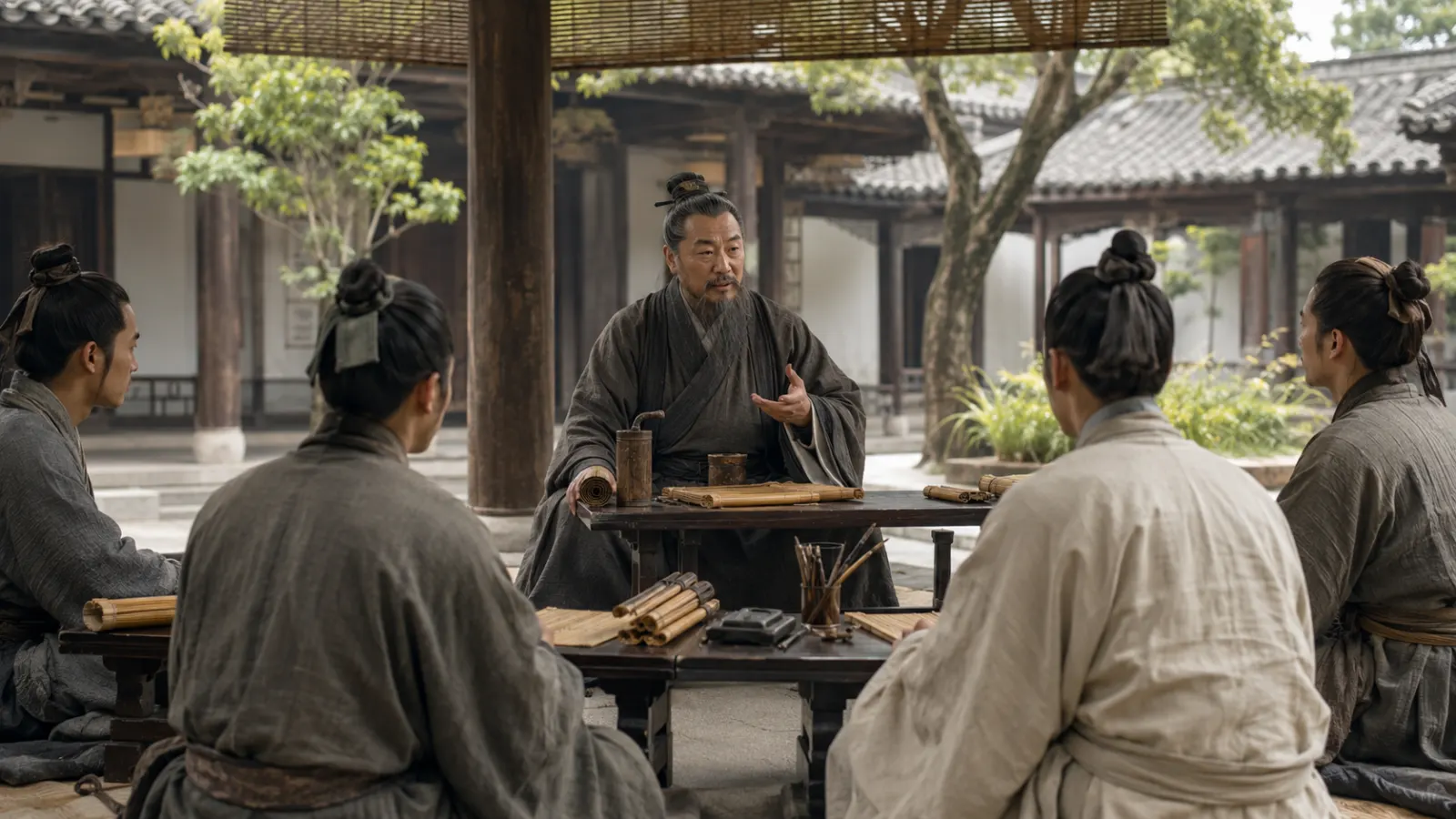
Much of the detailed biography later attached to Confucius comes from sources written long after his lifetime, particularly Sima Qian’s Records of the Grand Historian. Such sources are indispensable but need to be treated critically because they mix historical memory with traditions accumulated across generations. The Analects gives a different kind of evidence: not a continuous biography, but an image of a teacher surrounded by disciples and repeatedly discussing learning, virtue, ritual, speech and political responsibility.
Confucius Presented Himself as a Transmitter, Not a Revolutionary
Confucius is traditionally associated with the claim that he transmitted rather than invented. That can make him seem simply conservative, as though his project were to reproduce an older social order exactly.
His relationship to tradition was more active than that. Inherited rites, poetry, music and exemplary figures provided material through which character could be cultivated. The Zhou past functioned partly as a normative standard against which contemporary conduct could be judged.
Yet ritual was not valuable simply because it was old. Empty performance without seriousness, reverence or proper disposition could fail morally. Confucius therefore connects tradition with reform: inherited forms should shape conduct, but only when people understand how to inhabit those forms well.
This pattern became characteristic of later Confucian traditions. Reform frequently took the form not of rejecting the classics but of rereading them.
Learning Is a Moral Practice
The Analects repeatedly praises learning, but learning in this context is much broader than gathering information. It involves study, reflection, repeated practice, observing exemplary people, correcting one’s own conduct and developing appropriate habits.
This produces an important educational idea: character can be cultivated. Human beings are not treated simply as fixed personalities who either possess virtue or do not. Practice matters.
The ideal person is often described through the term junzi, traditionally translated as “gentleman” or “noble person.” Those translations preserve part of the ancient social context but can mislead modern readers because the ethical ideal increasingly concerns cultivated character rather than hereditary status. “Exemplary person” often captures the philosophical aspiration more clearly.
The junzi seeks consistency between speech and action, learns how to behave appropriately within relationships and develops judgment through repeated practice. Education is therefore not merely preparation for employment or the accumulation of facts. It is ethical formation.
Ren: What It Means to Become Fully Humane
One of the central terms in Confucian thought is ren, variously translated as humaneness, humanity, benevolence or authoritative conduct. No single English word captures its full range.
Ren concerns the quality of a person’s relationships with others. It is not merely private kindness or sentimental compassion. It involves cultivated responsiveness expressed through actual social life.
The Analects does not provide one definitive abstract formula for ren. Different passages associate it with restraint, care, seriousness, courage, reciprocity and disciplined conduct. This reflects Confucius’s wider teaching style. Ethical concepts are often explained through situations rather than systematic definitions.
The result is a relational account of morality. A person becomes humane by practising humanity toward actual people: family members, friends, colleagues, rulers, subordinates and others encountered within social life.
This raises a question that later Confucian traditions continue to debate. Does morality begin with differentiated obligations toward those closest to us, or should moral concern extend universally in the same way toward everyone? Confucian thought generally gives special importance to concrete relationships while also containing principles through which concern can move outward.
Reciprocity Places Limits on Self-Centred Conduct
The Analects contains a formulation frequently compared with the Golden Rule: do not impose on others what you yourself do not desire. The principle is often associated with shu, reciprocity or sympathetic understanding.
Its emphasis is significant. Moral judgment requires considering how one’s actions affect another person rather than treating one’s own perspective as sufficient.
Confucian ethics does not therefore erase social roles or hierarchies. Children and parents, rulers and ministers, older and younger people may have different responsibilities. Yet reciprocity places an ethical constraint on those relationships. A person’s superior position does not mean unlimited licence.
This helps explain why Confucian ethics cannot be reduced simply to obedience. Roles matter, but people can perform those roles well or badly. Authority itself is judged through moral expectations.
Li: Why Ritual Matters to Ethics
A second central term is li, translated as ritual, rites, propriety or ritualised conduct. Modern readers sometimes interpret ritual only as formal religious ceremony, but li encompasses a much wider field: manners, mourning practices, ceremonies, music, forms of address and repeated patterns of social behaviour.
Why should morality care about such forms?
Because Confucius treats conduct as something capable of training emotion. Mourning practices do not merely display grief; they organise how grief is expressed. Courteous forms train attention to others. Ceremonial restraint can discipline ego and impulse.
Yet external correctness alone is insufficient. The Analects repeatedly links ritual with seriousness, sincerity and humane concern. Performing every gesture perfectly while lacking the appropriate disposition would miss the point.
Li therefore represents an embodied theory of moral education. Character is formed not only by thinking about ethics but through repeated practices that shape how people respond to one another.
Family Is the First School of Moral Life
Filial piety, xiao, is among the most widely recognised features of Confucian ethics. It concerns responsibilities toward parents and ancestors, but popular summaries often reduce it to unquestioning obedience.
The early texts are more complicated. Respect and care matter, but material support alone is insufficient if provided without the appropriate attitude. Confucian traditions also recognise forms of remonstrance in which loyalty to parents or superiors does not require silently accepting conduct regarded as wrong.
The family functions as the first major environment in which people learn gratitude, responsibility, care and role-consciousness. Later Confucian political thought often extended this analogy outward, treating well-ordered families as foundations for political order.
That extension became historically influential and potentially dangerous. If rulers are imagined as fathers and subjects as children, hierarchy can acquire the appearance of natural necessity. Confucian traditions therefore contain both a rich account of relational obligation and resources that have been used to reinforce paternalistic authority.
The Rectification of Names Makes Language a Moral Problem
In one famous passage of the Analects, Confucius is asked what he would do first if entrusted with government. The answer concerns the rectification of names.
The concept can sound abstract, but its political logic is straightforward: titles and descriptions should correspond to reality. A ruler should act in a manner worthy of the title ruler; a minister should perform the responsibilities attached to being a minister. Words should not become devices for disguising failure.
Institutions depend upon categories people can trust. When corruption is routinely called service, incompetence described as excellence or arbitrary power presented as virtue, language stops functioning as a reliable guide to political responsibility.
Rectification is therefore linguistic and ethical at the same time. Social roles contain standards, and people should be judged partly by whether their conduct deserves the names they claim.
The principle also turns inward. Before correcting public language, people must learn to inhabit their own roles responsibly.
Good Government Begins With Example
Confucius repeatedly contrasts government based mainly on punishment with government based on moral example and ritual. The argument is not that formal rules are always unnecessary. It is that coercion has limits.
Punishment can make people avoid certain actions because they fear consequences. It does not necessarily produce shame, judgment or moral self-restraint. Exemplary leadership, by contrast, is supposed to shape expectations and habits.
The ruler’s character therefore matters. If leaders are greedy, corrupt or self-indulgent, formal rules alone may struggle to produce honesty below them. If leaders demonstrate restraint and responsibility, their behaviour can make ethical order more credible.
This remains one of the most attractive and vulnerable parts of Confucian political thought. Personal example matters enormously, but moral character cannot substitute entirely for institutions, laws or mechanisms capable of limiting abuse. Later Chinese political thought repeatedly confronted the relationship between cultivated rulers and formal political controls.
The enduring question is simple: can a political system remain good when the people exercising power are morally undisciplined?
Confucius and the Ideal of the Scholar-Official
Later tradition remembers Confucius as someone who sought political office because moral ideas should shape government. Exact details of his official career are difficult to establish securely, although later accounts describe administrative responsibilities in Lu and eventual political disappointment.
The Analects repeatedly discusses whether educated people should serve rulers, when political service is honourable and when withdrawal becomes necessary because principles cannot be maintained.
These themes contributed to the later ideal of the scholar-official: a person educated in classical and ethical traditions who advises political authority rather than merely flattering it.
Centuries later, imperial bureaucracies and examination systems gave this ideal enormous institutional importance. Confucian texts became central to elite education and government service. But it would be historically inaccurate to say Confucius himself designed those later institutions.
The transformation illustrates how intellectual traditions grow. A teacher’s ethical vocabulary can later become the framework for institutions unimaginable in his own lifetime.
The Wandering Teacher and the Limits of Political Advice
Traditional biographies describe Confucius leaving Lu and travelling among different states in search of rulers willing to adopt his advice. Historians should remain cautious about the exact itinerary and dramatic stories preserved in later sources, but the larger image aligns with important themes in the Analects.
Political rulers often seek immediate advantage rather than long-term moral reform. The teacher therefore occupies an awkward position: close enough to power to advise it, but rarely powerful enough to compel it.
This image shaped later Chinese intellectual culture. Service could be morally honourable because educated officials had responsibilities toward government, yet withdrawal could also be honourable when serving required compromising integrity.
The tension between engagement and withdrawal would become one of the enduring problems of the scholar-official tradition.
Poetry and Music Belong to Moral Education
Confucius is traditionally associated with the Book of Songs and with the cultural importance of music. Later traditions sometimes credit him with editing or organising major classical texts, but claims of direct authorship or editorial control should be treated cautiously.
What is clearer is the educational ideal associated with him. Poetry can refine language, emotional perception and moral judgment. Music can shape feeling and social harmony. Literature and musical practice are therefore not ornamental additions to serious education.
They participate in character formation.
This outlook differs sharply from a model of education organised mainly around information acquisition. For Confucius, people need to learn how to respond appropriately as well as what facts to know.
The Analects Is a Layered Text, Not a Transcript
The Analects is the most important surviving source for Confucius’s teaching, but it was not written by him as a completed book. Scholars generally understand it as a compilation shaped by disciples and later followers, with different sections potentially reflecting different periods of transmission.
This affects how its sayings should be handled historically. Instead of assuming every quotation reproduces Confucius’s exact spoken words, more cautious phrasing recognises that the Analects presents Confucius as saying particular things.
Its fragmentary structure is also central to its literary power. Many sayings are brief and situational. An answer that appears inconsistent with another passage may have been given to a different student with a different moral problem.
Later commentary therefore became essential. Confucianism developed through interpretation of the text, not merely through repetition of isolated sayings.
Commentary was not secondary material surrounding a frozen original doctrine.
It was one of the main ways the tradition remained alive.
Mencius and Xunzi Show That Confucianism Was Never One Doctrine
Mencius, living generations after Confucius, developed an influential account in which human beings possess moral tendencies capable of growth. His famous images describe these beginnings as sprouts requiring cultivation.
Xunzi, another major Confucian thinker, took a significantly different approach. He emphasised the disorder produced by untrained human desires and the need for ritual and education to transform conduct.
Both claimed the Confucian inheritance.
Their disagreement matters because it demonstrates that “Confucianism” should not be treated as one unchanging philosophy. Confucius supplied an ethical vocabulary, exemplary figures and questions about cultivation. Later thinkers constructed more systematic philosophical accounts around that inheritance.
Internal disagreement became one of the tradition’s sources of durability.
Confucianism Became an Imperial Institution
Over the centuries after Confucius’s death, texts associated with his tradition gained growing political importance, particularly from the Han period onward. This development was gradual rather than immediate.
Imperial governments employed Confucian language in education, ritual and bureaucratic administration. Confucius became an honoured cultural figure, and examination systems eventually made mastery of canonical traditions increasingly important for elite advancement.
Institutionalisation enormously expanded Confucian influence while also changing the tradition. The remembered teacher of moral cultivation became connected with state orthodoxy.
This relationship remained ambiguous. Confucian ideas could legitimise hierarchy, but officials could also use classical standards to criticise rulers for failing to behave virtuously.
A tradition incorporated by the state could therefore both serve authority and provide a language for judging authority.
Neo-Confucianism Changed the Tradition Again
During the Song and later dynasties, thinkers now grouped under the label Neo-Confucianism reworked Confucian philosophy partly in response to Buddhist and Daoist intellectual traditions.
Zhu Xi developed influential accounts of principle, material force, self-cultivation and classical interpretation. His commentaries became enormously important to later education and examination culture.
Wang Yangming later emphasised the relationship between moral knowledge and action in different ways, developing another major current within the tradition.
These developments demonstrate why the philosophy encountered under the label “Confucianism” cannot simply be projected backward onto the historical Confucius. Later Confucian thinkers constructed sophisticated metaphysical systems that go far beyond the material preserved in the Analects.
Confucius became a foundational ancestor within traditions that continued developing for centuries.
Confucian Traditions and Patriarchal Society
Confucian thought developed within patriarchal societies, and later social systems frequently invoked Confucian values when defining family hierarchy, women’s roles and gendered obligations.
A responsible history should neither ignore these structures nor attribute every later patriarchal practice directly to the historical Confucius. The Analects emerged from a predominantly male elite educational environment and does not provide anything resembling modern gender equality, while later ritual and social traditions developed more elaborate gender hierarchies.
Women nevertheless participated in Confucian intellectual and educational life and produced their own interpretations across East Asian history.
The historical picture is therefore layered. Early texts, later ritual codes, imperial institutions and ordinary family practices interacted without being identical.
Using “Confucianism” as a single explanation for every patriarchal feature of East Asian societies obscures that complexity.
Confucius Became a Political Symbol in the Modern Era
Modern political movements repeatedly reinterpreted Confucius. Reformers and revolutionaries debated whether Confucian traditions provided moral resources for modern society or represented obstacles to social and political transformation.
During the New Culture and May Fourth periods, Confucian hierarchy came under strong criticism. In the People’s Republic of China, political campaigns at different moments condemned Confucius as a symbol of feudal conservatism.
Later decades brought renewed interest in Confucius as a figure in discussions of education, cultural heritage, ethics and Chinese identity.
These reversals reveal something fundamental about canonical thinkers. Their reputations are continually reconstructed around contemporary needs.
Whenever someone appeals to “Confucian values,” the historical question should therefore be: which interpretation of Confucius, selected by whom and for what purpose?
Confucius Beyond China
Confucian traditions became influential across Korea, Japan, Vietnam and other parts of East Asia, but this was never a process of simple copying.
Korean Neo-Confucianism developed distinctive philosophical and institutional forms, particularly during the Joseon period. Japanese thinkers adapted Confucian learning within political and religious environments shaped by warrior government and Buddhism. Vietnamese examination and bureaucratic traditions incorporated classical learning within their own political history.
This regional variation matters. Confucius became an international historical figure through translation, adaptation and institutional transformation long before modern globalisation.
His legacy is therefore not the possession of one national narrative. It belongs to a network of intellectual traditions that repeatedly transformed what Confucianism meant.
Confucian Ethics Remains Relevant Because It Is Relational
Modern philosophers continue to examine Confucian thought when discussing virtue, family obligation, care, education, ritual, civic character and the relationship between individuals and institutions.
Confucian ethics offers a different emphasis from moral theories built primarily around abstract rules or individual rights. It asks how people become certain kinds of persons through relationships and practice.
That can be philosophically valuable while also generating criticism. Role-based ethics can emphasise responsibility and care, but it can also naturalise hierarchy or make dissent more difficult when roles are treated as morally fixed.
The tension should not be removed artificially. It is part of what makes the tradition worth studying.
Laws Alone Cannot Produce Character
One of the deepest Confucian insights is that institutions cannot manufacture good conduct solely through punishment. Laws can constrain behaviour, but everyday character develops through education, social expectations, habits, models and relationships.
Modern societies recognise versions of this problem whenever they ask why formal rules fail in organisations where corruption has become normal, or why civic behaviour depends partly on social trust rather than enforcement alone.
Yet the reverse is equally important. Virtuous individuals cannot guarantee good government when institutions reward abuse.
Confucius therefore remains relevant partly because his thought creates a problem rather than solving it completely: how can societies cultivate trustworthy conduct without allowing moral education to become coercive conformity?
Frequently Asked Questions
Who was Confucius? Confucius was an ancient Chinese teacher and thinker traditionally dated to 551–479 BCE whose teachings on learning, character, ritual and government became foundational to later Confucian traditions.
What was Confucius’s Chinese name? His family name was Kong and personal name Qiu. He became known respectfully as Kongzi or Master Kong.
Did Confucius write the Analects? No. The Analects is a collection of sayings and conversations compiled and transmitted by followers rather than a book written directly by Confucius.
What is Confucianism? Confucianism is a broad modern label for ethical, philosophical, educational, ritual and political traditions that developed from texts and teachings associated with Confucius and later thinkers.
What is ren? Ren is a central Confucian concept translated in various ways as humaneness, benevolence or humanity. It concerns cultivated moral responsiveness toward others.
What is li? Li refers to ritual, propriety and patterned conduct, ranging from ceremonies and mourning practices to manners and forms of social interaction.
What is filial piety? Filial piety, or xiao, concerns responsibilities of care, respect and reverence toward parents and ancestors.
Did Confucius teach blind obedience to parents? The tradition strongly values filial responsibility, but the early texts are more complex than unconditional obedience and include the possibility of remonstrance.
What is the junzi? The junzi is the exemplary or cultivated person who develops moral character through learning, disciplined conduct and appropriate relationships.
What did Confucius believe about education? He treated education as moral cultivation rather than merely the accumulation of information. Study, reflection, ritual, poetry and practice all contribute to character.
What is the Confucian Golden Rule? The Analects contains the principle that one should not impose upon others what one would not desire for oneself.
What is the rectification of names? It is the idea that social and political names should correspond to actual conduct—for example, someone called a ruler should behave according to the responsibilities of rulership.
What did Confucius believe about government? He emphasised moral example, cultivated leadership and ritual order rather than relying entirely on punishment.
Was Confucius against law? His teachings emphasise the limitations of punishment and coercion, but they should not be simplified into a complete rejection of legal institutions.
Did Confucius work in government? Later traditions describe him holding office and advising rulers, but detailed claims about his political career require caution because important biographies were written long after his lifetime.
Why did Confucius travel among states? Traditional accounts describe him seeking rulers willing to adopt his political and moral advice, although exact itineraries and anecdotes should be treated cautiously.
What did Confucius believe about poetry and music? He treated them as important parts of education because they could refine language, emotion and moral sensibility.
Who were Mencius and Xunzi? They were major later Confucian thinkers who developed significantly different theories of human nature while both claiming Confucian inheritance.
Did Confucius create the Chinese imperial examination system? No. Examination systems developed centuries later, although Confucian texts eventually became central to them.
What is Neo-Confucianism? Neo-Confucianism refers broadly to later philosophical traditions, especially from the Song period onward, that developed Confucian thought in conversation with Buddhist, Daoist and earlier classical ideas.
Was Confucianism patriarchal? Confucian traditions developed within patriarchal societies and later institutions often reinforced gender hierarchies, but the relationship between early texts and later social systems requires historical distinction.
Did Confucianism exist only in China? No. Confucian traditions became highly influential in Korea, Japan, Vietnam and elsewhere, where they were adapted to different political and cultural settings.
Why is Confucius still important? His work helped establish enduring questions about moral cultivation, education, political example, social relationships, ritual and the connection between personal character and public order.
The Historical Teacher and the Later Tradition Must Be Kept Separate
One of the easiest mistakes is to attribute everything later called “Confucian” directly to Confucius himself. Imperial examinations, Neo-Confucian metaphysics, bureaucratic institutions, family codes and modern political invocations of “Confucian values” developed across very different historical periods.
The opposite mistake is to treat those later developments as irrelevant.
Confucius became historically important precisely because later societies kept interpreting him. The remembered teacher provided language through which communities debated education, hierarchy, moral character and political responsibility.
His afterlife is therefore part of the history, but it should not be confused with his biography.
The Central Idea
Confucius’s philosophy begins from a simple but demanding proposition: good societies depend partly on people learning how to conduct themselves well in relation to others. Moral character develops through education, repetition, ritual, family responsibility, language, example and self-correction. Government cannot be separated entirely from this process because rulers themselves model conduct and institutions reflect assumptions about what kinds of behaviour deserve respect.
This relational approach explains why concepts such as ren, li, reciprocity and filial responsibility matter so much. Confucius does not generally begin from an isolated individual choosing abstract principles. He begins with people already embedded in families, communities and political relationships and asks how those relationships can be inhabited ethically.
That strength creates the tradition’s most serious difficulties as well. Roles can educate, but they can become rigid. Respect can sustain relationships, but hierarchy can become domination. Government by moral example can inspire better leadership, but personal virtue is not a substitute for institutional accountability.
Later Confucian thinkers repeatedly argued over these tensions. Mencius and Xunzi disagreed about human nature. Neo-Confucian philosophers created metaphysical systems beyond the Analects. Imperial institutions turned classical learning into bureaucratic culture. Modern political movements attacked, reinvented and rehabilitated Confucius again.
The result is not one doctrine preserved unchanged for 2,500 years.
It is an intellectual tradition organised around the problem of moral formation.
Confucius matters because he asked how people learn to become trustworthy parents, children, friends, teachers, officials and rulers—and because he insisted that public order ultimately depends on more than laws imposed from outside.
Character matters.
Education matters.
Institutions matter.
And none of them can be understood entirely apart from the relationships in which people learn how to live with one another.