Charles Darwin: How Natural Selection Was Built From Evidence, Doubt and Collaboration
Charles Darwin did not discover evolution in a sudden moment of revelation while staring at finches on the Galápagos Islands. That familiar story is memorable because it compresses an enormously complicated scientific process into one dramatic image. The real history is slower and more interesting. Darwin’s theory of evolution by natural selection developed through geology, fossil collecting, taxonomy, artificial breeding, correspondence, experiments, reading and years of hesitation. The Galápagos mattered, but so did South American fossils, mockingbirds, pigeons, barnacles, orchids, earthworms and thousands of observations gathered by people across an international scientific network.
Natural selection was also not Darwin’s discovery alone in the simplest sense. Alfred Russel Wallace independently developed a closely related explanation of evolutionary change and sent Darwin an essay in 1858. Material from both men was then presented jointly to the Linnean Society before Darwin published On the Origin of Species the following year. Darwin’s distinctive achievement was not merely identifying the mechanism. It was constructing an extraordinary body of evidence around evolution and turning species change from a controversial possibility into a coherent scientific research programme.
Darwin Began as a Collector, Not as the Founder of Evolutionary Biology
Charles Robert Darwin was born on 12 February 1809 in Shrewsbury, England, into a prosperous family with strong intellectual and professional connections. His father, Robert Darwin, was a physician, while his grandfather Erasmus Darwin had already speculated about the transformation of living organisms during the eighteenth century.
Charles first studied medicine at Edinburgh University. He disliked aspects of medical training, particularly surgery, and did not continue toward a medical career. Edinburgh nevertheless became scientifically important because it exposed him to marine zoology, natural history and debates about whether species could change over time.
He worked with anatomist Robert Grant, who was influenced by evolutionary ideas associated with Jean-Baptiste Lamarck and other European naturalists. Darwin therefore encountered discussions of species transformation well before developing natural selection.
He later moved to Christ’s College, Cambridge, initially expecting that he might eventually become a clergyman. There his interests increasingly shifted toward natural history, particularly through his relationship with botanist John Stevens Henslow and exposure to geology.
The Darwin who finished at Cambridge had not solved evolution.
He was a capable observer and collector searching for a scientific direction.
The Beagle Voyage Changed the Scale of Darwin’s Questions
In 1831 Henslow recommended Darwin for a position aboard HMS Beagle, commanded by Robert FitzRoy. The voyage lasted almost five years, from 1831 to 1836, and was primarily a surveying expedition, particularly around South America.
Darwin travelled as a gentleman naturalist and companion to FitzRoy rather than as a salaried institutional scientist in the modern sense.
The journey gave him access to an enormous range of geological and biological evidence. He collected specimens, examined fossils, studied coastlines, observed earthquakes and volcanic activity and recorded how related organisms differed across geography.
The intellectual significance of the voyage came partly from the questions these observations created.
Why did extinct South American mammals resemble living South American species? Why did populations vary from one island or region to another? Why did geological formations look as though enormous change could arise from processes operating slowly over very long periods?
These were not yet answers to evolution.
They were the beginnings of a new problem.
Charles Lyell Changed the Way Darwin Thought About Time
One of the most important books Darwin carried during the voyage was Charles Lyell’s Principles of Geology.
Lyell argued that large geological formations could be explained through processes still visible in the present—erosion, sedimentation, uplift and volcanic activity—operating gradually over immense spans of time.
Darwin applied that style of reasoning to what he observed.
A dramatic landscape did not necessarily require one dramatic event. Small causes could accumulate over deep time.
This geological framework became important for evolutionary thinking because biological transformation also requires time. If populations change gradually across generations, vast geological timescales make large evolutionary differences possible.
Darwin’s evolutionary reasoning therefore did not emerge from biology alone.
It was built partly from a geological understanding of cumulative change.
Fossils Were Important Before Finches Became Famous
The Galápagos finches dominate popular accounts of Darwin because they provide a simple visual story: different beaks supposedly reveal natural selection immediately.
The historical reality is more complicated.
Darwin collected finches on the islands, but he did not instantly recognise them as the decisive evidence for evolution. Much of their significance became clearer after specialists examined the specimens following his return to Britain.
Other observations may have been equally or more important during the development of his thinking.
In South America, Darwin found fossils of large extinct mammals that resembled living animals inhabiting the same geographical region. This raised a powerful question: why should extinct and modern organisms from the same place resemble one another?
He also noticed geographical replacement among related species.
On the Galápagos, mockingbirds appear to have attracted particularly significant attention because birds from different islands showed observable differences.
These examples illustrate a broader feature of science: evidence often becomes meaningful only after specimens are compared, classified and placed inside a larger pattern.
Discovery is not always the moment of observation.
Sometimes it is the later recognition of what multiple observations mean together.
The Critical Step Was Realising Species Were Not Fixed
By the late 1830s, Darwin had begun privately considering that species might change over time.
His notebooks contain early evolutionary diagrams, including the famous branching sketch associated with the idea of a tree of life.
But accepting species transformation created another problem.
What caused adaptation?
If a species changed, why would the changes tend to fit particular environments? Why would useful traits become common? Why would lineages branch rather than all organisms simply changing in the same direction?
Earlier evolutionary theories had proposed transformation, but Darwin needed a mechanism capable of explaining the appearance of adaptation without assuming that organisms consciously improved themselves.
The solution emerged from an unexpected source.
Malthus Helped Darwin See the Mechanism
In 1838 Darwin read Thomas Robert Malthus’s work on population.
Malthus argued that populations have the potential to grow faster than available resources, creating competition and pressure.
Darwin connected that principle with variation among organisms.
Individuals within a population are not identical. Some variations influence survival or reproductive success. If part of that variation is heritable, individuals possessing traits better suited to a particular environment can leave more descendants.
Across many generations, those differences accumulate.
This became the core logic of natural selection.
The process requires no conscious striving. A population does not decide to improve itself.
Selection emerges because different variants contribute unequally to later generations.
Evolutionary change therefore becomes a statistical consequence of heritable variation plus differential reproduction.
Natural Selection Has No Predetermined Destination
One of the most persistent misunderstandings of Darwinian evolution is that natural selection pushes organisms toward perfection.
It does not.
A trait is advantageous only relative to an environment. If the environment changes, the trait’s effect may change as well.
Natural selection also does not necessarily produce increasing complexity. Simple organisms can remain extraordinarily successful.
Evolution is therefore not a ladder with humanity at the top.
It is better represented as branching populations adapting under different ecological pressures.
This distinction matters because many social and cultural misunderstandings of evolution come from turning a historical biological process into a universal theory of progress.
Darwin’s own tree-like thinking was much closer to branching diversification than to a march toward a predetermined superior form.
Why Darwin Did Not Publish Immediately
Darwin produced an early sketch of his theory in 1842 and a much longer essay in 1844.
Yet On the Origin of Species did not appear until 1859.
The delay has generated extensive speculation. One explanation is that Darwin feared religious controversy or social consequences. Those concerns were real, but they do not fully explain the long period before publication.
Darwin was also assembling an enormous evidential foundation.
A theory capable of explaining the diversity of life had to account for domesticated animals, fossils, geographical distribution, classification, variation, complex structures and numerous apparent exceptions.
Darwin spent years gathering material that could answer objections.
His caution was therefore partly methodological.
He wanted more than a plausible mechanism.
He wanted enough evidence to make the mechanism difficult to dismiss.
Barnacles Were Part of the Evolution Problem
Darwin’s long study of barnacles can look bizarre in a simplified biography.
Why would someone who had already formulated natural selection spend years dissecting and classifying barnacles instead of immediately publishing the revolutionary theory?
Because taxonomy itself was one of the problems evolution needed to explain.
Species appear distinct enough for scientists to classify them, yet variation can blur boundaries. Detailed taxonomic work forced Darwin to confront how much individuals vary, what separates one species from another and how classification relates to natural relationships.
Barnacles gave him practical experience with exactly the kind of variation his evolutionary theory needed to explain.
The work was not simply procrastination.
It strengthened his understanding of species.
Darwin’s Science Was Built Through Correspondence
Darwin is often imagined working alone at Down House, surrounded by notebooks and specimens.
That image is incomplete.
The Darwin Correspondence Project has documented more than 15,000 known letters written by or addressed to him.
He communicated with breeders, gardeners, missionaries, naturalists, colonial officials, family members and scientific colleagues.
These correspondents supplied observations Darwin could never have gathered personally. They described domesticated animals, plant variation, unusual behaviours, geographical distributions and practical experience with breeding.
His theoretical synthesis depended on a large evidence network.
Darwin therefore illustrates an important feature of scientific authorship: one person may formulate and organise a theory while relying on observations produced by many others.
The theory was his intellectual synthesis.
The evidence base was profoundly collaborative.
Victorian Science Was Connected to Empire
Darwin’s international information network also operated within the structures of nineteenth-century British imperial expansion.
Ships, colonial administrations, missionaries, collectors and trading networks moved specimens and information across enormous distances.
Natural history benefited from these systems.
Recognising that context does not mean that every scientific observation was merely an imperial project. It means that nineteenth-century scientific knowledge was produced through political and logistical networks that determined who could travel, collect, correspond and move material.
The global circulation of specimens and information helped make Darwin’s synthesis possible.
Scientific history therefore becomes more accurate when intellectual achievements are placed inside the institutions and power structures that supported them.
Alfred Russel Wallace Independently Reached Natural Selection
The most dramatic moment in Darwin’s publication history occurred in 1858.
Alfred Russel Wallace, working in the Malay Archipelago, independently developed an explanation of evolution closely resembling natural selection and sent Darwin an essay describing it.
Darwin was deeply unsettled.
He had spent approximately two decades developing the idea and possessed notebooks and essays demonstrating earlier work, but he had not yet published the full theory.
His friends Charles Lyell and Joseph Dalton Hooker helped arrange a joint presentation of Darwin’s material and Wallace’s essay to the Linnean Society on 1 July 1858.
Neither Darwin nor Wallace attended.
The arrangement attempted to recognise both histories of discovery.
The central historical point is clear: Wallace independently conceived natural selection.
Darwin had independently developed the mechanism earlier and had accumulated a far larger unpublished body of evidence.
Both facts should remain visible.
Darwin and Wallace Should Not Be Reduced to a Priority Fight
It is tempting to present the 1858 episode as a dramatic competition over who “really” discovered natural selection.
That framing is too narrow.
Priority matters in scientific history, but Darwin and Wallace also differed in emphasis, evidence and later theoretical development.
Wallace remained a major evolutionary thinker and biogeographer in his own right.
Darwin’s later influence became much larger partly because On the Origin of Species offered a sustained argument integrating evidence across multiple areas of natural history.
The fairest formulation is therefore that natural selection was independently formulated by Darwin and Wallace, while Darwin produced the more extensive synthesis that transformed evolutionary biology.
That does not diminish Darwin.
It gives Wallace appropriate historical recognition.
On the Origin of Species Was an Argument, Not an Announcement
On the Origin of Species was published on 24 November 1859.
The book did not simply state that species change through time. Earlier thinkers had already proposed various forms of transformation.
Darwin’s achievement was to organise several independent lines of evidence around common descent and natural selection.
He discussed artificial selection practiced by breeders, geographical distribution, fossils, classification, embryology, variation and structures that appeared imperfect or vestigial.
The analogy with artificial selection was particularly powerful.
If breeders could transform domestic pigeons, dogs or livestock by repeatedly selecting particular variants, perhaps nature could produce much larger effects by filtering inherited variation over immense periods.
The analogy did not prove natural selection by itself.
It made cumulative selection intelligible.
Darwin Took Objections Seriously
One reason Origin became so influential was that Darwin did not simply present evidence supporting his theory and ignore everything difficult.
He explicitly confronted problems.
The fossil record appeared incomplete. Transitional forms were often missing. Complex organs such as the eye seemed difficult to explain through gradual modification. The mechanism of inheritance was unknown.
Darwin attempted to show how these problems might fit inside the theory while acknowledging the limitations of contemporary evidence.
He did not solve everything.
That is scientifically important.
A productive theory does not need to answer every question immediately. It needs to organise questions so that further evidence can test, refine or reject its explanations.
Darwin transformed several apparent objections into future research problems.
“Survival of the Fittest” Was Not Darwin’s Original Phrase
The phrase most commonly associated with Darwin was coined by philosopher Herbert Spencer.
Darwin later incorporated “survival of the fittest” into later editions of Origin as an alternative expression for natural selection.
The phrase can be misleading because modern readers often interpret “fitness” as strength, intelligence or superiority.
In evolutionary biology, fitness concerns reproductive success relative to a particular environment.
A physically weak organism can possess high evolutionary fitness if it leaves many viable descendants.
A powerful individual that produces no descendants contributes little to subsequent generations.
Evolutionary fitness is therefore not a moral ranking and not simply a measure of physical power.
Reproduction Matters More Than Survival Alone
An organism can survive for a long time without contributing genetically to future populations.
Natural selection therefore concerns differential reproduction, not merely survival.
A trait can spread when it increases the probability that its bearers produce successful offspring, even if the trait also carries costs.
This becomes especially important in Darwin’s later theory of sexual selection.
Survival matters because organisms generally need to survive long enough to reproduce.
But evolutionary success ultimately concerns what is transmitted into future generations.
Darwin Had a Major Problem: He Did Not Know Genetics
Natural selection requires heritable variation.
Darwin understood this requirement but lacked a correct modern theory of inheritance.
Gregor Mendel performed his famous pea experiments during Darwin’s lifetime, but Mendelian inheritance did not become integrated into evolutionary biology until later.
Darwin proposed speculative ideas of inheritance, including pangenesis.
Those ideas did not survive scientific scrutiny.
This limitation demonstrates something important about scientific theories.
Darwin could correctly identify a major population-level mechanism while being wrong about another essential component of the larger explanation.
Natural selection survived because later discoveries supplied mechanisms Darwin lacked rather than because every detail of Darwin’s biology was preserved unchanged.
Mendelian Genetics Transformed Darwinism
During the twentieth century, evolutionary biologists integrated Mendelian inheritance with natural selection.
This development eventually contributed to the modern evolutionary synthesis and population genetics.
Evolution could then be described in terms of changes in allele frequencies, mutation, recombination, selection and other population processes.
Modern evolutionary theory contains far more than Darwin’s original formulation.
Genetic drift, molecular evolution, horizontal gene transfer, developmental biology and genomic analysis have all expanded the field.
Darwin remains central because natural selection and common descent remain fundamental.
But modern evolutionary biology is not simply nineteenth-century Darwinism with better microscopes.
Science advanced by extending and correcting the framework.
Human Evolution Was Deliberately Less Central in Origin
Darwin said comparatively little about human evolution in the first edition of On the Origin of Species.
The implications were obvious, but detailed treatment came later.
In 1871, he published The Descent of Man, and Selection in Relation to Sex.
There Darwin explicitly incorporated humans into evolutionary history.
Human beings were no longer a biological exception standing outside common descent.
They belonged within the same natural processes affecting other organisms.
Scientifically, the implication was enormous.
Culturally, it was even more controversial.
Sexual Selection Expanded Darwin’s Evolutionary Theory
Natural selection can explain traits improving survival and reproduction, but Darwin recognised that some conspicuous features appeared costly.
A peacock’s tail requires resources and may make escape from predators harder.
Why should such a trait persist?
Darwin developed sexual selection to explain characteristics that increase mating success even when they impose other costs.
He broadly distinguished between competition for access to mates and mate choice.
Later evolutionary biology greatly revised and expanded these ideas.
Sexual selection can involve reciprocal choice, conflict, cooperation and diverse reproductive systems.
But Darwin’s insight was fundamental: traits can evolve because they affect reproduction, not merely survival.
Darwin’s Views of Race Require Historical Precision
The Descent of Man contains discussions of human groups shaped by nineteenth-century categories of race, civilisation and hierarchy.
These sections require careful treatment.
Darwin strongly opposed slavery and argued for human common ancestry. Those positions distinguished him from some polygenist racial theories that treated different human populations as separate creations.
At the same time, he was not free from assumptions and language shaped by Victorian racial hierarchies.
A responsible biography should therefore avoid two opposite distortions.
Darwin should not be converted into a modern egalitarian figure whose language perfectly matches contemporary values.
Nor should every nineteenth-century racial statement be treated as though it defines modern evolutionary biology.
Historical context and scientific legacy need to be separated carefully.
Darwin’s Relationship With Religion Changed Gradually
Darwin began adulthood within a broadly Christian environment and once considered entering the clergy.
Over time, his religious views became increasingly sceptical.
The death of his daughter Annie in 1851 is sometimes portrayed as the single event that destroyed his faith.
That interpretation is too simple.
His doubts developed gradually and involved intellectual as well as personal factors.
Darwin eventually described himself more comfortably as agnostic than atheist.
His scientific work clearly challenged literal interpretations of species creation, but he did not present evolution simply as a campaign against religion.
Religious responses to evolution were diverse even during his own lifetime.
Some rejected evolutionary ideas.
Others attempted to reconcile them with religious belief.
The historical relationship between evolution and religion is therefore more complicated than a simple permanent war between science and faith.
Social Darwinism Is Not Darwinian Evolution
Political and economic writers later used evolutionary language to justify competition, inequality, imperialism or laissez-faire economics.
These ideas are commonly grouped under the label social Darwinism.
They should not be confused with biological natural selection.
Natural selection describes how heritable variation affects reproductive success within populations.
It does not tell governments how economies should be organised or which social inequalities should be tolerated.
Turning a description of nature into a moral command for society is a form of the naturalistic fallacy.
What occurs in nature does not automatically establish what humans ought to do politically or ethically.
Evolutionary Biology Is Not Eugenics
The later history of heredity also became entangled with eugenics.
Darwin’s cousin Francis Galton helped develop the eugenics movement, which attempted to apply ideas about heredity to deliberate human reproductive policy.
Later eugenic programmes produced coercive sterilisation, racial policies and other severe abuses.
Those histories should be studied honestly.
They should not, however, be collapsed into modern evolutionary biology.
Evolutionary theory describes biological processes.
Eugenics was a political and social programme attempting to control human reproduction.
The distinction between scientific description and political prescription is essential.
Darwin Was Also an Experimental Scientist
Darwin is often remembered mainly as an observer collecting specimens during the Beagle voyage.
He also conducted numerous experiments, particularly at Down House.
He tested whether seeds could remain viable after exposure to salt water to investigate how plants might colonise islands.
He studied climbing plants.
He examined insectivorous plants.
He investigated orchid pollination.
He observed earthworms and soil formation.
He studied aspects of emotional expression in humans and animals.
These experiments were generally modest in equipment but conceptually connected to larger evolutionary questions.
Could seeds cross oceans?
Could complicated plant structures arise gradually?
Could small organisms reshape landscapes over time?
Darwin repeatedly tested mechanisms rather than merely accumulating examples that appeared compatible with his theory.
Orchids Became a Test of Natural Selection
Darwin’s work on orchids illustrates how he used specialised biological systems to test broader evolutionary principles.
The intricate structures of flowers and their relationships with pollinating insects might appear to require deliberate design.
Darwin investigated how those structures could arise through gradual modifications favouring effective reproduction.
The point was not that every orchid trait had already been explained completely.
It was that apparently extraordinary complexity could be investigated through ordinary biological processes.
Natural selection therefore became more than a historical claim about species change.
It became a working explanation capable of generating testable questions about specific organisms.
Earthworms Showed Darwin’s Preference for Cumulative Explanations
Darwin’s final major book examined earthworms and the formation of vegetable mould.
The subject may seem unexpectedly small compared with evolution.
The intellectual connection is strong.
Earthworms individually produce modest effects. Across large populations and long periods, those effects can transform soil.
This is the same style of reasoning Darwin had absorbed from geology and applied to evolution.
Small processes repeated over time can generate large consequences.
That cumulative logic appears across his work.
Geology, evolution and earthworm activity differ enormously in subject.
They share a method of explanation.
Darwin’s Health Influenced His Working Life
Darwin experienced recurrent illness for much of adulthood, including digestive problems, fatigue, headaches and other symptoms.
Many retrospective diagnoses have been proposed.
None can be established with sufficient certainty to be presented simply as historical fact.
What is clear is that illness affected his daily schedule.
At Down House, he structured work around relatively short periods of concentrated research, walking, correspondence and rest.
His productivity was therefore not the product of uninterrupted solitary labour.
It depended partly on financial security and household support.
Emma Darwin and others within the household helped create conditions that protected Darwin’s research time.
The history of scientific achievement therefore includes domestic labour that traditional biographies often leave in the background.
Down House Was a Research Environment
Darwin’s home became an important scientific workplace.
Experiments could continue for weeks or months. Plants could be observed through seasons. Letters arrived containing reports from distant parts of the world. Books and specimens could be compared repeatedly.
The relatively stable environment suited Darwin’s method.
He did not need constant dramatic expeditions after the Beagle voyage.
Much of the theory’s development came through sustained accumulation.
This is another reason the myth of the sudden Galápagos revelation is misleading.
The Darwin who transformed biology was largely the Darwin who spent years comparing evidence after returning home.
Darwin’s Greatest Strength Was Evidential Architecture
Natural selection can be stated surprisingly simply.
Populations vary.
Some variation is heritable.
Organisms differ in reproductive success.
Heritable traits associated with greater reproductive success tend to become more common.
The conceptual mechanism is elegant.
What made Darwin’s contribution revolutionary was the enormous structure of evidence surrounding it.
He connected domestication, biogeography, fossils, taxonomy, variation, anatomy and embryology through one historical framework.
A theory became powerful because many different categories of evidence began making sense together.
Darwin’s greatness therefore lies as much in synthesis as in conceptual invention.
What Darwin Got Wrong
Darwin was wrong about several important scientific questions.
His pangenesis hypothesis failed.
He lacked a correct theory of heredity.
Some of his geographical explanations were inaccurate.
The fossil record available to him was exceptionally incomplete.
He could not know DNA, genes, mutation, chromosomes, genetic drift, molecular phylogenetics or modern developmental biology.
Natural selection also turned out not to be the only mechanism of evolutionary change.
None of this undermines Darwin’s historical importance.
It demonstrates how science works.
A productive framework survives because later research can modify it without protecting every statement made by its founder.
Darwin matters because evolution continued developing after Darwin.
Natural Selection Is Only One Evolutionary Mechanism
Modern evolutionary biology includes processes that Darwin could not fully anticipate.
Mutation creates new genetic variation.
Genetic drift can alter allele frequencies through chance.
Gene flow moves variation among populations.
Recombination reshuffles genetic material.
Horizontal gene transfer can move genes between lineages in ways particularly important among microorganisms.
Selection remains central to understanding adaptation.
But evolution as a whole is broader than selection alone.
Using “Darwinism” as though it contains every component of modern evolutionary biology therefore risks collapsing more than a century of scientific development into one nineteenth-century framework.
Darwin Did Not Finish Evolutionary Biology
One of the most useful ways to understand Darwin is to reject the idea that he completed evolutionary theory.
He did something more productive.
He made evolution investigable.
Once common descent and natural selection supplied a framework, researchers could ask where variation comes from, how heredity works, how species split, how populations change and how evolutionary histories can be reconstructed.
Later genetics and molecular biology did not merely confirm Darwin word for word.
They transformed the field he helped create.
That is what a successful scientific revolution often looks like.
It produces questions future scientists can answer more precisely than the founder could.
Frequently Asked Questions
Who was Charles Darwin?
Charles Darwin was an English naturalist whose work on evolution by natural selection helped transform modern biology.
When was Charles Darwin born?
He was born on 12 February 1809 in Shrewsbury, England.
Did Darwin discover evolution?
Darwin did not originate the general idea that species could change over time. His major contribution was developing natural selection and constructing extensive evidence for evolution and common descent.
Did Darwin discover natural selection alone?
No. Alfred Russel Wallace independently formulated a closely related explanation, and Darwin and Wallace’s work was presented jointly in 1858.
Did Darwin discover evolution because of Galápagos finches?
No. The Galápagos contributed important evidence, but Darwin’s theory emerged gradually through fossils, geology, geographical distribution, breeding, taxonomy and later research.
Were finches Darwin’s most important Galápagos observation?
Not necessarily. Mockingbirds and other geographical patterns appear to have been significant, and the finches became more informative after specialists examined them in Britain.
What was HMS Beagle?
HMS Beagle was the surveying ship on which Darwin travelled from 1831 to 1836 as a gentleman naturalist and companion to Captain Robert FitzRoy.
What did Darwin learn from Charles Lyell?
Lyell’s geology emphasised that small processes operating over immense periods can create large changes, an intellectual framework that influenced Darwin’s thinking about biological transformation.
What did Malthus contribute to Darwin’s thinking?
Malthus’s discussion of population pressure helped Darwin connect competition with variation and differential reproduction.
What is natural selection?
Natural selection is the process through which heritable traits associated with greater reproductive success tend to become more common in populations over generations.
Does natural selection mean organisms try to adapt?
No. Natural selection does not require conscious effort or a predetermined goal.
Why did Darwin wait so long to publish?
He spent years building evidence and examining possible objections. Religious and social controversy may also have contributed, but the delay cannot be explained by one factor alone.
Why did Darwin study barnacles?
Barnacle taxonomy helped him examine variation, species boundaries and classification in great detail.
What happened between Darwin and Alfred Russel Wallace?
Wallace independently developed natural selection and sent Darwin an essay in 1858. Their work was subsequently presented jointly to the Linnean Society.
When was On the Origin of Species published?
It was published on 24 November 1859.
Did Darwin invent the phrase “survival of the fittest”?
No. Herbert Spencer coined the phrase. Darwin adopted it later.
What does evolutionary fitness mean?
Fitness refers broadly to reproductive success relative to a particular environment, not strength or moral superiority.
Did Darwin understand genetics?
No. He lacked modern genetics and proposed inheritance ideas, including pangenesis, that did not survive scientific testing.
Did Darwin know about Mendel?
Mendel’s work was published during Darwin’s lifetime, but it was not integrated into Darwin’s evolutionary framework.
Did Darwin study human evolution?
Yes. He addressed human evolution explicitly in The Descent of Man, published in 1871.
Was Darwin an atheist?
His beliefs changed over time, and he later identified more comfortably with agnosticism than with a straightforward declaration of atheism.
What is social Darwinism?
Social Darwinism refers to political and social doctrines that applied competition language to human society. It should not be confused with evolutionary biology.
Is eugenics the same as Darwinian evolution?
No. Eugenics was a political programme concerned with controlling human reproduction, while evolutionary biology describes biological processes.
Did Darwin conduct experiments?
Yes. He experimented with seeds, plants, pollination, insectivorous species, earthworms and other biological questions.
What did Darwin get wrong?
He lacked modern genetics, proposed an incorrect inheritance theory and did not know many mechanisms now central to evolutionary biology.
Why does Darwin still matter?
He helped establish common descent and natural selection as a powerful scientific framework and reorganised biology around historical change across deep time.
The Myth of Darwin Is Faster Than the Science
The popular Darwin story has a dramatic structure: a young naturalist sails to the Galápagos, studies finches and suddenly realises that species evolve.
The real history is less cinematic.
It is also more scientifically revealing.
Darwin collected specimens during the Beagle voyage, but many patterns became meaningful only after classification and comparison. He spent years building notebooks, studying breeders, dissecting barnacles, corresponding internationally and testing mechanisms through experiments.
He developed natural selection privately long before publishing it.
Then another naturalist independently reached the same central idea.
The decisive scientific achievement was therefore not one moment of discovery.
It was the construction of an argument capable of surviving sustained criticism.
The Central Idea
Charles Darwin transformed biology because he connected a relatively simple mechanism to an extraordinarily broad evidential structure.
Natural selection explains how heritable variation can become differentially represented across generations. But Darwin’s lasting achievement was showing that this mechanism could help unify observations from fossils, domestication, geographical distribution, taxonomy, anatomy and variation.
The theory did not emerge fully formed from the Galápagos.
Darwin accumulated questions during the Beagle voyage, adopted geological thinking from Lyell, connected population pressure with biological variation after reading Malthus and spent decades testing whether the mechanism could withstand difficult cases.
Wallace’s independent discovery in 1858 makes the history even more important. Natural selection was not the private property of one mind. Two naturalists reached comparable mechanisms independently, while Darwin’s enormous body of prior work allowed him to produce the synthesis that reshaped biological science.
Darwin also illustrates why scientific importance does not require infallibility. He did not understand genetics. His inheritance theory was wrong. Modern biology contains mutation, genetic drift, molecular genetics and processes he could not have imagined.
Evolutionary biology survived by changing.
That is precisely why Darwin remains important.
He did not provide the final answer to evolution.
He built a framework strong enough for future scientists to correct, extend and transform without destroying its central insight.
The lasting image of Darwin should therefore not be a man suddenly understanding a finch.
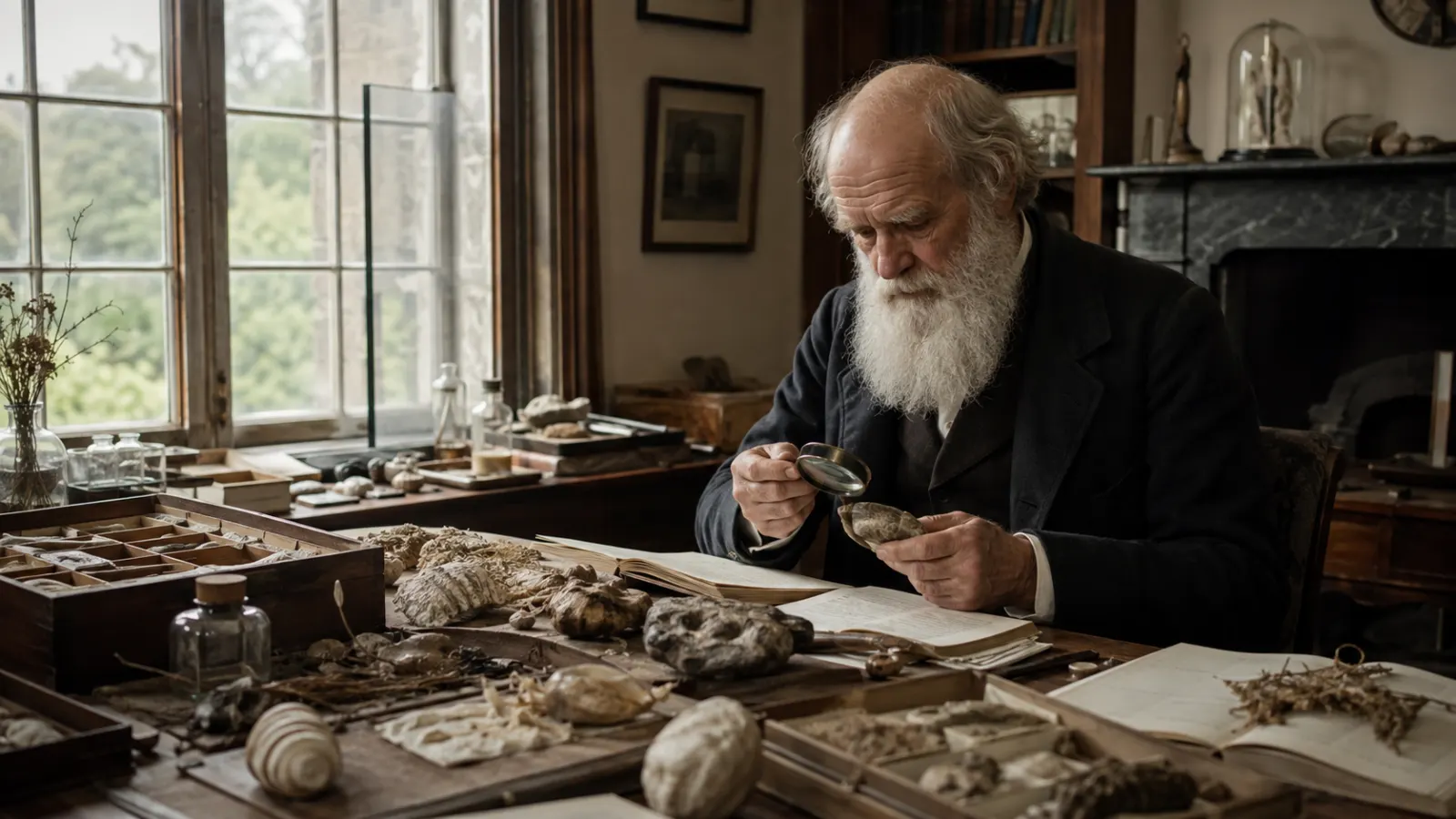
It should be a researcher comparing specimens, reading objections, designing experiments, writing letters, revising arguments and patiently building enough evidence to reorganise an entire science.