Chandragupta Maurya: Founder of the Mauryan Empire
Chandragupta Maurya founded one of the most consequential empires in South Asian history, yet the man himself remains unusually difficult to reconstruct. He left no known royal inscriptions comparable to the edicts later issued by his grandson Ashoka. The near-contemporary Greek diplomat Megasthenes wrote extensively about India and Chandragupta’s court, but his original Indica is lost and survives only through quotations and summaries preserved by later Greek and Roman authors. Indian accounts of Chandragupta are richer in narrative detail, but most were written or redacted centuries after his reign.
The result is a striking historical paradox. Chandragupta’s political achievement is unmistakable, while many familiar details of his biography—from his childhood and ancestry to his relationship with Chanakya and the circumstances of his final years—belong to traditions whose historical reliability varies greatly.
What can be established is extraordinary enough. Around the end of the fourth century BCE, Chandragupta displaced the Nanda dynasty of Magadha, established the Mauryan dynasty at Pataliputra, expanded into the political vacuum left by Alexander’s campaigns in the northwest and fought Seleucus I Nicator, one of the most powerful successors to Alexander. By the time his reign ended, conventionally around 297 BCE, he had created a territorial state on a scale unprecedented in the subcontinent’s earlier political history. Modern scholarship describes him as the maker of the first India-wide empire, although the nature and intensity of Mauryan control varied greatly across regions.
Chandragupta Rose in the Political World Left by Alexander
Chandragupta’s career unfolded during a period of exceptional political disruption. Alexander of Macedon crossed the Hindu Kush and entered the northwestern subcontinent in 327–326 BCE. His army defeated or negotiated with a number of regional rulers and famously fought King Porus on the Hydaspes, usually identified with the Jhelum River. Alexander continued east until his soldiers refused to advance beyond the Hyphasis, the Beas River, and he eventually withdrew from India.
Alexander died at Babylon in 323 BCE. His enormous empire fragmented as his generals and successors fought over its territories. The political arrangements he had established in the northwest of the subcontinent proved fragile. Recent scholarship emphasises that Alexander’s direct presence in India was brief but deeply disruptive, creating circumstances that helped Chandragupta expand westward from the Gangetic region into the Indus political world.
To the east, meanwhile, Magadha already represented one of South Asia’s strongest centres of territorial power. The Nanda dynasty controlled a wealthy kingdom based in the Gangetic plain. Classical authors describe the Nandas as possessing enormous military resources, although ancient figures for troop numbers are difficult to verify and should not be repeated as precise statistics.
Chandragupta therefore did not create imperial politics out of nothing. Magadha had undergone generations of political expansion under earlier dynasties. Its fertile agricultural base, river networks, large population and strategic location gave rulers access to resources capable of supporting armies and administration on a considerable scale.
His achievement was to take that political foundation and expand it dramatically.
Chandragupta’s Origins Remain Uncertain
Few aspects of Chandragupta’s life have generated more contradictory traditions than his ancestry.
Brahmanical, Buddhist and Jain narratives tell different stories. Some portray relatively humble or socially marginal origins; others connect him with established warrior status or dynastic ancestry. These accounts were produced in different religious and political environments and often reflect the concerns of the communities that preserved them.
There is no secure contemporary record that allows historians to reconstruct Chandragupta’s parents, childhood or precise social status with confidence.
That uncertainty is historically meaningful rather than merely frustrating. Successful founders frequently attract retrospective genealogies. Once a dynasty becomes powerful, later writers attempt to explain how its founder acquired legitimacy, and ancestry becomes part of the political story.
Chandragupta’s rise was so dramatic that later traditions naturally asked how someone outside the Nanda dynasty had acquired the ability to overthrow it. The surviving answers should be read as evidence of how Chandragupta was remembered as well as possible clues to his actual origins.
Chanakya, Chandragupta and the Problem of Later Tradition
Popular history rarely separates Chandragupta from Chanakya, also known as Kautilya or Vishnugupta in different traditions. The familiar story presents Chanakya as the brilliant strategist who identified Chandragupta’s potential, trained him, organised resistance to the Nandas and engineered the political manoeuvres that brought the young ruler to power.
The association is deeply rooted in later Indian historical memory, but the surviving detailed narratives are not contemporary accounts of Chandragupta’s court. The Sanskrit political drama Mudrarakshasa, for example, gives Chanakya a central role in the complex diplomacy surrounding the establishment of Chandragupta’s rule, but the work was composed centuries after the events it depicts.
The relationship between Chanakya and the Arthashastra requires even greater caution. Tradition identifies the text’s Kautilya with Chandragupta’s adviser and consequently treats the Arthashastra as the intellectual blueprint of the Mauryan Empire. Modern textual scholarship has complicated that picture substantially.
The work as it survives appears to contain material from different periods. One influential modern reconstruction argues that an earlier form was composed around the first century BCE and that the text was subsequently redacted by an author identified as Kautilya around the third century CE. Other scholars propose different chronologies, but there is broad reason to reject the simplistic assumption that the extant Arthashastra is a verbatim administrative handbook written for Chandragupta around 320 BCE.
This does not make the text irrelevant. It remains one of ancient India’s most important works on statecraft, taxation, diplomacy, intelligence, warfare and political economy. What it cannot safely provide is a direct departmental chart of Chandragupta’s government.
The Chanakya tradition remains significant for another reason: generations of Indian writers remembered the Mauryan revolution not merely as a battlefield victory but as an achievement of strategy, organisation, intelligence and political calculation.
The Overthrow of the Nandas and the Birth of the Mauryan Dynasty
The exact sequence by which Chandragupta defeated the Nandas cannot be reconstructed securely. Later Indian narratives describe failed campaigns, strategic lessons, espionage and complex manoeuvres, while classical sources preserve scattered indications that Chandragupta was politically active in the upheavals surrounding Alexander’s withdrawal.
What is considerably clearer is the result.
Around 321 BCE, the conventional date used by much modern scholarship, Chandragupta emerged as ruler of Magadha and founder of the Mauryan dynasty. The exact chronology remains a matter of scholarly reconstruction rather than the certainty of a dated royal inscription, but the early 320s BCE provide the usual framework.
Possession of Magadha gave Chandragupta an exceptional imperial base. Its agricultural resources could finance armies and administration, while the Ganges system enabled movement of people and goods. Existing urban centres, trade networks and traditions of state formation gave the Mauryas institutions that could be expanded rather than invented from the beginning.
His capital, Pataliputra, near modern Patna, stood at the centre of this system.
Megasthenes later described Pataliputra as an enormous fortified city protected by walls, towers, gates and a moat. Because the original Indica has disappeared, these descriptions reach us through later authors and cannot simply be treated as measurements taken from a modern survey. Yet the literary tradition consistently presents Pataliputra as a major political and administrative centre.
An empire spanning distant regions needed more than a victorious king. It required the movement of revenue, military supplies, information and officials. Pataliputra became the hub through which the new dynasty attempted to coordinate that power.
How Large Was Chandragupta Maurya’s Empire?
Modern maps often colour almost the entire Indian subcontinent as “the Mauryan Empire.” Those maps can create two misleading impressions.
First, many represent Mauryan territory at or near its maximum extent under Ashoka, not necessarily the territory controlled personally by Chandragupta. Second, they depict ancient political authority as though it operated like the fixed borders of a modern nation-state.
Ancient imperial control was rarely so uniform.
The Mauryan government probably exercised relatively direct power in important agricultural and administrative regions while relying on different arrangements in frontier territories, strategically important routes and areas incorporated through conquest or political agreement. Tributary relationships, local rulers and regional intermediaries could coexist with central authority.
Chandragupta certainly controlled Magadha and extensive parts of northern India. His expansion into the northwest is also strongly supported by his later confrontation with Seleucus. Recent scholarship describes his empire as extending from the Gangetic basin into territories that had previously fallen within Alexander’s sphere, eventually reaching into areas corresponding to parts of modern Afghanistan.
It is therefore reasonable to describe Chandragupta as the creator of an empire of extraordinary territorial scale. It is less responsible to draw an exact line around every area he supposedly administered directly.
Ancient empire was layered.
The War With Seleucus I Nicator
The most important external event that helps anchor Chandragupta’s chronology is his confrontation with Seleucus I Nicator.
Seleucus had been one of Alexander’s officers and emerged from the wars among Alexander’s successors as ruler of a vast Hellenistic kingdom. By the beginning of the third century BCE, he sought to recover or consolidate territories associated with Alexander’s eastern campaigns.
This brought him into conflict with the expanding Mauryan state.
Recent scholarship dates the Seleucid-Mauryan war approximately to 305–303 BCE, although the surviving literary accounts of the conflict are remarkably brief.
The confrontation ended not with the destruction of either kingdom but with a settlement that became one of the most important diplomatic agreements between the Hellenistic and South Asian worlds. Classical sources indicate that Seleucus gave up or recognised Mauryan control over territories in the eastern borderlands of his empire, while Chandragupta supplied him with 500 war elephants.
The exact geography transferred under the agreement remains debated, as does the degree to which the surviving sources preserve the original terms of the treaty. A 2026 reassessment of what is sometimes called the “Treaty of the Indus” stresses how limited the surviving evidence actually is and warns against reconstructing an overly precise territorial exchange from short later accounts.
The elephants, however, became enormously important in Hellenistic warfare. Seleucus possessed a major elephant force at the Battle of Ipsus in 301 BCE, where the coalition against Antigonus and Demetrius won one of the decisive battles among Alexander’s successors. Scholars continue to debate aspects of the ancient numerical tradition, but the Mauryan-Seleucid elephant connection demonstrates how strategically valuable Indian war elephants had become in the Hellenistic world.
The treaty reveals Chandragupta’s stature more clearly than later legend needs to. A ruler who had risen only a few decades earlier was negotiating from strength with one of the most formidable monarchs produced by Alexander’s shattered empire.
Did Chandragupta Marry a Greek Princess?
One of the most repeated stories about the Seleucid settlement is that Seleucus gave a daughter—often called Helena in modern popular accounts—in marriage to Chandragupta.
The evidence does not justify that level of certainty.
Classical material associated with the settlement contains terminology connected with marriage or intermarriage, but historians have debated whether it indicates a specific dynastic marriage, recognition of intermarriage between populations or another diplomatic arrangement.
No secure contemporary evidence identifies a wife of Chandragupta named Helena.
The safest historical conclusion is therefore that some kind of marriage-related provision may have formed part of the settlement, but the familiar romantic biography of a named Greek princess marrying Chandragupta goes beyond what the evidence can securely establish.
The treaty is historical. The romance is much harder to prove.
Megasthenes and the Mauryan Court
Peace between the Seleucid and Mauryan states also produced one of the most important encounters in ancient historiography: the presence of Megasthenes at Chandragupta’s court.
Megasthenes was a Greek diplomat associated with Seleucus who spent time in Mauryan India and wrote a work generally known as the Indica. His testimony is exceptionally valuable because he was effectively an eyewitness to the political order created by Chandragupta. Modern scholarship continues to use his material to examine the Mauryan army, political economy and organisation of royal resources.
But there is an unavoidable complication: the Indica itself is lost.
What survives consists of fragments, quotations and paraphrases embedded in works written by later authors such as Strabo, Arrian, Diodorus and Pliny. Recent scholarship emphasises that these “fragments” are not always literal pieces of Megasthenes’ original prose; they can be summaries filtered through authors writing centuries later for very different audiences.
Some material attributed to Megasthenes appears highly informative. Other passages describe fantastic peoples and wonders characteristic of ancient ethnographic writing.
He should therefore be used critically rather than either accepted unconditionally or dismissed altogether.
For Chandragupta, the importance of Megasthenes is enormous. Without him, the near-contemporary external evidence for the first Mauryan ruler would be considerably poorer.
The Army Behind the Empire
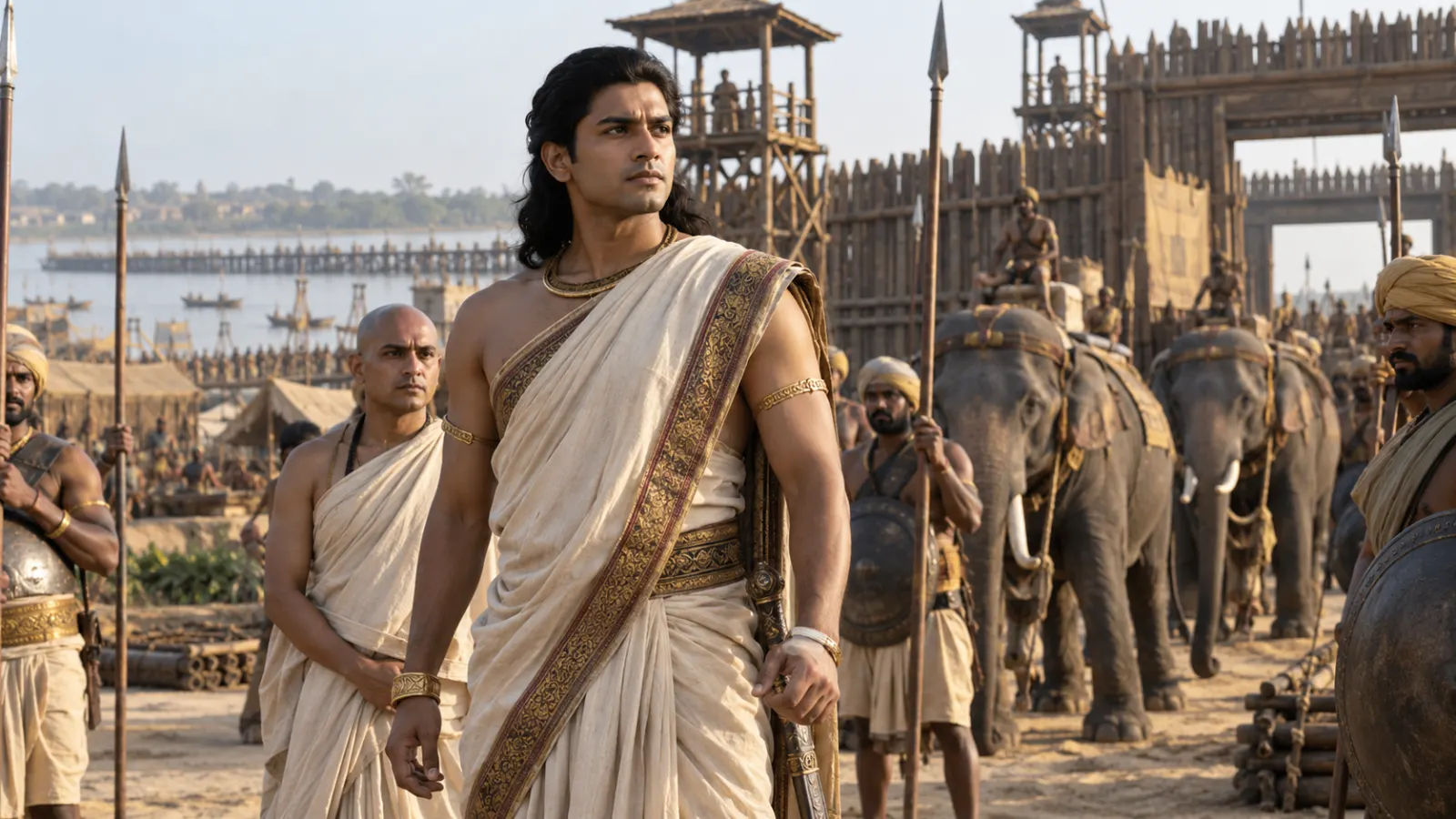
Chandragupta is often remembered primarily as a conqueror, but large-scale conquest required a substantial logistical system.
Elephants provide the clearest example.
War elephants were not simply dramatic battlefield animals. They required trained mahouts, capture or breeding systems, enormous quantities of fodder, veterinary knowledge, transport planning and specialised military organisation. A state capable of maintaining large numbers of elephants had to devote considerable resources to them.
Thomas Trautmann’s study of Megasthenes argues that royal control over military livestock—including elephants, horses and oxen—formed an important element in the system that allowed Chandragupta to build his empire. Megasthenes’ surviving testimony portrays a political order in which the state took responsibility for supporting military resources on a significant scale.
This shifts the story away from the idea that Chandragupta simply possessed superior courage or military genius.
An elephant corps cannot be improvised before a battle. An army cannot remain in the field without food, transport, revenue and organisation. Conquest was therefore inseparable from administration.
How Much Do We Know About Mauryan Administration Under Chandragupta?
Textbooks often provide extraordinarily detailed descriptions of Chandragupta’s administration: departments, spies, tax collectors, officials responsible for trade, forests, mines, agriculture, cities and military affairs.
Some of those descriptions may reflect real features of early Indian imperial government, but the evidence needs to be separated carefully.
Three bodies of material are frequently combined: fragments of Megasthenes, the Arthashastra and Ashoka’s inscriptions.
They do not come from exactly the same moment.
Megasthenes is close to Chandragupta’s reign but survives only fragmentarily. The surviving Arthashastra is a layered text whose final form is probably substantially later. Ashoka’s edicts are contemporary royal documents, but they belong to Chandragupta’s grandson and reflect a different ruler’s institutions and priorities.
Combining all three can create an administrative system far more precisely documented than the evidence actually allows.
What can safely be inferred is broader. Chandragupta’s empire needed regular revenue, military supply, routes of communication, officials acting on behalf of the monarchy and systems capable of coordinating distant regions. The fact that the state survived Chandragupta and passed successfully to Bindusara and then Ashoka suggests that his conquests had been converted into institutions durable enough to outlive the founder.
That may have been Chandragupta’s most important achievement.
Winning territory is one problem. Governing it after the army moves on is another.
The Economic Foundations of Mauryan Power
Imperial expansion depended ultimately on economic resources.
Magadha gave Chandragupta access to the highly productive Gangetic plain, where agriculture could support dense populations and generate revenue. Rivers facilitated movement and communication, while expanding cities and commercial routes connected northern India with regions farther west and south.
These developments predated Chandragupta. Urbanisation, craft production, monetisation and larger territorial states had been developing for generations.
The Mauryan Empire did not create the economic world of early historic India from nothing. It consolidated, redirected and exploited existing resources on an unusually large scale.
This matters because biographies of conquerors can make empire appear to be exclusively a sequence of battles.
Armies march on revenue. Capitals consume food. Elephants require fodder. Officials need to be maintained. Roads, rivers and communication networks determine how rapidly orders and supplies move.
The durability of the Mauryan state therefore depended as much on the mobilisation of resources as on military victory.
Chandragupta, Jain Tradition and Shravanabelagola
The final years of Chandragupta’s life are among the most famous and most debated parts of his biography.
Later Jain tradition strongly connects him with Bhadrabahu, renunciation and Shravanabelagola in present-day Karnataka. According to the best-known form of the story, Chandragupta gave up the throne, travelled south with the Jain teacher Bhadrabahu, became an ascetic and eventually died through sallekhana, the Jain practice of ritual fasting at the end of life.
Shravanabelagola retains a powerful association with this tradition, and inscriptions from the site refer to Bhadrabahu and a Chandragupta. But the inscriptions and developed literary narratives are substantially later than the Mauryan ruler himself, and historians have long debated whether every element refers securely to Chandragupta Maurya rather than to later figures or evolving religious memory. Scholarly assessments of the tradition have differed sharply.
A historically responsible biography should therefore avoid both extremes.
It should not dismiss the Jain tradition as meaningless simply because the evidence is late; its long connection with Chandragupta is itself an important part of Indian religious memory. But neither should it describe the renunciation, journey south and ritual death as though they were recorded by a contemporary witness.
The most defensible formulation is that Jain tradition strongly associates Chandragupta Maurya with renunciation and Shravanabelagola, while the precise historical details remain difficult to verify independently.
This preserves the tradition without converting later memory into contemporary documentation.
Bindusara and the Survival of Chandragupta’s State
Chandragupta was succeeded by his son Bindusara, conventionally around 297 BCE. His grandson Ashoka later inherited the Mauryan throne and left inscriptions across a vast geographical area, providing historians with evidence on a scale unavailable for Chandragupta.
The succession matters.
Many conquest-based states collapse quickly after the death or removal of their founder. Rival generals divide territory, local rulers reassert themselves or succession disputes destroy the centre.
That did not immediately happen to the Mauryan state.
Bindusara inherited the imperial structure, and Ashoka later ruled an even more extensively documented version of it. Whatever administrative arrangements Chandragupta established or inherited had therefore become durable enough to survive a change of ruler.
Chandragupta founded not merely a personal kingdom but a dynasty capable of sustaining imperial government across generations.
Was Chandragupta the First Ruler to Unite India?
Modern accounts frequently describe Chandragupta as the first ruler to “unify India.”
The phrase captures something important but can also project modern political geography backward by more than two millennia.
There was no modern Republic of India in the fourth century BCE. The Mauryan Empire did not correspond precisely to present-day international borders, and its authority was almost certainly uneven across its territories. Some regions now within India were never under Chandragupta’s direct rule, while his northwest frontier extended into territories now outside the country.
Yet dismissing the phrase entirely would obscure the genuine scale of his achievement.
Chandragupta built a state connecting the Gangetic heartland with large areas of northern and northwestern South Asia. Cambridge scholarship describes his achievement as the creation of the first India-wide empire beginning around 321 BCE.
The significance lies not in modern nationalism but in political scale.
Earlier northern Indian kingdoms had already developed substantial territorial power. Chandragupta demonstrated that one dynasty could coordinate authority, military resources and revenue across regions separated by enormous distances.
His grandson Ashoka would make the geographic extent of Mauryan rule more visible through inscriptions, but Chandragupta had created the imperial foundation.
Chandragupta Maurya Between History and Legend
The scarcity of contemporary evidence helps explain why Chandragupta accumulated so many legends.
Later generations wanted answers to irresistible questions. How did a man of uncertain origins defeat the wealthy Nandas? How did he build an empire during the political chaos following Alexander? How did he become powerful enough to negotiate with Seleucus? Who taught him? What kind of ruler was he? Why did he leave the throne?
Different traditions answered with Chanakya’s strategies, dramatic confrontations, prophecies, dynastic genealogies, romantic marriages and religious renunciation.
Some of these stories may preserve historical memories. Others clearly developed through literary and religious retelling.
The historian’s task is not to strip Chandragupta of every story until nothing remains. It is to distinguish levels of evidence.
The confrontation with Seleucus rests within Hellenistic diplomatic history. Megasthenes gives near-contemporary testimony, although only through later fragments. The existence of the Mauryan dynasty and its succession to Bindusara and Ashoka is secure. Pataliputra’s role as the imperial centre is well established.
The exact story of Chandragupta’s childhood is not.
A named Greek princess called Helena is not.
The extant Arthashastra cannot simply be placed on Chandragupta’s desk.
The detailed Jain account of his final renunciation belongs to a later tradition whose historical core remains debated.
This hierarchy does not make the biography weaker. It makes it more credible.
Why Chandragupta Maurya Still Matters
Chandragupta Maurya matters because he altered the political scale of South Asian history.
He took control of Magadha, one of the subcontinent’s most powerful existing kingdoms, and transformed it into the centre of a much larger imperial state. He expanded into regions destabilised by Alexander’s campaigns, confronted one of Alexander’s most formidable successors and reached a settlement that connected Mauryan India directly to the politics of the Hellenistic world.
His court became the setting for Megasthenes’ observations, giving later historians one of the earliest extended Mediterranean descriptions of South Asia. His military organisation demonstrated the importance of elephants and other logistical resources in sustaining imperial warfare. Most importantly, the state he founded survived him.
Bindusara inherited it.
Ashoka inherited it after Bindusara and transformed the dynasty into one of the best-documented political powers of ancient India.
Chandragupta left no personal inscriptions explaining how he wanted future generations to remember him. That absence may be why later traditions filled the silence so enthusiastically.
Yet the historically recoverable Chandragupta does not need embellishment.
Around 321 BCE, amid the collapse of Alexander’s eastern political arrangements and the established power of Magadha, a new ruler built an empire stretching across an unprecedented political geography. Within less than two decades, he was powerful enough to confront Seleucus I Nicator and emerge from the conflict with his position strengthened. The dynasty he founded survived to produce Ashoka and permanently changed the scale on which political power could be imagined in the subcontinent.
The legends make Chandragupta memorable.
The evidence makes him historically extraordinary.