The bank that is not a normal bank
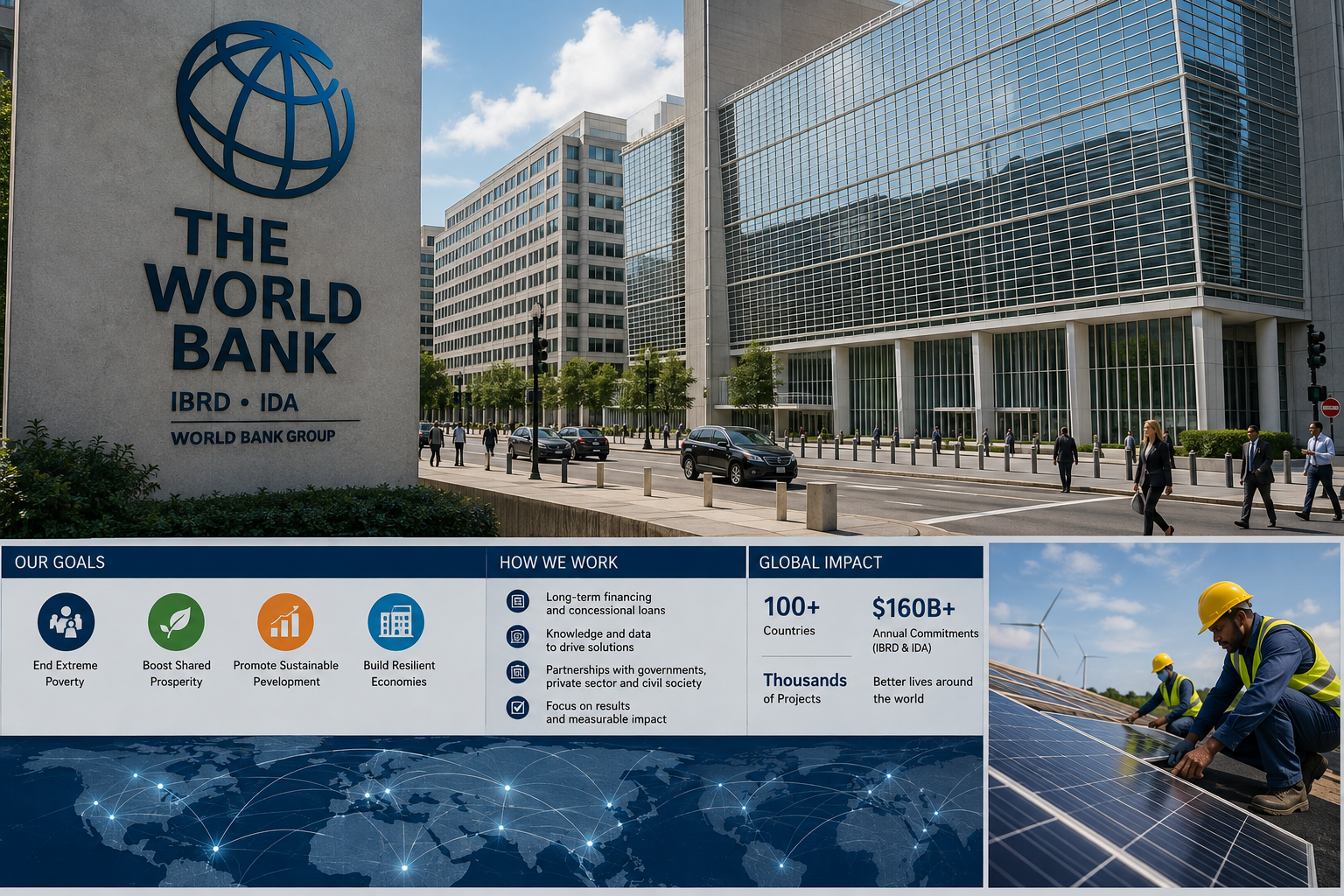
The World Bank is called a bank, but it is not a bank in the ordinary retail sense. It does not take household deposits or issue debit cards. It is a multilateral development institution created to finance development, reduce poverty, support reconstruction and advise governments on economic policy.
Its role is difficult to understand because it combines money, expertise, politics and ideology. It lends to countries, provides grants to poorer economies, supports infrastructure, funds health and education programmes, advises governments, collects data and shapes development debates. It is both a financier and a knowledge institution.
For developing countries, the World Bank can be a source of long-term finance when private markets are too expensive or unwilling. For critics, it can also represent the power of global institutions to influence domestic policy. To understand the World Bank, one must see both sides: its development mission and its political consequences.
What the World Bank is
The World Bank commonly refers to two institutions: the International Bank for Reconstruction and Development, or IBRD, and the International Development Association, or IDA. Together, they form the core of what most people mean when they say World Bank.
IBRD primarily works with middle-income and creditworthy lower-income countries. It raises money from global capital markets and lends to governments, often at better terms than those countries might obtain alone. It also provides guarantees, risk management tools and policy advice.
IDA focuses on the poorest countries. It provides concessional loans and grants, meaning the terms are softer than ordinary market borrowing. IDA is important because the poorest countries often cannot borrow sustainably from private markets for long-term development needs.
The wider World Bank Group also includes other institutions such as the International Finance Corporation, the Multilateral Investment Guarantee Agency and the International Centre for Settlement of Investment Disputes. But for a basic explainer, IBRD and IDA are the central starting point.
Why the World Bank was created
The World Bank was created in the aftermath of the Second World War. Its original purpose was reconstruction, especially rebuilding war-damaged economies. Over time, as Europe recovered and decolonisation changed the global map, the Bank’s mission shifted toward development and poverty reduction.
This historical shift matters. The World Bank began as part of the post-war economic order, alongside the International Monetary Fund. The IMF focused more on macroeconomic and balance-of-payments stability. The World Bank became more closely associated with long-term development finance, projects and policy support.
The institution’s evolution reflects the changing development agenda: roads and dams in one era, structural adjustment in another, poverty reduction later, and today a broader agenda that includes climate resilience, health systems, digital infrastructure, gender inclusion, education, governance and private-sector mobilisation.
What the World Bank actually does
The World Bank finances development projects. These may include roads, power systems, irrigation, schools, hospitals, sanitation, water supply, public administration reforms, social protection systems, digital infrastructure and climate adaptation projects. The objective is not merely to spend money, but to create public goods that support growth and human welfare.
It also provides policy advice. Governments often seek or receive guidance on taxation, public finance, infrastructure planning, financial inclusion, agricultural reform, education systems, health delivery and regulatory design. This advisory role can be valuable because the Bank has cross-country experience and technical expertise.
The Bank collects and publishes data. Its databases on poverty, income, development indicators, business conditions and global economics are widely used by researchers, governments, journalists and students. In this sense, the Bank is not only a lender; it is also an information system for the development world.
It also convenes. Because many governments, donors, private investors and institutions interact with it, the World Bank can coordinate development finance around large issues such as pandemic response, climate finance, debt stress, food security and infrastructure gaps.
How World Bank lending works
World Bank support usually begins with a country’s development priorities. The Bank and the government identify sectors where financing and technical assistance are needed. Projects are designed, appraised, approved, implemented and monitored. Loans are not meant to be casual cash transfers; they are tied to programmes, reforms or projects.
IBRD lending is backed by the Bank’s ability to raise funds from international capital markets. Because of its financial strength and member-country backing, it can often borrow at favourable rates and pass those terms to eligible countries. IDA uses donor contributions and internal resources to support poorer countries on concessional terms.
The Bank also attaches safeguards and conditions. Safeguards may relate to environmental protection, social impact, procurement and governance. Policy conditions can be more controversial, especially when they influence domestic economic choices. Supporters see these conditions as necessary for effectiveness; critics see them as external influence over sovereign policy.
Why the World Bank matters
The World Bank matters because many development needs are too large, too long-term or too risky for private finance alone. Roads, public health systems, rural water networks, climate adaptation and education reform may not generate immediate private profit, yet they are essential for national development.
It also matters during crises. Poor countries can face shocks from pandemics, wars, climate disasters, food-price spikes, debt stress or currency pressure. Multilateral finance can provide emergency support when market borrowing is costly or unavailable. This does not solve every problem, but it can prevent deeper collapse.
The Bank’s influence also comes from ideas. Its reports, rankings, frameworks and policy language shape how governments and experts talk about development. Sometimes this improves debate by bringing evidence and comparison. Sometimes it narrows debate by privileging certain models of reform. The World Bank is therefore not neutral in a simple sense; it operates within a particular institutional worldview.
Criticism and controversy
The World Bank has faced criticism on several fronts. One criticism is that its governance gives disproportionate influence to wealthy countries. Voting power and leadership traditions have long raised questions about whether developing countries have enough voice in an institution meant to serve development.
Another criticism concerns policy conditionality. In past decades, structural adjustment programmes were accused of pushing austerity, privatisation and liberalisation without enough attention to social costs. The Bank’s approach has changed over time, but the memory of those policies still shapes public distrust in many countries.
A third criticism concerns project impact. Large infrastructure projects can displace communities, damage ecosystems or create debt burdens if poorly designed. Even well-intentioned finance can fail if governance is weak, corruption is high or local realities are misunderstood.
These criticisms do not make the World Bank irrelevant. They make accountability essential. A development bank must be judged not only by how much it lends, but by whether its work improves lives, respects sovereignty, protects vulnerable communities and strengthens long-term capacity.
The India angle
India has had a long relationship with the World Bank. As a large developing economy, India has used multilateral finance for infrastructure, rural development, health, education, urban services, water, transport and institutional reform. The relationship has evolved as India’s economy has grown and its access to global capital markets has improved.
For India, the World Bank is no longer simply a lender of last resort. It is one of many financing and knowledge partners. India can borrow from markets, mobilise domestic savings, attract private capital and work with other development institutions. This gives India more bargaining power and more choice.
At the same time, India still faces enormous development requirements: urban infrastructure, climate adaptation, human capital, health systems, skilling, logistics and state capacity. Multilateral institutions can support these priorities if projects are aligned with national strategy and implemented well.
India also has a broader interest in World Bank reform. As the Global South demands fairer representation and more climate and development finance, India’s voice matters. The question is not only how India uses World Bank finance, but how India helps shape the future rules of development finance.
Final reader takeaway
The World Bank is a multilateral development institution that finances projects, supports policy reform, provides technical knowledge and helps countries address long-term development challenges. Its core lending arms are IBRD and IDA, serving different groups of countries with different financing terms.
Its importance lies in the gap between development needs and available finance. Many countries need roads, schools, health systems, climate resilience and public institutions before private markets can deliver broad prosperity. The World Bank tries to fill part of that gap.
But the World Bank must be understood critically. It can support development, but it also carries influence. Its legitimacy depends on transparency, effectiveness, fair governance and respect for local priorities. Development finance is not only about money; it is about power, priorities and the kind of future countries are able to build.
Editorial Disclaimer
This article is for general educational and editorial purposes. It is not legal, investment, development-policy or sovereign-borrowing advice. World Bank programmes, country relationships and lending terms change over time, so readers should verify current information from official World Bank documents.