Why Music Unites People: Synchrony, Shared Emotion and Social Bonding
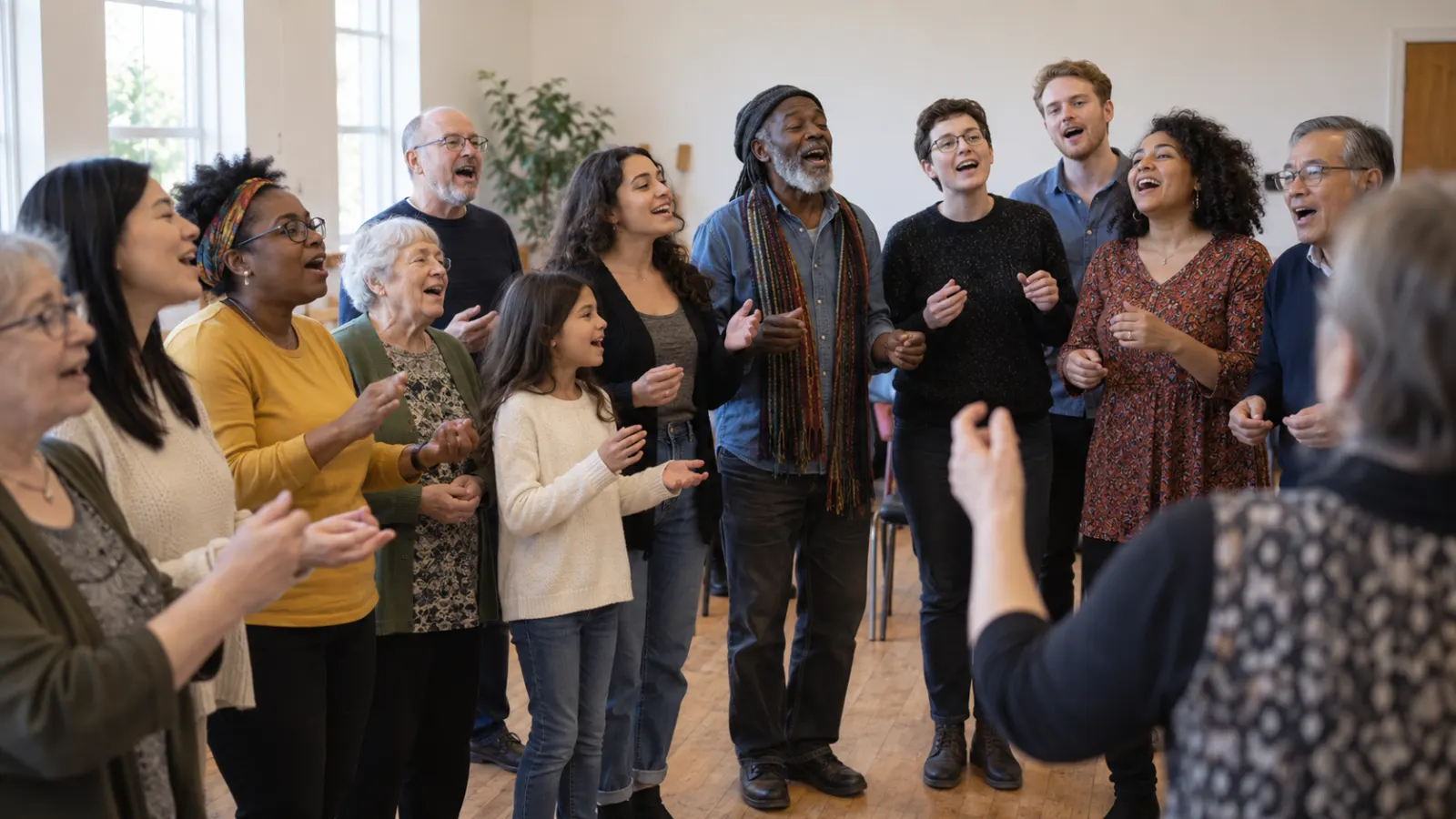
A song heard alone through headphones and the same song sung by hundreds of people in a room may contain almost identical notes, rhythms and words, but they are not the same social experience. In the first case, music is primarily something an individual receives. In the second, people may breathe together, anticipate the same chorus, move at approximately the same time, hear the voices around them and repeatedly adjust their own behaviour to remain part of a larger event.
That difference helps explain why music unites people so effectively.
Human beings use music in almost every kind of collective setting: religious ceremonies, weddings, funerals, military rituals, protests, football stadiums, festivals, classrooms, political movements, national celebrations and private gatherings. Music can make strangers sing the same words, make a crowd begin moving together without explicit instruction and make people who otherwise share little feel, temporarily at least, that they belong to the same event.
The effect should not be romanticised. Music does not automatically create friendship, tolerance or political agreement. National anthems can strengthen national solidarity while emphasising who does not belong. Partisan songs can energise political movements. Military music can coordinate groups preparing for violence. Rival football supporters can use chants to strengthen cohesion inside their own group while directing hostility toward another.
The social mechanism is therefore more neutral than the word unity implies.
Music creates unusually efficient opportunities for coordinated attention and action. What people build around that coordination depends on the group, its identity and the purpose of the gathering.
Moving and singing together can make cooperation feel more natural
One of the strongest themes in research on music and social bonding is synchrony: two or more people coordinating behaviour in time. Singing, clapping, drumming, dancing and marching all make synchronisation easy because the beat provides a shared temporal structure. Instead of every participant independently deciding when to move, the music supplies a common schedule.
A major review by Bronwyn Tarr, Jacques Launay and Robin Dunbar examined the idea that synchronous musical behaviour can contribute to social bonding partly by reducing the psychological distance people experience between themselves and others. The authors discuss mechanisms including behavioural synchrony, perceived “self-other” merging and the endogenous opioid system, while also stressing that the precise biological mechanisms require further investigation.
The important point does not require accepting every evolutionary or neurochemical hypothesis. When several people deliberately coordinate their bodies, they repeatedly receive evidence that they can predict and respond to one another. A drummer adjusts to the ensemble. A singer changes timing and volume to remain with the choir. Dancers monitor the beat and one another. These are small acts of cooperation occurring dozens or hundreds of times within one performance.
Research suggests that shared intention matters alongside timing. Paul Reddish, Ronald Fischer and Joseph Bulbulia tested synchrony and shared intentionality across three experiments. Cooperation was highest when people were not merely moving at the same time but were intentionally working together to produce synchrony.
That finding helps explain why accidentally walking at the same pace as a stranger on a railway platform feels different from singing the same chorus with someone at a concert. The physical timing may resemble synchrony in both situations, but only one includes the knowledge that we are doing this together.
Music is particularly effective at creating that condition because the task is clear without requiring lengthy negotiation. A group can begin clapping to a beat before members know one another's professions, politics or biographies. The shared objective may be as simple as staying in time.
That lowers the cost of initial cooperation.
A new work team might need conversation before members discover how to coordinate. A choir discovers something about coordination the moment everyone attempts the same entrance.
This does not mean music teaches every form of cooperation. Successfully singing a song together does not prove that people can resolve a budget dispute or overcome a political conflict. But it provides a low-risk environment in which people repeatedly experience mutual adjustment producing a shared result.
Singing can create social closeness surprisingly quickly
Group singing is especially interesting because it coordinates more than movement. Participants regulate breathing, pitch, timing, words, volume and attention while hearing themselves embedded inside a larger sound. Unlike a conversation, in which one person normally speaks while another listens, singing allows many people to contribute simultaneously without destroying the shared structure.
Research by Eiluned Pearce and colleagues has found evidence that singing can accelerate perceived social bonding. In the study often described as the “ice-breaker effect,” participants in newly formed singing classes reported a faster initial increase in closeness than people taking other adult-education classes, although the groups became more similar as relationships developed over time.
That qualification is important. Singing did not create a uniquely permanent type of relationship unavailable through other activities. It appeared to help unfamiliar people bond more quickly.
Other work has examined singing in very large groups. Daniel Weinstein and colleagues studied singers in small and large choirs and found increases in social closeness after singing, including evidence that large-scale singing could create a sense of connection across groups too large for everyone to develop individual relationships with everyone else.
That may help explain the emotional character of mass singing. In a group of 500 people, you cannot know every participant. Yet you can still hear the collective output and know that your voice forms a small part of it.
The resulting bond is different from friendship.
It is closer to collective belonging: a temporary sense that “I am one of the people doing this.”
This distinction matters because human social life depends on more than close one-to-one relationships. People also identify with schools, neighbourhoods, religious communities, nations, clubs, professions and movements containing many individuals they have never personally met. Music gives those large groups an unusually easy way to make membership perceptible.
A school song can connect current students with graduates they never met. A religious hymn can be shared by people separated by geography and generations. A football chant turns thousands of spectators into active participants. A protest song can connect an individual marcher to a movement whose membership extends far beyond the street they occupy.
Repeated music can therefore become a kind of social memory. The melody survives individual participants, allowing later groups to reenact something recognisable from earlier gatherings.
Shared emotion and attention can turn an audience into a temporary group
People do not need to perform music themselves for collective coordination to occur.
Audiences also behave rhythmically. They clap, sway, become quiet at similar moments, anticipate familiar passages and sometimes sing without being explicitly invited. Even seated audiences who barely interact can respond to musical changes at approximately the same time.
A 2023 Scientific Reports study measured 132 audience members across three live classical concerts. Researchers found above-random synchrony in heart rate, respiration rate, skin-conductance responses and body movement, although the detailed timing of inhalation and exhalation did not synchronise. Heart-rate synchrony was also greater during some passages that listeners described as emotionally moving, inspiring or immersive.
The finding should not be turned into the exaggerated claim that concerts literally make everyone's heart beat identically.
They do not.
The study measured statistical coordination in aspects of physiological and motor response. But it provides striking evidence that people attending to the same unfolding musical event can show related bodily patterns even when they are not directly interacting with one another.
This helps explain why being physically present at a concert can feel different from listening to the same recording alone.
Part of the experience comes from the performer.
Part comes from the acoustics.
But another part comes from awareness of other listeners reacting alongside you.
A familiar chorus approaches and hundreds of people prepare for it. A sudden silence produces collective stillness. A rhythmic change sends movement through a crowd. The listener does not merely experience the music; they see and hear evidence that other people are experiencing it too.
That produces what might be called shared emotional timing.
It does not require everybody to feel precisely the same emotion. One listener may experience nostalgia, another excitement and another sadness. The social effect can arise simply because many people recognise that something important is happening at the same moment.
Familiarity strengthens this process because predictability makes participation easier. When people know the melody, rhythm or chorus, they do not need instructions about when to enter. Shared musical repertoires become cultural shortcuts: members already possess enough knowledge to coordinate.
That is why an anthem, hymn or stadium chant often uses relatively simple melodic and rhythmic material. Musical sophistication is not necessarily the goal. Repeatability is.
A song that thousands of people can remember and reproduce becomes a highly efficient vehicle for collective identity.
Music can bridge differences—but it can reinforce boundaries too
The fact that musical coordination can strengthen social bonding naturally raises an appealing possibility: perhaps making music together can help people cross existing group boundaries.
There is some experimental support for this idea. Research by Bahar Tunçgenç and Emma Cohen examined coordinated movement across group divisions and found evidence that synchrony could increase affiliation beyond existing group boundaries under particular conditions.
Music can be well suited to this kind of contact because people do not need complete linguistic fluency to coordinate a rhythm or participate in a musical exercise. In intercultural classrooms, community programmes or collaborative arts projects, music can provide a task people perform together before they know enough about one another to sustain a complicated conversation.
Improvisation demonstrates that social musical coordination does not even require everyone to do the same thing. In jazz, ensemble improvisation or many traditional music forms, musicians contribute different material while maintaining enough shared timing and attention for those differences to belong inside one performance.
That may be a more useful social metaphor than perfect synchrony.
Cooperation does not always require identical behaviour.
It can require different contributions that remain mutually responsive.
But evidence that music can create bridging opportunities should not be transformed into the claim that music overcomes political conflict by itself. A joint concert cannot compensate for discrimination, violence, unequal rights or material deprivation. People may experience a powerful evening of musical connection and return the next morning to institutions that remain unequal.
Music can create an opening.
It cannot replace justice.
The opposite effect is equally important. The bonding power of music can strengthen boundaries rather than weaken them.
A national anthem tells members that they share an identity, but that identity necessarily distinguishes the nation from others. Political movements use songs because common music makes collective commitment emotionally visible. Military organisations have used drums, marches and songs for centuries partly because coordinated sound reinforces discipline and group identity.
Stadium chants can create wonderful solidarity among supporters and, in other cases, carry abuse or hostility toward opponents.
There is therefore nothing inherently tolerant about cohesion.
A highly cohesive group can be generous or hostile.
Music strengthens the experience of membership; the values associated with that membership come from somewhere else.
This is why it is more accurate to say that music organises belonging than to say that music simply produces harmony.
Musical communities become stronger when the interaction continues
A single concert can create intense temporary solidarity, but durable community usually requires more than one shared experience.
A choir that rehearses every week repeatedly places the same people in situations requiring attention, adjustment and cooperation. A school band creates shared responsibilities over months or years. Religious musicians combine musical practice with ritual and community life. Fans following an artist may see one another repeatedly at concerts, online or through local groups.
The social bond increasingly comes from the relationships surrounding the music rather than from the acoustic event alone.
This helps explain why festivals often generate unusually powerful memories. People do not merely hear performances. They travel together, wait in queues, camp, eat, dance, encounter strangers and retell what happened afterward. When a song from the festival is heard years later, the memory may include people, weather, place and identity as much as melody.
Music becomes an index to a shared episode.
Digital media can produce versions of this process without physical co-presence. Livestreamed concerts allow thousands of people to experience an event simultaneously while commenting online. Fan communities organise around shared artists and genres. Playlists are exchanged as signals of friendship, identity or romantic interest. People who never meet may still develop a sense of membership around the same musical culture.
But physical gatherings add feedback that digital listening cannot reproduce completely: shared acoustics, crowd noise, visible movement, touch and the constant awareness of other bodies responding nearby.
The distinction is not simply online versus offline.
It is about the number of social signals available.
Music also functions as identity outside any particular performance. People use musical taste to communicate generation, subculture, religion, class, nationality or personality. Recognising the same artist can make conversation with a stranger easier because the shared reference immediately supplies material for interaction.
The same process can become exclusionary. Musical taste can be used to distinguish insiders from “mainstream” listeners, one generation from another or supposedly sophisticated culture from supposedly inferior taste. Genre labels can carry associations with race, class, region and status.
Again, the mechanism itself is neutral.
Shared taste makes affiliation easier.
What people do with the affiliation depends on the surrounding social hierarchy.
Why music feels uniquely capable of creating belonging
Music is not the only activity capable of bonding people. Team sport, military drill, religious ritual, dance, shared meals and collective work can all produce coordination and belonging.
Music is unusual because it combines several bonding mechanisms exceptionally efficiently.
It supplies a shared clock through rhythm. It directs attention toward the same unfolding event. Singing and dancing require participants to coordinate their bodies. Familiar melodies provide common expectations. Lyrics can attach explicit ideas or identities to the activity. Repetition creates memory. Emotional changes occur at shared moments. Participation can scale from two people to tens of thousands without requiring every member to know every other member.
That makes music remarkably good at transforming a collection of individuals into something that temporarily feels like a group.
Research on synchrony gives part of the explanation. The Reddish experiments indicate that cooperation is especially affected when synchrony occurs together with an intention to coordinate. Research on singing suggests that musical participation can accelerate social closeness, including in groups of relative strangers. Research in live audiences shows that even listeners who are not performing can display coordinated movement and physiological responses while attending to the same music.
None of these findings means that every song strengthens every relationship. Studies differ in design, many involve specific populations and contexts, and researchers continue debating the psychological and biological mechanisms involved.
The more defensible conclusion is narrower and more useful.
Music creates conditions in which social coordination becomes unusually easy.
People can act together before they know each other well.
They can share timing before they share language.
They can contribute without having identical roles.
They can experience the same emotional turning points while interpreting them differently.
And they can repeat those experiences until temporary coordination develops into memory, identity or relationship.
That is why hearing the same beat is not automatically enough.
A shopping centre full of strangers may all hear the same background music without becoming a community.
The social transformation happens when people recognise, implicitly or explicitly:
we are attending to this together.
From a choir to a protest march, from a religious service to a football stadium, music gives that recognition a physical form. Voices align, bodies move, expectations converge and individual participation becomes audible inside something larger.
For a few minutes, people who remain separate individuals can experience themselves as participants in one event.
Sometimes that moment becomes friendship.
Sometimes it becomes community.
Sometimes it becomes national, religious or political identity.
And sometimes it ends when the song ends.
Music does not guarantee unity, and it certainly does not erase the conflicts that exist outside the performance. Its social power is more precise than that.
Music gives people one of the easiest ways humans have developed to coordinate attention, action and emotion—and that coordinated experience creates unusually fertile ground for belonging.