The Bystander Effect Explained: Why People Sometimes Fail to Help
It seems reasonable to assume that a person in trouble becomes safer as the number of witnesses increases. More people means more potential helpers, more chances that someone notices the problem and a greater probability that at least one person possesses useful skills. Yet social-psychological research identified an important complication: the bystander effect describes situations in which an individual can become less likely to intervene when other people are present.
That does not mean crowds are inherently uncaring, that witnesses normally ignore emergencies or that adding another person always reduces the victim’s chance of receiving help. A major meta-analysis covering more than 7,700 participants and 105 independent effect sizes found an overall bystander effect, but also showed that its strength depended heavily on the situation. The effect became weaker when emergencies were clearly dangerous, when a perpetrator was present and when intervention carried physical costs; in some circumstances, the presence of other people could provide support rather than inhibition.
Real-world research makes this qualification even more important. Researchers examining 219 naturally occurring public conflicts captured on CCTV in the United Kingdom, the Netherlands and South Africa found that at least one bystander intervened in roughly nine out of ten incidents, and usually several people became involved. In that dataset, having more bystanders present actually increased the probability that someone would help.
There is no contradiction between these findings once two different questions are separated. The classic bystander effect asks whether a particular individual becomes more or less likely to intervene when others are present. A victim, however, may care about a different question: if ten people are present, what is the probability that at least one of them will do something? Individual responsibility can become psychologically diluted while the larger number of potential helpers simultaneously increases the collective chance that somebody acts.
The scientifically useful lesson is therefore not “never trust a crowd.” It is that helping requires several psychological and practical steps, and the presence of other people can alter those steps. Witnesses have to notice what is happening, recognise that help is required, accept some responsibility, determine what they can safely do and then convert that judgment into action.
Helping can fail before anyone consciously decides not to help
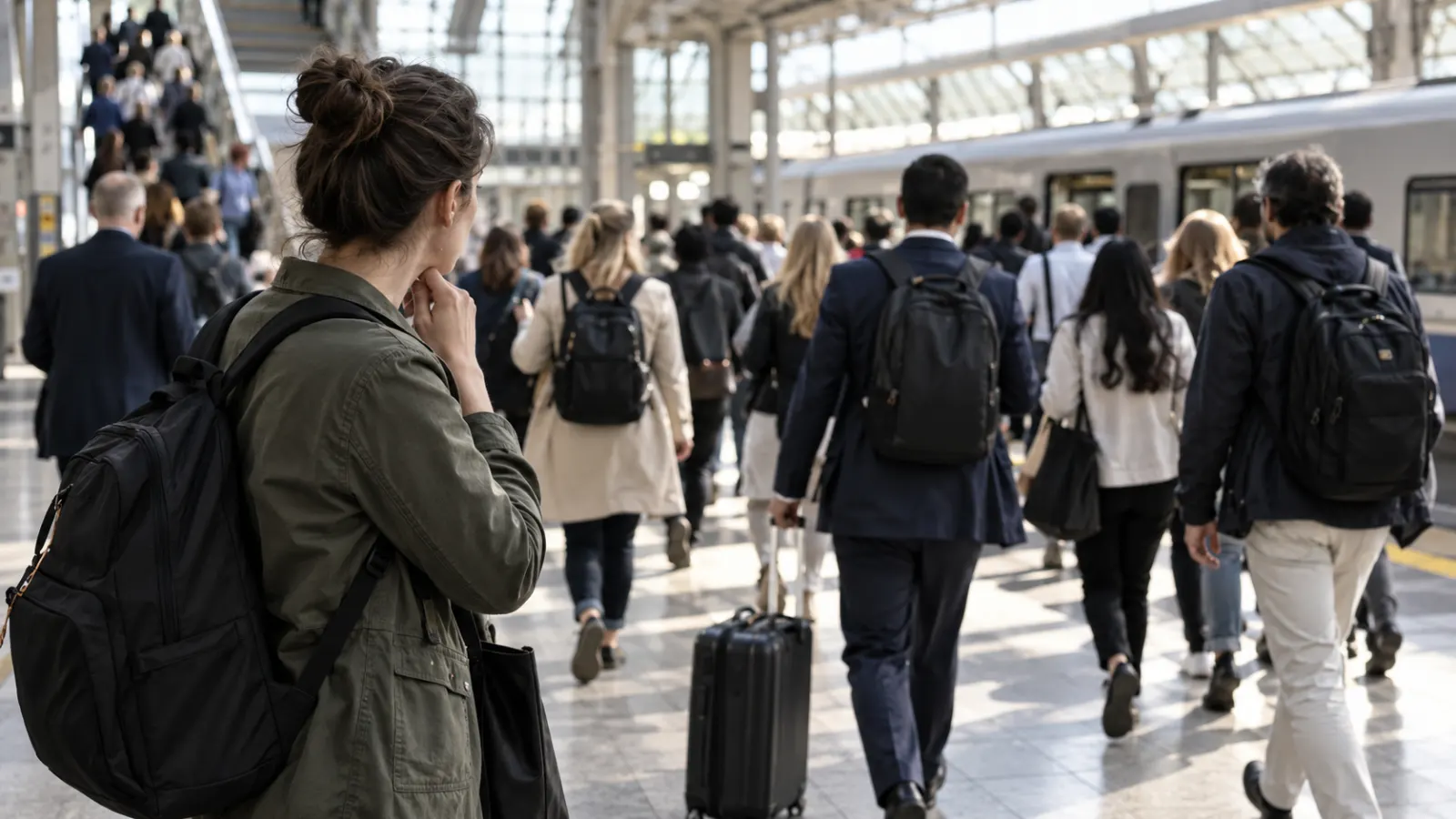
The first barrier is remarkably simple: an event has to be noticed. Public environments compete aggressively for attention. People walk while looking at phones, speak with friends, search for transport, think about work, listen through headphones or process dozens of visual and auditory signals simultaneously. A witness who never properly registers an incident has not yet made a moral decision to ignore it.
This helps explain why the bystander effect should not be interpreted entirely through character. Non-intervention can emerge from attention, interpretation and uncertainty before questions of generosity or selfishness even become relevant. Modern reviews of bystander behaviour continue to describe a decision process beginning with attention and evaluation before moving toward responsibility, competence and eventual helping.
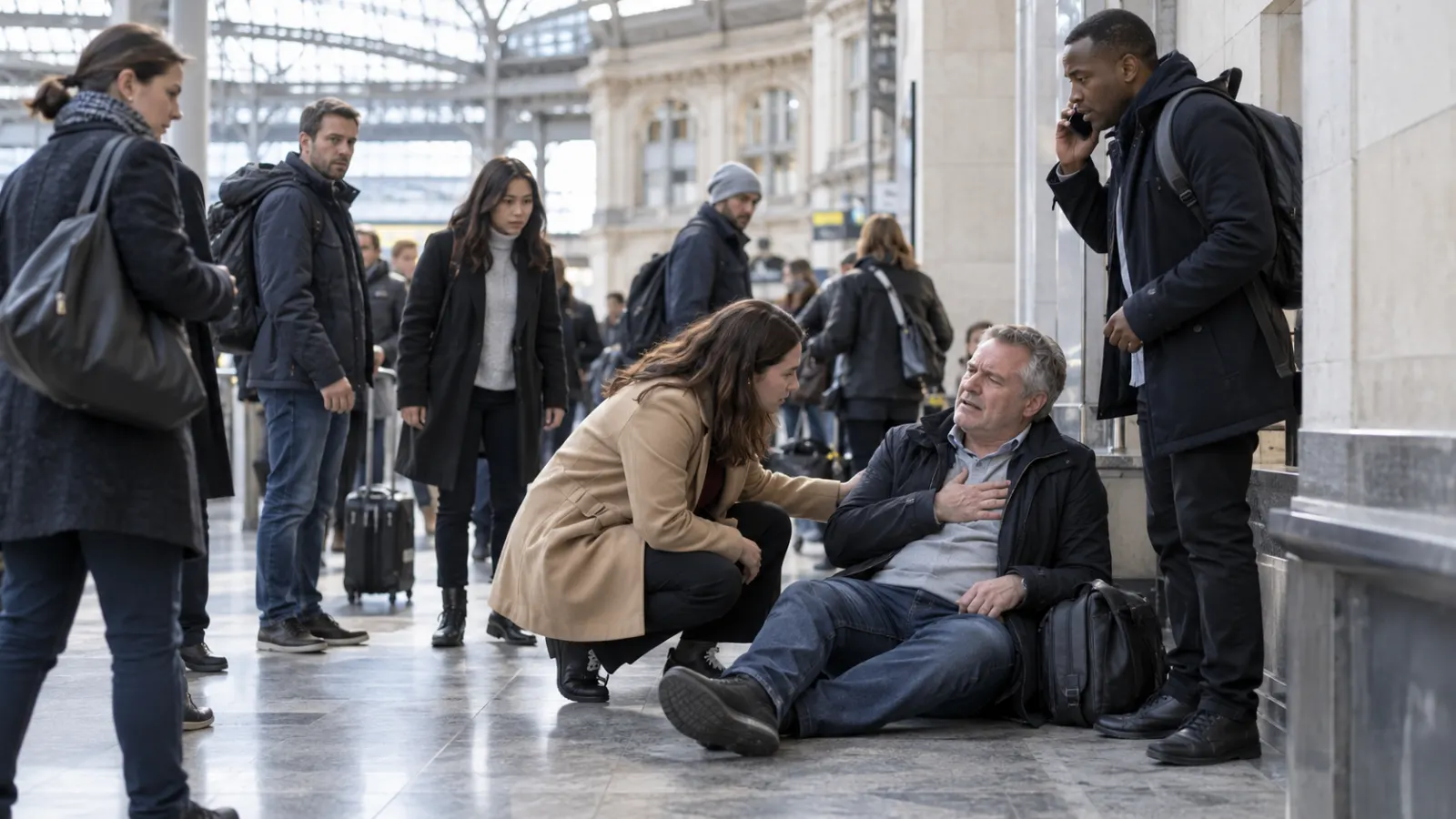
The next barrier is interpretation. Many emergencies are not immediately identifiable as emergencies. A person lying on a station platform could be sleeping, intoxicated, injured or experiencing a medical crisis. Raised voices could represent friends arguing, harassment or the beginning of violence. Someone crying in public may need help or may strongly prefer privacy.
When a situation is ambiguous, people naturally use the behaviour of others as information. If several nearby witnesses remain calm, an individual may infer that those people know something they do not. The problem is that everyone else may be performing exactly the same social calculation. Each privately feels uncertain, looks at the group, sees little visible concern and concludes that the situation is probably less serious than it first appeared.
This process is commonly associated with pluralistic ignorance: individuals privately experience concern or uncertainty while incorrectly interpreting the outward calm of others as evidence that those people do not share the concern. A group can therefore create apparent certainty without any member actually possessing better information.
That mechanism is different from diffusion of responsibility, one of the most famous explanations for the bystander effect. Darley and Latané’s foundational 1968 research showed that the perceived presence of other witnesses could reduce intervention, helping establish the idea that responsibility may feel less personally concentrated when several potential helpers are available.
If one person alone hears someone calling for medical help, the question “Who should respond?” is difficult to outsource. If twenty people hear the same call, each person can plausibly imagine that somebody closer, better trained or more authoritative is already taking care of it. The larger group has more total helping capacity, yet each individual may feel a smaller share of personal obligation.
This does not necessarily involve a conscious thought such as “I do not care because someone else will do it.” Responsibility can become ambiguous through ordinary role assumptions. A railway passenger may assume station staff have noticed. An employee may expect a manager to handle the problem. An online user may assume one of thousands of other viewers has already reported threatening content.
Another barrier is evaluation apprehension. Acting in public creates the possibility of being wrong in public. A witness may fear misinterpreting a harmless situation, embarrassing themselves, offending the person they approach or being judged as dramatic. The more ambiguous the event, the more immediate these social costs can feel compared with the uncertain possibility that the situation is genuinely serious.
Competence creates another transition point. A person can notice a problem, believe it is serious and feel responsible while still not knowing what to do. Someone witnessing a medical emergency may worry about causing additional harm. A person seeing violence may reasonably conclude that direct physical intervention would put them in danger. Someone witnessing harassment may want to help but be uncertain whether confronting the aggressor would escalate the situation.
This is why helping should not be equated only with direct physical intervention. Depending on the circumstances, useful action may mean contacting emergency services, alerting trained staff, bringing an automated external defibrillator, staying with the affected person, creating space, providing information to responders or supporting another person who is already helping. The psychological barrier becomes smaller when “help” is translated from a vague moral obligation into a feasible role.
More bystanders can inhibit helping—or make intervention easier
The classic stereotype imagines that each additional witness makes intervention less likely. The actual evidence is more conditional. Fischer and colleagues’ 2011 meta-analysis found an overall inhibition effect, but it was significantly weaker when situations appeared dangerous and when intervention involved physical costs. The researchers also identified circumstances in which the presence of others could provide useful physical or social support.
Clear danger can change the decision process because ambiguity falls sharply. A person may hesitate over someone quietly sitting against a wall but respond immediately when that person collapses. A witness may be unsure whether a heated argument requires intervention but recognise the need for help once physical violence begins. The increased seriousness of the event can make the situation easier to classify even though the potential cost of intervention has increased.
Other people can then become assets rather than merely sources of responsibility diffusion. Several witnesses can divide tasks, summon professional help, provide information, create physical space or support one another. In some violent situations, the knowledge that other potential helpers are nearby can make intervention feel safer than acting alone.
This is consistent with the large CCTV study of real public conflicts. Across 219 incidents in three countries, intervention was the norm rather than the exception, and additional bystanders were associated with a greater probability that at least somebody would act. The finding challenges the popular image of crowds as naturally passive audiences to suffering.
Social relationships also matter because bystanders are not interchangeable units. Research on shared identity found that people were more likely to help an injured stranger when that person was perceived as part of an important in-group. When researchers broadened the relevant group identity, helping could also extend to people previously treated as out-group members.
This means that the psychological boundary of “us” can affect who receives help. Friends, colleagues, supporters of the same team, members of a neighbourhood or people who perceive themselves as sharing some meaningful identity may coordinate differently from unrelated strangers. Familiarity can improve communication and create stronger expectations about mutual assistance.
Yet cohesive groups can also reproduce poor norms. If everyone in a workplace has learned not to challenge harassment, each person may interpret the others’ silence as evidence that intervention is inappropriate. Shared identity can support helping, but it does not automatically guarantee morally desirable behaviour.
The distinction between individual intervention probability and collective intervention probability becomes especially useful here. Imagine that each person in a crowd becomes somewhat less likely to help because responsibility feels shared. Adding more people can still make it statistically more likely that somebody among them intervenes. This helps reconcile laboratory evidence of individual inhibition with real-world evidence showing that public victims frequently receive assistance.
The same logic applies to competence. A larger group increases the chance that someone knows first aid, understands the environment or feels capable of coordinating others. In a crowd of strangers, one person may be a nurse, another may know where the emergency equipment is located and another may be able to call staff while someone else remains with the victim.
This is why the bystander effect should not be taught as a deterministic law. It is a change in social probabilities under particular conditions. Ambiguity, perceived danger, relationships, competence, social identity and whether witnesses can coordinate all affect the outcome.
The Kitty Genovese story became more influential than it was accurate
The bystander effect is inseparable in popular psychology from the murder of Catherine “Kitty” Genovese in New York City in 1964. The famous version of the story claimed that 38 respectable neighbours watched or heard her prolonged attack and did nothing while she was murdered. The case became a symbol of urban apathy and helped inspire the experimental research that produced the modern psychology of bystander intervention.
The problem is that the standard story is substantially inaccurate. Later historical investigations found no adequate evidence for the central claims that 38 people witnessed the attack, watched it for its duration and uniformly failed to respond. The attack occurred in different stages and locations, many residents could not have witnessed the full event, and some people did attempt to intervene or contact authorities.
Correcting the Genovese story does not invalidate the bystander effect. Experimental research on diffusion of responsibility exists independently of the newspaper narrative that helped stimulate it, and the 2011 meta-analysis still found an overall bystander effect across the wider literature.
What the correction changes is the moral story attached to the science. The familiar Genovese narrative encouraged generations of students to imagine a large crowd passively watching an obvious murder while nobody cared enough to act. That image made the bystander effect appear stronger, simpler and more universal than the evidence supports.
Later real-world research suggests a more constructive direction. Philpot and colleagues argued after analysing CCTV footage that psychology should move away from assuming that bystander absence is the normal response to public conflict and instead study what makes real intervention successful or unsuccessful.
That change in emphasis matters because research questions shape practical advice. If the central assumption is that ordinary people are naturally apathetic, intervention programmes may focus mainly on exhortations to become better people. If the problem is instead understood through ambiguity, responsibility, competence, identity and coordination, environments can be designed to make helping easier.
Responsibility becomes stronger when the next action is clear
One of the practical lessons of bystander psychology is that vague collective responsibility is weaker than clearly assigned responsibility. “Somebody call for help” leaves everyone as one anonymous member of an audience. Directing a specific person to perform a defined task removes some of that ambiguity: one person contacts emergency services, another alerts staff and another remains with the person who needs assistance.
This principle should not be turned into a promise that naming a person guarantees compliance. Its value is organisational: specific tasks reduce uncertainty about who owns the next step. The same logic applies outside emergencies. “Someone should verify these figures” allows every member of a team to assume somebody else will do it; assigning the verification to a named person creates accountability.
Training can address a related barrier by increasing competence. First-aid instruction, emergency drills and well-designed bystander programmes can give people recognised options instead of requiring them to invent a response while under stress. The strongest programmes also clarify limits—when to intervene directly, when to call trained professionals and when attempting direct action would create unnecessary danger.
This matters because effective helping is not synonymous with heroism. In a violent incident, running toward an armed aggressor may add another victim rather than improve the situation. Safe intervention might involve immediately contacting police or security, moving other people away, providing responders with accurate information or helping the affected person after the danger has passed.
Institutions can also reduce the psychological burden by making reporting and escalation obvious. Visible emergency numbers, staffed help points, clearly marked alarms, anonymous reporting systems and published harassment procedures tell people both that a situation counts as legitimate cause for concern and what action they are authorised to take.
The design principle is straightforward: reduce ambiguity and make responsibility legible. If witnesses have to decide whether an event is serious, determine which department is responsible, search for a number and worry that reporting will be treated as overreaction, every additional decision creates another place where intervention can fail.
Norms matter as much as procedures. A workplace that formally encourages reporting but socially punishes people who raise concerns may still produce silence. Conversely, an environment where checking on someone, reporting a hazard or questioning an unsafe instruction is treated as normal professional behaviour reduces the reputational cost of acting.
Bystander intervention also extends far beyond dramatic emergencies. People witness bullying, discriminatory jokes, workplace harassment, unsafe shortcuts, social exclusion and abusive online behaviour far more often than they witness violent street emergencies. These situations can be especially vulnerable to social inhibition because they are ambiguous and the consequences of intervention are interpersonal rather than obviously life-saving.
Direct confrontation is only one response. A colleague can interrupt a harmful conversation with a question, privately check on the person targeted, document a safety concern or report through an established channel. A student witnessing bullying can seek an adult, support the victim afterward or help create social evidence that the behaviour is not accepted. The appropriate response depends on safety, authority and context.
Online environments recreate several classic bystander mechanisms at enormous scale. A harmful post can have thousands of viewers, making personal responsibility feel extremely small. Each viewer may assume someone else has reported it or contacted the person involved. At the same time, digital platforms can reduce uncertainty by making reporting tools visible and confirming that a report has been received.
The mechanics are different from a physical emergency because a digital audience may be dispersed across locations and time. Yet the underlying question remains familiar: when everybody can potentially act, who feels personally responsible for becoming the person who actually does?
The real lesson of the bystander effect is about coordination, not human indifference
The most enduring value of bystander research is not the claim that people become uncaring in crowds. The evidence supports a more nuanced conclusion: social context changes the path between noticing a problem and acting on it. Other people can make responsibility feel distributed, make ambiguous situations harder to interpret and increase concern about social judgment. They can also provide information, reassurance, physical support and additional helping capacity.
The 2011 meta-analysis captures the first side of that picture. Across controlled studies, individuals were generally less likely to intervene when other bystanders were present, but the effect weakened substantially under dangerous conditions and in circumstances where other people could support intervention. The cross-national CCTV research captures the second side: in actual public conflicts, intervention by at least one witness occurred in approximately nine out of ten cases.
These findings should change how the question is framed. Instead of asking whether people are fundamentally selfish or helpful, it is more useful to ask what information the situation gives them, how responsibility is distributed, whether they possess safe response options and whether the social environment supports intervention.
Shared identity can increase helping, demonstrating that relationships among people matter rather than only the numerical size of the crowd. Clear danger can increase intervention because the need for help becomes easier to recognise. Competence can turn concern into action because witnesses know which response is useful.
Even the famous historical story that shaped the field reinforces the importance of interpretation. The oversimplified Kitty Genovese narrative presented a morality tale about dozens of people watching someone die without helping. Correcting that account does not destroy bystander psychology; it removes a misleading picture of human behaviour that had become more memorable than the underlying evidence.
A better practical model is to think of intervention as a sequence. A person must notice something unusual, recognise that it may require help, accept enough responsibility to avoid assuming somebody else will act, identify a safe and useful response and then actually perform it. Social conditions can interrupt or support every one of those stages.
For someone who needs help, this produces a simple implication: where possible, convert an anonymous crowd into identifiable helpers. Address someone directly, describe what is needed and assign concrete tasks. For institutions, the lesson is broader: make emergencies and misconduct easier to recognise, make reporting systems obvious, clarify who owns the response and create norms in which responsible intervention is expected rather than socially punished.
The bystander effect therefore reveals a paradox of collective life. A group can contain far more capacity to help than any individual possesses, while the presence of that same group can sometimes weaken an individual’s feeling that they personally need to act. The solution is not to distrust groups. It is to organise their capacity.
When responsibility is vague, everyone can become a witness. When responsibility becomes specific, witnesses can become helpers.