What Is Composting? How Food and Garden Waste Become Healthy Soil
What is composting? Composting is the managed, aerobic biological decomposition of organic materials such as food scraps, leaves and garden waste by microorganisms. The process turns these materials into a biologically stable, soil-like product called compost.
That definition contains an important word:
managed.
A banana peel eventually decomposes whether it falls onto a forest floor, sits in a compost pile or is buried in a landfill.
But it does not decompose in the same way in each place.
A well-managed composting system provides microorganisms with:
-
organic material;
-
carbon;
-
nitrogen;
-
moisture;
-
oxygen;
-
suitable temperature; and
-
time.
Under those conditions, bacteria, fungi and other decomposers transform waste into stable organic matter that can be returned to soil.
A landfill operates very differently. Compacted waste becomes largely oxygen-poor, encouraging anaerobic decomposition and methane generation.
Composting therefore does more than make rubbish disappear.
It deliberately redirects biological decomposition toward a useful end product.
The US Environmental Protection Agency defines composting as managed, oxygen-dependent decomposition of organic materials by microorganisms and distinguishes finished compost from raw or partially decomposed organic matter.
What Is Composting in Simple Terms?
In simple terms:
Composting is controlled recycling for organic material.
Instead of putting suitable food scraps and garden materials into general rubbish, they are allowed to decompose under conditions that encourage aerobic microorganisms.
The result is compost: dark, stable organic material that can improve soil.
A useful simplified formula is:
Browns + Greens + Water + Oxygen + Microorganisms + Time = Compost
Each part matters.
Remove enough moisture and decomposition slows.
Add too much water and air spaces disappear.
Remove oxygen and anaerobic organisms begin dominating.
Use far too much carbon-rich material and decomposition may become very slow.
Add excessive nitrogen-rich wet material and the pile can become dense, smelly and oxygen-poor.
Successful composting is therefore a biological balancing process.
How Does Composting Work?
Composting works because microorganisms consume organic material.
The principal decomposers include:
-
bacteria;
-
fungi;
-
actinomycetes; and
-
other microscopic organisms.
Larger organisms may also participate, particularly in backyard systems.
These can include:
-
mites;
-
springtails;
-
insects;
-
worms; and
-
other small invertebrates.
The microorganisms use carbon compounds for energy and nitrogen for growth and cellular processes.
As they metabolise organic material, they release:
-
heat;
-
carbon dioxide;
-
water vapour; and
-
progressively transformed organic matter.
The pile changes both physically and chemically.
Recognisable food scraps disappear.
Leaves become fragmented.
The volume decreases.
Temperature may rise dramatically.
Eventually biological activity slows and the material enters a curing or maturation phase.
The final goal is not simply decomposed-looking waste.
It is stable compost suitable for its intended use.
The Four Essential Ingredients of Composting
For practical purposes, composters need to manage four main ingredients:
1. Carbon-Rich Materials — “Browns”
Carbon provides energy for microorganisms and helps create structure inside a pile.
Common browns include:
-
dry leaves;
-
straw;
-
shredded uncoated cardboard;
-
shredded non-glossy paper;
-
small twigs;
-
plant stalks;
-
untreated wood chips; and
-
sawdust from untreated wood.
Browns are often dry and fibrous.
They are particularly useful because they can create air spaces.
2. Nitrogen-Rich Materials — “Greens”
Nitrogen supports microbial growth.
Common greens include:
-
fruit scraps;
-
vegetable scraps;
-
coffee grounds;
-
fresh grass clippings;
-
fresh plant trimmings;
-
some crop residues; and
-
suitable manures.
“Green” does not literally mean the material has to be green.
Coffee grounds, for example, are treated as a nitrogen-rich compost ingredient even though they are brown in colour.
3. Water
Microorganisms require moisture.
If a pile becomes extremely dry, decomposition slows.
But more water is not always better.
When a compost pile becomes saturated, water occupies spaces that would otherwise contain air.
The system can then become oxygen-poor.
For home composting, EPA recommends a moisture condition roughly comparable to a wrung-out sponge: moist but not waterlogged.
4. Oxygen
Composting is fundamentally aerobic.
Microorganisms require oxygen to carry out the decomposition process efficiently.
Air can enter through:
-
natural spaces in the pile;
-
coarse materials;
-
turning;
-
perforated pipes;
-
forced-air systems; or
-
mechanical mixing.
EPA specifically identifies aeration, moisture, material structure and carbon-nitrogen balance as key variables in managing composting.
Why Are Browns and Greens Important?
The brown-and-green system is a practical way to manage the relationship between carbon and nitrogen.
Composting organisms need both.
Too much carbon can cause decomposition to slow because microorganisms lack sufficient nitrogen.
Too much readily available nitrogen can contribute to ammonia loss, odours and other problems.
Cornell Composting describes an initial carbon-to-nitrogen ratio of roughly 30:1 by weight as a common target, while noting that the ideal varies with the materials and how biologically available their carbon and nitrogen are.
Home composters generally do not need laboratory calculations.
A more practical approach is to combine plenty of dry brown material with smaller quantities of moist greens.
EPA's current home-composting guidance recommends approximately two to three volumes of browns for every one volume of greens as a workable household rule.
That is a practical volume rule, not the same measurement as a scientific 30:1 carbon-to-nitrogen ratio by weight.
What Can Be Composted?
What can be composted depends on the system.
A backyard pile is not the same as a large commercial facility.
Common Backyard Compost Materials
Usually suitable materials include:
Greens
-
fruit scraps;
-
vegetable peelings;
-
coffee grounds;
-
paper coffee filters;
-
paper tea bags without staples;
-
crushed eggshells;
-
fresh plant trimmings;
-
limited grass clippings.
Browns
-
dry leaves;
-
small twigs;
-
dead plant stalks;
-
shredded plain cardboard;
-
shredded non-glossy paper;
-
brown paper bags without unsuitable coatings;
-
untreated wood chips.
EPA currently recommends many of these materials for backyard composting.
What Should Not Go Into a Home Compost Pile?
The answer varies by local system, but a typical backyard pile should generally avoid materials that:
-
attract animals;
-
carry pathogens;
-
contain persistent chemicals;
-
introduce non-compostable contamination; or
-
require industrial temperatures and processing conditions.
Common examples include:
-
meat;
-
fish;
-
bones;
-
dairy products;
-
fats and oils;
-
large quantities of cooked food;
-
pet waste;
-
cat litter;
-
treated or painted wood;
-
diseased plant material;
-
plants treated with problematic persistent herbicides;
-
glossy paper;
-
conventional plastic;
-
glass;
-
metal;
-
produce stickers.
Compostable food-service packaging should also not automatically be placed into a home compost pile.
Some products certified for industrial composting require conditions that ordinary backyard piles do not reliably achieve.
EPA specifically advises household composters to check whether commercial compostable products are accepted by their local facility rather than assuming they belong in a backyard pile.
“Biodegradable” Does Not Automatically Mean “Compostable”
These terms are often confused.
A material described as biodegradable may eventually be broken down biologically under certain conditions.
That does not mean it will:
-
decompose quickly;
-
break down in a home compost bin;
-
leave no harmful residue;
-
satisfy a compostability certification; or
-
be accepted by a local compost facility.
Compostability depends on conditions.
Industrial systems can maintain controlled:
-
temperature;
-
moisture;
-
aeration; and
-
residence time
that backyard piles may never achieve.
The safest rule is simple:
follow the acceptance rules of the composting system actually receiving the material.
Compost Contamination Is a Serious Problem
A composting programme can collect huge volumes of organic material and still produce poor compost if its feedstock is contaminated.
Common contaminants include:
-
plastic film;
-
packaging;
-
produce stickers;
-
glass;
-
metal;
-
synthetic fibres;
-
persistent chemicals.
Processing facilities may screen out larger contaminants.
Very small plastic fragments are much harder to remove.
This creates an important principle:
good compost begins with clean source separation.
Removing contamination after it has been shredded and mixed throughout organic material is much more difficult than preventing it from entering the compost stream in the first place.
Producing contaminated compost can simply transfer pollution from the waste system into soil.
What Happens Inside a Compost Pile?
Composting does not happen at one constant biological rate.
The process generally moves through stages.
Stage 1: Initial Decomposition
After fresh material is combined, microorganisms begin consuming easily degradable compounds.
Respiration increases.
Heat begins accumulating.
The temperature rises.
Stage 2: High-Temperature Decomposition
In sufficiently large and well-managed composting systems, microbial activity can raise temperatures substantially.
This is called the thermophilic phase.
EPA notes that commercial thermophilic composting can reach temperatures that help reduce pathogens, while process standards depend on composting method and applicable regulations.
Temperature is therefore both:
-
a consequence of microbial activity; and
-
an important process-control measurement.
Stage 3: Cooling
As easily decomposed material becomes less abundant, microbial activity begins declining.
The pile cools.
Other microorganisms continue transforming the remaining organic matter.
Stage 4: Curing or Maturation
Cooling does not automatically mean the compost is finished.
The material needs time to stabilise.
During curing:
-
microbial activity becomes less intense;
-
unstable organic compounds continue changing;
-
temperature approaches ambient conditions;
-
the material becomes more suitable for use.
EPA's home-composting guidance recommends allowing finished-looking material to cure for at least several weeks before use.
Commercial systems may use more sophisticated measures of stability and maturity.
Why Compost Maturity Matters
Immature compost can create problems.
It may:
-
continue consuming oxygen;
-
continue heating;
-
compete with plants for available nitrogen;
-
contain phytotoxic compounds;
-
have unstable chemistry.
This is why:
“It looks brown”
is not a complete definition of finished compost.
High-quality composting treats maturity as part of production rather than an optional waiting period.
EPA's 2025 review of compost use notes that a final curing phase is necessary after thermophilic composting to achieve adequate stability.
How Long Does Composting Take?
There is no universal composting time.
Speed depends on:
-
feedstock;
-
particle size;
-
pile size;
-
carbon-nitrogen balance;
-
moisture;
-
oxygen;
-
temperature;
-
turning frequency;
-
climate;
-
composting technology.
EPA says a well-managed backyard compost pile can often produce usable compost in roughly three to five months, while an unmanaged pile may take a year or longer.
Industrial systems can process material differently because they provide tighter environmental control.
The better question is therefore not:
“How many days does compost take?”
but:
“Has the material become adequately decomposed, stable and mature?”
How to Compost at Home: Step by Step
Home composting can be simple if the process is built around the needs of microorganisms.
Step 1: Choose a Composting Method
Common options include:
-
open pile;
-
enclosed bin;
-
tumbler;
-
multi-bin system;
-
vermicomposting.
Your choice depends on:
-
available space;
-
volume of organic material;
-
climate;
-
pests;
-
how much physical turning you want to do.
Step 2: Store a Supply of Browns
Many home compost problems arise because households generate food scraps every day but do not have enough dry carbon material available.
Store:
-
dry leaves;
-
shredded cardboard;
-
paper;
-
small dry twigs
near the compost bin.
That makes it easy to cover each new addition of kitchen scraps.
Step 3: Create an Airy Base
A layer of coarse brown material such as:
-
small twigs;
-
woody stalks;
-
wood chips
can help create initial airflow and drainage.
Step 4: Add Greens and Browns
Add food scraps and other greens along with substantially more dry brown material by volume.
EPA's practical household guidance suggests roughly two to three volumes of browns per volume of greens.
Cover exposed food scraps with browns.
This helps:
-
reduce odour;
-
discourage flies;
-
discourage rodents;
-
balance moisture;
-
maintain structure.
Step 5: Monitor Moisture
The pile should be damp.
Not dry.
Not dripping.
Think:
wrung-out sponge.
If too dry:
add some water while mixing.
If too wet:
add dry browns and improve airflow.
Step 6: Keep Oxygen Available
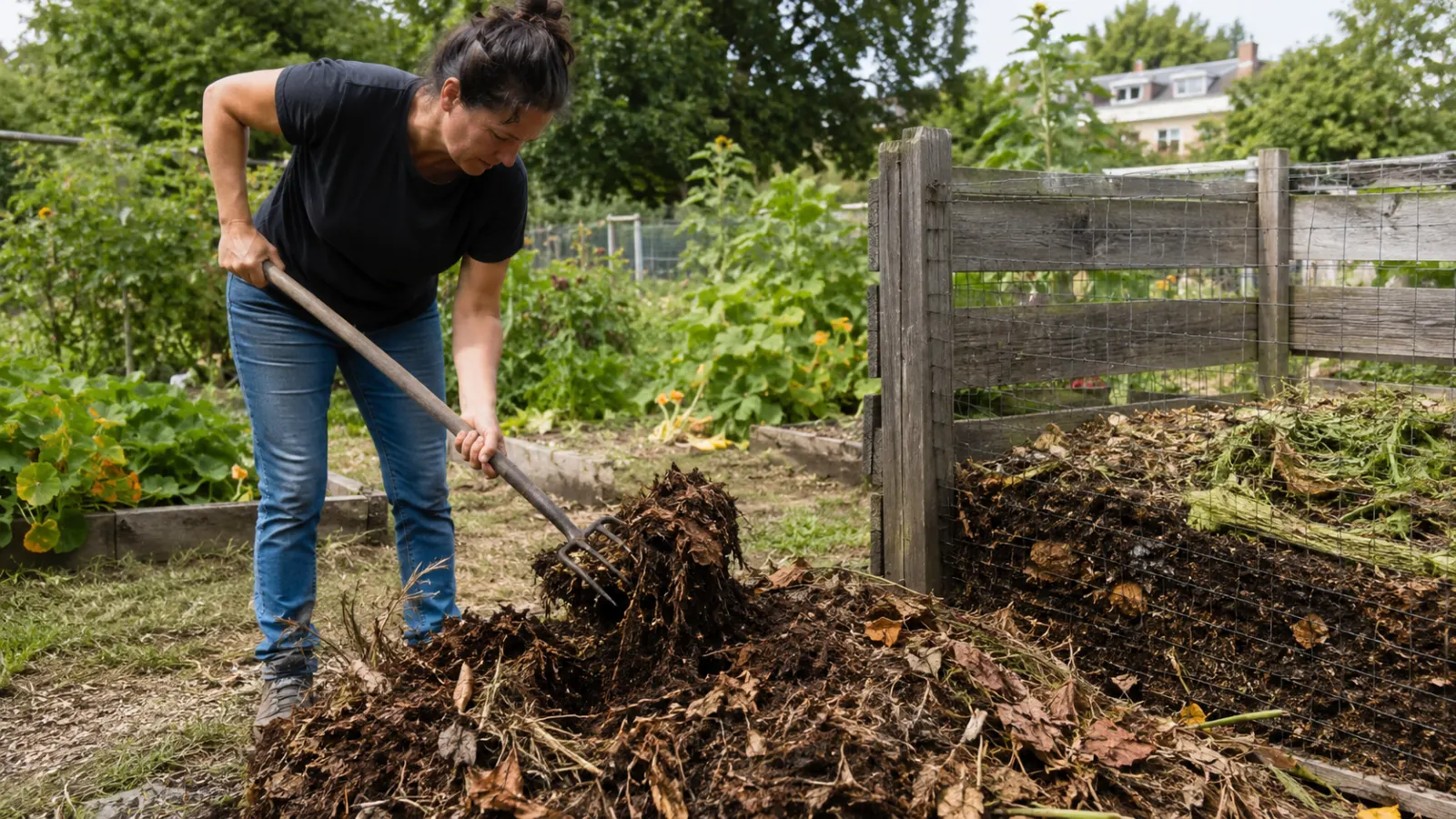
Turn or mix the pile periodically.
You do not necessarily need to turn it every day.
But turning can:
-
restore air;
-
mix dry and wet material;
-
redistribute microorganisms;
-
move outer material inward;
-
accelerate decomposition.
Step 7: Watch the Pile, Not Just the Calendar
Signs of active composting include:
-
rising temperature;
-
shrinking volume;
-
disappearing food scraps;
-
changing texture.
If conditions are wrong, troubleshoot them.
Step 8: Let the Compost Cure
When the pile has largely decomposed and no longer heats substantially after mixing, stop treating it as fresh feedstock.
Allow it to mature.
Finished compost should generally be:
-
dark;
-
crumbly;
-
relatively uniform;
-
earthy smelling;
-
cool and stable.
How Do You Know When Compost Is Ready?
Home compost is generally approaching readiness when:
-
most original ingredients are no longer recognisable;
-
the pile no longer reheats significantly when turned;
-
volume has fallen substantially;
-
texture is loose and crumbly;
-
colour is dark brown;
-
smell is earthy rather than sour or rotten.
A few persistent pieces of wood or nutshell may remain.
They can be screened out and returned to a new pile.
Professional compost facilities may test much more.
Quality testing can include:
-
stability;
-
maturity;
-
pathogens;
-
heavy metals;
-
soluble salts;
-
nutrients;
-
pH;
-
foreign matter;
-
particle size.
“Finished” is therefore a quality concept, not merely a visual one.
Why Does Compost Smell Bad?
Healthy aerobic compost should not smell like sewage or rotting rubbish.
A strong unpleasant smell often indicates that conditions have shifted away from efficient aerobic decomposition.
Problem: Rotten or Sour Smell
Possible causes:
-
too much water;
-
compacted material;
-
inadequate oxygen;
-
too many wet greens.
Possible response:
-
turn the pile;
-
add dry leaves or other browns;
-
loosen compacted areas;
-
prevent excess rainwater.
Problem: Ammonia Smell
Possible cause:
too much readily available nitrogen.
Possible response:
add carbon-rich browns.
Why Is My Compost Not Heating Up?
A compost pile does not always need to become extremely hot to decompose.
But a pile that remains inactive may have:
-
too little nitrogen;
-
too little moisture;
-
too much coarse carbon;
-
insufficient volume;
-
cold environmental conditions.
Try:
-
adding appropriate greens;
-
checking moisture;
-
mixing;
-
increasing pile size where appropriate.
Why Is My Compost Too Wet?
Wet compost can become dense and oxygen-poor.
Possible causes include:
-
too much food waste;
-
excess grass clippings;
-
poor drainage;
-
heavy rainfall;
-
too few structural browns.
Add:
-
dry leaves;
-
shredded cardboard;
-
coarse plant material.
Then mix to reopen air spaces.
Why Is My Compost Too Dry?
Dry piles can remain almost unchanged for long periods.
Check the centre rather than judging only the surface.
If necessary, add water gradually while mixing.
Do not flood the pile.
The goal is moisture throughout the material without saturation.
Why Are There Flies Around My Compost?
Flies are commonly attracted when food scraps remain exposed.
Reduce problems by:
-
burying fresh scraps;
-
covering them with several inches of browns;
-
avoiding inappropriate food;
-
keeping the pile balanced.
How Do You Prevent Rats and Other Pests?
Good compost management significantly reduces pest attraction.
Use:
-
an appropriate enclosed bin where rodents are a concern;
-
secure lids where necessary;
-
sufficient browns;
-
buried or covered food scraps.
Avoid adding:
-
meat;
-
fish;
-
dairy;
-
fats;
-
oily foods
to ordinary backyard systems.
What Is Hot Composting?
Hot composting deliberately maintains conditions that encourage high microbial activity and elevated temperature.
It generally requires closer management of:
-
pile size;
-
moisture;
-
oxygen;
-
carbon and nitrogen;
-
turning.
Advantages can include:
-
faster decomposition;
-
more uniform processing;
-
temperatures capable of reducing many pathogens and weed seeds when correctly maintained.
But hot composting requires more management than leaving organic material to decompose slowly.
What Is Cold Composting?
Cold composting is a slower, lower-maintenance approach.
Materials are added gradually and decomposition proceeds without deliberately maintaining a high thermophilic temperature.
Advantages:
-
little labour;
-
simple equipment;
-
suitable for many households.
Disadvantages:
-
slower;
-
less reliable destruction of weed seeds;
-
less reliable pathogen reduction;
-
materials may decompose unevenly.
Both methods can produce useful material when managed appropriately.
What Is Vermicomposting?
Vermicomposting uses selected earthworms together with microorganisms to process suitable organic material.
Commonly used worms include species adapted to living in decomposing organic matter rather than ordinary garden soil.
A worm bin generally contains:
-
bedding;
-
moisture;
-
suitable food scraps;
-
air;
-
worms.
Vermicomposting can work well in:
-
apartments;
-
classrooms;
-
balconies;
-
offices;
-
small homes
where a large outdoor pile is impractical.
It operates differently from high-temperature thermophilic composting.
Worms need moderate living conditions and can be killed by excessive heat.
Is Bokashi Composting?
Bokashi is commonly described as a household food-waste treatment system, but it differs biologically from conventional aerobic composting.
It uses fermentation under low-oxygen conditions.
The fermented material is not automatically equivalent to finished, stable compost.
It normally needs a subsequent stage such as:
-
burial in soil; or
-
aerobic composting
before functioning like mature compost.
Different organic-waste technologies should therefore not all be called composting simply because they process food scraps.
Composting vs Anaerobic Digestion
Composting and anaerobic digestion both process organic material.
The key difference is oxygen.
| Composting | Anaerobic digestion |
|---|---|
| Requires oxygen | Operates without oxygen |
| Produces compost | Produces biogas and digestate |
| Releases biological heat | Can capture methane-rich biogas |
| Returns stable organic matter to soil | Digestate can be used or further treated |
EPA specifically distinguishes anaerobic digestion from composting.
Anaerobic digestion can be extremely useful, particularly for wet organic waste streams and renewable energy production.
The two technologies can complement one another.
Digestate may sometimes be composted after digestion.
Composting vs Landfill
The difference is more fundamental.
Composting
Organic material decomposes primarily under aerobic conditions.
Landfill
Compacted waste eventually becomes largely anaerobic.
Microorganisms break down organic material without oxygen and generate landfill gas containing substantial methane.
Methane is a powerful greenhouse gas.
Keeping suitable food and organic material out of landfills is therefore one important reason communities develop:
-
composting;
-
anaerobic digestion;
-
food-waste prevention;
-
organics collection.
EPA identifies diversion of food scraps from landfills as an important way composting can reduce methane-generating waste.
Composting Does Not Make Food Waste Harmless
There is a crucial distinction between:
preventing edible food from being wasted
and
composting food after it has been wasted.
Suppose bread is produced and then thrown away.
Before reaching the compost pile, resources may already have been used for:
-
growing grain;
-
fertiliser;
-
irrigation;
-
harvesting;
-
milling;
-
baking;
-
packaging;
-
refrigeration;
-
transport;
-
retail;
-
cooking.
Composting can recover some organic matter and nutrients.
It cannot recover all those lost resources.
That is why EPA's current Wasted Food Scale places preventing wasted food, donation and upcycling above composting.
The correct sequence is therefore:
prevent avoidable food waste first
then
compost suitable unavoidable organic material.
Examples of difficult-to-avoid food material include:
-
banana peels;
-
coffee grounds;
-
eggshells;
-
vegetable trimmings;
-
spoiled food that could not safely be consumed.
Composting is an important recovery pathway.
It is not permission to waste edible food.
What Are the Benefits of Composting?
Composting can create benefits at several stages of the material cycle.
1. Less Organic Waste Goes to Landfill
Diverting food scraps, leaves and other suitable organic materials reduces the volume of material requiring disposal.
This can extend landfill capacity.
2. It Helps Reduce Landfill Methane
Food waste decomposing anaerobically in landfills contributes to methane emissions.
Aerobic composting avoids sending that organic fraction into the landfill environment.
Actual greenhouse-gas outcomes still depend on:
-
transportation;
-
facility operation;
-
methane capture at the alternative landfill;
-
compost use;
-
feedstock;
-
process efficiency.
Composting is not automatically impact-free.
But well-managed composting can substantially improve the outcome for many organic materials.
3. Compost Returns Organic Matter to Soil
Finished compost adds organic matter.
That can improve:
-
soil structure;
-
aggregation;
-
porosity;
-
microbial habitat;
-
nutrient retention.
EPA's 2025 review concludes that the broader scientific literature supports significant soil-health benefits from compost application.
4. Compost Can Improve Water Retention
Organic matter can help soil absorb and retain water.
This can be useful during dry periods.
Improved structure can also allow rainfall to infiltrate soil rather than immediately becoming runoff.
EPA identifies improved soil water-holding capacity, infiltration and retention among the documented benefits of compost application.
5. Compost Can Reduce Erosion and Runoff
Better soil structure and vegetation establishment can reduce erosion.
Compost is therefore used not only in household gardens but in:
-
landscaping;
-
roadside projects;
-
ecosystem restoration;
-
erosion-control applications;
-
stormwater infrastructure.
6. It Recycles Nutrients
Food scraps and plant material contain nutrients originally obtained from soil.
Composting can return part of that nutrient value rather than disposing of it.
This creates a more circular material flow:
soil → plant → food → organic residue → compost → soil
Is Compost a Fertiliser?
Compost contains plant nutrients.
But describing it simply as “fertiliser” can create the wrong expectation.
Compost's primary value often lies in improving the soil system.
It provides:
-
organic matter;
-
slowly available nutrients;
-
improved structure;
-
water-retention benefits;
-
microbial habitat.
A fertiliser is usually applied primarily to deliver specific nutrients such as:
-
nitrogen;
-
phosphorus;
-
potassium.
Compost nutrient concentrations vary substantially depending on its feedstock and processing.
EPA notes that compost may reduce reliance on inorganic fertilisers, but some crops can still require additional nutrient inputs because compost may not contain enough plant-available nutrients to meet all crop requirements.
Therefore:
compost and fertiliser are not automatically substitutes.
They can serve different but complementary roles.
Can Too Much Compost Harm Soil?
Yes.
Something beneficial is not automatically beneficial in unlimited quantities.
Excessive or inappropriate compost application can contribute to:
-
excess phosphorus;
-
high salt levels;
-
nutrient runoff;
-
inappropriate pH;
-
crop imbalances.
Risk depends on:
-
compost composition;
-
soil;
-
crop;
-
application rate;
-
existing nutrient levels.
Large agricultural applications should therefore consider soil testing and compost analysis rather than treating compost as universally safe at any dose.
What Is Industrial Composting?
Industrial or commercial composting operates at much larger scale than backyard systems.
Facilities can receive material from:
-
households;
-
restaurants;
-
supermarkets;
-
food processors;
-
farms;
-
institutions;
-
landscaping operations;
-
municipal collections.
Common systems include:
Windrow Composting
Organic material is formed into long rows.
The windrows may be mechanically turned to:
-
aerate;
-
mix;
-
redistribute heat and moisture.
Aerated Static Piles
Material remains relatively stationary while air is pushed or drawn through the pile using pipes and blowers.
In-Vessel Composting
Material is processed inside an enclosed:
-
drum;
-
container;
-
tunnel;
-
silo;
-
vessel.
Operators can control:
-
airflow;
-
temperature;
-
mixing;
-
moisture
more precisely.
EPA's current compost guidance recognises windrows, aerated static piles and in-vessel systems among common approaches.
Why Can't Every City Compost the Same Things?
Because composting infrastructure differs.
One city may have an enclosed industrial facility capable of processing:
-
meat;
-
bones;
-
dairy;
-
compostable serviceware.
Another may use open windrows intended mainly for:
-
garden waste;
-
leaves;
-
selected food material.
Another municipality may have no separate organics collection.
Therefore, the universal advice:
“This item is compostable”
can be misleading.
The better question is:
“Is this item accepted by my composting system?”
Local collection instructions should override generic internet lists.
Home Composting vs Industrial Composting
| Home composting | Industrial composting |
|---|---|
| Small scale | Large scale |
| Usually simple equipment | Specialised machinery |
| Limited temperature control | Process temperature can be monitored |
| Often accepts restricted food types | May accept broader feedstocks |
| Depends heavily on household management | Professionally monitored |
| Compost used locally | Finished compost may be sold/distributed |
Neither approach is inherently “better” in every context.
Home composting avoids collection transport and can produce compost directly where it will be used.
Industrial composting can process very large quantities and handle materials unsuitable for backyard systems.
What Is Community Composting?
Community composting sits between household and industrial models.
Material may be collected and processed at:
-
community gardens;
-
farms;
-
schools;
-
neighbourhood compost hubs;
-
small local facilities.
Finished compost can then return to:
-
gardens;
-
parks;
-
farms;
-
local landscaping.
EPA identifies community composting as a way to keep organic resources and their resulting soil benefits within local communities.
Compost Quality Matters as Much as Compost Quantity
A city could celebrate collecting thousands of tonnes of organic waste.
But what happens if the resulting compost contains:
-
plastic fragments;
-
glass;
-
persistent chemicals;
-
excessive salts;
-
pathogens?
That is not a successful circular system.
A good organics programme should optimise:
quality of feedstock
not merely:
quantity diverted from landfill.
High-quality compost has more potential markets.
Poor-quality compost can become difficult to use and may simply shift contamination from a waste-management facility into land.
Why Composting Matters for the Circular Economy
A linear material system looks like this:
extract → produce → consume → discard
Composting creates one possible biological loop:
grow → consume → separate organic residue → compost → return organic matter to soil
It does not make the entire food system circular.
Energy is still used.
Transport still occurs.
Food can still be unnecessarily wasted.
Contamination can still enter the system.
But composting helps retain biological materials within productive use instead of automatically treating them as disposable rubbish.
Global waste systems increasingly need such recovery capacity. The World Bank's What a Waste 3.0, released in 2026, specifically identifies expanded access to recycling, composting and sanitary waste management as part of improving global waste systems.
Common Composting Myths
Myth 1: Compost Is Just Rotten Food
Finished compost is biologically stable material produced through managed decomposition.
Raw food waste is not finished compost.
Myth 2: Anything Natural Can Go Into Any Compost Bin
A material may be organic and still be inappropriate for a particular composting system.
Myth 3: Composting and Anaerobic Digestion Are the Same
They are different biological processes.
Composting requires oxygen.
Anaerobic digestion does not.
Myth 4: Compost Completely Replaces Fertiliser
Not necessarily.
Compost improves soil and supplies nutrients, but crop nutrient requirements may still require other inputs.
Myth 5: Compost Should Always Smell Bad
Persistent rotten smells often indicate poor aeration or moisture balance.
Myth 6: Composting Food Means Wasting Food Is Fine
Preventing edible food waste remains preferable.
Myth 7: Biodegradable Plastic Can Always Go Into Compost
No.
Acceptance depends on certification and the specific composting system.
Myth 8: Once Material Looks Brown, It Is Finished
Not necessarily.
Compost needs adequate stability and maturity.
Frequently Asked Questions
What is composting?
Composting is the managed aerobic biological decomposition of organic material by microorganisms to produce a stable soil amendment called compost.
How does composting work?
Microorganisms break down carbon-based organic materials in the presence of oxygen and moisture. Their activity produces heat, carbon dioxide, water vapour and progressively stabilised organic matter.
What are browns in compost?
Browns are relatively carbon-rich materials such as dry leaves, shredded cardboard, straw, twigs and untreated wood chips.
What are greens in compost?
Greens are relatively nitrogen-rich materials such as fruit and vegetable scraps, coffee grounds, fresh plant material and grass clippings.
What is the best ratio of browns to greens?
For household composting, EPA recommends approximately two to three volumes of browns for each volume of greens as a practical guideline. Professional composters may manage carbon-to-nitrogen ratios more precisely.
Can I compost cooked food?
Small amounts may be possible in some systems, but typical backyard piles should generally avoid large quantities of cooked, oily or animal-based food because of pests and processing limitations. Check local guidance.
Can meat be composted?
Industrial composting facilities may accept meat. Ordinary backyard systems are generally advised not to because meat can attract animals and may not be adequately processed.
Can dairy be composted?
Some commercial facilities accept dairy products. Most backyard composting guidance recommends excluding them.
Can eggshells be composted?
Yes. Crushed eggshells are commonly accepted in home compost piles.
Can coffee grounds be composted?
Yes. Coffee grounds are commonly treated as nitrogen-rich compost material. Paper coffee filters may also be compostable if they do not contain unsuitable materials.
Can cardboard be composted?
Plain, non-glossy, uncoated cardboard can generally be shredded and composted. Remove plastic tape, labels and unsuitable coatings.
Can paper be composted?
Some plain, uncoated paper can be composted. Glossy, heavily printed, plastic-lined or otherwise treated paper may be inappropriate.
Can compostable plastic go into home compost?
Not automatically. Many certified compostable products are designed for industrial facilities and may not break down properly in backyard conditions.
What should never go in compost?
Conventional plastic, glass, metal, treated wood, harmful chemicals and other contaminants should not enter compost. Home systems should also generally avoid meat, dairy, fats and pet waste.
Does composting produce methane?
Well-managed aerobic composting is designed to maintain oxygen, limiting the anaerobic conditions responsible for substantial methane formation. Poorly managed oxygen-starved sections can become anaerobic, however.
Why does food waste produce methane in landfills?
As buried waste becomes oxygen-poor, microorganisms decompose organic material anaerobically. This generates methane as part of landfill gas.
Is composting better than landfill?
For suitable organic material, composting can avoid landfill disposal, recycle organic matter and nutrients and reduce methane-generating organic waste. The complete environmental outcome depends on the particular systems involved.
Is composting better than preventing food waste?
No. Preventing edible food from becoming waste generally preserves more of the resources used to produce that food. Composting is valuable for unavoidable organic residues and food that can no longer be used.
How long does compost take?
A well-managed backyard pile may produce compost in roughly three to five months, while slower systems can take a year or longer.
Does compost need sunlight?
No. Composting is driven primarily by microorganisms, moisture, oxygen, feedstock balance and temperature rather than direct sunlight.
Should compost be wet?
It should be moist, not saturated. A wrung-out sponge is a common practical comparison.
Why is my compost slimy?
Too much wet nitrogen-rich material and insufficient structure or airflow are common causes. Add dry browns and mix the pile.
Why does my compost smell?
Persistent bad smells often indicate excess moisture, insufficient oxygen or too much nitrogen-rich material.
Do I need worms for composting?
No. Conventional composting is driven primarily by microorganisms. Worms are specifically used in vermicomposting.
Is compost soil?
No.
Compost is an organic soil amendment.
It can be mixed with or applied to soil but should not automatically be treated as ordinary mineral soil.
Is compost fertiliser?
Compost contains nutrients but is better understood primarily as a soil amendment. Depending on soil and crop needs, additional fertiliser may still be required.
What does finished compost look like?
Mature home compost is generally dark, crumbly, earthy smelling and no longer reheats strongly after mixing. Most original feedstock should no longer be recognisable.
Can compost go bad?
Finished compost is relatively stable, but poor storage can cause nutrient loss, waterlogging, weed contamination or other quality problems.
Can you compost in an apartment?
Yes. Options can include vermicomposting, suitable small enclosed systems or participation in community or municipal food-scrap collection.
Does composting help soil?
Yes. Research reviewed by EPA associates compost use with increased soil organic matter, improved structure, better water infiltration and retention and support for beneficial soil organisms.
Composting Is Controlled Decomposition, Not Disappearance
The simplest answer to what is composting is that it is managed biological recycling.
But that simple definition hides an entire system.
Microorganisms need carbon.
They need nitrogen.
They need moisture.
They need oxygen.
They need suitable physical structure and enough time.
The material needs to decompose.
Then it needs to mature.
Contaminants need to be kept out.
The finished product needs to be applied appropriately.
And composting itself must sit within a larger waste hierarchy in which preventing unnecessary food waste remains more valuable than managing it after it has already been discarded.
When these principles are followed, food scraps, leaves and other suitable organic materials no longer have to be treated simply as rubbish.
They can move through a controlled biological process:
organic material → microbial decomposition → curing → stable compost → soil
That does not eliminate waste.
It does something more practical.
It takes a portion of the waste stream that still contains biological value and returns that value to the soil instead of automatically burying it in a landfill.