Water Conservation: Why Saving Water Means More Than Using Less
Water conservation is often reduced to a familiar set of household instructions: turn off the tap, repair a leak, take shorter showers and avoid unnecessary garden watering. Those actions are useful, but they describe only one part of the problem. Freshwater is also used to grow food, manufacture goods, cool power plants, support sanitation systems, supply cities and maintain rivers, wetlands and aquifers. A serious definition of conservation therefore has to ask not only whether individuals waste water, but whether entire societies are withdrawing, distributing, consuming, reusing and returning water in ways that can continue without degrading the sources on which future supply depends.
At its broadest, water conservation means protecting freshwater resources while using available water as efficiently and productively as possible. It can involve reducing unnecessary demand, repairing infrastructure, improving irrigation, recycling wastewater, protecting watersheds, maintaining environmental flows and limiting withdrawals when rivers or aquifers are being used faster than they can recover. The goal is not to eliminate water use. Water is essential to health, food production and economic activity. The goal is to prevent today's useful consumption from becoming tomorrow's scarcity.
Water Is Renewable, but That Does Not Make It Unlimited
Water circulates continuously through evaporation, clouds, precipitation, rivers, soil, groundwater and oceans. This global water cycle makes freshwater renewable in a broad physical sense, but renewal does not mean that unlimited usable water is available everywhere at all times.
Rainfall is highly uneven. Some regions receive abundant precipitation while others experience long dry seasons. Rivers can carry enormous wet-season flows and become extremely low months later. Aquifers may contain large volumes of water but replenish slowly. Pollution can make physically present water unsafe or expensive to use.
This is why water management must consider place and timing. A litre available during a flood is not automatically equivalent to a litre needed during a drought several months later. Water stored in an aquifer that took centuries to accumulate should not automatically be treated as though annual rainfall will replace whatever is pumped.
UN-Water's Sustainable Development Goal 6 framework reflects this distinction by tracking both water-use efficiency and the level of water stress. A society can become more efficient while still withdrawing too much from a stressed river basin. Conservation therefore requires looking beyond how efficiently water is used to ask whether the underlying source is being maintained.
Conservation and Efficiency Are Not the Same Thing
Water efficiency measures how much useful output is obtained from a given amount of water. If a factory produces the same quantity of goods using half as much freshwater, it has become more efficient. If a farmer applies irrigation more precisely and achieves the same crop yield with smaller withdrawals, efficiency has improved. If a city repairs leaking pipes, more of the treated water entering the network reaches customers.
These improvements matter. UN-Water's 2024 update reported that global water-use efficiency increased between 2015 and 2021. But greater efficiency does not automatically mean that total water pressure has fallen.
A farm can use less water per hectare and still increase total pumping if the irrigated area expands. A factory can reduce litres used per unit of production but consume more water overall after production doubles. A city can install efficient fixtures while population growth raises system-wide demand.
Conservation therefore asks a second question after efficiency: what happened to the total withdrawal from the river, reservoir or aquifer?
That distinction is essential because an efficiency programme can succeed technically while failing to reduce stress on the water source.
Water Accounting Has to Follow the Whole System
Water conservation becomes more complicated when water that appears to be “lost” in one location returns somewhere else in the system. Irrigation provides a clear example. Not all water applied to a field is consumed by crops or lost to evaporation. Some can infiltrate into groundwater or return to rivers and become available to downstream users.
If an irrigation system is redesigned so that almost every litre is delivered directly to plants, local application efficiency may improve significantly. But reduced seepage or return flow can sometimes decrease the amount of water reaching another part of the watershed.
This does not mean inefficient irrigation is desirable. It means conservation should be measured at the correct scale.
The goal is to reduce non-beneficial consumption, unnecessary withdrawals and unsustainable pressure on the source, not simply to make every farm-level percentage look more efficient. FAO's emphasis on water accounting reflects this need to understand where water goes across the entire system.
Agriculture Is Central to Global Water Conservation
Any global discussion of water conservation has to give agriculture a central role. Agriculture accounts for roughly 70% of global freshwater withdrawals, with FAO materials putting the share at about 72% depending on the dataset and year.
That does not mean household conservation is irrelevant. It means the scale of agricultural water use makes farming one of the largest opportunities for reducing water stress.
Strategies include better irrigation scheduling, improved soil-moisture management, canal maintenance, drip and sprinkler systems where appropriate, drought-tolerant crop varieties, different planting dates and crop choices better suited to local climates.
But the same efficiency warning applies. If irrigation improvements lower the cost of growing crops and farmers respond by expanding irrigated acreage, the aquifer or river may see little reduction in total withdrawals.
The important measure is therefore not simply water saved per hectare but whether the entire agricultural system reduces unsustainable demand.
Crop Choice Can Matter as Much as Irrigation Technology
Water conservation in agriculture is often discussed as though the solution is simply to install more efficient irrigation equipment. Technology is important, but what farmers grow can be equally significant.
A water-intensive crop cultivated in a dry region may require substantial irrigation regardless of how precisely the water is delivered. Crop choices are influenced by prices, subsidies, procurement systems, export demand, cultural preferences and farmer risk.
This means water policy cannot be separated entirely from agricultural policy. Governments can encourage efficient irrigation while simultaneously providing incentives that make water-intensive cropping financially attractive.
Where water scarcity is severe, effective conservation may require aligning crop choices and economic incentives with the realistic water budget of the basin.
Cities Should Repair Their Own Systems
Municipal conservation should not begin by asking households to make sacrifices while large quantities of treated water disappear through poorly maintained infrastructure.
Water lost through distribution leaks has already been captured, treated and pumped. The leak therefore represents wasted water as well as wasted treatment and energy.
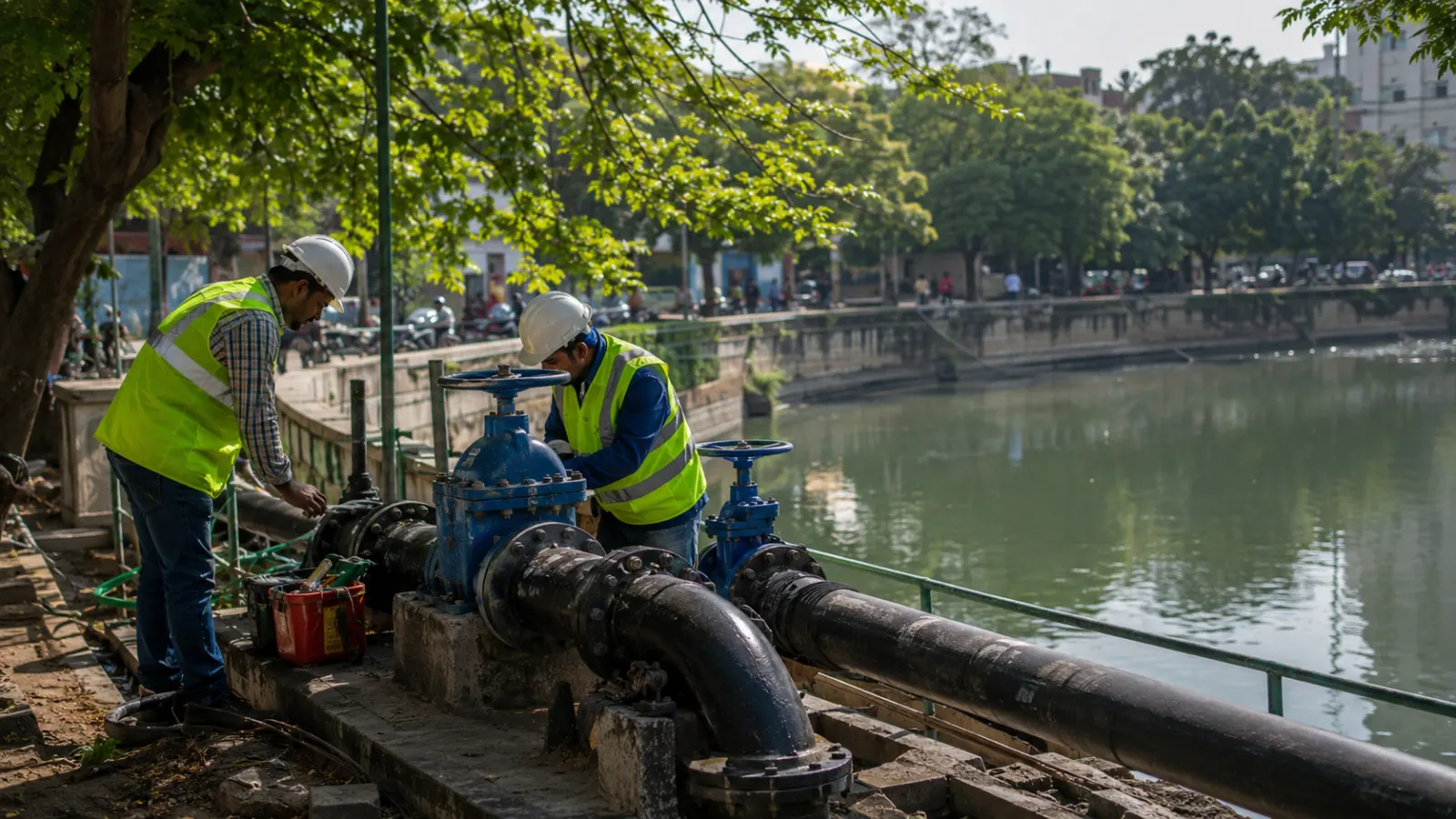
Utilities can reduce these losses through active leak detection, pressure management, replacement of ageing pipes, improved metering and faster repair programmes. In some systems, reducing distribution losses can create substantial savings without changing the amount of useful water households receive.
This represents one of the strongest principles of conservation: remove waste before restricting essential use.
Household Conservation Still Matters
Individuals can contribute meaningfully, particularly in cities where domestic consumption forms a significant part of local demand or during periods of drought.
The highest-value household actions are usually structural rather than symbolic. A continuously leaking toilet can waste far more water than a few unnecessary seconds at a kitchen tap. Efficient toilets and showerheads reduce consumption every time they are used. Full washing-machine and dishwasher loads make better use of each cycle. Appropriate irrigation can substantially reduce outdoor demand.
Monitoring consumption can also help identify hidden problems. An unexpected increase on a water bill may indicate a leak rather than a conscious change in behaviour.
The point is not that small actions have no value. It is that household conservation should prioritise the largest and most persistent sources of waste first.
Conservation Should Not Become a Morality Tale
Water campaigns sometimes imply that shortages exist because individuals fail to turn off taps quickly enough. That framing can shift responsibility away from institutions controlling much larger flows.
A household cannot repair a municipal transmission main, regulate industrial withdrawals, change an irrigation subsidy or establish limits on groundwater extraction. Individuals should avoid waste, but they should not be made solely responsible for structural water problems.
Effective conservation therefore divides responsibility according to control. Households manage household demand. Utilities manage networks. Farmers and agricultural institutions influence irrigation. Industries manage process water. Governments establish rules for shared rivers, aquifers and ecosystems.
The more closely responsibility follows actual control over water use, the more effective conservation policy becomes.
Pricing Can Influence Demand but Raises Equity Questions
Water pricing can encourage conservation because people generally pay more attention to consumption when use is measured and billed. Metering also gives utilities better information about how water moves through the system.
But water is not an ordinary consumer product. Drinking, cooking, sanitation and hygiene are essential human needs.
A pricing structure that makes basic consumption unaffordable can create serious health and equity problems. Conservation tariffs therefore need to distinguish between essential and discretionary use rather than treating every litre as socially equivalent.
One approach is to keep an affordable basic allocation while charging progressively more for high-volume consumption. The design depends on local conditions, but the principle is that conservation and affordability should be pursued together.
Water Reuse Changes the Linear Model
Most urban water does not vanish after being used once. It becomes wastewater.
If that wastewater is collected and treated to an appropriate standard, it can potentially be reused for agriculture, industrial processes, landscaping, groundwater recharge or, under highly controlled systems, potable supply.
Reuse therefore changes the traditional linear model of withdraw → use → discard into a more circular system in which water performs several functions before finally leaving the managed cycle.
This can reduce freshwater withdrawals while also reducing pollution caused by untreated wastewater discharge.
However, reuse requires infrastructure, monitoring, treatment, energy and public-health safeguards. The required treatment depends on the intended use. Water safe for industrial cooling is not automatically safe for drinking.
Conservation through reuse therefore depends on matching water quality to purpose.
Not Every Use Requires Drinking-Water Quality
Modern cities often treat large quantities of water to potable standards and then use some of that water for tasks that do not require drinking-water quality.
Depending on local infrastructure and health regulation, treated wastewater or other non-potable supplies may sometimes be suitable for landscaping, industrial cooling, toilet flushing or similar applications.
Using lower-quality water safely for appropriate purposes can reserve high-quality freshwater for uses where it is genuinely necessary.
This principle is sometimes described as matching water quality to use. It is a more sophisticated form of conservation than simply cutting demand because it asks whether the water supplied is appropriate for the task.
Water and Energy Conservation Are Connected
Moving and treating water requires energy. Pumps lift groundwater, treatment plants process raw water and distribution systems move it through cities. Households also use energy to heat water for showers, cleaning and washing.
Reducing unnecessary water use can therefore reduce energy consumption as well.
The reverse is also true: a conservation strategy that requires highly energy-intensive treatment or pumping should be evaluated across both systems.
Water policy increasingly needs this water-energy perspective because improving one resource system can affect the other.
Protecting Freshwater Ecosystems Is Conservation
Water conservation is not simply about reserving as much water as possible for human consumption. Rivers, lakes, wetlands and groundwater systems are living ecosystems.
UNEP emphasises the importance of freshwater ecosystems for biodiversity, water purification, flood regulation, livelihoods and human well-being.
A river from which every technically extractable litre is diverted may still fail ecologically. Wetlands can shrink, fish habitats can disappear and water quality can deteriorate.
This is why modern water-stress accounting includes environmental water requirements. Some flow needs to remain within rivers and connected ecosystems if the water system is expected to remain functional over the long term.
Conserving water therefore sometimes means deliberately not withdrawing it.
Environmental Flows Are Part of the Water Budget
Environmental flows describe the water needed to sustain river ecosystems and the human livelihoods that depend upon them.
The concept challenges an older assumption that any water remaining in a river after human demand has been satisfied is “unused.” In reality, flowing water performs ecological functions: transporting sediment, maintaining wetlands, supporting fisheries, diluting pollutants and sustaining connected groundwater systems.
A water allocation that ignores these functions may appear efficient economically while progressively degrading the system that produces the water.
Conservation therefore requires budgeting for ecosystems alongside cities, agriculture and industry.
Watershed Protection Can Reduce Future Costs
Protecting forests, wetlands and recharge zones can support water quality and regulate runoff. Healthy watersheds can slow flows, reduce erosion, retain sediment and provide natural filtration.
This does not eliminate the need for engineered treatment or reservoirs, but natural systems can complement infrastructure.
UNEP's watershed-management approach reflects the idea that water should be managed through the landscape from which it originates rather than only after it reaches a treatment plant or reservoir.
Polluting an upstream catchment and then building more expensive treatment downstream is often a less efficient strategy than preventing part of the contamination in the first place.
Groundwater Conservation Requires Extraction Limits
Groundwater poses a special conservation challenge because aquifers are invisible and may be accessed by large numbers of independent wells.
A farmer, household or industry can continue pumping as long as its well produces water even while the regional water table is declining. This creates the risk that individual decisions collectively exceed the aquifer's sustainable water budget.
Conservation therefore requires more than efficient pumps. Monitoring groundwater levels, regulating wells, controlling withdrawals where necessary and protecting recharge areas can all be important.
Groundwater depletion demonstrates especially clearly why using water efficiently is not the same as conserving the source. A highly efficient groundwater user can still contribute to depletion if total extraction remains excessive.
Rainwater Harvesting Can Reduce Pressure on Conventional Supply
Rainwater harvesting captures rainfall from roofs or other suitable surfaces for later use. Depending on treatment and local rules, collected rain can support gardening, cleaning and other purposes.
At larger scales, systems that slow runoff and encourage infiltration may contribute to groundwater recharge while reducing stormwater peaks.
But rainwater harvesting is not automatically beneficial in every setting. Large-scale interception of runoff can affect downstream flows, while poorly maintained storage can create contamination or mosquito problems.
The correct system therefore depends on local climate, hydrology and public-health requirements.
Conservation technologies should be adapted to the water system rather than copied universally.
Managed Aquifer Recharge Can Store Water Underground
In some locations, water available during wet periods can be intentionally directed into aquifers for storage. This can involve infiltration basins, recharge wells, stormwater or suitably treated recycled water.
Underground storage can reduce evaporation compared with surface reservoirs and strengthen drought resilience.
However, managed recharge cannot indefinitely compensate for heavy over-pumping. If withdrawals remain much greater than replenishment, the aquifer can continue declining despite recharge projects.
Water quality also matters because contaminants introduced underground can be extremely difficult to remove.
Recharge therefore works best as one component of a larger groundwater-management strategy.
The Rebound Effect Can Undermine Conservation
Efficiency improvements often lower the effective cost of using a resource. That can encourage additional consumption.
A farmer who uses less water per hectare may irrigate more hectares. A household installing highly efficient garden irrigation may decide it can maintain a larger lawn. An industry that lowers water use per unit of production may expand output.
This rebound effect does not make efficiency useless. It means efficiency needs to be paired with incentives, pricing, allocation rules or withdrawal limits capable of ensuring that the savings actually reduce pressure on the source.
The important outcome is total water use, not simply efficiency per unit.
Drought Conservation Is Different From Long-Term Conservation
Emergency drought restrictions and long-term conservation have related but different purposes.
During an acute drought, governments may restrict lawn watering, car washing or other discretionary uses because available supply has fallen rapidly. These measures protect storage through an immediate crisis.
Long-term conservation looks further ahead. It involves maintaining infrastructure, managing aquifers, reusing wastewater, aligning agriculture with water availability and protecting ecosystems so that the system is more resilient before the next drought begins.
A community repeatedly imposing emergency restrictions without addressing structural water demand may be treating symptoms rather than the underlying problem.
Climate Change Makes Flexibility More Important
Climate change can alter rainfall patterns, snowmelt, evaporation, drought frequency and water demand. Effects differ greatly by region, so it is inaccurate to describe one universal outcome for all water systems.
The broader management problem is increased uncertainty. Infrastructure and water allocations built around historical patterns may become less reliable if precipitation arrives at different times or extreme events become more frequent.
Conservation improves resilience because lower unnecessary demand leaves more flexibility when supply varies.
But adaptation also requires storage, watershed management, groundwater protection, reuse and infrastructure capable of responding to changing conditions.
Industry Can Conserve Through Process Design
Industrial water conservation can involve recycling process water, changing cooling technologies, detecting leaks, improving cleaning systems or redesigning production processes so they require less freshwater.
The most useful measure is often water consumed per unit of useful output combined with the total withdrawal from the local source.
Location matters as well. A water-intensive facility operating in a severely stressed basin creates a different conservation challenge from the same facility operating where water is abundant and renewable supply greatly exceeds demand.
This is why corporate water management increasingly needs local basin context rather than only company-wide efficiency percentages.
Water Footprints Extend Beyond the Tap
Household water bills show direct use but not the water embedded in food, electricity, clothing and manufactured goods.
Agricultural products can require substantial water during cultivation, while industrial products use water during processing and supply chains.
This does not mean consumers should calculate every hidden litre before purchasing anything. It does show why conservation cannot be analysed solely through household plumbing.
A large portion of society's water demand occurs indirectly through the products and services people consume.
Conservation Must Protect Water Quality Too
Water quantity and water quality are inseparable. A polluted river may contain large volumes of water while being unusable for drinking or irrigation without expensive treatment.
Reducing pollution can therefore function as water conservation because it preserves the usable freshwater resource.
Wastewater treatment, industrial pollution controls, agricultural nutrient management and protection of drinking-water catchments can all increase the amount of water that remains safely available.
Preventing pollution is often cheaper than attempting to remove contaminants after they enter an aquifer or reservoir.
Not All Water Savings Have Equal Value
Saving one litre of water in a wet region with abundant renewable supply may have a very different environmental value from saving one litre from an overdrawn aquifer during drought.
This does not mean waste is acceptable in water-rich areas. It means conservation priorities should reflect local scarcity and ecological conditions.
The greatest urgency belongs where withdrawals are creating genuine stress, environmental damage or competition among users.
Water conservation should therefore be informed by geography rather than treated as a universal contest to minimise every litre everywhere.
Conservation Sometimes Means Using Water Differently
Hospitals require water for hygiene. Farms need moisture to produce food. Communities need adequate sanitation. Cutting those uses indiscriminately could create serious health or economic damage.
The better question is not always “How can this user consume less?” It may be “How can the same social benefit be achieved with lower pressure on scarce freshwater?”
That might involve wastewater reuse, different crops, improved cooling systems, leak repair or relocating particularly water-intensive activity away from severely stressed basins.
Conservation is therefore a portfolio of strategies rather than one instruction applied to every user.
Water Conservation Is Ultimately a Governance Problem
Many technical solutions are already well understood. Leaks can be detected. Efficient irrigation exists. Wastewater can be treated. Aquifers can be monitored. Wetlands can be protected.
The harder question is often how societies allocate water among competing users and enforce limits when demand exceeds sustainable supply.
Water crosses administrative boundaries. Farmers, cities, industries and ecosystems may depend on the same river or aquifer. Saving water in one sector can affect availability elsewhere.
Institutions therefore need credible data, allocation rules, monitoring and mechanisms for resolving conflicts.
Conservation becomes durable when individual efficiency is connected to basin-level governance.
What Successful Water Conservation Looks Like
Effective conservation begins with measurement. Authorities and users need to know how much water is being withdrawn, where it is being consumed, how much is lost and whether rivers and aquifers are recovering.
It then removes unnecessary waste through infrastructure repair and better technology. Agriculture, cities and industry improve efficiency where appropriate. Wastewater is reused safely. Catchments and recharge areas are protected. Environmental water requirements are recognised rather than treated as leftover demand.
Most importantly, total withdrawals are kept compatible with the water available over the long term.
No single intervention accomplishes all of this. Conservation works through multiple layers that reinforce one another.
Frequently Asked Questions
What is water conservation?
Water conservation means protecting freshwater resources while using available water efficiently and keeping withdrawals compatible with long-term supply, water quality and ecosystem needs.
Is water conservation just about using less water?
No. It also includes repairing infrastructure, improving efficiency, reusing water, protecting watersheds, controlling pollution and managing withdrawals sustainably.
Why conserve water if water is renewable?
Freshwater is renewable through the water cycle, but rainfall, storage and recharge are uneven. Water can be locally scarce even though the global water cycle continues.
What is the difference between water conservation and water efficiency?
Efficiency measures useful output per unit of water. Conservation also asks whether total pressure on the water source has fallen.
Which sector uses the most freshwater globally?
Agriculture accounts for roughly 70% of global freshwater withdrawals, with FAO estimates around 72% depending on the dataset and period.
How can agriculture conserve water?
Approaches include improved irrigation scheduling, soil-moisture management, efficient irrigation, canal maintenance, suitable crop choices and reducing unsustainable groundwater pumping.
Does drip irrigation always save water?
It can improve field-level efficiency, but total basin withdrawals may not decline if farmers expand irrigated area or reduce return flows.
How can cities conserve water?
Cities can repair distribution leaks, improve metering, manage pressure, reuse wastewater, improve pricing structures and reduce unnecessary outdoor demand.
Do household water-saving measures matter?
Yes. Leak repair, efficient fixtures, full appliance loads, sensible irrigation and consumption monitoring can create meaningful recurring savings.
What is water reuse?
Water reuse means treating wastewater so it can safely perform another function, such as irrigation, industrial use, groundwater recharge or certain potable uses.
Why are freshwater ecosystems part of conservation?
Rivers, lakes, wetlands and aquifers support biodiversity, water purification, flood control and human livelihoods, so they require sufficient water to remain functional.
What are environmental flows?
Environmental flows are the quantities and timing of water needed to sustain healthy rivers and connected ecosystems.
Can rainwater harvesting conserve water?
Yes, where properly designed. It can substitute for mains water and sometimes support recharge, although local hydrology and water-quality safeguards matter.
What is groundwater conservation?
It involves managing extraction so pumping does not cause unacceptable long-term depletion, while protecting recharge areas and groundwater quality.
Can water pricing encourage conservation?
Yes, but tariff design should protect affordable access to essential water while discouraging excessive high-volume use.
What is the rebound effect?
It occurs when efficiency lowers the cost of water use and the resulting savings encourage additional consumption, reducing the expected conservation benefit.
Is water conservation important during drought only?
No. Emergency drought restrictions are one form of conservation, while long-term conservation prepares water systems before shortages occur.
How does climate change affect conservation?
Changing rainfall, drought, snowmelt and evaporation can increase uncertainty, making efficient use, storage, reuse and source protection more important.
Does reducing pollution count as water conservation?
Yes. Protecting water quality preserves the amount of freshwater that remains usable without costly treatment.
Can conservation solve every water crisis?
No. Some regions also require additional storage, infrastructure, wastewater treatment, institutional reform or changes in agricultural and industrial activity.
Saving Water Is Only the First Layer
The familiar household definition of conservation remains useful because unnecessary tap flow, leaking toilets and excessive irrigation genuinely waste water. But the supplied article correctly pushes the concept further. A society can install efficient household fixtures while continuing to over-pump aquifers, lose treated water through municipal pipes or allocate too much river flow to unsustainable uses.
Conservation therefore has to operate at several scales simultaneously. Individuals reduce avoidable household demand. Utilities manage leaks. Farmers and agricultural institutions improve irrigation and crop decisions. Industry redesigns processes and reuses water. Governments protect ecosystems and regulate shared supplies.
The critical measure is not simply whether one user became more efficient. It is whether the river, aquifer or watershed experiences less unsustainable pressure.
The Central Idea
Water conservation is not a campaign against using water. It is a strategy for ensuring that useful water use can continue.
Efficiency is part of that strategy, but efficiency alone is insufficient. A farm can become more efficient while total pumping rises. A growing city can install efficient fixtures while total demand increases. A factory can reduce water used per product while expanding production enough to increase withdrawals.
The deeper conservation question is therefore what happens to the water source after all of those individual improvements are added together.
Successful conservation reduces unnecessary losses, improves productivity, reuses water where safe and protects the natural systems that generate and store freshwater. It also recognises that rivers need environmental flows, groundwater extraction has to reflect recharge and water quality determines how much of a physical resource is actually usable.
This changes conservation from a list of personal virtues into a problem of systems management.
Households still matter. Repairing leaks and reducing avoidable use are worthwhile. But individuals cannot solve pipe losses, groundwater over-extraction or badly designed agricultural incentives alone.
The strongest conservation programmes therefore combine individual action with institutional responsibility.
They measure water. They identify where it goes. They distinguish useful consumption from waste. They recognise return flows and ecosystem requirements. They protect water quality. They plan for drought before reservoirs become empty. And when total demand exceeds what a basin can sustainably provide, they confront that imbalance rather than assuming another efficiency improvement will make it disappear.
Water is renewable.
That does not mean every withdrawal is renewable on the timescale at which society needs it.
Water conservation is ultimately the discipline of making sure today's use does not quietly destroy tomorrow's supply.