Five Dead in Delhi Building Collapse; More Feared Trapped
At least five people have died after a multi-storey residential building collapsed in Delhi’s New Seemapuri, while rescue teams continue searching the debris amid fears that one or two more people may still be trapped.
The collapse occurred at around 3:30 pm on Wednesday, October 7, in a densely built area of northeast Delhi. A pregnant woman and two children were among those killed, while several others were injured and taken to nearby hospitals. Rescue operations involving the National Disaster Response Force, Delhi Fire Service, Civil Defence and Delhi Police continued into Thursday.
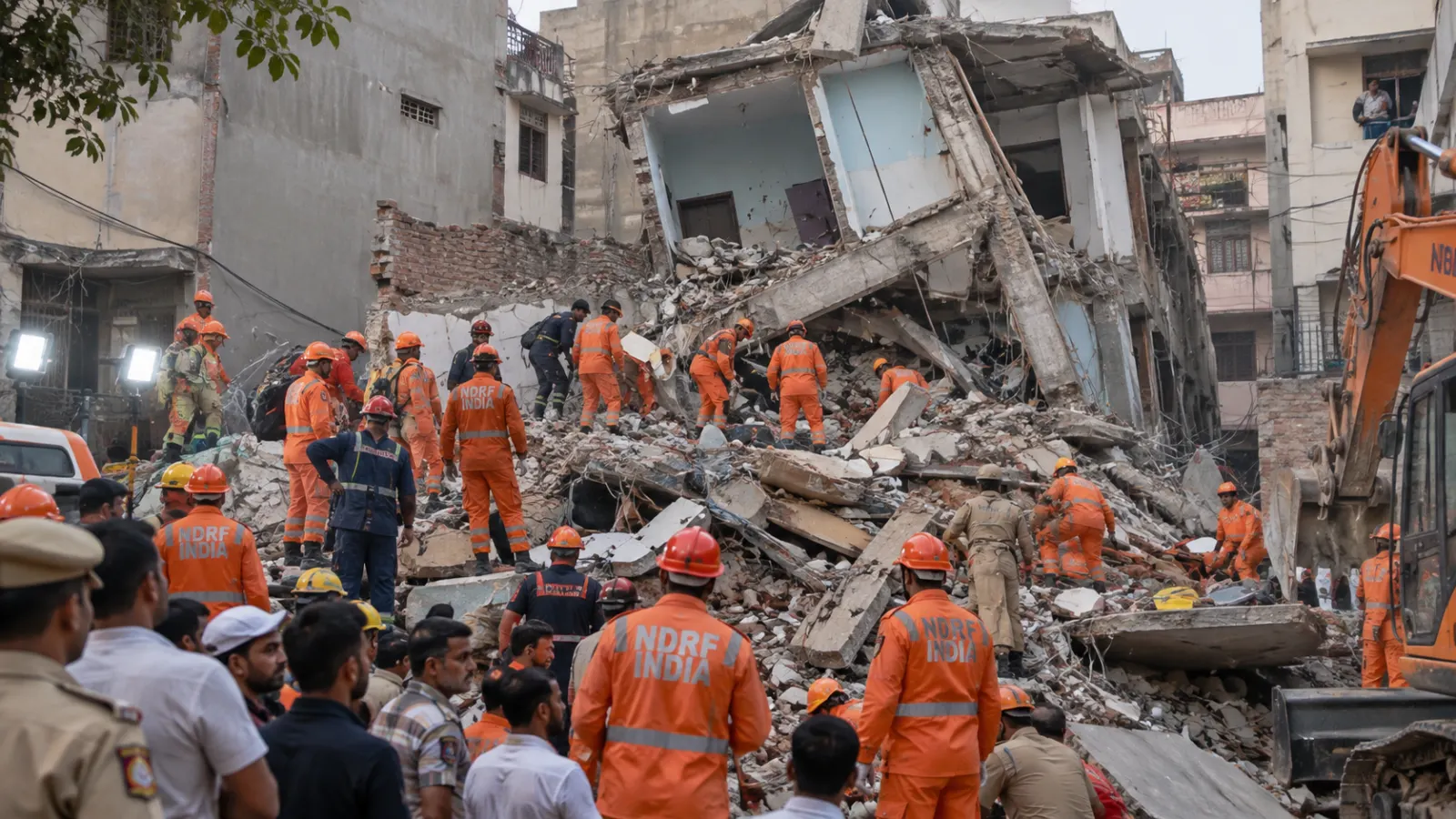
Rescue teams continue searching the debris
Emergency crews worked through the night to remove concrete, bricks and twisted structural material from the collapsed building.
Police said the death toll rose to five on Thursday after two more bodies were recovered. Locals continued to tell rescuers that additional residents could still be buried beneath the rubble, keeping search operations active even after most of the debris had been cleared.
The narrow lanes around the site complicated access for heavy rescue equipment, forcing teams to rely on a combination of machinery and manual clearing.
Officials said multiple agencies were coordinating at the scene as rescuers searched for signs of survivors.
Pregnant woman and children among those killed
Among the victims was 21-year-old Gulafsa, who was around four months pregnant.
Her family said she managed to call from beneath the debris after the collapse and told them she was struggling to breathe and needed water. She was later pulled from the rubble but did not survive.
Two children were also among the early confirmed fatalities.
A three-year-old boy trapped in the collapse was rescued with minor injuries. His mother was later confirmed among the dead.
The personal accounts emerging from the scene have added to the shock surrounding the incident, particularly because several members of the same families were inside the building when it came down.
Building reportedly developed cracks after earthquake tremors
Officials said the structure had developed cracks after earthquake tremors were felt in Delhi on Tuesday evening.
The building collapsed the following afternoon.
The exact relationship between those cracks and the collapse has not yet been formally established, and authorities will need a structural investigation before determining the cause.
That distinction is important because building collapses can result from several interacting factors, including structural weakness, unauthorised construction, poor maintenance, foundation problems and external stress.
Authorities are expected to examine whether the structure had existing vulnerabilities before the tremors.
Questions emerge over building safety
The New Seemapuri collapse has once again raised questions about the safety of older and unauthorised buildings in Delhi.
The Municipal Corporation of Delhi has said the collapsed structure was around 20 to 25 years old, although some local residents and victims have disputed that description.
Previous magisterial inquiries into building collapses and fires in the capital have repeatedly identified problems including illegal construction, ignored complaints, weak enforcement and inadequate emergency preparedness.
The latest incident is likely to intensify scrutiny of whether dangerous structures are being identified early enough and whether complaints about cracks or unauthorised alterations receive adequate follow-up.
Dense construction complicates emergency response
New Seemapuri contains tightly packed residential neighbourhoods where narrow lanes can make emergency access difficult.
The collapsed building was located behind a fish market, and fire-service vehicles had limited direct access to the structure. Local residents initially joined rescue efforts before specialised teams took over.
Such conditions can significantly slow disaster response.
Large cranes, excavators and ambulances may not be able to reach a collapse site directly, meaning rescuers sometimes have to move debris through narrow access points before trapped residents can be reached.
In building-collapse emergencies, the first several hours are particularly important because survivors may face injuries, dehydration, dust inhalation or restricted access to air.
Why Delhi continues to see dangerous building collapses
Delhi has experienced several deadly structural collapses in recent years.
Rapid urbanisation, overcrowding and unauthorised additions to existing buildings can create serious risks when construction takes place without adequate engineering supervision.
In some neighbourhoods, additional floors are built on structures that were never designed to carry the extra load.
Alterations to load-bearing walls, poor-quality materials and weak foundations can further increase vulnerability.
Enforcement is complicated by Delhi’s overlapping administrative system, where municipal bodies, development agencies, police and other authorities may all have different responsibilities.
That makes accountability after a collapse particularly important.
Residents demand answers
Families affected by the New Seemapuri collapse are now seeking clarity about whether the tragedy could have been prevented.
If visible cracks had appeared before the collapse, investigators will need to determine whether residents or authorities recognised the potential danger and whether evacuation should have occurred.
Officials will also examine building plans, ownership records and construction history.
Any unauthorised extensions or structural alterations could become central to the investigation.
The findings will matter not only for the victims’ families but also for thousands of residents living in similarly dense neighbourhoods across Delhi.
What happens next
Rescue teams are expected to continue searching until authorities are confident that nobody remains trapped beneath the debris.
Once the rescue phase ends, attention will shift to the structural investigation and responsibility for the collapse.
Authorities will need to establish whether the building failed because of earthquake-related damage, pre-existing structural weakness, unauthorised construction or a combination of factors.
The New Seemapuri tragedy has already claimed five lives and injured several others.
As rescuers continue searching the rubble, the incident is becoming another test of Delhi’s ability to identify unsafe buildings before structural failures turn into mass-casualty disasters.