The Dark Atlantic
The transatlantic slave trade was one of the greatest crimes and forced migrations in human history. It turned the Atlantic Ocean into a corridor of terror, profit and permanent separation. Between the sixteenth and nineteenth centuries, millions of Africans were captured, sold, marched to coastal forts, packed into ships and transported to the Americas, where they and their descendants were forced to labour under regimes of violence. The trade was not an accident of history. It was a commercial system built by European empires, African intermediaries, colonial planters, merchants, financiers, insurers, shipbuilders and consumers who benefited from sugar, tobacco, rice, cotton, coffee and other plantation commodities.
Its legacy is dark because it was not only about labour. It was about the conversion of human beings into property, the legal construction of race, the destruction of families, the militarisation of commerce and the creation of modern inequalities that survived abolition. Britannica estimates that the transatlantic slave trade transported between 10 million and 12 million enslaved Africans across the Atlantic from the sixteenth to the nineteenth century. Other databases and scholarship refine those numbers, but all serious accounts agree on the vast scale of forced movement and suffering.
To understand the trade is to understand the underside of the modern Atlantic world. The wealth of empires, the rise of plantations and the growth of global markets were built partly on stolen lives.
Time, Place and the Atlantic System
The transatlantic slave trade developed after sustained European colonisation of the Americas created a demand for coerced labour. It lasted roughly from the early sixteenth century to the nineteenth century, with illegal trafficking continuing even after formal abolition in many regions. Its geography linked West and West Central Africa, European ports, Atlantic islands, Caribbean colonies, Brazil, Spanish America and North America. It was not a single route but a web of routes, markets and colonial destinations.
The trade’s scale changed over time. Early shipments were smaller, but the expansion of sugar plantations in Brazil and the Caribbean dramatically increased demand. The eighteenth century became the peak period, as European empires intensified plantation production. The National Endowment for the Humanities notes that the Trans-Atlantic Slave Trade Database estimates about 12.5 million Africans were forced aboard slave ships, with about 10.7 million surviving the Middle Passage between 1526 and 1866.
The Atlantic slave trade must be understood as part of a larger global history of slavery, but it had distinctive features. It racialised slavery on an immense scale. It tied forced labour to plantation capitalism. It moved people across an ocean permanently. It created hereditary enslavement in which children inherited the enslaved status of their mothers. It transformed Africa, Europe and the Americas simultaneously. Its history therefore belongs not to one continent but to an interconnected Atlantic world.
Before the Trade: African Societies and European Demand
Africa before the Atlantic slave trade was not a passive reservoir of captives. It contained kingdoms, empires, city-states, trading networks, agricultural societies, pastoral communities and complex political cultures. States such as Kongo, Benin, Oyo, Dahomey, Asante and others interacted with European traders in different ways and at different times. Some African rulers resisted European demands; others participated in slave trading as part of warfare, diplomacy and state-building. This participation does not reduce European responsibility, but it reminds us that the trade operated through African as well as European power structures.
Slavery existed in parts of Africa before Atlantic expansion, as it did in many world regions, but Atlantic plantation slavery changed its scale, direction and meaning. European demand connected captive-taking to global commodity markets. Guns, textiles, metal goods, alcohol and other imports became linked to the export of human beings. Warfare and raiding intensified in some regions because captives could be converted into trade goods.
The demand came from American colonies. Europeans wanted labour to mine, plant, harvest, process and transport commodities. Indigenous demographic collapse and the limitations of European indentured labour pushed colonial economies toward African slavery. The result was a violent chain: European consumption and colonial profit encouraged plantation expansion; plantation expansion demanded labour; labour demand intensified the capture and sale of Africans. The Atlantic trade grew because distant markets made human bondage profitable.
Sugar, Plantations and the Demand for Bodies
Sugar was one of the central engines of the transatlantic slave trade. Before becoming an everyday sweetener, sugar was a luxury commodity that required expensive processing and harsh labour. Sugarcane had to be planted, cut, crushed and boiled quickly. Plantation work was exhausting, dangerous and deadly. Tropical disease environments, violent discipline and brutal work rhythms produced high mortality. Planters therefore demanded a constant supply of enslaved labour.
Brazil and the Caribbean became the largest destinations for enslaved Africans because sugar economies dominated these regions. The plantation was both an agricultural estate and a machine of social control. It combined land, capital, mills, armed force, overseers and enslaved workers. Everything was organised around production for export. Human life was subordinated to commodity output.
The demand for enslaved labour later expanded through tobacco in the Chesapeake, rice in the Carolinas and cotton in the nineteenth-century United States. But sugar remained especially important because it created some of the earliest and most lethal plantation societies. Islands such as Barbados, Jamaica and Saint-Domingue became enormously profitable and deeply violent.
The rise of plantations reveals the economic logic of the slave trade. Enslaved Africans were not transported because Europeans lacked moral awareness; they were transported because colonial wealth depended on extreme exploitation. The plantation converted pain into profit. The Atlantic slave trade supplied the bodies required by that conversion.
Capture, Marches and Coastal Forts
The Middle Passage began before the ship. Many enslaved Africans were captured through warfare, raids, kidnapping, judicial enslavement or political conflict. They were often marched from inland regions to coastal markets, sometimes over long distances and under deadly conditions. During these forced marches, captives could be chained, starved, beaten and separated from kin. Many died before reaching the coast.
European traders generally did not penetrate deep inland in the early phases of the trade. They relied on African traders, rulers and military networks to bring captives to coastal forts and factories. These coastal sites, such as Elmina, Cape Coast, Ouidah, Luanda and others, became places where human beings were inspected, priced, branded, confined and loaded onto ships. The architecture of the slave fort symbolised the moral structure of the trade: European commercial order built over African suffering.
The process of sale was designed to erase personhood. Captives were evaluated by age, sex, health and perceived strength. Families were separated because the market did not recognise family bonds as rights. Names, languages and identities were ignored or suppressed. Yet captives did not stop being people because traders treated them as cargo. They carried memories of home, skills, beliefs and grief.
The coastal stage of the trade shows that Atlantic slavery was not only a journey across water. It was a sequence of violence that began in African interiors and passed through militarised commerce.
The Middle Passage
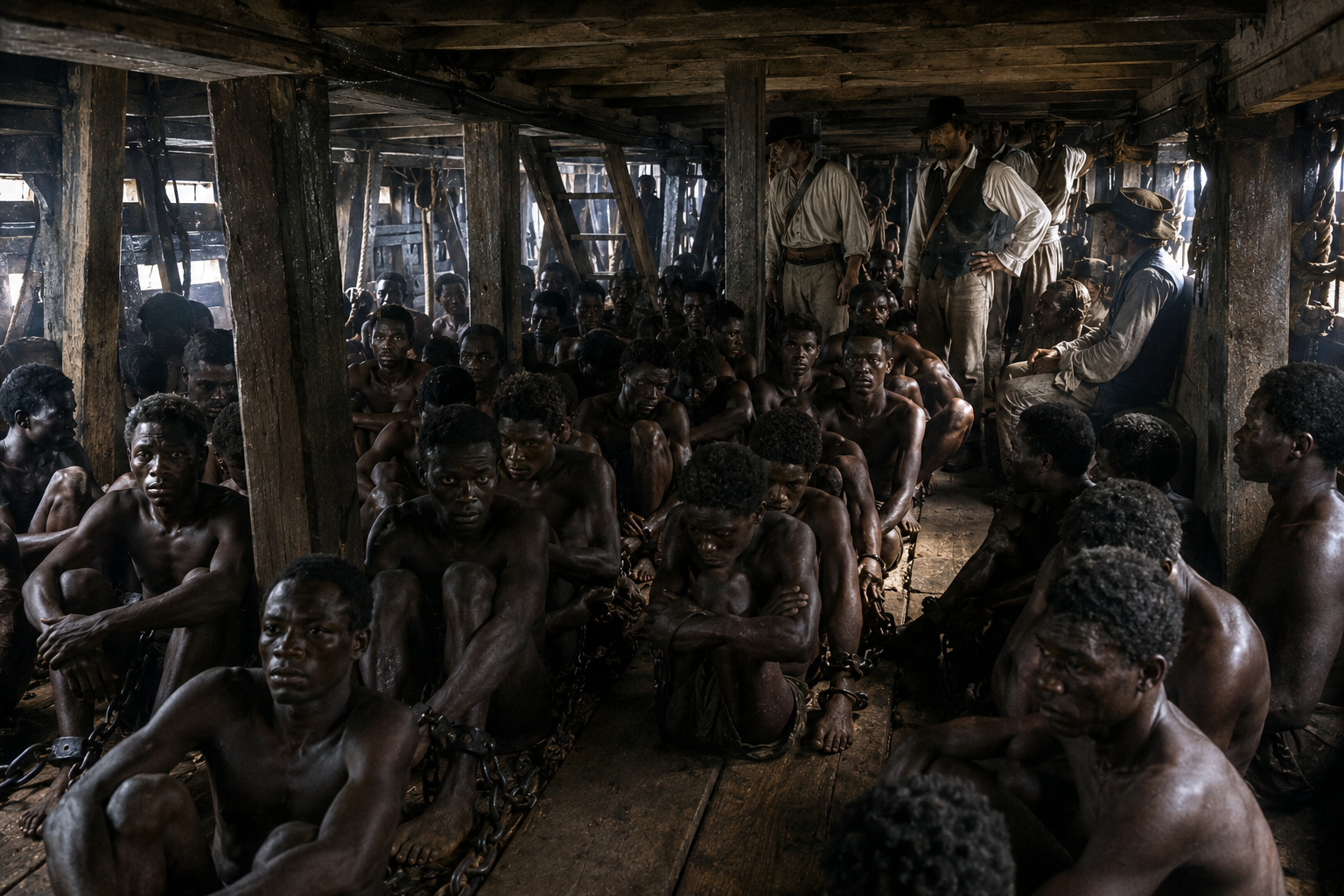
The Middle Passage was the oceanic horror at the centre of the transatlantic slave trade. Enslaved Africans were packed into ships under conditions designed for profit, not survival. Space was calculated to maximise cargo. Captives were chained, crowded, poorly fed, exposed to disease and often kept in suffocating holds. Dysentery, smallpox, dehydration, abuse and despair killed many. The NEH summary of the slave trade database estimates that about 10.7 million people survived the Middle Passage, implying that millions died before arrival or during the wider process of trafficking.
The voyage was not only physically brutal. It was psychologically devastating. Captives were torn from familiar languages, landscapes, kinship networks and spiritual worlds. They faced an unknown ocean and an unknown future. Some resisted by refusing food, jumping overboard, attacking crews or participating in shipboard revolts. Suicide, revolt and mourning were acts within a world of extreme coercion.
European ship logs often reduced death to numbers, but each death was a life with a name, memory and social world. The archive is therefore morally incomplete. It records cargo losses more easily than human grief. Modern historians must read against that archive, reconstructing experience from hostile documents.
The Middle Passage was the place where the Atlantic system revealed itself most nakedly. Commerce, racism, violence and empire converged in the hold of the slave ship. The ocean became a moving prison.
Triangular Trade and the Business of Slavery
The transatlantic slave trade is often described through the triangular trade: manufactured goods from Europe to Africa, enslaved Africans from Africa to the Americas, and plantation commodities from the Americas to Europe. This model is useful but simplified. In reality, Atlantic commerce involved multiple routes, bilateral trades, intra-American shipments, credit networks, insurance contracts, state monopolies and private merchants. Still, the triangle captures the system’s brutal logic: goods became captives, captives became labour, labour became commodities, commodities became profit.
European ports such as Liverpool, Bristol, Nantes, Bordeaux, Lisbon, Amsterdam and others benefited from slave commerce. Shipbuilders, rope makers, textile producers, bankers, insurers and investors were connected to the trade. Colonial planters depended on credit from metropolitan merchants. European consumers purchased sugar, coffee, tobacco and cotton without seeing the violence behind them.
The business of slavery also generated bureaucratic records. Ledgers, bills of sale, ship manifests, insurance documents and port registers now help historians reconstruct the trade. SlaveVoyages, a major database, compiles information about more than 36,000 voyages that forcibly transported enslaved Africans across the Atlantic between the sixteenth and nineteenth centuries.
The economic structure matters because it reveals responsibility. Slavery was not only the cruelty of individual planters. It was an Atlantic system embedded in finance, law, shipping and consumption. Ordinary habits of sweetness, smoking and textile use were tied to extraordinary violence.
Gender, Family and the Violence of Separation
The slave trade attacked family life directly. Captives were separated from parents, spouses, children, siblings and communities. Markets treated family bonds as irrelevant unless they affected sale value. This violence continued in the Americas, where enslaved people could be sold away from family members at any time. The destruction of kinship was one of slavery’s central weapons.
Gender shaped the experience of enslavement. Men, women and children endured forced labour, violence and sale, but enslaved women faced specific forms of sexual exploitation and reproductive control. In many slave societies, the legal status of children followed the mother, making enslaved women’s bodies part of the reproduction of slavery itself. Sexual violence by owners and overseers was widespread and often legally protected.
Yet enslaved people rebuilt family and community under impossible conditions. They formed marriages, raised children, created fictive kin networks, preserved naming traditions and built mutual aid. These relationships were acts of survival. They challenged the slaveholder’s claim that enslaved people were property without emotional worlds.
Family history also shaped memory after slavery. Descendants inherited broken genealogies because the trade and plantation system deliberately obscured origins. Modern archival research, oral tradition and genetic work attempt to recover some of what slavery tried to erase. The dark legacy of the trade includes not only labour exploitation but ancestral rupture. Millions of people were cut from recorded lineage by a system that profited from separation.
Plantation Societies in the Caribbean and Brazil
The Caribbean and Brazil were at the centre of the transatlantic slave system. Their plantations consumed enormous numbers of enslaved Africans, especially in sugar production. Mortality rates were often high, and natural population growth among enslaved communities was limited in many regions because conditions were so brutal. Planters therefore relied heavily on continual importation.
Plantation societies were structured around extreme inequality. A small white elite controlled land, mills, law and violence. Free people of colour sometimes occupied intermediate positions, varying by colony. Enslaved Africans formed the majority in many plantation zones. The fear of revolt haunted slaveholding societies because enslaved people often vastly outnumbered free whites.
Brazil’s long history of slavery made it the largest recipient of enslaved Africans in the Americas. Portuguese colonial and imperial economies depended on sugar, gold, coffee and other labour-intensive sectors. In the Caribbean, islands such as Jamaica, Barbados, Cuba and Saint-Domingue became major plantation centres. Saint-Domingue, before the Haitian Revolution, was among the richest colonies in the world because of enslaved labour.
Plantation life was not only economic; it was cultural. African languages, religions, music, healing practices and foodways survived and transformed under plantation conditions. The enslaved created communities in the quarters, in religious gatherings, in markets and in resistance networks. Even where masters controlled labour, they never fully controlled culture or memory.
Slavery in North America
Although most enslaved Africans transported across the Atlantic went to the Caribbean and Brazil, slavery in British North America and later the United States became historically central because of its long political afterlife. In the Chesapeake, tobacco plantations expanded dependence on enslaved labour during the seventeenth and eighteenth centuries. In South Carolina and Georgia, rice and indigo shaped plantation society. In the nineteenth century, cotton transformed slavery into the foundation of the southern United States economy.
North American slavery differed in demography from many Caribbean colonies because enslaved populations eventually grew through natural reproduction. This did not make slavery humane. It meant that family formation existed under constant threat of sale. The domestic slave trade within the United States later tore apart countless families as enslaved people were sold from the Upper South to the cotton frontier.
Slavery also shaped northern colonies and states through trade, shipping, finance, insurance, consumption and gradual emancipation. The North was not innocent of slavery simply because plantation agriculture was less dominant there. Atlantic commerce tied many regions to slave-produced commodities.
North American slavery produced a racial republic contradiction. Ideas of liberty developed alongside human bondage. The American Revolution proclaimed rights while preserving slavery in many states. This contradiction later exploded into abolitionist conflict, sectional crisis and civil war. The transatlantic slave trade’s legacy therefore shaped not only colonial economies but the political foundations of the modern United States.
Resistance on Ships, Plantations and Frontiers
Enslaved Africans and their descendants resisted slavery from the beginning. Resistance took many forms: shipboard revolts, work slowdowns, sabotage, flight, cultural preservation, poisonings, armed rebellion, legal petitions, religious gatherings and the creation of maroon communities. To focus only on suffering is to miss the courage and intelligence with which enslaved people opposed domination.
Ship revolts occurred despite chains, armed crews and unfamiliar conditions. Some captives seized weapons, attacked sailors or attempted to steer vessels back to Africa. On plantations, everyday resistance included breaking tools, feigning illness, slowing work, stealing food, preserving forbidden rituals or refusing complete psychological submission. Flight was one of the most common forms of resistance. In forests, mountains and swamps, runaway communities created maroon societies that sometimes survived for generations.
Large revolts terrified slave societies. The Haitian Revolution, beginning in 1791, was the greatest successful slave revolt in world history. It destroyed slavery in Saint-Domingue and created Haiti, challenging the entire Atlantic system. Other revolts, conspiracies and uprisings occurred across the Americas.
Resistance also occurred through culture. Songs, spirituals, drumming, funeral rites, storytelling and religious practices preserved humanity in a system designed to deny it. Enslaved people resisted not only by fighting but by remembering, loving, praying, laughing and teaching children that they were more than property.
African Diaspora and Cultural Creation
The transatlantic slave trade created an African diaspora in the Americas. This diaspora was born from violence, but it produced extraordinary cultural creativity. Enslaved Africans came from many regions and spoke many languages. In the Americas, they built new communities across difference. They combined African traditions with Indigenous and European influences, creating new religions, musical forms, cuisines, languages and identities.
Religious traditions such as Vodou, Santeria, Candomble, Obeah, Kumina and others preserved African cosmologies while adapting to Catholic or Protestant colonial settings. Music and rhythm carried memory across generations. Foodways blended African crops and techniques with American ingredients. Creole languages emerged from the need to communicate across linguistic boundaries under slavery.
Diasporic culture was not merely survival; it was world-making. It gave enslaved and free Black communities tools for healing, resistance and identity. It also shaped the wider Americas. Much of what the world now recognises as Caribbean, Brazilian, African American and Latin American culture emerged from African diasporic creativity under colonial violence.
This cultural legacy challenges any account that treats enslaved Africans only as victims. They were victims of a monstrous system, but they were also creators of new worlds. The slave trade tried to turn people into commodities; the diaspora turned memory into culture. That transformation is one of history’s most powerful forms of resistance.
Abolition and the End of the Legal Trade
The abolition of the transatlantic slave trade did not happen because slaveholding societies suddenly discovered morality. It resulted from enslaved resistance, Black activism, religious movements, economic change, political struggle and humanitarian campaigns. Abolitionists exposed the horrors of the Middle Passage, circulated petitions, published narratives and pressured governments. Enslaved people themselves forced the issue through rebellion, escape, military service and daily resistance.
Britain abolished its slave trade in 1807 and used naval power in the nineteenth century to suppress some illegal trafficking, though British wealth had already been deeply shaped by slavery. The United States also banned the transatlantic trade in 1808, but domestic slavery expanded. Other European and American states abolished the trade at different times. Illegal slave voyages continued for decades, especially to Brazil and Cuba.
Ending the trade did not end slavery. Plantation societies continued to exploit enslaved labour where slavery remained legal. Brazil abolished slavery only in 1888. Cuba ended slavery in the 1880s. The United States required civil war and constitutional amendment to destroy legal slavery.
Abolition was therefore a process, not a single date. It closed some routes while leaving other forms of bondage intact. It also forced former slave societies to invent new labour controls. The end of the legal trade was a major turning point, but the legacy of the trade continued through racial capitalism, colonialism and inequality.
After Slavery: Racism, Capitalism and Inequality
The end of slavery did not end the systems of thought and wealth built by slavery. Former slave societies developed new mechanisms of racial control: segregation, sharecropping, apprenticeship, vagrancy laws, debt peonage, colonial forced labour and discriminatory citizenship. In many places, emancipation granted legal freedom without land, reparations or equal power. Former enslavers often retained property and political influence, while the formerly enslaved faced poverty and racial exclusion.
The economic afterlife of slavery was immense. Plantation wealth helped finance banks, industries, ports and family fortunes. Slave-produced commodities shaped consumer habits and industrial production. Cotton grown by enslaved labour fed textile mills. Sugar changed diets. Tobacco generated revenue. The profits of slavery entered buildings, universities, companies and state treasuries.
Racism provided the ideological afterlife. The idea that Africans and their descendants were naturally suited for servitude did not disappear with abolition. It adapted into scientific racism, colonial paternalism, segregationist law and modern prejudice. The trade’s dark legacy therefore includes both material inequality and mental structures.
Modern debates over reparations, museum collections, public monuments and institutional accountability emerge from this history. They ask whether societies that inherited slavery’s profits can ignore slavery’s victims. The answer depends on whether history is treated as memory alone or as a living structure. The evidence shows that slavery’s consequences did not end when the ships stopped sailing.
Numbers, Archives and the Recovery of Human Lives
One of the major achievements of modern scholarship is the reconstruction of the slave trade through databases, archives and interdisciplinary research. The SlaveVoyages database compiles information about tens of thousands of slave voyages, allowing historians to analyse routes, ports, ship names, mortality rates, embarkation regions and destinations. Harvard’s Hutchins Center notes that the database includes detailed information on about 35,000 transatlantic voyages between 1520 and 1866, along with estimates of the trade’s overall size.
Numbers matter because they reveal scale. They show that the trade was not isolated cruelty but a vast system. Yet numbers also risk abstraction. Twelve million people is a statistic; each person was a life. Historians therefore combine quantitative data with narratives, court records, runaway advertisements, ship logs, plantation documents, oral traditions and archaeological evidence.
The archive itself is uneven. Most records were created by traders, owners, officials and courts, not by the enslaved. This means historians must read documents critically, looking for human presence inside commercial language. A notation of “loss” may mean death. A price may hide grief. A shipping list may be the only surviving trace of a person’s forced crossing.
Recovering the history of the slave trade is therefore an ethical task. It requires counting the dead and listening for the living. Scholarship becomes a form of remembrance when it restores humanity to records designed to erase it.
Historical Debates: Responsibility, Capitalism and Reparations
The transatlantic slave trade remains the subject of major historical debate. One debate concerns responsibility. European empires organised shipping, colonial law and plantation demand, while African intermediaries also participated in capture and sale. Serious history must acknowledge this complexity without creating false equivalence. The largest profits and imperial structures were tied to European colonial expansion and American plantation slavery.
Another debate concerns capitalism. Some historians argue that slavery was foundational to the rise of modern capitalism, especially through plantation profits, finance, insurance, shipping and industrial raw materials. Others caution against reducing capitalism’s origins to slavery alone. The stronger position recognises that slavery was not the only source of modern capitalism, but it was deeply entangled with Atlantic commercial expansion.
Reparations form a contemporary debate rooted in history. If institutions, states and families accumulated wealth from slavery, do they owe repair to descendants and affected communities? Critics ask how responsibility can be assigned across generations. Supporters argue that inherited inequalities and institutional profits make the question unavoidable.
There are also debates about memory: whether public monuments should honour slave traders, whether museums should present national greatness beside colonial violence, and how schools should teach slavery. These debates show that the slave trade is not dead history. It remains a moral and political argument about how societies remember injustice and whether memory should lead to repair.
Legacy Across Africa, Europe and the Americas
The slave trade reshaped three continents. In Africa, it intensified warfare in some regions, distorted economies, destabilised communities and removed millions of people in their most productive years. Its effects varied by region, but the demographic, political and psychological damage was severe. It also altered African state formation, trade patterns and relationships with Europe.
In Europe, the trade contributed to port growth, commercial wealth and imperial power. Cities that profited from slave commerce later built museums, universities, banks and civic institutions. European national histories often celebrated maritime achievement while minimising the violence behind it. The recovery of slave trade history has forced a reckoning with the hidden foundations of prosperity.
In the Americas, the legacy is everywhere: racial demographics, music, religion, cuisine, language, inequality, land ownership and political conflict. African-descended peoples built the hemisphere through labour and culture while being denied full freedom and citizenship. Their struggles for emancipation, civil rights and dignity form one of the central narratives of modern history.
The trade’s legacy is therefore not confined to slavery museums or memorial days. It is written into cities, economies, identities and racial structures. The Atlantic world was made by forced African labour. Any honest account of modernity must place that fact at the centre, not at the margins.
Memory, Mourning and Historical Justice
Remembering the transatlantic slave trade is difficult because the archive is both vast and incomplete. We know ship names, ports and numbers, but many personal names are lost. We know plantation outputs, but not every song sung in the quarters. We know laws and sale records, but not every mother’s grief when a child was sold. Memory must therefore combine scholarship with mourning.
Memorials, museums, databases, novels, films, oral histories and public rituals all help societies confront the slave trade. But memory can also be resisted. Some prefer narratives of national glory without colonial violence. Others treat slavery as an unfortunate past unrelated to present inequality. Such avoidance is itself part of the legacy.
Historical justice requires more than guilt. It requires truth, education, acknowledgement and material attention to consequences. This does not mean reducing people of African descent to suffering. It means recognising both the violence endured and the worlds created despite that violence.
The task of memory is to restore moral scale. The slave trade was not a side story to exploration, empire or capitalism. It was central to them. Ships carried more than bodies across the Atlantic; they carried systems of power whose effects still shape life chances. To remember accurately is to refuse the old commercial language that counted humans as cargo.
Legacy: The Trade That Built Wealth and Left a Wound
The dark legacy of the transatlantic slave trade lies in its combination of profit and dehumanisation. It helped build Atlantic wealth while tearing apart African families. It made plantation commodities cheap while making human life disposable. It contributed to modern economies while creating racial ideologies that outlived slavery itself. Its deepest horror is not only that cruelty happened, but that cruelty became organised, legal, insurable and profitable.
Yet the legacy is not only darkness. It also includes resistance, survival and creation. Enslaved Africans and their descendants built new cultures, fought for freedom, transformed religion and music, challenged empires and forced the world to confront the meaning of liberty. The Haitian Revolution, abolition movements, Black intellectual traditions and modern civil rights struggles all belong to the afterlife of the slave trade.
A powerful conclusion must therefore hold two truths. The transatlantic slave trade was a crime of immense scale. It was also survived by people whose humanity no system could erase. The enslaved were not simply transported; they remembered. They were not simply exploited; they resisted. They were not simply victims; they became ancestors of cultures that changed the world.
The Atlantic still carries their history. Every discussion of race, inequality, migration, capitalism and freedom in the modern world is incomplete without it. The slave trade’s wound remains dark because it is not fully closed. Its study is not an act of looking backward only; it is a demand to understand the foundations of the present.
Additional Analytical Note: The Moral Arithmetic of the Trade
The moral arithmetic of the slave trade can never be reduced to numbers, yet numbers remain necessary. They reveal the industrial scale of violence: thousands of voyages, millions transported, millions more affected through warfare, displacement and inherited trauma. But every number hides a name, and every route on a map hides footsteps, chains, hunger, salt water and fear. The central danger in studying the slave trade is abstraction. Economic analysis can explain profit; demographic analysis can explain scale; legal analysis can explain property. None of these alone can explain what it meant for a person to be forced from home and converted into cargo. The historian’s task is to hold system and humanity together: to show the machinery without losing the human face.