The Empire That Outlived Ages
The Ottoman Empire began as a small frontier principality and grew into a power that connected Europe, Asia and Africa for more than six centuries. The subject cannot be understood as a single event or as a simple list of dates. It was a long historical movement shaped by geography, institutions, military pressure, economic change, social expectation and political imagination. In the rise and fall of the Ottoman Empire, power was never just an idea at the top of society. It moved through roads, ports, barracks, farms, parliaments, newspapers, trenches, schools and households, forcing ordinary people to experience history as a change in daily life.
The story matters because it shows how civilisations are made and unmade through accumulated pressure. A ruler, soldier, minister or reformer may appear at the centre of the narrative, but the deeper forces are often slower: demographic growth, fiscal stress, rival empires, technology, nationalism, administrative reform and fear of decline. Frontier expansion, religious legitimacy, military innovation, fiscal pressure, provincial autonomy, european naval and commercial expansion, nationalism, reform from above and the difficulty of governing many peoples through one imperial centre gave the story its urgency and made compromise increasingly difficult.
This article follows a historical narrative flow: time and place, background, development, key actors and events, peak or turning point, decline or impact, debates and legacy. The aim is not to reduce the rise and fall of the Ottoman Empire to a slogan but to reconstruct the historical sequence that made it possible, meaningful and lasting. Its importance lies in the way it changed how later generations understood power, suffering and civilisation.
Time and Place: From Anatolian Frontier to Three Continents
Its history unfolded across Anatolia, the Balkans, the Arab lands, the Mediterranean and the Black Sea, making it both an Islamic empire and a European power. The geography of Anatolia, the Balkans, the eastern Mediterranean, the Arab provinces, North Africa and the Black Sea world shaped the possibilities of the period. Empires, alliances and armies were never detached from terrain. Seas connected distant markets; mountain passes slowed armies; rivers fed cities; railways compressed time; and frontiers turned uncertainty into strategy. During the centuries from the late thirteenth century to the abolition of the sultanate in 1922, the map itself became a historical actor, because distance determined what rulers could defend and what societies could imagine.
Place also shaped identity. Capitals projected authority, ports carried goods and rumours, borderlands produced both loyalty and rebellion, and rural regions supplied food, taxes and manpower. The people who lived inside this landscape did not experience politics as an abstract theory. They experienced it through conscription, taxation, migration, prices, censorship, schoolbooks, railway timetables, military orders and the presence or absence of security.
Time mattered just as much as space. The turning point did not arrive in isolation. Earlier structures survived into a world that had begun to demand new forms of organisation. Old legitimacy depended on dynasty, religion, estate, honour or imperial prestige; new pressures came from industry, mass politics, nationalism and global competition. That collision made the historical setting unstable before the decisive crisis became visible.
Background: The Byzantine Borderlands and Turkish Principalities
Before Ottoman greatness, Anatolia was a fractured landscape of Byzantine weakness, Seljuk collapse, Mongol pressure and competing Turkish beyliks. Before the crisis or transformation became dramatic, there was an older order with its own logic. It had survived because it solved certain problems: it distributed authority, legitimised hierarchy, organised revenue, defended territory and gave people a language through which obedience could be explained. Its leaders were not necessarily foolish men waiting for collapse; many believed they were preserving a necessary order against chaos.
Yet the same order carried weaknesses that became more visible over time. Frontier expansion, religious legitimacy, military innovation, fiscal pressure, provincial autonomy, european naval and commercial expansion, nationalism, reform from above and the difficulty of governing many peoples through one imperial centre did not appear suddenly. They gathered through repeated confrontations between old institutions and new conditions. A state could still command symbols of prestige while losing fiscal strength. A society could still believe in inherited status while railways, factories, schools and newspapers were changing the balance of power beneath it.
The background is therefore not a passive prelude. It explains why later events were so consequential. When conflict came, it challenged not only a government decision but an entire way of organising authority. The old order could adapt, repress or negotiate, but every choice carried risk. Reform could weaken tradition; repression could intensify anger; delay could make collapse more expensive.
Rise and Development: Frontier Warfare and Institutional Adaptation
The early Ottomans expanded because they combined frontier warfare with flexible alliances, settlement policy and military organisation. The rise or development phase shows how scattered forces became a recognisable historical structure. Institutions expanded, military systems changed, economic networks widened and political claims acquired sharper language. In the rise and fall of the Ottoman Empire, development was not a straight road. It involved ambition, accident, adaptation and competition between groups that wanted different futures.
The principal actors were Osman I, Orhan, Murad I, Mehmed II, Selim I, Suleiman the Magnificent, provincial notables, janissaries, ulema, merchants, Balkan Christian communities, Arab elites, reforming sultans, Young Turks and the European powers that pressed against Ottoman frontiers. Each actor operated inside constraints. Rulers needed revenue, soldiers needed supplies, merchants needed security, officials needed obedience and communities needed survival. The relationship between centre and periphery was constantly negotiated. Orders issued from capitals had to pass through provinces, armies, local notables, bureaucrats and social expectations before becoming reality.
This process mattered because it made later turning points possible. No crisis erupts from empty ground. It erupts from systems already under pressure. The institutions, routes, alliances, weapons, assumptions and social habits built during the development phase created both strength and vulnerability. What looked like consolidation in one generation could become overextension in the next.
Key Actors: Sultans, Soldiers and Imperial Servants
The empire was shaped by powerful rulers, disciplined military households, religious scholars, provincial elites and communities incorporated through negotiated hierarchy. Key actors matter because historical structures still require human decisions. The people involved did not know the ending. They acted with partial information, personal ambition, inherited prejudice, ideological conviction and fear of humiliation. Their choices gave direction to pressures that might otherwise have remained diffuse.
The most important figures and groups included Osman I, Orhan, Murad I, Mehmed II, Selim I, Suleiman the Magnificent, provincial notables, janissaries, ulema, merchants, Balkan Christian communities, Arab elites, reforming sultans, Young Turks and the European powers that pressed against Ottoman frontiers. Some sought stability, others reform, expansion, protection, revenge, survival or recognition. Their motives cannot be reduced to greed or idealism alone. They often mixed calculation with emotion. Statesmen feared encirclement; commanders feared weakness; reformers feared backwardness; communities feared loss of identity; soldiers feared death and disgrace.
To study these actors seriously is to avoid both hero worship and simple blame. Individuals can accelerate events, but they rarely create the whole landscape. They inherit institutions, rivalries, myths and anxieties. Their greatness or failure lies in how they read those conditions. In the rise and fall of the Ottoman Empire, leadership mattered most when it converted uncertainty into irreversible action.
Constantinople: The Conquest That Changed the World
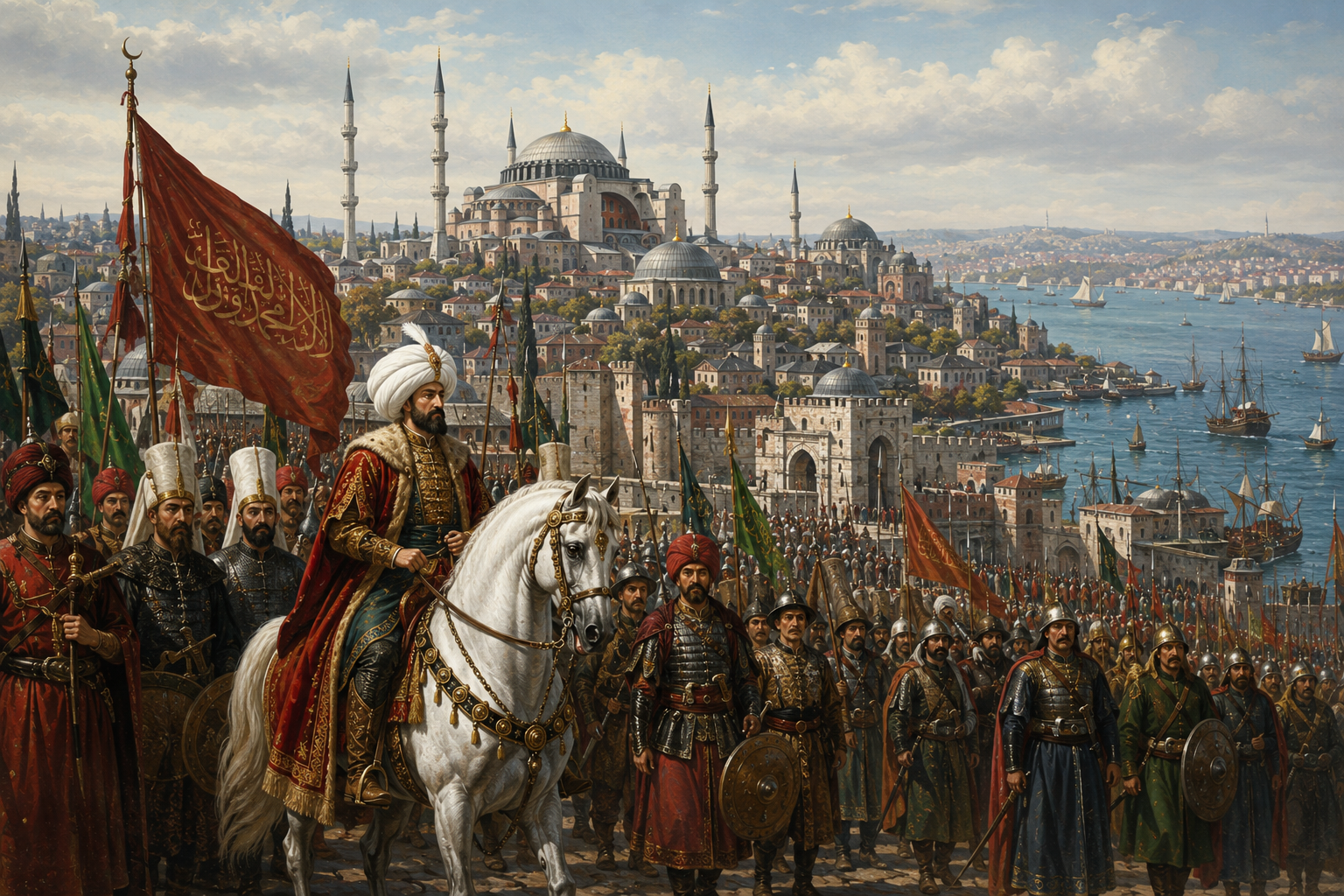
Mehmed II’s capture of Constantinople in 1453 transformed a regional power into an imperial heir to Rome, Byzantium and Islamic sovereignty. This phase connected earlier pressures with later transformation. It shows that historical change is rarely caused by one factor alone. Political ambition, economic interest, social anxiety, cultural memory and institutional weakness often combine before a society recognises that it has entered a new age.
The most important actors were Osman I, Orhan, Murad I, Mehmed II, Selim I, Suleiman the Magnificent, provincial notables, janissaries, ulema, merchants, Balkan Christian communities, Arab elites, reforming sultans, Young Turks and the European powers that pressed against Ottoman frontiers. They acted within frontier expansion, religious legitimacy, military innovation, fiscal pressure, provincial autonomy, European naval and commercial expansion, nationalism, reform from above and the difficulty of governing many peoples through one imperial centre. Their decisions turned possibility into consequence. Some sought reform, others security, conquest, honour or survival. Many believed they were preventing disaster, even when their actions helped produce one.
The significance lies in the relationship between intention and result. People rarely enter history intending to create all the consequences that follow. Yet once systems are mobilised, outcomes escape control. the empire created a durable Afro-Eurasian political order, made Istanbul a major imperial capital, shaped Islamic and Mediterranean history, then fragmented under military defeat, nationalism, debt, reform conflict and the pressures of modern international politics This is why the rise and fall of the Ottoman Empire remains a subject of deep civilisational analysis rather than simple chronology.
Peak: Suleiman and the Classical Imperial Order
Under Suleiman the Magnificent, Ottoman power reached a high point in law, administration, architecture, diplomacy, military reach and imperial prestige. The peak or turning point was the moment when previous tensions became impossible to contain. It did not erase the past; it revealed it. Decisions that once seemed adjustable now appeared urgent. Compromise narrowed. Violence, reform, mobilisation or collapse became the language through which history moved.
At such moments, events acquire symbolic force. A battle, assassination, proclamation, treaty, siege or mobilisation can stand for much larger processes. In the rise and fall of the Ottoman Empire, the turning point mattered because it changed expectations. After it, people no longer believed that the old balance could simply continue. The mental world of politics shifted before institutions had fully adjusted.
The turning point also exposed limits. Military strength had limits, administrative reach had limits, public patience had limits and moral justification had limits. The event became decisive because it made those limits visible. Its significance lies not only in what happened immediately but in what could no longer be believed afterward.
Economic, Social and Cultural Dimensions
Ottoman civilisation rested on land revenue, urban trade, religious pluralism, legal diversity, architectural patronage, craft production and court culture. The social and economic dimensions are essential because high politics always enters ordinary life. Policy becomes taxation, enlistment, hunger, opportunity, migration, censorship, education, debt or death. A decision made in a palace or cabinet room becomes historical only when society absorbs its consequences.
The underlying tensions were frontier expansion, religious legitimacy, military innovation, fiscal pressure, provincial autonomy, European naval and commercial expansion, nationalism, reform from above and the difficulty of governing many peoples through one imperial centre. These pressures were not experienced equally. Elites could describe sacrifice as national necessity while workers, peasants, minorities, colonial subjects or soldiers paid the heavier price. Merchants might benefit from new markets while artisans lost older protections. Families often encountered grand strategy through absence, rationing, mourning or displacement.
Culture also shaped response. Songs, newspapers, sermons, schoolbooks, rumours, rituals and public ceremonies helped people interpret events. They could produce loyalty, resentment, fear or hope. Civilisations do not move by material force alone. They also move by stories that teach people what honour, sacrifice, decline, progress and betrayal are supposed to mean.
The Long Strain: War, Finance and European Competition
From the late sixteenth century onward, the empire faced rising military costs, fiscal stress, shifting trade routes and stronger European rivals. This phase connected earlier pressures with later transformation. It shows that historical change is rarely caused by one factor alone. Political ambition, economic interest, social anxiety, cultural memory and institutional weakness often combine before a society recognises that it has entered a new age.
The most important actors were Osman I, Orhan, Murad I, Mehmed II, Selim I, Suleiman the Magnificent, provincial notables, janissaries, ulema, merchants, Balkan Christian communities, Arab elites, reforming sultans, Young Turks and the European powers that pressed against Ottoman frontiers. They acted within frontier expansion, religious legitimacy, military innovation, fiscal pressure, provincial autonomy, European naval and commercial expansion, nationalism, reform from above and the difficulty of governing many peoples through one imperial centre. Their decisions turned possibility into consequence. Some sought reform, others security, conquest, honour or survival. Many believed they were preventing disaster, even when their actions helped produce one.
The significance lies in the relationship between intention and result. People rarely enter history intending to create all the consequences that follow. Yet once systems are mobilised, outcomes escape control. the empire created a durable Afro-Eurasian political order, made Istanbul a major imperial capital, shaped Islamic and Mediterranean history, then fragmented under military defeat, nationalism, debt, reform conflict and the pressures of modern international politics This is why the rise and fall of the Ottoman Empire remains a subject of deep civilisational analysis rather than simple chronology.
Reform and Resistance: The Tanzimat and the Search for Renewal
Nineteenth-century reformers tried to save the empire by centralising administration, modernising armies, revising law and redefining Ottoman citizenship. This phase connected earlier pressures with later transformation. It shows that historical change is rarely caused by one factor alone. Political ambition, economic interest, social anxiety, cultural memory and institutional weakness often combine before a society recognises that it has entered a new age.
The most important actors were Osman I, Orhan, Murad I, Mehmed II, Selim I, Suleiman the Magnificent, provincial notables, janissaries, ulema, merchants, Balkan Christian communities, Arab elites, reforming sultans, Young Turks and the European powers that pressed against Ottoman frontiers. They acted within frontier expansion, religious legitimacy, military innovation, fiscal pressure, provincial autonomy, European naval and commercial expansion, nationalism, reform from above and the difficulty of governing many peoples through one imperial centre. Their decisions turned possibility into consequence. Some sought reform, others security, conquest, honour or survival. Many believed they were preventing disaster, even when their actions helped produce one.
The significance lies in the relationship between intention and result. People rarely enter history intending to create all the consequences that follow. Yet once systems are mobilised, outcomes escape control. the empire created a durable Afro-Eurasian political order, made Istanbul a major imperial capital, shaped Islamic and Mediterranean history, then fragmented under military defeat, nationalism, debt, reform conflict and the pressures of modern international politics This is why the rise and fall of the Ottoman Empire remains a subject of deep civilisational analysis rather than simple chronology.
Turning Point: Nationalism, Defeat and the Young Turks
Nationalist movements, military defeats and the Young Turk Revolution revealed that reform could not easily hold together all imperial communities. The peak or turning point was the moment when previous tensions became impossible to contain. It did not erase the past; it revealed it. Decisions that once seemed adjustable now appeared urgent. Compromise narrowed. Violence, reform, mobilisation or collapse became the language through which history moved.
At such moments, events acquire symbolic force. A battle, assassination, proclamation, treaty, siege or mobilisation can stand for much larger processes. In the rise and fall of the Ottoman Empire, the turning point mattered because it changed expectations. After it, people no longer believed that the old balance could simply continue. The mental world of politics shifted before institutions had fully adjusted.
The turning point also exposed limits. Military strength had limits, administrative reach had limits, public patience had limits and moral justification had limits. The event became decisive because it made those limits visible. Its significance lies not only in what happened immediately but in what could no longer be believed afterward.
Decline and Impact: World War One and Imperial Dissolution
The First World War turned Ottoman weakness into final collapse, producing occupation, partition, resistance and the end of the sultanate. The aftermath was not a clean ending. Historical consequences usually unfold in layers. Some are visible immediately in treaties, casualties, territorial losses, reforms or political revolutions. Others move more slowly through memory, institutions, class relations, borders, education and national identity.
The broad consequences included this pattern: the empire created a durable Afro-Eurasian political order, made Istanbul a major imperial capital, shaped Islamic and Mediterranean history, then fragmented under military defeat, nationalism, debt, reform conflict and the pressures of modern international politics These outcomes changed the scale of political imagination. People began to ask different questions about sovereignty, citizenship, empire, military service, economic power and moral responsibility. A society that passes through such an upheaval rarely returns to its earlier confidence.
Impact also differed by region and class. The same event could appear as liberation to one group, humiliation to another, tragedy to a third and opportunity to a fourth. That unevenness is central to historical analysis. Civilisation is not a single voice; it is an argument among memories, and the aftermath of the rise and fall of the Ottoman Empire produced many memories at once.
Historical Debates: Decline, Transformation or Adaptation
Historians debate whether Ottoman history should be described as decline, transformation, decentralisation, imperial adaptation or violent modernisation. The rise or development phase shows how scattered forces became a recognisable historical structure. Institutions expanded, military systems changed, economic networks widened and political claims acquired sharper language. In the rise and fall of the Ottoman Empire, development was not a straight road. It involved ambition, accident, adaptation and competition between groups that wanted different futures.
The principal actors were Osman I, Orhan, Murad I, Mehmed II, Selim I, Suleiman the Magnificent, provincial notables, janissaries, ulema, merchants, Balkan Christian communities, Arab elites, reforming sultans, Young Turks and the European powers that pressed against Ottoman frontiers. Each actor operated inside constraints. Rulers needed revenue, soldiers needed supplies, merchants needed security, officials needed obedience and communities needed survival. The relationship between centre and periphery was constantly negotiated. Orders issued from capitals had to pass through provinces, armies, local notables, bureaucrats and social expectations before becoming reality.
This process mattered because it made later turning points possible. No crisis erupts from empty ground. It erupts from systems already under pressure. The institutions, routes, alliances, weapons, assumptions and social habits built during the development phase created both strength and vulnerability. What looked like consolidation in one generation could become overextension in the next.
Legacy: The Ottoman Past in the Modern Middle East and Balkans
The empire’s legacy survives in borders, cities, legal memories, religious institutions, migration histories and arguments about identity across many modern states. The legacy of the rise and fall of the Ottoman Empire survives because it changed the vocabulary of power. Later generations used it to explain decline, courage, failure, injustice, endurance, reform or national destiny. It became a reference point not merely because it happened, but because it helped societies interpret what had happened to them.
The deeper lesson is this: the Ottoman story shows that empires rise through flexibility and frontier energy but decline when institutions that once solved problems become too rigid, expensive or contested for a changing world That lesson remains powerful because it reaches beyond one period. It shows how institutions can outlive their usefulness, how fear can accelerate decisions, how technology can alter moral experience and how ordinary people can carry the cost of ambitions framed in grand language.
A powerful conclusion must therefore avoid easy closure. The subject remains important because it continues to ask uncomfortable questions. How do empires manage diversity? How do alliances turn insecurity into disaster? How does modern war enter the human body and mind? The past does not repeat mechanically, but it leaves patterns. To study those patterns is to take civilisation seriously.
Final Reflection: Why the Ottoman Story Still Matters
The Ottoman Empire matters because it shows how a civilisation can be both durable and fragile, plural and coercive, adaptive and burdened by its own scale. The legacy of the rise and fall of the Ottoman Empire survives because it changed the vocabulary of power. Later generations used it to explain decline, courage, failure, injustice, endurance, reform or national destiny. It became a reference point not merely because it happened, but because it helped societies interpret what had happened to them.
The deeper lesson is this: the Ottoman story shows that empires rise through flexibility and frontier energy but decline when institutions that once solved problems become too rigid, expensive or contested for a changing world That lesson remains powerful because it reaches beyond one period. It shows how institutions can outlive their usefulness, how fear can accelerate decisions, how technology can alter moral experience and how ordinary people can carry the cost of ambitions framed in grand language.
A powerful conclusion must therefore avoid easy closure. The subject remains important because it continues to ask uncomfortable questions. How do empires manage diversity? How do alliances turn insecurity into disaster? How does modern war enter the human body and mind? The past does not repeat mechanically, but it leaves patterns. To study those patterns is to take civilisation seriously.
Source-Based Chronology and Evidence Notes
A reliable chronology places the Ottoman emergence in northwestern Anatolia around the late thirteenth century, the conquest of Constantinople in 1453, the classical high point in the sixteenth century and the abolition of the sultanate in 1922. This long duration is central to interpretation. The empire was not a short episode of conquest but a flexible political organism that repeatedly remade itself in response to military, fiscal and diplomatic change.
The empire’s end after the First World War should not be read as proof that it had been dying in a simple straight line for centuries. It survived many crises through reform, negotiation and coercion. Its final dissolution came when global war, nationalism, European intervention, internal centralisation and military defeat converged. That convergence made the old imperial framework impossible to preserve in its previous form.
Comparative Imperial Analysis
The Ottoman Empire can be compared with the Roman, Byzantine, Habsburg and British empires, but its structure was distinctive. It governed Muslims, Christians and Jews through a combination of dynasty, military service, religious authority, negotiated community rights and provincial compromise. Its durability came from not forcing every region into one uniform model. That flexibility helped it survive across many languages and landscapes, but it also made later centralisation difficult when modern nationalism demanded sharper political identities.
This comparison reveals a central paradox. Premodern imperial flexibility could be a strength, yet modern states increasingly demanded standard law, standard schooling, standard citizenship, standard armies and standard loyalty. The Ottoman centre tried to create a more uniform state through reform, but uniformity could appear as oppression to communities that had once negotiated autonomy. Modernisation therefore did not simply save the empire. It also destabilised older balances.
The Human Experience of Imperial Dissolution
The fall of the Ottoman Empire was not only a diplomatic event. It was lived as migration, massacre, famine, conscription, refugee movement, property loss, identity change and memory. Families that had lived under one imperial order found themselves inside new borders and new national projects. Some celebrated liberation; others experienced dispossession. The same historical process could produce independence for one community and catastrophe for another.
This human dimension is essential because imperial collapse is often described through maps. Maps show territory changing colour, but they do not show fear at railway stations, abandoned villages, orphaned children, soldiers returning to a state that no longer exists or merchants discovering that old routes have become international borders. The Ottoman ending remade daily life across the Balkans, Anatolia and the Middle East.
Comparative Imperial Analysis - Further Analysis
The Ottoman Empire can be compared with the Roman, Byzantine, Habsburg and British empires, but its structure was distinctive. It governed Muslims, Christians and Jews through a combination of dynasty, military service, religious authority, negotiated community rights and provincial compromise. Its durability came from not forcing every region into one uniform model. That flexibility helped it survive across many languages and landscapes, but it also made later centralisation difficult when modern nationalism demanded sharper political identities.
This comparison reveals a central paradox. Premodern imperial flexibility could be a strength, yet modern states increasingly demanded standard law, standard schooling, standard citizenship, standard armies and standard loyalty. The Ottoman centre tried to create a more uniform state through reform, but uniformity could appear as oppression to communities that had once negotiated autonomy. Modernisation therefore did not simply save the empire. It also destabilised older balances.
The Human Experience of Imperial Dissolution - Further Analysis
The fall of the Ottoman Empire was not only a diplomatic event. It was lived as migration, massacre, famine, conscription, refugee movement, property loss, identity change and memory. Families that had lived under one imperial order found themselves inside new borders and new national projects. Some celebrated liberation; others experienced dispossession. The same historical process could produce independence for one community and catastrophe for another.
This human dimension is essential because imperial collapse is often described through maps. Maps show territory changing colour, but they do not show fear at railway stations, abandoned villages, orphaned children, soldiers returning to a state that no longer exists or merchants discovering that old routes have become international borders. The Ottoman ending remade daily life across the Balkans, Anatolia and the Middle East.
Comparative Imperial Analysis - Further Analysis
The Ottoman Empire can be compared with the Roman, Byzantine, Habsburg and British empires, but its structure was distinctive. It governed Muslims, Christians and Jews through a combination of dynasty, military service, religious authority, negotiated community rights and provincial compromise. Its durability came from not forcing every region into one uniform model. That flexibility helped it survive across many languages and landscapes, but it also made later centralisation difficult when modern nationalism demanded sharper political identities.
This comparison reveals a central paradox. Premodern imperial flexibility could be a strength, yet modern states increasingly demanded standard law, standard schooling, standard citizenship, standard armies and standard loyalty. The Ottoman centre tried to create a more uniform state through reform, but uniformity could appear as oppression to communities that had once negotiated autonomy. Modernisation therefore did not simply save the empire. It also destabilised older balances.
The Human Experience of Imperial Dissolution - Further Analysis
The fall of the Ottoman Empire was not only a diplomatic event. It was lived as migration, massacre, famine, conscription, refugee movement, property loss, identity change and memory. Families that had lived under one imperial order found themselves inside new borders and new national projects. Some celebrated liberation; others experienced dispossession. The same historical process could produce independence for one community and catastrophe for another.
This human dimension is essential because imperial collapse is often described through maps. Maps show territory changing colour, but they do not show fear at railway stations, abandoned villages, orphaned children, soldiers returning to a state that no longer exists or merchants discovering that old routes have become international borders. The Ottoman ending remade daily life across the Balkans, Anatolia and the Middle East.
Comparative Imperial Analysis - Further Analysis
The Ottoman Empire can be compared with the Roman, Byzantine, Habsburg and British empires, but its structure was distinctive. It governed Muslims, Christians and Jews through a combination of dynasty, military service, religious authority, negotiated community rights and provincial compromise. Its durability came from not forcing every region into one uniform model. That flexibility helped it survive across many languages and landscapes, but it also made later centralisation difficult when modern nationalism demanded sharper political identities.
This comparison reveals a central paradox. Premodern imperial flexibility could be a strength, yet modern states increasingly demanded standard law, standard schooling, standard citizenship, standard armies and standard loyalty. The Ottoman centre tried to create a more uniform state through reform, but uniformity could appear as oppression to communities that had once negotiated autonomy. Modernisation therefore did not simply save the empire. It also destabilised older balances.
The Human Experience of Imperial Dissolution - Further Analysis
The fall of the Ottoman Empire was not only a diplomatic event. It was lived as migration, massacre, famine, conscription, refugee movement, property loss, identity change and memory. Families that had lived under one imperial order found themselves inside new borders and new national projects. Some celebrated liberation; others experienced dispossession. The same historical process could produce independence for one community and catastrophe for another.
This human dimension is essential because imperial collapse is often described through maps. Maps show territory changing colour, but they do not show fear at railway stations, abandoned villages, orphaned children, soldiers returning to a state that no longer exists or merchants discovering that old routes have become international borders. The Ottoman ending remade daily life across the Balkans, Anatolia and the Middle East.