A Drug, an Empire and a Civilisational Shock
The Opium Wars began as a conflict over a drug, but they became a civilisational shock because they exposed how commercial pressure could break an old imperial order. This was the moment when accumulated pressure became open confrontation. Political language hardened into action, and decisions that had once been debated in courts, councils or party circles were now tested in streets, ports, battlefields and barracks.
The principal actors were the Qing court, Commissioner Lin Zexu, British merchants, the East India Company’s commercial legacy, naval commanders, treaty negotiators, Chinese officials, Canton traders and ordinary communities caught inside the violence of unequal exchange. None of them controlled the whole field. Each acted under pressure, with imperfect information and competing fears. Military power, popular anger, elite calculation and ideological conviction moved together, creating a crisis that no single institution could easily contain.
The event mattered because it changed what seemed possible. After it, older compromises looked weaker and more radical solutions became imaginable. The immediate outcome was dramatic, but the deeper consequence was psychological: people learned that the old order could be forced, broken or remade.
Time and Place: Qing China Meets Industrial Britain
The wars unfolded between Qing China and Western imperial powers at a moment when Britain possessed industrial finance, naval reach and a powerful belief in commercial access. The geography of Qing China, the Canton trade system, the South China coast and the expanding British imperial world mattered because events did not unfold in empty space. Ports, capitals, roads, frontiers, villages and military corridors shaped what rulers could command and what ordinary people could endure. During the nineteenth century, especially the decades from the 1830s to the 1860s, the meaning of distance changed as armies, ships, railways, telegraphs, pamphlets and diplomatic missions compressed older worlds into more urgent contact.
Time also mattered. The crisis was not born in one day. Earlier institutions had once appeared stable, but by this period their weaknesses became more visible. Old rules continued to speak in the language of order, hierarchy and legitimacy, while new forces pressed with the language of trade, reform, nation, class or revolution. The result was a historical setting in which inherited authority had to answer questions it was not designed to solve.
This setting explains why the Opium Wars and their consequences became more than a local disturbance. It exposed the gap between an older political imagination and a world increasingly shaped by mobility, mass pressure and unequal power. To understand what followed, one must see the landscape itself as an actor: rivers, ports, capitals, industrial centres and frontiers became instruments through which history moved.
The Canton System and the Controlled World of Trade
Before the crisis, foreign trade with China was concentrated through Canton under restrictions that protected Qing authority while frustrating Western merchants. Every major turning point rests on a prior structure. In the Opium Wars and their consequences, the older order had its own logic: it promised stability, hierarchy and continuity. Its rulers did not think of themselves as waiting for collapse. They believed they were preserving a workable system against disorder.
Yet the same structure carried hidden weaknesses. The imbalance between chinese sovereignty and british commercial expansion, the social damage of opium addiction, the silver drain from china, the limits of the canton system, the ideology of free trade and the military gap between qing coastal defence and industrial naval power made the inherited order increasingly brittle. Institutions that functioned in one era could become obstacles in another. Practices once seen as prudent began to look defensive, slow or unjust when external pressure and internal grievance rose together.
The background is therefore not a passive prelude. It explains why later events became so disruptive. When the crisis came, it did not merely challenge a policy; it challenged the assumptions that had allowed society to understand authority, obedience, trade, status and security.
Tea, Silver and the Commercial Problem
British demand for Chinese tea, silk and porcelain created a trade imbalance that British merchants increasingly tried to solve through the opium trade. In the Opium Wars and their consequences, this phase connected earlier tensions with later transformation. It was one part of a wider historical movement in which institutions, social groups and political ideas were forced to adjust to conditions they could no longer ignore.
The actors involved included the Qing court, Commissioner Lin Zexu, British merchants, the East India Company’s commercial legacy, naval commanders, treaty negotiators, Chinese officials, Canton traders and ordinary communities caught inside the violence of unequal exchange. Their choices were shaped by the imbalance between Chinese sovereignty and British commercial expansion, the social damage of opium addiction, the silver drain from China, the limits of the Canton system, the ideology of free trade and the military gap between Qing coastal defence and industrial naval power. History at this level is never only the biography of leaders. It is also the story of administrative limits, economic interests, social pressures and cultural expectations that narrow or widen the choices available to decision-makers.
The consequences were substantial: China lost control over key commercial terms, Hong Kong was ceded to Britain, treaty ports opened, extraterritorial privileges expanded and later powers used the precedent to force further concessions. The enduring meaning lies in the way this episode revealed the fragility of older arrangements and the force of new historical demands. The wars became a central symbol of China’s ‘century of humiliation’ and a warning about what happens when imperial commerce is backed by gunboats.
Opium as Commodity and Social Crisis
Opium was not merely an imported good; it became a social, fiscal and administrative crisis that alarmed officials and damaged households across parts of Chinese society. The social dimension is essential because high politics never remains confined to palaces, ministries or diplomatic tables. It enters households, workplaces, markets, schools, farms, ports and military camps. Ordinary people experience transformation not as an abstract process but as changed prices, changed duties, changed laws and changed fears.
The deeper tensions were the imbalance between Chinese sovereignty and British commercial expansion, the social damage of opium addiction, the silver drain from China, the limits of the Canton system, the ideology of free trade and the military gap between Qing coastal defence and industrial naval power. These tensions were lived unevenly. Merchants could see opportunity where officials saw danger. Soldiers could see betrayal where politicians saw necessity. Peasants, workers, families and local communities often carried the heaviest burdens while elites argued over the language of national interest or historical destiny.
That is why the social history of the Opium Wars and their consequences cannot be treated as secondary. It reveals the cost of transformation. A civilisation changes not only when borders move or rulers fall, but when daily routines, loyalties, identities and expectations are reorganised around new forms of power.
Lin Zexu and the Moral Authority of Suppression
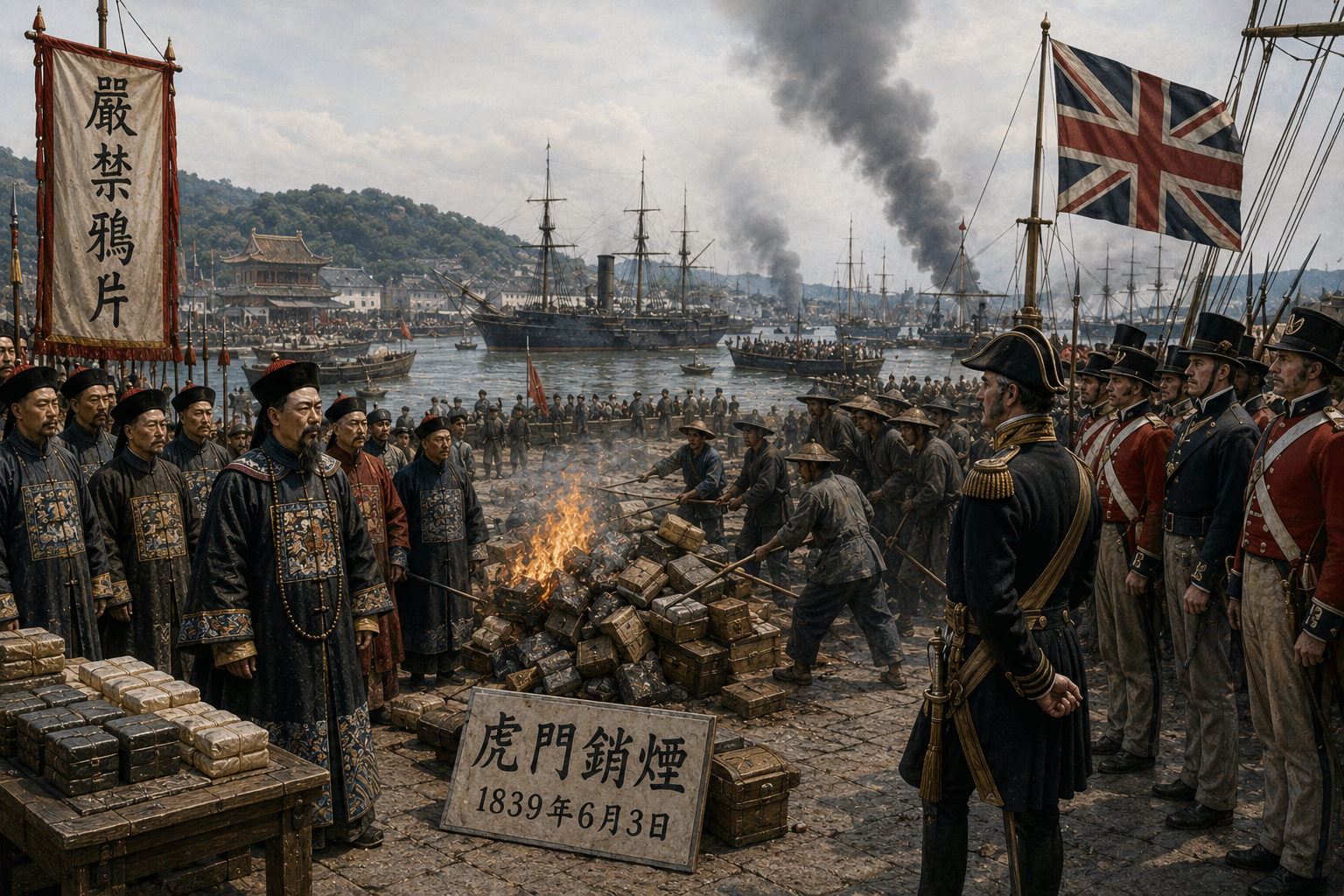
Commissioner Lin Zexu represented the Qing state’s attempt to defend moral order and sovereignty by confiscating and destroying opium at Canton. In the Opium Wars and their consequences, this phase connected earlier tensions with later transformation. It was one part of a wider historical movement in which institutions, social groups and political ideas were forced to adjust to conditions they could no longer ignore.
The actors involved included the Qing court, Commissioner Lin Zexu, British merchants, the East India Company’s commercial legacy, naval commanders, treaty negotiators, Chinese officials, Canton traders and ordinary communities caught inside the violence of unequal exchange. Their choices were shaped by the imbalance between Chinese sovereignty and British commercial expansion, the social damage of opium addiction, the silver drain from China, the limits of the Canton system, the ideology of free trade and the military gap between Qing coastal defence and industrial naval power. History at this level is never only the biography of leaders. It is also the story of administrative limits, economic interests, social pressures and cultural expectations that narrow or widen the choices available to decision-makers.
The consequences were substantial: China lost control over key commercial terms, Hong Kong was ceded to Britain, treaty ports opened, extraterritorial privileges expanded and later powers used the precedent to force further concessions. The enduring meaning lies in the way this episode revealed the fragility of older arrangements and the force of new historical demands. The wars became a central symbol of China’s ‘century of humiliation’ and a warning about what happens when imperial commerce is backed by gunboats.
The First Opium War: Naval Power Against Imperial Confidence
The First Opium War showed how industrial naval firepower and mobile expeditionary warfare could defeat a much older imperial defence system. This was the moment when accumulated pressure became open confrontation. Political language hardened into action, and decisions that had once been debated in courts, councils or party circles were now tested in streets, ports, battlefields and barracks.
The principal actors were the Qing court, Commissioner Lin Zexu, British merchants, the East India Company’s commercial legacy, naval commanders, treaty negotiators, Chinese officials, Canton traders and ordinary communities caught inside the violence of unequal exchange. None of them controlled the whole field. Each acted under pressure, with imperfect information and competing fears. Military power, popular anger, elite calculation and ideological conviction moved together, creating a crisis that no single institution could easily contain.
The event mattered because it changed what seemed possible. After it, older compromises looked weaker and more radical solutions became imaginable. The immediate outcome was dramatic, but the deeper consequence was psychological: people learned that the old order could be forced, broken or remade.
The Treaty of Nanjing and the Opening of Ports
The Treaty of Nanjing ended the first war but opened a new era of treaty-port capitalism, territorial loss and diplomatic humiliation. Legal documents often appear calm, but they are frequently the written surface of coercion and compromise. Treaties, constitutions and proclamations translate conflict into clauses, offices, rights and obligations. They give a crisis a new institutional form.
In the Opium Wars and their consequences, formal language became a tool for reorganising power. Some clauses strengthened the state; others limited sovereignty; some promised representation; others created hierarchy beneath the appearance of order. The text mattered because it converted victory, fear or reform into rules that people had to live under.
This is why documents in history must be read politically. They do not merely record decisions; they redistribute authority. They decide who can trade, who can command, who can be punished, who can speak and who must obey. Their consequences often outlive the men who sign them.
Between the Wars: Unequal Treaties and Growing Pressure
The years after the first war did not restore balance; instead, foreign privileges, missionary activity, commercial demands and Qing weakness deepened tension. This was the moment when accumulated pressure became open confrontation. Political language hardened into action, and decisions that had once been debated in courts, councils or party circles were now tested in streets, ports, battlefields and barracks.
The principal actors were the Qing court, Commissioner Lin Zexu, British merchants, the East India Company’s commercial legacy, naval commanders, treaty negotiators, Chinese officials, Canton traders and ordinary communities caught inside the violence of unequal exchange. None of them controlled the whole field. Each acted under pressure, with imperfect information and competing fears. Military power, popular anger, elite calculation and ideological conviction moved together, creating a crisis that no single institution could easily contain.
The event mattered because it changed what seemed possible. After it, older compromises looked weaker and more radical solutions became imaginable. The immediate outcome was dramatic, but the deeper consequence was psychological: people learned that the old order could be forced, broken or remade.
The Second Opium War and the Expansion of Coercion
The Second Opium War extended the logic of coercion, involving Britain and France and forcing China into further commercial and diplomatic concessions. This was the moment when accumulated pressure became open confrontation. Political language hardened into action, and decisions that had once been debated in courts, councils or party circles were now tested in streets, ports, battlefields and barracks.
The principal actors were the Qing court, Commissioner Lin Zexu, British merchants, the East India Company’s commercial legacy, naval commanders, treaty negotiators, Chinese officials, Canton traders and ordinary communities caught inside the violence of unequal exchange. None of them controlled the whole field. Each acted under pressure, with imperfect information and competing fears. Military power, popular anger, elite calculation and ideological conviction moved together, creating a crisis that no single institution could easily contain.
The event mattered because it changed what seemed possible. After it, older compromises looked weaker and more radical solutions became imaginable. The immediate outcome was dramatic, but the deeper consequence was psychological: people learned that the old order could be forced, broken or remade.
The Burning of the Summer Palace
The destruction of the Old Summer Palace became one of the most powerful symbols of imperial violence and cultural humiliation in modern Chinese memory. This was the moment when accumulated pressure became open confrontation. Political language hardened into action, and decisions that had once been debated in courts, councils or party circles were now tested in streets, ports, battlefields and barracks.
The principal actors were the Qing court, Commissioner Lin Zexu, British merchants, the East India Company’s commercial legacy, naval commanders, treaty negotiators, Chinese officials, Canton traders and ordinary communities caught inside the violence of unequal exchange. None of them controlled the whole field. Each acted under pressure, with imperfect information and competing fears. Military power, popular anger, elite calculation and ideological conviction moved together, creating a crisis that no single institution could easily contain.
The event mattered because it changed what seemed possible. After it, older compromises looked weaker and more radical solutions became imaginable. The immediate outcome was dramatic, but the deeper consequence was psychological: people learned that the old order could be forced, broken or remade.
Political and Economic Consequences for China
The wars weakened Qing sovereignty, strained state finance, intensified foreign penetration and complicated China’s attempts to manage rebellion and reform. The social dimension is essential because high politics never remains confined to palaces, ministries or diplomatic tables. It enters households, workplaces, markets, schools, farms, ports and military camps. Ordinary people experience transformation not as an abstract process but as changed prices, changed duties, changed laws and changed fears.
The deeper tensions were the imbalance between Chinese sovereignty and British commercial expansion, the social damage of opium addiction, the silver drain from China, the limits of the Canton system, the ideology of free trade and the military gap between Qing coastal defence and industrial naval power. These tensions were lived unevenly. Merchants could see opportunity where officials saw danger. Soldiers could see betrayal where politicians saw necessity. Peasants, workers, families and local communities often carried the heaviest burdens while elites argued over the language of national interest or historical destiny.
That is why the social history of the Opium Wars and their consequences cannot be treated as secondary. It reveals the cost of transformation. A civilisation changes not only when borders move or rulers fall, but when daily routines, loyalties, identities and expectations are reorganised around new forms of power.
Social and Cultural Consequences
The wars changed everyday life in treaty ports, shaped new missionary and merchant worlds, and generated anger over foreign privilege and cultural intrusion. The social dimension is essential because high politics never remains confined to palaces, ministries or diplomatic tables. It enters households, workplaces, markets, schools, farms, ports and military camps. Ordinary people experience transformation not as an abstract process but as changed prices, changed duties, changed laws and changed fears.
The deeper tensions were the imbalance between Chinese sovereignty and British commercial expansion, the social damage of opium addiction, the silver drain from China, the limits of the Canton system, the ideology of free trade and the military gap between Qing coastal defence and industrial naval power. These tensions were lived unevenly. Merchants could see opportunity where officials saw danger. Soldiers could see betrayal where politicians saw necessity. Peasants, workers, families and local communities often carried the heaviest burdens while elites argued over the language of national interest or historical destiny.
That is why the social history of the Opium Wars and their consequences cannot be treated as secondary. It reveals the cost of transformation. A civilisation changes not only when borders move or rulers fall, but when daily routines, loyalties, identities and expectations are reorganised around new forms of power.
Historical Debates: Free Trade, Drug War or Imperial Aggression?
Historians debate whether the wars should be understood primarily as conflicts over opium, free trade, sovereignty, imperialism or the uneven encounter between industrial and agrarian empires. This was the moment when accumulated pressure became open confrontation. Political language hardened into action, and decisions that had once been debated in courts, councils or party circles were now tested in streets, ports, battlefields and barracks.
The principal actors were the Qing court, Commissioner Lin Zexu, British merchants, the East India Company’s commercial legacy, naval commanders, treaty negotiators, Chinese officials, Canton traders and ordinary communities caught inside the violence of unequal exchange. None of them controlled the whole field. Each acted under pressure, with imperfect information and competing fears. Military power, popular anger, elite calculation and ideological conviction moved together, creating a crisis that no single institution could easily contain.
The event mattered because it changed what seemed possible. After it, older compromises looked weaker and more radical solutions became imaginable. The immediate outcome was dramatic, but the deeper consequence was psychological: people learned that the old order could be forced, broken or remade.
Turning Point in World History
The Opium Wars marked a turning point because they revealed that the nineteenth-century world order would increasingly be shaped by industrial power, maritime coercion and unequal treaties. The legacy of the Opium Wars and their consequences survives because it changed the vocabulary of power. Later generations used it to think about sovereignty, reform, revolution, humiliation, progress and national survival. It became a reference point through which societies explained their wounds and ambitions.
The long consequences included this broad pattern: China lost control over key commercial terms, Hong Kong was ceded to Britain, treaty ports opened, extraterritorial privileges expanded and later powers used the precedent to force further concessions. These outcomes did not remain confined to the original period. They shaped institutions, political memory, international relations and the moral stories that communities told about themselves.
The final lesson is not that history moves in a straight line. The wars became a central symbol of China’s ‘century of humiliation’ and a warning about what happens when imperial commerce is backed by gunboats. The episode shows how civilisations are remade through pressure, conflict and interpretation. Its importance lies in the fact that it still helps explain how power enters society and how society remembers power.
Legacy: The Memory of Humiliation and Sovereignty
The legacy of the Opium Wars continues because they remain bound to questions of sovereignty, national revival, colonial memory and the moral limits of global commerce. The legacy of the Opium Wars and their consequences survives because it changed the vocabulary of power. Later generations used it to think about sovereignty, reform, revolution, humiliation, progress and national survival. It became a reference point through which societies explained their wounds and ambitions.
The long consequences included this broad pattern: China lost control over key commercial terms, Hong Kong was ceded to Britain, treaty ports opened, extraterritorial privileges expanded and later powers used the precedent to force further concessions. These outcomes did not remain confined to the original period. They shaped institutions, political memory, international relations and the moral stories that communities told about themselves.
The final lesson is not that history moves in a straight line. The wars became a central symbol of China’s ‘century of humiliation’ and a warning about what happens when imperial commerce is backed by gunboats. The episode shows how civilisations are remade through pressure, conflict and interpretation. Its importance lies in the fact that it still helps explain how power enters society and how society remembers power.
Final Reflection: When Commerce Became Conquest
The Opium Wars teach that trade is never innocent when backed by military force and unequal power; commerce can become conquest without formally calling itself empire. This was the moment when accumulated pressure became open confrontation. Political language hardened into action, and decisions that had once been debated in courts, councils or party circles were now tested in streets, ports, battlefields and barracks.
The principal actors were the Qing court, Commissioner Lin Zexu, British merchants, the East India Company’s commercial legacy, naval commanders, treaty negotiators, Chinese officials, Canton traders and ordinary communities caught inside the violence of unequal exchange. None of them controlled the whole field. Each acted under pressure, with imperfect information and competing fears. Military power, popular anger, elite calculation and ideological conviction moved together, creating a crisis that no single institution could easily contain.
The event mattered because it changed what seemed possible. After it, older compromises looked weaker and more radical solutions became imaginable. The immediate outcome was dramatic, but the deeper consequence was psychological: people learned that the old order could be forced, broken or remade.
Source-Based Chronology and Interpretive Notes
The First Opium War is usually dated from 1839 to 1842, ending with the Treaty of Nanjing. The Second Opium War is usually dated from 1856 to 1860, ending with further treaties and the entry of foreign diplomats into a transformed diplomatic landscape. These dates matter because they show escalation rather than a single isolated event. The first war forced open ports and ceded Hong Kong; the second widened foreign access, deepened treaty rights and made imperial coercion an enduring feature of China’s nineteenth-century experience.
Commissioner Lin Zexu has remained central to the moral memory of the crisis because he saw opium not as a normal commodity but as poison to society and threat to state sovereignty. British officials and merchants presented the conflict in the language of property, trade and diplomatic equality, yet that language avoided the deeper ethical problem: a narcotic trade defended by naval power was being used to force open a civilisation that had not accepted Western commercial terms. The clash was therefore legal, moral, economic and imperial at once.
The Opium Wars also reshaped China’s relationship with modernity. Reformers later looked back on them as proof that China needed military, educational, diplomatic and industrial renewal. Conservatives saw them as evidence of foreign greed and internal weakness. Nationalists treated them as the beginning of humiliation that had to be overcome. In each interpretation, the wars became more than nineteenth-century conflicts. They became a historical mirror in which China measured sovereignty, weakness, reform and revival.
Comparison With Other Imperial Encounters
The Opium Wars can be compared with other nineteenth-century imperial encounters, but they also had a distinct character. In India, Britain often expanded through company rule, revenue systems and alliances before assuming direct imperial control. In China, formal colonisation of the whole country did not occur, but treaty privileges, ports, indemnities and legal exemptions created a semi-colonial pressure zone. This made the Chinese case different: sovereignty survived in name and structure, yet its exercise was repeatedly constrained by foreign demands. The humiliation lay not only in defeat but in the forced rearrangement of sovereignty itself.
This distinction shaped later Chinese political thought. Reformers did not simply ask how to defeat an invader; they asked how to restore autonomy in a world where law, commerce, finance and diplomacy had become instruments of pressure. The lesson was that a civilisation could be weakened without being fully conquered. It could retain emperors, officials and rituals while losing control over ports, tariffs and legal jurisdiction. That is why the Opium Wars occupy such an important place in the history of modern sovereignty.
The Human Cost Behind Treaty Language
Treaties often make violence look orderly. They reduce war to clauses, ports, indemnities and diplomatic privileges. Yet behind the treaty language of the Opium Wars stood displaced families, addicted communities, dead soldiers, humiliated officials, disrupted merchants and ordinary people forced to live in a changed world. The human cost was not limited to battlefields. It entered households through addiction, taxation, social anxiety and the sense that the state could no longer protect its people from external coercion.
This human dimension is essential because the wars are sometimes described too abstractly as trade disputes. A trade dispute becomes historically different when one side uses military force to defend access to a harmful commodity and then imposes legal privileges after victory. The moral problem of the Opium Wars therefore lies in the relationship between profit and coercion. They are a reminder that economic history without human suffering becomes incomplete and dangerously clean.
Comparison With Other Imperial Encounters
The Opium Wars can be compared with other nineteenth-century imperial encounters, but they also had a distinct character. In India, Britain often expanded through company rule, revenue systems and alliances before assuming direct imperial control. In China, formal colonisation of the whole country did not occur, but treaty privileges, ports, indemnities and legal exemptions created a semi-colonial pressure zone. This made the Chinese case different: sovereignty survived in name and structure, yet its exercise was repeatedly constrained by foreign demands. The humiliation lay not only in defeat but in the forced rearrangement of sovereignty itself.
This distinction shaped later Chinese political thought. Reformers did not simply ask how to defeat an invader; they asked how to restore autonomy in a world where law, commerce, finance and diplomacy had become instruments of pressure. The lesson was that a civilisation could be weakened without being fully conquered. It could retain emperors, officials and rituals while losing control over ports, tariffs and legal jurisdiction. That is why the Opium Wars occupy such an important place in the history of modern sovereignty.
The Human Cost Behind Treaty Language
Treaties often make violence look orderly. They reduce war to clauses, ports, indemnities and diplomatic privileges. Yet behind the treaty language of the Opium Wars stood displaced families, addicted communities, dead soldiers, humiliated officials, disrupted merchants and ordinary people forced to live in a changed world. The human cost was not limited to battlefields. It entered households through addiction, taxation, social anxiety and the sense that the state could no longer protect its people from external coercion.
This human dimension is essential because the wars are sometimes described too abstractly as trade disputes. A trade dispute becomes historically different when one side uses military force to defend access to a harmful commodity and then imposes legal privileges after victory. The moral problem of the Opium Wars therefore lies in the relationship between profit and coercion. They are a reminder that economic history without human suffering becomes incomplete and dangerously clean.
Comparison With Other Imperial Encounters
The Opium Wars can be compared with other nineteenth-century imperial encounters, but they also had a distinct character. In India, Britain often expanded through company rule, revenue systems and alliances before assuming direct imperial control. In China, formal colonisation of the whole country did not occur, but treaty privileges, ports, indemnities and legal exemptions created a semi-colonial pressure zone. This made the Chinese case different: sovereignty survived in name and structure, yet its exercise was repeatedly constrained by foreign demands. The humiliation lay not only in defeat but in the forced rearrangement of sovereignty itself.
This distinction shaped later Chinese political thought. Reformers did not simply ask how to defeat an invader; they asked how to restore autonomy in a world where law, commerce, finance and diplomacy had become instruments of pressure. The lesson was that a civilisation could be weakened without being fully conquered. It could retain emperors, officials and rituals while losing control over ports, tariffs and legal jurisdiction. That is why the Opium Wars occupy such an important place in the history of modern sovereignty.