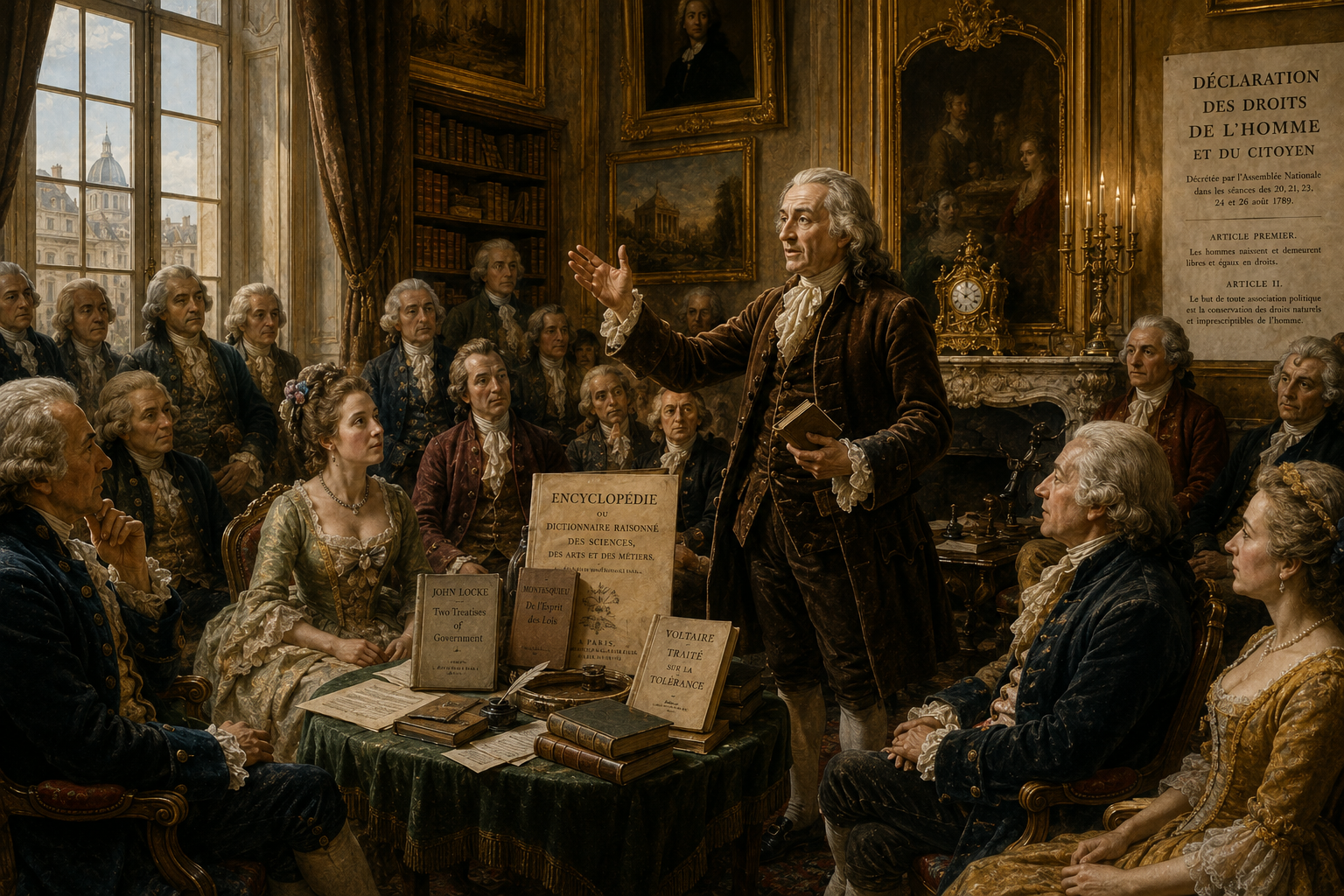
Reason Enters the Public Square
The Enlightenment was not simply a period when Europeans became more rational. Human beings had reasoned for millennia. What made the Enlightenment distinctive was the public confidence that reason could examine almost everything: government, religion, law, economy, education, punishment, science, gender, slavery and human nature itself. It was a cultural movement in which inherited authority was asked to justify itself before the court of criticism.
Its power came from a new tone of intellectual courage. Philosophers, essayists, scientists, political reformers and salon writers asked whether monarchy was natural, whether religious persecution was moral, whether torture was just, whether women should be educated, whether commerce could civilise manners, whether progress was possible and whether human beings possessed rights prior to government. Not every Enlightenment thinker agreed. The movement was full of contradictions. But the shared impulse was unmistakable: the world should not be accepted merely because it had been inherited.
That is why the Enlightenment became one of the great turning points in modern civilisation. It did not create modern democracy by itself, and many Enlightenment figures remained elitist, colonial or patriarchal. Yet it changed the language in which power had to defend itself. Rulers could no longer rely only on tradition. They increasingly had to speak of reform, utility, rights, reason and improvement.
Time, Place and the Age of Reason
The Enlightenment belongs mainly to the seventeenth and eighteenth centuries, with its strongest public force in the eighteenth-century Atlantic and European world. Its centres included France, Britain, Scotland, the Dutch Republic, German-speaking lands, Italy, Switzerland and the American colonies. Britannica describes the Enlightenment as a European intellectual movement of the seventeenth and eighteenth centuries that synthesised ideas about God, reason, nature and humanity into a worldview that inspired developments in art, philosophy and politics.
The phrase “Age of Reason” captures part of the movement, but not all of it. The Stanford Encyclopedia of Philosophy notes that enthusiasm for human reason was central, yet empiricism and scientific method were also characteristic of the period. Enlightenment thought was not pure abstract rationalism. It drew energy from Newtonian science, Locke’s empiricism, religious dissent, commercial society, print culture and political crisis.
The Enlightenment also travelled beyond Europe. Its ideas shaped revolutionary movements in North America, Haiti, Latin America and later anti-colonial thought. But its global history is contradictory. European thinkers spoke of universal rights while European empires expanded slavery and colonial domination. The Enlightenment was therefore not a clean moral victory. It was a powerful language of emancipation born inside an unequal world.
Before the Enlightenment: Crisis of Authority
The Enlightenment emerged from a Europe shaken by religious war, scientific change, dynastic conflict and expanding commerce. The Protestant Reformation had fractured Western Christendom. The Thirty Years’ War devastated central Europe. Confessional conflict made many thinkers ask whether religious certainty could coexist with civil peace. If every church claimed exclusive truth, how could societies avoid endless violence?
The Scientific Revolution also transformed intellectual expectations. Newtonian physics suggested that nature followed laws accessible to reason. If the heavens could be explained without constant appeal to mystery, perhaps society could also be studied through general principles. Political economy, moral philosophy and social theory began to imitate the clarity associated with natural science.
Political events mattered as well. The English Civil War, the execution of Charles I, the Glorious Revolution and debates over sovereignty raised urgent questions about monarchy, consent and rights. Commercial expansion created new urban publics: merchants, professionals, readers, coffeehouse debaters and newspaper consumers. Print made criticism portable. Ideas that once circulated in elite manuscripts could reach broader audiences.
The Enlightenment therefore did not arise because thinkers suddenly became bold. It arose because older forms of authority had been destabilised. Church, monarchy and tradition still mattered, but they no longer seemed beyond question. A space opened for critique.
Locke, Experience and the Language of Rights
John Locke was one of the central figures in the intellectual background of the Enlightenment. His theory of knowledge emphasised experience rather than innate ideas, giving later thinkers a powerful model of the mind as shaped by sensation, reflection and education. If human beings were formed by experience, then institutions mattered. Bad laws, bad education and bad governments could deform people; better arrangements might improve them.
Locke’s political theory was equally influential. In his writings on government, he argued that legitimate political authority rests on consent and that individuals possess rights to life, liberty and property. Government exists to protect these rights; when it becomes destructive, resistance can be justified. These arguments did not create democracy in a modern universal sense, but they weakened divine-right monarchy and strengthened constitutional liberalism.
Locke’s thought also contained tensions. He wrote about liberty while living in a world tied to colonial expansion and slavery. His property theory could be used to justify dispossession when Europeans claimed Indigenous lands were insufficiently improved. The Enlightenment repeatedly produced this contradiction: universal language alongside unequal application.
Still, Locke’s importance is immense. He gave later thinkers a vocabulary of rights, consent, toleration and improvement. He helped make government appear as a human construction rather than a sacred inheritance. Once government is seen as constructed, it can be criticised, reformed or replaced.
Voltaire and the Attack on Fanaticism
Voltaire became the Enlightenment’s most famous critic of fanaticism, intolerance and cruelty. He was not a systematic philosopher in the manner of Kant or Locke. His power lay in wit, irony, publicity and moral outrage. Through essays, plays, letters, histories and interventions in legal cases, he attacked superstition, clerical abuse and judicial injustice.
His famous concern with tolerance emerged from a Europe still marked by religious persecution. Voltaire believed that fanaticism corrupted both religion and politics. He did not necessarily reject belief in God; he often defended a deistic view of divine order. But he opposed religious institutions when they became engines of oppression. His anger at wrongful punishment and torture helped turn public opinion into a weapon against arbitrary authority.
Voltaire also embodied the Enlightenment public intellectual. He understood that ideas needed style. A dry argument might convince specialists, but satire could embarrass power before a wider audience. His writing circulated through print networks that made censorship difficult. The more authorities tried to suppress certain works, the more desirable they became.
Voltaire’s legacy is not that he solved every philosophical problem. It is that he made cruelty look intellectually shameful. He helped create a modern expectation that public power should answer to reasoned criticism and that injustice should be exposed before an informed public.
Montesquieu and the Architecture of Liberty
Montesquieu’s The Spirit of the Laws offered one of the Enlightenment’s most influential analyses of political institutions. He did not imagine one simple model for all societies. He studied law in relation to climate, customs, economy, geography and political structure. This comparative method made politics appear as a field of analysis rather than mere moral preaching.
His most famous idea was the separation of powers. Liberty, he argued, required that legislative, executive and judicial powers not be concentrated in the same hands. This argument deeply influenced constitutional thought, especially in the United States and later liberal systems. Montesquieu feared despotism because concentrated power could turn law into the ruler’s instrument.
His thought reflected moderation. Unlike more radical revolutionaries, he admired balanced government, intermediary institutions and legal restraint. Yet moderation could be radical when directed against absolute monarchy. By analysing how power should be limited, Montesquieu helped shift political thought from the virtue of rulers to the design of institutions.
This was a major Enlightenment contribution. Good government could not depend only on good men. It required structures that prevented abuse. The question became architectural: how should institutions be arranged so that power checks power? That question remains at the heart of constitutional democracy.
Rousseau and the Problem of Freedom
Jean-Jacques Rousseau gave the Enlightenment its most unsettling voice. He shared the period’s concern with human improvement, but he rejected the easy assumption that civilisation always meant progress. In his writings on inequality, he argued that social development had produced dependence, vanity, competition and domination. Human beings were not simply liberated by society; they were also corrupted by it.
In The Social Contract, Rousseau asked how people could obey laws and still remain free. His answer centred on the general will: legitimate law expresses the collective will directed toward the common good. This idea inspired democratic and republican thought, but it also carried dangers. If rulers claim to represent the general will, dissent can be treated as selfish or corrupt.
Rousseau’s influence on later revolutionaries was enormous. He made political legitimacy depend not on tradition or elite wisdom, but on the people. He also made equality central to freedom. A society of extreme dependence could not be truly free, even if it possessed formal laws.
His thought reveals the Enlightenment’s internal conflict. Was reason enough? Was progress real? Could civilisation be moral? Rousseau answered with suspicion and passion. He forced the Enlightenment to confront its own arrogance. The Age of Reason contained a critic of reason’s complacency.
Salons, Coffeehouses and the Public Sphere
The Enlightenment spread not only through books but through spaces of conversation. Salons in Paris, often hosted by elite women, brought together writers, nobles, diplomats and thinkers. Coffeehouses in Britain and elsewhere became places where newspapers, trade, politics and debate mixed. Masonic lodges, reading societies, academies and correspondence networks widened intellectual life.
This social infrastructure mattered because ideas need publics. A philosopher writing alone is not yet a movement. The Enlightenment became powerful when readers discussed texts, criticised authorities, circulated pamphlets and formed opinions. The public sphere did not include everyone equally. Women, workers, peasants, enslaved people and colonised populations were often excluded or marginalised. Yet the expansion of discussion still changed politics.
Print culture accelerated the process. Encyclopedias, dictionaries, journals, pamphlets and novels made knowledge more mobile. Diderot and d’Alembert’s Encyclopedie symbolised the ambition to gather and organise human knowledge. Its articles did not merely inform; they challenged hierarchy by implying that knowledge belonged in circulation.
The Enlightenment was therefore a communication revolution. It created new audiences for criticism. Public opinion became a political force. Rulers could still censor, imprison and punish, but they increasingly had to worry about reputation among readers. In modern politics, legitimacy depends heavily on public argument. The Enlightenment helped build that world.
Religion, Deism and Toleration
Enlightenment thinkers did not simply abandon religion. Some were atheists or materialists, but many were deists, reforming Christians or defenders of rational religion. Deism imagined God as the rational creator of a lawful universe rather than as an authority mediated exclusively by churches. Natural religion appealed to thinkers who admired Newtonian order but distrusted priestly power.
The key political issue was toleration. After centuries of religious conflict, many Enlightenment writers argued that civil peace required limits on coercion in matters of belief. The state should not burn, torture or disenfranchise people merely because of conscience. This argument did not always extend equally to all groups, and tolerance often remained incomplete. But it marked a major shift from confessional uniformity toward pluralism.
Toleration was both moral and practical. Moral because forced belief degrades conscience. Practical because persecution produces instability. The Enlightenment did not end religious conflict, but it helped make persecution intellectually suspect. It changed the burden of argument: defenders of coercion now had to justify why the state should police belief.
This legacy remains central to modern constitutional life. Freedom of religion, freedom from religious coercion and the distinction between civil law and theological authority all owe much to Enlightenment-era debates, even when they also draw from older traditions.
Economy, Progress and the Science of Society
The Enlightenment also transformed economic thought. Thinkers began to ask whether wealth followed discoverable laws. Physiocrats in France argued that agriculture was the source of wealth and that economic life had a natural order. Adam Smith, in The Wealth of Nations, offered a more complex account of markets, labour, specialisation and moral society. Political economy emerged as a field of inquiry.
This development reflected the broader Enlightenment desire to understand society systematically. Poverty, trade, taxation, population, education, crime and punishment could be studied rather than accepted as fate. Reformers questioned torture, arbitrary imprisonment, poor laws, monopolies and inefficient administration. Cesare Beccaria’s critique of cruel punishment exemplified the effort to make law rational and humane.
The idea of progress held these inquiries together. Many Enlightenment thinkers believed that knowledge could improve human conditions. Better laws could reduce cruelty. Better education could form better citizens. Better commerce might soften manners. Better institutions could restrain power. This confidence inspired reform, but it could also become arrogant. European claims of progress were sometimes used to judge, dominate or “civilise” others.
The Enlightenment’s science of society therefore had two faces. It produced tools for liberty and reform, but also categories later used by empires and bureaucracies. Reason could liberate, but it could also classify and control.
Empire, Slavery and the Contradictions of Universalism
The Enlightenment spoke of universal humanity while living inside an age of empire and slavery. This contradiction is impossible to ignore. European powers expanded colonial rule, extracted wealth from Asia and the Americas, and profited from the transatlantic slave trade. Some Enlightenment thinkers criticised slavery and imperial cruelty; others accepted racial hierarchies, commercial empire or colonial assumptions.
The contradiction did not make Enlightenment ideals meaningless. It made them contested. Enslaved and colonised people could use the language of rights against European hypocrisy. The Haitian Revolution later exposed the radical potential of universalism when enslaved people claimed liberty for themselves, not merely as an abstract European slogan. Anti-slavery activists also drew on Enlightenment arguments about natural rights and human dignity.
At the same time, Enlightenment classification of peoples, climates and stages of civilisation sometimes contributed to racial thought. The desire to categorise humanity could produce hierarchy. Universal reason was proclaimed, but Europeans often positioned themselves as its highest representatives.
This is one of the most important historical debates about the Enlightenment. Was it emancipatory or imperial? The answer is both. It provided a vocabulary for human rights and a vocabulary that could be distorted into domination. Its legacy depends on who used its ideas and for what purpose.
From Enlightenment to Revolution
The Enlightenment did not cause revolution mechanically, but it supplied ideas that revolutionaries used. The American Revolution drew on rights, consent and constitutionalism. The French Revolution radicalised debates over sovereignty, citizenship, equality and representation. In Latin America, Enlightenment and revolutionary ideas mixed with local grievances, imperial crisis and creole ambitions. In Haiti, enslaved revolutionaries transformed universal liberty into a direct challenge to slavery.
Ideas alone do not topple regimes. Fiscal crisis, war, social inequality, administrative failure and political mobilisation matter. But ideas shape what people believe is possible. A starving crowd may riot; a politically educated public may demand rights, representation and a new constitution. Enlightenment thought helped convert grievance into program.
The relationship between Enlightenment and revolution also raised hard questions. Could reason guide political transformation, or would revolution unleash violence? Could liberty and equality coexist? Could universal rights survive war, fear and faction? The French Revolution would test these questions brutally.
The Enlightenment therefore stands at the doorway to modern politics. It weakened the sacred aura of old regimes and strengthened the claim that government must justify itself before reason and the people. Once that claim entered political life, the world of monarchy and inherited privilege could never be as secure again.
Historical Debates About the Enlightenment
Historians debate whether the Enlightenment was one movement or many. The French Enlightenment differed from the Scottish Enlightenment; radical materialists differed from moderate reformers; religious Enlightenment differed from anticlerical Enlightenment. There was no single Enlightenment doctrine. It was a family of arguments about reason, reform, nature, authority and improvement.
Another debate concerns elitism. Much Enlightenment writing circulated among educated minorities. Many thinkers distrusted mass democracy. Women participated as salon hosts, writers and readers, yet were often excluded from full intellectual equality. The movement criticised hierarchy while reproducing hierarchy. This tension shaped its development.
A third debate concerns modernity. Admirers see the Enlightenment as the source of human rights, secular government, scientific progress and liberal democracy. Critics see it as connected to domination, instrumental reason, colonialism and the arrogance of universal categories. A balanced history must hold both views together. The Enlightenment was neither pure liberation nor pure oppression. It was a field of intellectual struggle.
Its importance lies in the questions it made unavoidable. What is legitimate authority? What are human rights? How should reason guide public life? What does progress mean? Who counts as fully human? Modern society still lives inside these questions.
Legacy: The Unfinished Age of Reason
The Enlightenment’s legacy is everywhere in modern life: constitutional government, public education, scientific culture, religious toleration, human rights language, legal reform, political economy, secular criticism and the idea that society can be improved by deliberate action. Even those who criticise the Enlightenment often use Enlightenment tools: reasoned argument, public evidence, universal moral claims and critique of power.
Its legacy is unfinished because its promises were never fully realised. Liberty was proclaimed while slavery endured. Equality was celebrated while women were subordinated. Reason was praised while empire expanded. Progress was invoked while violence continued. The Enlightenment therefore remains not only an achievement but a challenge.
The best way to understand it is not as a completed age, but as an argument that modern civilisation inherited. It taught people to ask why kings should rule, why churches should coerce, why laws should be cruel, why knowledge should be restricted, why birth should determine status and why suffering should be accepted as fate. These questions did not solve history, but they changed its direction.
The Age of Reason was powerful because it made obedience intellectually restless. It taught societies to examine themselves. That habit of examination remains one of the foundations of modern freedom.
Kant and the Courage to Think Publicly
Immanuel Kant gave one of the most famous definitions of Enlightenment when he described it as humanity’s emergence from self-incurred immaturity. His challenge was intellectual courage: dare to know. For Kant, enlightenment required the public use of reason, the willingness to think and argue openly rather than accept guardians who think on one’s behalf.
Kant’s importance lies in making Enlightenment a moral discipline, not merely an intellectual fashion. To reason publicly is to accept responsibility for judgment. It also requires a public sphere where argument can circulate. This ideal was not fully realised in eighteenth-century Europe, where censorship, class hierarchy and gender exclusion remained powerful. But Kant’s formulation captured the movement’s deepest aspiration: freedom begins when people are no longer afraid to examine authority.
Diderot, the Encyclopedie and the Politics of Knowledge
Denis Diderot and Jean le Rond d’Alembert’s Encyclopedie symbolised the Enlightenment ambition to gather, classify and distribute knowledge. It was not simply a reference work. It was an intellectual weapon. By placing mechanical arts, philosophy, science, politics and criticism within one project, it challenged hierarchies that separated elite learning from practical skill.
The Encyclopedie also showed that knowledge could be political without shouting slogans. Articles on law, religion, manufacture or authority could quietly undermine inherited assumptions. The project faced censorship because rulers and church authorities understood its danger. A society in which knowledge circulates widely is harder to govern through mystery and monopoly. The Encyclopedie turned information into a form of power.
Women, Salons and the Limits of Enlightened Equality
Women played important roles in Enlightenment culture, especially as salon hosts, correspondents, readers, translators and writers. Figures such as Madame Geoffrin, Madame de Stael and Mary Wollstonecraft show that women were not merely spectators. Salons created spaces where aristocrats, writers and diplomats could meet across conventional boundaries. Female hosts shaped conversation, patronage and reputation.
Yet the Enlightenment often denied women the equality its principles seemed to imply. Many male thinkers defended education and reason while assuming women belonged primarily to domestic life. Wollstonecraft’s Vindication of the Rights of Woman exposed this contradiction, arguing that women appeared inferior because they were denied serious education. The gender history of the Enlightenment reveals both its emancipatory potential and its social limits.
The Radical Enlightenment and the Fear of Excess
Not all Enlightenment thought was moderate. Radical thinkers questioned monarchy, revealed religion, aristocracy and social hierarchy more deeply than cautious reformers wished. Materialists, republicans and democratic writers pushed reason toward more disruptive conclusions. If all authority must justify itself, why preserve kings? If all humans share reason, why preserve inherited rank? If nature follows laws, why accept miracles?
Moderate Enlightenment figures often feared such radicalism. They wanted reform without social explosion. This tension later shaped reactions to the French Revolution. Admirers saw 1789 as reason entering politics; critics saw it as reason becoming fanaticism. The radical Enlightenment matters because it shows that critique has momentum. Once authority is questioned, the questions do not always stop where polite society wants them to stop.
Counter-Enlightenment and Romantic Reaction
The Enlightenment produced reaction as well as reform. Critics argued that abstract reason ignored tradition, religion, emotion, community and historical depth. Later conservative and Romantic thinkers warned that society could not be rebuilt like a machine. Customs, symbols and inherited loyalties gave human life meaning. To destroy them in the name of reason could produce violence.
These criticisms were not always simple defenses of oppression. Some exposed real weaknesses in Enlightenment confidence. Human beings are not purely rational calculators. Communities are held together by memory and belonging as well as law. The encounter between Enlightenment and Counter-Enlightenment shaped modern thought. The modern world inherited both: the demand for reasoned reform and the warning that reason without humility can become destructive.
Extended Analysis: Education, Citizenship and the Making of the Modern Public
The Enlightenment transformed education from a privilege of tradition into a project of citizenship. If human beings could be improved through reason, then schools, books, libraries and public debate became instruments of social reform. Ignorance was no longer simply a private limitation; it became a political problem. A population kept in darkness could be governed by superstition, fear and inherited obedience. A population trained to read, compare, criticise and argue could become a public.
This educational vision was not fully democratic at first. Many Enlightenment thinkers still imagined reform being led by educated elites. Yet their own principles pushed beyond elitism. If reason belongs to humanity, why restrict education by birth, gender or class? If government rests on public legitimacy, how can citizens judge laws without knowledge? These questions later shaped movements for mass education, literacy campaigns and civic instruction.
The modern idea that citizens should understand rights, institutions, evidence and public affairs owes much to this Enlightenment inheritance. It also creates a burden. Public reason requires more than information. It requires habits of patience, comparison, self-criticism and respect for evidence. The Enlightenment began the modern struggle over education as a foundation of freedom. That struggle continues wherever propaganda, censorship or shallow opinion threaten the quality of civic judgment.
Extended Analysis: Enlightenment Universalism and Its Test
The boldest Enlightenment claim was that human beings could be discussed in universal terms. Rights, reason, dignity and improvement were not supposed to belong only to one province or estate. This universalism was powerful because it allowed criticism to cross borders. A law could be condemned not merely because it offended local custom, but because it violated human nature or human rights. A ruler could be judged not only by dynastic success, but by standards of justice.
Yet universalism became morally serious only when those excluded from it claimed it for themselves. Women asked why reason did not qualify them for education and citizenship. Enslaved people asked why natural rights stopped at the plantation. Colonised peoples asked why liberty justified European revolutions but not their own freedom. Religious minorities asked why toleration remained partial. Workers asked why formal liberty coexisted with economic dependence.
In this sense, the Enlightenment was not completed by its philosophers. It was expanded by those who exposed its exclusions. Its highest ideals survived because they could be used against the societies that first proclaimed them incompletely. That is the paradox of its legacy: the Enlightenment was historically limited, but its language made those limits contestable. Its universalism became revolutionary when the marginalised turned it into a demand rather than a theory.
Closing Expansion: Reform, Revolution and the Discipline of Doubt
The Enlightenment’s most durable contribution was not any single doctrine but the discipline of doubt. It taught that laws, customs and institutions should not be immune from examination merely because they are old. This did not mean that every tradition had to be destroyed. The best Enlightenment reformers understood that reason must study circumstances carefully. But they refused to treat inherited authority as self-justifying.
This habit of doubt changed reform. Prisons could be criticised. Torture could be condemned. Tax systems could be redesigned. Education could be expanded. Religious minorities could demand toleration. Colonies could ask why distance from Europe made liberty less valid. Women could ask why reason was praised but denied to them. The Enlightenment created a chain reaction of questions that travelled far beyond elite salons.
Its danger was overconfidence. If reason becomes impatient with history, it may underestimate the emotional, religious and communal bonds that hold societies together. If reformers imagine society as a machine, they may treat people as parts. This is why the Enlightenment must be inherited critically. Its courage is necessary; its arrogance must be restrained. Its best legacy is not blind faith in reason, but public accountability to argument and evidence.
Final Synthesis: The Burden of Enlightenment
The Enlightenment endures because it turned criticism into a civic duty. It asked citizens, writers and rulers to treat public life as something that could be examined and improved. That was a profound shift. A law was no longer good simply because it was old. A king was no longer legitimate simply because he inherited a throne. A belief was no longer protected from scrutiny simply because an institution guarded it.
But the burden of Enlightenment is that criticism must also examine itself. Reason can expose oppression, but it can also become proud. Universal rights can liberate, but they can also be proclaimed selectively. Progress can inspire reform, but it can also justify domination. The best inheritance of the Age of Reason is therefore disciplined humility: the courage to question power and the wisdom to question one’s own certainty.
Final Addendum: Reason as an Ongoing Public Practice
Reason, in the Enlightenment sense, was never only a private mental faculty. It was a public practice. It required debate, correction, publication, reply and the willingness to revise judgment. That public dimension is why the Enlightenment still matters in an age of mass media and digital conflict. A society can possess information and still lack Enlightenment if it lacks the habits of careful judgment.
The Age of Reason therefore survives wherever people demand evidence from rulers, fairness from courts, tolerance from communities and education for citizens. It also survives wherever people resist censorship and inherited fear. Its promise remains incomplete, but incompleteness is not failure. It is the reason the Enlightenment remains a task rather than a museum piece.