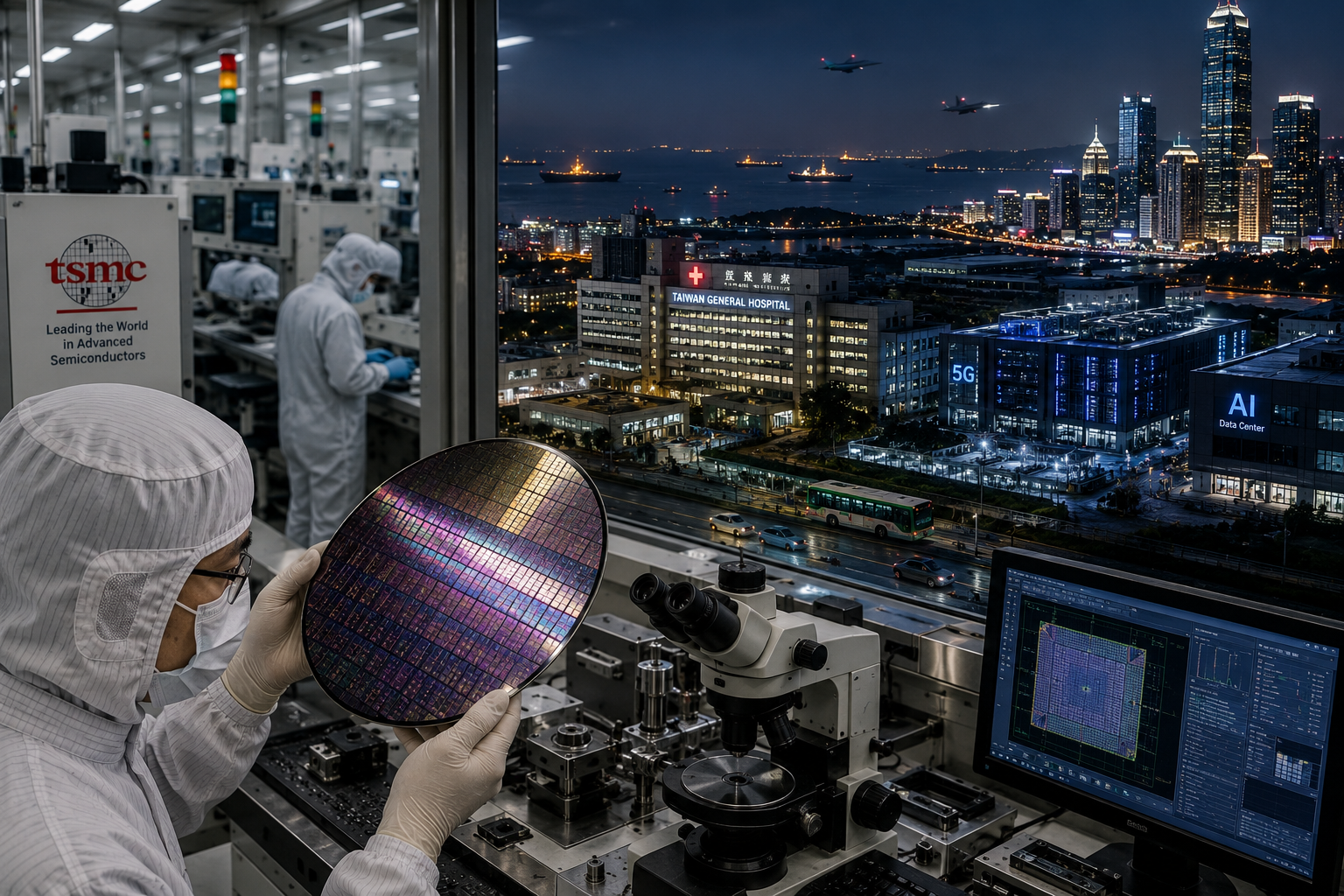
Taiwan matters because the modern world has concentrated an extraordinary amount of technological, economic and strategic risk on one island. To describe Taiwan only as a political dispute between Beijing and Taipei is to miss the scale of the issue. Taiwan is a democracy, a semiconductor powerhouse, a maritime node, a U.S.-China flashpoint and a test of whether coercion can redraw the regional order.
The global economy runs on chips, and Taiwan sits near the centre of the most advanced chip manufacturing ecosystem. Smartphones, cars, data centres, AI systems, defence platforms, medical devices and industrial machines all depend on semiconductor supply chains. A disruption in Taiwan would not be a regional event. It would be a global economic shock.
Taiwan also matters because it compresses the great dilemmas of twenty-first-century geopolitics: technology dependence, deterrence, democracy, sovereignty, supply-chain resilience and the risk of war between major powers.
Why the Issue Matters Now
The rise of AI has increased the strategic value of advanced chips. High-performance computing, cloud infrastructure and military applications all require cutting-edge semiconductors. Taiwan's foundries, especially TSMC, have become indispensable to this ecosystem. Official trade and commercial sources consistently highlight Taiwan's dominant role in global foundry revenue and leading-edge manufacturing.
At the same time, cross-strait tensions have intensified. China claims Taiwan as part of its territory and has not renounced the use of force. The United States maintains strategic ambiguity while supporting Taiwan's self-defence. Japan, Australia, Europe and India all watch the situation because a crisis would affect trade, technology and regional security.
The question is no longer whether Taiwan is important. The question is whether the world can reduce Taiwan-related risk without increasing the probability of conflict.
Historical Context
Taiwan's current status emerged from the Chinese civil war, Cold War alignments and decades of separate political development. Over time, Taiwan transformed from authoritarian rule into a vibrant democracy. Its economy moved from manufacturing to high-technology leadership, with semiconductors becoming its strategic signature.
The ambiguity around Taiwan's international status has helped avoid immediate war, but it has not resolved the dispute. Most countries do not formally recognise Taiwan as a sovereign state, yet many maintain economic, cultural and informal strategic ties. This ambiguity has preserved stability, but it also leaves room for miscalculation.
Analytical Dimension 1: The Semiconductor Chokepoint
Taiwan's semiconductor role is not easily replaceable. Advanced chip fabrication requires extreme precision, specialised equipment, skilled engineers, supplier ecosystems, intellectual property, water, energy reliability and decades of accumulated process knowledge. Building fabs elsewhere is possible, but replicating the full ecosystem is slow and expensive.
This concentration creates what analysts call a silicon shield, but the shield is double-edged. Taiwan's importance may deter conflict because disruption would hurt everyone, including China. But it also makes Taiwan a strategic target because control over advanced chips is a form of power.
Analytical Dimension 2: Democracy and Identity
Taiwan is not only a factory. It is a democratic society with its own elections, public debate, media, civil society and political identity. This matters because any coercive settlement would not be a mere administrative adjustment. It would affect the political choices of more than 23 million people.
Taiwan's democratic identity also shapes global perceptions. For many countries, Taiwan represents the question of whether a democratic society can be forced into political absorption by a larger authoritarian power. That symbolism increases the stakes beyond territory.
Analytical Dimension 3: The U.S.-China Deterrence Problem
Taiwan is the most dangerous flashpoint in U.S.-China relations because it combines core interests, military proximity and political symbolism. China sees reunification as a historic mission. The U.S. sees peace and stability across the Taiwan Strait as central to regional order. Taiwan seeks security without provoking disaster.
Deterrence requires convincing Beijing that force would be too costly while also avoiding steps that make Beijing believe peaceful options are closing. This is an extremely narrow path. Too little deterrence invites coercion; too much political signalling can trigger escalation.
Analytical Dimension 4: Maritime and Economic Security
Taiwan sits near crucial sea lanes connecting Northeast Asia, Southeast Asia and the wider Pacific. A conflict would disrupt shipping, insurance, aviation, energy flows and manufacturing networks. Even a blockade or quarantine scenario could trigger global panic before a shot is fired.
Economic security planners now think about Taiwan not only as a political risk but as a continuity risk. Companies and governments are diversifying chip supply chains, building strategic inventories and encouraging fabs in the U.S., Japan, Europe and elsewhere. But diversification is insurance, not instant replacement.
Analytical Dimension 5: The Risk of Normalised Pressure
War is not the only danger. Grey-zone pressure - military exercises, cyber operations, disinformation, diplomatic isolation and economic coercion - can gradually change the status quo. This is harder to respond to because each action may fall below the threshold of war.
Taiwan's security therefore depends not only on invasion deterrence but on resilience: cyber defence, civil preparedness, energy security, communications redundancy, social cohesion and international support.
India Angle
India's Taiwan policy remains shaped by its broader China policy, strategic autonomy and economic interests. India does not maintain formal diplomatic ties with Taiwan, but economic and technology engagement has grown. Semiconductor cooperation, electronics manufacturing, education and investment all create space for deeper practical ties.
For India, a Taiwan crisis would have direct consequences. It could disrupt electronics imports, affect global inflation, intensify U.S.-China rivalry, and force difficult diplomatic balancing. It would also influence China's behaviour across the Indo-Pacific and possibly along India's own border.
Global Implications
A Taiwan crisis would be one of the most consequential events in the global economy. It could freeze semiconductor supply, shock equity markets, disrupt shipping, trigger sanctions, split technology ecosystems and militarise the Indo-Pacific further.
The implications would extend to every country that uses chips - which is every country. This is why Taiwan's security is not a niche issue. It is a global economic stability issue.
Counter-view and Complexity
Some argue that fears over Taiwan are exaggerated because all sides have too much to lose from war. China relies on global markets. The U.S. wants to avoid direct conflict. Taiwan wants survival. Semiconductor disruption would damage everyone.
This logic is comforting but incomplete. History shows that interdependence reduces some risks but does not eliminate nationalism, miscalculation, domestic politics or military escalation. The cost of war may be high, yet crises can still occur when leaders believe delay is costlier than action.
What Happens Next
Watch three indicators: Chinese military activity around Taiwan, Taiwan's domestic politics and defence reforms, and the pace of global semiconductor diversification. Also watch U.S.-China crisis communication, Japanese security policy and European technology restrictions.
Taiwan matters because it is where the global economy's most advanced technology meets the world's most consequential rivalry. The island is small on the map, but enormous in the architecture of modern power.
Deeper Editorial Lens: Why This Is Not a Single-Issue Story
The first mistake in reading Taiwan geopolitics is to treat it as a narrow file. It is not. It is a pressure point where economics, security, legitimacy and institutional design meet. The central tension is a global technology chokepoint inside a high-risk sovereignty dispute. That tension makes the subject larger than a headline and more durable than a news cycle.
Every serious assessment has to follow at least five moving parts: advanced chip fabrication, deterrence, grey-zone pressure, supply-chain diversification and strategic ambiguity. None of these works in isolation. A change in one can alter the political meaning of another. This is why simple explanations often fail; they describe the event but miss the operating system underneath it.
The deeper story is about confidence. Citizens need confidence that national leaders have not lost control. Markets need confidence that rules are predictable. Partners need confidence that commitments will be honoured. Rivals watch for loss of confidence because it creates strategic openings. In that sense, Taiwan geopolitics is a test of authority as much as policy.
Domestic Political Economy
International issues become decisive when they enter domestic life. In this case, the pressure can be felt through identity politics, civil defence, industrial confidence, energy security and election narratives. These are not abstract variables. They affect household budgets, political narratives, elite bargaining and the credibility of governments.
Domestic politics also determines how much room leaders have to compromise. A technically rational agreement can become politically impossible if citizens see it as surrender, elites see it as a loss of privilege, or opposition forces convert it into a symbol of weakness. Good statecraft is therefore not only about choosing the correct policy; it is about creating the consent required to sustain it.
This is why the public language around Taiwan geopolitics matters. Governments often prefer strategic ambiguity, but citizens tend to demand clarity. The gap between what diplomacy requires and what domestic politics rewards can become the space in which miscalculation grows.
Institutional Choices and the Credibility Gap
The relevant institutions - TSMC ecosystem, Taiwan government, U.S. Congress, Japanese security planners and technology firms - can reduce uncertainty, but only if they are seen as legitimate. Institutions do not work merely because charters exist. They work when powerful actors accept restraint and weaker actors believe the process is not rigged.
A credibility gap emerges when rules are invoked selectively. States then comply when convenient, delay when costly, and reinterpret obligations when power allows. This is not always dramatic. Often it appears as procedural delay, vague communiques, underfunded commitments or carefully worded statements that preserve unity while avoiding difficult choices.
For Taiwan geopolitics, institutional credibility will depend on whether rules produce behaviour change. Declarations, scorecards and summits are useful only if they alter incentives. Otherwise, the process becomes performative governance: visible enough to claim action, weak enough to avoid transformation.
India's Strategic Calculation
India cannot look at Taiwan geopolitics only as a distant global issue. It connects with electronics imports, semiconductor mission, China strategy and Indo-Pacific balance. These are central to India's foreign policy because New Delhi is trying to expand influence without losing autonomy, deepen partnerships without entering rigid blocs, and defend development space while accepting global responsibilities.
India's approach therefore tends to combine principle with prudence. It supports rules, but resists rules written without developing-country participation. It supports stability, but does not want stability to become a code word for preserving old hierarchies. It supports reform, but prefers reform that expands strategic options rather than replacing one dependency with another.
The Indian lens also brings a neighbourhood test. If Taiwan geopolitics produces instability around India, the cost will not remain diplomatic. It can affect trade, technology flows, migration, energy prices, security planning and domestic political debate. For a rising power, external shocks increasingly become internal governance questions.
Risk Map for 2026 and Beyond
The immediate risk map includes blockade, chip disruption, U.S.-China escalation and cyber attacks. These risks are not equal in probability, but they are connected. A small procedural failure can produce political mistrust; mistrust can produce harder bargaining; harder bargaining can make a crisis more likely.
The medium-term risk is normalisation. The world can become used to dysfunction. Repeated crises, repeated warnings and repeated emergency meetings can create fatigue. Once fatigue sets in, even serious risks begin to look routine until a shock proves they were not routine at all.
The long-term question is whether Taiwan geopolitics becomes a case study in adaptation or drift. Adaptation would mean clearer rules, better financing, stronger deterrence, more credible institutions and wider participation. Drift would mean symbolic language, selective enforcement and rising costs postponed to the next crisis. The choice between these paths will define the strategic value of the issue.
What Serious Readers Should Track
First, track the financial base behind every promise linked to Taiwan geopolitics. Announcements are easy; budget lines, lending windows, enforceable timelines and operational capacity reveal seriousness. A policy without resources is often a press release disguised as strategy.
Second, track who controls information. In Taiwan geopolitics, data, inspections, disclosures, intelligence, market signals and official statements can all become instruments of power. The actor that defines the facts often shapes the political choices available to everyone else.
Third, track the behaviour of middle powers. Great powers dominate headlines, but middle powers often determine whether Taiwan geopolitics becomes polarised or manageable. Their hedging, coalition-building and refusal to accept binary choices can slow escalation and preserve diplomatic space.
Fourth, track the cost distribution. Every settlement around Taiwan geopolitics creates winners and losers. If costs fall mainly on weaker states, poorer citizens, smaller firms or politically excluded groups, the settlement may appear stable in documents but unstable in society.
Fifth, track whether crisis language becomes permanent. Emergency logic can justify extraordinary policies, but when emergency tools become routine, accountability weakens. The line between necessary urgency and institutional overreach must remain visible.
Sixth, track the India connection. Even when Taiwan geopolitics appears geographically distant, it can affect Indian trade, technology, energy, diplomacy, security planning and the larger debate over strategic autonomy. India's rise makes external shocks harder to treat as external.
Seventh, track narrative competition. Countries do not only fight over territory, money or rules; they fight over interpretation. Whoever frames Taiwan geopolitics as fairness, sovereignty, security, development or coercion gains political advantage.
Finally, track implementation after public attention shifts elsewhere. Many international issues look dramatic during summits and silent between them. The real story often happens in the quiet phase: regulations written, budgets released, inspections scheduled, projects delayed, ships deployed, or creditors called back to the table.
Publishing Angle for Editors Outlook
For an Editors Outlook audience, the value of this article lies in making Taiwan geopolitics understandable without making it simplistic. The article should not read like a policy brief alone. It should read like a map of power: who has leverage, who is exposed, who pays, who delays and who benefits from ambiguity.
The strongest headline treatment should connect Taiwan geopolitics with a wider question of sovereignty, security, development or institutional fairness. This helps the reader see why the subject belongs in a serious international section rather than a narrow explainer box.
The article should use facts carefully but not drown the reader in numbers. Figures are useful when they prove scale, reveal imbalance or challenge a popular assumption. A number without interpretation is decoration; interpretation without evidence is opinion. The article needs both.
The best visual treatment would avoid literal cliches. For Taiwan geopolitics, the image should show pressure, networks, institutions and strategic geography rather than a simple flag collage. Editorial visuals should help readers feel the structure of the issue before they read the full argument.
The concluding social-media caption should be framed around a question: what does Taiwan geopolitics reveal about the world we are entering? This encourages engagement without reducing the subject to outrage or slogan.
Editorial Conclusion
The most important conclusion is that Taiwan geopolitics cannot be solved by one speech, one summit or one technical adjustment. It requires political patience and institutional seriousness. Leaders must stop treating structural problems as temporary disturbances.
For readers, the key is to watch implementation rather than announcement. Who funds the promise? Who changes behaviour? Who bears the cost? Who gains leverage? Who remains excluded? These questions reveal more than diplomatic language ever will.
In the end, the story of Taiwan geopolitics is the story of a world struggling to update its rules under pressure. The old order is not fully gone, and the new order is not fully born. That unstable middle is where the most important strategic stories now unfold.
Internal Links to Add
• Why the South China Sea Is One of the World's Most Dangerous Waters
• Why Iran Remains Central to West Asian Geopolitics
• Why Central Asia Matters to India's Energy and Security Strategy
• Why Africa Is Becoming the Next Big Geopolitical Theatre
Premium editorial feature image for Taiwan geopolitics: geopolitical map, diplomatic table, flags, corridors and strategic pressure lines. Dark navy, muted gold and deep red palette, realistic magazine style, no text, no cartoon.
Source Notes / Fact-checking References
Use these sources to verify figures, institutional positions and latest developments before publishing:
• U.S. International Trade Administration - Taiwan semiconductors: https://www.trade.gov/country-commercial-guides/taiwan-semiconductors-including-chip-design-ai
• TSMC annual reports: https://investor.tsmc.com/english/annual-reports
• Taiwan Ministry of Economic Affairs / statistical data: https://www.moea.gov.tw
• Excel source priority: https://data.worldbank.org; https://www.imf.org; https://www.cia.gov/the-world-factbook; https://www.sipri.org; https://mea.gov.in