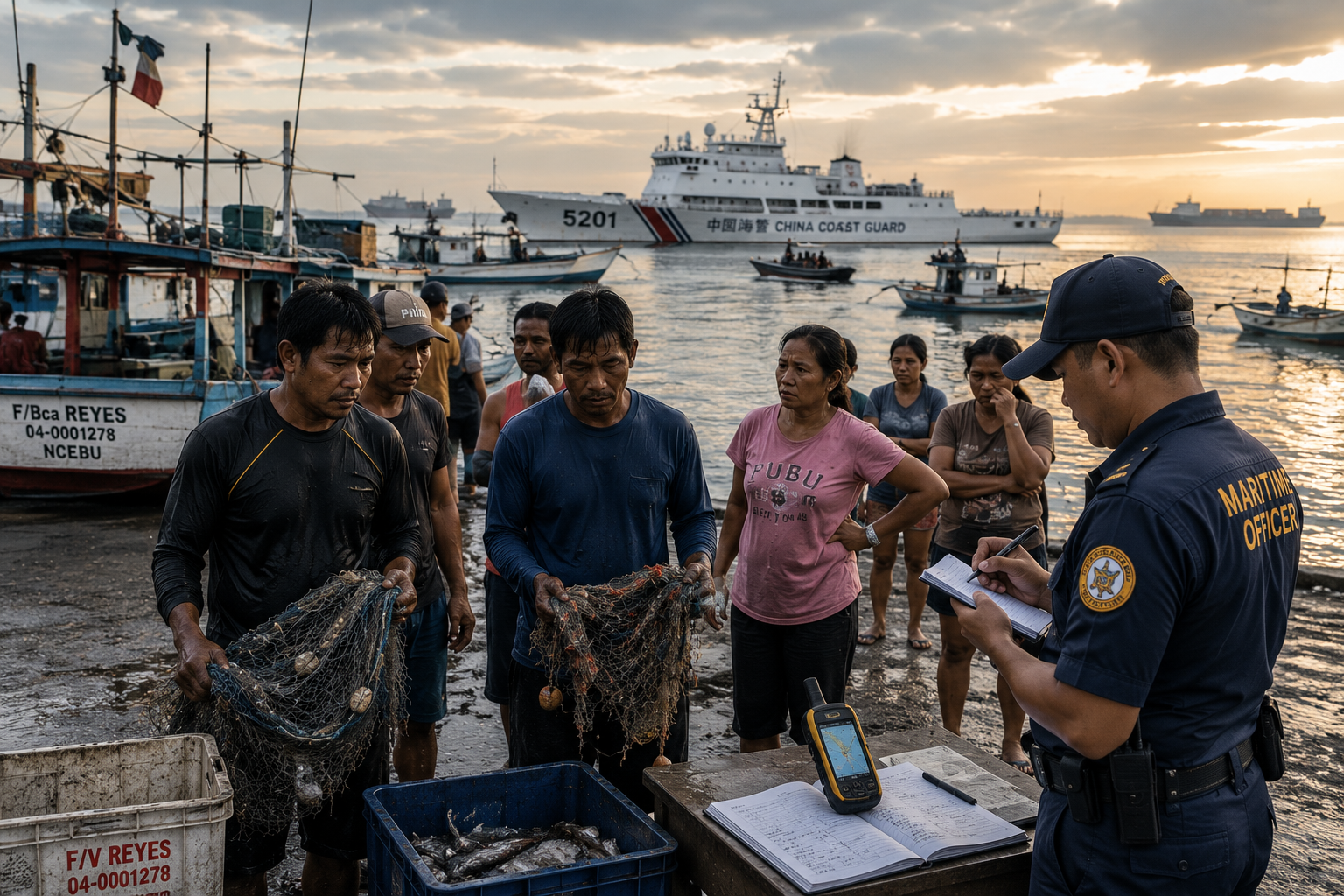
The South China Sea is dangerous because it is not one dispute. It is many disputes layered on top of one another: sovereignty claims, maritime law, fisheries, hydrocarbons, military positioning, nationalism, great-power rivalry and trade security. A collision between coast guard ships can become a diplomatic crisis. A reef can become a military outpost. A legal disagreement can become a test of regional order.
The waterway matters because it connects major economies and carries a large share of global maritime trade. It is also claimed in overlapping ways by China, Taiwan, Vietnam, the Philippines, Malaysia and Brunei. The sea is therefore both an economic highway and a geopolitical fault line.
Its danger lies in the grey zone. Most actors do not want full-scale war. Yet coercive actions below the level of war can accumulate, harden positions and create the conditions for a crisis no one fully controls.
Why the Issue Matters Now
The South China Sea has become more tense because physical control is changing faster than diplomacy. Artificial islands, military facilities, coast guard deployments, maritime militia activity, oil and gas exploration disputes, fishing confrontations and resupply missions all shape the facts on the water.
International law provides principles, especially through UNCLOS, but enforcement remains difficult. The 2016 arbitral ruling rejected the legal basis for China's expansive claims in important respects, but China rejected the ruling. This gap between law and power sits at the centre of the crisis.
The issue matters now because the South China Sea is no longer only about Southeast Asia. It is tied to U.S.-China rivalry, ASEAN credibility, Japanese and Australian security concerns, Indian maritime strategy and the future of freedom of navigation.
Historical Context
Claims in the South China Sea have long historical roots, but the modern dispute intensified with the growth of maritime law, offshore resource interest and China's rise. As technology made reefs, rocks and waters more strategically usable, previously remote features became valuable.
The dispute deepened as China built artificial islands and expanded its maritime presence. Other claimant states strengthened legal, diplomatic and security responses. The result is a region where history, law and military capability produce competing maps of reality.
Analytical Dimension 1: Trade Chokepoint
The South China Sea is one of the world's major maritime corridors. Energy, manufactured goods, raw materials and container trade move through it. Disruption would affect not only claimant states but also Japan, South Korea, China, India, Europe and the United States.
This trade importance raises the stakes. A conflict or blockade would not remain local. Insurance rates, shipping routes, delivery schedules and commodity prices could all be affected. The sea's economic value makes it too important to ignore and too dangerous to militarise.
Analytical Dimension 2: Law versus Power
UNCLOS provides a legal framework for territorial seas, exclusive economic zones, continental shelves and navigational rights. But law depends on recognition, compliance and enforcement. When a powerful state rejects an unfavourable interpretation, weaker states face a difficult choice: resist, negotiate or adapt.
The South China Sea therefore tests whether international law can restrain power in contested spaces. If legal rulings do not change behaviour, smaller states may lose faith in rules. If rules collapse, maritime order becomes a contest of ships and stamina.
Analytical Dimension 3: Grey-zone Coercion
The most common danger is not naval war but grey-zone coercion: coast guard manoeuvres, water cannons, ramming risks, maritime militia swarming, administrative rules, fishing bans and pressure on resupply missions. These actions are designed to change behaviour without triggering full military response.
Grey-zone tactics create ambiguity. Are they law enforcement, sovereignty assertion or military coercion? That ambiguity complicates response and increases the risk of accidental escalation.
Analytical Dimension 4: ASEAN's Credibility
The South China Sea is also a test of ASEAN centrality. Several ASEAN members are claimants, but ASEAN as a group must manage relations with China while maintaining unity. This is extremely difficult because members have different levels of dependence on China and different threat perceptions.
A weak ASEAN position allows external powers to define the issue. A united ASEAN position is difficult to achieve but necessary if Southeast Asia wants to shape its own maritime environment.
Analytical Dimension 5: Military Geography
Military facilities on islands and reefs can extend surveillance, air defence, logistics and operational reach. Even small features can become strategic nodes if equipped with runways, radars, missiles or ports.
This changes the military balance. A sea that once looked open becomes a network of monitored spaces. For navies and air forces, the operational environment becomes more contested and less predictable.
India Angle
India is not a claimant in the South China Sea, but it has major interests there. Indian trade passes through these waters, and India's Act East policy depends on stable maritime access. India also supports freedom of navigation, respect for international law and ASEAN centrality.
The South China Sea influences India's broader China strategy. If China can reshape maritime rules in Southeast Asia, India must consider what that means for the Indian Ocean. Maritime order is interconnected. Norms weakened in one theatre can affect expectations in another.
Global Implications
The South China Sea could reshape global alignments. The U.S. conducts freedom of navigation operations. Japan and Australia support maritime capacity building. The Philippines has deepened security cooperation with the U.S. Vietnam diversifies partnerships. India engages through naval presence and diplomacy. China continues to assert its claims.
This makes the sea a barometer of the Indo-Pacific order. If coercion succeeds, power politics gains ground. If rules hold, smaller states retain more agency.
Counter-view and Complexity
A counter-view argues that the dispute is managed and unlikely to produce war because all sides understand the costs. Trade continues. Diplomacy continues. Crisis management channels exist. The Code of Conduct negotiations, though slow, show that parties still seek mechanisms.
This is partly true. The South China Sea is not destined for war. But danger does not require inevitability. It requires dense interaction, high stakes, weak trust and repeated close encounters. The region has all four.
What Happens Next
Watch incidents involving Philippine resupply missions, Vietnamese and Malaysian energy exploration, Chinese coast guard rules, U.S. naval operations, ASEAN-China Code of Conduct negotiations and defence agreements involving external powers.
The South China Sea is one of the world's most dangerous waters because the question beneath the waves is larger than territory. It is whether maritime Asia will be governed by rules, bargaining or coercive control.
Deeper Editorial Lens: Why This Is Not a Single-Issue Story
The first mistake in reading South China Sea dispute is to treat it as a narrow file. It is not. It is a pressure point where economics, security, legitimacy and institutional design meet. The central tension is the clash between maritime law and the changing facts created by power on the water. That tension makes the subject larger than a headline and more durable than a news cycle.
Every serious assessment has to follow at least five moving parts: UNCLOS claims, coast guard operations, maritime militia, freedom of navigation and resource exploration. None of these works in isolation. A change in one can alter the political meaning of another. This is why simple explanations often fail; they describe the event but miss the operating system underneath it.
The deeper story is about confidence. Citizens need confidence that national leaders have not lost control. Markets need confidence that rules are predictable. Partners need confidence that commitments will be honoured. Rivals watch for loss of confidence because it creates strategic openings. In that sense, South China Sea dispute is a test of authority as much as policy.
Domestic Political Economy
International issues become decisive when they enter domestic life. In this case, the pressure can be felt through fisheries, national honour, energy exploration, naval budgets and public opinion. These are not abstract variables. They affect household budgets, political narratives, elite bargaining and the credibility of governments.
Domestic politics also determines how much room leaders have to compromise. A technically rational agreement can become politically impossible if citizens see it as surrender, elites see it as a loss of privilege, or opposition forces convert it into a symbol of weakness. Good statecraft is therefore not only about choosing the correct policy; it is about creating the consent required to sustain it.
This is why the public language around South China Sea dispute matters. Governments often prefer strategic ambiguity, but citizens tend to demand clarity. The gap between what diplomacy requires and what domestic politics rewards can become the space in which miscalculation grows.
Institutional Choices and the Credibility Gap
The relevant institutions - ASEAN, UNCLOS, arbitral tribunals, coast guards and navies - can reduce uncertainty, but only if they are seen as legitimate. Institutions do not work merely because charters exist. They work when powerful actors accept restraint and weaker actors believe the process is not rigged.
A credibility gap emerges when rules are invoked selectively. States then comply when convenient, delay when costly, and reinterpret obligations when power allows. This is not always dramatic. Often it appears as procedural delay, vague communiques, underfunded commitments or carefully worded statements that preserve unity while avoiding difficult choices.
For South China Sea dispute, institutional credibility will depend on whether rules produce behaviour change. Declarations, scorecards and summits are useful only if they alter incentives. Otherwise, the process becomes performative governance: visible enough to claim action, weak enough to avoid transformation.
India's Strategic Calculation
India cannot look at South China Sea dispute only as a distant global issue. It connects with maritime trade, Act East, Indian Ocean lessons and freedom of navigation. These are central to India's foreign policy because New Delhi is trying to expand influence without losing autonomy, deepen partnerships without entering rigid blocs, and defend development space while accepting global responsibilities.
India's approach therefore tends to combine principle with prudence. It supports rules, but resists rules written without developing-country participation. It supports stability, but does not want stability to become a code word for preserving old hierarchies. It supports reform, but prefers reform that expands strategic options rather than replacing one dependency with another.
The Indian lens also brings a neighbourhood test. If South China Sea dispute produces instability around India, the cost will not remain diplomatic. It can affect trade, technology flows, migration, energy prices, security planning and domestic political debate. For a rising power, external shocks increasingly become internal governance questions.
Risk Map for 2026 and Beyond
The immediate risk map includes collision, blockade fear, coercive precedent and Code of Conduct failure. These risks are not equal in probability, but they are connected. A small procedural failure can produce political mistrust; mistrust can produce harder bargaining; harder bargaining can make a crisis more likely.
The medium-term risk is normalisation. The world can become used to dysfunction. Repeated crises, repeated warnings and repeated emergency meetings can create fatigue. Once fatigue sets in, even serious risks begin to look routine until a shock proves they were not routine at all.
The long-term question is whether South China Sea dispute becomes a case study in adaptation or drift. Adaptation would mean clearer rules, better financing, stronger deterrence, more credible institutions and wider participation. Drift would mean symbolic language, selective enforcement and rising costs postponed to the next crisis. The choice between these paths will define the strategic value of the issue.
What Serious Readers Should Track
First, track the financial base behind every promise linked to South China Sea dispute. Announcements are easy; budget lines, lending windows, enforceable timelines and operational capacity reveal seriousness. A policy without resources is often a press release disguised as strategy.
Second, track who controls information. In South China Sea dispute, data, inspections, disclosures, intelligence, market signals and official statements can all become instruments of power. The actor that defines the facts often shapes the political choices available to everyone else.
Third, track the behaviour of middle powers. Great powers dominate headlines, but middle powers often determine whether South China Sea dispute becomes polarised or manageable. Their hedging, coalition-building and refusal to accept binary choices can slow escalation and preserve diplomatic space.
Fourth, track the cost distribution. Every settlement around South China Sea dispute creates winners and losers. If costs fall mainly on weaker states, poorer citizens, smaller firms or politically excluded groups, the settlement may appear stable in documents but unstable in society.
Fifth, track whether crisis language becomes permanent. Emergency logic can justify extraordinary policies, but when emergency tools become routine, accountability weakens. The line between necessary urgency and institutional overreach must remain visible.
Sixth, track the India connection. Even when South China Sea dispute appears geographically distant, it can affect Indian trade, technology, energy, diplomacy, security planning and the larger debate over strategic autonomy. India's rise makes external shocks harder to treat as external.
Seventh, track narrative competition. Countries do not only fight over territory, money or rules; they fight over interpretation. Whoever frames South China Sea dispute as fairness, sovereignty, security, development or coercion gains political advantage.
Finally, track implementation after public attention shifts elsewhere. Many international issues look dramatic during summits and silent between them. The real story often happens in the quiet phase: regulations written, budgets released, inspections scheduled, projects delayed, ships deployed, or creditors called back to the table.
Publishing Angle for Editors Outlook
For an Editors Outlook audience, the value of this article lies in making South China Sea dispute understandable without making it simplistic. The article should not read like a policy brief alone. It should read like a map of power: who has leverage, who is exposed, who pays, who delays and who benefits from ambiguity.
The strongest headline treatment should connect South China Sea dispute with a wider question of sovereignty, security, development or institutional fairness. This helps the reader see why the subject belongs in a serious international section rather than a narrow explainer box.
The article should use facts carefully but not drown the reader in numbers. Figures are useful when they prove scale, reveal imbalance or challenge a popular assumption. A number without interpretation is decoration; interpretation without evidence is opinion. The article needs both.
The best visual treatment would avoid literal cliches. For South China Sea dispute, the image should show pressure, networks, institutions and strategic geography rather than a simple flag collage. Editorial visuals should help readers feel the structure of the issue before they read the full argument.
The concluding social-media caption should be framed around a question: what does South China Sea dispute reveal about the world we are entering? This encourages engagement without reducing the subject to outrage or slogan.
Editorial Conclusion
The most important conclusion is that South China Sea dispute cannot be solved by one speech, one summit or one technical adjustment. It requires political patience and institutional seriousness. Leaders must stop treating structural problems as temporary disturbances.
For readers, the key is to watch implementation rather than announcement. Who funds the promise? Who changes behaviour? Who bears the cost? Who gains leverage? Who remains excluded? These questions reveal more than diplomatic language ever will.
In the end, the story of South China Sea dispute is the story of a world struggling to update its rules under pressure. The old order is not fully gone, and the new order is not fully born. That unstable middle is where the most important strategic stories now unfold.
Internal Links to Add
• Why Taiwan Matters to the Global Economy and World Security
• Why Iran Remains Central to West Asian Geopolitics
• Why Central Asia Matters to India's Energy and Security Strategy
• Why Africa Is Becoming the Next Big Geopolitical Theatre
Premium editorial feature image for South China Sea dispute: geopolitical map, diplomatic table, flags, corridors and strategic pressure lines. Dark navy, muted gold and deep red palette, realistic magazine style, no text, no cartoon.
Source Notes / Fact-checking References
Use these sources to verify figures, institutional positions and latest developments before publishing:
• ASEAN Outlook on the Indo-Pacific: https://asean.org/wp-content/uploads/2021/01/ASEAN-Outlook-on-the-Indo-Pacific_FINAL_22062019.pdf
• UNCLOS official materials: https://www.un.org/depts/los
• CSIS ChinaPower data on South China Sea trade: https://chinapower.csis.org/much-trade-transits-south-china-sea/
• CFR Global Conflict Tracker: South China Sea: https://www.cfr.org/global-conflict-tracker/conflict/territorial-disputes-south-china-sea
• Excel source priority: https://data.worldbank.org; https://www.imf.org; https://www.cia.gov/the-world-factbook; https://www.sipri.org; https://mea.gov.in