Sigmund Freud: Psychoanalysis, the Unconscious, Major Theories and Why His Legacy Remains Controversial
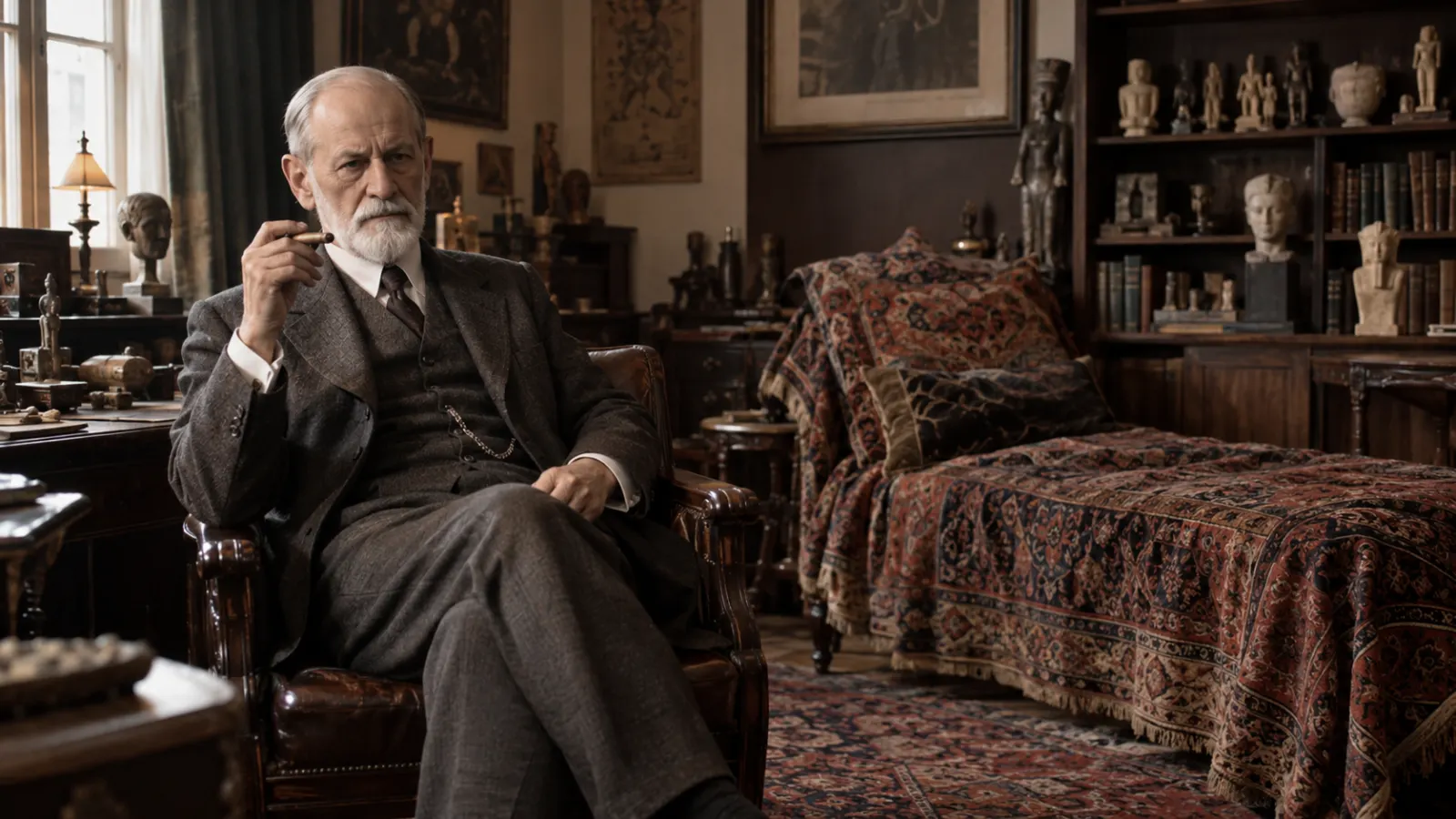
Sigmund Freud became one of the most influential and disputed thinkers in the history of psychology. His consulting room—with patterned rugs, archaeological objects and the famous couch on which patients spoke while the analyst sat largely outside their direct view—became an enduring symbol of psychoanalysis.
The room embodied Freud's central argument: human beings are not completely transparent to themselves.
People may consciously believe they understand why they think, feel and behave as they do, yet Freud argued that important motives can remain outside ordinary awareness. Dreams, symptoms, slips of speech, fantasies, avoidance and recurring relationship patterns could therefore reveal conflicts that conscious explanations conceal.
Freud did not arrive at that theory fully formed. He began as a physician and neurological researcher. His early career included work on anatomy, childhood cerebral palsy and disorders of the nervous system. Over several decades he moved from hypnosis to free association, from a theory of hysteria to a general model of mental conflict, and from clinical treatment into theories about childhood, sexuality, religion, aggression and civilisation.
The resulting system transformed psychiatry, psychotherapy, literature, art and ordinary language.
It also created major scientific problems.
Modern psychology does not generally treat the Oedipus complex, universal psychosexual stages, the death drive or id-ego-superego model as empirically established maps of human development or brain function. Freud's famous case histories frequently fall far short of contemporary research standards, and some of his interpretations were far more confident than the evidence justified.
Yet it would be equally inaccurate to say that Freud contributed nothing because many of his original theories were later rejected.
Psychoanalysis helped establish prolonged therapeutic conversation as a serious clinical method. Freud made unconscious motivation, early experience, defensive processes, internal conflict and recurring interpersonal patterns central questions in psychological thought. Contemporary psychodynamic therapies are now evaluated using modern clinical research rather than accepted simply because Freud proposed their intellectual ancestors. A 2023 systematic umbrella review found evidence supporting psychodynamic therapy for several common adult mental disorders, while also demonstrating how far the modern evidence base has moved beyond Freud's original case-method approach.
The useful question is therefore not:
“Was Freud right or wrong?”
It is:
Which of Freud's ideas transformed how people think about the mind, which claims failed under later scrutiny, and why does psychoanalysis still influence psychology and culture more than a century later?
Who Was Sigmund Freud?
Sigmund Freud was born on 6 May 1856 in Freiberg in Moravia, today Příbor in the Czech Republic, into a Jewish family. His father, Jakob Freud, was a wool merchant. The family moved to Vienna while Freud was still a child, and Vienna became the centre of almost his entire professional life.
He entered the University of Vienna in 1873 and studied medicine. Freud's early scientific environment was strongly materialist: his mentors expected biological phenomena ultimately to be explained through physical processes rather than mystical forces.
Freud worked under physiologist Ernst Brücke and conducted neurological and anatomical research. He studied the nervous systems of animals, wrote on aphasia and became an authority on childhood cerebral palsy. The Freud Museum notes that he continued neurological work for more than a decade after the period often portrayed as his abrupt conversion from brain science to psychoanalysis.
That background matters.
Freud did not begin his career as a philosopher trying to invent a symbolic theory of personality.
He was a doctor trying to understand patients whose symptoms did not fit the available neurological explanations.
Charcot, Hysteria and the Problem That Redirected Freud
A major turning point came in 1885–1886, when Freud studied in Paris with the famous neurologist Jean-Martin Charcot at the Salpêtrière Hospital.
Charcot worked with patients diagnosed with hysteria who could display paralysis, convulsions, anaesthesia or other striking physical symptoms despite having no obvious anatomical lesion capable of explaining them.
His use of hypnosis appeared to show something radical: mental processes could produce or alter symptoms that looked physically real.
The Freud Museum describes Freud's encounter with Charcot as a decisive shift because it encouraged him to consider conditions whose causes might be psychogenic—arising from mental processes rather than identifiable physical damage.
This was the medical problem from which psychoanalysis eventually emerged.
If the body could behave as though it were injured when no corresponding injury existed, what was producing the symptom?
Freud increasingly began searching for psychological mechanisms.
Josef Breuer, Anna O. and the “Talking Cure”
Freud's collaboration with Viennese physician Josef Breuer became central to the origin story of psychoanalysis.
Breuer had treated a young woman known in the published case literature as Anna O., whose real name was Bertha Pappenheim. She experienced a range of symptoms that included disturbances of speech, vision and movement.
Breuer used hypnosis and encouraged her to talk through memories and emotionally charged experiences associated with particular symptoms. The method came to be described as cathartic, and Pappenheim herself became associated with the phrase “talking cure.”
Freud and Breuer published Studies on Hysteria in 1895, presenting cases in which symptoms were interpreted as connected with psychologically significant memories and emotional conflicts. The Freud Museum describes the book as one of the foundational texts through which the cathartic method developed toward psychoanalysis.
The famous Anna O. story later became neater than the historical record justified.
The treatment was not the simple dramatic cure often described in introductory accounts. Pappenheim subsequently experienced further illness and treatment and later became an important Jewish social reformer and feminist in her own right. Even the Freud Museum's historical material now stresses that the story should not be reduced entirely to Breuer's clinical narrative.
Nevertheless, the collaboration marked an important conceptual shift.
A symptom could be investigated not merely as a malfunctioning bodily process but as something psychologically meaningful.
That became one of Freud's defining ideas.
Why Freud Abandoned Hypnosis
Freud initially used hypnosis, but the method created practical and theoretical problems.
Not every patient could be hypnotised reliably. Hypnotic suggestion also gave the doctor unusually direct power over what happened during treatment.
Freud gradually moved toward a technique that allowed patients to remain in an ordinary waking state.
He asked them to say whatever came to mind, including thoughts that seemed irrelevant, embarrassing, trivial or absurd.
This became free association.
In later lectures Freud explicitly explained that he abandoned hypnosis partly because only a fraction of his patients could enter the required state. The Library of Congress notes that free association became his alternative: rather than using suggestion to impose material, the analyst followed the patient's spontaneous sequence of thoughts.
The change altered the entire treatment model.
Silence mattered.
Hesitation mattered.
Changing the subject mattered.
Forgetting could matter.
Freud began interpreting these interruptions as resistance—processes that prevented psychologically threatening material from entering awareness.
What Freud Meant by the Unconscious
Freud did not invent the idea that mental activity could occur outside consciousness.
Philosophers, writers and physicians had discussed nonconscious processes long before psychoanalysis.
His distinctive contribution was to make the unconscious dynamic.
For Freud, unconscious material was not merely information the brain happened not to be thinking about at the moment. Wishes, memories and conflicts could remain outside awareness because keeping them unconscious served a psychological purpose.
This was where repression became central.
Repression, in Freud's theory, keeps threatening or unacceptable mental material from ordinary consciousness. But repression does not destroy that material. It may continue influencing emotions, symptoms, dreams and behaviour.
The mind therefore becomes divided against itself.
Part of the person wants or remembers something.
Another part prevents that content from becoming conscious.
Symptoms can emerge from the compromise.
The Library of Congress's Freud collection documents how his work developed around precisely these themes: psychoanalytic theory, clinical technique, unconscious processes and the proliferation of supporters and critics.
The Interpretation of Dreams
Freud considered The Interpretation of Dreams one of his most important achievements.
The book appeared at the end of 1899 but carried the publication date 1900, helping associate it symbolically with the new century.
Freud argued that dreams were psychologically meaningful rather than meaningless mental noise. He treated them as transformed expressions of wishes, conflicts and memories operating outside ordinary conscious control.
He called dream interpretation a route toward understanding unconscious mental activity.
A crucial distinction was between the manifest content and the latent content.
The manifest content is the dream as remembered: the people, images and events that appeared.
The latent dream-thoughts are the underlying associations and psychological material Freud believed could be reconstructed through analysis.
Condensation, Displacement and Dream-Work
Freud argued that latent material does not simply appear transparently in dreams.
It undergoes what he called dream-work.
Condensation combines several people, memories or ideas into one dream element.
Displacement shifts emotional importance from one idea toward another apparently less significant image.
Other forms of transformation make the underlying wish or conflict less recognisable.
The result, Freud argued, was a compromise between a wish and the mental processes preventing that wish from appearing directly.
This should not be confused with the popular idea that Freud used one fixed dictionary of universal dream symbols.
His method actually emphasised the dreamer's own associations.
The Freud Museum explicitly notes that Freud rejected the simple formula “If you dream X, it always means Y.” A dream image had to be explored through what that image meant to the individual dreamer.
Was Freud Right About Dreams?
Modern dream research has not established Freud's broad claim that dreams are disguised fulfilments of repressed wishes as a general scientific law.
Contemporary sleep science studies dreaming through neurological, cognitive, emotional and memory processes. No accepted scientific framework treats all dreams as products of the Freudian dream-work.
That does not make every observation in The Interpretation of Dreams meaningless.
Dreams clearly can incorporate recent experiences, emotions and autobiographical memories. People can also use dreams as material for psychological reflection.
The key distinction is between saying:
“Dreams can contain personally meaningful material”
and saying:
“Freud scientifically demonstrated the universal mechanism that creates dreams.”
The first remains plausible.
The second is not accepted contemporary sleep science.
Freud and Childhood Sexuality
Freud's theories of sexuality became among the most controversial parts of his work.
In Three Essays on the Theory of Sexuality, published in 1905, he challenged the common assumption that sexuality begins suddenly at puberty.
Freud used sexuality in a broader sense than adult sexual intercourse. He argued that bodily pleasure, desire, attachment, fantasy and prohibition developed through childhood and contributed to later personality.
From this theory came the familiar psychosexual stages:
oral, anal and phallic phases, followed later by latency and mature genital organisation.
Freud believed experiences and conflicts associated with these stages could shape adult personality.
The Freud Museum continues to present this theory as one of the central components of Freud's historical account of sexuality, while distinguishing the theory from contemporary psychology.
Modern developmental science does not accept Freud's psychosexual stages as established universal developmental laws.
But his insistence that childhood experiences and family relationships can have lasting psychological significance became enormously influential.
What Is the Oedipus Complex?
The Oedipus complex is perhaps Freud's most famous and most caricatured idea.
Drawing on the Greek story of Oedipus, Freud proposed that young children pass through a developmental conflict involving attachment to one parent and rivalry toward the other, eventually resolving the conflict partly through identification.
He regarded this as central to the development of personality, morality and sexual identity.
Modern psychology does not recognise the Oedipus complex as a scientifically demonstrated universal stage through which all children pass.
Family attachment, identification and rivalry obviously exist, but Freud's specific developmental structure is not established contemporary developmental science.
Its influence survives more strongly in psychoanalytic theory, cultural criticism and ordinary language than in mainstream empirical psychology.
Freud's Seduction Theory and the Abuse Controversy
Freud's changing account of early sexual experience remains one of the most contested parts of his intellectual history.
During the 1890s, he initially argued that hysteria could be traced to premature sexual experiences in childhood.
He later moved away from treating all such reconstructed scenes as literal events and increasingly emphasised childhood fantasy, desire and unconscious psychic reality.
This shift has been interpreted very differently.
Some critics argue that Freud retreated from recognising real abuse and instead classified patients' reports as fantasy.
Others argue that this oversimplifies how Freud's theory changed and fails to distinguish between remembered events, reconstructed scenes and unconscious fantasy.
A responsible account should avoid using Freud's history to make any general claim that childhood sexual-abuse reports are fantasies.
Modern medicine and psychology recognise childhood sexual abuse as real, harmful and clinically important.
Freud's historical theoretical shift is a dispute about his interpretation, not evidence against abuse itself.
Transference: When the Relationship Becomes Part of Therapy
One of Freud's most durable clinical concepts is transference.
Freud observed that patients did not relate to the analyst purely as a neutral person in the present.
They could experience the analyst through patterns associated with important earlier relationships.
A patient might expect criticism, abandonment, admiration or rejection in ways shaped partly by previous experiences.
Freud eventually treated these reactions not as distractions from therapy but as clinical material.
The relationship itself could reveal recurring patterns.
This insight changed psychotherapy fundamentally.
Treatment was no longer simply one person explaining a problem while an expert supplied advice.
The interpersonal relationship between clinician and patient became part of what needed to be understood.
Modern psychotherapy does not equate every therapeutic relationship with classical Freudian transference. But contemporary research gives major importance to the therapeutic alliance, the quality of cooperation and trust between therapist and patient.
The concepts are not identical.
The broader lesson—that treatment happens through a relationship rather than outside one—has endured.
Freud's Famous Case Histories
Freud's case histories gave psychoanalytic interpretation much of its literary power.
Among the most famous were:
Dora, a young woman whose symptoms Freud connected to family and sexual relationships;
the Rat Man, a lawyer suffering from obsessive fears and rituals;
Little Hans, a child whose fear of horses Freud interpreted through family and developmental conflict;
and the Wolf Man, whose childhood dream became central to an elaborate reconstruction of early experience.
These narratives helped readers see how Freud reasoned from symptoms and associations toward hidden psychological conflict.
They also expose one of the largest methodological problems in his work.
The analyst generated the theory, treated the patient, selected the observations and then wrote the published account.
Independent verification was extremely difficult.
The Library of Congress notes, for example, that Freud's surviving process notes from the Rat Man case show differences between the clinical record and the polished published narrative, including exaggeration of aspects of treatment success and duration.
By modern standards, these are not controlled clinical trials.
They are historically important case narratives.
That distinction should remain explicit.
Freud and Carl Jung
As psychoanalysis gained followers, Freud attempted to build an international movement.
One of his most important relationships was with Swiss psychiatrist Carl Gustav Jung.
Freud initially regarded Jung as a particularly promising ally who might expand psychoanalysis beyond the Viennese circle.
Their relationship eventually broke down because the disagreement was both theoretical and institutional.
Jung did not accept Freud's emphasis on sexuality as the central source of psychic conflict. He developed broader ideas about libido, symbolism, myth and what he later called the collective unconscious.
Freud believed that Jung was abandoning essential foundations of psychoanalysis.
Their correspondence records the progressive deterioration of their relationship, and the Library of Congress places the rupture alongside Freud's earlier split with Alfred Adler as a major episode in the history of the psychoanalytic movement.
The conflict shows that psychoanalysis never developed as one perfectly unified body of ideas.
Major schools began emerging almost as soon as the movement became successful.
Freud and Alfred Adler
Alfred Adler was another early member of Freud's circle who eventually rejected important parts of Freud's theory.
Adler placed greater emphasis on feelings of inferiority, striving, social relationships and the individual's orientation toward goals.
Freud treated the divergence as sufficiently fundamental that Adler's approach became a separate school: individual psychology.
These early divisions matter because the word “psychoanalysis” eventually covered a wide family of ideas, some of which departed significantly from Freud's original theory.
Modern psychodynamic therapy is therefore not simply nineteenth-century Freud performed with modern furniture.
Beyond the Pleasure Principle and the Repetition Problem
The First World War and Freud's observations of repetitive psychological patterns challenged parts of his earlier theory.
People sometimes appeared compelled to repeat distressing experiences rather than simply seeking pleasure and avoiding pain.
Traumatised individuals could repeatedly relive disturbing material.
Patients sometimes seemed to reproduce painful relationship patterns despite consciously wanting to escape them.
In Beyond the Pleasure Principle in 1920, Freud tried to explain this through ideas including a repetition compulsion and eventually a speculative death drive.
The death drive proposed that life contains not only forces toward attachment, sexuality and preservation but also tendencies toward aggression, destruction and a return to an inorganic state.
Even within psychoanalysis, the theory was controversial.
Modern psychology does not treat a literal Freudian death drive as an established biological mechanism.
The concept is historically valuable mainly because it shows Freud continually revising his system when earlier explanations no longer seemed sufficient.
Id, Ego and Superego
Freud's most famous vocabulary appeared relatively late in his career.
In The Ego and the Id, published in 1923, he reformulated mental life around three interacting agencies.
The id represented instinctual pressures seeking satisfaction.
The ego negotiated among these pressures, external reality and defensive processes.
The superego developed from internalised authority, prohibitions and ideals.
Popular culture often reduces the model to:
id = desire,
ego = reason,
superego = morality.
Freud's model was more complicated.
The ego itself could operate partly unconsciously, and the superego could be harsh, punitive and psychologically destructive rather than simply an internal moral guide. The Freud Museum emphasises this internal conflict when explaining why the later structural model cannot simply be mapped onto conscious versus unconscious mental life.
Modern neuroscience does not identify literal brain systems corresponding to the id, ego and superego.
Their continuing importance is conceptual and cultural rather than anatomical.
Defence Mechanisms
Freud's theory of mental conflict produced another influential idea: defence.
If certain thoughts or emotions create psychological danger, the mind may defend itself against them.
Repression became Freud's central defence, but later psychoanalytic thinkers—especially his daughter Anna Freud—systematised a wider range of defence mechanisms.
Terms such as denial, projection and rationalisation entered both psychology and popular speech.
Modern psychology sometimes studies processes that resemble these ideas, but everyday use can become dangerously loose.
Calling someone “in denial” or accusing them of “projecting” is not a clinical diagnosis simply because the terms sound psychological.
The historical importance of defence mechanisms lies in the proposition that people sometimes distort or avoid information partly to protect themselves from emotional threat.
That general possibility is far less controversial than every specific psychoanalytic explanation attached to it.
Freud, Women and Gender
Freud's writings about women have attracted sustained criticism.
Ideas involving penis envy, female psychosexual development and his descriptions of femininity reflected assumptions that many later psychologists, psychoanalysts and feminists rejected.
These theories should not be sanitised simply because Freud was writing in another era.
At the same time, Freud's relationship with later feminist thought is more complicated than simple rejection.
Psychoanalysis provided language for thinking about sexuality, family authority, desire and identity that some feminist thinkers later transformed for their own purposes.
Women also became major psychoanalytic theorists, including Anna Freud, Melanie Klein, Karen Horney and Helene Deutsch, often revising or directly challenging Freudian positions.
The sensible distinction is again between historical influence and current validity.
A theory can reshape intellectual debate even when later scholars reject its original conclusions.
Freud Beyond the Clinic
Freud increasingly extended psychoanalytic thinking beyond individual treatment.
In works such as Totem and Taboo, Group Psychology and the Analysis of the Ego, The Future of an Illusion and Civilization and Its Discontents, he applied psychological ideas to religion, groups, authority, guilt, aggression and civilisation itself.
His theory of civilisation was fundamentally conflict-based.
Human beings possess desires and aggressive impulses.
Civil society requires people to restrain at least some of them.
The institutions that make collective life possible therefore also generate frustration.
For Freud, discontent was not merely a temporary failure of social organisation.
Conflict between individual desire and social constraint was partly built into civilisation itself.
These writings profoundly influenced literature, philosophy, political theory, anthropology and cultural studies.
They also demonstrate Freud's tendency to extrapolate from clinical theory into extremely broad claims about human history without the comparative evidence modern social science would normally demand.
Was Freud Scientific?
This question has dominated discussion of Freud for decades.
Critics have argued that psychoanalytic interpretation can become too flexible.
If a patient accepts an interpretation, that may be taken as confirmation.
If the patient rejects it, the rejection itself can sometimes be interpreted as resistance.
A theory that can explain both an event and its opposite risks becoming difficult to falsify.
Philosopher Karl Popper famously used psychoanalysis as an example when developing his argument that scientific theories should expose themselves to possible refutation.
Other critics have focused less on falsifiability and more on Freud's evidence.
His sample of patients was limited.
His cases were not randomised.
The treating clinician was also the interpreter.
Alternative explanations were rarely tested systematically.
The Library of Congress's exhibition captures the historical reality well: few twentieth-century thinkers were simultaneously so culturally influential and so persistently contested.
The strongest conclusion is not that Freud met today's standards and therefore should be treated as modern experimental psychology.
He did not.
It is that Freud belongs partly to the history through which psychotherapy moved from speculative clinical observation toward increasingly testable psychological treatment.
Is the Unconscious Still Accepted in Psychology?
Yes—but not necessarily Freud's unconscious.
Modern cognitive science contains extensive evidence that perception, memory, decision-making and behaviour can be influenced by processes outside conscious awareness.
Automatic processing, implicit learning, attentional biases and nonconscious memory effects are serious research topics.
But it does not follow that this evidence proves Freud's entire theory of repression, infantile sexuality or symbolic symptom formation.
The word unconscious now covers multiple ideas.
Freud's unconscious was dynamic and conflictual: unacceptable mental material was pushed from awareness and returned indirectly.
Contemporary cognitive research often studies unconscious processing without assuming that mechanism.
Freud therefore helped make unconscious mental activity intellectually central.
Modern science investigated the broader question using methods very different from his own.
Freud Is Not the Same as Modern Psychodynamic Therapy
This distinction is essential.
Modern psychodynamic psychotherapy descends historically from psychoanalysis but has evolved substantially.
Treatment can be shorter.
Therapists may speak more directly.
Theories have changed.
Methods can be manualised.
Clinical outcomes can be studied using randomised trials and systematic reviews.
A 2023 umbrella review concluded that psychodynamic therapy meets contemporary evidence criteria for several common adult mental disorders, finding high-quality evidence in depressive and somatic-symptom disorders and moderate-quality evidence in anxiety and personality disorders. It also found evidence that outcomes can be comparable with other established active therapies in these areas.
That should not be misread as proof that Freud's Oedipus complex or dream theory was correct.
A treatment tradition can evolve and become empirically testable even when some of its founder's original theoretical claims are abandoned.
Psychodynamic therapy today and classical Freudian psychoanalysis are related.
They are not identical.
Long-Term Psychoanalytic Treatment Remains More Debated
Evidence becomes more complex when discussion moves specifically toward very long-term psychoanalytic therapy or classical psychoanalysis.
Different reviews have reached different conclusions depending on which studies are included and what comparison treatments are used.
One meta-analysis found evidence supporting long-term psychodynamic psychotherapy for complex mental disorders, while another review of randomised and quasi-randomised studies concluded that evidence for superiority over other specialised treatments was limited and conflicting.
That disagreement is useful rather than embarrassing.
It demonstrates what modern clinical science does differently from early psychoanalysis.
Researchers debate inclusion criteria.
They compare treatments.
They report confidence intervals.
They examine bias.
They revise conclusions when better evidence appears.
Freud's historical importance does not require exempting his clinical descendants from that process.
Freud's Consulting Couch
The famous couch has become almost synonymous with psychoanalysis.
Patients reclined rather than sitting directly opposite Freud, while Freud typically sat outside their immediate field of vision.
This arrangement had a practical theoretical purpose.
It reduced the pressure of continuous face-to-face social interaction and encouraged the patient to speak with fewer immediate cues from the analyst.
The couch was originally a gift from patient Madame Benvenisti and later travelled with the Freud family from Vienna to London.
It remains in Freud's final study at 20 Maresfield Gardens, now the Freud Museum London.
The physical arrangement became part of the cultural image of psychotherapy even though most modern therapists do not conduct treatment in precisely this way.
Freud's Archaeological Collection
Freud surrounded himself with ancient Egyptian, Greek, Roman and Near Eastern objects.
This was more than decoration.
Archaeology became one of Freud's favourite metaphors for psychoanalysis.
Just as an archaeologist reconstructs a buried civilisation from fragments, Freud imagined the analyst reconstructing hidden psychological history from dreams, memories, symptoms and associations.
The Freud Museum preserves much of this collection and his working environment.
The metaphor also reveals something about his method.
Freud believed observable mental life contained traces pointing toward structures no longer directly visible.
That idea produced brilliant interpretive possibilities.
It also encouraged the danger of overinterpretation: if almost anything can become a clue, strong methods are needed to distinguish genuine evidence from an analyst's imaginative reconstruction.
Cancer and Freud's Final Years
Freud was a heavy cigar smoker for much of his adult life.
In the early 1920s he developed a serious cancer of the mouth and jaw.
He underwent numerous operations and lived for years with considerable pain and a complicated prosthesis while continuing to see patients and write.
His illness did not end his intellectual activity.
Some of his major later books—including The Ego and the Id and Civilization and Its Discontents—were produced during this period.
By the late 1930s, however, the political danger around him had become as serious as his illness.
The Nazi Annexation of Austria
Freud was Jewish.
When Nazi Germany annexed Austria in March 1938, Jewish Austrians immediately faced persecution.
Freud's home and psychoanalytic publishing operations were raided, and his daughter Anna Freud was detained and questioned by the Gestapo.
The Freud Museum records that Sigmund, Martha and Anna Freud finally left Vienna on 4 June 1938, travelled through Paris and reached London as refugees.
International contacts, including Princess Marie Bonaparte, were important in helping the family escape.
Freud settled at 20 Maresfield Gardens in Hampstead, where his study, couch, books and antiquities were reconstructed around him.
Four of Freud's sisters who remained in Europe were later murdered during the Holocaust.
The exile gave Freud's final year an extraordinary historical setting: the founder of psychoanalysis, already seriously ill, had been driven from the city in which he had built his intellectual movement because of Nazi antisemitism.
When Did Sigmund Freud Die?
Freud died in London on 23 September 1939, only weeks after the Second World War began.
He was 83.
His final home later became the Freud Museum, and the Library of Congress holds an extensive Freud collection documenting his correspondence, manuscripts, clinical thinking and the international development of psychoanalysis.
By his death, psychoanalysis had already fragmented into multiple schools and travelled far beyond Vienna.
Freud's physical life had ended.
The argument over Freud was only beginning.
What Freud Got Wrong
A serious account of Freud should identify failed or weak claims rather than hiding them behind the word “influential.”
His psychosexual stages are not accepted as universal developmental laws.
The Oedipus complex has not been demonstrated as a universal psychological stage.
The id, ego and superego are not validated anatomical or neurological structures.
The death drive remains speculative rather than scientifically established.
The claim that dreams generally represent disguised wish fulfilment has not become the accepted scientific explanation of dreaming.
His case histories lack the controls and independent verification expected in modern clinical research.
Some interpretations of women and sexuality reflected assumptions now regarded as seriously problematic.
And many psychoanalytic explanations can become too flexible if every possible response is interpreted within the theory.
These limitations are substantial.
Freud should not be taught as though twentieth- and twenty-first-century psychology simply confirmed his map of the mind.
What Freud Changed Permanently
Freud nevertheless altered several intellectual habits in ways that proved much more durable than individual theories.
He insisted that people may have motives they do not fully understand.
He made childhood psychologically consequential.
He treated symptoms as potentially connected with personal history rather than meaningless defects.
He made sexuality discussable as a developmental and psychological subject.
He emphasised recurring patterns in relationships.
He made defence and avoidance legitimate objects of psychological inquiry.
And perhaps most importantly, he helped establish the idea that extended, structured conversation itself could be a form of treatment.
The Library of Congress notes that modern ideas about identity, memory, childhood, sexuality and meaning have all been shaped either through Freud or through attempts to argue against him.
That is an unusual form of influence.
A thinker can shape an intellectual field even when later researchers reject many of his answers because they continue investigating the questions he forced into view.
Freudian Words That Entered Everyday Language
Few psychological theorists have contributed so much vocabulary to popular culture.
People speak casually of:
repression, denial, projection, ego, unconscious motives, Freudian slips, fixation and defence mechanisms.
Popular usage often differs significantly from technical psychoanalytic meaning.
“Ego,” for example, is frequently used to mean arrogance.
Freud's ego was an organising agency trying to negotiate among desire, prohibition and reality.
A “Freudian slip” is often used jokingly whenever someone says the wrong word.
Freud was interested more specifically in errors he believed could reveal underlying motives or associations.
The transformation of these concepts into ordinary language demonstrates Freud's cultural penetration.
It also makes it easy to believe that familiar terminology must necessarily represent settled science.
Familiarity and empirical validity are different things.
Sigmund Freud's Major Books
| Work | Year | Main significance |
|---|---|---|
| Studies on Hysteria with Josef Breuer | 1895 | Early clinical work linking symptoms with psychological conflict and memories |
| The Interpretation of Dreams | 1900 | Developed dream theory and an early systematic model of the unconscious |
| The Psychopathology of Everyday Life | 1901 | Applied unconscious interpretation to slips, forgetting and everyday mistakes |
| Three Essays on the Theory of Sexuality | 1905 | Developed Freud's controversial account of childhood sexuality and psychosexual development |
| Five Lectures on Psycho-Analysis | 1910 | Accessible account of early psychoanalytic ideas |
| Totem and Taboo | 1913 | Extended psychoanalytic ideas into religion and social organisation |
| Introductory Lectures on Psycho-Analysis | 1916–17 | Major presentation of psychoanalytic theory for a wider audience |
| Beyond the Pleasure Principle | 1920 | Introduced repetition compulsion and the speculative death-drive concept |
| Group Psychology and the Analysis of the Ego | 1921 | Applied psychoanalytic thinking to group identification and leadership |
| The Ego and the Id | 1923 | Developed the structural model of id, ego and superego |
| The Future of an Illusion | 1927 | Psychoanalytic interpretation of religion |
| Civilization and Its Discontents | 1930 | Explored conflict between individual desires and social order |
| Moses and Monotheism | 1939 | Late and highly speculative psychoanalytic treatment of religion and history |
The diversity of these works demonstrates how far Freud travelled from his original medical problem of hysteria.
By the end of his career, psychoanalysis had become not just a clinical treatment but an attempted theory of human civilisation.
Frequently Asked Questions About Sigmund Freud
Who was Sigmund Freud? Sigmund Freud was an Austrian physician and neurologist who founded psychoanalysis, a theory of mental life and a method of psychological treatment based on ideas such as unconscious conflict, free association, repression and transference.
When was Sigmund Freud born? Freud was born on 6 May 1856 in Freiberg, Moravia, now Příbor in the Czech Republic.
What did Sigmund Freud discover? It is more accurate to say Freud developed psychoanalytic theories and clinical methods than to say he “discovered” the unconscious. Nonconscious mental activity had been discussed before him, but he made dynamic unconscious conflict central to an influential theory of treatment and personality.
What is psychoanalysis? Psychoanalysis is the therapeutic and theoretical tradition developed by Freud that investigates unconscious processes, psychological conflict, defence, personal history and recurring relational patterns.
What is free association? Free association is Freud's method of encouraging patients to say whatever comes to mind without deliberately editing thoughts because they seem irrelevant, embarrassing or irrational.
Why did Freud stop using hypnosis? He found that not all patients could be hypnotised effectively and increasingly preferred working with patients in their ordinary waking state through free association.
What did Freud mean by the unconscious? Freud proposed that thoughts, wishes and conflicts can operate outside ordinary conscious awareness and still influence behaviour, dreams and symptoms.
Did Freud invent the unconscious? No. Earlier philosophers and psychologists discussed unconscious mental activity. Freud's major contribution was creating a clinical and theoretical system centred on dynamic unconscious conflict.
What did Freud believe about dreams? Freud believed dreams were meaningful and generally represented transformed or disguised wish fulfilments. His method relied on the individual dreamer's associations rather than a simple universal dream dictionary.
Does modern science accept Freud's dream theory? Not as a universal scientific explanation of dreaming. Contemporary sleep science uses neurological and cognitive models that do not require Freud's theory of disguised wish fulfilment.
What is repression? In Freud's theory, repression is a process through which psychologically threatening material is prevented from becoming ordinarily conscious while continuing to influence mental life indirectly.
What is the Oedipus complex? Freud proposed that children experience unconscious attachment, rivalry and identification within the family as part of psychosexual development. Modern developmental psychology does not treat the Oedipus complex as a proven universal stage.
What are the id, ego and superego? They are components of Freud's later structural model of personality. The id represents instinctual pressures, the ego mediates between competing demands and reality, and the superego represents internalised authority and ideals. They are theoretical concepts rather than recognised anatomical brain structures.
What is transference? Transference is Freud's concept that feelings and expectations formed in earlier relationships can become directed toward the analyst and emerge within the therapeutic relationship.
Who was Anna O.? Anna O. was the pseudonym used for Bertha Pappenheim, a patient treated by Josef Breuer whose case became central to the early history of the “talking cure.”
Who was Carl Jung to Freud? Jung was initially one of Freud's most important colleagues and prospective successors, but they eventually split over theoretical differences, especially Freud's emphasis on sexuality. Jung subsequently developed analytical psychology.
What were Freud's most famous cases? Major cases include Dora, Little Hans, the Rat Man and the Wolf Man. They are historically influential but do not meet modern controlled research standards.
Was Freud scientifically correct? Some broad themes—such as the importance of processes outside conscious awareness and the influence of early relationships—remain psychologically relevant, but many specific Freudian theories have not been confirmed by modern research.
Is psychoanalysis still used today? Yes, although contemporary psychoanalysis and psychodynamic psychotherapy have evolved substantially. Modern psychodynamic treatments can be evaluated through contemporary clinical research.
Does psychodynamic therapy work? Evidence supports psychodynamic therapy for several common mental disorders, though effectiveness varies by condition and treatment format. This evidence supports modern treatments, not every original Freudian theory.
Why did Freud leave Vienna? Freud and his family fled Austria in June 1938 after the Nazi annexation subjected Jews to persecution and Anna Freud had been questioned by the Gestapo.
Where did Freud spend his final year? He lived at 20 Maresfield Gardens in London, now the Freud Museum.
When did Sigmund Freud die? Freud died on 23 September 1939 in London at age 83.
Why Sigmund Freud Still Matters
The easiest way to tell the history of Sigmund Freud is to choose one of two myths.
In the first, Freud was a genius who discovered the unconscious, decoded dreams, explained childhood and invented the correct scientific map of personality.
In the second, he was a pseudoscientist whose theories were so mistaken that nothing of value remains.
Both versions flatten the history.
Freud clearly proposed claims that modern psychology has not accepted.
There is no validated neurological id fighting an anatomical superego.
The Oedipus complex is not an established universal developmental stage.
Dream science does not accept disguised wish fulfilment as a universal mechanism.
His clinical cases were selected and interpreted in ways that would not satisfy contemporary standards of clinical evidence.
Those criticisms matter.
But Freud also changed the intellectual environment in which later psychology developed.
Before Freud, unconscious mental processes existed as philosophical and medical ideas.
After Freud, it became far harder for psychology and culture to assume that people always know the reasons for their own behaviour.
Before psychoanalysis, prolonged conversation about a patient's personal history was not one of the dominant models of psychiatric treatment.
Freud helped make that conversation itself clinically important.
Before Freud, childhood sexuality and intimate family conflict were subjects many respectable institutions preferred not to discuss openly.
Freud placed them at the centre of debate—sometimes with theories that later proved difficult to defend, but with enormous consequences for what society was willing to examine.
He also changed the status of apparently trivial psychological events.
Dreams, forgetting, slips, avoidance and repetitive patterns could become worthy of interpretation.
The consequences went far beyond medicine.
Novelists absorbed Freud.
Artists used him.
Filmmakers used him.
Anthropologists and philosophers argued with him.
Feminists criticised and reworked him.
Political theorists borrowed and rejected his concepts.
Advertisers and popular culture absorbed simplified versions of unconscious desire.
Even people who have never read a page of Freud casually use words associated with the intellectual world psychoanalysis created.
This influence should not be confused with scientific confirmation.
Newton remains influential partly because physics confirmed and extended much of his framework.
Freud's legacy is different.
He remains influential partly because later thinkers have spent more than a century testing, revising, attacking and transforming the questions he made unavoidable.
Modern psychotherapy provides perhaps the best illustration.
Contemporary psychodynamic treatments are not accepted because Freud wrote compelling case histories.
They are increasingly judged through systematic reviews, controlled studies and comparisons with other treatments. Current evidence indicates that psychodynamic psychotherapy can be effective for several mental-health conditions while leaving many of Freud's original metapsychological claims unnecessary.
That is how an intellectual tradition matures.
A founder does not need to remain infallible.
Useful ideas can survive.
Weak ideas can be discarded.
Methods can change.
New evidence can replace old authority.
Freud himself revised his theories repeatedly across five decades.
The irony is that psychoanalysis is most intellectually defensible today when it applies the same principle to Freud.
His strongest historical claim is therefore not that he solved the human mind.
He did not.
It is that he helped make hidden motivation, internal conflict, childhood experience and therapeutic conversation impossible for modern psychological culture to ignore.
Sigmund Freud's lasting achievement was not providing the final map of the mind. It was persuading generations of clinicians, researchers and thinkers that the mind contained enough unexplored territory to require one.