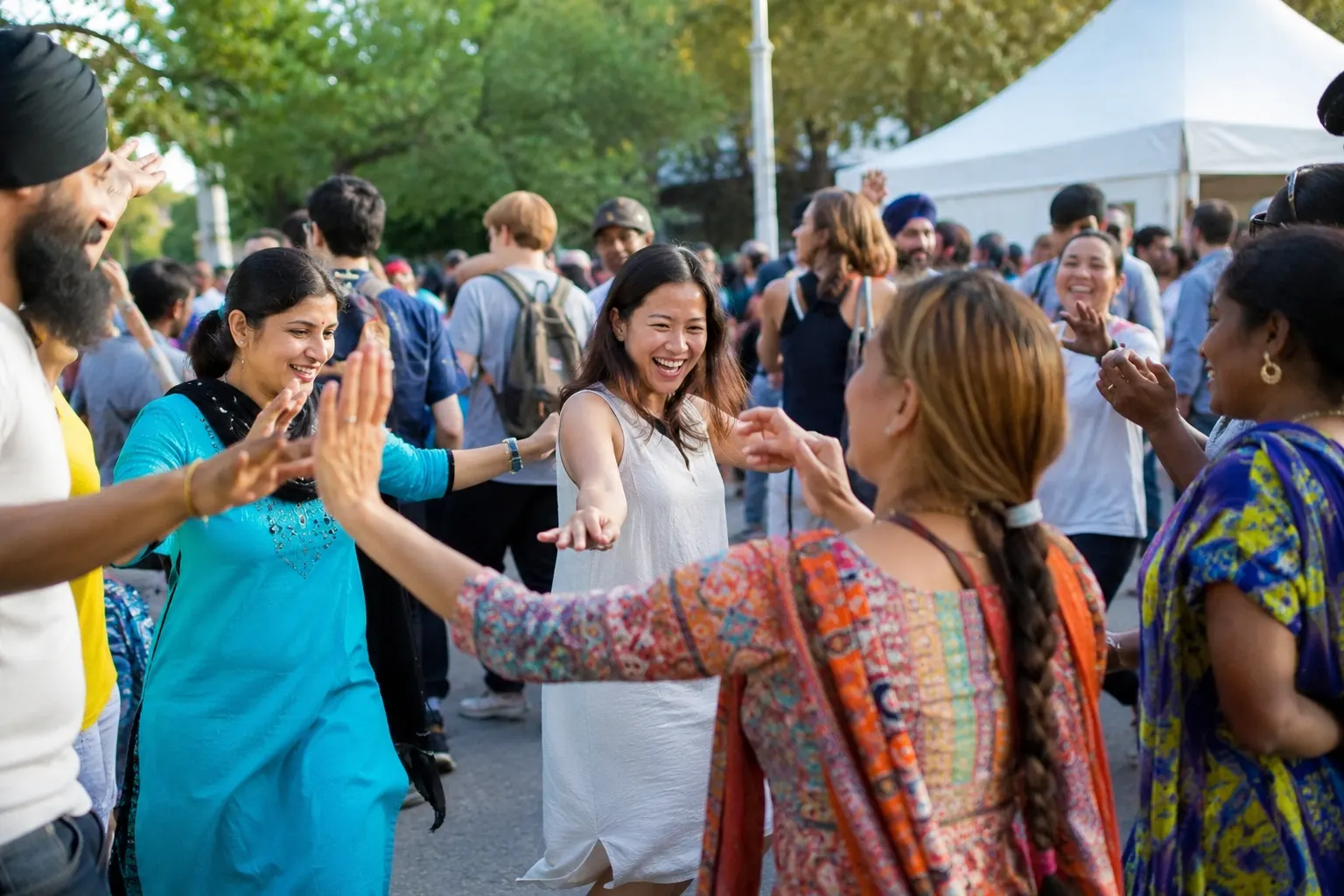
Salad Bowl Theory: Meaning, Examples, Melting Pot Comparison and Criticisms
Salad bowl theory describes a multicultural society in which different cultural groups participate in the same wider society while continuing to preserve important parts of their distinct identities. Instead of expecting immigrants or minorities to gradually become culturally indistinguishable from the majority, the model suggests that people can share citizenship, institutions and public life while retaining their language, religion, cuisine, customs and cultural memory.
The metaphor is usually contrasted with the melting pot. In a melting pot, different ingredients combine until their original forms become difficult to distinguish. In a salad bowl, the ingredients occupy the same container but remain recognisably different. Applied to society, the distinction becomes one between cultural fusion and cultural retention.
The model has an appealing message: belonging does not have to require cultural disappearance. But it also has a major limitation. Real societies are not static collections of separate ingredients. People interact, marry across groups, influence one another, create hybrid identities and compete for unequal access to institutions and resources. A diverse society can therefore preserve cultural difference and still suffer from segregation or inequality.
The real question is not simply whether a country resembles a melting pot or a salad bowl. It is whether cultural freedom can coexist with equal citizenship, common institutions and meaningful interaction between groups.
What Is Salad Bowl Theory?
Salad bowl theory is a social metaphor used to explain how cultural diversity can exist within one political society without requiring complete assimilation. Different communities may share common laws, schools, labour markets, public services and political institutions while retaining traditions that remain distinctive.
A family, for example, may speak one language at home and another at school or work. It may celebrate national holidays while also observing religious or cultural festivals inherited from another country. Its members may vote, work, pay taxes and participate fully in public life without abandoning family customs or ancestral identity.
This is the central idea behind the salad bowl model: integration and cultural retention can occur at the same time.
Although the phrase is commonly called a “theory,” it is more accurately understood as a metaphor or conceptual model. It does not provide a scientific formula for predicting how immigrant communities will behave. Its value lies in simplifying one important social question: must cultural differences disappear before people can be considered fully integrated?
What Does the Salad Bowl Represent?
The metaphor works because both the ingredients and the container have symbolic meaning. The different ingredients represent cultural, ethnic, linguistic or religious communities, while the bowl represents the shared civic framework that holds society together.
That shared framework may include citizenship, law, political institutions, schools, public services, infrastructure and economic systems. Cultural pluralism becomes politically workable only when these common structures are strong enough to connect people across difference.
The ingredients, meanwhile, represent identities that can remain visible. These may include language, religion, family traditions, food, music, clothing, cultural organisations and historical memory.
The important point is that the bowl matters as much as the ingredients. Without functioning common institutions and equal rights, a collection of separate cultural communities does not automatically become a successfully integrated society.
Salad Bowl vs Melting Pot
The salad bowl and melting pot describe different ways of imagining cultural integration. The melting pot emphasises cultural blending. Over time, differences in language, customs, religion and identity may weaken as groups converge into a broader common culture. The salad bowl places greater value on maintaining visible distinctions while still participating in the larger society.
A melting-pot society therefore tends to emphasise fusion and assimilation, whereas a salad-bowl society emphasises retention and pluralism.
The difference should not be exaggerated, however. Actual societies usually contain both processes. Someone may adopt the dominant public language and workplace norms while retaining religious traditions and family customs. Another person may marry across cultural groups and develop a hybrid identity while still maintaining a strong connection with ancestral heritage.
Real integration is therefore rarely a choice between complete fusion and complete separation.
What Is Assimilation?
Assimilation refers broadly to a process in which cultural differences between groups become smaller over time. This can involve language, behaviour, social networks, residential patterns, intermarriage and identity.
Assimilation does not always mean coercion. Some people voluntarily adopt elements of the surrounding culture because doing so creates social or economic opportunities. Others gradually change simply because later generations grow up in different schools, workplaces and neighbourhoods from their parents.
The controversial question is whether assimilation should be treated as a requirement for belonging. The strongest interpretation of the melting pot suggests that successful integration ultimately makes minority identity less visible. Salad bowl theory challenges that expectation by arguing that political membership does not require cultural uniformity.
Salad Bowl Theory and Multiculturalism
Salad bowl theory is closely associated with multiculturalism, but the two terms are not identical. The salad bowl is a metaphor. Multiculturalism is a much broader political and philosophical framework concerned with how societies should respond to cultural, linguistic and religious diversity.
Multicultural policies can involve anti-discrimination protections, minority-language accommodation, recognition of cultural institutions, inclusive education, religious freedom and political representation. These are concrete institutional questions that a metaphor cannot resolve on its own.
The salad bowl nevertheless captures an important multicultural intuition: people should not have to erase their identities in order to be accepted as full members of society.
Cultural Pluralism Came Before the Salad Bowl
The underlying principle is older than the salad-bowl metaphor itself. Thinkers associated with cultural pluralism argued long ago that common citizenship did not require every community to become culturally identical.
The basic idea is that people can belong to the same political society while maintaining meaningful differences in religion, language and cultural life. This directly challenges the assumption that national unity requires cultural sameness.
Modern multiculturalism develops the same problem in more sophisticated terms: how can common rights, shared institutions and political solidarity coexist with recognised cultural difference?
Examples of Salad Bowl Theory
Language provides one of the clearest examples. A family may use Hindi, Punjabi, Spanish or Arabic at home while using English in school, work or government. Bilingualism does not necessarily indicate incomplete integration. It can become a stable form of belonging in which different languages serve different parts of social life.
Food provides another obvious example. Multicultural cities may contain Indian restaurants, Korean grocery stores, Lebanese bakeries, Mexican markets and Ethiopian cafés. These food traditions may become part of the wider city's identity while remaining recognisably connected to particular communities.
Religion creates more difficult cases. A plural society may accommodate different houses of worship, religious clothing, dietary rules and festivals. But questions become more complicated when cultural or religious practices interact with common law, schooling, gender equality or children's rights. Cultural freedom therefore has to operate inside a shared legal framework rather than replacing it.
Ethnic neighbourhoods can also resemble the salad-bowl model. They may provide language support, community institutions, familiar businesses and family networks. But residential concentration can result either from voluntary community formation or from exclusion and discrimination. The visible existence of a distinctive neighbourhood therefore does not tell us whether integration is succeeding.
Why the Salad Bowl Model Appeals to Immigrant Societies
Immigration creates a practical tension between adaptation and continuity. Newcomers usually have to learn how to function within the legal, economic and institutional structure of the destination country, but that does not automatically mean they should abandon everything associated with their previous identity.
The salad bowl gives a simple answer: adaptation does not have to mean erasure. Someone can learn a public language, follow common law, work in the national economy and participate politically while continuing to maintain religious traditions, family customs and ancestral memory.
This makes the metaphor attractive because it allows belonging to be layered. A person can be national, regional, religious, linguistic and professional at the same time.
Layered Identity Is Normal
Modern identity is rarely singular. Someone may simultaneously identify as Indian, Tamil, British, Hindu, Londoner, doctor and parent. These identities may become more or less important depending on context.
The strongest assimilationist model can make such layering look temporary, as though eventually one identity should replace the others. Salad bowl theory is more comfortable with the idea that several forms of belonging can remain meaningful throughout a person's life.
National identity itself can also be defined in different ways. If national belonging requires common ancestry, religion and culture, diversity will create tension. If national identity is based primarily on citizenship, institutions, rights and public participation, cultural differences are easier to accommodate.
What Salad Bowl Theory Gets Right
The model's greatest strength is its rejection of the idea that political unity requires cultural uniformity. Modern societies already contain substantial differences in accent, region, religion, cuisine, family history and lifestyle. Diversity is often ordinary rather than exceptional.
The model also draws attention to cultural loss. Assimilation can bring opportunities, but it can also result in disappearing languages, weakened traditions and loss of intergenerational memory. Salad bowl theory reminds societies that this disappearance should not automatically be treated as evidence of successful integration.
It also challenges the tendency to measure integration only by asking how much minorities have changed. A more balanced approach asks whether institutions have created enough room for different citizens to participate as equals.
The Biggest Weakness: Ingredients Do Not Interact
The central weakness of the salad-bowl metaphor is that actual salad ingredients simply sit beside one another. Human communities do not.
People form friendships, work together, marry, exchange language, influence music, share schools, participate in politics and create new cultural forms. The surrounding society changes as newcomers arrive, and migrant communities themselves change through contact with their new environment.
A metaphor built around separate ingredients therefore understates how much cultural exchange actually occurs.
This matters because coexistence is not the same as integration.
Diversity Without Interaction Can Become Separation
Imagine two communities living in the same city. They maintain different cultural traditions, but they attend different schools, live in separate neighbourhoods, rarely form friendships across groups and have little political or economic interaction.
They clearly coexist, but it would be difficult to describe the relationship as deeply integrated.
This is where salad bowl theory can become misleading. It can make parallel existence appear automatically healthy simply because cultural identity is being preserved.
A functioning plural society needs opportunities for people to encounter one another through schools, workplaces, public spaces, sport, local government and civic institutions.
Diversity Without Equality Can Be Decorative
Cultural visibility is not the same as equal membership. A city may proudly advertise multicultural festivals while minority communities remain concentrated in low-paid work or face discrimination in housing and employment.
A company may publish photographs showing employees from many backgrounds while its senior leadership remains extremely homogeneous.
Restaurants, festivals and cultural celebrations matter, but they cannot substitute for equal access to institutions. A serious assessment of diversity has to examine employment, income, housing, education, political influence and discrimination.
The important question is therefore not just who is present, but who has power and opportunity.
Cultural Retention Is Not Segregation
Retaining culture and living separately are not the same thing. A minority community can maintain language, religion and cultural organisations while interacting extensively with people from other groups.
Likewise, a community can become culturally similar to the majority while remaining economically or residentially excluded.
The difference becomes clearer when comparing voluntary community concentration with forced segregation. People may choose to live close to relatives, places of worship and familiar businesses while still having full access to jobs, education and wider society. Another community may appear similarly concentrated because housing discrimination or poverty limits where its members can live.
The visible outcome may look similar, but the social conditions are very different.
Social Contact Matters
Meaningful interaction can shape how people understand other groups. Research on immigrant integration has repeatedly examined the relationship between direct social contact and attitudes toward immigration and diversity.
Contact does not automatically eliminate prejudice, and poorly structured contact can even create conflict. But integration cannot reasonably mean that communities remain permanently distant from one another.
People need shared spaces where cooperation becomes routine rather than exceptional.
The Intercultural Alternative
This concern has helped produce greater interest in intercultural integration. The intercultural approach does not reject cultural diversity, but it places greater emphasis on equality, interaction and participation.
The difference can be understood simply. Assimilation asks people to become more similar. A basic salad-bowl model allows people to remain different while coexisting. An intercultural model aims for people to remain different while also participating equally and interacting meaningfully.
This does not mean multiculturalism and interculturalism are complete opposites. Many multicultural institutions already encourage interaction. But the intercultural approach highlights something the static salad metaphor struggles to show: diversity works best when people encounter one another as fellow members of a common society.
Culture Is Dynamic, Not Frozen
Another weakness of the metaphor is that vegetables in a salad remain essentially unchanged. Human cultures do not.
Immigrant communities adapt to schools, laws, workplaces, technology and new neighbours. Practices can disappear, revive or acquire new meanings. Children may maintain some traditions while rejecting others.
This process becomes particularly visible across generations. Second- and third-generation descendants of immigrants may speak the ancestral language less often but retain strong religious identity. Others may revive traditions their parents abandoned. Some develop identities that combine several cultural influences.
Cultural retention therefore does not mean preserving a community exactly as it existed at the moment migration occurred.
Hybrid Identity Challenges the Salad Bowl
Hybrid identities are especially difficult to fit into the metaphor. A person with parents from different cultural backgrounds may combine several languages, cuisines, religions or traditions. Musicians and artists routinely mix cultural styles in ways that make clear boundaries impossible.
This suggests that societies do not contain only separate cultures that coexist. They also produce new cultural forms through interaction.
For this reason, alternatives such as the cultural mosaic, tapestry, kaleidoscope or overlapping circles have also been used to describe diversity. None is perfect, but overlapping circles may capture modern identity particularly well because people share some memberships while differing in others.
Digital Media Makes Cultural Retention Easier
Technology has changed migration profoundly. Earlier migrants could become physically separated from newspapers, music, television and extended family in their countries of origin. Today they can video-call relatives, follow news, stream entertainment and participate in online communities almost continuously.
This makes transnational identity much easier to sustain. Someone can live permanently in one country while remaining deeply connected to cultural life elsewhere.
But digital media can also strengthen separation. If people consume almost all of their news, entertainment and social interaction within one cultural network, strong transnational connections may coexist with limited local engagement.
Technology therefore supports both cultural continuity and the possibility of social distance.
Schools Reveal the Trade-Off
Education is one of the clearest places where shared citizenship and cultural recognition meet. Schools need common rules, qualifications, curricula and civic knowledge. At the same time, they decide whose histories and traditions are represented in the public story.
A school system may teach a common national curriculum while including minority histories, migration, regional traditions and several literary or cultural perspectives. This allows common civic education without implying that only one cultural inheritance belongs to the nation.
Schools are also important because they create regular interaction among children from different backgrounds. If education becomes heavily segregated, cultural pluralism can begin to resemble parallel social worlds.
Public Symbols Influence Belonging
Street names, monuments, museums, holidays and public ceremonies communicate whose history is considered part of the national story. Recognising several cultural traditions can broaden public belonging.
But symbolic inclusion has limits. A community represented in public festivals but excluded from jobs or political decision-making is not fully integrated simply because its culture is visible.
Recognition matters most when it is combined with meaningful institutional equality.
Workplaces and Local Institutions Matter
Integration often occurs through ordinary institutions more than dramatic national debates. Workplaces, libraries, schools, sports facilities, transport systems and neighbourhood organisations bring people into repeated contact.
A workplace creates shared tasks and professional expectations. A sports club creates common rules and goals. A local library or community centre can serve several groups simultaneously.
These ordinary interactions are difficult for the salad metaphor to represent, but they are central to creating shared civic experience.
Intermarriage Blurs Cultural Boundaries
Intermarriage demonstrates perhaps more clearly than anything else why cultures cannot always be treated as separate ingredients. Families may combine languages, religious traditions, cuisines, holidays and naming practices.
Children may inherit several identities without considering any of them secondary or temporary.
Real societies therefore involve both retention and mixing. Some boundaries persist while others weaken or disappear.
Does Integration Require Assimilation?
Some adaptation is unavoidable in any functioning society. People need to understand common laws and institutions, and in many countries effective participation requires competence in a widely shared public language.
But this does not mean every cultural difference has to disappear. Learning a common public language does not require abandoning a family language. Following national law does not require eating the same food or celebrating the same holidays.
The real debate concerns which areas of social life legitimately require common standards and which should remain open to cultural variation.
Cultural Freedom Has Limits
Pluralism cannot mean that every cultural practice automatically overrides common law. Democratic societies generally maintain limits where practices conflict with fundamental rights, safety, criminal law or protection of children.
This is another place where the salad metaphor becomes too simple. Salad ingredients never disagree about legal principles. Citizens do.
Successful pluralism therefore requires institutions capable of negotiating disagreement while protecting both cultural freedom and equal rights.
Is the United States a Salad Bowl or Melting Pot?
The United States is commonly described using both metaphors. Neither completely captures the society.
Some processes resemble assimilation. English becomes dominant across generations, intermarriage is common and shared institutions create broad national culture. At the same time, ethnic neighbourhoods, religious communities, ancestral identities and cultural organisations remain visible.
There is also extensive hybridisation. Music, language, cuisine and popular culture constantly combine influences from different groups.
The most accurate answer is therefore that the United States contains melting, retention and hybridisation simultaneously.
Salad Bowl vs Cultural Mosaic
The cultural mosaic is another metaphor for multicultural society. Instead of ingredients in one bowl, it imagines separate pieces forming a larger picture.
Both metaphors emphasise continued cultural distinctiveness. The mosaic arguably communicates common membership more clearly because every piece contributes to one design.
But mosaic pieces are also fixed and separate. Like the salad bowl, the metaphor struggles to represent interaction, cultural change and hybrid identity.
How Should Integration Actually Be Measured?
Rather than asking only whether a country resembles a salad or melting pot, integration can be examined through measurable social outcomes.
Employment and income show whether minority communities have meaningful economic opportunity. Education reveals whether children have comparable chances to succeed. Housing patterns can indicate whether residential concentration reflects choice or exclusion.
Political participation matters too. Full citizenship means more than cultural recognition; people need opportunities to vote, organise, run for office and influence government.
Social contact, discrimination, trust and language proficiency also matter. These indicators reveal whether groups merely occupy the same territory or genuinely participate in shared society.
A multicultural society should therefore be evaluated not just by the amount of visible diversity it contains but by the quality of inclusion experienced by the people living within it.
Advantages of Salad Bowl Theory
The salad bowl remains useful because it offers a simple explanation of cultural pluralism and challenges the assumption that minorities must become culturally invisible before they can belong.
It recognises layered identity, validates language and cultural retention and makes cultural loss easier to discuss. It also encourages societies to separate political membership from complete cultural sameness.
For introductory discussions of immigration and multiculturalism, these are significant strengths.
Criticisms and Limitations of Salad Bowl Theory
Its simplicity also creates major limitations. The metaphor treats cultures as relatively fixed, underestimates cultural exchange and cannot easily represent mixed identities or intermarriage.
More importantly, it can confuse coexistence with successful integration. Groups can preserve cultural distinctiveness while remaining economically unequal, politically underrepresented or socially isolated.
It also offers little guidance when differences involve questions of common law, human rights or competing political values.
The salad bowl is therefore best understood as an argument against cultural erasure, not as a complete theory of how diverse societies should function.
Salad Bowl vs Melting Pot vs Intercultural Integration
A useful way to compare the models is to focus on their central question.
The melting pot asks how different groups combine into a broader shared culture. The salad bowl asks whether people can remain culturally distinct while belonging to the same society. Intercultural integration asks how diversity can coexist with equality, interaction and active participation.
None of these models describes every dimension of a real society. But together they reveal that integration has several possible components: cultural adaptation, cultural freedom, social contact, economic inclusion and shared political membership.
Frequently Asked Questions
What is salad bowl theory?
Salad bowl theory is a metaphor for a multicultural society in which different cultural groups live within one wider society while retaining important aspects of their distinct identities.
Why is it called the salad bowl?
The metaphor compares cultural communities to ingredients in a salad. They share the same container but remain recognisably different rather than blending completely.
What is an example of salad bowl theory?
A bilingual immigrant family that participates fully in national schools, employment and politics while preserving its ancestral language, religious traditions and cultural celebrations is a simple example.
What is the difference between salad bowl and melting pot?
The melting pot emphasises cultural blending and assimilation, while the salad bowl emphasises cultural retention within a shared society.
Is salad bowl theory the same as multiculturalism?
No. Salad bowl theory is a metaphor. Multiculturalism is a broader political and philosophical framework dealing with cultural diversity, minority recognition and equal participation.
What is cultural pluralism?
Cultural pluralism is the idea that cultural groups can maintain meaningful differences while participating within a common political society.
Does salad bowl theory encourage segregation?
Not necessarily. Cultural retention does not require isolation. The problem arises when separate communities have little interaction or when separation results from discrimination and unequal opportunity.
What are the advantages of salad bowl theory?
It recognises cultural freedom, layered identity and the possibility that people can belong fully to a country without abandoning language, religion or traditions.
What are the disadvantages of salad bowl theory?
It can treat cultures as fixed, underestimate cultural exchange, struggle with hybrid identities and make simple coexistence appear equivalent to successful integration.
Is the United States a melting pot or salad bowl?
It contains elements of both. Some differences weaken through assimilation, others remain strong, and many cultural influences combine into new hybrid forms.
What is the difference between a salad bowl and cultural mosaic?
Both emphasise cultural distinctiveness. The salad bowl imagines different ingredients sharing one container, while the mosaic imagines distinct pieces contributing to one larger picture.
What is intercultural integration?
Intercultural integration emphasises cultural diversity together with equality, social interaction, participation and cooperation across different groups.
Can someone have more than one cultural identity?
Yes. People frequently hold national, regional, religious, linguistic, ethnic and professional identities simultaneously.
Does integration require cultural assimilation?
Some adaptation to common institutions is normally necessary, but integration does not require complete cultural disappearance.
Why is equality important in multicultural societies?
Visible cultural diversity means little if some groups lack comparable access to education, housing, employment, political participation and public institutions.
What Salad Bowl Theory Ultimately Means
The lasting value of salad bowl theory is its rejection of one simple assumption: people should not have to disappear culturally in order to belong politically.
A person can participate fully in a country while maintaining a family language, religion, cuisine, cultural traditions and ancestral memory. That insight remains important in societies shaped by migration and diversity.
But cultural preservation alone is not enough. A successful plural society also needs equal rights, economic opportunity, political participation, shared institutions and meaningful contact across group boundaries.
Real cultures also do things salad ingredients cannot. They interact, change, borrow, combine and produce new identities.
The best way to understand the metaphor is therefore as a warning against forced cultural erasure, not as a complete description of integration.
A strong plural society does not have to choose between complete fusion and permanent separation. It can preserve cultural freedom while building common civic habits through schools, workplaces, public institutions and democratic participation.
The better goal is not simply to keep every ingredient separate.
It is to create a society in which people can remain different, interact as equals and still recognise themselves as members of something shared.