
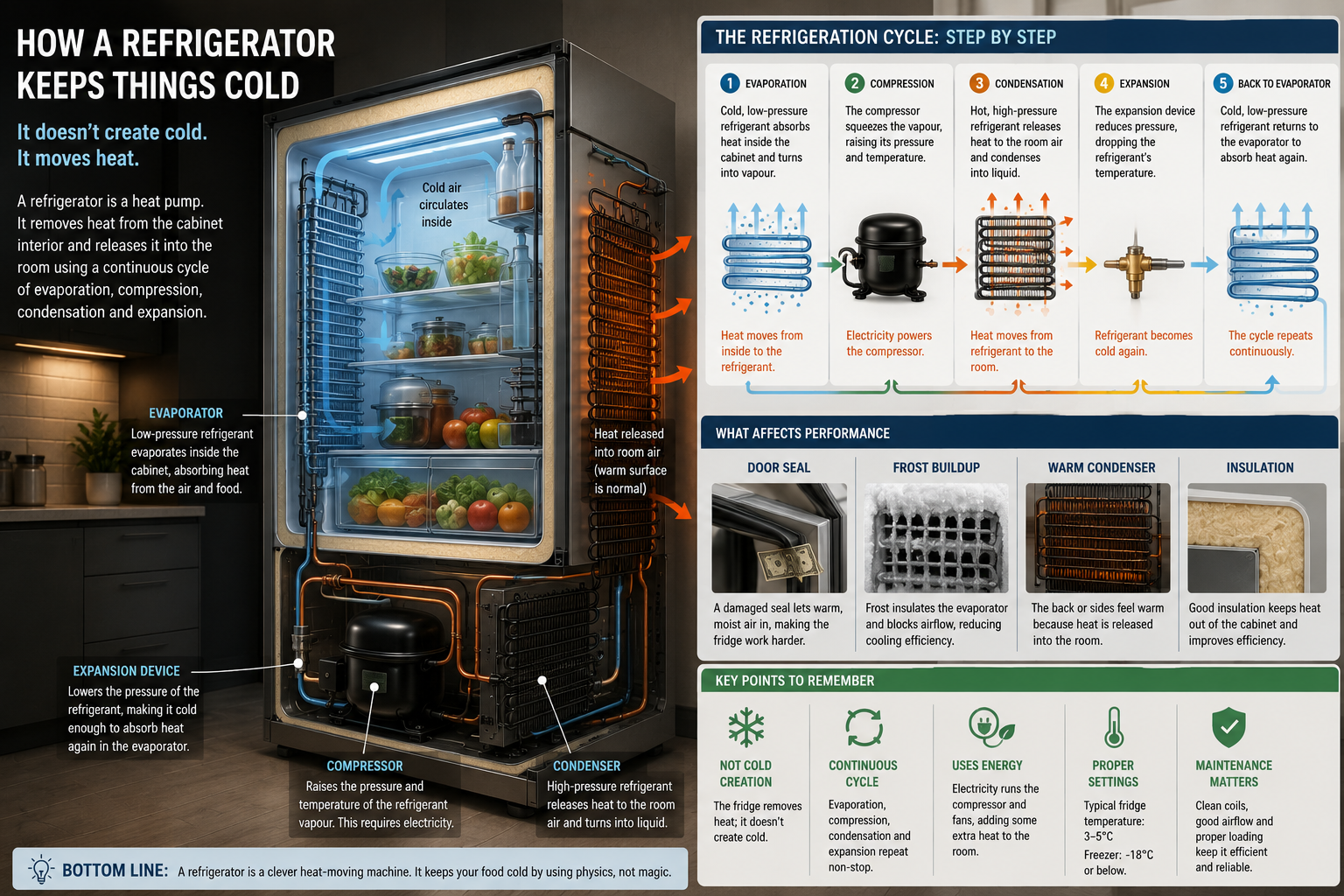
A refrigerator appears to create cold, but that is not exactly what it does. It removes heat from one place and releases it somewhere else. The inside of the fridge becomes cold because heat is continuously moved out of it. The warm air you may feel near the back or sides of a refrigerator is the other half of the story. The machine keeps food cold by using electricity to run a heat-moving cycle based on evaporation, compression, condensation and expansion.
The Simple Definition
A refrigerator is a heat pump designed to move heat from the low-temperature interior of the cabinet to the higher-temperature room outside. It uses a working fluid called a refrigerant. The refrigerant changes pressure, temperature and physical state as it circulates through the system. By evaporating inside the fridge, it absorbs heat. By condensing outside the fridge, it releases heat. The cycle repeats as long as the compressor runs.
Step One: Heat Must Be Removed, Not Destroyed
Cold is not a substance that a machine injects into the cabinet. In thermodynamics, cooling means reducing the thermal energy of a space or object. Food, air, shelves and containers inside the refrigerator contain heat. The refrigerator removes some of that heat and transfers it to the surrounding room. This is why a fridge cannot cool a closed kitchen overall. It makes its interior colder, but it releases heat to the room and also adds some waste heat from the electrical work done by the compressor.
Step Two: The Evaporator Absorbs Heat Inside
Inside the refrigerator is an evaporator coil or cold surface connected to the refrigerant circuit. Low-pressure refrigerant enters this section and evaporates. Evaporation requires energy, and that energy is absorbed as heat from the fridge interior. As air passes near the cold evaporator, heat moves from the warmer air and food environment into the refrigerant. This lowers the temperature inside the cabinet. In frost-free refrigerators, fans and defrost systems help manage airflow and ice buildup.
Step Three: The Compressor Raises Pressure and Temperature
After absorbing heat, the refrigerant leaves the evaporator as a low-pressure vapour. The compressor then squeezes this vapour, raising its pressure and temperature. This step requires electricity. Compression is crucial because it prepares the refrigerant to release heat to the room. A hot, high-pressure refrigerant can lose heat through the condenser even when the kitchen air is warmer than the fridge interior. Without the compressor, the cycle would not keep moving heat against the natural temperature direction.
Step Four: The Condenser Releases Heat Outside
The hot, high-pressure refrigerant flows through the condenser coil, usually located at the back, bottom or sides of the refrigerator. Here, heat flows from the refrigerant into the surrounding air. As it releases heat, the refrigerant condenses from vapour into liquid. This is why the outside of a working refrigerator can feel warm. That warmth is not a malfunction by itself. It is evidence that the appliance is moving heat out of the cabinet and dumping it into the room.
Step Five: The Expansion Device Lowers Pressure
After condensation, the refrigerant is a high-pressure liquid. It passes through an expansion device, such as a capillary tube or expansion valve, where its pressure drops. This pressure drop makes the refrigerant cold enough to absorb heat again in the evaporator. The cycle then repeats. The four core parts - evaporator, compressor, condenser and expansion device - form the basic vapour-compression refrigeration cycle used in many refrigerators, air conditioners and heat pumps.
Why the Door Seal Matters
The refrigerator cycle can only work efficiently if the cabinet is reasonably insulated and sealed. When the door seal is damaged, warm moist air enters. The appliance must remove more heat and may create more frost. Frequent door opening has the same effect. Hot food placed inside also adds heat load. The refrigerator can handle these loads, but it must run longer, use more energy and work harder. Good cooling is therefore not only about the compressor; it is also about insulation, airflow and user behaviour.
Why Frost Can Be a Problem
Frost forms when moisture in the air freezes on cold surfaces. A thin layer may be normal in some systems, but heavy frost can reduce heat transfer and block airflow. Frost-free refrigerators periodically warm the evaporator area just enough to melt accumulated ice, then drain the water away. This sounds counterintuitive, but controlled defrosting can improve overall performance by keeping the heat exchange surfaces effective. Cooling is a balance between temperature control, moisture control and energy use.
Energy Efficiency and Refrigerants
Refrigerators run for years, so efficiency matters. Better insulation, improved compressors, smarter controls, efficient fans and better heat exchangers reduce electricity consumption. Refrigerants also matter because some older chemicals damaged the ozone layer or had high global warming potential. Modern refrigeration has had to balance performance, safety, environmental impact and cost. The refrigerator is therefore both a household appliance and a climate-relevant technology.
Common Misconceptions
The first misconception is that a refrigerator creates cold. It moves heat. The second is that a colder thermostat always protects food better. Excessively low settings can waste energy and freeze items not meant to be frozen. The third is that the back of a fridge getting warm is automatically bad. Some warmth is normal because heat must be released. A problem is more likely when the appliance cannot maintain temperature, runs constantly, leaks refrigerant, has blocked airflow or has damaged seals.
Final Takeaway
A refrigerator keeps things cold by moving heat from inside the cabinet to the room outside. The refrigerant absorbs heat as it evaporates, the compressor raises its pressure and temperature, the condenser releases heat, and the expansion device prepares the refrigerant to absorb heat again. The fridge is not a cold-making box. It is a heat-moving machine, quietly using thermodynamics to preserve food every day.
Source References for Verification
Electronics Cooling - How Vapor-Compression Cooling Works: https://www.electronics-cooling.com/2017/07/vapor-compression-cooling-works/
U.S. Department of Energy - Refrigerators and Freezers: https://www.energy.gov/energysaver/refrigerators-and-freezers
Energy Star - Refrigerators: https://www.energystar.gov/products/refrigerators
ASHRAE - Refrigeration resources: https://www.ashrae.org/technical-resources/refrigeration
Editorial Publishing Notes
Keep the explainer evergreen and avoid short-term product claims unless the article is updated later.
Add one labelled diagram or process-flow visual near the top of the article for stronger reader retention.
Before publishing, verify technical terms, source URLs and any device-specific examples against current official documentation.
Editors Outlook | Science & Technology | Page


