Rainwater Harvesting Explained: How Capturing Rain Strengthens Water Security
Rain often creates a timing problem. A heavy storm can send thousands of litres of water from roofs, streets and fields into drains or rivers within a few hours, yet the same household or community may face shortages weeks or months later. Rainwater harvesting tries to bridge that gap by capturing rainfall when it arrives and keeping some of it available for later use. The method can be as simple as directing roof runoff into a tank or as broad as using farm bunds, basins and terraces to slow runoff and retain moisture in the soil. The underlying principle is the same: rainwater harvesting does not create new water; it changes how long rainfall remains useful.
Modern systems range from small household tanks to agricultural catchments and urban stormwater-retention measures. Their apparent simplicity can be misleading because a reliable system requires more than a roof and container. Rainfall varies from year to year, storage capacity is limited, roofs and gutters can introduce contamination, tanks need protection from insects and debris, and excess water requires a safe overflow route. If harvested water is intended for drinking, treatment, monitoring and local health requirements become even more important. Rainwater harvesting therefore works best as part of a broader water-security strategy rather than as a universal replacement for conventional supply.
What Is Rainwater Harvesting?
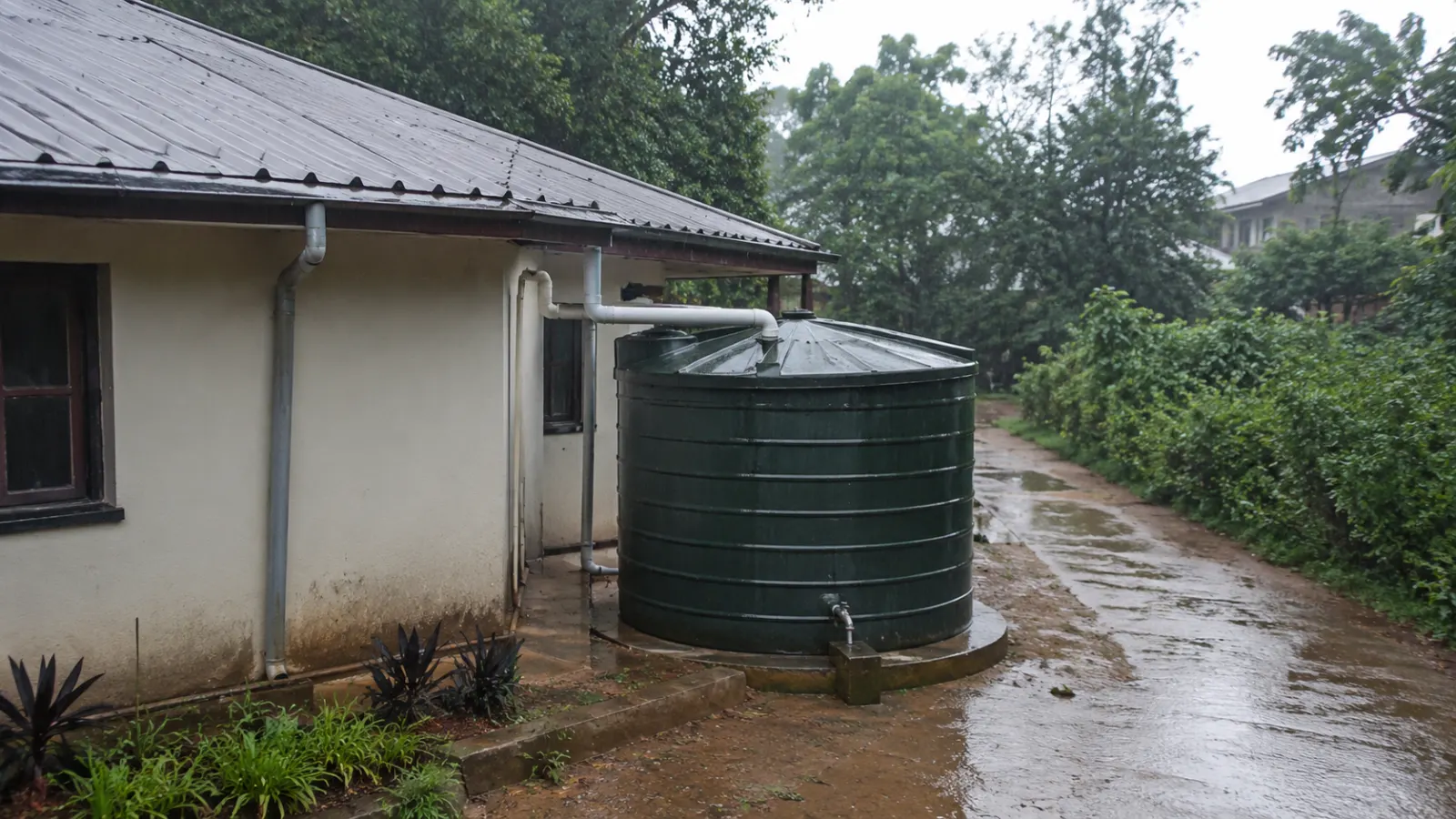
Rainwater harvesting is the deliberate collection and use of rainfall or runoff that would otherwise flow away. In a rooftop system, the roof acts as the catchment, gutters and downpipes move the water, screens help prevent leaves and larger debris from entering, and a tank or cistern stores the collected water. Some systems also use a first-flush device to divert the earliest runoff after rain begins because that water may contain a higher concentration of dust, bird droppings and material accumulated on the roof during dry weather. The system also needs a safe outlet for use and an overflow route for rainfall that arrives after the tank is full.
Agricultural harvesting often works differently. Farmers may not try to place every litre into a tank; instead, they can slow runoff so that more water infiltrates into soil near crops or trees. Bunds, terraces, basins and micro-catchments can retain water within the landscape and reduce how quickly it disappears downslope. FAO identifies rainwater harvesting, soil-moisture conservation and supplementary irrigation as useful tools for improving water productivity in rainfed agriculture.
How Much Water Can a Roof Collect?
The potential yield from a roof depends mainly on rainfall, catchment area and collection efficiency. A useful approximation is harvested volume = rainfall × catchment area × runoff coefficient. One millimetre of rain falling on one square metre represents approximately one litre of water before losses, so a 100-square-metre roof receiving 10 millimetres of rain receives roughly 1,000 litres. Actual storage will be lower because some water wets the roof, evaporates, splashes away or is deliberately discarded during the first flush.
The annual rainfall total does not tell the whole story because timing can matter more than the yearly average. A region may receive substantial rain during a short monsoon and almost none during the following months. In that situation, the technical challenge is not collecting rainfall during storms but storing enough of it to remain useful through the dry period. Two places with similar annual rainfall can therefore require very different harvesting systems depending on how that rainfall is distributed across the year.
Why Rainwater Harvesting Can Help Households
For households, harvested rainwater can supplement mains supply, wells or purchased water. Non-potable uses such as garden irrigation, cleaning and toilet flushing are often the simplest applications because they can reduce demand for fully treated drinking water. In communities with intermittent municipal supply, a well-sized tank can also provide a local reserve between supply interruptions. Where groundwater is under pressure, substituting harvested rainwater for suitable uses may reduce a portion of household pumping demand.
The benefit depends on scale. A small tank might comfortably meet gardening needs while contributing very little to total household consumption. A larger system can provide more meaningful seasonal resilience, but it requires more space, greater investment and additional maintenance. Rainwater itself may be free, but tanks, gutters, pumps, screens, filters and plumbing are not, so the economics should be assessed against the cost and reliability of alternative water sources.
Rainwater Harvesting in Agriculture
On farms, rainwater harvesting can be especially valuable where rainfall is erratic rather than entirely absent. Instead of allowing rainfall to run rapidly across the land, farmers can slow and concentrate runoff so that more water remains available to crops during short dry spells. This approach can improve soil moisture and sometimes reduce erosion when it is properly designed.
Local conditions are critical. A structure designed for gentle rainfall on one soil type can fail under intense storms or steep slopes elsewhere. Soil permeability, rainfall intensity, erosion risk, crop type and land gradient all influence design. Agricultural rainwater harvesting therefore cannot be reduced to copying one successful structure from another region; the principle is transferable, but the engineering must be local.
Rainwater Harvesting and Stormwater Management
Urban rainwater harvesting can also reduce the speed at which stormwater reaches drains. Roofs, roads and paved surfaces shed water rapidly, and when many surfaces discharge simultaneously, drainage networks can become overwhelmed. Storage tanks, rain gardens and other retention systems can temporarily hold or slow part of that runoff, helping reduce peak flows.
This does not mean a household tank can prevent major flooding. If the tank is already full when a storm arrives, it provides little additional storage. However, many distributed systems operating together can contribute to a wider stormwater strategy by delaying some runoff and creating additional local retention. Rainwater harvesting can therefore support both water supply and urban drainage, although the two functions need to be considered during design.
Harvested Rainwater Is Not Automatically Safe
Rain may begin relatively clean, but it can pick up contaminants from the atmosphere and especially from surfaces it touches before entering storage. Roofs can carry dust, bird and animal droppings, chemicals or particles from roofing materials. Gutters can contain leaves and debris, while open or poorly protected tanks can admit insects, animals and additional contamination.
WHO’s July 2026 sanitary-inspection package for rainwater collection and storage treats the system as a chain of identifiable risks that require regular inspection, maintenance and corrective action. That is an important public-health principle because water safety depends on the entire system rather than the fact that the original source was rainfall. Clear-looking rainwater should not automatically be assumed safe to drink.
What a First-Flush Device Does
The first rainfall after a dry period can wash accumulated dust, droppings and other material from the roof. A first-flush device diverts part of this initial runoff before the remaining water enters storage, reducing one important contamination pathway. This can improve stored-water quality, but it does not make the water automatically potable.
First-flush systems do not remove every microorganism or chemical contaminant, and they cannot compensate for unsuitable roofing materials, poorly sealed tanks or neglected maintenance. Where water will be consumed, additional treatment and water-quality safeguards may still be necessary. The first flush is therefore best understood as one protective barrier within a larger water-safety system.
Storage Is Often the Main Limitation
Collecting rain during a heavy storm can be easy; storing enough of it for later is often the harder problem. Small tanks fill quickly and then overflow, while large tanks retain more water but cost more and require additional space and sometimes structural preparation. The correct storage size depends on rainfall patterns, catchment area, intended use, demand and the reliability of alternative supplies.
Design should begin with demand rather than with the tank catalogue. A household wanting rainwater only for seasonal gardening needs a different system from one hoping to supply toilet flushing and cleaning throughout the year. A household attempting to bridge several dry months requires much more storage and should consider dry-year rainfall rather than designing only around average conditions. Oversizing wastes money, while undersizing can create unrealistic confidence about the security the system will provide.
Stored Rainwater Needs Ongoing Maintenance
A rainwater system changes over time if nobody maintains it. Gutters clog, screens tear, first-flush devices stop working, sediment accumulates in tanks and covers can become damaged or left open. Pumps and filters can fail, while poorly designed overflow can create erosion or stagnant water near the building.
Routine maintenance should therefore inspect the roof, gutters, downpipes, screens, first-flush device, tank cover, overflow and outlet. If the water is used for drinking, treatment performance and water quality also need appropriate monitoring. WHO’s sanitary-inspection approach is useful precisely because it treats maintenance as part of the technology rather than something separate from it.
Mosquito Control and Safe Storage
Poorly protected tanks can become mosquito-breeding sites, particularly in regions where mosquito-borne diseases are an important public-health concern. Openings, vents and overflow points should therefore be protected so that insects cannot enter while the system remains functional. Tank covers also help prevent animals, debris and sunlight from affecting stored water.
Overflow requires equal attention because every tank eventually reaches capacity during sufficiently heavy rainfall. Excess water should be routed to a safe drain, infiltration area, rain garden or another appropriate location rather than being allowed to erode soil, damage foundations or create standing water. A harvesting system must manage both the water it stores and the water it cannot store.
Rainwater Harvesting and Groundwater
Harvested rainfall can reduce some groundwater demand when it substitutes for water that would otherwise be pumped from wells. This may be useful where aquifers are under pressure, especially if rainwater is used for irrigation, washing or other suitable non-potable purposes. A single household tank will not solve regional groundwater depletion, but many complementary measures can reduce total demand.
Some systems are also designed to encourage groundwater recharge by slowing runoff and allowing more water to infiltrate. The effectiveness depends on soil, geology, water quality and local hydrology. Recharge should not be approached casually because directing polluted runoff underground can threaten groundwater rather than protect it. The objective is controlled and safe recharge, not simply sending as much stormwater as possible into the ground.
Climate Change Creates Both Opportunity and Uncertainty
Climate change can increase the value of local water storage because rainfall may become more variable and dry periods may become harder to manage. At the same time, WHO notes that climate change is expected to increase fluctuations in harvested rainwater, which means the amount available may become less predictable. Longer dry periods can require larger storage, while more intense storms can exceed the capacity of gutters, downpipes and overflow systems.
This creates an important limitation. A storage tank can preserve water that has already fallen, but it cannot produce water during a year when rainfall is unusually low. Rainwater harvesting should therefore be viewed as a climate-adaptation tool that can improve resilience, not as insurance against every drought.
Where Rainwater Harvesting Works Best
Rainwater harvesting is most attractive where there is a meaningful amount of seasonal rainfall, adequate catchment area, space for storage and a clear use for the collected water. It can be particularly valuable where municipal water is unreliable or expensive, groundwater pumping needs to be reduced, agricultural rainfall is erratic or urban stormwater creates drainage problems.
It is less effective where annual rainfall is extremely low, roofs are unsuitable, storage is prohibitively expensive or expected demand is far larger than the available catchment could supply. Local water balance matters more than the general appeal of harvesting “free rain.” A good system is one whose expected supply, cost and maintenance burden make sense for the place where it is installed.
Rainwater Harvesting Works Best With Water Conservation
Rainwater harvesting and water conservation are complementary but different strategies. Conservation reduces unnecessary demand or improves the efficiency of water use, while harvesting increases the amount of locally captured supply available for suitable purposes.
Combining the two can make a smaller system more effective. A household that reduces avoidable water use requires less storage to achieve the same degree of resilience, while a farm using soil-moisture conservation and efficient irrigation can gain more value from each unit of harvested rainfall. Capturing more water without addressing unnecessary demand can produce less benefit than improving both sides of the water balance together.
Drinking-Water Use Requires Stronger Safeguards
Using collected rainwater for drinking or food preparation requires a higher standard than using it for irrigation or toilet flushing. Potable use creates direct exposure to any microorganisms, chemicals or contaminants remaining in the system, so catchment materials, storage, treatment, monitoring and local health requirements all matter.
WHO drinking-water guidance provides the broader framework for managing these risks. The practical principle is straightforward: water quality should match the intended use. Not every harvested litre needs to be treated to drinking-water standards if it will never be consumed, but water intended for consumption should not be assumed safe merely because it originated as rain.
A Simple Rainwater-Harvesting Calculation
Consider a house with a 100-square-metre roof receiving 10 millimetres of rainfall. Before losses, approximately 1,000 litres of water fall on the roof. The actual amount entering storage will be lower after accounting for runoff losses, first-flush diversion and other inefficiencies.
Now suppose most of the region’s rainfall occurs during only three months of the year. The important design question is no longer whether 1,000 litres can be captured during one storm, but how much water the household needs during the following dry months and how much storage would be required to preserve enough of the seasonal rainfall. That timing problem explains why rainwater harvesting is fundamentally about storage and demand rather than simply rainfall volume.
Frequently Asked Questions
What is rainwater harvesting?
Rainwater harvesting is the deliberate collection and use of rainfall or runoff that would otherwise flow away. Systems can include rooftop tanks, agricultural runoff-management structures, infiltration systems and urban stormwater-retention measures.
Can rainwater harvesting provide drinking water?
It can in appropriately designed and managed systems, but drinking-water use requires suitable catchment materials, safe storage, treatment, monitoring and compliance with local health guidance. Collected rainwater should not automatically be assumed potable.
How much water can a roof collect?
Before losses, one millimetre of rain over one square metre equals approximately one litre. Actual harvest is lower because of wetting, evaporation, splash, first-flush diversion and system inefficiencies.
What is a first-flush system?
A first-flush system diverts some of the earliest roof runoff after rain begins because it may contain higher levels of accumulated dust, droppings and debris.
Can rainwater harvesting reduce groundwater use?
Yes, when harvested rain substitutes for water that would otherwise be pumped from aquifers. Its impact depends on the scale of harvesting relative to total groundwater demand.
Can it help with flooding?
Rainwater storage and retention can delay some stormwater entering drains, especially when many systems operate together, but household tanks alone cannot prevent major floods.
Can mosquitoes breed in rainwater tanks?
Yes, if tanks and openings are poorly protected. Proper covers, screens and maintenance are necessary.
Is rainwater harvesting useful in agriculture?
Yes. Agricultural systems can slow runoff, improve soil-moisture retention and concentrate available rainfall near crops, particularly where rainfall is erratic.
Does rainwater harvesting work during drought?
It can provide previously stored water during dry periods, but a prolonged low-rainfall period will eventually empty storage. It cannot generate water when no rain has been captured.
What is the biggest limitation?
For many systems, the main limitation is the combination of irregular rainfall and finite storage capacity. A tank can only provide water that previously entered it.
Rainwater Harvesting Is Really About Moving Water Through Time
The easiest way to understand rainwater harvesting is to recognise that it does not create water. The rainfall would have occurred regardless. What the system changes is how quickly that water stops being available for useful purposes. Without capture, roof runoff may disappear down a drain within minutes. With storage, some of that same water may remain available weeks or months later, while agricultural systems can retain rainfall in soil rather than allowing it to leave the field immediately.
That is why tanks, soil moisture, recharge and runoff control all belong under the same concept. They are different ways of extending the useful life of rainfall. The technical question is not merely how much rain can be captured, but whether it can be stored or retained safely and economically until the moment it is needed.
The Central Idea
Rainwater harvesting is a simple idea with practical limits. It captures rainfall during wet periods and preserves part of its value for later use, which can supplement household supply, support rainfed agriculture, reduce some pressure on groundwater and contribute to stormwater management. Your supplied draft correctly emphasises that the method can range from rooftop tanks to farm-scale soil and runoff management while sharing the same underlying purpose.
Its usefulness depends on local conditions rather than on the assumption that rain is automatically an abundant free resource. Rainfall timing, catchment area, storage capacity, intended use, water quality, maintenance, cost and alternative supplies all matter. Potable use requires stronger safeguards because roof-collected rain can acquire microbiological or chemical contamination before reaching storage, while poorly maintained tanks can create their own public-health problems.
Rainwater harvesting therefore works best as one part of a diversified water strategy. It can complement municipal supply, groundwater, conservation, water recycling and recharge rather than replacing all of them. A successful system begins by identifying the problem it is meant to solve, estimating realistic rainfall and demand, providing sufficient but not excessive storage, protecting water quality and assigning responsibility for maintenance.
The goal is not to capture every possible drop. It is to capture an appropriate amount of rainfall, preserve it safely and make it available when natural rainfall would otherwise leave the user without enough water. That is how rainwater harvesting becomes more than a tank beside a building and starts functioning as a genuine water-security tool.