Family Law Through Community-Specific Rules
In India, many aspects of family life are governed not by one single national family code, but by different personal laws. These laws deal with marriage, divorce, maintenance, adoption, guardianship, succession and related family matters.
Personal laws are called personal because they apply to persons based on religious or community identity, or because a person chooses a secular statutory route such as the Special Marriage Act.
This system reflects India’s religious and cultural diversity, but it also raises difficult questions about equality, gender justice, secularism and legal reform.
Meaning of Personal Laws
Personal laws are laws that govern family and personal-status matters for different communities. They may come from legislation, custom, religious principles or judicial interpretation.
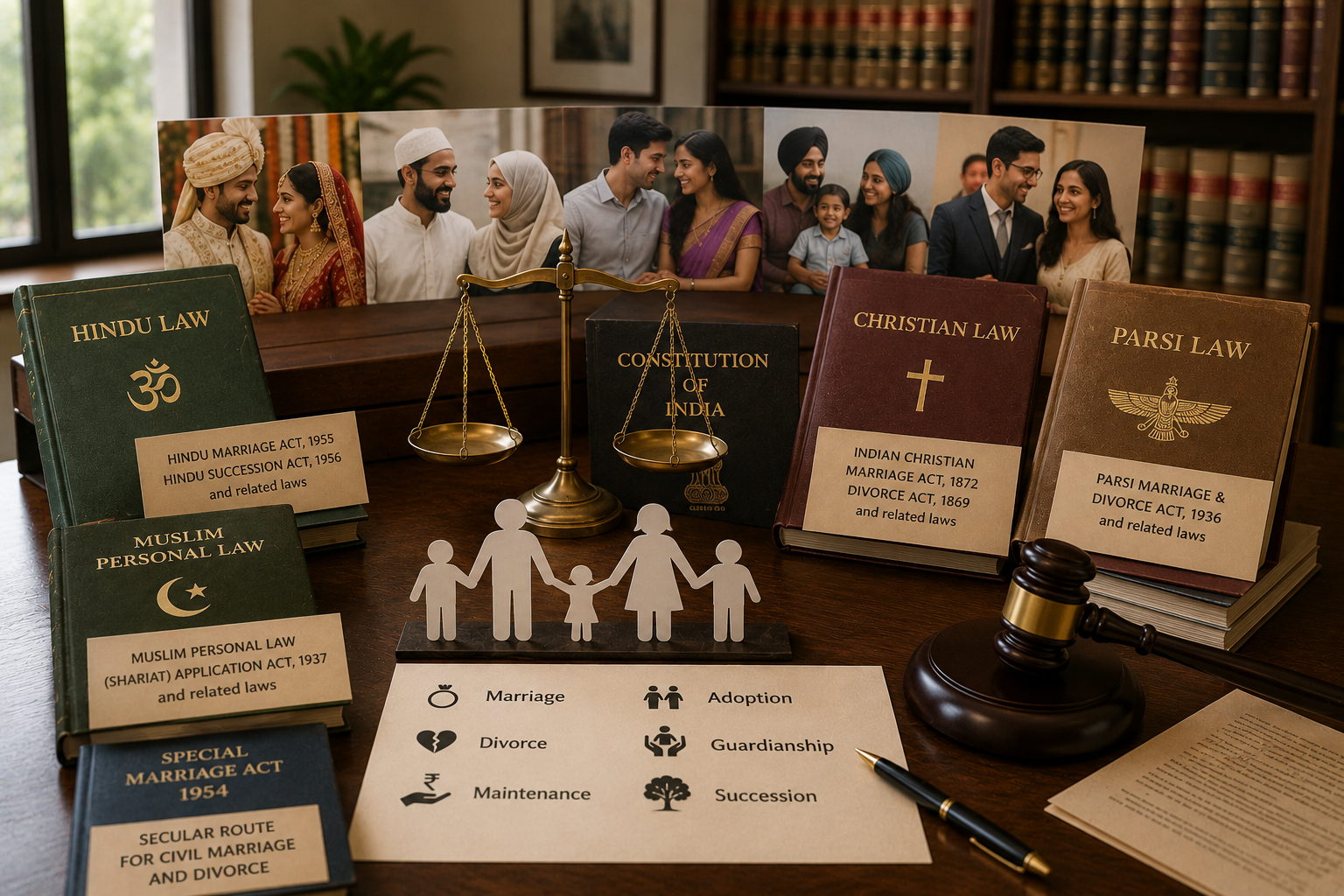
For example, Hindu family matters are largely governed by codified statutes such as the Hindu Marriage Act, 1955 and Hindu Succession Act, 1956. Muslim personal law is applied in several matters through the Muslim Personal Law (Shariat) Application Act, 1937 and other specific statutes. Christians and Parsis have statutory marriage and divorce frameworks.
Personal law therefore is not one single law. It is a field of laws dealing with intimate civil relationships.
Major Areas Covered
Personal laws usually cover marriage, divorce, restitution, judicial separation, legitimacy, maintenance, adoption, guardianship, inheritance and succession.
Different communities may have different legal rules on who can marry, how marriage is solemnised, what grounds exist for divorce, who inherits property, whether adoption is recognised in the same way, and how maintenance obligations work.
These rules affect daily family life and property rights, which is why personal laws remain socially sensitive.
Codified Hindu Law
After independence, Parliament enacted several statutes often called the Hindu Code laws. These include the Hindu Marriage Act, Hindu Succession Act, Hindu Minority and Guardianship Act, and Hindu Adoptions and Maintenance Act.
These laws generally apply to Hindus, Buddhists, Jains and Sikhs, with statutory details and exceptions. The Hindu Marriage Act’s long title describes it as a law to amend and codify the law relating to marriage among Hindus. The Hindu Succession Act’s long title describes it as a law to amend and codify the law relating to intestate succession among Hindus.
Codification changed many traditional rules and made them statutory.
Muslim Personal Law
Muslim personal law in India is applied in several matters through the Muslim Personal Law (Shariat) Application Act, 1937. The Act’s long title describes it as a law to make provision for the application of Muslim Personal Law to Muslims.
It covers areas such as marriage, dissolution of marriage, maintenance, dower, guardianship, gifts, trusts and succession in specified contexts, subject to statutory developments and judicial interpretation.
Muslim personal law has also seen legislative intervention, such as laws relating to divorce and rights of Muslim women. This shows that personal law is not completely outside the reach of the State.
Christian and Parsi Laws
Christians and Parsis also have statutory personal law frameworks. The Indian Christian Marriage Act, 1872 deals with solemnisation of Christian marriages. The Divorce Act, 1869 has historically dealt with divorce among Christians, subject to amendments.
The Parsi Marriage and Divorce Act, 1936 governs marriage and divorce among Parsis.
These examples show that personal laws in India are not only religious customs. Many are statutes passed or amended by the legislature.
The Special Marriage Act as a Secular Route
The Special Marriage Act, 1954 provides a secular form of marriage. It allows people to marry without undergoing religious conversion or relying on religious ceremonies. It is especially important for interfaith, inter-caste or civil marriages.
The Act’s long title says it provides a special form of marriage in certain cases, for registration of such and certain other marriages, and for divorce.
This Act gives citizens an alternative to personal-law marriage, although it has its own procedural requirements.
Personal Laws and the Constitution
Personal laws raise complex constitutional questions. On one side, India protects religious freedom and cultural diversity. On the other side, the Constitution guarantees equality, dignity, non-discrimination and liberty.
When personal law rules appear unequal, especially on gender lines, courts and legislatures face difficult questions. Should reform come from within the community? Should Parliament legislate? Should courts apply constitutional principles directly?
These questions have appeared in debates over maintenance, divorce, inheritance, adoption, entry into religious spaces and marital rights.
Reform and Social Change
Personal laws have changed over time. Hindu succession law was significantly amended in 2005 to give daughters equal coparcenary rights. Christian divorce law has undergone reform. Muslim divorce law has been the subject of major legislative and judicial debate. Secular marriage laws have provided alternatives to religious ceremonies.
This shows that personal laws are not frozen. They evolve through statute, judgment, social pressure and constitutional values.
The central challenge is to reform unfair rules while maintaining social trust and constitutional balance.
Citizen Impact
Personal laws affect citizens directly. They decide whether a marriage is valid, how divorce is obtained, who can claim maintenance, whether adoption is legally recognised, who inherits property and how family disputes are resolved.
A person entering marriage must know which law applies. A widow, daughter, divorced spouse, child or parent may depend on personal law for property or support.
Because consequences are serious, citizens should not rely on general community assumptions. The applicable statute, facts and legal route matter.
Limits and Misunderstandings
One misunderstanding is that personal laws are purely religious and not legal. Many personal laws are statutory and enforceable in courts.
Another misunderstanding is that all members of a religion follow one identical rule in every case. Custom, sect, statute, State amendments and chosen legal route may matter.
A third misunderstanding is that secular law and personal law never overlap. In reality, criminal law, maintenance law, domestic violence law, constitutional rights and personal law often interact.
Final Takeaway
Personal laws in India govern family and personal-status matters across communities. They reflect diversity but also raise questions of equality, gender justice and constitutional reform.
Understanding personal laws is essential because they affect marriage, divorce, inheritance, adoption, maintenance and family dignity. In a constitutional democracy, personal law must continue to evolve toward fairness while respecting India’s plural character.
Disclaimer: This article is for general information and educational understanding only. It is not personal legal advice. For specific legal problems, consult a qualified legal professional.