Ozone Hole: What Caused It, Why It Forms Over Antarctica and How It Is Recovering
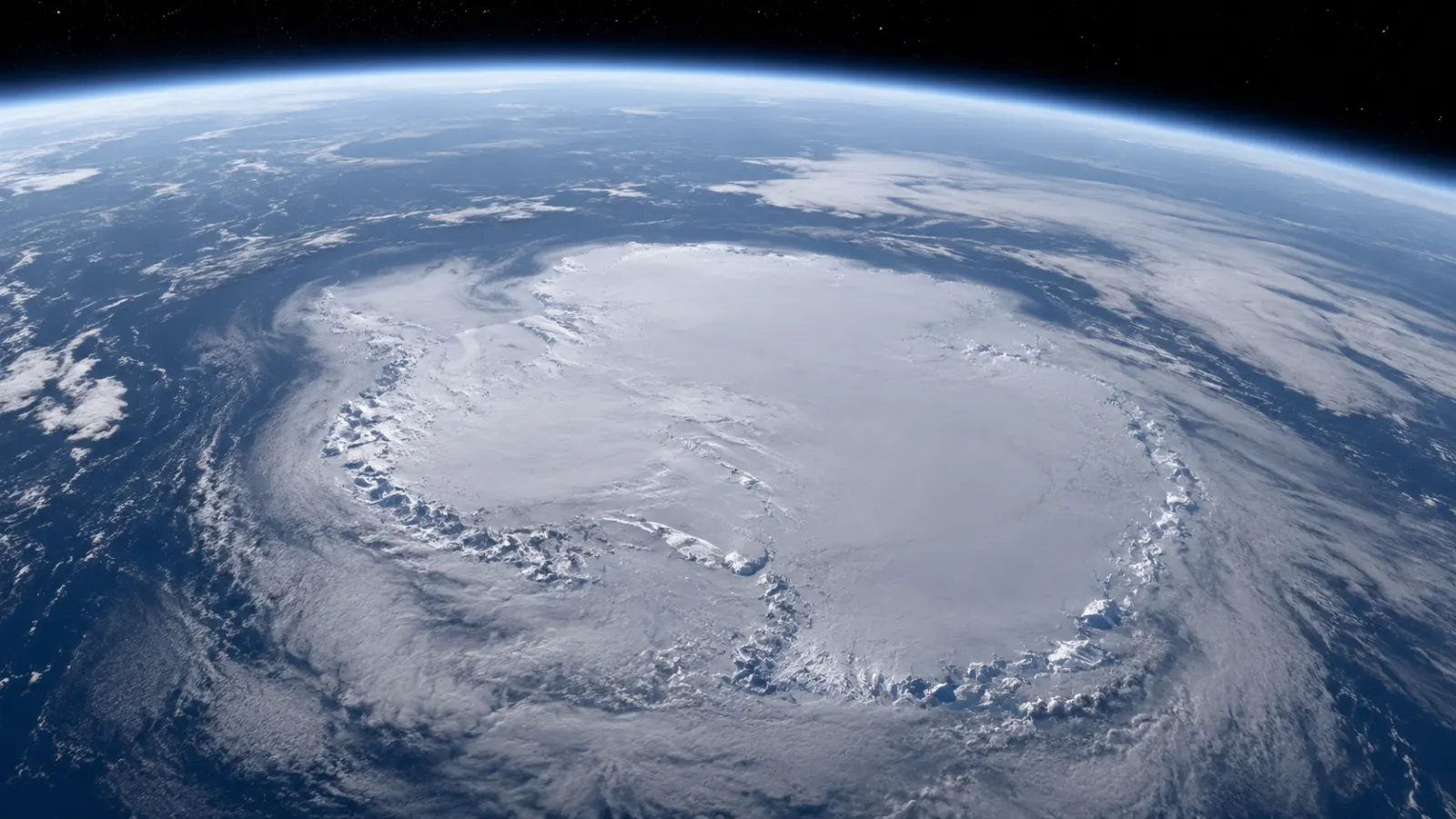
The ozone hole is a large area of severe seasonal thinning in Earth's protective stratospheric ozone layer, occurring mainly over Antarctica during Southern Hemisphere spring. Despite the familiar name, there is no empty hole in the atmosphere. Ozone remains present, but its concentration can fall dramatically below the levels historically measured over Antarctica.
Human-made chemicals are the principal cause. Chlorofluorocarbons, better known as CFCs, along with halons and several other ozone-depleting substances, released chlorine and bromine into the stratosphere. Antarctica's extreme winter cold, polar stratospheric clouds and isolated polar vortex then created unusually favourable conditions for those halogens to destroy ozone rapidly when sunlight returned in spring.
That distinction is important because the ozone hole is sometimes described as though pollution simply floated over Antarctica and dissolved the ozone directly. The real mechanism is more remarkable. Chemicals emitted around the world survived long enough to reach the stratosphere, atmospheric circulation distributed them globally, unusual Antarctic meteorology activated destructive chemistry and sunlight initiated catalytic reactions capable of destroying enormous numbers of ozone molecules.
The problem eventually produced one of the most successful examples of international environmental action. The Montreal Protocol, adopted in 1987, led countries to phase out the major ozone-depleting substances. UNEP says nearly 99% of banned ozone-depleting substances have now been phased out, and current projections expect ozone to return to approximately 1980 values around 2066 over Antarctica if compliance continues.
What Is the Ozone Hole?
The ozone hole is an area of exceptionally low total column ozone over Antarctica.
Scientists measure the total amount of ozone above a location in Dobson Units, or DU. NASA conventionally defines the Antarctic ozone hole as the region south of 40°S where total ozone falls below 220 Dobson Units. That threshold is significant because values below 220 DU were not observed in the historical Antarctic record before severe human-driven ozone depletion developed.
The hole is seasonal. It normally begins developing during August, expands through September and often reaches its greatest size around September or early October. As the Antarctic stratosphere warms and the polar vortex weakens later in spring, ozone-rich air from lower latitudes mixes back into the region and the severe depletion ends for that season. NASA's current monitoring continues to track this annual cycle.
It is therefore more accurate to imagine the ozone hole as a recurring seasonal depression in ozone concentration, not as a permanent opening.
What Is the Ozone Layer?
Ozone is a molecule containing three oxygen atoms, written O₃.
Most atmospheric ozone is found in the stratosphere, the atmospheric layer above the troposphere. Although ozone molecules make up only a tiny proportion of the atmosphere, they perform a vital biological function by absorbing much of the Sun's damaging ultraviolet radiation, particularly UV-B. NASA describes the ozone layer as a form of natural sunscreen for Earth.
This protection matters because excessive UV-B exposure can damage DNA and increase risks including:
- skin cancer;
- cataracts;
- damage to crops;
- harm to aquatic organisms;
- disruption of sensitive ecosystems.
The ozone layer is therefore chemically thin but biologically extremely important.
How Is Ozone Naturally Created?
Stratospheric ozone is not a fixed shield permanently sitting above Earth. It is continuously being created and destroyed.
High-energy ultraviolet radiation can split an ordinary oxygen molecule, O₂, into individual oxygen atoms. A free oxygen atom can then combine with another O₂ molecule to form ozone, O₃.
Ozone can later absorb ultraviolet radiation and break apart again.
This creates a natural photochemical cycle in which ozone is continuously formed and destroyed. Under relatively undisturbed conditions, these processes maintain a dynamic balance.
The ozone crisis occurred because human-made chlorine- and bromine-containing chemicals introduced additional reactions that greatly accelerated the destruction side of that balance.
What Caused the Ozone Hole?
The principal cause was the release of ozone-depleting substances, particularly long-lived industrial compounds containing chlorine or bromine.
Important examples included:
- chlorofluorocarbons, or CFCs;
- halons;
- carbon tetrachloride;
- methyl chloroform;
- methyl bromide;
- hydrochlorofluorocarbons, or HCFCs.
CFCs became widely used because they appeared remarkably useful and chemically stable. They were used in refrigeration, air conditioning, foam production, aerosol applications and industrial processes.
That chemical stability became the problem.
Most ordinary pollutants react or are removed relatively quickly in the lower atmosphere. CFCs could survive for years or decades, giving them enough time to become mixed throughout the atmosphere and eventually reach the stratosphere.
There, stronger ultraviolet radiation could finally break the molecules apart.
Why Were CFCs So Destructive to Ozone?
CFC molecules contain chlorine.
In the lower atmosphere, the chlorine remains locked inside extremely stable compounds. After those compounds reach the stratosphere, intense ultraviolet radiation can break them down and ultimately release chlorine into chemically active forms.
Reactive chlorine can participate in catalytic cycles that destroy ozone.
The important word is catalytic. The chlorine is regenerated during the chemical cycle rather than permanently consumed after destroying one ozone molecule. A single chlorine atom can therefore participate repeatedly in ozone destruction. NASA notes that catalytic chemistry allows one chlorine atom to destroy thousands of ozone molecules.
That multiplication effect explains how comparatively small concentrations of chlorine-containing compounds could have a disproportionately large effect on stratospheric ozone.
Bromine Also Matters
Chlorine receives most of the public attention, but bromine-containing compounds also contributed substantially.
Halons, which were used especially in fire-suppression systems, delivered bromine to the stratosphere. Bromine is much less abundant than chlorine but is highly efficient in ozone-destroying chemistry.
Antarctic ozone depletion therefore results from interacting chlorine and bromine catalytic cycles rather than from CFC chemistry alone.
This is why the Montreal Protocol ultimately controlled a wider family of substances rather than simply banning one type of CFC.
Why Does the Ozone Hole Form Over Antarctica?
This is one of the most important questions.
If CFCs were emitted around the world and chlorine became widely distributed through the stratosphere, why did the most dramatic destruction occur over Antarctica?
The answer is that Antarctica combines several conditions that occur together with unusual intensity:
- extremely cold stratospheric temperatures;
- polar stratospheric clouds;
- a strong and isolated polar vortex;
- accumulated chlorine and bromine compounds;
- returning sunlight in Antarctic spring.
The severe ozone hole requires this combination.
Human-made chemicals supplied the destructive ingredients. Antarctic meteorology created the chemical laboratory.
The Antarctic Polar Vortex
During the long Antarctic winter, powerful winds circulate around the continent high in the atmosphere.
This circulation forms the polar vortex.
The vortex acts partly as a barrier, isolating the air inside it from warmer stratospheric air at lower latitudes. Because Antarctica experiences months of darkness and extreme cold, temperatures inside the vortex can fall dramatically.
NASA describes this system as a continuously circulating region of polar stratospheric air whose isolation helps maintain the cold conditions necessary for ozone-depleting chemistry.
The isolation matters because the reactive chemistry is allowed to develop without rapid mixing with ozone-rich air from elsewhere.
Polar Stratospheric Clouds Are Crucial
The stratosphere is normally extremely dry, so ordinary clouds rarely form there.
But the Antarctic stratosphere becomes so cold that unusual polar stratospheric clouds, or PSCs, can develop.
The 2022 scientific assessment explains that PSC formation becomes important at temperatures around −78°C and below, conditions that occur extensively over Antarctica during winter.
The surfaces of these cloud particles provide reaction sites for chemistry that would otherwise occur very slowly.
During winter, much of the chlorine exists in relatively inactive reservoir compounds. Reactions on polar stratospheric cloud particles convert these reservoirs into forms that can later become highly reactive.
The atmosphere is therefore being chemically prepared during the dark winter.
Why Sunlight Triggers Rapid Ozone Destruction
For much of the Antarctic winter there is little or no sunlight.
That prevents the most destructive phase of the chemistry from proceeding rapidly.
When sunlight returns during late winter and spring, ultraviolet light breaks apart some of the chlorine-containing molecules created during the winter processing. Reactive chlorine becomes available, and catalytic ozone-destruction cycles accelerate.
NASA describes this as the point when free chlorine begins rapidly destroying ozone while being regenerated to continue the process.
This explains the unusual timing of the ozone hole.
The cold winter prepares the chemistry.
The returning Sun activates it.
How the Antarctic Ozone Hole Forms Step by Step
The process can be simplified into eight stages:
| Stage | What happens |
|---|---|
| 1. ODS emissions | CFCs, halons and related chemicals are released |
| 2. Long atmospheric lifetime | Stable gases survive long enough to reach the stratosphere |
| 3. UV breakdown | Strong ultraviolet radiation releases chlorine and bromine |
| 4. Polar winter | Antarctica's stratosphere becomes extremely cold |
| 5. PSC formation | Polar stratospheric clouds provide chemical reaction surfaces |
| 6. Chlorine activation | Inactive chlorine reservoirs are converted into more reactive forms |
| 7. Sunlight returns | Spring sunlight triggers rapid catalytic ozone destruction |
| 8. Vortex breaks down | Warmer air eventually mixes in and seasonal depletion ends |
This sequence explains why the phrase “CFCs destroy ozone” is scientifically correct but incomplete.
CFCs provided the chlorine burden, but the spectacular Antarctic hole required very specific atmospheric conditions.
Why Is 220 Dobson Units Used?
A Dobson Unit measures the total amount of ozone in a vertical column of atmosphere.
If all the ozone in a column above a location were compressed to sea-level pressure and temperature, 300 Dobson Units would correspond to a layer only about 3 millimetres thick.
That illustrates how little ozone is actually required to provide significant ultraviolet protection.
Scientists use 220 DU as the conventional threshold for the Antarctic ozone hole because total ozone values below that level were not seen in the historical observations before severe depletion emerged. NASA tracks the area below this threshold each year.
The size of the hole therefore refers to the geographic area where ozone has dropped below the threshold—not an area in which ozone has vanished completely.
How Was the Ozone Hole Discovered?
The discovery depended on long-term scientific monitoring.
British Antarctic Survey researchers had been measuring ozone at Halley Research Station in Antarctica since the International Geophysical Year in 1956. Because the measurements had continued for decades, researchers had a long baseline against which unusual changes could be recognised.
By the early 1980s, the springtime ozone values were declining dramatically.
Scientists Joe Farman, Brian Gardiner and Jonathan Shanklin published their findings in Nature on 16 May 1985, identifying large and unexpected Antarctic spring ozone losses.
The discovery became one of the landmark environmental findings of the twentieth century.
Scientists Had Already Suspected CFCs
The ozone hole was surprising, but the possibility that CFCs could damage stratospheric ozone was not entirely new.
Earlier theoretical and laboratory work had already shown that long-lived chlorofluorocarbons could reach the stratosphere and release chlorine capable of catalytically destroying ozone.
What surprised researchers was the speed, depth, seasonal concentration and geographic scale of the Antarctic depletion.
The BAS observations transformed a predicted atmospheric risk into visible evidence of a major environmental change.
NASA satellite data were subsequently re-examined, confirming that severe depletion extended across a huge region over Antarctica.
Why Long-Term Monitoring Was So Important
Environmental change can be difficult to identify without a baseline.
If researchers had begun measuring Antarctic ozone only in 1983, they might have observed low values without knowing how unusual they were.
Instead, decades of measurements showed that Antarctic spring ozone had previously followed a substantially different pattern.
The discovery illustrates a fundamental role of environmental monitoring: scientists often cannot know in advance which long-term datasets will become critically important.
The value of the Halley record was that researchers could see the atmosphere changing rather than merely measuring its condition at one moment.
Why Didn't Satellites Discover It First?
A popular version of the story sometimes claims that NASA's satellite computers automatically discarded low ozone measurements because scientists assumed they were errors.
The actual history is more nuanced.
Satellite observations contained information capable of showing Antarctic depletion, but analysing polar data and distinguishing extreme values from instrument or retrieval issues was complicated. Once the BAS findings established the seriousness of the decline, satellite records were re-examined and helped reveal the continental scale.
The larger lesson is not that scientists ignored obvious evidence. It is that independent observing systems—ground stations, satellites, atmospheric chemistry and modelling—became much more powerful when their evidence was combined.
Why Is the Arctic Ozone Hole Different?
Ozone depletion also occurs in the Arctic.
But the Northern Hemisphere usually does not develop an Antarctic-style ozone hole as consistently because Arctic stratospheric conditions are different.
The Arctic polar vortex is generally more disturbed by large atmospheric waves. Those disturbances can bring warmer air into the polar stratosphere and disrupt the vortex, reducing the persistence of temperatures cold enough for widespread polar stratospheric clouds.
Antarctica's vortex is normally colder and more stable.
However, unusual Arctic winters can still produce substantial ozone loss. NASA documented severe Arctic depletion in 2011 after unusually persistent cold conditions allowed extensive chlorine activation.
The Arctic is therefore not immune.
It simply less often provides the full set of conditions that make Antarctic depletion so extreme.
What Happens When the Ozone Layer Gets Thinner?
Less stratospheric ozone means more UV-B radiation can reach Earth's surface.
Higher UV exposure can increase risks to humans, including:
- skin cancer;
- cataracts;
- sunburn;
- damage to genetic material.
NASA also notes potential impacts on plants, agricultural productivity and aquatic ecosystems, including sensitive plankton.
The ecological consequences matter because phytoplankton and other small organisms occupy foundational positions in aquatic food webs.
The ozone problem was therefore never solely a concern about human sunburn.
It involved a planetary protective system.
Does the Ozone Hole Cause Skin Cancer?
The ozone hole itself does not directly cause cancer.
The mechanism is indirect.
Stratospheric ozone absorbs ultraviolet radiation. If ozone decreases, more UV-B can reach the surface. Greater UV exposure increases the probability of biological damage and raises skin-cancer risk.
That is why preventing ozone depletion has substantial public-health value.
The relationship also demonstrates why atmospheric changes occurring tens of kilometres above Earth can still affect biological systems at ground level.
Is the Ozone Hole the Same as Global Warming?
No.
The ozone hole and climate change are different environmental problems.
The ozone hole was caused primarily by chlorine- and bromine-containing ozone-depleting substances disrupting stratospheric chemistry.
Modern global warming is driven primarily by greenhouse gases such as carbon dioxide, methane and nitrous oxide trapping additional heat in Earth's climate system.
There are connections, however.
Many ozone-depleting substances are also powerful greenhouse gases. Phasing them out therefore provided climate benefits in addition to protecting ozone. UNEP estimates ozone-protection efforts avoided enormous greenhouse-gas emissions, while the later Kigali Amendment targets high-global-warming-potential HFCs used as replacements for some older chemicals.
So the problems are distinct, but their policies and atmospheric effects overlap.
Did Aerosol Spray Cans Cause the Ozone Hole?
Some aerosol products historically used CFCs as propellants, so aerosol applications contributed to ozone-depleting emissions.
But aerosol cans were only one source.
CFCs and related chemicals were also widely used in:
- refrigerators;
- air conditioners;
- foam production;
- industrial solvents;
- fire-suppression systems.
The simplified public memory of “aerosol cans caused the ozone hole” therefore captures one historic use but misses the industrial scale of the problem.
Did Refrigerators Cause the Ozone Hole?
Older refrigeration and air-conditioning systems commonly used CFC or HCFC refrigerants.
When those substances leaked during operation, servicing or disposal, they could eventually reach the atmosphere.
Refrigeration was therefore an important contributor, but again, no single appliance created the problem.
The ozone hole emerged from the global accumulation of long-lived ozone-depleting chemicals from many applications over decades.
What Is the Montreal Protocol?
The Montreal Protocol on Substances that Deplete the Ozone Layer was adopted in 1987.
It created an international framework for controlling and eventually phasing out major ozone-depleting substances.
The agreement was subsequently strengthened through amendments and adjustments as scientific knowledge improved and alternatives became available.
UNEP reports that the treaty has now phased out nearly 99% of banned ozone-depleting substances.
This is one reason the Montreal Protocol is frequently described as one of the most successful international environmental agreements.
Why the Montreal Protocol Worked
Several features helped.
First, the underlying causal science became unusually strong. Researchers could identify the major chemical compounds responsible and explain their atmospheric chemistry.
Second, governments targeted the source chemicals, not merely the environmental symptom.
Third, the treaty could be strengthened over time rather than remaining fixed at its original level of ambition.
Fourth, technological alternatives became available for many uses of CFCs and halons.
Fifth, the treaty developed mechanisms to help countries transition away from controlled substances.
The result was global rather than merely regional regulation of a global atmospheric problem.
Why Didn't the Ozone Hole Disappear After CFCs Were Banned?
Because the atmosphere has a long memory.
Many ozone-depleting substances remain in the atmosphere for decades. Even after new production and consumption were sharply reduced, chemicals already released continued circulating and eventually reaching the stratosphere.
This creates a long delay between policy and complete atmospheric recovery.
The Montreal Protocol changed the direction of the system. It did not instantly remove every CFC molecule already present.
As concentrations of chlorine and bromine in the stratosphere gradually decline, the chemical capacity for severe ozone destruction also declines.
Recovery therefore occurs on a timescale of decades rather than months.
Is the Ozone Hole Healing?
Yes, but slowly and unevenly.
The UN-backed 2022 Scientific Assessment concluded that ozone recovery is underway and that continued compliance with the Montreal Protocol should return total ozone to approximately 1980 values around:
- 2040 for much of the world;
- 2045 over the Arctic;
- 2066 over Antarctica.
These are projections rather than guaranteed dates.
Future recovery depends on continued compliance, atmospheric chemistry, climate interactions and unexpected emissions.
The Antarctic ozone hole can also vary significantly from year to year because stratospheric temperature and circulation influence how efficiently ozone is destroyed.
What Happened to the Ozone Hole in 2025?
The 2025 Antarctic ozone hole was relatively small by recent historical standards.
NASA and NOAA ranked its seasonal average as the fifth-smallest since 1992. Between September 7 and October 13, its average area was approximately 18.71 million square kilometres. Its maximum extent reached about 22.86 million square kilometres on September 9, 2025.
It also broke up earlier than typical for much of the previous decade.
These observations are consistent with long-term recovery, but one season cannot establish the trend by itself.
Atmospheric weather matters.
A particularly warm or disturbed polar stratosphere can produce a smaller hole even while chlorine concentrations remain significant. A cold stable season can temporarily produce a larger hole despite long-term chemical recovery.
What About the 2026 Ozone Hole?
As of September 3, 2026, the Antarctic depletion season is still developing, so it is too early to use a final 2026 ozone-hole size as an annual comparison.
NASA's Ozone Watch is already monitoring the 2026 season and notes that the hole normally develops through August before reaching its largest area and depth from mid-September into early October.
The next annual WMO Ozone and UV Bulletin is scheduled for September 16, 2026, while the full 2026 Scientific Assessment of Ozone Depletion is still being finalised for submission later in 2026.
For an evergreen article, the correct approach is therefore to use the completed 2025 season as the latest full-year comparison and update the article once authoritative 2026 seasonal results are available.
Why One Small Ozone Hole Does Not Mean the Problem Is Solved
Year-to-year variation can be large.
Imagine two underlying processes:
long-term chemistry is improving because chlorine and bromine burdens are declining;
annual meteorology changes each year.
A cold, persistent polar vortex can intensify ozone destruction. A warmer or more disturbed vortex can limit it.
Therefore, a single large hole does not prove the Montreal Protocol has failed, and a single small hole does not prove recovery is complete.
Scientists evaluate trends over many years and use measurements of atmospheric halogens, ozone, temperature and circulation together.
This is one of the most important lessons in interpreting environmental data: trend and annual variability are not the same thing.
Could the Ozone Hole Come Back?
The chemicals responsible have not disappeared completely, so seasonal Antarctic depletion will continue for decades.
There are also reasons for continued vigilance.
Unexpected emissions of controlled ozone-depleting substances have previously been detected through atmospheric monitoring. Scientists also study how climate change, volcanic eruptions, wildfire smoke and proposed interventions such as stratospheric aerosol injection could interact with ozone chemistry.
This is why monitoring remains necessary even after successful regulation.
Environmental policy does not end when a treaty is signed.
Its success has to be continually verified in the atmosphere.
Did the Montreal Protocol Also Help the Climate?
Yes.
Many CFCs and related compounds are extremely powerful greenhouse gases.
By preventing enormous quantities of these gases from accumulating in the atmosphere, the Montreal Protocol produced substantial climate benefits in addition to protecting the ozone layer.
UNEP reports that ozone-protection measures avoided an estimated 135 billion tonnes of CO₂-equivalent emissions from 1990 to 2010.
The Kigali Amendment, adopted in 2016, expanded the climate dimension by targeting the phase-down of hydrofluorocarbons, or HFCs. HFCs generally do not destroy stratospheric ozone in the same way as CFCs, but many are powerful greenhouse gases.
This is an important distinction: Kigali is fundamentally a climate measure built within the Montreal Protocol system rather than a response to HFC-driven ozone destruction.
Is the Ozone Layer Fully Recovered?
No.
The recovery signal is encouraging, but Antarctica still experiences a major seasonal ozone hole.
NASA's recent measurements continue to show depletion on continental scales. Even the relatively small 2025 hole averaged nearly 19 million square kilometres during its peak period.
The correct description is therefore:
recovering, not recovered.
This distinction matters because environmental success stories can become politically misleading if success is interpreted as permission to stop monitoring or enforcement.
The Montreal Protocol is working precisely because controls remain in place.
What Would Have Happened Without the Montreal Protocol?
Scientists have used atmospheric and climate models to examine scenarios in which ozone-depleting chemicals continued increasing.
Those scenarios produce dramatically greater ozone loss and ultraviolet exposure.
British Antarctic Survey notes that the discovery of the ozone hole accelerated international action and helped prevent a much more dangerous future. It also highlights major health and climate benefits associated with the Montreal Protocol.
This makes the ozone story unusual among environmental crises.
Scientists can compare the observed atmosphere with modelled worlds in which humanity did not control CFCs.
The difference illustrates the consequences of policy in a particularly measurable way.
Common Ozone Hole Myths
Myth 1: There Is a Literal Hole in Earth's Atmosphere
No. The ozone hole is severe thinning of stratospheric ozone, not an empty opening.
Myth 2: The Ozone Hole Is Caused by Global Warming
No. Its primary cause is chlorine and bromine from ozone-depleting substances. Climate conditions can influence ozone chemistry, but global warming is a different environmental problem.
Myth 3: The Ozone Hole Exists All Year
No. Antarctic depletion is strongly seasonal and becomes most severe during Southern Hemisphere spring.
Myth 4: CFC Pollution Was Mainly an Antarctic Problem
No. Ozone-depleting chemicals were emitted worldwide and circulated globally. Antarctica experienced the most dramatic depletion because of its unusual atmospheric conditions.
Myth 5: One CFC Molecule Destroys One Ozone Molecule
The chemistry is catalytic. Chlorine can be regenerated and participate repeatedly in ozone destruction.
Myth 6: The Montreal Protocol Fixed the Ozone Layer Immediately
No. Long-lived chemicals remain in the atmosphere for decades, so recovery takes many years.
Myth 7: The Ozone Hole Is Still Getting Worse Every Year
No. The long-term outlook is recovery, although annual size varies strongly with Antarctic atmospheric conditions.
Myth 8: The Ozone Hole Has Already Closed
No. It still forms each Antarctic spring.
Myth 9: The Arctic Has Exactly the Same Ozone Hole
No. Severe Arctic depletion can occur, but Antarctic meteorology produces much more consistent and extreme seasonal depletion.
Myth 10: Ozone Is Always Beneficial
No. Stratospheric ozone protects Earth from ultraviolet radiation, but ozone near the ground is an air pollutant and a component of photochemical smog.
Frequently Asked Questions About the Ozone Hole
What is the ozone hole?
The ozone hole is an area of severe seasonal depletion of stratospheric ozone over Antarctica, conventionally defined as the region where total ozone falls below 220 Dobson Units.
Is the ozone hole really a hole?
No. Ozone remains in the atmosphere. The term describes unusually severe thinning.
What caused the ozone hole?
Human-made ozone-depleting substances such as CFCs and halons released chlorine and bromine that catalytically destroy ozone in the stratosphere.
Why does the ozone hole form over Antarctica?
Antarctica combines extremely cold stratospheric temperatures, polar stratospheric clouds, an isolated polar vortex and returning spring sunlight, which activate rapid chlorine- and bromine-driven ozone destruction.
What are CFCs?
Chlorofluorocarbons are stable industrial chemicals formerly used extensively in refrigeration, air conditioning, foams, aerosols and other applications.
Why are CFCs harmful to ozone?
Their long atmospheric lifetimes allow them to reach the stratosphere, where ultraviolet radiation eventually releases chlorine capable of catalytically destroying ozone.
What are polar stratospheric clouds?
They are unusual high-altitude clouds that form in the extremely cold polar stratosphere. Their particle surfaces enable reactions that activate chlorine for rapid springtime ozone destruction.
Why does sunlight matter?
Returning spring sunlight photochemically releases reactive chlorine from compounds formed during the cold winter, allowing catalytic ozone destruction to accelerate.
What is a Dobson Unit?
A Dobson Unit is a measure of total ozone in a vertical column of atmosphere.
Why is 220 Dobson Units important?
NASA uses 220 DU as the conventional threshold for defining the Antarctic ozone hole because lower values were not observed in the historical Antarctic record before severe depletion.
When was the ozone hole discovered?
British Antarctic Survey scientists published the landmark discovery on May 16, 1985.
Who discovered the ozone hole?
Joe Farman, Brian Gardiner and Jonathan Shanklin of the British Antarctic Survey reported the severe Antarctic spring ozone decline.
Does the ozone hole cause skin cancer?
Thinner ozone allows more damaging UV-B radiation to reach Earth's surface, increasing biological damage and skin-cancer risk.
Does the ozone hole cause climate change?
No. Ozone depletion and climate change are distinct problems, although many ozone-depleting substances are also greenhouse gases and the atmospheric systems interact.
Are CFCs still used?
Production and consumption of major controlled CFCs have been phased out under the Montreal Protocol, although old equipment and stored materials can still contain them.
What is the Montreal Protocol?
It is the 1987 international agreement created to control and phase out ozone-depleting substances.
Did the Montreal Protocol work?
Yes. Nearly 99% of banned ozone-depleting substances have been phased out, and measurements and models indicate that the ozone layer is recovering.
Is the ozone hole getting smaller?
The long-term trend is toward recovery, but annual size varies considerably depending on Antarctic stratospheric weather.
How big was the 2025 ozone hole?
Its average area during the main depletion period was about 18.71 million square kilometres, making it the fifth-smallest seasonal average since 1992.
When will the Antarctic ozone hole recover?
Current UN-backed projections estimate a return to approximately 1980 ozone values around 2066, assuming continued Montreal Protocol compliance.
Why will recovery take so long?
Many ozone-depleting chemicals remain in the atmosphere for decades, so chlorine and bromine disappear from the stratosphere only gradually.
Does an ozone hole form over the Arctic?
Strong Arctic ozone depletion can occur in unusually cold years, but a persistent Antarctic-style hole is less common because the Arctic polar vortex is generally warmer and more disturbed.
Can the ozone layer be damaged again?
Yes, if significant ozone-depleting emissions re-emerge or other atmospheric changes disrupt recovery. Continued international compliance and monitoring remain important.
What is the difference between ozone depletion and air pollution?
Stratospheric ozone depletion concerns loss of protective ozone high in the atmosphere. Ground-level ozone is itself a harmful air pollutant and component of smog.
The Ozone Hole Is a Story About Both Chemistry and Cooperation
The ozone hole became one of the defining environmental discoveries of the twentieth century because it showed that human activity could alter atmospheric chemistry on a planetary scale.
No factory had to sit beside Antarctica.
CFCs released from refrigerators, air conditioners, industrial processes and other applications remained in the atmosphere for years, spread around the planet and eventually delivered chlorine to the stratosphere.
Antarctica then supplied the conditions that made the consequences spectacular. Its isolated polar vortex created exceptional cold. Polar stratospheric clouds transformed chlorine chemistry. Returning sunlight triggered catalytic destruction. Within weeks, enormous amounts of ozone could disappear from the Antarctic stratosphere.
Scientists understood this chain because theoretical chemistry, laboratory research, ground observations, satellites and long-term monitoring eventually converged on the same explanation.
Governments then targeted the source.
The Montreal Protocol did not attempt to rebuild the ozone layer directly. It progressively removed the chemicals that were disturbing the natural ozone cycle.
The response has worked—but slowly, because atmospheric chemistry has long timescales.
The 2025 ozone hole still covered an enormous area, yet it ranked among the smaller holes observed since the early 1990s. The best scientific projections now expect Antarctic ozone to return toward 1980 conditions around 2066 if international controls remain effective.
That makes the ozone hole more than a story about environmental damage.
It is also evidence that environmental damage can be identified, traced to specific causes, regulated internationally and gradually reversed.
But the final lesson is not complacency.
Recovery remains incomplete, annual variability is substantial and scientists still need to monitor both the ozone layer and the chemicals capable of damaging it.
The ozone hole showed how unexpectedly human activity could disrupt Earth's atmospheric systems.
Its recovery is showing something equally important: when scientific evidence is strong and governments act on the source of a global environmental problem, the chemistry of the future can still be changed.