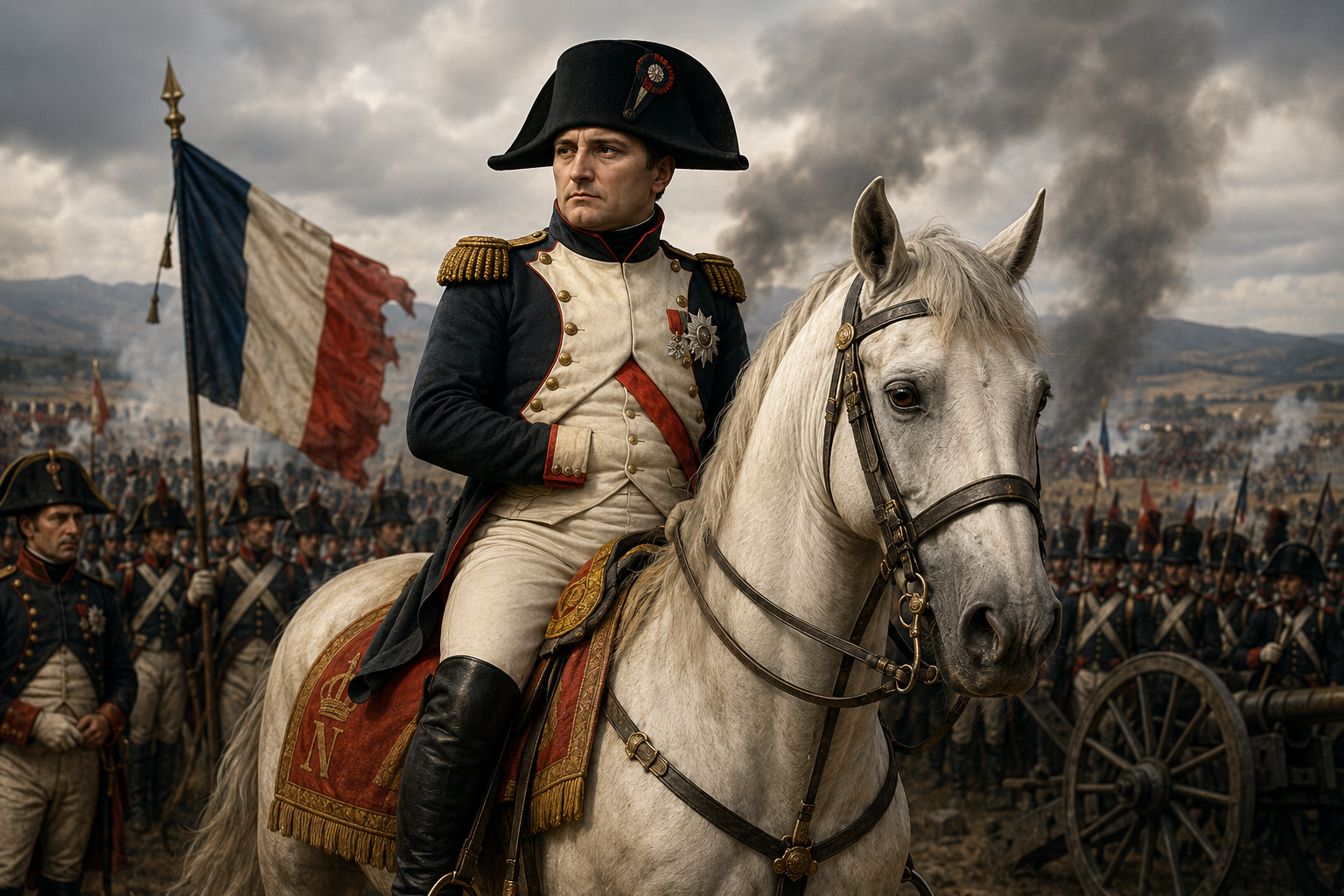
A General Who Made Revolution Wear a Crown
Napoleon Bonaparte’s story begins with the promise of revolution and ends with the loneliness of exile. He rose from a modest Corsican background to become the dominant figure of European politics, not because he inherited an ancient throne, but because the French Revolution destroyed enough old certainties to make military talent politically explosive. His career is one of the sharpest examples in history of how war, ideology, personal ambition and institutional reform can combine to produce both extraordinary achievement and catastrophic overreach. He did not merely command armies; he reorganised law, administration, education, finance and the political imagination of France. Yet he also turned revolutionary energy into imperial domination, dragging Europe into years of conflict and leaving behind a legacy that remains fiercely debated.
Napoleon matters because he cannot be placed neatly into one moral category. To admirers, he was a moderniser who preserved the Revolution’s legal and civic gains while replacing chaos with order. To critics, he was a military dictator whose hunger for glory cost millions of lives and subordinated Europe to French power. Both views contain truth. His rise was made possible by revolutionary meritocracy, but his rule became monarchical. He claimed to defend equality before law, but crowned himself emperor. He promoted rational administration, but built a system dependent on his personal genius. The drama of Napoleon’s life is therefore not only the rise and fall of one man. It is the story of a revolution that conquered Europe, lost its balance and finally collapsed under the weight of its own ambition.
Time, Place and the Revolutionary Context
Napoleon was born in 1769 on Corsica, a Mediterranean island that had only recently come under French control. This timing mattered. He was neither fully a product of old aristocratic France nor simply an outsider to it. He received military education in France and entered service as the monarchy was approaching crisis. When the French Revolution erupted in 1789, it overturned the privileged order into which older military careers had been born. Noble birth no longer guaranteed command; ability, loyalty and opportunity began to matter more. In that unstable world, a young artillery officer with intelligence, discipline and ambition could rise with astonishing speed.
The geographical stage of his career expanded rapidly. His early significance came in France and Italy; his Egyptian expedition carried French ambitions into the eastern Mediterranean; his rule later transformed the politics of Germany, Italy, Spain, the Netherlands and central Europe. Britain became his maritime enemy, Russia his continental challenge, and Europe his battlefield. His life therefore belongs not only to French history but to European history as a whole. Britannica identifies Napoleon as a French general and statesman who played a key role in the French Revolution, served as First Consul from 1799 to 1804 and became emperor from 1804 to 1814/15. That concise chronology captures the political arc: revolutionary officer, republican strongman, imperial ruler, defeated exile. The setting is crucial because Napoleon’s career cannot be understood without the breakdown of old regime Europe. He rose in a world where monarchy had been shaken, armies had become mass national institutions, and political legitimacy was being rewritten by revolution.
Before Napoleon: France in Crisis
Before Napoleon became a ruler, France had already passed through a decade of upheaval. The Revolution abolished feudal privileges, declared rights, challenged the Church, executed Louis XVI, created a republic, fought European coalitions and experienced the violence of the Terror. By the late 1790s, the Directory governed France, but it was unstable, corrupt and militarily dependent. The Revolution had destroyed the old order, but it had not yet created a secure new one. Many French citizens wanted the Revolution’s gains preserved but feared continued disorder. This desire for order made Napoleon possible.
The army became central to politics because revolutionary France survived through war. Enemies surrounded the republic; internal rebellion threatened it; military victories became the government’s main source of legitimacy. Generals who could win battles became political figures. Napoleon’s early career must be placed in this militarised republic. His success at Toulon in 1793, where his artillery skill helped recapture the port from royalist and British forces, first brought him attention. His later suppression of a royalist uprising in Paris in 1795 made him valuable to the revolutionary government. The Italian campaign of 1796-97 turned him from a promising officer into a national hero. The background is therefore essential: Napoleon did not seize a peaceful society. He emerged from a state exhausted by ideology, civil conflict, foreign war and administrative weakness. His rise was the answer many elites and citizens accepted when liberty without stability began to feel dangerous.
The Italian Campaign and the Birth of a Legend
Napoleon’s Italian campaign revealed the qualities that would define his career: speed, calculation, psychological confidence and the ability to convert military success into political capital. Sent to command the Army of Italy in 1796, he inherited poorly supplied troops and faced Austrian and allied forces. Instead of accepting defensive caution, he used mobility, concentration of force and audacious manoeuvre to defeat stronger enemies in sequence. The campaign brought victories at places such as Lodi, Arcole and Rivoli, and it forced Austria toward negotiation.
But the Italian campaign was more than battlefield success. Napoleon mastered propaganda. He issued bulletins, addressed soldiers directly and presented himself as the embodiment of revolutionary glory. He promised his troops honour, wealth and victory. He also reorganised conquered territories, extracted resources and created sister republics under French influence. The general was already behaving like a statesman. Italy gave him not only fame but a political education in ruling through war, administration and symbolism.
The campaign also exposed an important contradiction. Napoleon carried the language of liberation across Europe, but French armies often imposed contributions, seized art and subordinated local politics to French interests. Revolutionary ideals travelled with occupation. Many Europeans welcomed the weakening of old regimes, but others experienced French power as domination. This contradiction would later define the Napoleonic Empire. The man who rose as the soldier of liberty was also learning how conquest could be used to build personal authority. Italy made Napoleon a legend, but it also taught him that victory could become government.
Egypt, Ambition and the Limits of Glory
The Egyptian expedition of 1798 showed both the range and the recklessness of Napoleon’s ambition. France could not easily defeat Britain at sea, so Napoleon imagined striking British imperial interests indirectly by occupying Egypt and threatening routes toward India. The expedition combined military conquest with scientific and cultural ambition. Scholars, artists and engineers accompanied the army, producing research that later contributed to European knowledge of ancient Egypt. The discovery of the Rosetta Stone during the campaign became one of its most enduring intellectual consequences.
Yet the campaign also revealed hard limits. British naval power under Horatio Nelson destroyed the French fleet at the Battle of the Nile, trapping Napoleon’s army in Egypt. Military victories on land could not solve the problem of sea control. The expedition became strategically precarious, and Napoleon eventually left his army and returned to France. His departure was politically successful for him but morally questionable for critics who saw abandonment. Egypt showed that Napoleon’s imagination was global before his resources were adequate.
The expedition’s importance lies in what it teaches about Napoleonic power. He thought in grand strategic terms, combining empire, science, propaganda and geopolitics. But he also underestimated logistical realities. The pattern would recur later in Spain and Russia: ambition outrunning sustainable control. Egypt did not destroy him because France itself was ready for a stronger ruler. But it foreshadowed the central weakness of his career. Napoleon could see farther than most statesmen, but he often tried to reach farther than institutions, supply lines and human endurance could carry him.
The Coup of Brumaire and the First Consul
When Napoleon returned to France, the Directory was weak and unpopular. In November 1799, the coup of 18 Brumaire brought him to power as First Consul. The event marked the end of the revolutionary republic in its unstable form and the beginning of authoritarian consolidation. Napoleon did not present himself as a reactionary restoring the old regime. He presented himself as the man who would save the Revolution from disorder. This was the genius of his politics: he offered authority without openly rejecting revolutionary achievements.
As First Consul, Napoleon moved quickly to centralise power. He reorganised administration, strengthened the executive, stabilised finances, negotiated the Concordat with the Catholic Church and laid the foundations for legal reform. The new regime preserved important revolutionary principles such as equality before the law and careers open to talent, but political liberty was restricted. Elections existed in controlled forms; censorship increased; opposition was contained. The Revolution’s social gains survived, but its democratic energies were narrowed.
This period is essential because it shows Napoleon as more than a soldier. He was an institution builder. He understood that victory in politics required predictable administration, financial stability and reconciliation with major social forces. He healed parts of the revolutionary fracture without restoring aristocratic privilege. Yet his solution depended on concentration of power. The First Consul became the axis of the state. France gained order, but the price was liberty. The rise of Napoleon was therefore not simply a military takeover. It was the transformation of revolutionary fatigue into authoritarian modernisation.
The Napoleonic Code and the Architecture of Modern Order
One of Napoleon’s most durable achievements was the Civil Code of 1804, commonly called the Napoleonic Code. It simplified and standardised French law, replacing a patchwork of local customs and revolutionary legislation with a clearer legal framework. It affirmed equality before the law, property rights, secular legal authority and the abolition of feudal privileges. In many regions influenced or conquered by France, the code became a model for modern legal reform.
Its importance lies in the way it converted revolutionary principles into durable institutions. Revolutions can proclaim rights; states must organise them. The code gave legal shape to the new society created after 1789. It protected property and civil equality, creating security for landowners and the bourgeoisie. It also reflected patriarchal assumptions, strengthening male authority within the family and limiting women’s legal independence. Thus, like Napoleon himself, the code combined modernity with hierarchy.
The Napoleonic state also reformed education, bureaucracy, taxation and public administration. Prefects represented central authority in departments. The Bank of France helped stabilise finance. The Legion of Honour rewarded service. Schools trained officials and officers. These institutions made France more governable and helped create the modern administrative state. Napoleon’s legacy therefore cannot be judged only through battles. He built systems that outlived him. The paradox is that these rational institutions were placed at the service of personal rule and imperial war. The architecture was modern; the ambition was imperial. That combination explains why his influence endured long after his armies were defeated.
Emperor of the French: Revolution Becomes Monarchy
In 1804, Napoleon crowned himself Emperor of the French. The symbolism was deliberate. He did not call himself king of France, a title associated with the old monarchy, but emperor of a people transformed by revolution. The coronation ceremony mixed Roman imagery, Catholic ritual and revolutionary legitimacy. According to famous accounts, Napoleon placed the crown on his own head, signalling that his authority came not as a passive gift from the Church but from his own power and the nation he claimed to embody.
The empire represented both continuity and betrayal. It preserved many revolutionary reforms, but it replaced republican ideals with hereditary rule. Napoleon created a new nobility, built dynastic alliances and placed relatives on European thrones. He insisted that his empire carried modern law and rational administration, yet it increasingly looked like a family monarchy backed by military force. Revolutionary equality had produced an emperor.
Why did many French people accept this? The answer lies in memory. The Revolution had brought civil war, economic crisis, terror and instability. Napoleon offered glory, order and social mobility. For landowners, he protected revolutionary property settlements. For officials, he created careers. For soldiers, he offered honour. For many citizens, he seemed to reconcile revolution with stability. The imperial title therefore did not end his legitimacy at once. It strengthened it for those who valued order and national pride. But it also deepened the contradiction that would later isolate him. An empire born from revolution could not easily claim to liberate Europe while ruling it through conquest and dynasty.
Austerlitz and the Peak of Napoleonic Power
Napoleon’s military peak is often associated with the Battle of Austerlitz in 1805, where he defeated the combined Austrian and Russian armies. The victory demonstrated his operational brilliance: deception, timing, concentration of force and psychological command. Austerlitz destroyed the Third Coalition, forced Austria to accept harsh terms and confirmed Napoleon as Europe’s dominant military figure. The Holy Roman Empire, which had existed in various forms for centuries, was dissolved in 1806 after the creation of the Confederation of the Rhine under French influence.
The peak of Napoleonic power was not one battle but a system. France controlled or influenced much of continental Europe. Client kingdoms, allied states and dependent territories extended French power. The Napoleonic Code and administrative reforms moved into conquered regions. Old feudal structures weakened in parts of Germany and Italy. National and liberal ideas spread, sometimes through French institutions and sometimes in resistance to French occupation.
Yet the peak carried the seeds of decline. Napoleon’s empire depended on continuous victory. Each victory created new enemies, new frontiers and new obligations. Occupied peoples grew resentful. Britain remained undefeated at sea after Trafalgar. The Continental System, designed to weaken Britain economically, required coercive control over Europe and damaged many economies. The empire became a machine that had to keep expanding to sustain itself. Austerlitz made Napoleon appear invincible, but invincibility is politically dangerous. It tempts rulers to mistake repeated success for permanent immunity. Napoleon’s greatness encouraged the overconfidence that would undo him.
Spain and the Beginning of the Imperial Wound
The Peninsular War in Spain and Portugal became one of the great wounds of the Napoleonic Empire. Napoleon’s intervention in Spain in 1808, including the forced abdication of the Spanish Bourbons and the installation of his brother Joseph Bonaparte as king, turned a dynastic manipulation into a national resistance struggle. Spanish guerrillas, British forces under Wellington and Portuguese resistance transformed the peninsula into a draining theatre of war.
Spain exposed the limits of military occupation. Napoleon could defeat armies, but he could not easily defeat a hostile society fighting through irregular warfare, local religion, patriotism and foreign support. French troops faced ambushes, uprisings and brutal reprisals. The war consumed manpower and legitimacy. It also gave Britain a continental foothold, allowing Wellington to build experience and eventually push into France.
The conflict mattered ideologically. Napoleon claimed to bring reform and modern administration, but many Spaniards saw him as a foreign usurper attacking monarchy, religion and national dignity. This pattern repeated elsewhere: French reforms could modernise institutions, but occupation turned reform into humiliation. Resistance to Napoleon helped stimulate modern nationalism. People began to define themselves against imperial domination.
Spain was therefore more than a military mistake. It was a civilisational turning point in the meaning of Napoleonic rule. The empire that claimed to spread liberty now provoked popular wars of liberation against itself. From this point, Napoleon’s power remained enormous, but it was increasingly forced to fight not only armies but peoples.
Russia and the Catastrophe of Overreach
The invasion of Russia in 1812 was the decisive catastrophe of Napoleon’s career. The immediate causes involved the breakdown of alliance, Russian resistance to the Continental System and geopolitical mistrust. Napoleon assembled a vast multinational Grande Armee and crossed into Russia expecting a campaign that would force Tsar Alexander I back into obedience. Instead, the Russians avoided decisive defeat, retreated into the interior and used scorched-earth tactics. Napoleon captured Moscow, but the city did not deliver peace.
The retreat from Moscow became one of history’s most famous images of military disaster. Cold, hunger, disease, exhaustion, desertion and Russian attacks destroyed the army. The problem was not simply winter, though winter intensified suffering. The deeper problem was logistics. Napoleon had taken an enormous force into a vast territory where supply systems could not sustain it and where political victory required the enemy’s willingness to negotiate. Russia refused to behave according to his expectations.
The Russian campaign shattered the myth of invincibility. It encouraged Prussia, Austria, Russia and Britain to form renewed coalitions. The War of the Sixth Coalition followed, leading to Napoleon’s defeat at Leipzig in 1813, invasion of France and abdication in 1814. Russia revealed the central weakness of his empire: it could win battles more easily than it could secure durable obedience across continents. Napoleon’s rise had depended on speed, concentration and decisive engagements. Russia defeated him through depth, endurance and refusal. It turned his genius against him by denying him the kind of war he knew how to win.
Elba, Waterloo and the Final Fall
After his abdication in 1814, Napoleon was exiled to Elba, a small island in the Mediterranean. Many rulers would have vanished into comfortable irrelevance; Napoleon returned. In 1815, he escaped, landed in France and marched toward Paris. Soldiers sent to stop him joined him. Louis XVIII fled. The Hundred Days revealed that Napoleon’s charisma and the memory of his rule still possessed extraordinary force. Yet Europe would not allow his restoration to become permanent.
The final test came at Waterloo on 18 June 1815. Facing allied forces under the Duke of Wellington and Prussian forces under Blucher, Napoleon failed to secure decisive victory. Tactical delays, muddy ground, resilient allied defence, Prussian arrival and French exhaustion combined to end his last campaign. Waterloo became more than a battle. It became the symbolic end of an age.
After Waterloo, Napoleon was exiled to Saint Helena in the South Atlantic, far from Europe. There he spent his final years shaping his memory, defending his actions and becoming, in defeat, a legend. Exile turned the emperor into a mythic figure: the lonely genius betrayed by fate, the revolutionary soldier who had remade Europe, the tyrant punished for ambition. His death in 1821 did not end debate. If anything, it intensified it.
Napoleon’s fall was not caused by one mistake. It resulted from cumulative overreach: endless war, British resistance, Spanish nationalism, Russian catastrophe, coalition endurance and a system too dependent on one man. His genius built the empire; his indispensability made it fragile.
Historical Debates About Napoleon
Historians have never agreed on Napoleon because he embodied contradiction. Was he the heir of the French Revolution or its gravedigger? The answer depends on which part of the Revolution is emphasised. He preserved civil equality, meritocratic careers, secular law and the abolition of feudal privilege. But he destroyed republican liberty, censored opposition, restored authoritarian government and built hereditary empire. He was both heir and betrayer.
Another debate concerns his wars. Were they defensive wars forced on revolutionary France by hostile monarchies, or wars of aggression driven by ambition? Again, the answer changes over time. Early revolutionary wars were closely tied to France’s survival and European hostility. Later Napoleonic wars increasingly served dynastic expansion and imperial control. The moral balance shifts as Napoleon moves from defender of France to master of Europe.
A third debate concerns modernisation. Many regions under French influence experienced legal reform, administrative rationalisation and weakening of feudal institutions. But these changes arrived with taxation, conscription, censorship and occupation. Reform imposed by foreign armies can become both progressive and oppressive. The conquered may receive modern law while losing political dignity.
Napoleon therefore resists simple judgement. He was not a monster without achievement, nor a hero without guilt. He was a ruler of immense talent who transformed Europe and destroyed countless lives. To study him honestly is to accept that history’s most consequential figures often combine brilliance with danger. His career remains a warning about charisma unrestrained by institutional limits.
Legacy: The Man Who Made Modern Europe Tremble
Napoleon’s legacy is visible in law, administration, nationalism, warfare and political imagination. The Napoleonic Code influenced legal systems far beyond France. Administrative centralisation, meritocratic bureaucracy and state education became models for modern governance. His armies spread revolutionary ideas even as they provoked resistance. Across Europe, opposition to French rule helped awaken national consciousness in Germany, Spain, Italy and elsewhere. The Congress of Vienna tried to restore balance after him, but it could not fully restore the world before him.
His military legacy was equally profound. Napoleon transformed the scale and tempo of war. Mass armies, corps organisation, rapid manoeuvre, decisive battle and national mobilisation became central to nineteenth-century warfare. Later commanders studied his campaigns obsessively, sometimes learning genius and sometimes learning dangerous illusions. His victories inspired; his disasters warned.
Politically, Napoleon showed how a revolution can produce authoritarian order. He proved that modern legitimacy could combine popular approval, military glory, legal reform and personal rule. This pattern would reappear in later strongmen who claimed to rescue nations from chaos. His life therefore remains relevant wherever societies trade liberty for order under a charismatic leader.
The rise and fall of Napoleon Bonaparte is not merely a biography. It is a study of modern power in its most concentrated form. He rose because revolution opened the gates of talent and destroyed old constraints. He fell because ambition outran geography, institutions and human endurance. Between those two movements, he changed Europe forever. His story endures because it asks a question every age must answer: when greatness is joined to unlimited power, does it liberate history, or consume it?
Additional Analytical Perspective
This final analytical note reinforces the central lesson of the topic: history is not a chain of isolated dates, but a layered process in which power, economy, society, culture and memory interact. The event or transformation discussed above mattered because it altered institutions and expectations, not merely because it produced dramatic episodes. Its consequences moved beyond rulers and battlefields into law, labour, belief, identity and public life. That is why its legacy survives in political language, social structures and historical debate. This final analytical note reinforces the central lesson of the topic: history is not a chain of isolated dates, but a layered process in which power, economy, society, culture and memory interact. The event or transformation discussed above mattered because it altered institutions and expectations, not merely because it produced dramatic episodes. Its consequences moved beyond rulers and battlefields into law, labour, belief, identity and public life. That is why its legacy survives in political language, social structures and historical debate. This final analytical note reinforces the central lesson of the topic: history is not a chain of isolated dates, but a layered process in which power, economy, society, culture and memory interact. The event or transformation discussed above mattered because it altered institutions and expectations, not merely because it produced dramatic episodes. Its consequences moved beyond rulers and battlefields into law, labour, belief, identity and public life. That is why its legacy survives in political language, social structures and historical debate. This final analytical note reinforces the central lesson of the topic: history is not a chain of isolated dates, but a layered process in which power, economy, society, culture and memory interact. The event or transformation discussed above mattered because it altered institutions and expectations, not merely because it produced dramatic episodes. Its consequences moved beyond rulers and battlefields into law, labour, belief, identity and public life. That is why its legacy survives in political language, social structures and historical debate. This final analytical note reinforces the central lesson of the topic: history is not a chain of isolated dates, but a layered process in which power, economy, society, culture and memory interact. The event or transformation discussed above mattered because it altered institutions and expectations, not merely because it produced dramatic episodes. Its consequences moved beyond rulers and battlefields into law, labour, belief, identity and public life. That is why its legacy survives in political language, social structures and historical debate. This final analytical note reinforces the central lesson of the topic: history is not a chain of isolated dates, but a layered process in which power, economy, society, culture and memory interact. The event or transformation discussed above mattered because it altered institutions and expectations, not merely because it produced dramatic episodes. Its consequences moved beyond rulers and battlefields into law, labour, belief, identity and public life. That is why its legacy survives in political language, social structures and historical debate. This final analytical note reinforces the central lesson of the topic: history is not a chain of isolated dates, but a layered process in which power, economy, society, culture and memory interact. The event or transformation discussed above mattered because it altered institutions and expectations, not merely because it produced dramatic episodes. Its consequences moved beyond rulers and battlefields into law, labour, belief, identity and public life. That is why its legacy survives in political language, social structures and historical debate. This final analytical note reinforces the central lesson of the topic: history is not a chain of isolated dates, but a layered process in which power, economy, society, culture and memory interact. The event or transformation discussed above mattered because it altered institutions and expectations, not merely because it produced dramatic episodes. Its consequences moved beyond rulers and battlefields into law, labour, belief, identity and public life. That is why its legacy survives in political language, social structures and historical debate. This final analytical note reinforces the central lesson of the topic: history is not a chain of isolated dates, but a layered process in which power, economy, society, culture and memory interact. The event or transformation discussed above mattered because it altered institutions and expectations, not merely because it produced dramatic episodes. Its consequences moved beyond rulers and battlefields into law, labour, belief, identity and public life. That is why its legacy survives in political language, social structures and historical debate. This final analytical note reinforces the central lesson of the topic: history is not a chain of isolated dates, but a layered process in which power, economy, society, culture and memory interact. The event or transformation discussed above mattered because it altered institutions and expectations, not merely because it produced dramatic episodes. Its consequences moved beyond rulers and battlefields into law, labour, belief, identity and public life. That is why its legacy survives in political language, social structures and historical debate. This final analytical note reinforces the central lesson of the topic: history is not a chain of isolated dates, but a layered process in which power, economy, society, culture and memory interact. The event or transformation discussed above mattered because it altered institutions and expectations, not merely because it produced dramatic episodes. Its consequences moved beyond rulers and battlefields into law, labour, belief, identity and public life. That is why its legacy survives in political language, social structures and historical debate. This final analytical note reinforces the central lesson of the topic: history is not a chain of isolated dates, but a layered process in which power, economy, society, culture and memory interact. The event or transformation discussed above mattered because it altered institutions and expectations, not merely because it produced dramatic episodes. Its consequences moved beyond rulers and battlefields into law, labour, belief, identity and public life. That is why its legacy survives in political language, social structures and historical debate. This final analytical note reinforces the central lesson of the topic: history is not a chain of isolated dates, but a layered process in which power, economy, society, culture and memory interact. The event or transformation discussed above mattered because it altered institutions and expectations, not merely because it produced dramatic episodes. Its consequences moved beyond rulers and battlefields into law, labour, belief, identity and public life. That is why its legacy survives in political language, social structures and historical debate.