Microplastics: What They Are, Where They Come From and What We Know About Health Risks
Microplastics have been detected across oceans, rivers, sediments, soils, air, food and drinking water. Researchers have also reported plastic particles in a growing range of human biological samples. That widespread detection has turned microplastics into one of the most discussed environmental-health issues of the past decade.
But ubiquity does not mean that every important scientific question has already been answered. Researchers agree that small plastic particles are widespread, that humans and wildlife are exposed to them and that preventing further release is difficult once particles become dispersed. Much greater uncertainty remains about how different particle sizes, shapes, polymers and associated chemicals behave inside organisms and what levels of long-term exposure cause clinically meaningful harm in humans.
That distinction is essential. Finding a particle inside a tissue demonstrates exposure or presence; it does not automatically prove that the particle caused a particular disease. At the same time, incomplete evidence of harm is not evidence that exposure is harmless. The scientifically responsible position lies between dismissal and alarmism.
Understanding microplastics therefore begins with a more basic question: what exactly are we talking about when we use the word?
What Are Microplastics?
NOAA commonly defines microplastics as plastic pieces or fibres smaller than 5 millimetres. They can occur as fragments, fibres, films, foams, beads and pellets. Five millimetres is roughly the size of a pencil eraser, but many particles studied as microplastics are vastly smaller and cannot be seen without specialised equipment.
The lower boundary is less straightforward. EPA's current research framework defines microplastics across a broad size range extending from 5 millimetres toward the nanoscale and describes nanoplastics as extremely small plastic particles below about 1 micrometre. Scientific literature does not always use exactly the same boundaries, which is one reason results from different studies require careful comparison.
Size is only one characteristic. Two particles that both qualify as microplastics can be completely different biologically and chemically. One may be a long polyester fibre, another an irregular polyethylene fragment, another a tyre-wear particle containing a complex mixture of polymers and additives.
Researchers therefore increasingly ask not simply whether “microplastics” are present but which particles are present, how large they are, what shape they have, which polymer they contain, which chemicals accompany them and how much exposure occurs.
This diversity is why statements such as “microplastics are toxic” are too crude to describe the science accurately. The hazard posed by a particle may depend on size, dose, chemistry, surface properties, exposure route and duration.
Where Microplastics Come From
Microplastics are often divided into primary and secondary sources. Primary microplastics are produced or handled in a small form from the beginning. Industrial plastic pellets, sometimes called nurdles, are an important example because they are transported in enormous quantities as raw material for manufacturing larger plastic products. Microbeads historically used in some cosmetics and personal-care products are another familiar example.
Secondary microplastics originate when larger plastic products fragment or shed particles. Sunlight can weaken exposed plastics. Waves and sand abrade marine debris. Packaging fragments as it ages. Synthetic ropes and fishing gear release fibres. Paints and coatings wear away. Plastic products can therefore create microplastics both after becoming waste and during normal use.
Two sources deserve particular attention because they show why microplastic pollution cannot be reduced to litter: vehicle tyres and synthetic textiles. Tyres lose particles through friction with roads during ordinary driving. Synthetic clothing and other textiles shed fibres through wear and washing. OECD has highlighted these sources specifically because substantial releases can occur even when consumers dispose of products correctly.
The prevention strategy therefore depends on the source. Industrial pellet loss calls for better handling and containment. Packaging fragments are connected to waste prevention and collection. Textile fibres may be reduced through product design, filtration and washing technology. Tyre emissions involve material design, vehicle characteristics, driving, road surfaces and runoff management.
There is no single “microplastic source,” so there cannot be one universal solution.
How Microplastics Spread Through Water, Soil and Air
Once microplastics enter the environment, their small size makes them difficult to contain. Rivers carry particles from cities and industrial areas toward lakes and oceans. Stormwater washes tyre particles and fragmented litter from roads. Wastewater can carry synthetic fibres. Wind transports lightweight fibres and fragments through the atmosphere.
NOAA's marine database contains records from surface waters, beaches, sediments and other environments, while NOAA notes that microplastics occur from the ocean surface down to sediments on the seafloor. They have also been documented in freshwater, polar regions and air.
The difference between macroplastic and microplastic pollution is particularly important for cleanup. A bottle on a beach can be picked up. A fishing net can sometimes be removed. Once the same material breaks into thousands or millions of tiny pieces mixed through sediment or suspended in water, recovery becomes much more difficult.
Fragmentation therefore changes the economics of pollution control. Preventing a large item from entering the environment can be far more practical than attempting to recover the microscopic particles it later produces.
Microplastics can also continue fragmenting into even smaller particles. At nanoplastic scales, the behaviour of the material can differ because particle size affects transport, surface area and interactions with biological barriers. Measuring those smallest particles is technically challenging, which is one reason knowledge about nanoplastics is less complete.
Why Measuring Microplastics Is Harder Than Headlines Suggest
A headline saying that one litre of water contains a certain number of microplastic particles sounds precise. The number can be much less straightforward than it appears.
Researchers first have to decide how to collect the sample. A net with a relatively large mesh will miss particles that pass through it. A much finer filter will detect smaller particles but will also make laboratory processing more demanding. Scientists then have to separate suspected plastic from biological material, sediment and other debris.
Laboratory contamination is another serious problem. Synthetic clothing, plastic equipment and airborne fibres can accidentally enter samples. Good studies therefore require blanks and contamination-control procedures.
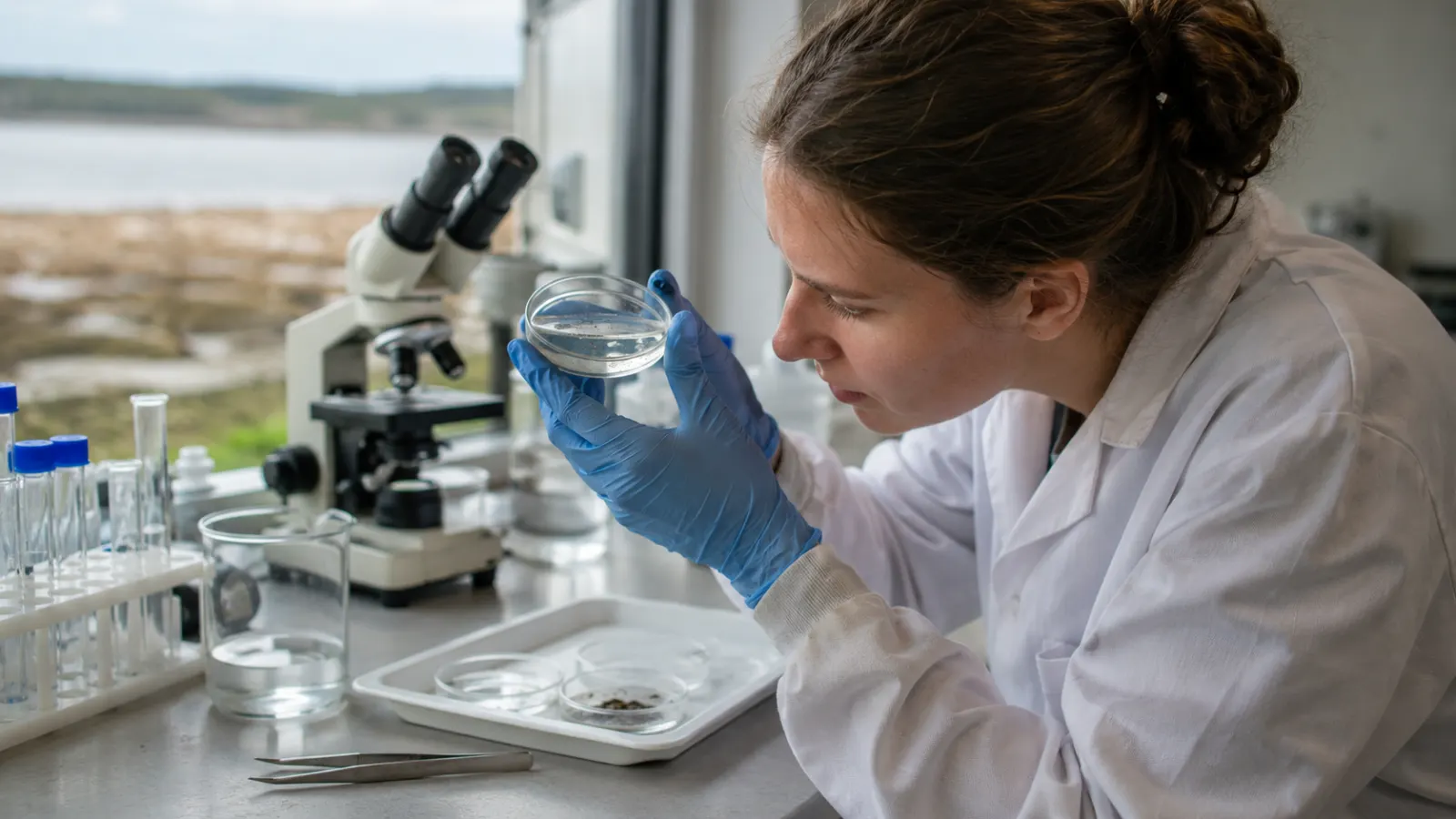
Identification also varies. Visual microscopy can classify suspected particles by appearance but may mistake natural material for plastic. FTIR and Raman spectroscopy can identify polymer chemistry across certain size ranges. Pyrolysis-GC/MS measures chemical signatures in another way but provides different information from particle-counting approaches.
EPA says explicitly that there is currently no single method capable of characterising the wide range of micro- and nanoplastics and that better standardisation is needed for collection, extraction, quantification and identification. NOAA's NCEI database gives a similar warning: because studies use different sampling, extraction, analysis and reporting methods, concentrations from different datasets may not always be directly comparable.
This is one of the most important points for interpreting sensational comparisons. Two studies can both be competent while reporting very different concentrations because they sampled different particle-size ranges or used different identification methods.
Methodological uncertainty does not mean microplastic pollution is imaginary.
It means precision matters when comparing how much is present.
Microplastics in Wildlife and Ecosystems
Small particles are available to organisms that would never be able to swallow a plastic bottle or large fragment. Filter feeders can take up particles while processing water. Fish and other organisms can ingest particles directly or indirectly through prey. Plastic fibres and fragments have consequently been identified across many aquatic food webs.
Potential effects observed in laboratory and field research include altered feeding, physical irritation, changes in energy use, inflammation and exposure to chemicals associated with particles. But the severity of those effects varies greatly with species, particle properties, exposure concentration and experimental design.
This creates another important distinction: exposure is not the same as population-level ecological damage.
Finding microplastics inside an individual animal confirms that the organism encountered plastic. Demonstrating that those particles caused reduced reproduction or population decline requires considerably more evidence.
At the same time, microplastics form only one part of the wider plastic-pollution problem. Larger debris can entangle wildlife, block digestive systems and damage habitat directly. Preventing macroplastic leakage therefore provides two benefits: it reduces immediate harm from large debris and prevents some of that material from becoming future microplastics.
Are Microplastics in Food and Drinking Water?
Yes. Studies have reported microplastics in bottled water, tap water, source water, food products and other materials humans consume. They have also been detected in airborne dust, making ingestion and inhalation important exposure pathways.
WHO's assessment of microplastics in drinking water concluded that substantial limitations in data quality and methodology prevented precise estimates of health risk and called for better standardised research. WHO subsequently expanded its assessment to dietary and inhalation exposure, again identifying major uncertainties concerning exposure levels and possible health effects.
Water treatment can remove many particles, although performance depends on particle characteristics and treatment technology. WHO reported that wastewater treatment can remove a high proportion of microplastics, particularly where advanced treatment is used, while conventional drinking-water processes that remove suspended particles can also reduce microplastic concentrations.
This does not mean treatment removes every particle or eliminates the broader environmental problem. Wastewater plants can concentrate captured particles into sludge, creating another pathway that requires management.
For public health, priorities also need perspective. WHO has emphasised that water suppliers must continue controlling established hazards such as microbial contamination and harmful chemicals while research clarifies the additional risk posed by microplastics. Improving water and wastewater treatment can address several problems simultaneously.
Microplastics Have Been Reported in Human Samples—What Does That Mean?
Human exposure is no longer only theoretical. Research has reported microplastics or micro- and nanoplastics in biological materials including blood, lungs, placental tissue, gastrointestinal samples and vascular tissue. EPA currently acknowledges detection in human tissues while emphasising that more research is needed to determine the implications for health.
The important phrase is reported detection.
Detecting material inside the body answers one question: exposure and internal presence can occur.
It does not by itself answer three harder questions: how much material reaches particular tissues under normal conditions, how long it remains there, and whether those quantities cause disease.
This is why exposure studies and disease studies should not be treated as interchangeable.
A measurement showing particles in tissue can be important without proving that they caused the person's illness.
What Do We Know About Microplastics and Human Health in 2026?
The human-health evidence is developing rapidly, but causal conclusions remain limited.
A 2025 systematic review focused on human evidence found recurring associations between microplastic exposure and biomarkers involving inflammation, oxidative stress and endocrine-related changes. However, the authors stressed that these were primarily associations, methodological differences prevented quantitative meta-analysis and causal relationships with specific clinical diseases had not been established.
Other recent systematic reviews reach broadly similar conclusions: micro- and nanoplastics have been detected in a variety of human biological samples, experimental evidence identifies plausible mechanisms of harm, but direct human evidence remains limited and methodologically heterogeneous.
One of the most discussed human studies was published in the New England Journal of Medicine in 2024. Researchers analysed carotid artery plaques removed from people undergoing surgery and reported micro- and nanoplastics in many samples. Patients whose plaques contained detected plastics had a higher rate of a combined outcome of heart attack, stroke or death during follow-up.
The study is important because it moves beyond merely detecting particles.
But it remains observational, so it cannot establish that the particles caused the cardiovascular events. Other researchers subsequently raised questions about possible contamination and aspects of the analytical methodology, illustrating how technically difficult human microplastics research remains.
The correct conclusion is therefore not “microplastics cause heart attacks.”
It is that emerging human evidence has produced associations serious enough to justify further investigation.
Hazard Is Not the Same Thing as Risk
This distinction is essential in environmental-health reporting.
A hazard is something capable of causing harm under some conditions.
Risk depends on the hazard together with exposure: dose, duration, route and susceptibility.
Laboratory experiments may expose cells or animals to concentrations much higher than typical human environmental exposures. Those studies can identify biological mechanisms, but the findings cannot automatically be translated into real-world disease risk.
Conversely, uncertainty about current exposure levels does not justify assuming that long-term risk is zero.
The scientifically useful questions are therefore quantitative: How many particles are people exposed to? Which sizes cross biological barriers? Which polymers or additives matter most? Do particles accumulate or clear? Which exposures correlate with clinical outcomes? What doses are relevant?
Current evidence cannot answer all of these questions confidently.
That uncertainty should be communicated openly rather than converted into either reassurance or panic.
The Particle and the Chemicals Are Different Questions
Plastic is not one chemical.
Products can contain additives used for flexibility, colour, flame resistance, ultraviolet stability and other properties. Particles can also interact with contaminants in the environment and develop biological material on their surfaces.
A microplastic exposure can therefore involve several possible mechanisms: the physical particle itself, chemicals originally present in the plastic, substances acquired from the surrounding environment and biological material attached to the surface.
WHO's assessment of dietary and inhalation exposure specifically considered the particles, associated chemicals and biofilms as distinct potential sources of concern.
This matters because a study detecting an effect after exposure to one particular plastic formulation cannot automatically establish the same effect for every polymer.
Microplastics should therefore be understood as a heterogeneous category of particles, not one uniform toxic substance.
Primary vs Secondary Microplastics
The distinction between primary and secondary particles remains useful because it changes what prevention looks like.
Primary microplastics begin small. Industrial pellets can escape during manufacturing, loading or transport. Preventing those releases requires containment, handling standards and accountability across industrial supply chains.
Secondary microplastics are generated from larger products through weathering or ordinary use. Bottles and packaging fragment after entering the environment, but tyres and textiles can create particles without ever becoming conventional litter.
The boundary can occasionally become conceptually messy. A tyre is manufactured as a large product, but its normal intended use generates small particles. Depending on classification systems, these releases may be grouped differently.
The policy lesson matters more than the terminology: identify where particles are generated and intervene there.
Why Tyre Wear Deserves More Attention
Tyre particles demonstrate why banning microbeads cannot solve the broader problem.
Every time a vehicle moves, friction gradually removes material from the tyres. Some particles remain near roads, while others move through stormwater or air into wider environments.
OECD has identified tyre wear as a major source requiring dedicated policy because the particles are generated during normal product use and are difficult to capture once dispersed. Possible responses include improving tyre design, reducing unnecessary vehicle kilometres, controlling road runoff and understanding how vehicle weight affects wear.
Electric vehicles do not automatically eliminate this source. They remove tailpipe exhaust during driving but still use tyres, and vehicle mass can influence tyre wear.
Microplastic policy therefore overlaps with transport policy.
Synthetic Textiles and Microfibres
Polyester, nylon and other synthetic textiles can release fibres during manufacturing, wearing, washing and drying.
Some fibres enter wastewater, where treatment systems may capture a substantial share. Others can reach the environment through effluent or sludge. Fibres can also become airborne indoors through ordinary use of clothing, carpets and furnishings.
Potential interventions can occur at several stages: fibre and fabric design, manufacturing processes, washing-machine filtration, wastewater treatment and consumer behaviour.
Again, no single intervention solves the problem.
Telling households to wash clothes differently may help at the margin, but manufacturers determine textile construction, appliance companies determine filtration and governments regulate wastewater systems.
Microfibre pollution is a systems problem as well as a consumer problem.
Why Microbeads Receive More Attention Than Their Current Importance
Microbeads became a public symbol of microplastic pollution because the source was easy to understand: tiny plastic particles were deliberately added to certain rinse-off products and then washed directly into wastewater.
Several jurisdictions subsequently restricted or banned particular uses.
These measures were sensible because the particles were often unnecessary and the source could be directly controlled.
But microbeads represent only one part of today's microplastic challenge. Tyre wear, synthetic fibres, paint, industrial pellets and fragmentation of larger plastic waste create broader and often more difficult pathways.
Successful microbead regulation therefore demonstrates that targeted source control can work.
It does not mean the microplastics problem has been solved.
Can We Remove Microplastics Once They Are in the Environment?
In specific controlled streams, yes.
Wastewater treatment can capture many particles. Filters can intercept fibres. Industrial facilities can prevent pellet losses. Stormwater infrastructure may reduce particles carried from roads.
Removing microplastics after they are widely dispersed through oceans, soils and atmosphere is another matter.
There is no practical technology capable of filtering every microscopic plastic particle from an ocean, agricultural landscape or atmosphere without also disrupting the environment being treated.
Cleanup becomes increasingly difficult as particles become smaller.
This is why microplastics strongly favour source prevention.
Prevent the pellet spill.
Capture fibres before discharge.
Reduce unnecessary plastic entering the environment.
Improve waste collection before larger plastic fragments.
Control industrial releases.
Reduce particle generation where product redesign can do so.
Once contamination becomes microscopic and globally dispersed, remediation has severe technical limits.
What Individuals Can Realistically Do
People understandably want to know whether they can reduce personal exposure.
The evidence is not yet strong enough to justify elaborate routines or expensive products marketed specifically as “microplastic detox” solutions. Human bodies are not cleaned of microplastics through supplements, juices or wellness products, and claims that a particular commercial product removes internal plastic exposure should be treated sceptically unless supported by rigorous evidence.
Practical behaviour can nevertheless reduce some unnecessary plastic use and contribute to lower environmental releases. Avoiding disposable plastic where a durable alternative genuinely works, maintaining reusable items, reducing unnecessary packaging and disposing of plastic correctly can help prevent future fragmentation.
People concerned about drinking water should prioritise established water-quality guidance rather than assuming that a filter marketed for microplastics improves overall safety. Filter performance depends on technology and certification, and microbial or chemical contaminants with well-established health risks may be far more important in a particular water supply.
For synthetic textiles, keeping clothing in use longer and avoiding unnecessary replacement can reduce overall material throughput. But responsibility should not be shifted entirely to individuals when product design and infrastructure determine much of the pollution.
What Governments and Industry Can Do
The highest-leverage interventions occur upstream.
Manufacturers can reduce unnecessary plastic, prevent pellet loss, redesign products to shed fewer particles and remove problematic materials where substitutes perform appropriately. Textile companies can investigate fibre shedding across the entire product lifecycle. Tyre manufacturers can optimise durability and wear while regulators develop comparable testing standards.
Governments can strengthen waste collection, stormwater management and wastewater treatment while establishing source-specific controls. They can require industrial containment, support research standardisation and design producer-responsibility systems that connect product design with downstream environmental costs.
Microplastic policy should also remain connected with wider plastic-pollution policy.
Every unnecessary bottle, wrapper or discarded plastic object prevented from entering the environment is also material that cannot later fragment into secondary microplastics.
This is why Plastic Pollution and Microplastics should function as closely linked but separate Editors Outlook articles. The plastic-pollution pillar explains the full material system; this page should own the microscopic-particle question.
Common Myths About Microplastics
One common myth is that all microplastics are the same. They differ in polymer, shape, size, chemistry and exposure route, and those differences can influence biological behaviour.
Another is that all microplastics come from broken bottles and bags. Fragmented litter is important, but tyres, textiles, paints and industrial pellets are also substantial sources.
It is also incorrect to assume that detecting microplastics in human tissue proves they caused disease. Detection establishes exposure or presence; causal health effects require additional evidence.
The opposite claim—that microplastics have been proved harmless—is equally unjustified. Current human evidence remains incomplete, and recent studies have produced associations that warrant further research.
Another misconception is that recycling alone prevents microplastic pollution. Recycling can reduce some future material demand and leakage, but particles are also generated during normal use of products such as tyres and textiles.
Finally, no credible evidence supports products claiming to detox the body of microplastics through supplements, drinks or similar consumer treatments.
Frequently Asked Questions About Microplastics
What are microplastics? Microplastics are small plastic particles or fibres generally defined as smaller than 5 millimetres. They include fragments, fibres, pellets, films, foams and beads.
What is the difference between microplastics and nanoplastics? Microplastics cover particles below 5 millimetres, while nanoplastics refer to particles at much smaller nanoscale dimensions. Exact lower boundaries vary among scientific frameworks.
Where do microplastics come from? Sources include fragmentation of larger plastic waste, tyre wear, synthetic textiles, paints, industrial pellets, fishing gear and some products manufactured with small plastic particles.
What are primary microplastics? They are particles produced or handled at small sizes, such as industrial pellets and certain intentionally manufactured particles.
What are secondary microplastics? They form when larger plastic products fragment or release particles through weathering, abrasion or use.
Are microplastics in drinking water? Yes. Studies have detected them in bottled and tap water, although concentrations vary and comparing studies can be difficult because measurement methods differ.
Are microplastics in food? Research has reported particles in a range of foods and beverages. Human exposure can occur through ingestion as well as inhalation.
Are microplastics in the human body? Researchers have reported micro- and nanoplastics in several human biological samples and tissues. The health significance of different levels of internal exposure is still being investigated.
Do microplastics cause cancer? Current evidence does not establish that ordinary environmental microplastic exposure causes cancer in humans. Research into possible long-term health effects remains active.
Do microplastics cause heart disease? A 2024 observational study found an association between detected micro- and nanoplastics in carotid plaques and later cardiovascular events, but the study cannot establish causation and methodological questions remain.
Are microplastics toxic? That question is too broad for a single yes-or-no answer. Toxicological effects depend on particle characteristics, associated chemicals, dose, exposure route and biological context.
Can water treatment remove microplastics? Treatment can remove substantial numbers of particles, although efficiency varies according to particle size and technology. WHO has emphasised improving overall drinking-water and wastewater treatment while research continues.
Are bottled water and tap water different for microplastics? Studies have detected microplastics in both. Concentrations reported across individual studies should be interpreted cautiously because sampling and analytical methods can differ significantly.
Do plastic bottles create microplastics? Plastic containers can shed or eventually fragment into smaller particles through manufacturing, use, weathering and degradation.
Do tyres produce microplastics? Yes. Tyre abrasion during normal driving generates small particles that can enter air, roadside environments and waterways.
Do clothes release microplastics? Synthetic textiles such as polyester and nylon can release plastic microfibres during manufacturing, wear, washing and drying.
Can microplastics be removed from oceans? Large-scale removal of dispersed microscopic particles is technically extremely difficult. Preventing releases at their source is generally more realistic.
Why do microplastic studies report different numbers? Differences in sampling, filter size, contamination control and analytical techniques can produce substantially different results. NOAA and EPA both identify methodological standardisation as a major research need.
Should people be worried about microplastics? Concern and further research are justified because exposure is widespread and biological effects are plausible. Current evidence does not, however, justify treating every detected particle as proof of disease.
What We Know—and What We Still Need to Know
The clearest conclusion about microplastics is not that science knows nothing and not that every risk has already been proved.
Several facts are now difficult to dispute. Small plastic particles are widespread across environmental systems. They come from many sources, including the fragmentation of larger waste, tyres, textiles and industrial materials. Wildlife encounters and ingests them. Humans are exposed through air, food and water, and researchers have reported them in human biological samples.
The uncertainties begin when we move from presence to consequence.
How much does a typical person inhale or ingest? Which particles enter circulation? Which are eliminated? Which sizes can cross particular biological barriers? How important are the polymers compared with the additives or chemicals carried with them? Which laboratory findings occur at realistic human doses? Do long-term exposures contribute causally to specific diseases?
Research published through 2025 and 2026 is beginning to provide more human evidence, including associations with biological markers and clinical outcomes, but systematic reviews continue to describe substantial methodological heterogeneity and incomplete causal evidence.
Measurement remains part of the problem. A field in which laboratories cannot yet use one universally standardised approach will inevitably produce uncertainty about concentration, comparability and exposure.
That should make communication more precise, not less urgent.
We do not need proof that every form of microplastic causes every suspected disease before reducing unnecessary releases. Once tiny persistent particles become distributed through oceans, soil and air, retrieving them is extraordinarily difficult.
Prevention therefore remains the strongest practical principle.
Reduce unnecessary plastic that will later fragment. Prevent industrial pellet losses. Design textiles and tyres to shed less material. Capture particles in wastewater and runoff where technically feasible. Improve waste systems so larger plastic does not escape into environments where it can spend decades fragmenting.
At the same time, health reporting should resist the temptation to turn emerging evidence into certainty. A detected particle is not automatically a diagnosis. An observational association is not automatically causation. A laboratory hazard is not automatically a real-world human risk at ordinary exposure levels.
Microplastic pollution is serious enough that it does not need exaggeration.
The particles are widespread.
Exposure is real.
Some biological mechanisms are plausible and concerning.
Human-health evidence is developing rapidly.
And because the material is much easier to prevent than to remove after dispersion, waiting for perfect certainty before reducing avoidable releases would solve the scientific uncertainty by allowing the environmental burden to grow.
The best response is therefore the same one good science requires: measure better, distinguish evidence from inference, communicate uncertainty honestly and reduce preventable exposure at the source.
Medical Note
This article provides general educational information and is not a substitute for medical diagnosis or personalised health advice. Current research does not support diagnosing illness based solely on presumed microplastic exposure or using unproven products marketed to “detox” microplastics from the body. People with health concerns should seek advice based on their symptoms and established medical evidence rather than assuming microplastics are the cause.