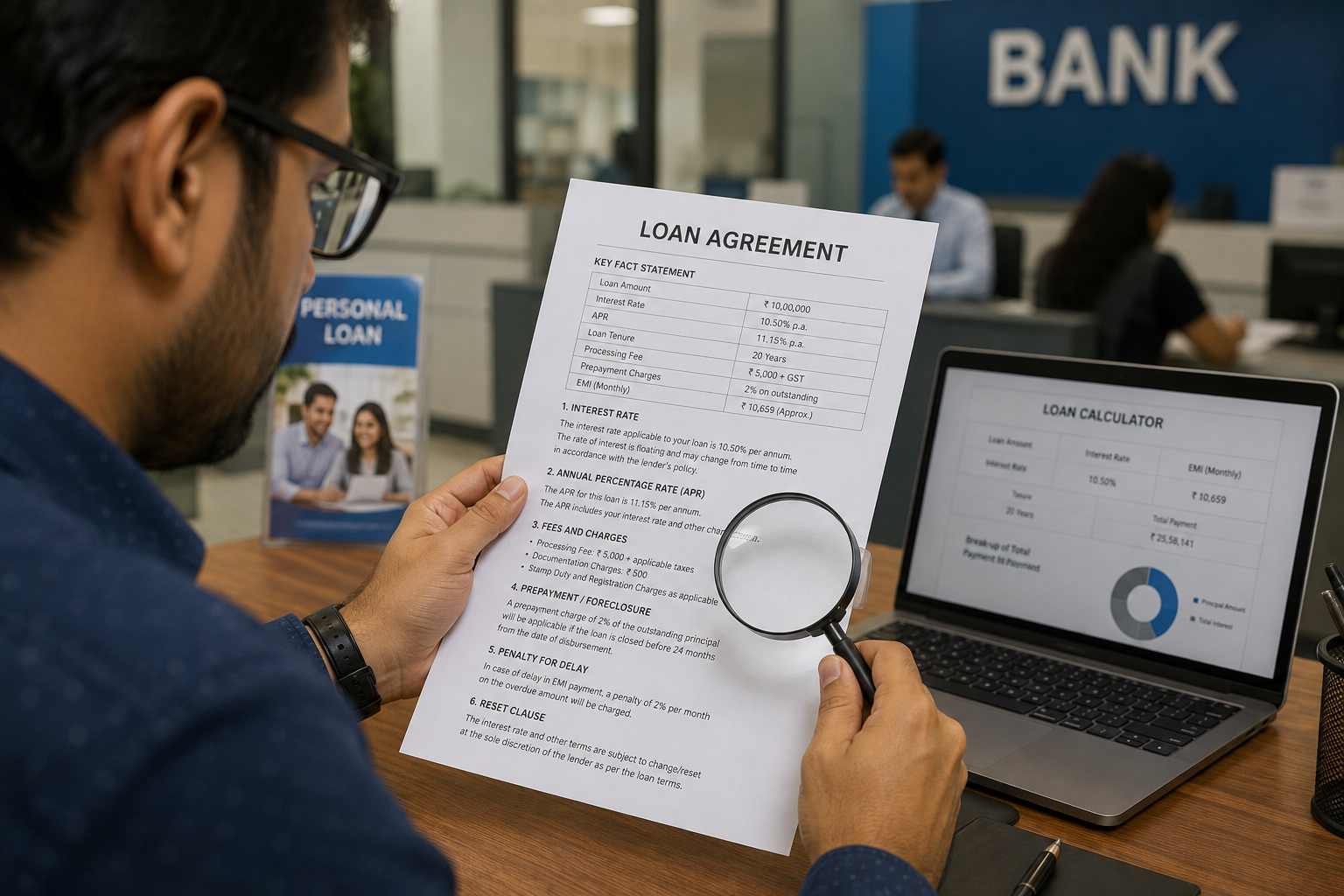
The loan is not only the amount you receive
Most borrowers read a loan offer from the top line: how much money will I get and what EMI will I pay? That is understandable. The need for money is usually immediate. A home buyer wants the property funded. A student wants fees paid. A business owner wants working capital. A salaried borrower wants cash for an emergency. In that moment, the loan amount and monthly instalment dominate attention.
But the real loan is hidden in the fine print. It is not only the principal amount. It is the interest method, tenure, processing fee, insurance charge, prepayment condition, foreclosure rule, late payment treatment, reset clause, collateral condition, guarantor obligation, default consequence and grievance mechanism. A borrower who ignores these details may accept a loan that looks affordable but becomes expensive under stress.
Fine print matters because borrowing is a contract. Once signed, the lender and borrower are bound by terms. A verbal assurance from a sales executive is weak if the written agreement says something else. The safest borrower is not the one who negotiates the lowest EMI. It is the one who understands the full cost and the full risk before accepting the money.
Start with the Key Fact Statement
A good loan reading habit begins with the Key Fact Statement or equivalent summary document. This is meant to present the most important terms in a concise form: loan amount, annual percentage rate, interest type, fees, charges, repayment schedule and other core obligations. Borrowers should not treat it as a formality. It is the first map of the loan.
The most important figure is not always the advertised interest rate. The better figure is the annualised total cost or annual percentage rate where applicable, because it can include charges beyond basic interest. A loan that advertises a lower rate but adds heavy processing fees, compulsory insurance or other charges may not be cheaper than a loan with a slightly higher interest rate and cleaner costs.
The borrower should compare loans using the same basis: amount disbursed, total cost, EMI, tenure, fees, flexibility and risk. Comparing only headline interest rates is like comparing hotel rooms by rent while ignoring taxes, service charges and cancellation penalties.
Understand fixed, floating and reducing balance interest
The interest clause deserves careful attention. A fixed interest rate remains unchanged for a defined period or tenure depending on the product. A floating rate can change when the benchmark changes. Floating rates may begin cheaper, but they carry reset risk. If rates rise, the EMI may increase, the tenure may lengthen, or both may change depending on the lender policy and borrower choice.
Borrowers should also understand the difference between flat rate and reducing balance rate. A flat rate may sound lower but can be misleading because interest is calculated on the original principal for the full period. In a reducing balance method, interest is calculated on the outstanding principal as it declines. For most borrowers, reducing balance cost is the more meaningful way to understand real interest burden.
The key question is simple: on what amount is interest charged, how often is it calculated, and what happens when rates change? A borrower who cannot answer these questions has not yet understood the loan.
Read every fee as part of the price
Loan pricing does not end with interest. Processing fees, documentation charges, valuation fees, legal charges, stamp duty, insurance premiums, technical inspection charges, account maintenance fees, bounce charges, late payment charges, foreclosure charges and part-payment fees can all affect the true cost. Some are unavoidable. Some are negotiable. Some may be unnecessary or optional depending on the product.
Borrowers should ask three questions about each fee. Is it compulsory? Is it refundable? Is it included in the annual cost calculation? A processing fee deducted before disbursal means the borrower receives less cash than the sanctioned amount but may still repay based on the full loan amount. That difference matters.
Insurance is another common area of confusion. Loan protection insurance may be useful in some cases, but it should be clearly understood. Is the insurance mandatory or optional? What does it cover? What is excluded? Is the premium financed into the loan? If it is added to the loan, the borrower may pay interest on the premium as well.
Check prepayment and foreclosure rules
Many borrowers assume early repayment is always rewarded. That is not always true. Some loans allow part-prepayment or foreclosure freely; others impose conditions or charges. A borrower expecting bonuses, business cash flows or property sale proceeds should read these clauses carefully.
Prepayment flexibility is valuable because it allows the borrower to reduce future interest. Even small extra payments can shorten tenure significantly in long-term loans. But if the agreement restricts part-payments, sets minimum amounts, permits them only after a lock-in period, or applies charges, the borrower needs to know before signing.
The right loan is not always the one with the lowest EMI. Sometimes a slightly higher EMI with strong prepayment flexibility is better than a rigid loan that traps the borrower for years.
Know what default really means
Default is not only complete non-payment. A loan agreement may define default broadly: missed EMI, cheque bounce, breach of covenant, false information, unauthorised sale of collateral, deterioration in security, insolvency, death without proper documentation, or cross-default from another facility. The borrower should understand what events give the lender the right to act.
The consequences can include late charges, penal charges, credit bureau reporting, collection activity, recall of the loan, enforcement of security, legal notice or action against guarantors. This is why borrowers should never sign casually as guarantors. A guarantor may become responsible if the borrower fails to repay.
Borrowers should also check grievance and dispute-resolution channels. A serious loan document should make clear whom to contact, how to escalate and what records matter. Every borrower should preserve sanction letters, repayment schedules, receipts, bank statements and written communication.
Floating-rate reset and EMI shock
For long-tenure loans such as home loans, the reset clause is critical. A floating-rate loan can change when benchmark rates change. Lenders may respond by increasing EMI, extending tenure or offering a combination. If tenure keeps extending quietly, the borrower may pay interest for longer than expected. If EMI jumps suddenly, household cash flow can be strained.
A borrower should ask for illustrations before signing. What happens if the rate rises by 1 percentage point? What happens if it rises by 2 percentage points? Will the EMI rise, will the tenure rise, or can the borrower choose? Is switching to a fixed rate possible? What charges apply? These are not academic questions. Interest-rate cycles can reshape the total cost of a loan.
The fine print should therefore be read not only for today’s affordability but for tomorrow’s stress. A loan is safe only if the borrower can survive reasonable adverse movement in income, expenses and interest rates.
A borrower’s fine-print checklist
Before accepting any loan, the borrower should check the sanctioned amount, net disbursal amount, interest type, annualised cost, EMI, tenure, repayment date, processing fee, insurance, prepayment rule, foreclosure charge, late payment charge, collateral condition, guarantor clause, reset clause, credit bureau reporting, grievance process and total amount payable over the loan life.
The borrower should also compare the loan with alternatives. Can the expense be postponed? Is a secured loan cheaper than an unsecured one? Is the tenure too long? Is the EMI too close to monthly surplus? Is the loan funding an asset, education, emergency or consumption? The purpose of the loan matters because debt taken for temporary lifestyle pressure often becomes long-term financial stress.
A useful discipline is to sleep on the loan before accepting it, except in genuine emergencies. Pressure to sign immediately is itself a warning signal. Good lenders can explain costs clearly. Bad loans often depend on urgency, confusion and borrower fatigue.
Questions to ask before signing
A borrower should ask the lender to explain the loan in plain language before accepting it. What is the net amount that will actually reach the bank account? What is the annualised cost? What is the total amount payable if the loan runs for the full tenure? What happens if one EMI is missed? What happens if the borrower wants to prepay? What happens if interest rates rise?
The answers should be written or reflected in the loan documents, not only spoken during a sales call. Sales conversations are often optimistic; contracts are enforceable. A borrower should never rely only on phrases like “don’t worry”, “this is standard”, “everyone signs this” or “charges are very small”. Small charges repeated over years can become meaningful, and standard clauses can still be harmful if they do not suit the borrower’s cash flow.
Another practical step is to compare the repayment date with income timing. A salaried borrower paid on the last day of the month may prefer an EMI date soon after salary credit. A business borrower with uneven cash flow may need more careful planning. A technically affordable loan can still create default risk if repayment dates and cash receipts do not match.
Final takeaway
Loan fine print is not decorative legal language. It is the real price and risk of borrowing. The borrower who reads it carefully understands not only what the loan gives but what it can take: future income, flexibility, credit score, collateral and peace of mind.
The safest question before borrowing is not “Can I get this loan?” It is “Can I repay this loan under stress, and do I understand every major cost?” If the answer is unclear, the loan is not yet understood.
A loan can build a home, education, business or financial bridge. But when the fine print is ignored, the same loan can become a long contract of regret. Reading before signing is not caution; it is financial self-defence.