Isaac Newton: Biography, Discoveries, Laws and the Man Behind the Genius
Isaac Newton did not discover that objects fall.
Human beings had watched stones, fruit and rain descend toward the ground for thousands of years.
Nor did a falling apple suddenly deliver the completed theory of universal gravitation to Newton in one miraculous moment.
The apple story does, however, have genuine historical roots.
William Stukeley recorded that Newton himself later described watching an apple fall while thinking about why objects move toward Earth. Other Newton-associated accounts similarly connect the episode with his speculation that Earth's gravitational attraction might extend as far as the Moon. The Newton Project describes the story as historical rather than simply invented, while also warning that an elderly and already famous Newton may have been shaping the story of his own intellectual life.
What the apple did not provide was:
- the inverse-square law in finished mathematical form;
- the laws of motion;
- accurate measurements of Earth;
- Kepler's astronomical evidence;
- a mathematical treatment of planetary orbits;
- or the hundreds of pages that eventually became the Principia.
Those required years of calculation, experimentation, reading, correspondence, revision and conflict.
That difference captures the gap between Newton the legend and Newton the historical person.
The legend receives sudden revelations.
The historical Newton:
- worked obsessively;
- delayed publication;
- experimented with light;
- developed new mathematics;
- quarrelled over intellectual priority;
- investigated alchemy;
- wrote extensively about theology;
- prosecuted counterfeiters;
- ran the Royal Mint;
- controlled powerful scientific institutions;
- and produced a mathematical description of nature that transformed physics.
His Philosophiae Naturalis Principia Mathematica, published in 1687, provided a framework capable of treating falling objects, projectiles, planetary motion, the Moon, tides and comets within the same mathematical system. The Royal Society describes the work as the product of ideas Newton had been considering since the 1660s, developed decisively after Edmond Halley's intervention in 1684.
But Newton's intellectual world was much stranger than the modern physics classroom usually suggests.
He was simultaneously:
mathematician, experimental natural philosopher, astronomer, theologian, alchemical investigator, administrator and public official.
Understanding Newton therefore requires more than memorising three laws.
It requires understanding the seventeenth-century world from which modern physics emerged.
Isaac Newton at a Glance
| Question | Short answer |
|---|---|
| Who was Isaac Newton? | An English mathematician and natural philosopher whose work transformed mechanics, astronomy, optics and mathematics. |
| When was Newton born? | 25 December 1642 under the Julian calendar then used in England, equivalent to 4 January 1643 in the Gregorian calendar. |
| When did Newton die? | 1727. |
| What is Newton most famous for? | The laws of motion, universal gravitation, major work in optics and independent development of calculus. |
| Did Newton invent calculus? | Newton and Gottfried Wilhelm Leibniz developed calculus independently; Newton developed key methods earlier, while Leibniz published first and his notation became enormously influential. |
| Did an apple really inspire Newton? | Newton later told a story connecting a falling apple with his thinking about gravity, but it did not instantly produce his completed theory. |
| Did Newton discover gravity? | Not in the sense of discovering that things fall. His achievement was developing a mathematical theory of universal gravitation. |
| What was Newton's most important book? | Philosophiae Naturalis Principia Mathematica (1687), usually called the Principia. |
| What did Newton discover about light? | He showed experimentally that white light contains rays of different colours with different refrangibility. |
| Did Newton invent a telescope? | He built the first successful practical reflecting telescope of the Newtonian type. |
| Was Newton interested in alchemy? | Extensively. Large numbers of his surviving manuscripts concern alchemical subjects. |
| Was Newton religious? | Deeply. He wrote extensively on theology, biblical chronology and prophecy and held unconventional Christian views. |
| Did Newton work for government? | Yes. He became Warden and later Master of the Royal Mint. |
| Was Newton president of the Royal Society? | Yes. He became president in 1703 and remained in the role until his death. |
Why Isaac Newton Was So Important
Newton's achievement was not simply that he discovered several unrelated scientific facts.
His deeper achievement was unification.
Before Newton, enormous progress had already been made by figures including:
- Nicolaus Copernicus;
- Johannes Kepler;
- Galileo Galilei;
- René Descartes;
- Christiaan Huygens;
- Robert Hooke;
- and others.
Kepler had described planetary motion mathematically.
Galileo had transformed the study of motion.
Astronomers were producing increasingly precise observations.
Mathematicians were developing new methods for curves, areas, rates and infinite processes.
Newton brought several of these intellectual streams together.
The same physical principles could apply to:
a falling stone,
a cannonball,
the Moon,
a planet,
and
a comet.
This was revolutionary because celestial and terrestrial motion no longer needed to belong to fundamentally separate systems.
Nature could be mathematically unified.
Isaac Newton's Early Life
Newton was born at Woolsthorpe in Lincolnshire.
Under the calendar then used in England, his birthday was 25 December 1642. Under the modern Gregorian calendar, the corresponding date is 4 January 1643. The Newton Project notes this calendar difference explicitly in its chronology.
His father, also named Isaac Newton, died before Newton was born.
His mother, Hannah Ayscough, later remarried.
Newton spent part of his childhood living with his maternal grandmother while his mother lived with her second husband.
Later biographies have sometimes attempted to explain Newton's:
- secrecy;
- emotional intensity;
- distrust;
- or combative personality
through these childhood separations.
Such retrospective psychological diagnoses should be treated cautiously.
What can be established more securely is that nothing about Newton's childhood guaranteed that he would become one of history's most influential intellectual figures.
At one point, his family appears to have expected him to manage the agricultural estate.
That plan did not last.
School in Grantham
Newton attended the King's School in Grantham.
Accounts of his youth describe an interest in:
- mechanical devices;
- models;
- reading;
- and practical construction.
Some stories of his childhood genius come from later biographical traditions and should not all be read as perfectly documented facts.
What matters more is what happened next.
Instead of becoming a farmer, Newton returned to education.
In 1661 he entered Trinity College, Cambridge.
The Newton Project records his admission to Trinity that year and shows how rapidly his intellectual interests moved beyond the conventional university curriculum.
Newton at Cambridge
Cambridge education still contained substantial Aristotelian material.
But European natural philosophy was changing rapidly.
Newton encountered ideas associated with:
- Descartes;
- Kepler;
- Galileo;
- Boyle;
- Wallis;
- and other mathematicians and natural philosophers.
He read independently and filled notebooks with questions.
One important notebook carried the heading:
Quaestiones quaedam Philosophicae — “Certain Philosophical Questions.”
The Newton Project's chronology says that by 1664 Newton was largely pursuing private studies in mathematics and optics beyond the official university curriculum.
This matters because the popular image of Newton as a person who simply “thought harder than everybody else” misses an important fact:
Newton was an extraordinary reader.
His innovations grew inside a dense intellectual environment.
He learned from predecessors.
Then he pushed their methods much further.
The Plague Years: Newton's “Year of Wonders”
In 1665, plague disrupted Cambridge.
Newton returned to Lincolnshire.
He remained away from normal university life through much of 1665–67 as plague repeatedly affected Cambridge.
This period later became famous as Newton's annus mirabilis, or “year of wonders.”
The achievements associated with these years were extraordinary.
According to the Newton Project, Newton established major foundations of:
- calculus;
- optics;
- and gravitational thinking
during this period.
But the popular story often exaggerates what happened.
Newton did not leave Cambridge, sit beneath an apple tree for a few months and return with modern physics completed.
His early ideas needed decades of:
- refinement;
- improved evidence;
- mathematical development;
- and argument.
The plague years were an intellectual explosion.
They were not the end of the story.
Did an Apple Really Fall on Isaac Newton?
Probably something close to the famous story happened.
But the familiar version has been distorted.
There is no reliable historical basis for the cartoon version in which an apple strikes Newton on the head and instantaneously causes him to “discover gravity.”
A much more credible account comes from William Stukeley.
Stukeley later remembered sitting in a garden with Newton, who recalled watching an apple fall and wondering why it moved toward Earth's centre rather than sideways or upward.
The account then connects this thought with a larger question:
Could Earth's gravitational influence extend beyond the surface—perhaps even to the Moon?
That is far more intellectually interesting than:
apple falls → gravity discovered.
The question was not why objects fall in the ordinary sense.
It was whether the force responsible for falling bodies belonged to the same physics that governed celestial motion.
Why the Apple Was Only the Beginning
Even if the apple helped stimulate Newton's thinking, he still faced enormous problems.
He needed to determine whether gravitational acceleration at Earth's surface could be mathematically connected to the motion of the Moon.
That required knowing:
- Earth's size;
- the Moon's distance;
- orbital periods;
- and the mathematical relationship between central force and orbital motion.
A Newton-associated account preserved by the Newton Project says that one early calculation did not initially agree because Newton used an inaccurate estimate of Earth's dimensions; later improved measurements helped bring the calculation into alignment.
Whatever precise reconstruction historians prefer, one conclusion is secure:
the apple did not contain the mathematics.
Newton had to build that.
Newton and the Invention of Calculus
Newton developed a mathematical approach that he eventually called the method of fluxions.
It dealt with quantities changing continuously.
In modern terminology, this belongs to the development of:
- differential calculus;
- integral calculus;
- rates of change;
- tangents;
- areas;
- and related mathematical problems.
The Newton Project preserves a significant October 1666 tract in which Newton developed key parts of this work.
But calculus created one of the most famous priority disputes in intellectual history.
Newton vs Leibniz: Who Invented Calculus?
The most accurate short answer is:
Isaac Newton and Gottfried Wilhelm Leibniz developed calculus independently.
Newton developed essential ideas earlier.
Leibniz independently developed his own differential and integral calculus and published before Newton fully published his method.
Stanford's biography summarises Newton as developing calculus in the mid-to-late 1660s, before Leibniz independently developed his version.
Leibniz's notation included forms that remain familiar today, such as:
dx
and
∫
Newton used different ideas and notation associated with fluxions.
An older historical assessment reproduced by the Newton Project also recognised two critical facts:
Newton developed his fluxional method earlier, while Leibniz communicated and published a developed differential calculus independently and earlier in print.
Why the Calculus Dispute Became So Bitter
Scientific priority is not one simple question.
“Who was first?” can mean:
Who thought of something first privately?
Who wrote it down first?
Who told another scholar first?
Who published first?
Who created the most usable notation?
Who influenced later mathematics most strongly?
Newton and Leibniz had different strengths under different measures.
Instead of remaining a technical historical question, the dispute became:
- personal;
- institutional;
- and nationalistic.
British mathematicians rallied around Newton.
Continental mathematicians defended Leibniz.
The Royal Society investigated the controversy while Newton was its president.
That hardly created ideal conditions for neutral adjudication.
Newton's own writings show how intensely he remained involved in defending his priority.
The modern historical conclusion is much less dramatic:
both men deserve recognition as independent creators of calculus.
Newton's Experiments With Light
Newton's work in optics was revolutionary in a completely different way.
One major question concerned colour.
A common assumption was that white light was pure and that coloured light arose because transparent materials somehow modified it.
Newton's prism experiments challenged this.
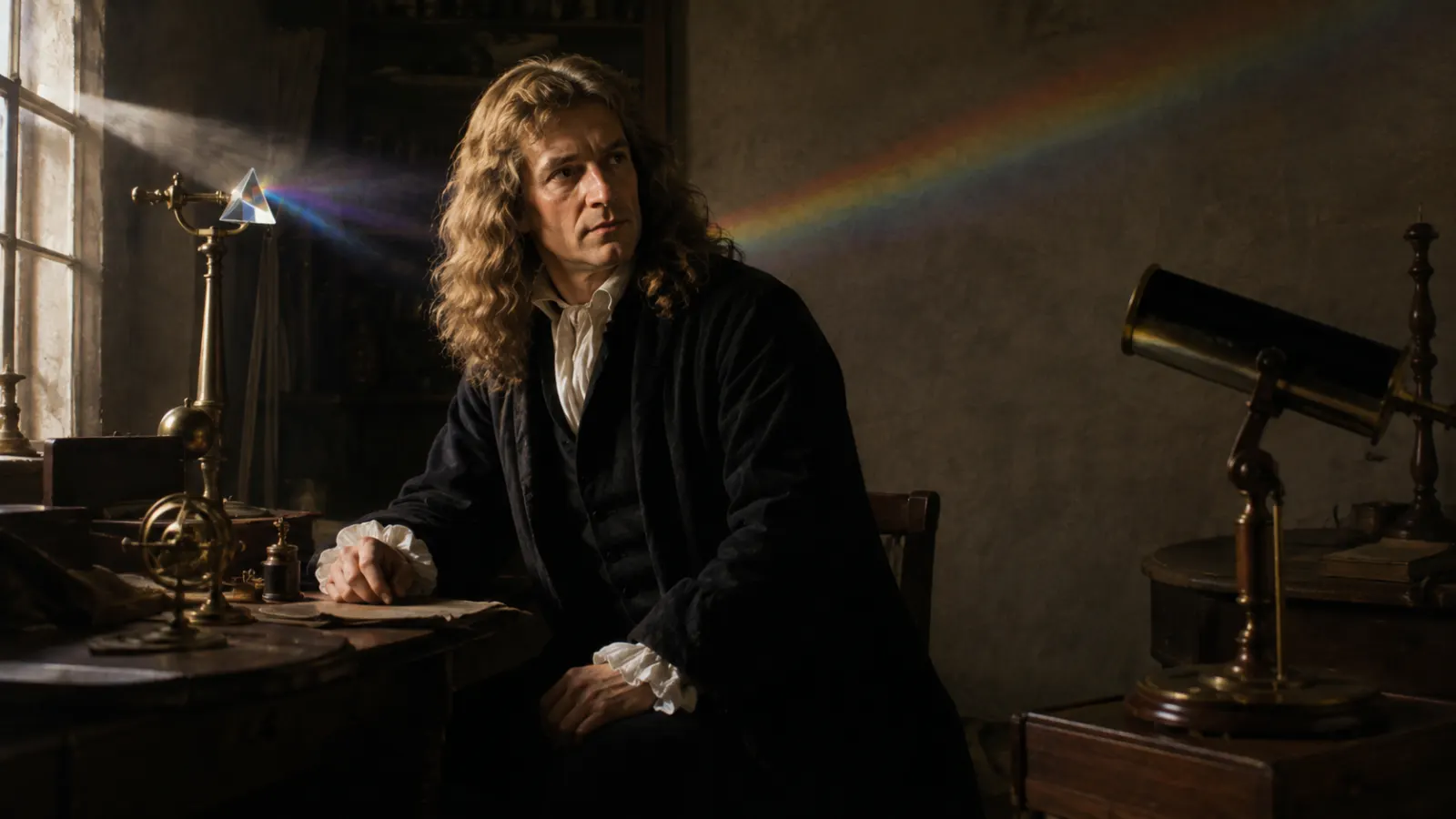
When white light passed through a prism, it separated into colours.
But Newton went further.
He performed experiments showing that individual colours behaved differently under refraction and that the prism was not simply “colouring” the white light.
His conclusion was that white light itself is composed of rays with different refrangibilities.
The Newton Project describes his early optical work as establishing the heterogeneous nature of white light.
Newton's Prism Experiment
The usual illustration shows:
white beam → prism → rainbow.
But that image alone does not prove Newton's theory.
The more important work involved controlling the experiment.
Newton investigated what happened when selected portions of the spectrum were passed through additional optical arrangements.
He also showed that separated colours could be recombined toward white light.
The experimental logic mattered as much as the colourful visual effect.
Newton was trying to distinguish between two possibilities:
The prism creates colour
or
the prism separates colours already present in white light.
His evidence supported the second interpretation.
Newton Almost Injured His Own Eyes
Newton's optical investigations were sometimes extraordinarily dangerous.
The Newton Project documents experiments in which he studied visual phenomena using his own eyes, including staring toward the Sun and applying pressure around the eye.
These procedures should obviously not be copied.
They show something important about seventeenth-century experimental practice.
Newton was willing to treat his own sensory system as experimental apparatus.
Newton and Robert Hooke
Newton presented his theory of light and colour to the Royal Society after being elected a Fellow in 1672.
Criticism followed.
One important critic was Robert Hooke, already one of England's leading experimental natural philosophers and the author of Micrographia.
Hooke had his own theories concerning light.
Newton reacted badly to criticism.
Their relationship became increasingly hostile.
This pattern would recur throughout Newton's life.
He was capable of extraordinary intellectual confidence.
He was also extraordinarily sensitive about:
- priority;
- criticism;
- ownership;
- and reputation.
Newton's Reflecting Telescope
Newton's optical theory also influenced instrument design.
Refracting telescopes use lenses.
Different colours of light refract by different amounts, contributing to chromatic aberration.
Newton pursued another design:
a telescope using a curved mirror rather than a large objective lens.
He built a successful compact reflecting telescope.
The Royal Society's surviving instrument records state that Newton built his first reflector in 1668, while another model dated 1671 was presented to the Society and helped establish his scientific reputation.
The design became known as the Newtonian telescope.
Versions of the basic configuration are still used by amateur and professional astronomers.
What Did Isaac Newton Invent?
Newton is sometimes given long lists of “inventions.”
That terminology needs care.
His most important achievements were often:
- theories;
- mathematical methods;
- experimental discoveries;
- or major improvements
rather than conventional inventions.
Important Newtonian achievements include:
calculus / fluxions
the three laws of motion
universal gravitation
major optical discoveries
the practical reflecting telescope
the generalised binomial theorem and other mathematical work
It is more accurate to describe Newton as a mathematician and natural philosopher who transformed several fields than as a conventional inventor.
Edmond Halley and the Question That Became the Principia
One of the most important moments in Newton's career occurred in 1684.
Astronomer Edmond Halley visited Newton and asked what orbit would result if a planet were attracted toward the Sun by a force following an inverse-square relationship.
Newton reportedly answered that the orbit would be an ellipse.
Halley wanted the proof.
Newton subsequently developed a short treatment known as De Motu.
That work expanded dramatically.
The result became:
Philosophiae Naturalis Principia Mathematica.
The Royal Society's account stresses that Halley's role went far beyond asking one question.
He:
- encouraged Newton;
- managed the publication;
- helped navigate the Hooke dispute;
- and ultimately took responsibility for financing publication when the Society lacked the money to do so.
Even Newton's greatest book therefore had a social history.
Genius required a publisher.
The Principia Mathematica
The first edition appeared in 1687.
Its Latin title translates approximately as:
Mathematical Principles of Natural Philosophy.
The book is among the most consequential works in the history of science.
Newton presented:
- definitions;
- laws of motion;
- mathematical propositions;
- orbital analysis;
- gravitational theory;
- and applications to astronomical phenomena.
The great conceptual result was that one mathematical physics could describe both Earth and heaven.
Newton's Three Laws of Motion
The three laws became foundational to classical mechanics.
Newton's First Law
A body remains at rest or continues in uniform straight-line motion unless acted upon by an external force that changes that state.
This captures the concept of inertia.
Objects do not need a continuous force simply to continue uniform motion.
They require a net force to change motion.
Newton's Second Law
Newton's original formulation concerns the relationship between force and change in quantity of motion.
In elementary modern mechanics, it is commonly represented under appropriate assumptions as:
F = ma
where:
F = net force
m = mass
a = acceleration
The simplified equation is enormously useful, although it should not be confused word-for-word with Newton's original seventeenth-century formulation.
Newton's Third Law
For forces between interacting bodies, action and reaction occur in equal and opposite directions.
Examples include:
- walking;
- rocket propulsion;
- recoil;
- pushing against a wall;
- and interacting objects generally.
Newton's Law of Universal Gravitation
Newton proposed that material bodies attract one another.
In modern notation, the gravitational force between two masses is represented as:
F = Gm₁m₂/r²
where:
F is gravitational force,
G is the gravitational constant,
m₁ and m₂ are the masses,
and
r is the distance between their centres.
The great idea was universality.
Gravity was not something that happened only near Earth's surface.
The same general interaction helped explain:
- falling objects;
- the Moon's orbit;
- planetary orbits;
- comets;
- and other celestial motion.
That transformed astronomy into mathematical physics.
Did Newton “Discover Gravity”?
The phrase is useful shorthand but historically misleading.
Newton did not discover that:
objects fall
or even that celestial bodies might attract one another.
Ideas about attraction and inverse-square relationships were already being discussed.
Robert Hooke, in particular, had important ideas concerning central attraction and planetary motion before the Principia.
Newton's decisive contribution was much more sophisticated.
He developed a mathematically powerful system that could derive and calculate the consequences of gravitational attraction.
Scientific discovery is often not:
being the first person to say an idea.
It can mean:
turning an idea into a quantitative theory that explains and predicts phenomena.
Newton vs Hooke Over Gravity
Hooke later claimed that Newton had not adequately credited his contributions.
The dispute remains historically important.
Hooke had discussed:
- attraction toward a central body;
- the combination of inertial motion and attraction;
- and inverse-square behaviour.
But he did not produce the complete mathematical theory Newton eventually presented.
Newton possessed extraordinary mathematical tools Hooke did not.
This allowed Newton to connect gravitational force systematically with:
- Keplerian orbital motion;
- planetary dynamics;
- lunar motion;
- comets;
- and other phenomena.
The fairest conclusion is therefore neither:
“Hooke discovered gravity and Newton stole it”
nor
“Newton created the entire subject from nothing.”
Newton built on a developing scientific conversation and transformed it.
Newton's Famous “Standing on the Shoulders of Giants” Line
Newton's phrase:
“If I have seen further it is by standing on the shoulders of Giants”
is often presented as evidence of extraordinary humility.
The line appeared in correspondence with Robert Hooke.
Its exact tone and whether it contained an ironic element have been debated.
Whatever Newton intended in that particular exchange, the phrase describes something genuinely important about scientific progress:
Newton depended on intellectual predecessors.
His achievements would have been impossible without work by people such as:
- Galileo;
- Kepler;
- Descartes;
- Huygens;
- Wallis;
- Barrow;
- Hooke;
- and many others.
Science advances cumulatively even when its participants quarrel over the credit.
Gravity Without Explaining What Gravity “Was”
Newton's gravitational theory was extraordinarily predictive.
But it raised a serious philosophical question.
How can one body attract another across apparently empty space?
Mechanical philosophers often expected physical influence to operate through contact or an intelligible intermediary mechanism.
Newton's mathematical law described gravitational behaviour with extraordinary precision.
It did not provide a simple mechanical cause for gravity.
That made some contemporaries deeply uncomfortable.
Stanford notes that leading figures including Huygens and Leibniz objected to Newtonian gravity partly because it seemed to invoke action at a distance without an adequate contact mechanism.
Newton refused to fabricate a mechanism merely to fill the explanatory gap.
Prediction came before ultimate mechanism.
“Hypotheses Non Fingo”
Newton is associated with the famous phrase:
hypotheses non fingo
usually translated as:
“I frame no hypotheses”
or
“I feign no hypotheses.”
The phrase should not be interpreted as meaning Newton never speculated.
His unpublished manuscripts and the Queries of Opticks show that he speculated extensively.
The narrower point was that he did not want unsupported speculation to be presented as an established physical explanation of gravity.
This distinction between:
what can be mathematically established
and
what remains conjectural
became enormously influential.
Newton's Opticks
Newton published Opticks in 1704, long after much of the underlying work had been performed.
The Newton Project preserves its full title:
Opticks: Or, A Treatise of the Reflections, Refractions, Inflexions and Colours of Light.
Its front matter reveals something very characteristic of Newton.
He explained that part of the optical work dated from the 1670s and that he had delayed printing partly because he wanted to avoid renewed controversy.
Publication delay was a recurring Newtonian habit.
Opticks Used a Different Scientific Style
The Principia is famously mathematical.
Opticks is much more visibly experimental.
Newton organised investigations around:
- experiments;
- observations;
- propositions;
- and optical phenomena.
The book also ended with increasingly ambitious Queries.
These questions allowed Newton to speculate about broader problems involving:
- matter;
- forces;
- light;
- electricity;
- magnetism;
- chemical phenomena;
- and the structure of nature.
The Newton Project notes that later versions of the Queries became an important vehicle for Newton's wider physical thinking.
This makes one popular claim misleading:
Newton did not practise one single “scientific method.”
He moved between:
- mathematics;
- experiment;
- instrument-building;
- deduction;
- and cautious speculation
depending on the problem.
Did Newton Invent the Scientific Method?
No.
Scientific methods existed before Newton and evolved through many traditions.
Figures such as:
- Galileo;
- Francis Bacon;
- Robert Boyle;
- Descartes;
- Kepler;
- Hooke;
- and many others
were already developing experimental, mathematical and observational methods.
Newton's importance lies elsewhere.
He demonstrated the extraordinary explanatory power produced when:
mathematics + carefully formulated principles + observation
were brought together.
He helped establish a model that later theoretical physics would expand dramatically.
Newton the Alchemist
This is where the popular image of Newton becomes much stranger.
Newton spent enormous amounts of time studying alchemy.
The Newton Project exists partly because Newton left extensive manuscripts beyond his famous published scientific works, including large bodies of alchemical writing.
Newton:
- copied alchemical recipes;
- interpreted coded texts;
- performed laboratory experiments;
- studied metals and chemical transformations;
- and investigated theories of matter.
For earlier generations of biographers, this sometimes created embarrassment.
How could the author of the Principia also devote years to alchemy?
The problem is largely modern.
Alchemy Was Not Completely Separate From Early Modern Science
The boundaries familiar today between:
chemistry
and
alchemy
did not yet exist in the same form.
Important seventeenth-century natural philosophers—including Robert Boyle—investigated subjects modern readers might classify partly as alchemical.
Newton's alchemy should therefore not be treated as proof that:
“even geniuses believe silly things.”
Nor should it be retroactively relabelled as ordinary modern chemistry.
It belonged to a different intellectual world.
Newton was exploring:
- matter;
- transformation;
- active principles;
- chemical processes;
- and hidden structures of nature
using conceptual resources available in his period.
Newton the Theologian
Newton also wrote enormously about religion.
This was not an occasional private hobby.
The Stanford Encyclopedia notes that Newton devoted no less intellectual effort to chemical/alchemical research and theology and biblical studies than he did to mathematics and physics during his long intellectual life.
His theological interests included:
- biblical prophecy;
- chronology;
- early Christianity;
- church history;
- textual questions;
- and the nature of God.
His private beliefs departed from orthodox Trinitarian Christianity.
Publishing some of those views openly could have created severe personal and professional difficulties.
Much of the theological work therefore remained unpublished.
Newton, Religion and the Scientific Revolution
Newton complicates a simplistic historical story:
religion dominated → science appeared → religion disappeared.
That is not how Newton understood his intellectual world.
For him, investigating nature and investigating divine order could be connected projects.
This does not mean modern physics depends on Newton's theology.
It means a historically accurate biography should not project modern disciplinary categories backward onto him.
Newton did not experience himself as a twenty-first-century secular physicist accidentally trapped in the seventeenth century.
He was a seventeenth-century natural philosopher.
Newton Leaves Cambridge
By the 1690s, Newton's life changed dramatically.
He moved from the largely academic world of Cambridge into government administration in London.
In 1696, Newton became Warden of the Royal Mint.
The Royal Mint Museum says he arrived during the enormous Great Recoinage, when England was replacing old and badly degraded silver currency.
Newton did not treat the role as an honorary appointment.
He became deeply involved.
Isaac Newton the Counterfeiter Hunter
Counterfeiting was a major problem.
Newton personally:
- investigated cases;
- interviewed criminals and informants;
- collected evidence;
- and helped pursue prosecutions.
The Royal Mint Museum describes him as taking an active role in investigating and bringing coin clippers and counterfeiters to justice.
This version of Newton looks very different from the solitary mathematician beneath an apple tree.
He now possessed:
- government authority;
- administrative responsibility;
- investigators;
- records;
- and access to the machinery of criminal prosecution.
Newton was not only explaining physical laws.
He was enforcing English law.
Master of the Royal Mint
In 1699, Newton became Master of the Mint.
He remained in the position until his death.
The role gave him substantial responsibility for:
- coin production;
- standards;
- administration;
- and monetary questions.
The Mint records portray Newton as unusually active compared with some officeholders who had treated such posts more passively.
His scientific reputation can obscure the fact that the final decades of Newton's life were also the career of a senior state administrator.
Newton and the Royal Society
Newton had been elected a Fellow of the Royal Society in 1672.
In 1703, he became its president.
He remained president until his death.
This gave Newton enormous institutional influence within British science.
The Royal Society was no longer simply the organisation evaluating a young Cambridge researcher's telescope.
Newton was now leading it.
That change in status matters when evaluating his later controversies.
Newton's Difficult Personality
Newton's intellectual greatness should not be confused with personal generosity.
He could be:
- secretive;
- obsessive;
- suspicious;
- vindictive;
- intensely competitive;
- and unwilling to concede priority.
His conflicts involved major figures including:
Robert Hooke
Gottfried Wilhelm Leibniz
John Flamsteed
and others.
This does not reduce his scientific accomplishments.
It makes the history more realistic.
Great reasoning ability in one domain does not automatically produce:
- emotional maturity;
- fairness;
- humility;
- or generosity.
Newton and John Flamsteed
Newton's dispute with Astronomer Royal John Flamsteed concerned astronomical observations Newton wanted for his own research.
The relationship deteriorated badly over access, publication and control of Flamsteed's data.
The conflict shows how scientific information had become a form of power.
Observations were not merely facts floating freely through the scientific community.
They required:
- instruments;
- labour;
- institutions;
- publication;
- and decisions about ownership.
Newton, by this stage, possessed enormous institutional influence.
Scientific disagreement was therefore also a dispute about authority.
The Problem of Newton's Power
A young Newton could withdraw after criticism.
The older Newton could shape institutions.
As:
- Master of the Mint;
- President of the Royal Society;
- internationally celebrated author;
- and politically connected public figure,
he occupied a very different position from many of his rivals.
The calculus dispute becomes particularly uncomfortable in this context.
Newton was effectively deeply involved in a controversy being considered by an institution he headed.
This should not be used to erase his mathematical achievement.
It should remind us that:
science is performed by people inside institutions.
Those institutions have hierarchies.
Newton Was Knighted
Queen Anne knighted Newton in 1705.
He became Sir Isaac Newton.
The knighthood was an unusual level of social recognition for a figure primarily famous for intellectual work, although political circumstances also formed part of the context.
By now Newton had become much more than an academic mathematician.
He was a public symbol of British intellectual achievement.
Newton's Publication Problem
One of the strangest features of Newton's career is how much important work he delayed publishing.
His early calculus circulated in manuscripts.
His optical work emerged through papers and later Opticks.
His theological and alchemical work remained largely unpublished.
Newton wanted recognition.
But he also disliked:
- criticism;
- controversy;
- and loss of control over his ideas.
The tension created consequences.
The calculus dispute is the clearest.
Private priority is historically interesting.
But publication determines who can actually use an idea.
Leibniz's calculus entered mathematical networks effectively because it was published with highly usable notation.
Scientific influence requires communication.
Newton and Information Control
Newton's career therefore raises a surprisingly modern question:
Who owns knowledge before it is published?
If a mathematician develops a method privately but tells almost nobody:
does that establish priority?
If someone independently publishes another version:
who deserves credit?
If manuscripts circulate privately:
does that count as publication?
The Newton-Leibniz conflict reveals that scientific priority depends partly on rules created by scientific communities.
It is not simply a timestamp attached by nature.
Newton After Einstein
In 1915, Albert Einstein completed the general theory of relativity.
Newton's gravitational theory was no longer the deepest available description of gravity.
General relativity describes gravity through the geometry of spacetime rather than simply as a Newtonian attractive force acting between masses.
Does that mean Newton was wrong?
The better answer is:
Newtonian gravity is an extraordinarily successful approximation within an enormous range of ordinary conditions.
For:
- many engineering problems;
- everyday mechanics;
- spacecraft calculations under appropriate conditions;
- orbital approximations;
- buildings;
- machines;
- projectiles
Newtonian physics remains extremely useful.
Einstein did not make Newton irrelevant.
He revealed the limits of Newton's theory.
Scientific Theories Can Be Useful Without Being Final
This is one of Newton's most important modern lessons.
Science does not always proceed by:
old theory completely false → new theory completely true.
Often the relationship is:
old theory works extremely well within a particular domain → new theory explains a wider domain.
Newtonian mechanics works when:
- velocities are not extremely close to the speed of light;
- gravitational fields are not so extreme that relativity becomes essential;
- and quantum effects do not dominate.
Within those conditions, Newton remains extraordinarily effective.
Newton and Quantum Physics
Quantum mechanics transformed physics still further.
At atomic and subatomic scales, the deterministic picture associated with classical mechanics is no longer sufficient.
Again, this does not make Newtonian mechanics useless.
Different theories operate at different scales and levels of approximation.
Newton's intellectual legacy survives partly because his framework taught physicists to ask:
Can nature be represented mathematically in a way that produces quantitative predictions?
That aspiration remains central to physics.
What Was Isaac Newton's Greatest Achievement?
There are several plausible answers.
Calculus
It transformed mathematics and became indispensable across science, engineering and economics.
Optics
Newton fundamentally changed understanding of white light and colour.
Universal gravitation
He connected terrestrial falling and celestial motion.
The laws of motion
They became the basis of classical mechanics.
The Principia
It combined these mathematical and physical insights into a system.
But the deepest answer may be:
mathematical unification.
Newton showed that apparently different phenomena could follow common quantitative principles.
That style of explanation became one of the defining ambitions of modern theoretical physics.
Did Newton Work Alone?
No.
This does not diminish him.
Newton depended intellectually or practically on:
- earlier mathematicians;
- astronomers;
- experimentalists;
- instrument-makers;
- publishers;
- correspondents;
- institutions;
- and patrons.
Halley was indispensable to the publication of the Principia.
Kepler supplied laws of planetary motion that Newton's theory helped explain.
Hooke participated in the intellectual discussions surrounding central attraction.
Astronomical observations supplied data.
Mathematical predecessors supplied methods Newton extended.
The myth of the completely isolated genius misunderstands how even extraordinary originality works.
Was Isaac Newton a Genius?
By almost any reasonable historical standard, yes.
But the word becomes unhelpful when it suggests that genius means:
effortless revelation.
Newton's surviving manuscripts reveal almost the opposite.
His achievements involved:
- enormous quantities of calculation;
- repeated experiments;
- years of revision;
- abandoned approaches;
- private notes;
- disputes;
- corrections;
- and delayed publication.
The better picture of genius is not:
someone who never struggles.
It is someone capable of taking unusually difficult problems much further than almost anyone else.
Common Myths About Isaac Newton
Myth 1: An apple hit Newton on the head and he discovered gravity
The apple story has historical evidence, but there is no strong basis for the head-strike version or instant discovery.
Myth 2: Newton discovered that objects fall
People already knew objects fall.
Newton developed a mathematical theory linking terrestrial and celestial gravitation.
Myth 3: Newton invented calculus completely alone
Newton and Leibniz developed calculus independently within a mathematical culture built by many predecessors.
Myth 4: Newton's three laws appeared fully formed during the plague
Important early ideas emerged during those years, but Principia was not published until 1687 after substantial later development.
Myth 5: Newton was only a physicist
He also worked intensively in:
- mathematics;
- optics;
- alchemy;
- theology;
- administration;
- and monetary policy.
Myth 6: Newton loved scientific debate
He often reacted badly to criticism and sometimes withdrew or delayed publication because of controversy.
Myth 7: Newton explained the mechanism of gravity
He mathematically characterised gravitation with enormous success but did not provide a fully accepted mechanical cause for action at a distance.
Myth 8: Einstein proved Newton useless
General relativity superseded Newtonian gravity at a deeper theoretical level, but Newtonian mechanics remains highly accurate and useful in appropriate domains.
Myth 9: Newton invented the scientific method
No single individual invented “the scientific method.” Newton powerfully combined mathematical and experimental approaches already developing across European natural philosophy.
Myth 10: Newton's alchemy was an irrelevant eccentric hobby
His alchemical work occupied a substantial part of his intellectual life and belongs to the early-modern investigation of matter, even though it is not equivalent to modern chemistry.
Isaac Newton Timeline
| Year | Event |
|---|---|
| 1642/1643 | Born at Woolsthorpe in Lincolnshire |
| 1661 | Enters Trinity College, Cambridge |
| 1665–67 | Plague interruptions; major early work on mathematics, optics and gravity |
| 1667 | Elected Fellow of Trinity |
| 1669 | Becomes Lucasian Professor of Mathematics |
| 1671 | Reflecting telescope demonstrated to the Royal Society |
| 1672 | Elected Fellow of the Royal Society; presents optical work |
| 1684 | Edmond Halley visits Newton about orbital motion |
| 1687 | First edition of the Principia published |
| 1696 | Becomes Warden of the Royal Mint |
| 1699 | Becomes Master of the Mint |
| 1703 | Becomes President of the Royal Society |
| 1704 | Publishes Opticks |
| 1705 | Knighted by Queen Anne |
| 1713 | Second edition of the Principia |
| 1726 | Third edition of the Principia |
| 1727 | Newton dies |
Frequently Asked Questions
Who was Isaac Newton?
Isaac Newton was an English mathematician and natural philosopher whose work in mechanics, gravitation, optics and mathematics helped establish the foundations of classical physics.
What is Isaac Newton famous for?
He is best known for:
- the three laws of motion;
- universal gravitation;
- major contributions to calculus;
- experiments on light and colour;
- and the reflecting telescope.
When was Isaac Newton born?
Newton was born on 25 December 1642 according to the Julian calendar used in England at the time, equivalent to 4 January 1643 in the Gregorian calendar.
Where was Isaac Newton born?
He was born at Woolsthorpe in Lincolnshire, England.
When did Isaac Newton die?
Newton died in 1727.
Did an apple really fall on Newton?
Newton later told William Stukeley that observing a falling apple contributed to his thinking about gravitation. There is no reliable evidence that an apple hit him on the head or that the completed theory appeared instantly.
Did Newton discover gravity?
Newton developed the mathematical theory of universal gravitation. He did not discover the ordinary fact that objects fall.
What are Newton's three laws?
They concern:
- inertia;
- the relationship between force and change in motion;
- equal and opposite interaction forces.
What is Newton's law of gravity?
In modern notation, gravitational force is proportional to the product of two masses and inversely proportional to the square of the distance between them.
Did Newton invent calculus?
Newton and Leibniz independently developed calculus. Newton developed key ideas earlier, while Leibniz published his differential calculus earlier and introduced notation that became highly influential.
What did Newton discover about light?
Newton demonstrated that white light contains different coloured rays with differing refrangibilities and that a prism separates these components rather than simply creating colour.
Did Newton invent the telescope?
Telescopes already existed.
Newton developed and successfully built an important reflecting telescope, now associated with the Newtonian design.
What books did Isaac Newton write?
His two most famous works are:
Philosophiae Naturalis Principia Mathematica — 1687
and
Opticks — 1704.
Why is the Principia important?
It established a mathematical framework for motion and universal gravitation that unified terrestrial mechanics and celestial astronomy.
Was Newton an alchemist?
Yes. Newton spent substantial time studying alchemical texts, laboratory processes and theories of matter.
Was Isaac Newton religious?
Yes. He wrote extensively on Christianity, prophecy, chronology and church history and privately held some theological views outside conventional Trinitarian orthodoxy.
What did Newton do at the Royal Mint?
He became Warden in 1696 and Master in 1699. He participated actively in the Great Recoinage and pursued counterfeiters and coin clippers. The Royal Mint Museum documents his substantial administrative involvement.
Was Isaac Newton president of the Royal Society?
Yes. He became president in 1703 and remained in office until his death.
Was Newton knighted?
Yes. Queen Anne knighted him in 1705.
Why did Newton and Leibniz fight?
They and their supporters disputed priority over the invention of calculus. The conflict developed into a bitter personal, institutional and national controversy.
Why did Newton and Hooke disagree?
They disputed issues involving optics, scientific criticism and priority concerning ideas relevant to gravitation.
Did Einstein prove Newton wrong?
Einstein showed that Newtonian gravitation is not the deepest description of gravity. Newton's framework remains an excellent approximation for many ordinary physical conditions.
Is Newtonian physics still used?
Yes.
It remains fundamental in:
- engineering;
- mechanics;
- many astronomical calculations;
- structural problems;
- vehicle dynamics;
- and numerous everyday physical applications.
Why Isaac Newton Still Matters
Isaac Newton died in 1727.
The world he inhabited has largely disappeared.
His:
- theology belongs to early-modern religious controversy;
- alchemy belongs to an intellectual landscape unlike modern chemistry;
- Royal Mint work belongs to a different monetary system;
- and scientific institutions operated very differently from contemporary research organisations.
Yet Newton's intellectual influence remains everywhere.
Students still learn:
Newton's laws.
Engineers still calculate with Newtonian mechanics.
Telescopes still use Newtonian optical designs.
Calculus remains fundamental to science and engineering.
Physics still searches for mathematical unification.
That last point may be Newton's deepest legacy.
He demonstrated with extraordinary power that phenomena which look completely different can sometimes be expressions of the same underlying mathematical structure.
The falling apple and orbiting Moon were not separate worlds.
They belonged to one physics.
The Genius and the Human Being
The marble-statue version of Newton is easy to admire.
He sits alone.
An apple falls.
Gravity appears.
Calculus appears.
The laws of nature emerge.
The real Newton is far more interesting.
He worked for years before publishing.
He depended on ideas developed by other people.
He sometimes withheld results.
He fought bitterly over credit.
He pursued subjects modern textbooks barely mention.
He could be an exacting experimentalist and an obsessive interpreter of biblical prophecy.
He could revolutionise celestial mechanics and then spend years hunting counterfeiters through London.
He could write one of history's most rigorous mathematical works while devoting enormous energy to investigations modern readers classify as alchemy.
These are not contradictions that need to be removed from the story.
They are the story.
Newton was not a modern scientist dropped into seventeenth-century England.
He was a product of that world who transformed it.
The Central Idea
Isaac Newton's greatest achievement was not noticing an apple fall.
It was recognising that the question raised by ordinary falling objects could be connected mathematically to the motion of the heavens.
He then possessed the mathematical ability and persistence to make that connection extraordinarily powerful.
But even that achievement did not emerge in isolation.
Newton needed:
- Kepler's astronomy;
- Galileo's mechanics;
- mathematical predecessors;
- astronomical observations;
- correspondence;
- Robert Hooke's challenges;
- Edmond Halley's intervention;
- the Royal Society;
- and decades of his own relentless work.
The history of Newton therefore teaches two things at once.
Individual intellectual ability can matter enormously.
And:
great discoveries still belong to networks of previous knowledge, evidence, institutions and other people.
Newton's laws survived.
His theory of gravity was later surpassed by Einstein's.
His calculus became part of a mathematical language far larger than either Newton or Leibniz.
His optical work became part of modern physics.
His alchemical and theological manuscripts revealed a person much less tidy than later scientific mythology wanted him to be.
That is why the historical Newton is more compelling than the legend.
The legend gives us an apple.
The real Newton gives us a picture of how extraordinarily difficult intellectual revolutions actually happen.