Sardar Baldev Singh: India’s First Defence Minister and the Making of a National Military
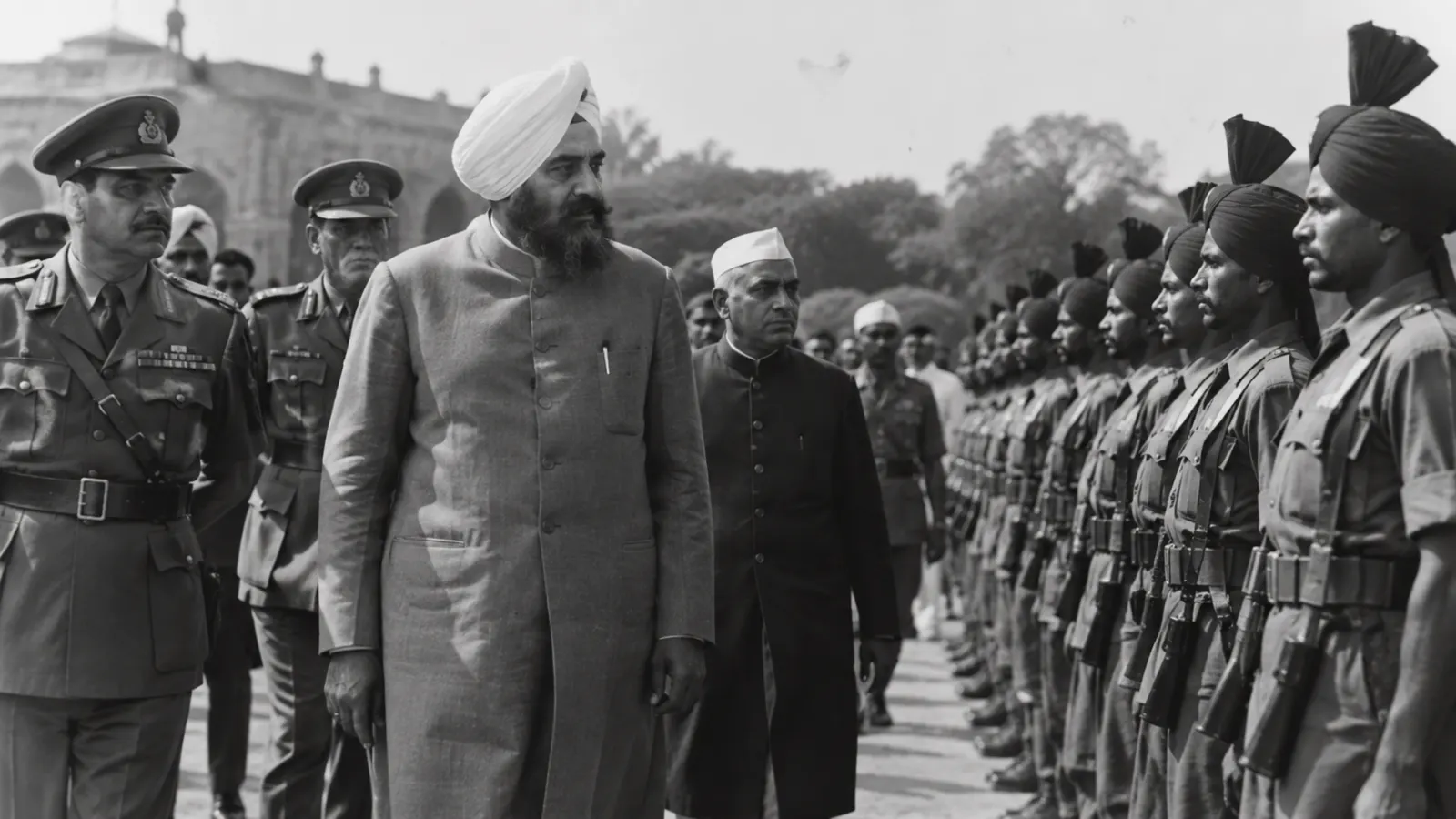
Sardar Baldev Singh occupies an unusual place in the history of independent India. He became the country's first Defence Minister at a moment when there was barely an independent defence establishment to administer. The armed forces inherited from British rule were being divided between India and Pakistan, senior commands still included British officers, Punjab was engulfed by communal violence and mass displacement, and within months the new government faced war in Jammu and Kashmir. His importance lies less in battlefield command than in the political and administrative work required to turn a colonial military institution into the armed forces of a sovereign state.
Baldev Singh had already emerged before independence as an important Sikh political representative. He negotiated during the Cripps and Cabinet Mission periods, served in the Punjab government and joined the Interim Government in 1946 as the member responsible for defence. On 15 August 1947 he continued in Jawaharlal Nehru's cabinet as Defence Minister. Contemporary records show him working at the intersection of cabinet government, military command, Punjab politics, Partition relief and the gradual Indianisation of the armed forces.
His career is therefore useful for understanding a less dramatic side of independence. Nations are not created only through declarations, constitutional debates and public speeches. They also have to inherit departments, budgets, weapons, command structures and administrative personnel—and make those institutions answerable to a new political authority.
From Punjab politics to the Interim Government
Baldev Singh was born on 11 July 1902 in Dhummna in Ropar district, Punjab. He studied in Ambala and at Khalsa College, Amritsar, before joining his family's industrial business. By the mid-1930s he had entered Sikh politics through the Akali movement and was elected to the Punjab Provincial Assembly in 1937. Punjab's political environment differed markedly from provinces in which Congress dominated: the Unionist Party, Muslim League, Sikh organisations, Congress and other groups operated in a province where questions of religion, land, representation and coalition government were inseparable.
That environment encouraged a politics of negotiation. In 1942 an understanding commonly known as the Sikandar-Baldev Singh Pact helped bring Baldev Singh into the Punjab government as Development Minister under Premier Sir Sikandar Hayat Khan. The arrangement attempted to reconcile some Akali demands with the Unionist administration and included questions of Sikh representation, language, public services and religious practice. It was not universally accepted within Sikh politics, but it placed Baldev Singh inside provincial government during the Second World War and gave him executive experience at a critical moment.
His political trajectory therefore differed from that of Congress leaders imprisoned during the Quit India Movement. That difference is better understood through Punjab's distinctive political circumstances than through a simple division between nationalist and non-nationalist politicians. Sikh leaders were attempting to protect the interests of a community concentrated in Punjab but lacking an overall provincial majority, while constitutional proposals increasingly raised the possibility that the province could become part of a Muslim-majority political unit.
Baldev Singh represented Sikh interests during negotiations with the Cripps Mission in 1942 and the Cabinet Mission in 1946. The central problem was demographic as well as political. Sikhs were heavily concentrated in Punjab, yet they did not form a majority across the province, and major religious sites, agricultural interests and population centres were spread across territory that could not easily be separated along clean communal lines. Baldev Singh initially opposed partition and sought minority safeguards within a wider Indian constitutional settlement.
When the Interim Government was established in September 1946, he became the member responsible for defence. The appointment marked an important institutional transition. Under colonial rule, defence had remained one of the areas most closely protected from effective Indian political control. Baldev Singh now had to work with senior military officers while an Indian political executive gradually asserted authority over defence policy. The transition did not instantly remove British influence from the armed forces, but it changed the constitutional relationship between political leadership and military command.
Partition and the division of the armed forces
Independence created an extraordinary administrative problem: one imperial military establishment had to become the armed forces of two sovereign states.
Personnel, formations, weapons, depots, training establishments, transport, communications, records and military property had to be divided between India and Pakistan. At the same time, many soldiers were personally affected by the communal upheaval surrounding Partition. Families were displaced, routes through Punjab became dangerous and military units were expected to preserve order while their own institutional structure was being reorganised.
Baldev Singh's Defence Department therefore had to maintain operational continuity during institutional separation. Correspondence from July 1947 shows Nehru and Baldev Singh discussing staffing of the Defence Department and the need to preserve efficiency during the transition. In another exchange involving Mountbatten, Nehru stressed rapid “nationalisation” of the defence services and the principle that the armed forces of independent India should ultimately be led by Indian officers.
Partition also turned defence administration into emergency humanitarian administration. The armed forces escorted refugee columns, protected important routes, guarded camps and intervened during communal disorder. In April 1947, before formal independence, Nehru and Baldev Singh were already corresponding about the use of troops in communal disturbances and the balance between civil authority and military freedom of action.
It would be misleading to attribute the protection or movement of refugees to a single minister. Provincial governments, military commanders, police forces, civil servants, voluntary organisations and political leaders all participated, often under chaotic conditions. Baldev Singh's responsibility was institutional: the defence apparatus had to continue functioning while the state around it was being divided.
That achievement rarely produces heroic imagery because administrative success often appears as the absence of complete breakdown. Units continued to receive orders, supply systems continued to operate and the government retained enough control over its armed forces to deploy them during one of the largest forced migrations in modern history.
Kashmir and the pressure of immediate war
The new defence structure was tested almost immediately in Jammu and Kashmir. In October 1947, armed tribal forces entered the princely state amid a wider conflict involving Pakistan. Maharaja Hari Singh signed the Instrument of Accession to India, after which Indian forces were airlifted to Srinagar. A government that had existed independently for only weeks was suddenly directing a major military operation.
Baldev Singh was part of a decision-making system involving Prime Minister Jawaharlal Nehru, Deputy Prime Minister Vallabhbhai Patel, Governor-General Lord Mountbatten, senior commanders and other officials. The surviving correspondence demonstrates that Kashmir policy was not being made by one individual in isolation. Nehru wrote directly to Baldev Singh about future operations, military delays and assessments from commanders, while Baldev Singh transmitted military and departmental information into the political process.
This matters because later political arguments frequently compress the 1947–49 Kashmir conflict into claims about the decision of a single leader. The documentary record instead shows a civil-military decision-making structure in which strategic, logistical, diplomatic and political considerations interacted. In December 1947, for example, Nehru informed Baldev Singh of plans to take the Kashmir dispute to the United Nations Security Council and called a cabinet meeting to consider the consequences.
Baldev Singh's position was important but specific. He was not personally directing troops in the field. Military commanders planned and conducted operations; cabinet ministers established political objectives, considered resources and diplomacy, and authorised or modified policy. His significance lies precisely in that division of responsibility.
The distinction is central to civilian control. A defence minister does not need to become a battlefield commander to exercise political authority. The minister's task is to ensure that military power operates within policy determined by the elected government while allowing professional commanders to provide military advice and conduct operations.
Hyderabad and the wider meaning of defence
The integration of Hyderabad in 1948 demonstrated that the new Defence Ministry also had responsibilities beyond conventional external war. Hyderabad was a large princely state surrounded by Indian territory whose ruler had not acceded to the Indian Union. Negotiations deteriorated amid political conflict, Razakar violence, armed mobilisation and mounting concern in New Delhi.
The Government of India eventually authorised the military operation launched in September 1948 and known as Operation Polo. Baldev Singh was Defence Minister during the operation and formed part of the government machinery coordinating with the military establishment, while policy also involved Nehru, Patel, the States Ministry, the Governor-General and senior officers. Nehru Archive material from September 1948 shows Baldev Singh among the central officials involved as the government considered the Hyderabad situation and restoration of order.
The episode should not be reduced to a simple story of territorial integration. Hyderabad's incorporation was followed by serious communal violence and allegations of large-scale killings, subjects that require their own careful historical treatment. For Baldev Singh's biography, its significance lies in showing how quickly defence policy after independence became intertwined with questions of state integration, internal order and the legitimate use of armed force by the Union.
The early Indian government was therefore learning in real time where political authority ended and military discretion began. Those institutional questions would continue long after Baldev Singh left office.
Indianisation and civilian control of the military
One of the most consequential changes during Baldev Singh's tenure was also one of the least dramatic: the gradual transfer of senior military responsibility from British to Indian officers.
Independence did not immediately replace every British officer. The armed forces needed continuity, particularly during Partition and the Kashmir conflict, and experienced officers could not simply be manufactured overnight. At the same time, an independent country could not indefinitely retain a command structure in which its highest military positions remained predominantly British.
Correspondence from July 1947 makes the political objective explicit. Nehru wrote that rapid nationalisation of the defence services was considered highly important and that the armed forces of a free country should eventually have their own officers occupying the highest ranks. Yet the process had to be managed without destroying operational effectiveness.
This tension continued after independence. British officers still occupied some senior commands during the first years, while Indian officers were progressively promoted into higher positions. In January 1949, General K. M. Cariappa became the first Indian Commander-in-Chief of the Indian Army, symbolising a major stage in that transition.
More significant than the nationality of individual commanders was the emerging constitutional relationship between soldiers and elected ministers. Research on India's early higher-defence organisation shows that the Interim Government altered the colonial arrangement: the Commander-in-Chief ceased to be a member of the Viceroy's Executive Council, while the Defence Minister became the political head of the department. After independence, defence increasingly operated through cabinet responsibility and civilian ministries rather than through the semi-autonomous military position inherited from the Raj.
Baldev Singh did not invent Indian civilian control by himself, nor did the structure reach its final form during his tenure. Defence secretaries, service chiefs, finance officials, Nehru, Patel and others shaped the arrangement. But Baldev Singh happened to occupy the ministry during the period in which several precedents became embedded: ministers set policy, military commanders advised and executed, and defence was gradually integrated into ordinary cabinet government.
That institutional outcome was significant because the political instability of Partition might have produced a different relationship between military and civilian power. Independent India's military remained an important state institution without becoming an independent political authority capable of overruling elected government.
Sikh representation in a country transformed by Partition
Baldev Singh's position was complicated by the fact that he was simultaneously Defence Minister of India and one of the most visible Sikh representatives in national politics.
Partition devastated Sikh communities in West Punjab. Families were killed or displaced, religious sites were divided by the new international boundary, property was abandoned and millions of refugees had to rebuild their lives in East Punjab and elsewhere. A Sikh politician serving in the central cabinet could not treat those issues as abstract questions of administration.
Yet cabinet government required Baldev Singh to operate as a minister of the Union rather than simply as a communal representative. That produced an enduring tension. Sikh political organisations expected him to communicate their concerns at the highest levels, while national government required collective responsibility and policies that could not be defined solely around one community.
His participation in the Constituent Assembly reflected the same dual role. He represented East Punjab and served on the Advisory Committee on Fundamental Rights, Minorities and Tribal and Excluded Areas, although he was not among the Assembly's most frequent speakers. The Constitution of India project notes that his constitutional significance lay more in political representation and executive responsibility than in extensive plenary debate.
His presence nevertheless mattered. The new Union was attempting to demonstrate that a religious community deeply traumatised by Partition could pursue its political claims within cabinet government and constitutional institutions. That arrangement did not settle later disputes over Punjabi language, state reorganisation, federalism or Sikh political demands. Those conflicts developed in subsequent decades.
Baldev Singh's approach was essentially accommodationist: Sikh interests could be negotiated within the Indian Union while national institutions retained authority. Later Sikh politics generated different strategies and leadership figures, which partly explains why his own political model became less prominent in public memory.
Parliament, later years and a quieter political career
Baldev Singh remained Defence Minister until 1952. He then continued in parliamentary politics rather than maintaining the extraordinary visibility associated with the first years of independence. According to the Constitution of India biographical record, he entered the First Lok Sabha and returned to Parliament in 1957 from Hoshiarpur, this time as a Congress candidate. He died on 29 June 1961.
His reduced public profile after leaving the Defence Ministry helps explain his relative absence from popular accounts of independence. He did not establish a durable ideological school, dominate a mass political party or leave behind a large collection of famous speeches. His historical reputation is instead tied to negotiation and administration.
That form of political leadership is inherently harder to memorialise. A dramatic speech can be quoted; an election victory has a date and result; a battlefield action can become a national legend. Administrative continuity is more difficult to turn into public mythology.
Yet it is precisely this quieter record that makes Baldev Singh useful for understanding the formation of the Indian state. His ministry operated while the military was being divided, refugee violence threatened public order, Indian officers were gradually replacing colonial commanders, and the new government faced military crises in Kashmir and Hyderabad.
Why Baldev Singh's legacy is institutional
Baldev Singh should neither be transformed into a military strategist he was not nor treated as a ceremonial figure who merely occupied a historic office. The documentary record shows a working defence minister regularly involved in correspondence about military organisation, personnel, communal disturbances, Kashmir, nationalisation and the relationship between cabinet policy and professional command.
His leadership was largely managerial and political. That meant receiving military advice without becoming a general, representing Sikh concerns without reducing the Defence Ministry to communal politics, maintaining continuity without preserving colonial control indefinitely, and operating inside collective cabinet government rather than building a personalised military authority.
The distinction is important because state formation depends on precisely this kind of work. Independence required the transformation of inherited institutions into institutions that accepted the authority of a new political order. Defence was particularly difficult because mistakes could threaten territorial control, public security or the survival of the government itself.
By the time Baldev Singh left the ministry, India's defence establishment was markedly different from the one he had inherited in 1946. The armed forces had been divided with Pakistan, the Union had fought its first major conflict, Hyderabad had been incorporated, Indian officers were occupying senior commands and defence policy was functioning within cabinet government.
None of those outcomes belonged to Baldev Singh alone. Nehru, Patel, military commanders, civil servants and many others participated, sometimes disagreeing sharply about strategy. Recognising collective decision-making is not a reason to minimise his role; it is the key to understanding it.
Sardar Baldev Singh's legacy is therefore best measured in systems rather than mythology. He represented Sikh interests at one of the most dangerous moments in Punjab's history while helping administer the armed forces of a country being created around him. His career shows that independence required more than ending colonial rule. It required converting inherited instruments of state power into institutions that could function under Indian civilian authority—and doing so while the new state was already being tested by Partition, war and political integration.